Content Menu
>> 1. Zhejiang Bril Welding Equipment Co., Ltd.
>> 2. Gala Gar
>> 4. Nicrotec
● Acetylene Regulator Specifications
>> Standards and product scope
>> Pressure, flow, and connections
>> Verify the factory and sample
>> The often-missed purchasing trap
● FAQ
>> 1.How can I check whether an ISO 9001 certificate has expired or been withdrawn?
>> 2.Does a CE mark prove an acetylene regulator is approved for sale in Europe?
>> 3.Can I use a cylinder acetylene regulator on a manifold?
>> 4.Why might two samples with the same gauge reading perform differently?
>> 5.What should an OEM agreement lock down before a bulk order?
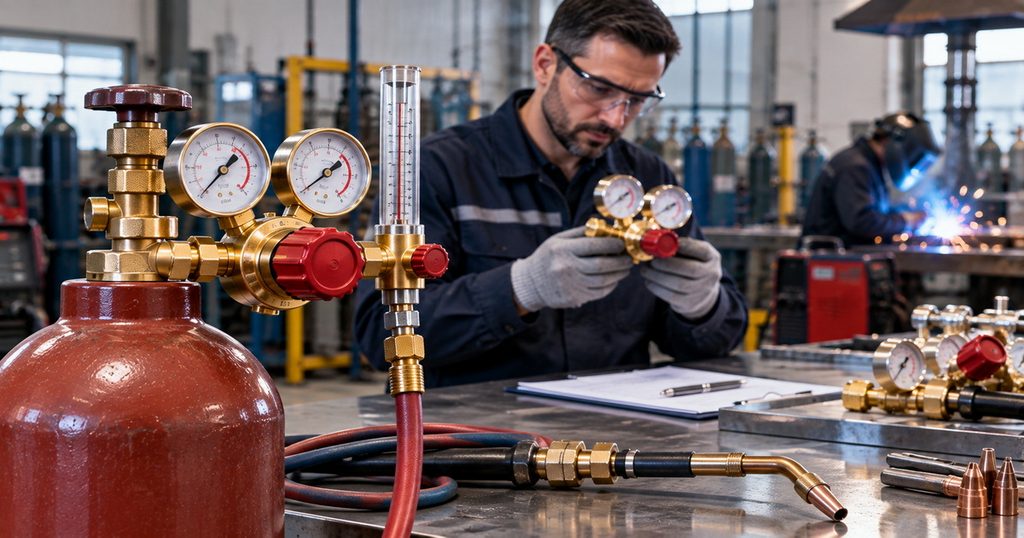
Spain offers buyers a strong welding-equipment market, established gas-control suppliers, and access to European distribution networks. But a regulator sold in Spain is not necessarily manufactured there. For acetylene equipment, that distinction matters: the buyer must establish who designs the product, who manufactures it, and who controls testing and changes to safety-critical parts.
Why Source Through Spain?
Spain is a useful sourcing market for buyers who need European specifications, Spanish-language support, or distribution into nearby markets. Zaragoza-based Gala Gar provides a particularly clear example of domestic regulator manufacturing. Other businesses on this shortlist supply acetylene regulators through Spanish sales and distribution channels, although their individual products may be made elsewhere.
Industry data requires careful interpretation. A Grand View Research country report valued Spain’s overall welding-equipment market at USD 471.3 million in 2023 and forecast USD 609.0 million by 2030. Its category includes several welding technologies, so those figures must not be described as acetylene-regulator sales or evidence of Spanish regulator production. For current official export research, Spain’s DataComex database allows queries by product, trade flow, destination, and period; buyers should confirm the relevant customs classification before drawing conclusions about regulators specifically.
Selection Criteria
A useful shortlist is not an unverified ranking by size. The following criteria are more valuable when building a long-term supply base:
1. Product evidence: Is a specific acetylene model listed with inlet pressure, outlet range, flow, and connection details?
2. Manufacturing responsibility: Does the business manufacture the regulator, sell its own brand, or distribute another company’s product?
3. Technical control: Can it provide drawings, material specifications, test methods, and revision-controlled components?
4. Quality evidence: Can it produce model-specific test records and explain its inspection process?
5. Commercial fit: Will it disclose MOQ, achievable monthly output, sample lead time, and repeat-order lead time?
6. Customization: Can it support a private label, packaging, connection variant, or engineering change without weakening safety controls?
7. Compliance: Can it identify the applicable standard and supply documentation for the exact model and destination market?
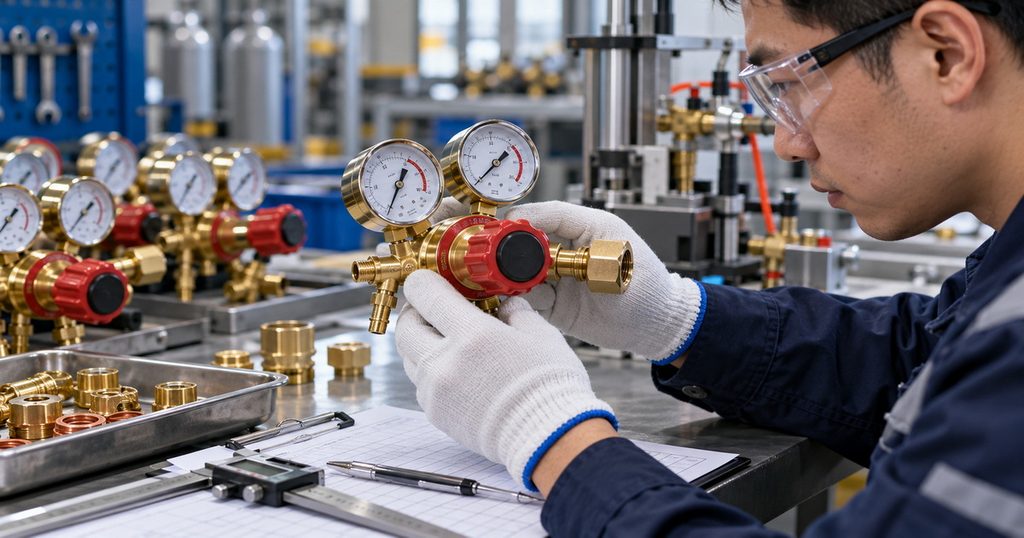
A note on the list: Publicly available evidence does not support a credible claim that five to ten independent companies manufacture acetylene regulators in Spain. Rather than fill that gap with invented factories, this guide profiles five distinct procurement options: one overseas OEM manufacturer, two Spanish welding-equipment brands, one Spanish distributor, and one European manufacturer with a Spanish office.
Five Suppliers to Evaluate
| Supplier and role | Relevant strength | Monthly capacity | MOQ | Certification or compliance evidence to request |
|---|---|---|---|---|
| Zhejiang Bril Welding Equipment Co., Ltd.; China-based OEM manufacturer | Custom industrial-gas regulator projects | Not publicly verified; request model-specific capacity | Not publicly verified; request by configuration | Current ISO 9001 status; model-specific test and EU documentation |
| Gala Gar; Spanish manufacturer | Published acetylene models and Spanish-made gas-regulation products | Not publicly verified | Not publicly verified | Applicable model standards, declarations, and batch tests |
| Solter Soldadura; Spanish welding-equipment brand | Published R25 acetylene regulator and international distribution | Regulator-specific output not publicly verified | Not publicly verified | R25 test report, standard editions, and manufacturing origin |
| Nicrotec; Spanish distributor | Locally listed acetylene regulator choices, including Gloor products | Distributor stock; factory output not disclosed | Not publicly verified | Original manufacturer documents and product traceability |
| GCE Group / GCE Ibérica; European manufacturer with Spanish office | Broad gas-control range and local sales contact | Spanish-office and model-specific output not publicly verified | Not publicly verified | Exact-model technical file and applicable conformity documents |
1. Zhejiang Bril Welding Equipment Co., Ltd.
Location and role: Wenzhou, Zhejiang, China; overseas OEM manufacturing option for buyers comparing Spanish sourcing routes.
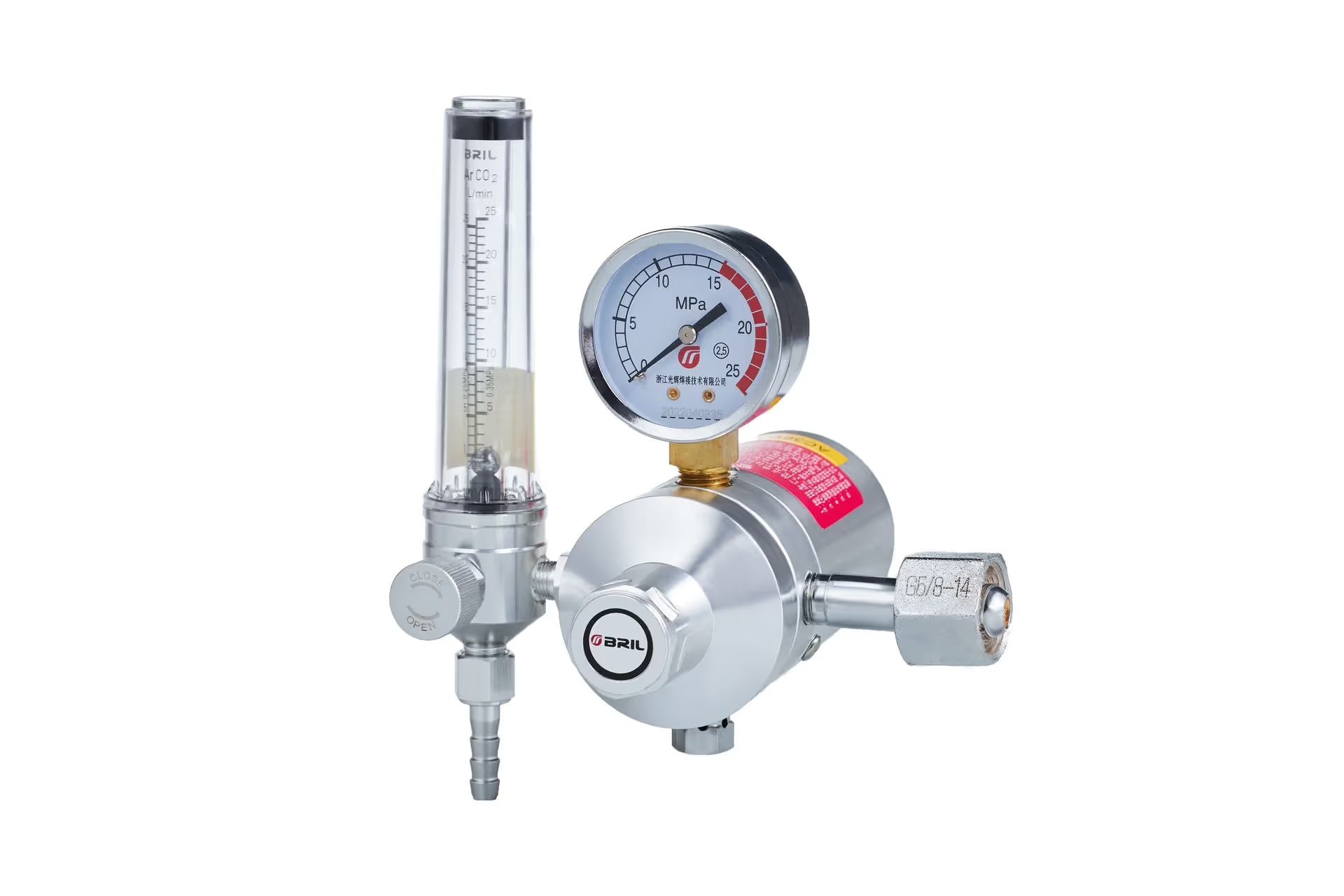
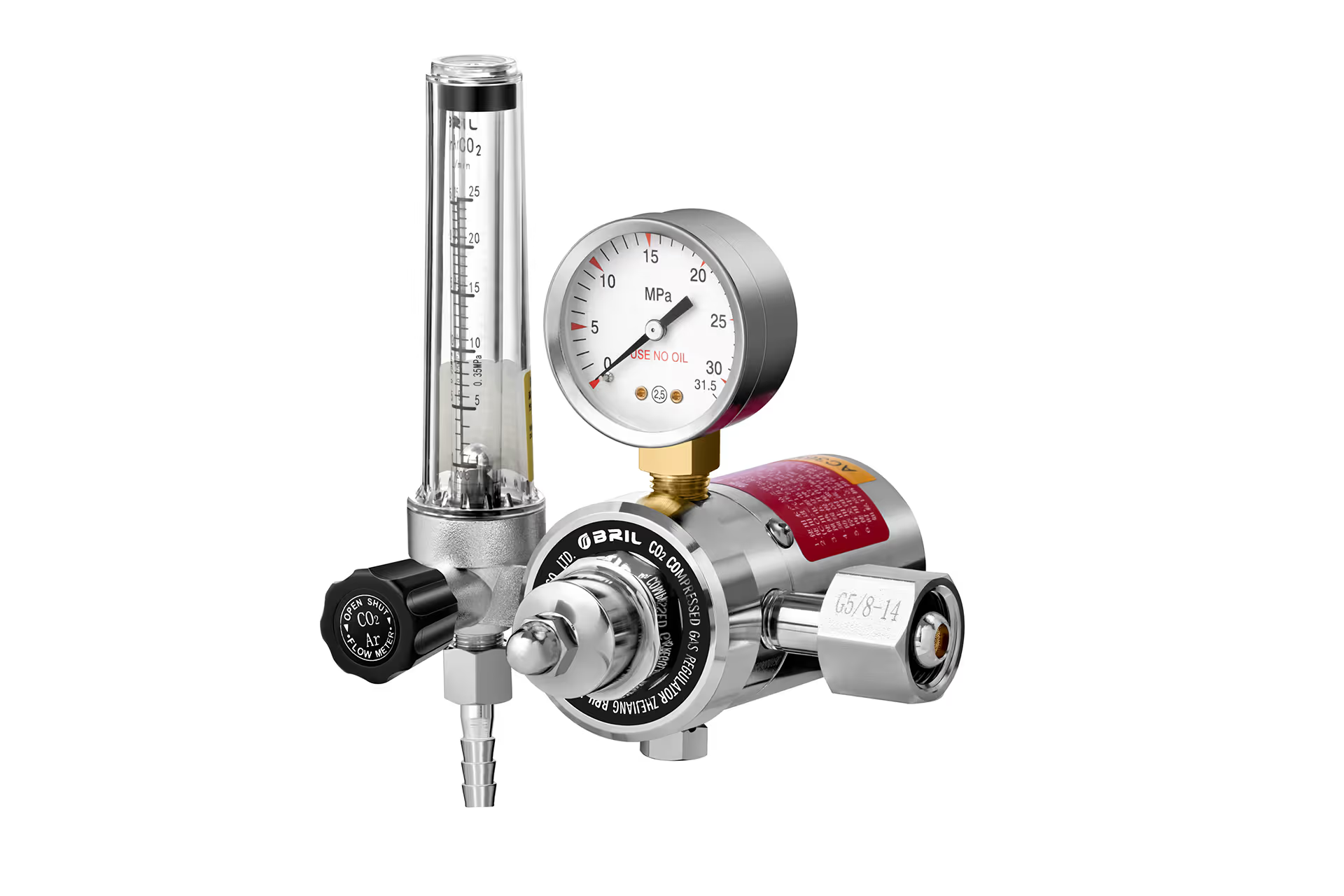
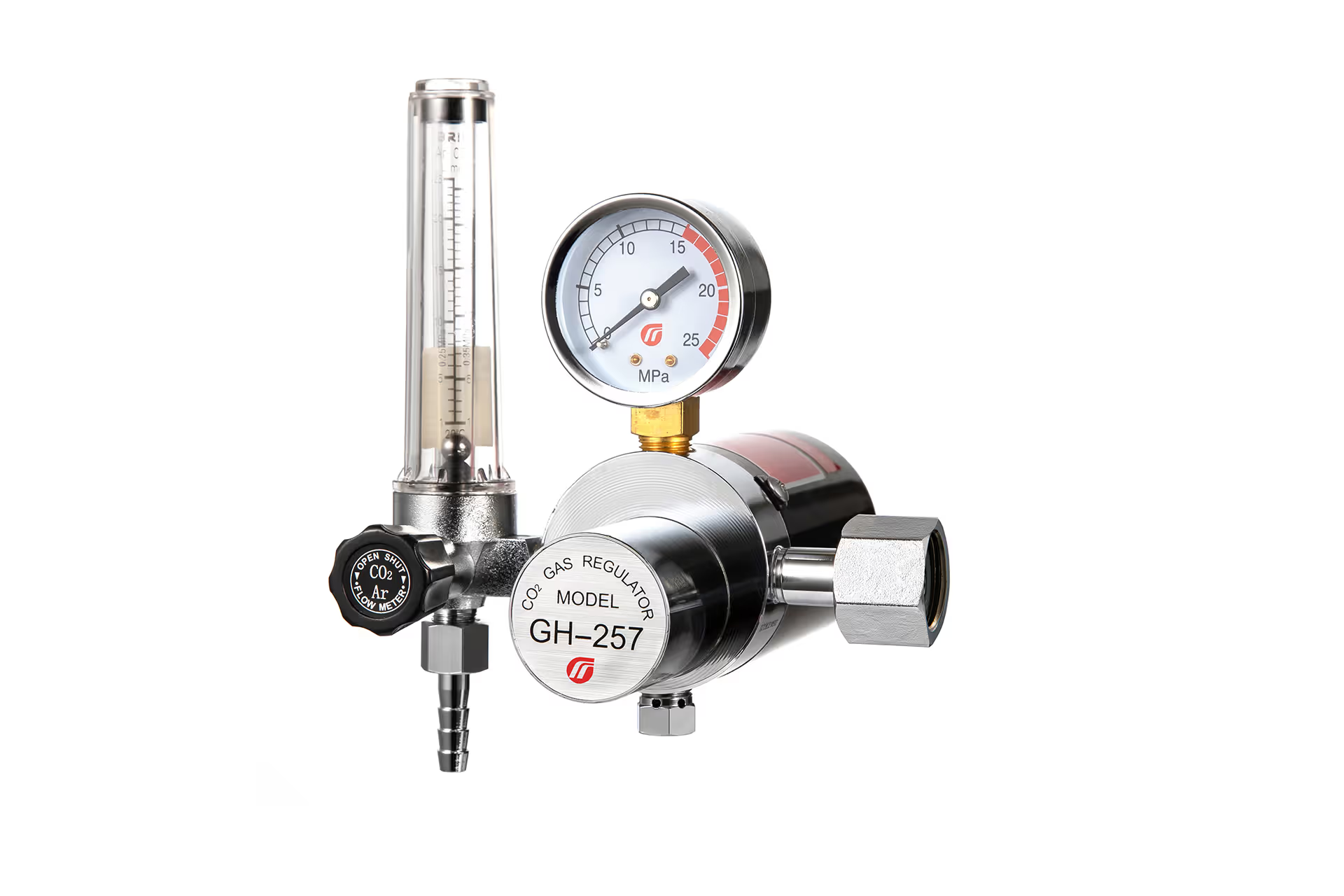
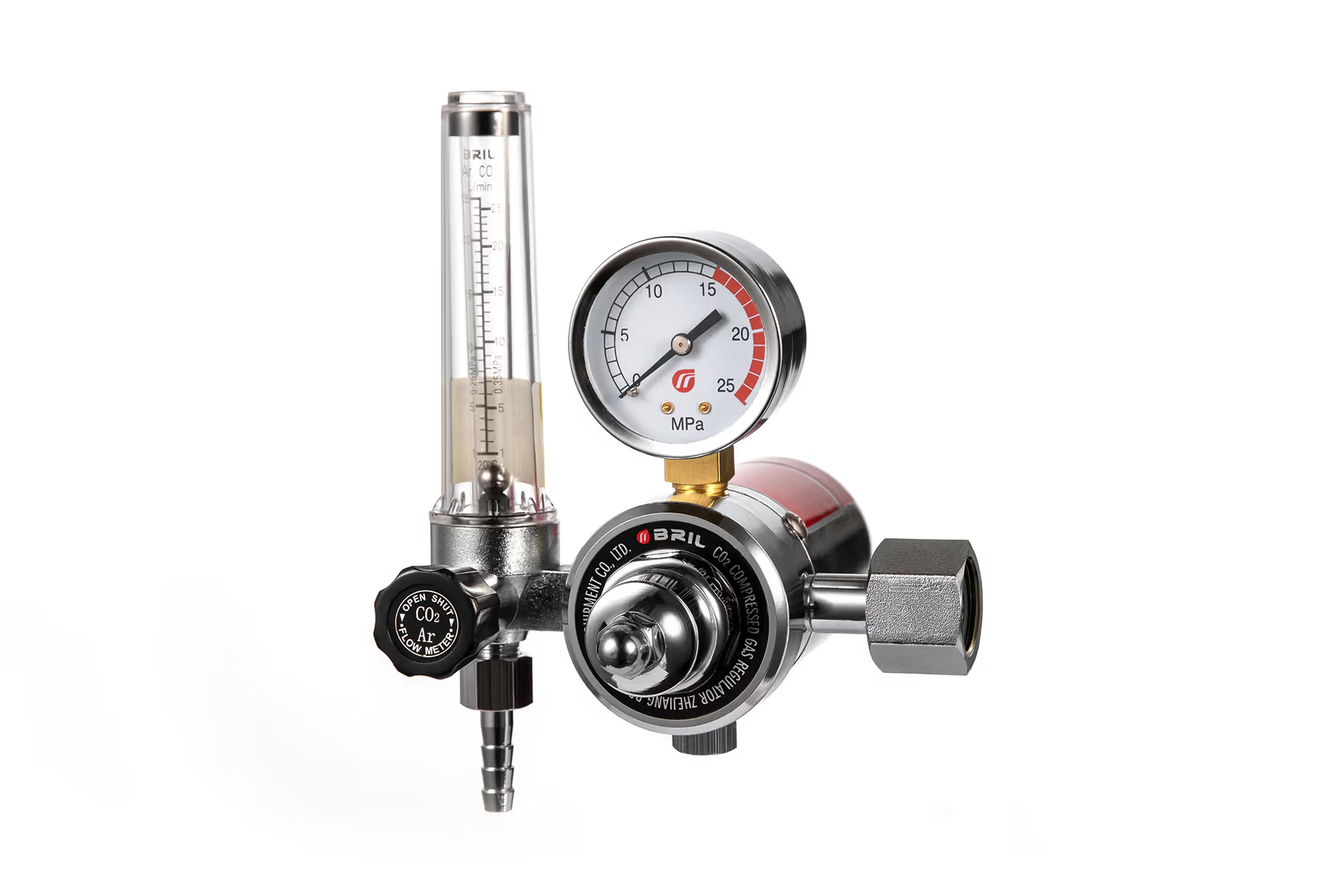
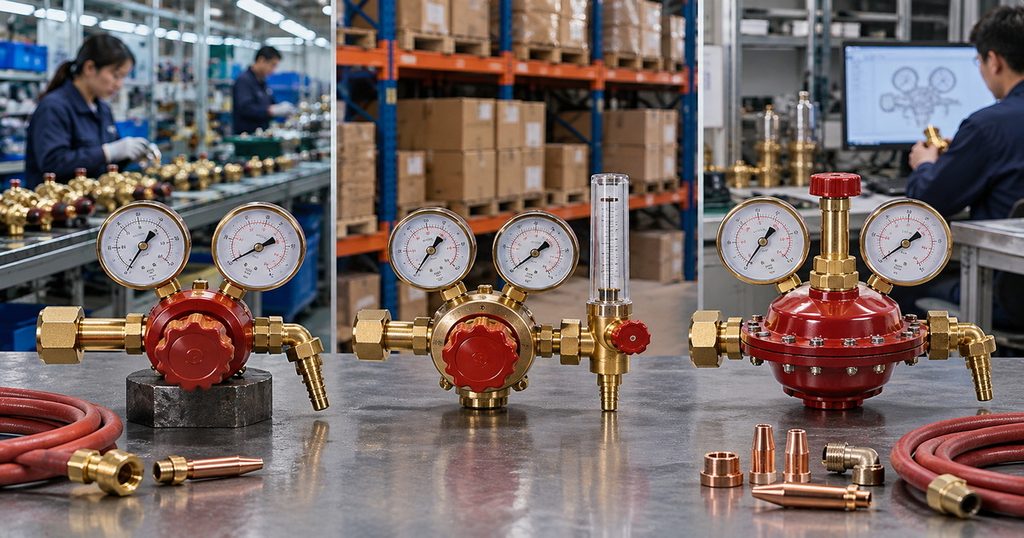
Founded in 2002, Bril states that it develops, manufactures, and sells industrial gas pressure regulators. Its company profile places it in Wenzhou’s Longwan District and describes inspection equipment, technical capabilities, and OEM supply relationships. The profile also says it has more than 200 employees and refers to ISO 9001 and product-related certification. These are supplier-published claims: buyers should independently verify certificate status, scope, and the documentation for the particular acetylene model they intend to purchase.
Bril is worth placing first as a commercial benchmark, not as a company located in Spain. For a small or midsize overseas brand, its potential appeal is direct factory dialogue about branding, packaging, product configuration, and repeat-order planning. Its published company profile describes OEM work, but it does not disclose a universal acetylene-regulator MOQ or production rate. Neither should be assumed.
A practical first enquiry would request the acetylene model drawing, destination-market inlet connection, outlet range, gauge specification, material list, sample price, proposed MOQ, and production lead time. Buyers should ask which changes are established options and which require fresh design verification. That distinction prevents a cosmetic private-label request from being confused with an engineering approval.
Best fit: Importers and developing brands prepared to manage an overseas OEM qualification process. The buyer should compare its tested samples and landed cost against locally available Spanish alternatives rather than treating a lower initial quotation as a complete cost comparison.
2. Gala Gar
Location and role: Zaragoza, Spain; documented domestic manufacturer of gas regulators and wider welding equipment.
Gala Gar says it has manufactured welding products since 1945. More importantly for this article, its published materials specifically say that it designs and manufactures gas pressure regulators in Spain. Its EN-2000 range lists two acetylene references with a 25 bar inlet specification, 1.5 bar outlet specification, and 5 m³/h nominal flow. A separate large-flow listing identifies an acetylene model rated at 25 m³/h nominal flow. These are product specifications, not statements about Gala Gar’s factory output per month.
This makes Gala Gar a particularly relevant first contact when a buyer’s central requirement is Spanish-manufactured acetylene regulation. Its wider range of regulators, gas-distribution equipment, and welding products may also simplify procurement across a workshop or distributor catalogue. The company’s published catalogue indicates an international presence; buyers should still confirm the service arrangements and exact model availability in their intended market.
For an RFQ, specify whether the application uses a single cylinder or a manifold, the required flow at working pressure, and the local cylinder connection. Ask which acetylene references are available for export and whether a private-label programme is offered for those particular models. Do not assume OEM availability merely because a company manufactures products.
Best fit: Buyers prioritizing identifiable Spanish manufacture, published acetylene specifications, and an established welding-equipment range.
3. Solter Soldadura
Location and role: Campdevànol, Girona, Spain; Spanish welding-equipment manufacturer and brand offering an acetylene regulator.
Solter describes itself as a welding-equipment manufacturer with a presence in more than 30 countries. Its catalogue lists the R25 Acetileno, a two-gauge regulator. The product page identifies an HPB58-2 brass body, 25 bar inlet rating, 5 m³/h flow figure, and left-hand connections. It also states a maximum working outlet pressure of 1.6 bar. That last figure merits particular scrutiny: buyers should not automatically substitute it for the operating limit in their own jurisdiction or welding procedure. Obtain the manual and ask Solter to explain the specified adjustment range and applicable standard for the exact unit offered.
Solter says it designs and manufactures equipment in Spain. That general company statement does not, by itself, establish that every R25 component or finished regulator is made at its Girona facility. A buyer making a country-of-origin claim should request origin and manufacturing documentation for the selected reference. Public sources reviewed for this guide did not establish Solter’s founding year, regulator-specific output, MOQ, or a regulator private-label programme; those details should remain RFQ questions rather than article claims.
Best fit: Distributors who already buy welding products through Solter, or buyers who value a Spanish brand with an international support network and a published acetylene model.
4. Nicrotec
Location and role: Barcelona area, Spain; gas-accessory supplier and distributor, not verified here as the manufacturer of its listed acetylene regulators.
Nicrotec’s online catalogue lists acetylene pressure regulators, including a unit with a 0–1.5 bar working range, inlet and outlet gauges, an integrated safety valve, an outlet shut-off valve, and a stated sintered filter. It also lists a compact acetylene model with a stated 5.1 m³/h maximum flow. The catalogue identifies Gloor among its manufacturer categories, so buyers must distinguish Nicrotec’s sales and service role from the underlying product maker’s manufacturing role.
The company is useful for a different procurement problem from an OEM factory: sourcing a specified product locally, comparing configurations, and obtaining a Spanish commercial contact. Its publicly reviewed product listing does not establish a manufacturing founding year, factory output, or OEM/ODM capability for acetylene regulators. If private labelling is required, ask whether Nicrotec can arrange it with the original manufacturer and who would own the resulting technical documentation.
Best fit: Buyers seeking Spanish-based distribution of established regulator models rather than assuming direct factory customization.
5. GCE Group / GCE Ibérica
Location and role: European gas-control manufacturer with a Spanish sales office; not presented as a Spain-based regulator factory.
GCE’s Spanish site describes the group as a manufacturer of regulators for cutting and welding, while its contact information lists an office in Madrid. ESAB’s company information gives 1987 as GCE’s founding year in its present corporate profile and notes that ESAB acquired it in 2018. The group’s industrial standards material explicitly discusses EN ISO 2503 for cylinder-connected welding regulators and distinguishes it from ISO 7291 for manifold regulators.
GCE merits consideration where a purchaser needs a broad gas-control portfolio, established technical literature, and a contact in Spain. Yet the presence of a Madrid office does not prove that a quoted acetylene model is made there. Ask for the product reference, manufacturing entity, country of origin, connection standard, test documentation, and the sales office’s role in after-sales support. Publicly reviewed sources do not establish a standard OEM MOQ or Spanish production capacity for the relevant acetylene model.
Best fit: Buyers looking for a European gas-control product range and Spanish sales access, while remaining flexible about the actual production location.
Acetylene Regulator Specifications
An acetylene regulator is not interchangeable with an oxygen, argon, or propane regulator. The purchase specification must begin with the gas and the complete system, not just a target price or a familiar body shape.
Standards and product scope
EN ISO 2503 covers specified single- and two-stage regulators connected to gas cylinders for welding, cutting, and allied processes, including dissolved acetylene. Manifold-system regulators fall under a different scope addressed by ISO 7291. The pressure gauge is another component for which ISO 5171 may be relevant. Buyers should ask suppliers to identify the edition, scope, model, and test evidence behind every standards claim.
A regulator also does not replace a correctly selected flashback arrestor. Specify and verify safety devices for the complete installation rather than accepting a regulator label as proof that every downstream hazard has been addressed.
Pressure, flow, and connections
Do not compare outlet pressure figures without checking the application and destination-market rules. Gala Gar’s published cylinder-regulator specifications include a 1.5 bar acetylene outlet figure, while Solter’s R25 page states 1.6 bar maximum. Separately, the US OSHA welding rule limits acetylene utilization to 15 psig (103 kPa gauge), subject to its stated context and exceptions. These figures serve different purposes; they are not permission to use a regulator at its maximum indicated setting. Require a written application-specific operating range and have a qualified safety specialist check the applicable local rules.
A nominal flow figure also needs a stated test condition. Ask whether the quoted flow can be maintained at the required outlet pressure and realistic inlet conditions. Confirm the cylinder connection, handedness, outlet fitting, and hose arrangement against the target market. A visually similar threaded part may still be incompatible.
Materials and conformity
Specify the material of gas-wetted components, not merely “brass body.” Ask for the actual alloy designation, material records, diaphragm and seat specifications, and evidence of acetylene compatibility. This reduces the risk of an attractive sample being followed by lower-grade or different production components. For paired oxygen products, request a separate oxygen-service cleanliness procedure rather than assuming the acetylene bill of materials qualifies an oxygen version.
Treat CE, RoHS, and ISO 9001 as different claims. ISO 9001 concerns a management system; it is not approval of every regulator. The European Commission says CE marking is required only where applicable EU legislation calls for it and does not itself mean an EU authority approved the product. For an EU-bound regulator, request the manufacturer’s written regulatory assessment, applicable conformity documents, and exact model identification. Do not assume that a generic “CE certificate” or RoHS statement resolves the regulator’s legal requirements.
Buyer’s Guide
Verify the factory and sample
1. Identify the legal entities. Ask who quotes, manufactures, tests, and exports the regulator. Match those names to invoices, certificates, markings, and declarations.
2. Issue one controlled specification. State the gas, cylinder interface, outlet range, required flow, gauges, materials, safety devices, packaging, destination, and intended standard.
3. Request a documented sample. Obtain its drawing revision, bill of materials, serial or batch identification, and inspection results before testing it.
4. Test the working conditions. Check connection fit, leakage, pressure stability during flow, shut-off behavior, and the agreed test points through a qualified laboratory or competent test team.
5. Approve a retained reference sample. Both parties should identify the approved configuration before the first production order.
6. Audit the first production batch. Compare material records, critical dimensions, test logs, markings, and packed units against the approved reference.
A paper certificate cannot substitute for a sample that passes the buyer’s actual use conditions. Likewise, a successful sample cannot establish that later batches will use identical seats, diaphragms, springs, or gauges unless the supplier controls substitutions.
The often-missed purchasing trap
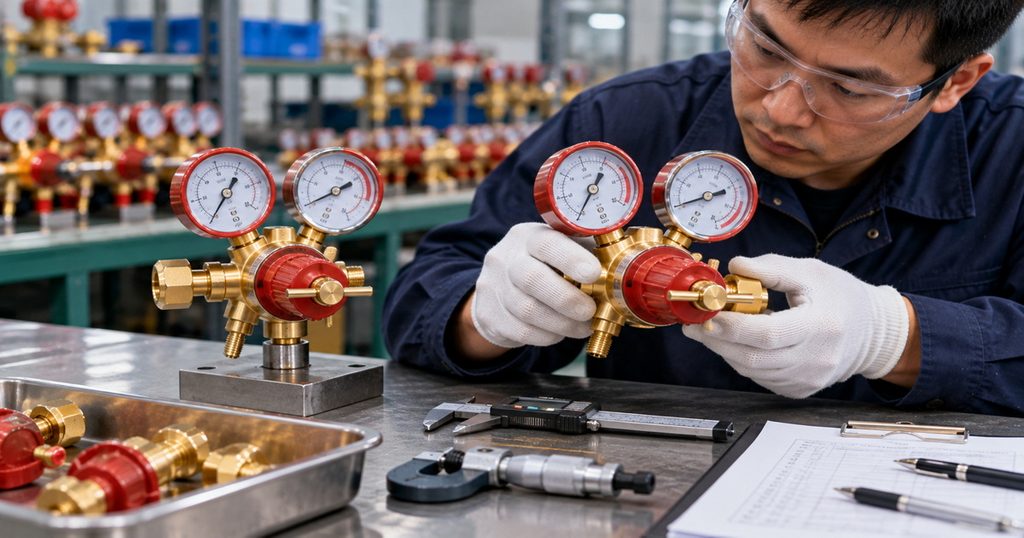
Watch for “silent equivalence.” After a sample wins approval, a purchasing team may accept a supplier’s statement that a substitute diaphragm, valve seat, spring, inlet filter, or gauge is “equivalent.” The outside appearance and quoted pressure range may remain unchanged, while pressure stability, sealing, or service life changes.
The remedy is a contractually controlled critical-parts list. Identify the approved material and component revision, require written notice and approval before substitutions, and define when a change triggers renewed testing. Keep a retained sample and compare a production unit with it. This is more effective than trying to resolve a performance dispute after several shipments.
Compare the delivered cost
For a Spanish or overseas offer, compare the same scope: tested regulator, specified connection, required documentation, packaging, spare parts, inspection, freight, duties, and warranty handling. Confirm the Incoterm, shipment dimensions, carton protection for gauges, and any destination-specific labelling before placing an order.
An uncharged, appropriately packed regulator shipment is not the same item as an acetylene cylinder shipment. Confirm the actual goods and applicable carrier requirements with the freight provider; do not copy cylinder-shipping assumptions into the regulator purchase order.
Conclusion
For verified Spanish manufacture, Gala Gar is the clearest starting point in this shortlist. Solter adds a published acetylene model from a Spanish welding brand; Nicrotec offers a Spanish distribution route; and GCE provides a European manufacturing group with local sales access. Zhejiang Bril belongs in the comparison as a China-based OEM alternative for buyers willing to qualify an overseas factory—not as a Spanish supplier. These are sourcing roles, not a measured ranking of product quality.
Send the same technical RFQ to every shortlisted company. Request a documented acetylene sample, model-specific capacity and MOQ, test evidence, origin information, and a written change-control process. The supplier that can substantiate those answers—and repeat the approved performance in production—is the stronger long-term candidate.
FAQ
1.How can I check whether an ISO 9001 certificate has expired or been withdrawn?
Ask for the certificate number, legal company name, certified site, scope, issuing certification body, and current validity dates. Search IAF CertSearch and compare its status and details with the supplier’s document. If a record is missing or inconsistent, ask the issuing body to confirm it directly. Check that the certified activity and location are relevant to the company making your regulators; a valid certificate for an unrelated office is not enough.
2.Does a CE mark prove an acetylene regulator is approved for sale in Europe?
No. The European Commission explicitly distinguishes CE marking from approval by an EU authority and notes that not every product requires the mark. Ask the manufacturer which EU rules apply to the specific configuration, who is responsible for conformity, and what declaration and technical evidence support its position.
3.Can I use a cylinder acetylene regulator on a manifold?
Do not assume so. EN ISO 2503 and ISO 7291 address different regulator applications. Give the supplier a diagram of the installation and obtain written confirmation that the proposed model is suitable for that arrangement, along with the applicable documentation.
4.Why might two samples with the same gauge reading perform differently?
A static gauge reading does not show how outlet pressure behaves when gas starts flowing or demand changes. Ask for performance results at defined inlet conditions and flow points, then compare pressure behavior, leakage, and shut-off performance. Also check whether the samples have the same internal component revisions.
5.What should an OEM agreement lock down before a bulk order?
Lock down the drawing and bill-of-materials revisions, gas-wetted materials, connection specification, marking, packaging, sample approval, batch tests, change-notification rules, rejection criteria, and responsibility for destination-market documents. Record MOQ and lead time for each configuration, not for the supplier’s catalogue as a whole.
References
1. – [Zhejiang Bril Welding Equipment Co., Ltd. — About Us] — Company location, founding year, manufacturing description, and self-reported OEM and quality information. [chinesewelding]
2. – [Gala Gar — Company Website] and [EN-2000 Regulators] — Spanish manufacturer profile and published acetylene model specifications. [galagar]
3. – [Gala Gar — Large Flow Regulators] — Published nominal flow for a high-flow acetylene model. [galagar]
4. – [Solter Soldadura — Company Profile] and [R25 Acetylene Regulator] — Company reach and model information; confirm the model’s operating limits directly. [solter]
5. – [Nicrotec — Gas Accessories Catalogue] — Spanish supplier listings and acetylene regulator descriptions. [nicrotec]
6. – [GCE — Spanish Product Site], [Spain Office], and [Industrial Standards] — Manufacturer, sales-office, and standards information. [spain.gcegroup]
7. – [Spain’s DataComex — Official Foreign Trade Statistics] — Government source for product- and period-specific import/export queries; not a stand-alone acetylene-regulator figure. [datacomex.comercio]
8. – [Grand View Research — Spain Welding Equipment Market] — Broader welding-equipment market estimate and forecast, not regulator-only market data. [grandviewresearch]
9. – [European Commission — CE Marking] and [EU Access2Markets — Machinery and Technical Products] — EU guidance for assessing applicable product requirements. [trade.ec.europa]
10. – [IAF CertSearch — Certificate Verification] and [US OSHA — Oxygen-Fuel Gas Welding and Cutting] — Management-system certificate checks and US acetylene-use safety requirements. [osha]
Hot Tags: Acetylene Regulator Manufacturers In Spain, Acetylene Regulator Suppliers In Spain, Acetylene Regulator Manufacturer, Acetylene Regulator Supplier, Wholesale Acetylene Regulators, OEM Acetylene Regulators, Industrial Acetylene Regulators, Acetylene Welding Regulators, Acetylene Pressure Regulators, Acetylene Regulator Factory