Content Menu
● Quick Comparison: Which MIG Welding Regulator Should You Choose?
● CO₂ vs Argon vs Mixed Gas: What Actually Changes?
>> Pure CO₂: Economical Shielding for Mild Steel
>> Pure Argon: The Standard Starting Point for Aluminum
>> Argon/CO₂ Mixtures: A Practical Choice for Mild Steel
● Gas Regulator vs Flowmeter: Why the Difference Matters
● Five Specifications That Matter More Than Appearance
>> 1. Cylinder Connection and Gas Compatibility
>> 3. Flow Range and Adjustment Resolution
>> 5. Materials and Inspection Evidence
● When Is a Heated CO₂ Regulator Worth Buying?
● How Much Gas Flow Does MIG Welding Need?
● A Practical Seven-Step Regulator Setup Checklist
● A Better Cost Comparison: Measure Cost per Accepted Weld
● What Overseas Buyers Should Include in an OEM Specification
● Specify Your MIG Welding Regulator with Confidence
>> 1.Can I Use an Argon Regulator for CO₂ Welding?
>> 2.Is C25 Better Than Pure CO₂ for MIG Welding?
>> 3.Do I Need a Heated CO₂ Regulator?
>> 4.Is a Two-Stage Regulator Better for MIG Welding?
>> 5.Can One Flowmeter Measure Argon and CO₂?
>> 6.What Is the Best Regulator for Aluminum MIG Welding?
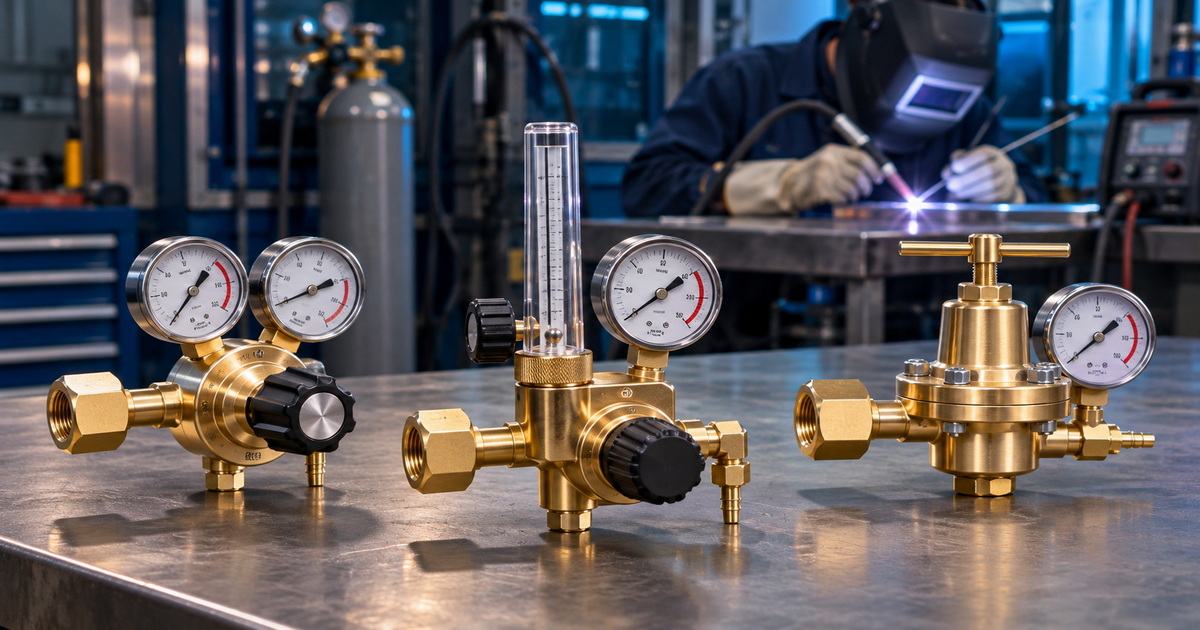
The best gas regulator for MIG welding is a gas-compatible regulator with accurate flow control—not simply the model with the highest pressure rating. For general mild-steel fabrication, an argon/CO₂ flowmeter regulator is usually the most practical choice. For aluminum, choose an argon-compatible unit. For pure CO₂, use a regulator specifically rated for CO₂ service, considering a heated model when sustained withdrawal creates freeze-up problems.
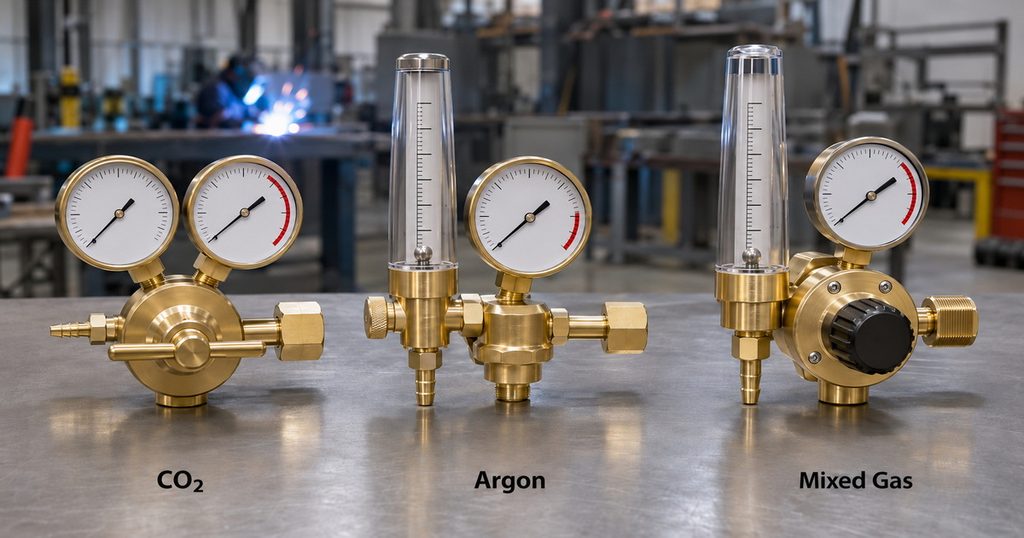
Quick Comparison: Which MIG Welding Regulator Should You Choose?
| Welding application | Typical shielding gas | Recommended regulator configuration | Main consideration |
|---|---|---|---|
| General mild-steel fabrication | 75% argon / 25% CO₂ | Compatible argon/CO₂ flowmeter regulator | Balanced arc quality and practical flow adjustment |
| Cost-sensitive mild-steel welding | 100% CO₂ | CO₂-rated regulator with suitable flow indication | Spatter, cleanup, and withdrawal demand |
| Sustained CO₂ consumption | 100% CO₂ | CO₂-rated regulator; heating where necessary | Freeze-up resistance and rated continuous flow |
| Aluminum MIG welding | 100% argon | Argon-compatible flowmeter regulator | Clean delivery and adequate shielding |
| Spray-transfer mild-steel welding | Suitable argon-rich mixture | Mixture-compatible flowmeter regulator | Match gas to wire, equipment, and procedure |
| Stainless-steel welding | Procedure-specific low-CO₂ mixture or tri-mix | Regulator and flowmeter approved for that blend | Calibration and weld chemistry |
CO₂ vs Argon vs Mixed Gas: What Actually Changes?
Pure CO₂: Economical Shielding for Mild Steel
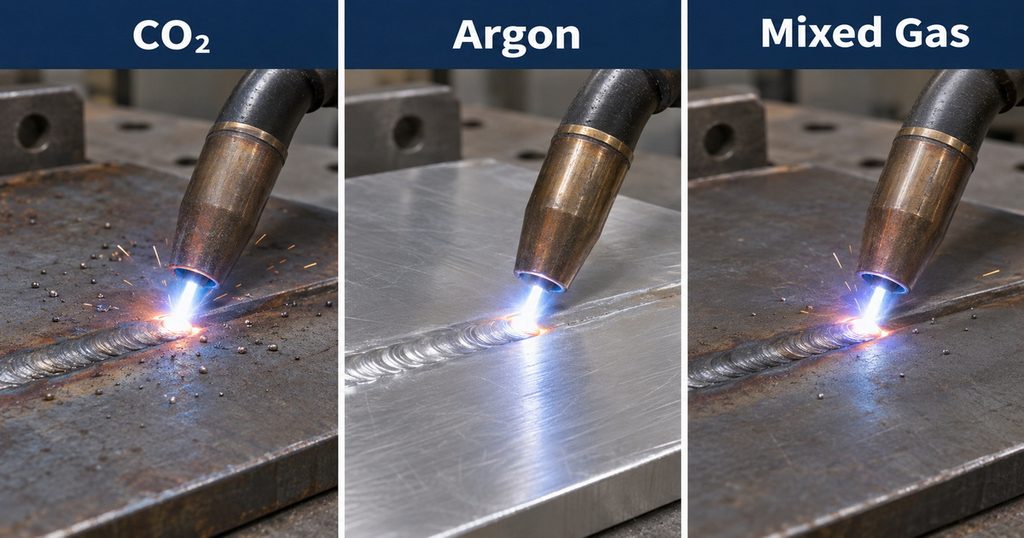
Pure CO₂ is a cost-effective shielding option for many mild-steel applications. It provides good penetration, but generally produces more spatter and a less stable arc than suitable argon/CO₂ mixtures.
Its regulator requirements deserve particular attention. CO₂ withdrawal and pressure reduction can create substantial cooling. Under demanding conditions, freezing can interfere with reliable gas delivery.
Choose a CO₂ regulator by checking:
– Explicit approval for CO₂ service.
– Correct cylinder connection and inlet-pressure rating.
– Suitable flow range and gas calibration.
– Continuous-duty capability under expected conditions.
– Heating requirements, if freeze-up is anticipated.
Do not assume every CO₂ installation needs electrical heating. Intermittent work and sustained production impose different demands.
Pure Argon: The Standard Starting Point for Aluminum
Pure argon is commonly used for aluminum MIG welding. It supports suitable transfer characteristics without introducing the active CO₂ component used in many steel-welding mixtures.
However, pure argon is not a universal upgrade for mild steel. Gas selection depends on weld-metal behavior, not simply gas purity.
An argon regulator should provide controllable flow within the required working range. For purchasing, check scale readability and adjustment sensitivity rather than choosing an unnecessarily large maximum flow.
Argon/CO₂ Mixtures: A Practical Choice for Mild Steel
A 75% argon / 25% CO₂ mixture, commonly called C25, is widely used for short-circuit MIG welding of mild steel. Compared with pure CO₂, it generally offers smoother arc behavior, reduced spatter, and good bead appearance.
Argon-richer mixtures, such as 90% argon / 10% CO₂, may suit spray-transfer applications when supported by the welding equipment and procedure.
Stainless steel needs a separate decision. Low-CO₂ argon mixtures and helium-containing tri-mixes serve different processes. Do not treat C25 as a general-purpose stainless-steel solution.
Gas Regulator vs Flowmeter: Why the Difference Matters
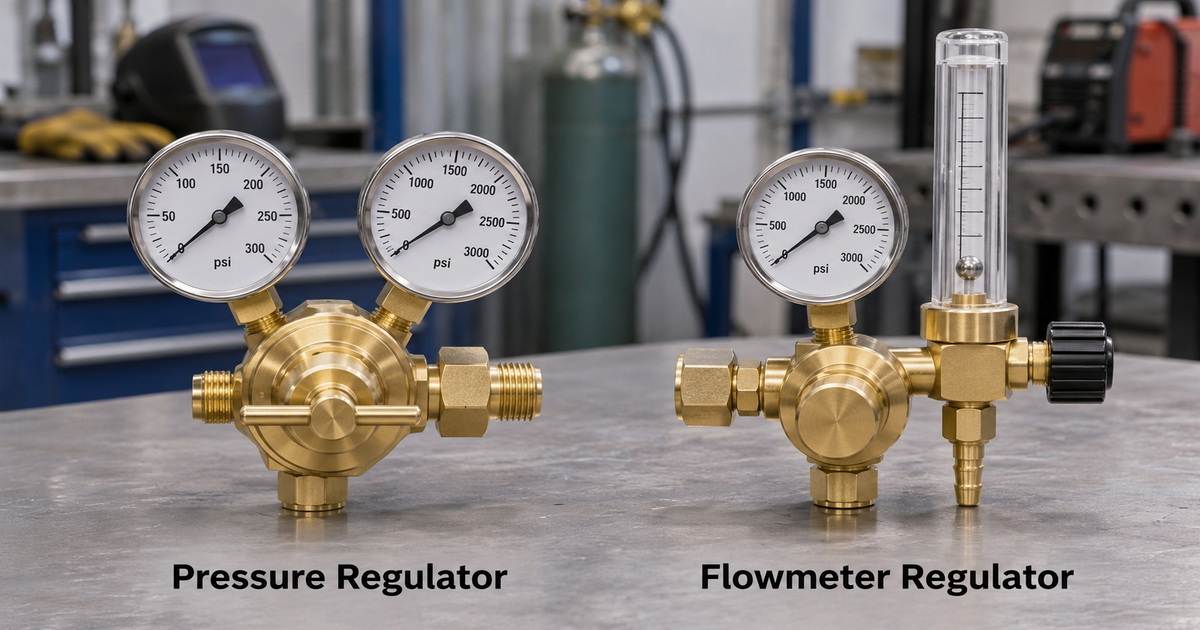
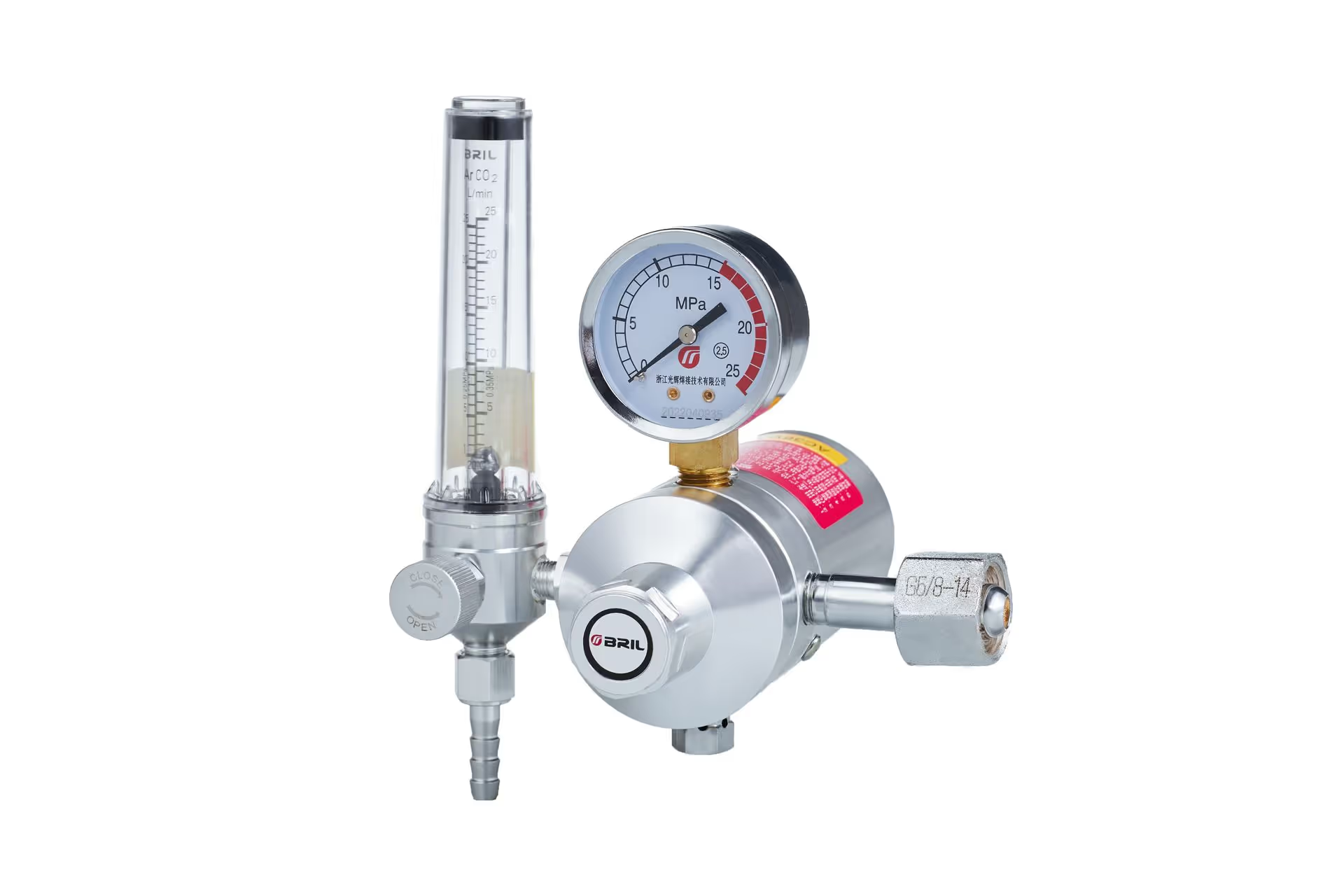
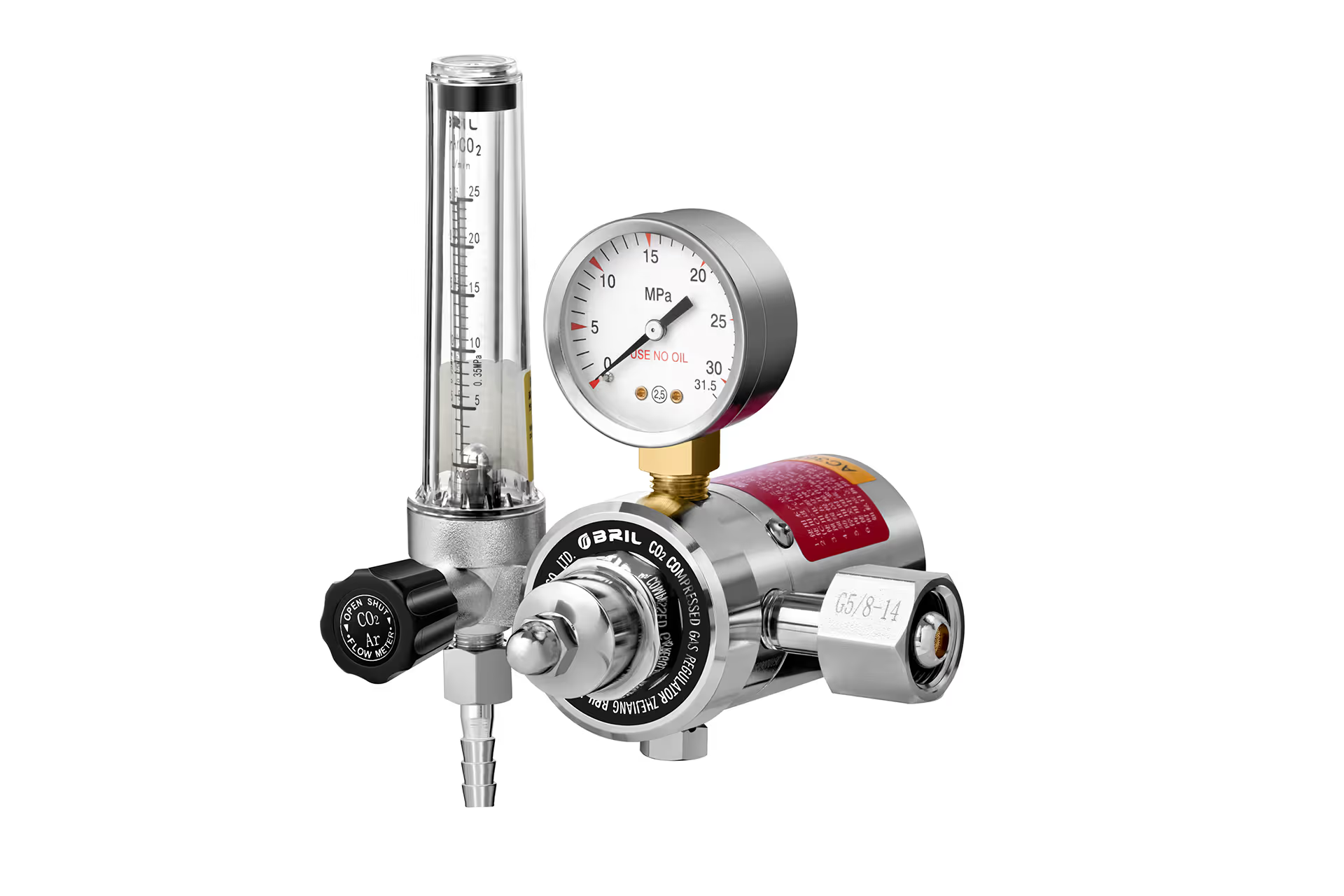
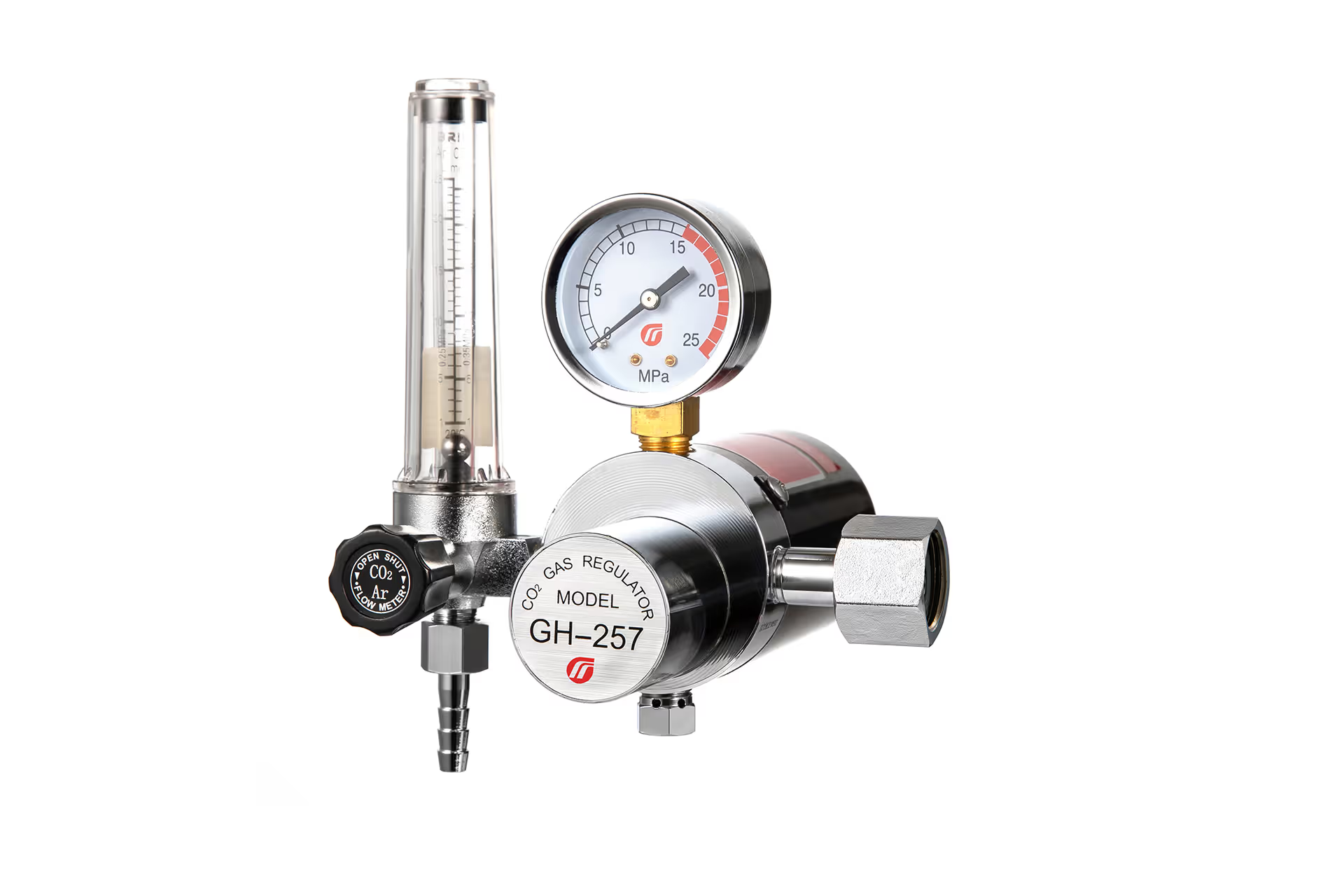
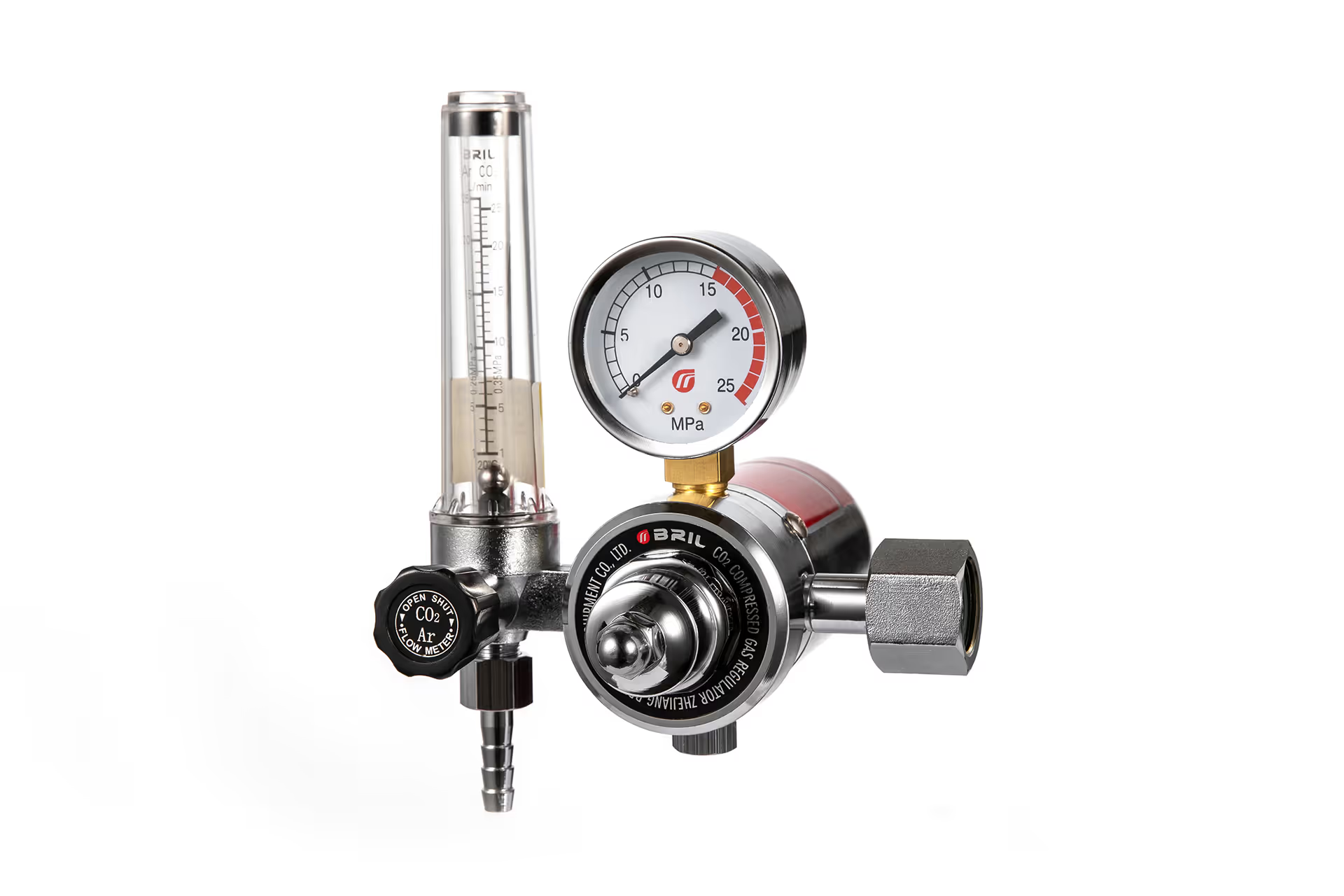
A regulator reduces cylinder pressure to a usable delivery pressure. A flowmeter indicates gas flow. An integrated flowmeter regulator combines these functions.
That distinction matters because shielding depends on gas reaching the torch—not merely on a pressure reading.
Flowgauge Regulators
Some welding regulators use a dial marked in flow units. These flowgauges infer flow from pressure through a defined restriction.
They can be practical, but their indicated flow depends on the intended gas and operating arrangement. A dial reading is not automatically a direct measurement of flow at the nozzle.
Flowmeter Regulators
A tube-type flowmeter commonly uses a float and calibrated scale. Read it according to the manufacturer’s instructions, including its required orientation and float-reading position.
For buyers, my preference is a clearly specified flow-control assembly with documented gas compatibility. A transparent tube alone does not establish accuracy.
Also remember that dual-stage describes two pressure-reduction stages. It does not mean two gauges, two outlets, or two flowmeter tubes.
Five Specifications That Matter More Than Appearance
1. Cylinder Connection and Gas Compatibility
Confirm the actual cylinder-valve standard in the destination market.
For example, North American product ranges commonly offer CGA-580 configurations for argon service and CGA-320 configurations for CO₂. Other markets use different connections.
A fitting that can be physically connected does not, by itself, establish gas-service suitability. Verify the complete regulator specification rather than relying on an adapter.
2. Flowmeter Calibration
Gas density affects flow indication. A scale calibrated for one gas may not indicate another gas accurately.
Some flowmeters provide multiple scales; others require manufacturer-specified correction factors.
Ask the supplier:
– Which gas or mixture is the scale calibrated for?
– What operating pressure does that calibration require?
– Is a correction factor necessary?
– What accuracy or tolerance is documented?
An “argon/CO₂” label should be supported by clear instructions.
3. Flow Range and Adjustment Resolution
An oversized scale can make ordinary welding settings difficult to adjust precisely.
Select a working range that places normal operation in an easily readable portion of the scale. Confirm capacity for the intended torch, nozzle, and procedure without sacrificing useful resolution.
4. Pressure Stability
A suitable single-stage regulator is sufficient for many industrial applications.
A two-stage regulator becomes attractive when more consistent delivery pressure is required as cylinder pressure falls, or when cylinders are difficult to monitor.
It is not automatically necessary for every MIG workstation. Judge the benefit against actual process sensitivity.
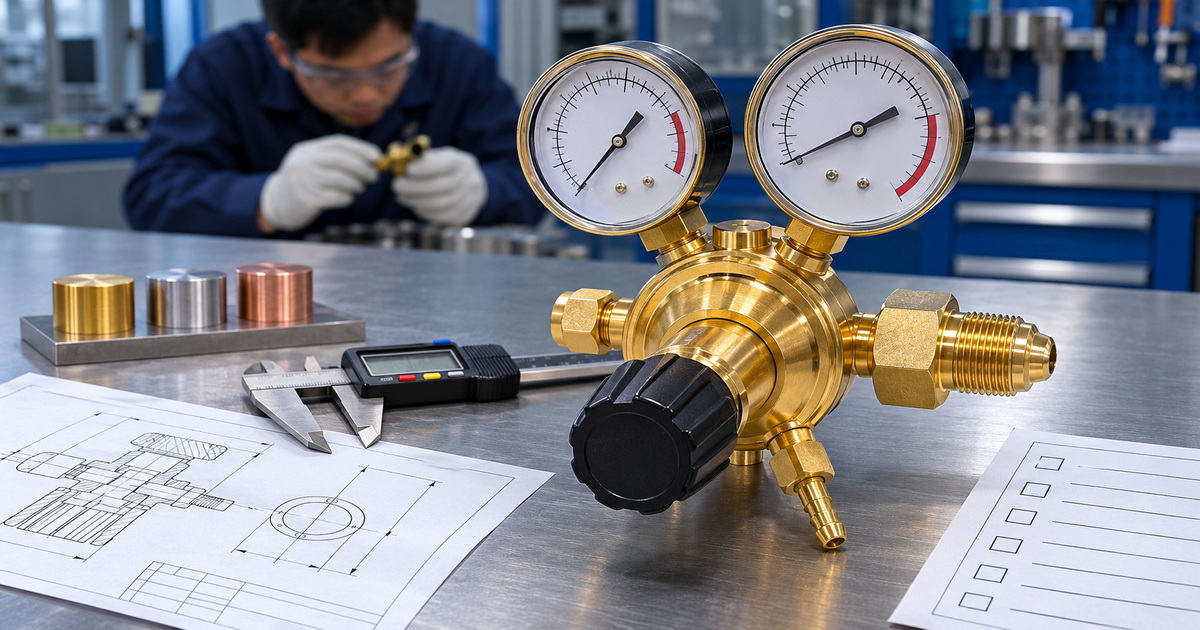
5. Materials and Inspection Evidence
Brass bodies are common in welding regulators, but “high-quality brass” is not a complete performance specification.
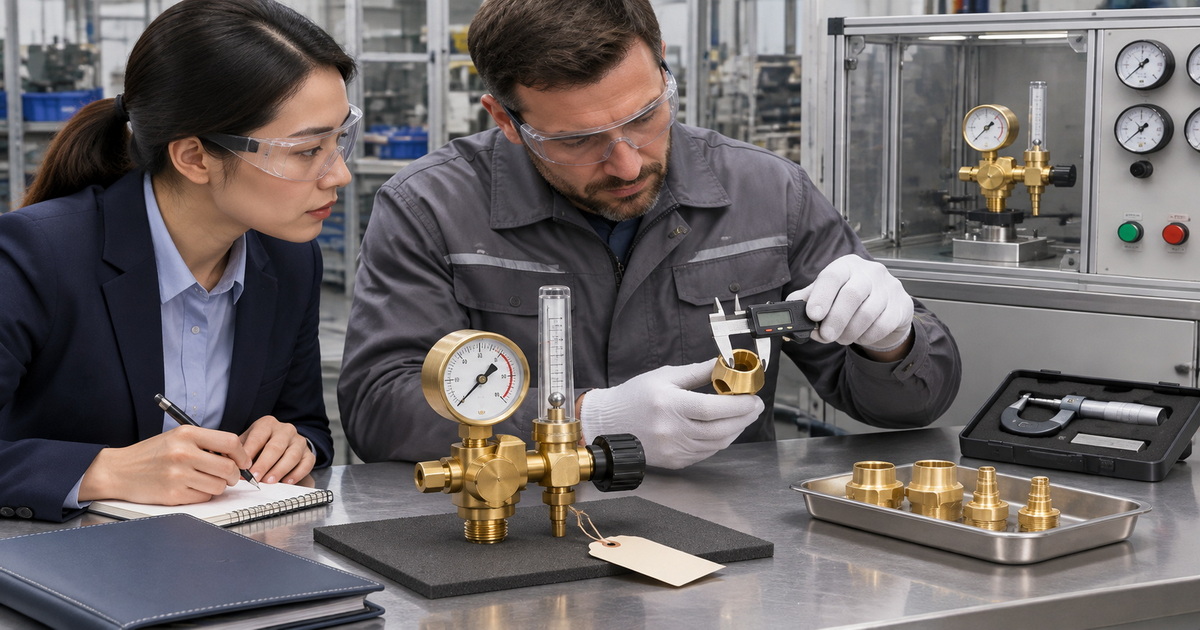
Request documented checks covering:
– External leakage.
– Shutoff-seat integrity.
– Pressure indication.
– Flow indication under defined conditions.
– Delivery stability across the intended operating range.
For OEM purchasing, agree on acceptance criteria before approving the production sample.
When Is a Heated CO₂ Regulator Worth Buying?
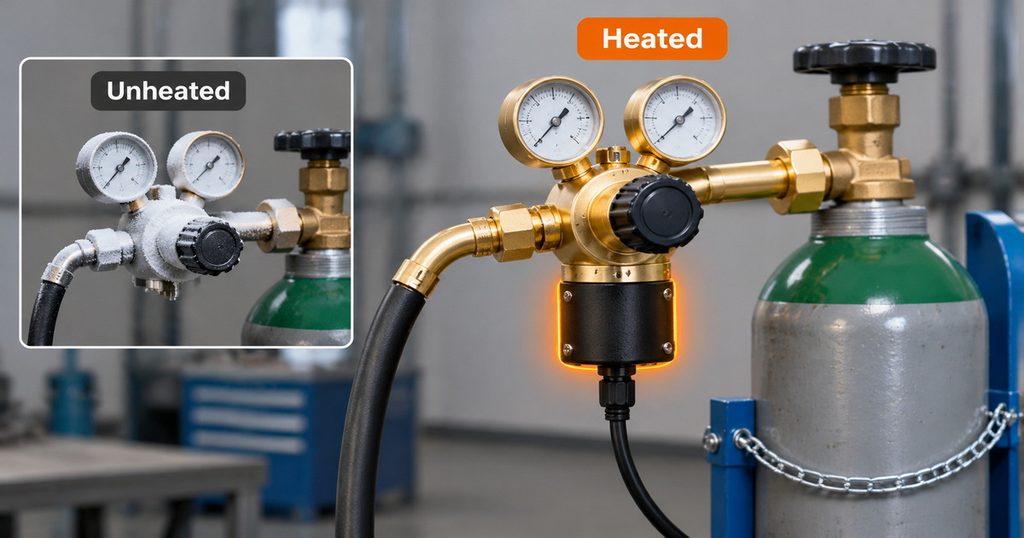
A heated CO₂ regulator is worth considering when cooling and freeze-up prevent stable delivery at the required duty cycle.
The important distinction is between occasional frost and operational failure. Evaluate whether flow becomes unstable, delivery falls, or production must stop.
Before specifying heating, review:
1. Continuous gas demand.
2. Ambient conditions.
3. Cylinder or supply-system capacity.
4. Regulator continuous-flow rating.
5. Electrical supply and installation requirements.
A heater cannot compensate for every undersized supply arrangement.
Likewise, heater wattage alone does not establish performance. Ask for the supported CO₂ flow, test conditions, duty rating, and protective features. Never use an open flame to warm a regulator or cylinder.
How Much Gas Flow Does MIG Welding Need?
| Condition | Sensible response |
|---|---|
| Porosity appears | Check leaks, contamination, drafts, nozzle condition, and flow |
| Gas consumption seems excessive | Check leakage and actual flowing setting |
| Regulator indicates flow but shielding is poor | Verify delivery at the torch |
| Drafts disturb shielding | Improve shielding from air movement |
| Nozzle contains heavy spatter | Clean or replace affected consumables |
More flow is not always better. Excessive flow can create turbulence and draw atmospheric contamination into the shielding envelope.
A Practical Seven-Step Regulator Setup Checklist
1. Secure the cylinder upright and confirm the gas identity.
2. Inspect the valve outlet, regulator connection, seals, and hose.
3. Confirm gas compatibility, pressure rating, and the correct connection.
4. Install the regulator following its instructions; do not improvise sealing methods.
5. Open the cylinder valve and adjust the regulator as directed by the manufacturer.
6. Check connections using an approved leak-detection method.
7. Set flow while gas is actually flowing, then verify delivery at the torch where practical.
Use the machine’s purge function when available. If triggering the gun could feed wire, follow the machine instructions to prevent unintended wire movement.
After setup, make a test weld under representative conditions. A regulator reading alone does not confirm adequate shielding.
A Better Cost Comparison: Measure Cost per Accepted Weld
The cheapest cylinder refill does not necessarily produce the cheapest finished component.
A useful comparison is:
Total welding cost = gas + welding labor + cleanup + rework + downtime.
Consider a hypothetical mild-steel workshop comparing pure CO₂ with C25. CO₂ may reduce shielding-gas expenditure, while C25 may reduce spatter removal.
Rather than assuming either option wins, run matched trials using the same joint, wire, machine, and acceptance criteria.
Record:
– Gas consumed.
– Welding time.
– Cleanup time.
– Rejected or repaired welds.
– Interruptions linked to gas delivery.
This approach also helps evaluate regulators. Better flow control has commercial value when it reduces verified waste or interruptions—not merely because a product is described as “precision.”
What Overseas Buyers Should Include in an OEM Specification
| Specification | Information to provide |
|---|---|
| Gas service | Pure CO₂, argon, or exact mixture |
| Destination | Country and cylinder-valve connection |
| Supply conditions | Maximum inlet pressure and supply type |
| Delivery requirement | Flow range, units, and outlet conditions |
| Construction | Body, seals, gauges, hose, and fittings |
| Heated models | Voltage, frequency, plug, and duty requirement |
| Verification | Inspection methods and acceptance limits |
| Documentation | Manuals, traceability, and applicable conformity requirements |
For our manufacturing business, these details provide the foundation for a meaningful OEM or ODM proposal.
We manufacture CO₂, heated CO₂, argon, and dual-stage regulators alongside other industrial gas-control products. Product selection should still remain application-specific: one regulator should never be assumed suitable across unrelated gas services.
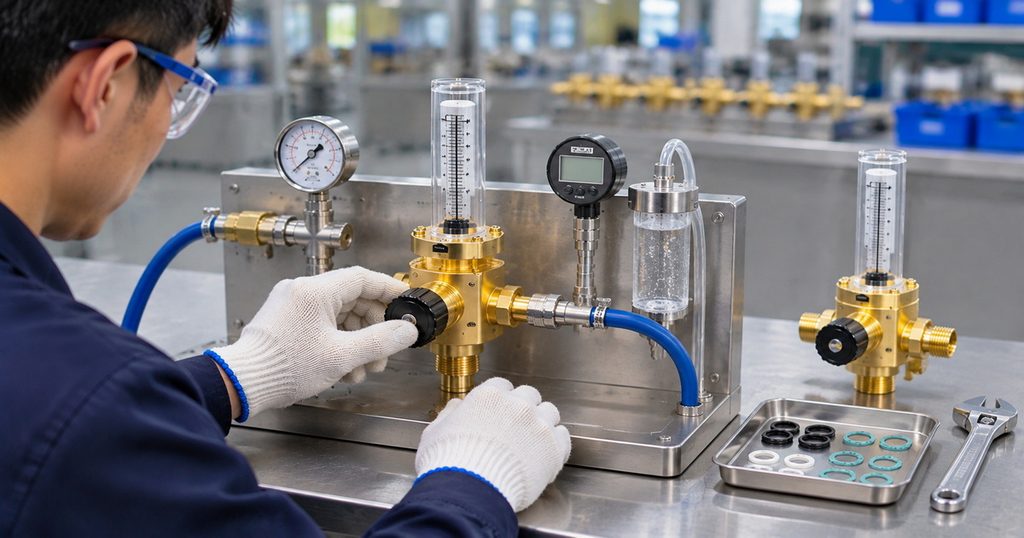
Specify Your MIG Welding Regulator with Confidence
For general mild-steel work, start by evaluating an argon/CO₂ flowmeter regulator. Choose a CO₂-rated model for pure CO₂, adding heating where operating conditions justify it. For aluminum, select an argon-compatible assembly.
For an application-specific OEM or ODM quotation, send us your shielding gas, destination market, cylinder connection, required flow range, and expected duty cycle. We can then discuss a configuration, sample specification, and inspection requirements suited to your welding-equipment business.
Frequently Asked Questions
1.Can I Use an Argon Regulator for CO₂ Welding?
Only when the manufacturer explicitly approves the assembly for CO₂ service. Confirm the connection, pressure rating, materials, and flow calibration. An adapter alone is insufficient.
2.Is C25 Better Than Pure CO₂ for MIG Welding?
For many mild-steel short-circuit applications, C25 provides smoother operation and less spatter. Pure CO₂ remains a cost-effective option. Compare finished-weld quality and total operating cost.
3.Do I Need a Heated CO₂ Regulator?
Not necessarily. Consider heating when sustained withdrawal causes freeze-up that disrupts delivery. Check the complete gas-supply arrangement before selecting a heated model.
4.Is a Two-Stage Regulator Better for MIG Welding?
It can maintain more consistent delivery pressure as cylinder pressure changes. However, a properly selected single-stage unit is adequate for many applications.
5.Can One Flowmeter Measure Argon and CO₂?
Some models can, using separate scales or specified correction factors. Follow the manufacturer’s calibration instructions rather than assuming identical readings.
6.What Is the Best Regulator for Aluminum MIG Welding?
Choose an argon-compatible regulator with suitable flow capacity, clear adjustment, and the correct cylinder connection. Match the setup to the machine, torch, and welding procedure.
References
1. Miller Electric. “What Type of Gas Is Best for MIG Welding in DIY Applications?” Supports the shielding-gas comparisons, material-specific selections, short-circuit flow guidance, and torch-flow verification. [millerwelds]
2. Miller Electric. “MIG Welding Tips and Techniques for Beginners.” Supports the light-duty starting-flow example and basic shielding-gas setup discussion. [millerwelds]
3. Miller Electric. “10 Welding Operation Mistakes and How to Solve Them.” Supports the discussion of shielding-gas selection, excessive flow, contamination, and gas-delivery arrangements. [millerwelds]
4. Miller Electric. “Want to Improve Results When MIG Welding Stainless Steel?” Supports the distinction between stainless-steel gas mixtures and ordinary mild-steel shielding selections. [millerwelds]
5. Harris Products Group. “Model 355-2 Flowmeter Regulator.” Documents integrated regulation and flow measurement, dual calibration, gas-specific configurations, and connection examples. [harrisproductsgroup]
6. Harris Products Group. “Gas Regulation.” Explains selection by gas service, source, delivery pressure, and single-stage versus two-stage requirements. [harrisproductsgroup]
7. Harris Products Group. “CO₂ Freeze Up: Why It Happens, What You Can Do.” Supports the discussion of heated regulators as a response to CO₂ freeze-up. [harrisproductsgroup]
8. Harris Products Group. “Model 32 Three-Gas Flowmeter.” Provides an example of a flowmeter calibrated for multiple identified gases. [harrisproductsgroup]
Hot Tags: Gas Regulator Manufacturer, MIG Welding Gas Regulator, CO₂ Welding Regulator, Argon Gas Regulator, Argon CO₂ Flowmeter Regulator, Heated CO₂ Regulator, Dual Stage Gas Regulator, Industrial Gas Regulator Supplier, OEM Gas Regulator, Wholesale Welding Regulators