Content Menu
● 1. Do All Welding Gas Regulators Require CE Marking?
>> Pressure Accessories Versus Safety Accessories
>> Sound Engineering Practice Versus PED Categories
● 2. Prepare a Product-Specific PED Classification
>> Gas Service Changes the Assessment
● 3. Select the Right Welding Gas Regulator Standards
>> ISO 2503 for Cylinder-Mounted Regulators
>> Manifold and Pipeline Regulators Need Different References
● 4. Build a Technical File That Matches the Delivered Regulator
● 5. Turn Material Quality Into Verifiable Manufacturing Evidence
● 6. Prepare a Risk-Based Test and Inspection Plan
● 7. Give Heated CO₂ Regulators a Separate Compliance Review
>> Check the Interaction Between Legal Requirements
● 8. Resolve OEM and ODM Responsibilities Before Branding
● 9. Three Practical Checks Before Shipment
>> Check One: Run a Model-to-Evidence Audit
>> Check Two: Challenge the “CE Certificate”
>> Check Three: Review the Instructions as a Buyer Would
● 10. Prepare Your Next OEM Gas Regulator Project
>> 1.Do All Welding Gas Regulators Need a CE Certificate?
>> 2.Does ISO 2503 Compliance Automatically Establish CE Compliance?
>> 3.Can an Argon Regulator and an Oxygen Regulator Use the Same Technical File?
>> 4.Do Heated CO₂ Regulators Always Need PED CE Marking?
>> 5.Who Signs the Declaration for a Private-Label Regulator?
>> 6.Does Every Customization Require Complete Retesting?
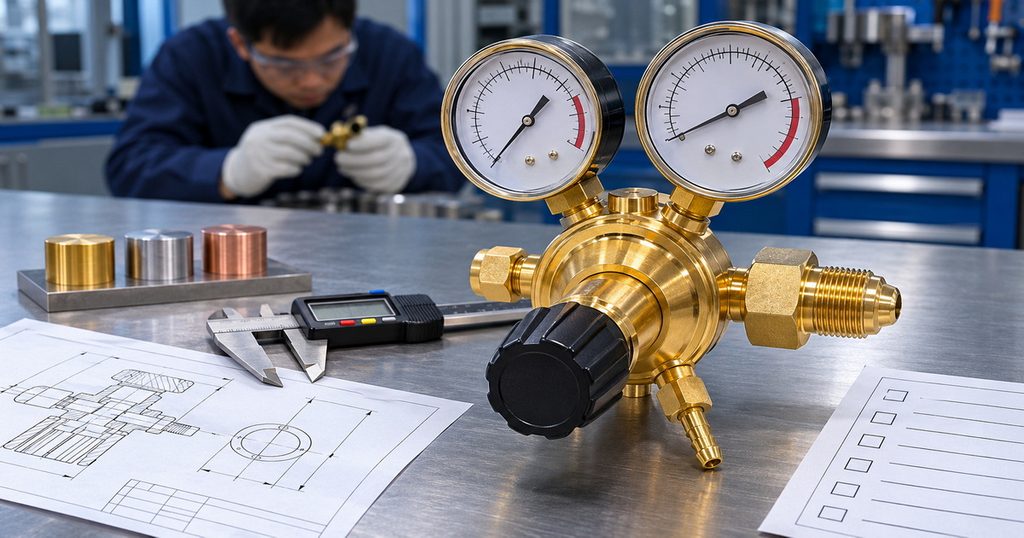
CE requirements for welding gas regulators begin with a question many purchasing specifications overlook: does this particular regulator require CE marking under the applicable European legislation? The answer depends on its pressure classification, gas service, construction, intended use, and electrical features—not simply whether it connects to a high-pressure cylinder.
1. Do All Welding Gas Regulators Require CE Marking?
No. The Pressure Equipment Directive, 2014/68/EU, commonly called the PED, generally applies to pressure equipment with a maximum allowable pressure above 0.5 bar. However, being within its general scope does not automatically mean a regulator must carry CE marking under the PED.
Pressure Accessories Versus Safety Accessories
A conventional welding gas regulator normally functions as a pressure accessory: it controls pressure and has a pressure-bearing housing.
A device specifically designed to protect equipment against exceeding allowable limits may instead qualify as a safety accessory. That distinction affects classification and conformity assessment.
Manufacturers should not describe an ordinary regulator as an independent overpressure safety device unless that function has been specifically designed and assessed.
Sound Engineering Practice Versus PED Categories
Equipment falling within Article 4(3) must follow sound engineering practice, often abbreviated SEP. It must have adequate instructions, but it must not carry CE marking on the basis of the PED.
Equipment classified in Categories I–IV follows the applicable essential safety requirements and conformity assessment procedures.
An SEP regulator may still require CE marking under another applicable law. Therefore, “no PED CE marking” and “no CE marking under any legislation” are different conclusions.
2. Prepare a Product-Specific PED Classification
A gas regulator CE compliance assessment should start with a controlled specification sheet.
Record:
– Intended gases and mixtures.
– Maximum allowable pressure, PS.
– Minimum and maximum allowable temperatures, TS.
– Relevant chamber volumes, V.
– Nominal size, DN, where applicable.
– Inlet and outlet operating ranges.
– Cylinder, manifold, or pipeline installation.
– Pressure-control and claimed safety functions.
– Electrical heating or electronic controls.
For pressure accessories, classification considers PS, V and/or DN, and the fluid group. Where both volume and nominal size are appropriate, the higher resulting category applies.
Do not assign a category using cylinder pressure alone. Likewise, do not substitute a threaded connection’s commercial size for DN without an engineering basis.
Gas Service Changes the Assessment
| Gas service | Typical PED fluid-group starting point | Additional preparation |
|---|---|---|
| Argon, nitrogen, pure CO₂ | Group 2 | Confirm actual fluid classification and operating conditions |
| Oxygen | Group 1 because of its oxidizing classification | Address material compatibility and ignition hazards |
| Acetylene and propane | Group 1 because of flammability | Review gas-specific materials, pressure limits, and foreseeable misuse |
| Gas mixtures | Depends on mixture classification | Obtain the mixture’s classification information |
3. Select the Right Welding Gas Regulator Standards
A relevant product standard provides a technical framework. It does not, by itself, determine the legal need for CE marking.
ISO 2503 for Cylinder-Mounted Regulators
ISO 2503 addresses cylinder-connected pressure regulators and regulators with flow-metering devices for welding, cutting, and allied processes.
Its scope includes single-stage and two-stage designs, compressed gases up to 300 bar, and specified other gas services. Important scope limits apply, including the exclusion of regulators with nominal outlet pressures above 20 bar.
Manufacturers should review the applicable edition and amendments rather than copying a standard number from an older catalogue.
Manifold and Pipeline Regulators Need Different References
ISO 7291 addresses pressure regulators for manifold systems. ISO 22073-1 addresses line pressure regulators connected to industrial gas distribution pipelines.
The installation point matters. A cylinder regulator, bundle regulator, and pipeline regulator should not automatically share the same compliance specification.
For any claimed presumption of conformity, verify the relevant European standard’s current citation in the Official Journal and the requirements it covers. An ISO publication alone does not establish harmonized status under the PED.
4. Build a Technical File That Matches the Delivered Regulator
| File section | Evidence to prepare |
|---|---|
| Product definition | Model list, intended use, gas service, operating limits |
| Regulatory assessment | Scope decision, classification rationale, conformity route |
| Design evidence | Drawings, calculations, materials, component specifications |
| Risk assessment | Identified hazards, protective measures, residual risks |
| Verification | Test procedures, acceptance criteria, reports, sample identification |
| Production controls | Inspection plans, traceability, change-control records |
| Market documentation | Markings, instructions, declaration where required |
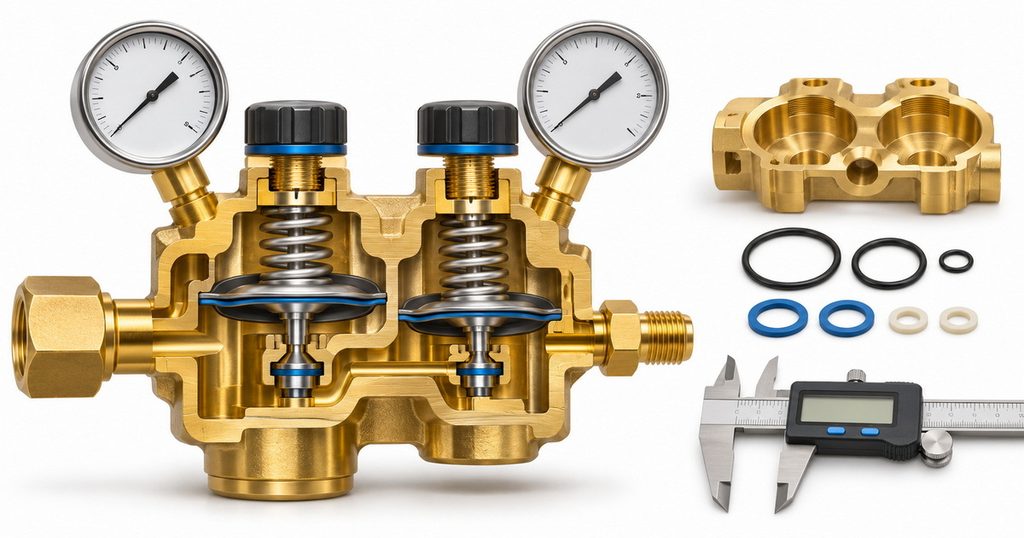
5. Turn Material Quality Into Verifiable Manufacturing Evidence
High-quality brass is a useful starting point, but the phrase is not a material specification.
Manufacturers should define alloy composition, mechanical properties, service compatibility, and purchasing acceptance criteria. Trace pressure-bearing parts to the relevant material documentation and production batches.
For oxygen regulators, material selection and cleanliness require particular attention. Assess contamination, lubricants, non-metallic components, and ignition risks under intended operating conditions.
For acetylene regulators, review every wetted material for suitability rather than assuming that a material accepted for argon is automatically acceptable.
Our recommendation is to connect incoming inspection with finished-product identification. A material document has limited value if it cannot be linked to the regulator actually shipped.
6. Prepare a Risk-Based Test and Inspection Plan
A credible welding gas regulator test report should identify the tested configuration, procedure, acceptance criteria, equipment, and results.
Depending on the applicable standard, design, and conformity route, the verification plan may include:
– External leakage and internal seat leakage.
– Pressure resistance and structural integrity.
– Pressure regulation across specified inlet conditions.
– Flow performance and flowmeter accuracy.
– Pressure creep and closing behavior.
– Mechanical endurance.
– Gas-specific safety testing.
– Temperature-related performance.
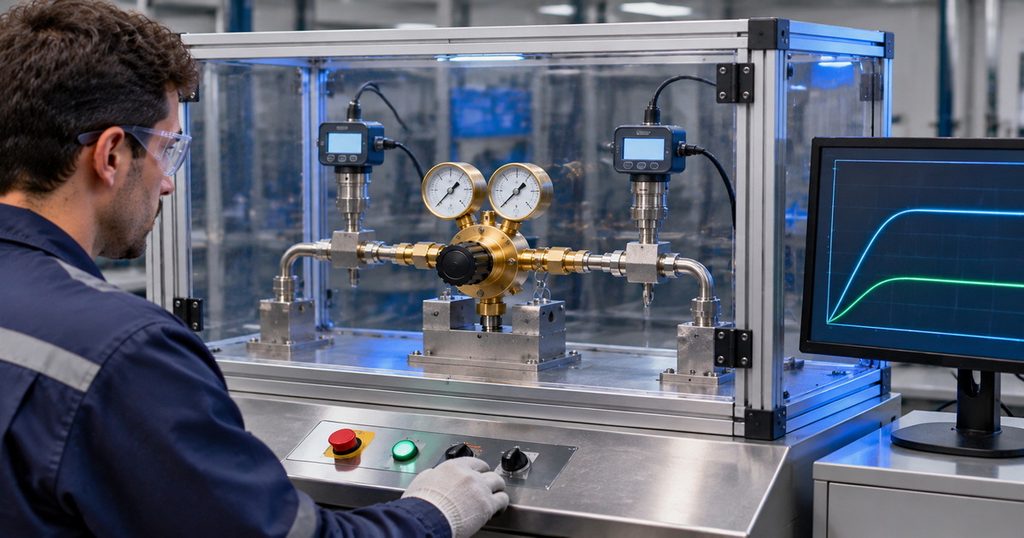
Distinguish design-validation testing from routine production checks. Some tests establish design performance; others verify manufacturing consistency.
Avoid applying one universal pressure-test multiplier to every product. Test conditions must follow the applicable requirements and engineering assessment.
For dual-stage gas regulators, validate the complete pressure-reduction arrangement. Two stages do not remove the need to evaluate failure conditions or downstream pressure exposure.
7. Give Heated CO₂ Regulators a Separate Compliance Review
A heated CO₂ regulator combines pressure-control equipment with electrical functionality. A mechanical regulator’s existing documentation should not simply be reused.
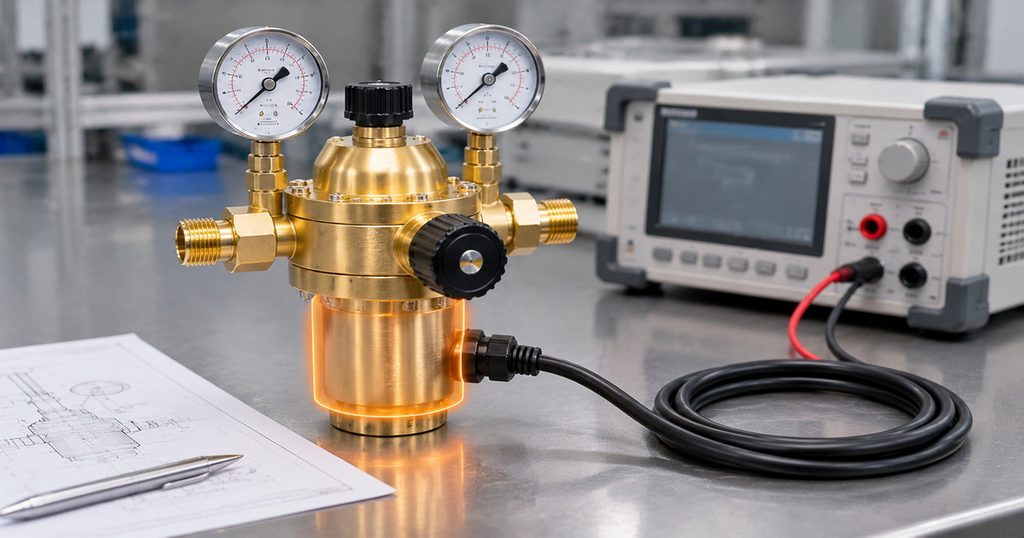
The Low Voltage Directive generally covers electrical equipment designed for 50–1,000 V AC or 75–1,500 V DC. A mains-powered heater therefore needs a specific scope assessment.
A lower-voltage heater may fall outside those voltage limits, but electrical and thermal risks still need assessment. Electromagnetic compatibility and restricted-substance requirements should also be screened where relevant.
Check the Interaction Between Legal Requirements
PED Article 1(2)(f) excludes certain equipment classified no higher than Category I when covered by specified other legislation, including the Low Voltage Directive.
Consequently, the correct route is not always “PED plus electrical directives.” Document whether requirements apply together or whether a specific exclusion changes the assessment.
Prepare evidence addressing insulation, accessible temperatures, overheating, wiring security, and the supplied power arrangement as applicable.
8. Resolve OEM and ODM Responsibilities Before Branding
Private-label production changes more than the logo.
Under the PED, an importer or distributor placing equipment on the market under its own name or trademark assumes manufacturer obligations.
The factory and brand owner should agree on:
1. Who is the legal manufacturer.
2. Who approves the classification and technical specification.
3. Who controls and can retrieve the technical documentation.
4. Who signs the declaration where required.
5. Who approves labels and translations.
6. Who manages complaints, corrective actions, and recalls.
Commercial agreements can allocate work, but they do not erase statutory responsibilities.
For customized regulators, require written approval before changing seats, diaphragms, springs, body materials, connections, or heaters. A visually identical replacement can still affect compliance.
9. Three Practical Checks Before Shipment
Check One: Run a Model-to-Evidence Audit
Select one finished regulator and trace its model code through the drawing, bill of materials, test report, instructions, and declaration where applicable.
Every document should describe the same configuration. Differences in gas service, pressure rating, or heater voltage require resolution before release.
This audit method is a practical recommendation, not a separate statutory certification.
Check Two: Challenge the “CE Certificate”
Ask what legal function the document performs.
Category I generally permits internal production control under Module A without notified-body involvement. Higher categories require the involvement specified by the chosen procedure.
Where a notified body is required, verify its designation and relevant scope in the European Commission’s database. A voluntary certificate does not replace the prescribed assessment or the manufacturer’s declaration.
Check Three: Review the Instructions as a Buyer Would
Confirm that users can identify:
– Correct gas and connection.
– Rated pressures and temperatures.
– Installation and operating procedures.
– Relevant warnings and prohibited uses.
– Inspection, maintenance, and replacement guidance.
– Manufacturer and importer contact information where required.
Provide instructions in the language required by the destination Member State. An English-only manual is not a universal solution for Europe.
10. Prepare Your Next OEM Gas Regulator Project
A well-prepared project begins with an agreed compliance specification, not a request for a generic certificate.
For our CO₂, heated CO₂, argon, oxygen, acetylene, propane, nitrogen, and dual-stage regulator projects, we recommend confirming the target market and operating conditions before sample approval.
Send our team your gas type, maximum inlet pressure, outlet range, required flow, connection standard, destination countries, branding requirements, and heater voltage where relevant. Request a model-specific discussion covering the proposed design, inspection plan, available supporting evidence, and any additional assessment needed before production.
Frequently Asked Questions
1.Do All Welding Gas Regulators Need a CE Certificate?
No. First establish whether CE marking is required and which legislation applies. SEP equipment must not carry PED-based CE marking. Where marking is required, the prescribed conformity process—not a generic certificate—determines the necessary evidence.
2.Does ISO 2503 Compliance Automatically Establish CE Compliance?
No. It supports technical verification within its scope. Manufacturers must separately establish applicable legislation, classification, conformity assessment, and documentation requirements.
3.Can an Argon Regulator and an Oxygen Regulator Use the Same Technical File?
Some common design evidence may be shared. However, gas classification, material compatibility, cleanliness, testing, and instructions need gas-specific justification. A shared appearance is insufficient.
4.Do Heated CO₂ Regulators Always Need PED CE Marking?
No. Assess the pressure classification, electrical legislation, and relevant exclusions together. The heater voltage and complete supplied configuration can change the applicable route.
5.Who Signs the Declaration for a Private-Label Regulator?
The legal manufacturer, or its authorized representative acting within its mandate, signs as applicable. The parties should establish the legal manufacturer’s identity before approving branding.
6.Does Every Customization Require Complete Retesting?
Not necessarily. Perform a documented change-impact assessment. The extent of additional testing depends on how the change affects safety, performance, applicable requirements, and existing assessment coverage.
References
1. European Parliament and Council. Directive 2014/68/EU on pressure equipment, consolidated text dated 30 May 2026. Relevant provisions include Articles 1–14 and Annexes I–IV: scope, SEP, manufacturer obligations, classification, assessment, and documentation. [eur-lex.europa]
2. European Commission. Pressure Equipment Directive overview, including implementation guidance, harmonized standards, and conformity-assessment resources. [single-market-economy.ec.europa]
3. International Organization for Standardization. ISO 2503:2009, *Gas welding equipment—Pressure regulators and pressure regulators with flow-metering devices for gas cylinders used in welding, cutting and allied processes up to 300 bar (30 MPa)*. Includes scope information and amendment listing. [iso]
4. International Organization for Standardization. ISO 7291:2010, *Gas welding equipment—Pressure regulators for manifold systems used in welding, cutting and allied processes up to 30 MPa (300 bar)*. [iso]
5. International Organization for Standardization. ISO 22073-1:2024, *Gas welding equipment—Part 1: Line pressure regulators and line pressure regulators with flow-metering devices for gas distribution pipelines up to 6 MPa (60 bar)*. [iso]
6. European Commission. Low Voltage Directive guidance: voltage limits, manufacturer responsibility, and warnings concerning unregulated voluntary certificates. [single-market-economy.ec.europa]
7. European Commission. CE marking: manufacturer responsibilities for conformity assessment, technical documentation, declarations, and marking. [single-market-economy.ec.europa]
8. European Commission. Notified-body database: verification of bodies designated under applicable European legislation. [webgate.ec.europa]
Hot Tags: Welding Gas Regulators, Gas Regulator Manufacturer, Gas Regulator Supplier, Industrial Gas Regulators, OEM Gas Regulators, CO₂ Gas Regulators, Heated CO₂ Regulators, Dual Stage Gas Regulators, Oxygen Gas Regulators, CE Requirements For Gas Regulators