Content Menu
● Brazil’s Position in the Argon Gas Regulator Supply Chain
>> What the Latest Industry Figures Actually Show
● Selection Criteria: How to Evaluate a Long-Term Supplier
● Five Argon Gas Regulator Manufacturers and Suppliers to Consider
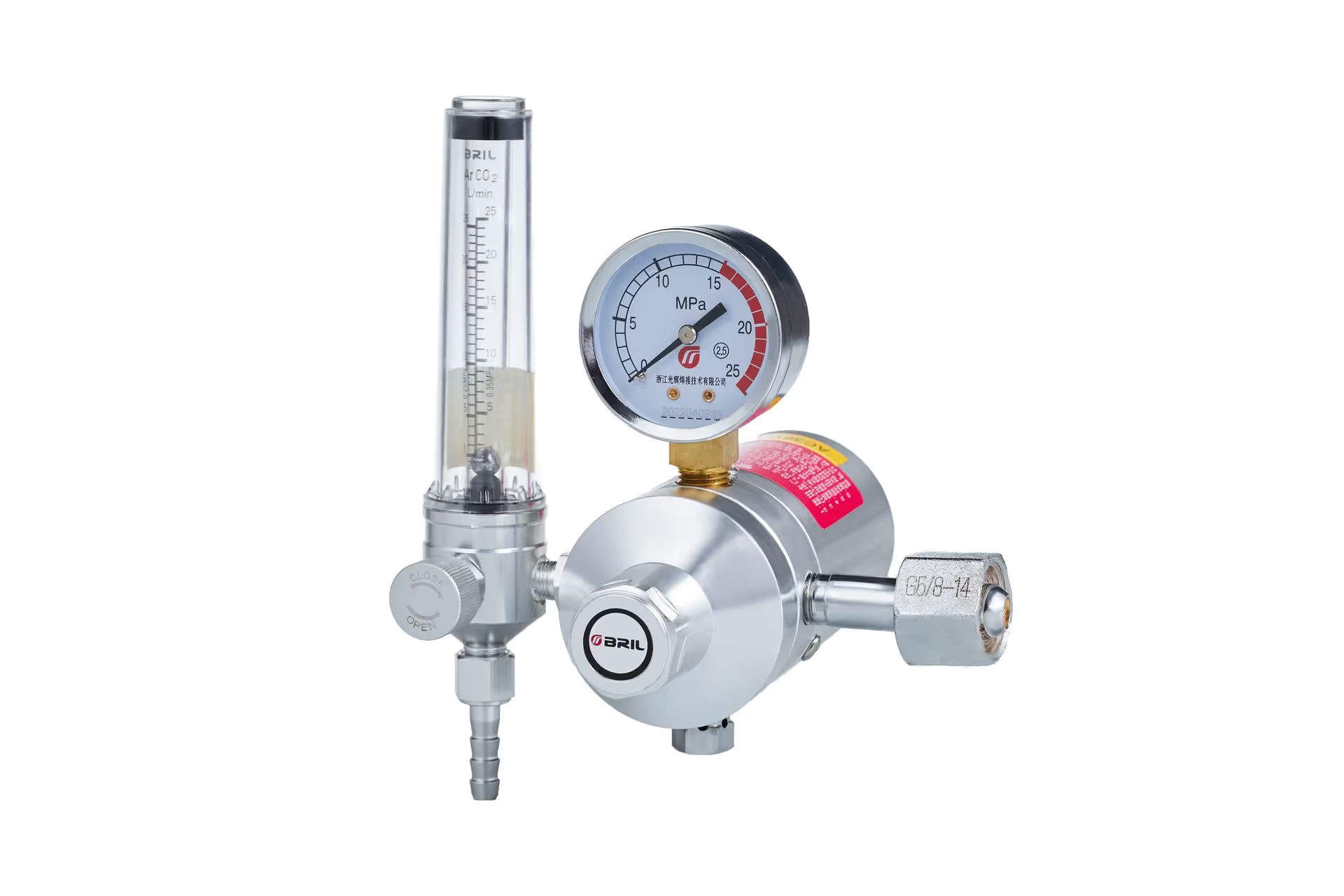
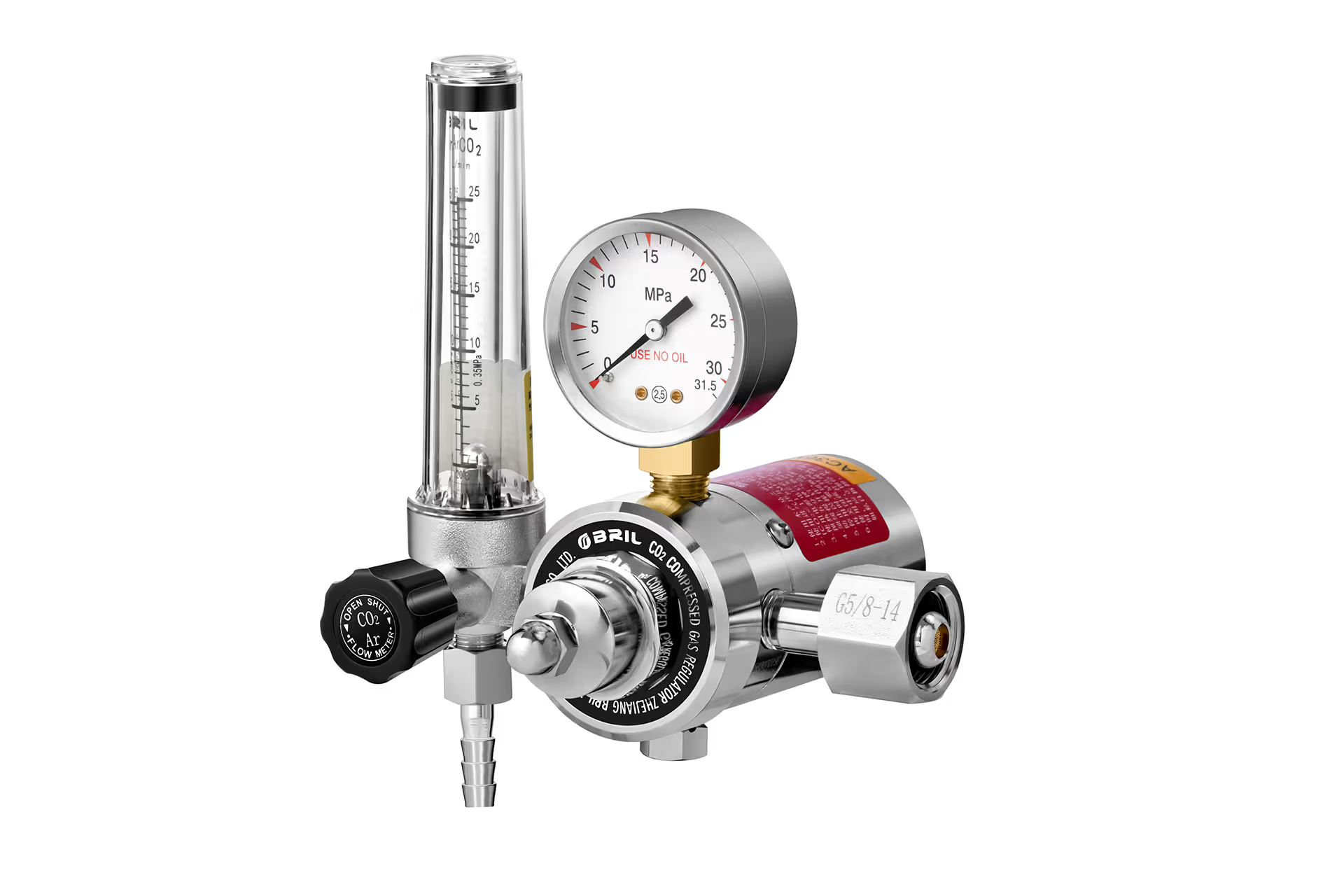
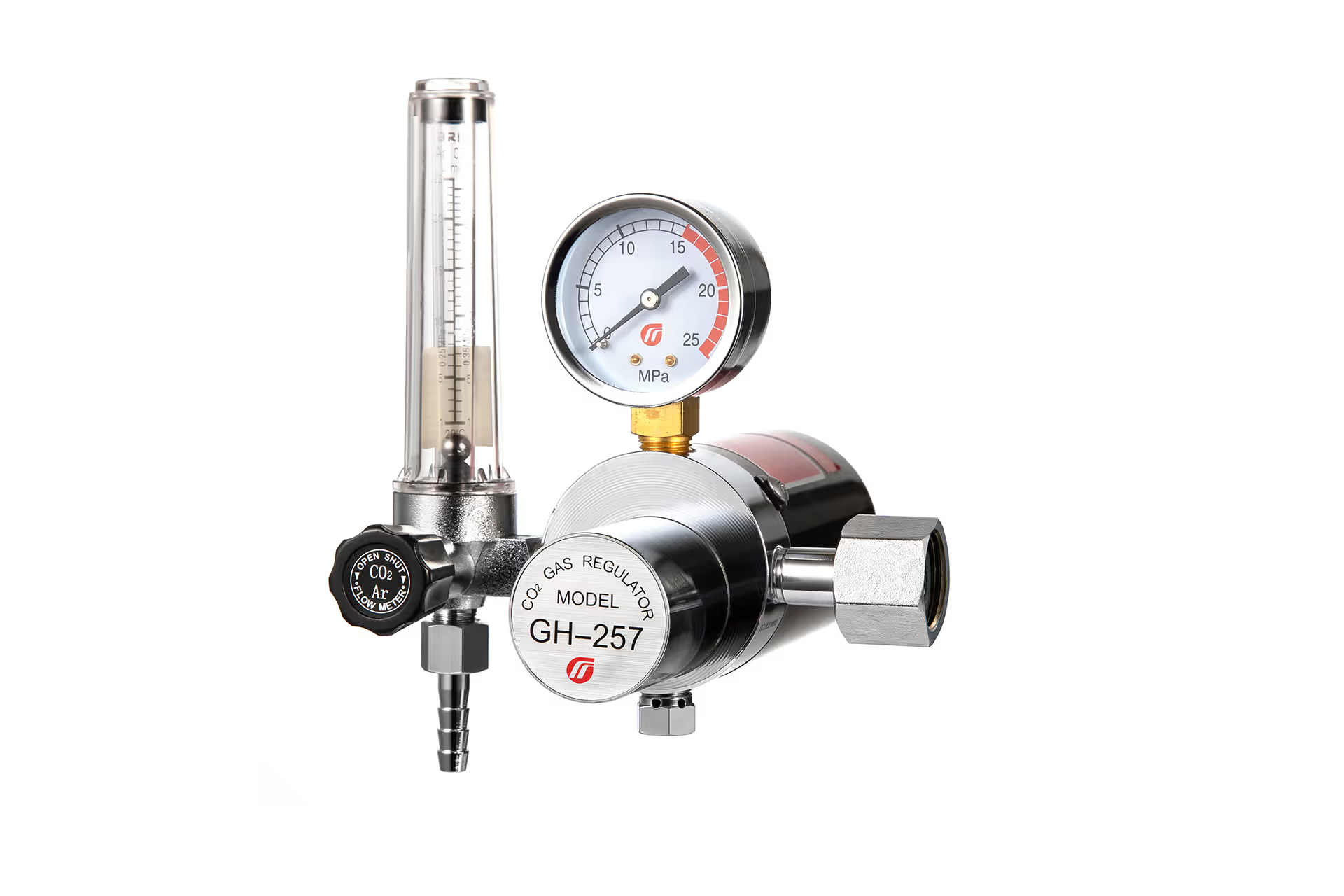
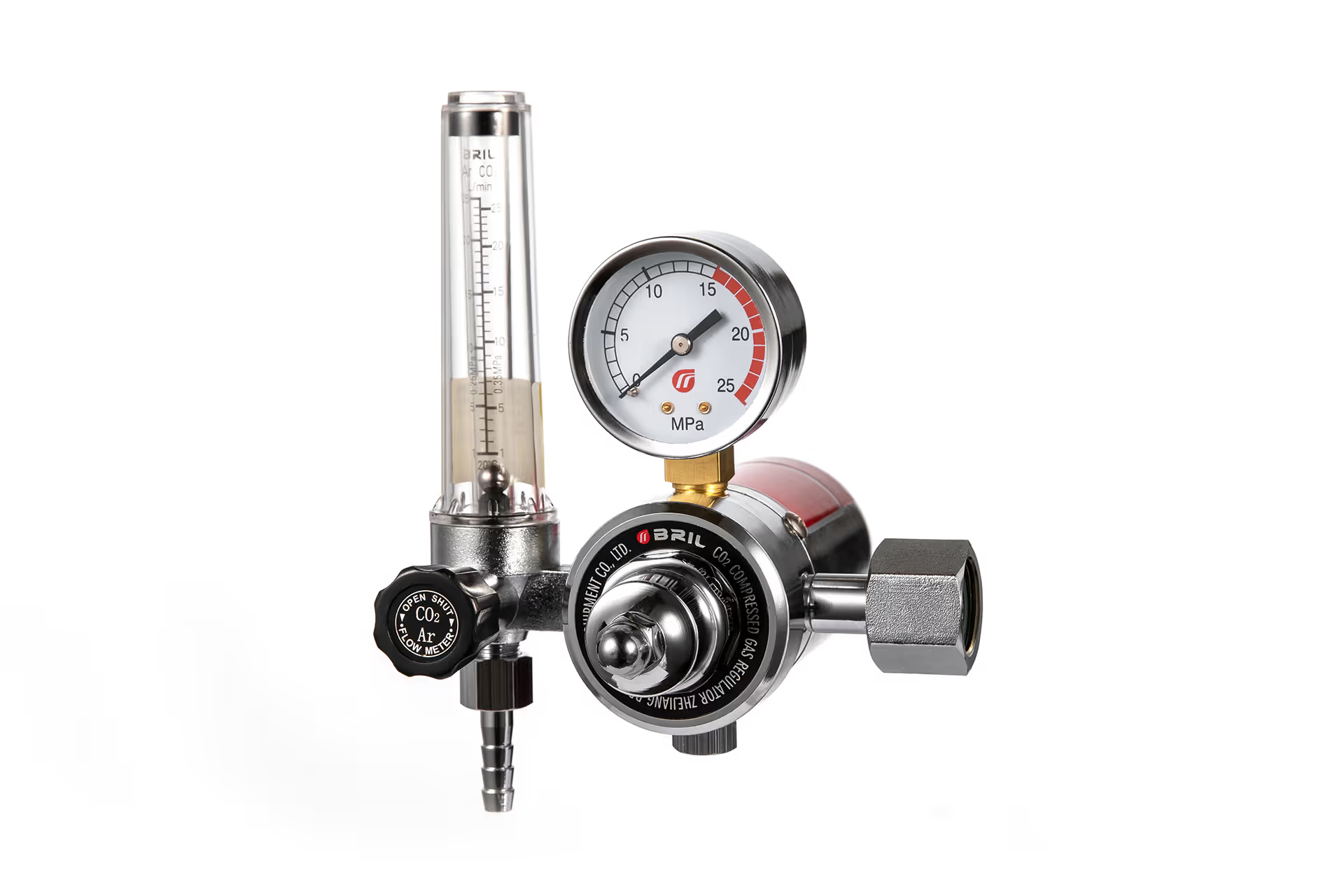
>> 1. Zhejiang Bril Welding Equipment Co., Ltd.
>>> Company Background and Market Position
>>> Core Strengths and OEM/ODM Fit
>>> Certification and Procurement Cautions
>> 2. Famabras
>>> Company Background and Main Markets
>>> Core Strengths
>>> OEM/ODM Scope and Verification Points
>>> Company Background and Main Markets
>>> Core Strengths
>>> OEM/ODM Scope and Verification Points
>>> Company Background and Main Markets
>>> Core Strengths
>>> OEM/ODM Scope and Verification Points
>>> Company Background and Main Markets
>>> Core Strengths
>>> OEM/ODM Scope and Verification Points
● Supplier Comparison: Capacity, MOQ, Certification, and Sourcing Fit
● Technical Buyer’s Guide: What to Specify Before Requesting Prices
>> Define Pressure and Flow Separately
>> Specify Materials Instead of Requesting “High-Quality Brass”
>> Distinguish Single-Stage and Dual-Stage Requirements
>> Interpret Certifications Correctly
● Common Procurement Traps and How to Avoid Them
>> Uncontrolled Material or Component Substitution
>> Gauge Range Mistaken for Regulator Rating
>> Connection Descriptions Without Drawings
>> The Less-Discussed Trap: Correct Flowmeter Reading, Incorrect Actual Flow
● Factory Verification, Samples, and Logistics
>> Use Samples as an Engineering Approval Stage
>> Validate the Supply Chain Behind the Factory
>> Compare Delivered Cost and Responsibilities
● Conclusion: Match the Supplier to the Procurement Model
● FAQ
>> 1. How can I verify whether a manufacturer’s ISO certificate has expired or been suspended?
>> 2. Can I approve a regulator using only its CE certificate?
>> 3. How can I verify that a dual-stage argon regulator is genuinely dual-stage?
>> 4. Why do two argon regulators showing the same flow produce different results?
>> 5. How should I negotiate MOQ without weakening quality control?
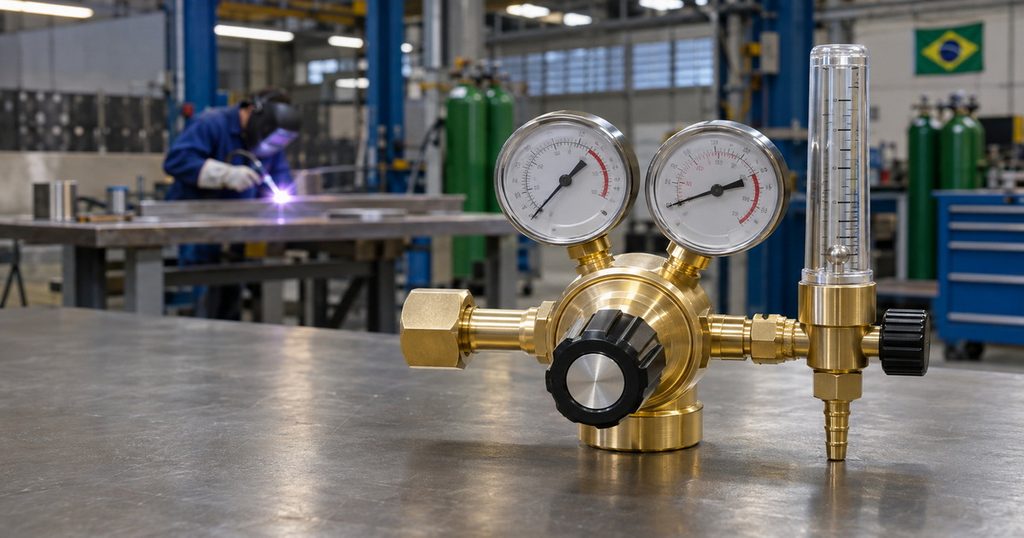
Brazil offers several credible sourcing routes for argon gas regulators, including domestic manufacturers, established international welding brands, and industrial gas suppliers with local distribution networks. For professional buyers, the right choice depends on whether the priority is local availability, documented pressure-control performance, technical support, or private-label manufacturing.
Brazil’s Position in the Argon Gas Regulator Supply Chain
Brazil has an established industrial base serving welding, metal fabrication, machinery, and industrial gas applications. Its supplier landscape combines locally manufactured equipment with internationally branded products and imported components.
For argon regulator procurement, the São Paulo industrial corridor is a practical starting point. Famabras identifies its manufacturing business in Itaquaquecetuba, while Harris has an established Brazilian presence. This concentration helps buyers coordinate supplier visits and evaluate complementary welding and gas-control equipment. It does not, by itself, prove that every regulator sold locally is manufactured in Brazil.
Local sourcing can offer easier Portuguese-language communication, domestic invoicing, and access to replacement equipment. Factory-direct imports may offer greater control over branding and product configuration. Buyers should compare these routes using delivered cost and service obligations rather than unit price alone.
What the Latest Industry Figures Actually Show
In its October 28, 2026 industry update, ABIMAQ reported that Brazilian machinery and equipment exports reached US$10.15 billion during January–September 2026, up 5.5% from the corresponding period of 2025. It also reported machinery and equipment imports of US$24.99 billion, up 4.8%. These figures describe the wider machinery sector—not the market size or export value of argon gas regulators.
That distinction matters. Broad industrial statistics can establish market context, but they cannot support claims that Brazil leads global argon regulator production.
For product-level trade research, Brazil’s official Comex Stat system provides monthly import and export data. Procurement teams should confirm the appropriate customs classification and recognize that a pressure-reducing-valve category may include products unrelated to welding argon service.
Selection Criteria: How to Evaluate a Long-Term Supplier
| Evaluation area | Evidence to request | Procurement significance |
|---|---|---|
| Manufacturing identity | Legal entity, factory address, process map, subcontractor disclosure | Distinguishes manufacturers from resellers |
| Engineering capability | Drawings, design-change records, prototype procedure | Establishes whether customization extends beyond labeling |
| Material control | Specified alloy, material certificates, batch identification | Reduces substitution risk |
| Pressure-control performance | Model-specific test reports and acceptance criteria | Supports comparison beyond catalog claims |
| Quality management | Current certificate, certified address, scope, issuing body | Helps establish traceable management controls |
| Delivery reliability | Historical delivery records and written production milestones | Tests whether promised lead times are realistic |
| Serviceability | Spare-parts list, repair policy, warranty responsibilities | Reduces lifecycle costs |
Five Argon Gas Regulator Manufacturers and Suppliers to Consider
1. Zhejiang Bril Welding Equipment Co., Ltd.
Company Background and Market Position
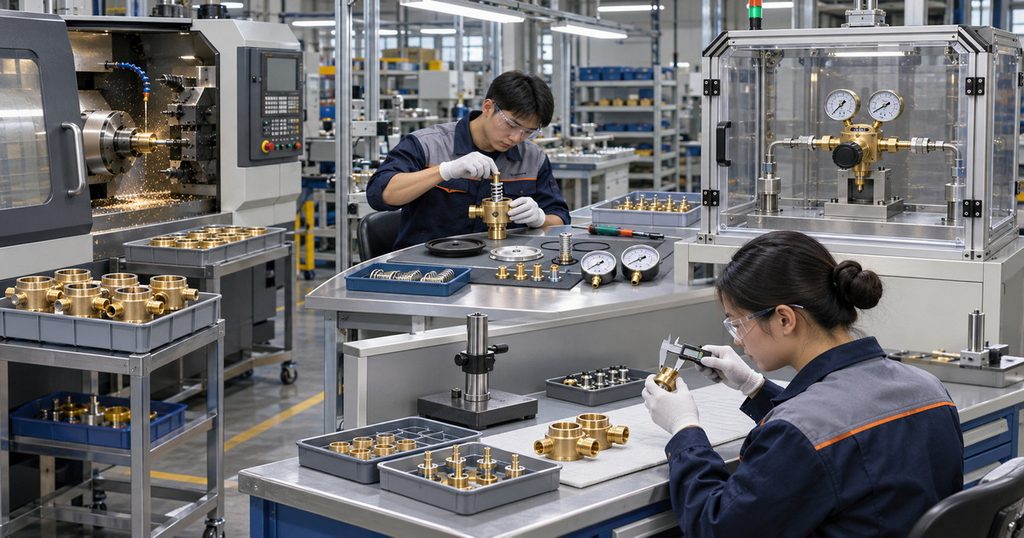
Founded in 2002, Zhejiang Bril Welding Equipment Co., Ltd. is located in Wenzhou, Zhejiang, China. Its published company profile describes a business focused on developing, manufacturing, and selling industrial gas pressure regulators.
The company reports serving more than 30 countries and regions, employing over 200 people, and operating more than 3,500 square meters of production space. These are company-reported figures, not independently audited production-capacity measurements.
Its stated market coverage includes domestic and overseas welding-equipment businesses. The public profile does not provide a country-by-country sales breakdown or verified Brazilian distribution coverage.
Core Strengths and OEM/ODM Fit
Bril is relevant to smaller and midsized brands seeking a value-oriented manufacturing partner rather than an established branded resale program. Its published profile describes regulator development capabilities, testing equipment, and OEM supply relationships with welding-equipment companies.
The company also states that it has supplied OEM regulator products for Messer since 2022. Buyers should treat named customer relationships as supplier statements unless independently confirmed.
For an argon regulator program, the most useful customization discussion should cover:
– Cylinder connections and outlet fittings.
– Gauge ranges and multilingual markings.
– Flowmeter configuration and calibration requirements.
– Branding, packaging, manuals, and spare-parts kits.
– Sample approval, drawing ownership, and engineering-change control.
Bril’s appeal is the possibility of deeper factory-level coordination. However, flexibility, communication efficiency, and cost competitiveness should be demonstrated through an actual development project—not assumed from a company introduction.
A practical assessment is to request one consolidated technical response, a documented sample schedule, and written clarification of which changes require new tooling or testing.
Certification and Procurement Cautions
Bril’s website reports ISO 9001 certification and refers to CE, UKAS, IAF, and CNAS. These terms describe different roles within certification, accreditation, conformity assessment, and testing. They are not interchangeable product approvals. Request the underlying certificates, issuing organizations, accreditation details, model coverage, and validity dates.
Monthly regulator output, private-label MOQ, tooling charges, and Brazil-specific compliance documentation were not established from the reviewed profile.
2. Famabras
Company Background and Main Markets
Founded in 1965, Famabras describes itself as a wholly Brazilian-owned manufacturer of instruments for pressure and temperature monitoring, together with equipment for heating, welding, cutting, and compressed-gas control.
Its published address is in Itaquaquecetuba, São Paulo. Its identifiable market focus is industrial measurement and gas-control applications; the reviewed sources do not establish its export-market distribution.
Core Strengths
Famabras offers a useful domestic-manufacturing option for buyers who want a Brazilian supplier with both instrumentation and regulator experience.
Its argon RI-30P is described in Brazilian sales documentation as a single-stage regulator with a fully forged brass body and maximum flow of 40 L/min. Published listings position it for industrial welding and workshop applications. These specifications should be checked against the current manufacturer-controlled datasheet before purchase.
The important procurement advantage is the ability to evaluate an established local product family rather than develop a new private-label design from the beginning.
OEM/ODM Scope and Verification Points
The reviewed public material does not establish a formal private-label or ODM program. Buyers should ask whether Famabras can support:
– Customer-specific gauge faces.
– Alternative connections.
– Customized outlet assemblies.
– Distributor packaging.
– Contract-manufactured configurations.
Do not interpret an extensive catalog as proof that all these services are available.
Argon-regulator production capacity, wholesale MOQ, and current model-specific certification evidence require direct confirmation.
3. Condor, Part of ESAB
Company Background and Main Markets
Condor identifies itself as part of ESAB and offers gas-control and oxy-fuel equipment. Its official product information includes industrial pressure regulators, while its support resources provide catalogs and operating manuals.
The reviewed official company overview did not establish Condor’s original founding year. ESAB’s 1904 founding date should not be presented as Condor’s establishment date.
Its documented commercial focus is industrial welding, cutting, and related gas-control applications. Detailed country-level sales shares were not established.
Core Strengths
Condor is relevant for buyers who value an established welding-equipment brand and accessible technical literature.
Its publicly available regulator information and support materials help procurement teams investigate:
– Intended applications.
– Operating instructions.
– Maintenance requirements.
– Product-family compatibility.
– Available technical assistance.
A regional distributor lists the Condor BR801 MDN30 for inert gases in MIG/TIG welding. Because distributor listings can remain online after product changes, buyers should obtain a current official specification and confirmation of availability.
OEM/ODM Scope and Verification Points
Condor should initially be evaluated as a branded supply option. The reviewed sources do not establish an open OEM/ODM offering for unrelated overseas brands.
Request written clarification of the manufacturing origin, authorized sales channel, spare-parts availability, and warranty arrangements for the exact argon regulator model.
Regulator-specific capacity, MOQ, and current conformity documentation were not publicly established in the reviewed material.
4. Harris Products Group
Company Background and Main Markets
Harris Products Group was formed in 2006 by combining Harris businesses. Its equipment heritage includes Harris Calorific, founded in 1905. These dates distinguish the present group’s formation from its predecessor’s history.
Harris serves welding, brazing, cutting, heating, and gas-control applications. Published information describes a Brazilian manufacturing presence within its international operations, although that does not establish the country of origin of every regulator sold in Brazil.
Core Strengths
Harris is a relevant choice for buyers seeking an internationally established gas-control product range.
Brazilian sales listings include argon and argon-mixture regulators such as the 25GX-50-L-AR and 801 series. Procurement teams should verify current models through an authorized channel rather than relying exclusively on marketplace descriptions.
For technically demanding projects, request a model-level comparison covering pressure regulation, rated flow, inlet connection, repairability, and available service kits.
OEM/ODM Scope and Verification Points
The reviewed material supports branded equipment supply but does not establish a generally available private-label program.
Custom industrial gas-control projects and private-label manufacturing are different commercial arrangements. Ask which services are offered, by which legal entity, and under what order-volume requirements.
Brazilian regulator output, wholesale MOQ, and current certificates for the exact factory and model require confirmation. A group-level statement about quality systems should not replace site-specific evidence.
5. White Martins
Company Background and Main Markets
White Martins traces its history to 1912 and operates as a Linde company. Its business includes industrial gases, gas-handling equipment, and welding-related products.
For this shortlist, White Martins is most appropriately treated as an industrial gas and equipment supplier—not automatically as the original manufacturer of every regulator in its catalog.
Its Brazilian online store lists several argon regulator models, including RFG54A, RFG84A, RFM84A, and RDFG24A.
Core Strengths
White Martins is relevant when buyers want to coordinate regulator procurement with industrial gas supply and application support.
Its RFG54A listing describes a single-stage argon regulator intended for TIG, MIG, fabrication, maintenance, and related industrial applications.
This sourcing model may suit end users who prioritize gas-system compatibility and an established domestic purchasing channel over private-label development.
OEM/ODM Scope and Verification Points
The reviewed sources do not establish an OEM/ODM regulator manufacturing service for third-party brands.
Buyers should confirm:
– Original manufacturer and country of origin.
– Authorized repair arrangements.
– Spare-parts availability.
– Suitability for the supplied cylinder valve.
– Whether purchasing terms support distributor resale.
Product availability and order quantities depend on the commercial channel; gas-production capacity is not evidence of regulator-manufacturing capacity.
Supplier Comparison: Capacity, MOQ, Certification, and Sourcing Fit
| Supplier | Establishment information | Capacity evidence | MOQ | Certification position | Primary sourcing fit |
|---|---|---|---|---|---|
| Zhejiang Bril | Founded 2002 | Reports 200+ employees and 3,500+ m²; regulator output undisclosed | Confirm by model and customization | Website reports ISO 9001 and CE-related claims; documents require verification | Overseas factory-direct OEM/ODM discussions |
| Famabras | Founded 1965 | Argon-regulator output not publicly established | Request wholesale terms | Request current site and model documents | Brazilian manufacturing and established industrial products |
| Condor | Founding year not verified in reviewed official overview | Regulator-specific output not publicly established | Channel-dependent; confirm | Request current factory and model evidence | Branded industrial gas-control supply |
| Harris Products Group | Group formed 2006; predecessor founded 1905 | Brazilian presence documented; model output undisclosed | Confirm with authorized channel | Verify current site scope and product evidence | International branded regulator programs |
| White Martins | History dates to 1912 | Regulator manufacturing capacity not established | Confirm by product and channel | Verify supplied model and original manufacturer | Gas supply coordinated with equipment purchasing |
Technical Buyer’s Guide: What to Specify Before Requesting Prices
Define Pressure and Flow Separately
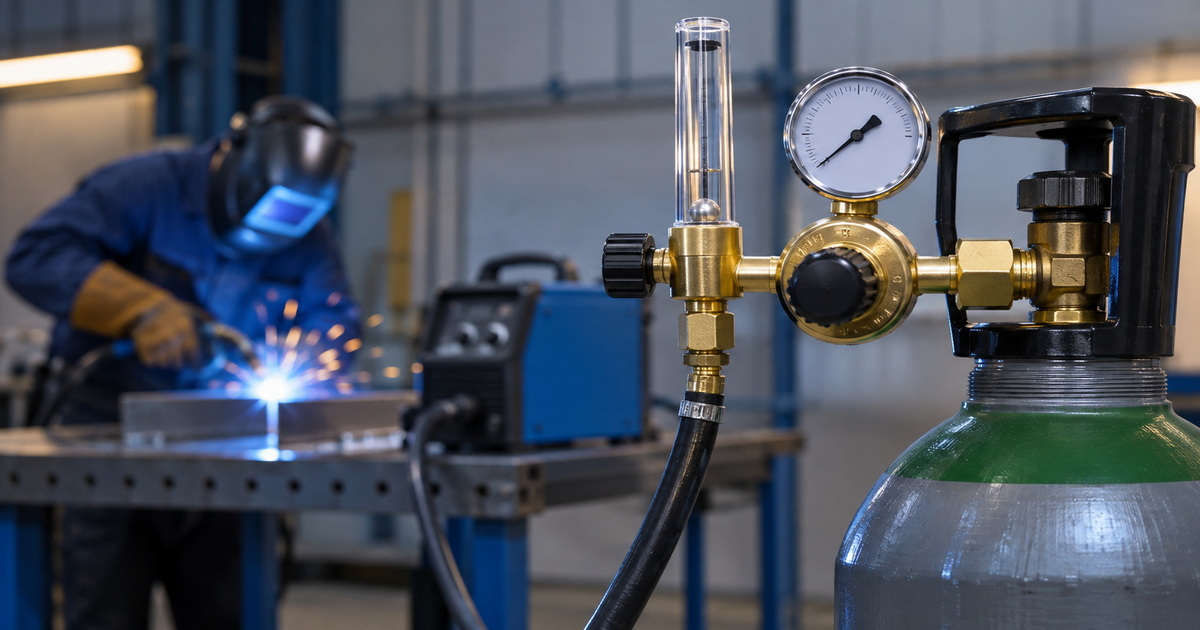
An argon gas regulator reduces cylinder pressure. A flowmeter measures gas flow under specified conditions. A pressure gauge marked in flow units may depend on a calibrated restriction rather than directly measuring flow.
Your inquiry should identify:
1. Gas composition.
2. Maximum cylinder pressure.
3. Required outlet pressure.
4. Normal and maximum flow.
5. Cylinder-valve connection.
6. Outlet connection and hose arrangement.
7. Welding process and duty cycle.
ISO 2503 explicitly covers regulators both with and without flow-metering devices, reinforcing the importance of identifying the actual product architecture.
Specify Materials Instead of Requesting “High-Quality Brass”
Ask for the exact body alloy, manufacturing route, material traceability, and acceptable substitutions. A description such as “brass body” is not a complete engineering specification.
For a production contract, recommended controls include material documentation, incoming verification, approved bills of materials, and written authorization before changing pressure-containing components.
Forged construction may be a useful selection factor, but the manufacturing route alone does not demonstrate finished-product safety or regulation accuracy.
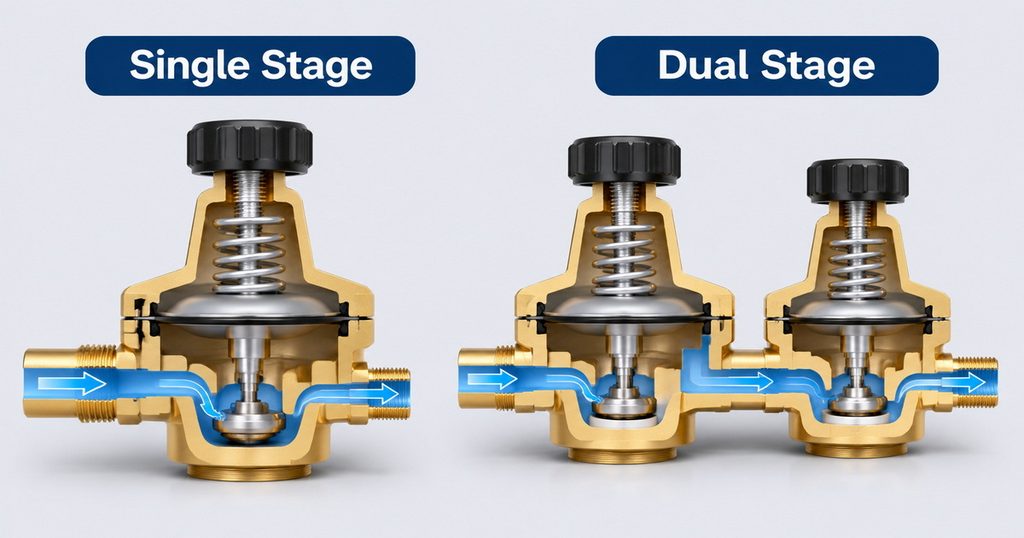
Distinguish Single-Stage and Dual-Stage Requirements
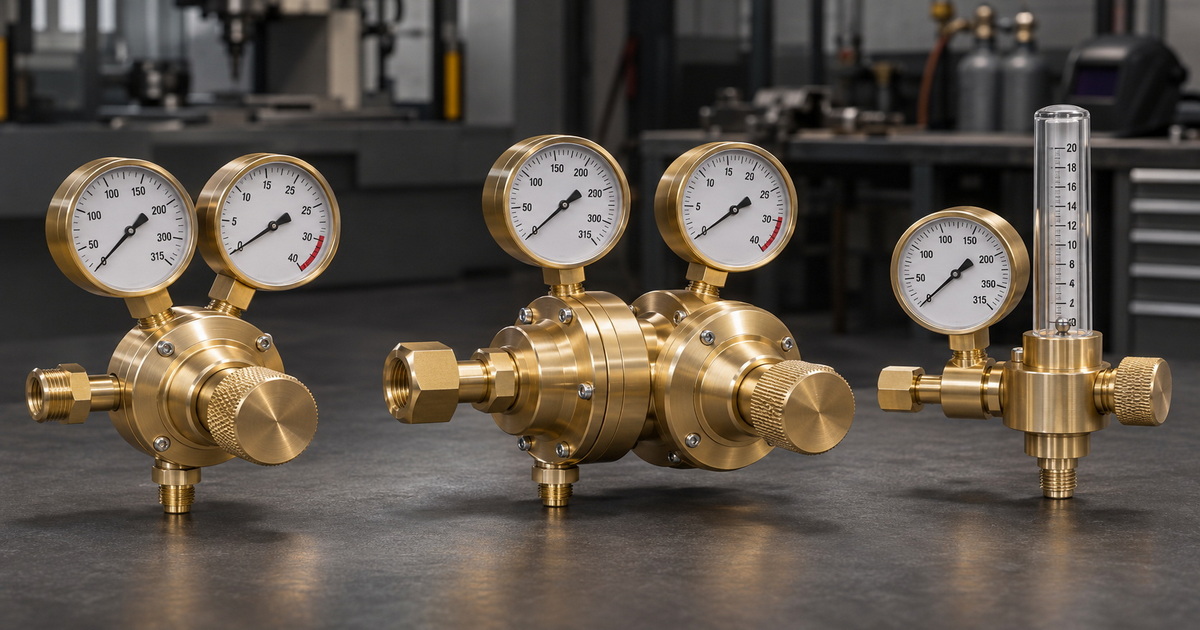
Request performance curves or test results showing behavior across the intended cylinder-pressure range. Do not accept “dual-stage” as sufficient evidence of tighter control.
For either architecture, establish contractual limits for pressure stability, outlet-pressure creep, leakage, and flow performance.
Similarly, a dual-flowmeter regulator is not necessarily a dual-stage regulator. Two outlet flowmeters do not prove two pressure-reduction stages.
Interpret Certifications Correctly
ISO 9001 concerns the supplier’s quality-management system. It does not certify the performance of every regulator model.
ISO 5171 addresses pressure gauges used in welding, cutting, and allied processes. A gauge-related document should not be presented as complete regulator conformity evidence.
CE marking is not an environmental award. For applicable European sales, pressure-equipment classification and conformity obligations require product-specific assessment under the relevant legislation.
RoHS concerns hazardous substances in electrical and electronic equipment. It is not a universal approval requirement for every purely mechanical argon regulator. Electrically heated regulators or electronically monitored assemblies require a separate applicability review.
Neither a CE logo nor a RoHS report alone establishes compliance for the Brazilian market.
Common Procurement Traps and How to Avoid Them
Uncontrolled Material or Component Substitution
A sample may use different gauges, seats, seals, or body materials from subsequent production.
Reduce this risk through an approved bill of materials, a retained reference sample, batch traceability, and a supplier obligation to obtain approval before substitutions.
Gauge Range Mistaken for Regulator Rating
A high-pressure gauge face is not proof that the complete regulator assembly is rated for the same pressure.
Request the assembly’s maximum inlet rating, controlled drawings, marking details, and supporting test evidence.
Connection Descriptions Without Drawings
“Brazil connection” or “standard argon inlet” is too ambiguous for a purchase order.
Specify the complete connection standard, dimensions, sealing arrangement, and mating valve. Confirm compatibility with the local gas supplier before approving production.
The Less-Discussed Trap: Correct Flowmeter Reading, Incorrect Actual Flow
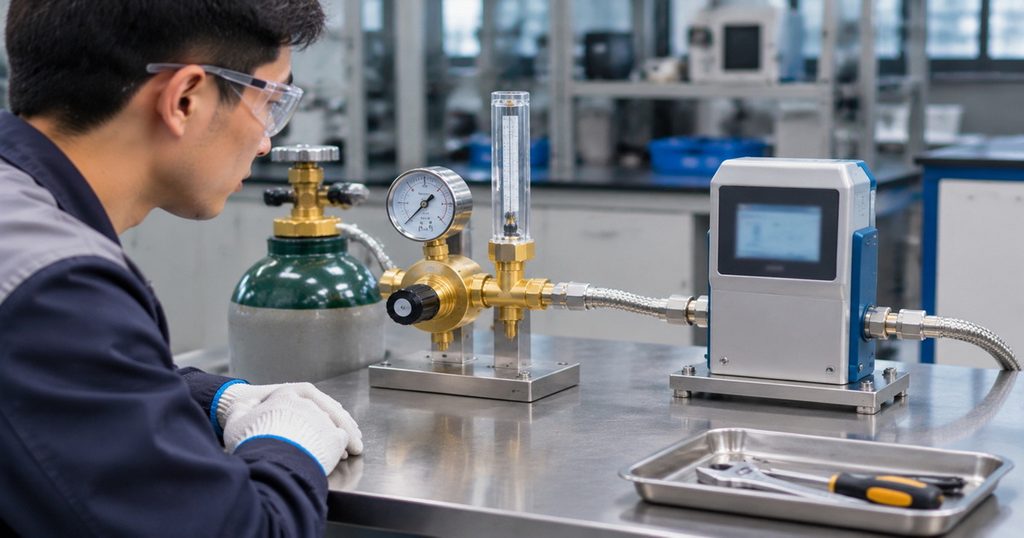
A flowmeter can appear normal while delivering the wrong flow if it operates at a pressure different from its calibration pressure.
Air Products specifically warns that flowmeters must match the gas, pressure, and operating range. Its published example shows a 24% error when a variable-area flowmeter is used at a substantially different pressure from its calibration condition.
The practical safeguard is to ask:
– What gas was used for calibration?
– What operating pressure does the scale assume?
– Where is the controlling restriction?
– Under what downstream conditions was performance verified?
– Does the supplied regulator maintain the required meter pressure?
Compare complete regulator-flowmeter assemblies under the same conditions. A matching scale and tube appearance do not establish matching performance.
Factory Verification, Samples, and Logistics
Use Samples as an Engineering Approval Stage
A recommended sequence is:
1. Approve the specification and connection drawing.
2. Obtain representative samples.
3. Have qualified personnel evaluate leakage, pressure behavior, and flow against agreed criteria.
4. Approve labels, manuals, packaging, and spare parts.
5. Place a pilot order before a larger commitment.
Dangerous pressure testing should be performed only by competent personnel using appropriate facilities and procedures.
Validate the Supply Chain Behind the Factory
Ask which operations are performed in-house: body manufacture, machining, assembly, gauge procurement, calibration, and final inspection.
For OEM/ODM projects, establish who owns drawings, tooling, test fixtures, and design changes. Also agree whether customized components remain available after a model is discontinued.
Compare Delivered Cost and Responsibilities
For imports into Brazil, obtain a broker-reviewed estimate covering freight, insurance, customs classification, applicable charges, clearance, and inland delivery.
Specify the Incoterm and named place. Confirm who handles import clearance, warranty returns, and replacement shipments.
For Brazilian suppliers, verify stock location rather than assuming that a domestic invoice guarantees immediate availability.
Conclusion: Match the Supplier to the Procurement Model
Brazil-focused argon regulator sourcing offers several distinct routes.
Famabras merits consideration for domestic manufacturing. Condor and Harris provide established branded equipment options. White Martins is relevant when equipment purchasing needs to align with gas supply. Zhejiang Bril offers an overseas factory-direct alternative for buyers investigating OEM/ODM development and private-label product lines.
No supplier should receive a long-term contract solely because of its age, brand recognition, or stated factory size.
Start with a model-specific specification, request documentary evidence, and compare approved samples under consistent conditions. For a customized program, send Zhejiang Bril—and alternative candidates—the same connection drawings, performance requirements, packaging brief, and annual demand forecast. Ask each supplier to return a technical proposal, sample plan, MOQ, and written production schedule before negotiating the final price.
FAQ
1. How can I verify whether a manufacturer’s ISO certificate has expired or been suspended?
Check the certificate number, legal entity, factory address, standard edition, certified scope, issue date, and expiry date.
Then verify current status with the issuing certification body. If the certificate claims accredited certification, check the accreditation relationship as well.
An expiry date alone does not establish active status: ask whether the certificate has been suspended, withdrawn, or affected by a change of site or ownership.
2. Can I approve a regulator using only its CE certificate?
No. First establish which legislation applies to the exact product and destination.
For European pressure equipment, request the classification rationale, applicable conformity documents, and model identification. A generic certificate covering another regulator family is insufficient. CE-related documentation also does not replace a Brazil-specific compliance assessment.
3. How can I verify that a dual-stage argon regulator is genuinely dual-stage?
Request a sectional drawing or other controlled technical documentation showing two pressure-reduction stages.
Confirm the model identity and request performance evidence across the specified inlet-pressure range. Do not confuse two gauges or two flowmeters with two regulating stages.
Where the design is commercially confidential, arrange a qualified third-party review rather than relying on exterior appearance.
4. Why do two argon regulators showing the same flow produce different results?
Their flowmeters may use different calibration pressures, gas assumptions, or operating conditions.
Check the calibration gas, meter pressure, scale units, installation requirements, and actual delivery at the point of use. Air Products recommends matching the flowmeter to the gas and calibration pressure, with normal operation generally within 30%–70% of full scale.
5. How should I negotiate MOQ without weakening quality control?
Separate standard production from customization.
A standard regulator with existing components may have different order economics from a new body design, special connection, custom gauge, or printed retail package.
Request separate quantities and charges for samples, pilot production, standard products, and customized packaging. Preserve the approved specification, traceability, and inspection requirements at every quantity.
Reference
1. – Zhejiang Bril Welding Equipment Co., Ltd. — company history, reported facilities, certification statements, and OEM background. [chinesewelding]
2. – Famabras — company establishment, Brazilian ownership, industrial scope, and factory address. [famabras.com]
3. – Famabras RI-30P product listings — published argon regulator construction and performance specifications; confirm against current manufacturer documentation. [luitex.com]
4. – Condor — official company overview, regulator portfolio, and support information. [condornet.com]
5. – Harris Products Group — official corporate history and formation dates. [harrisproductsgroup]
6. – White Martins — industrial equipment catalog, argon regulator models, and company-history resources. [catalog.hathitrust]
7. – ABIMAQ — October 28, 2026 machinery and equipment industry update, including January–September trade figures. [abimaq.org]
8. – Brazilian Government / MDIC — official Comex Stat service and trade-statistics portal. [gov]
9. – International Organization for Standardization — ISO 2503 cylinder pressure-regulator requirements and ISO 5171 pressure-gauge requirements. [iso]
10. – European Commission — Pressure Equipment Directive and RoHS scope guidance. [single-market-economy.ec.europa]
11. – Air Products — argon flowmeter calibration, operating-pressure effects, and range-selection guidance. [airproducts]
Hot Tags: Argon Gas Regulator, Argon Gas Regulator Manufacturers, Argon Gas Regulator Suppliers, Argon Gas Regulator Manufacturers In Brazil, Industrial Argon Gas Regulators, Argon Flowmeter Regulator, Dual Stage Argon Regulator, OEM Argon Gas Regulator, Wholesale Argon Gas Regulators, TIG Welding Argon Regulator