Content Menu
● Why Source Argon Gas Regulators Through Germany?
>> What the Latest Industry Figures Actually Tell Buyers
● How These Argon Gas Regulator Suppliers Were Selected
● Leading Suppliers to Consider
>> 1. Zhejiang Bril Welding Equipment Co., Ltd.—An Overseas OEM/ODM Alternative
>> 2. ewo—A German Option for Conventional Welding-Regulator Ranges
>> 3. WITT-Gasetechnik—For Central Gas Supply and Higher-Flow Systems
>> 4. GCE Speciality / DruVa—For High-Purity Argon and Specialty-Gas Applications
>> 5. Spectron Gas Control Systems—For Documented Precision and High-Purity Control
>> 6. Messer Cutting Systems—For Welding and Cutting Equipment Procurement
● Supplier Comparison: Capacity, MOQ, Certification, and Commercial Fit
● Technical Buyer’s Guide: Specifying the Right Argon Gas Regulator
>> Match the Standard to the Application
>> Specify Materials Beyond “High-Quality Brass”
>> Distinguish Two Gauges From Two Stages
>> Treat CE and RoHS as Applicability Questions
● An Overlooked Procurement Trap: Flow Indication Is Not the Whole System
● How to Qualify a Factory and Approve Samples
>> Step 1: Issue a Controlled Technical Requirement
>> Step 2: Verify the Legal Entity and Quality System
>> Step 3: Approve Performance, Not Just Appearance
>> Step 4: Place a Pilot Order
>> Step 5: Control Logistics and After-Sales Exposure
● FAQ
>> 1. How can I verify whether a manufacturer’s ISO 9001 certificate has expired or been suspended?
>> 2. Can a regulator legally be sold in Germany without a CE mark?
>> 3. How can we compare regulators when suppliers quote different maximum flow rates?
>> 4. How do we verify that a “German regulator” is actually manufactured in Germany?
>> 5. What should an OEM agreement include to prevent quality changes after sample approval?
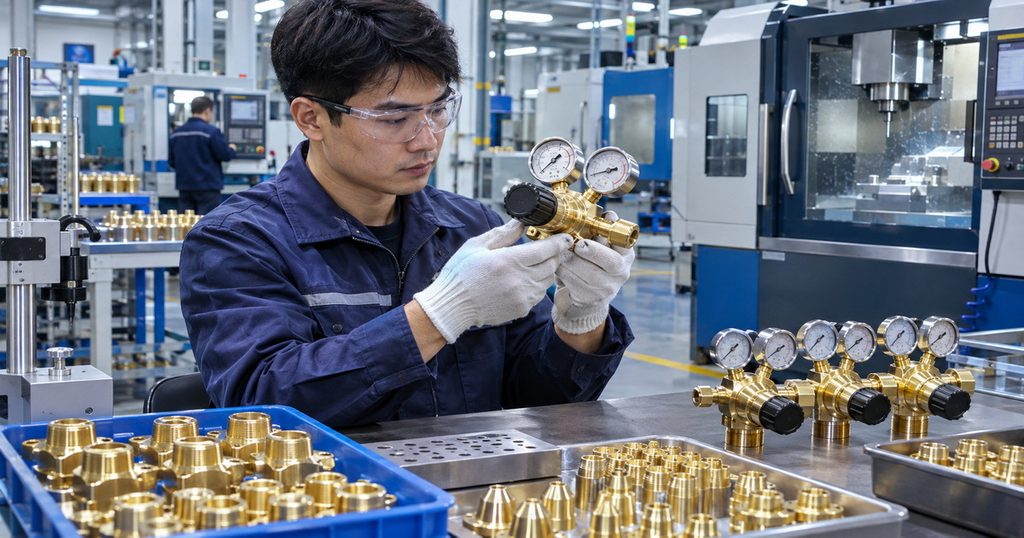
Germany offers several credible sourcing routes for an argon gas regulator: established welding-equipment manufacturers, specialist high-purity gas-control companies, and suppliers of complete industrial gas systems. The right partner depends on whether you need a distributor-ready welding regulator, a private-label product range, or a precision pressure-control assembly.
Why Source Argon Gas Regulators Through Germany?
Germany’s advantage lies in its wider industrial engineering ecosystem: precision machining, welding equipment, industrial gases, instrumentation, and application support.
The companies in this guide illustrate several regional connections:
– Stuttgart provides a southern German manufacturing base for ewo.
– Witten places WITT within North Rhine-Westphalia’s industrial landscape.
– Groß-Umstadt is home to Messer Cutting Systems’ oxyfuel operation.
– Eppelheim is the German origin of the DruVa specialty-gas business.
These locations indicate a distributed engineering network rather than one concentrated argon-regulator manufacturing cluster. Buyers should therefore evaluate each factory and product line individually.
What the Latest Industry Figures Actually Tell Buyers
VDMA’s 2026 industry overview reports that EU machinery exports reached approximately €593 billion in 2025, with Germany contributing roughly €199 billion—more than one-third of the total. This demonstrates the scale of Germany’s machinery export infrastructure, but it is not an argon-regulator market-size estimate.
That distinction matters. Broad machinery statistics cannot establish a supplier’s regulator capacity, delivery reliability, or product quality. Those questions require model-specific documentation and factory-level verification.
Germany is particularly relevant when buyers value established distribution channels, local technical communication, replacement parts, and integration with industrial gas systems. An overseas OEM can remain a practical alternative when private labeling, product adaptation, and target landed cost carry greater weight.
How These Argon Gas Regulator Suppliers Were Selected
The selection framework considers six purchasing priorities.
| Selection criterion | Evidence buyers should request |
|---|---|
| Relevant product capability | Current argon-compatible regulator datasheets, pressure ranges, and connection options |
| Engineering resources | Application review, drawings, material specifications, and documented design changes |
| Quality management | Current certificates covering the correct legal entity, factory, and manufacturing activities |
| Inspection capability | External leak, seat leak, pressure-control, and flow-verification procedures |
| Supply reliability | Model-specific capacity, component lead times, order history, and production scheduling |
| Commercial compatibility | OEM/ODM scope, minimum order quantity, warranty, spare parts, and change-control terms |
Leading Suppliers to Consider
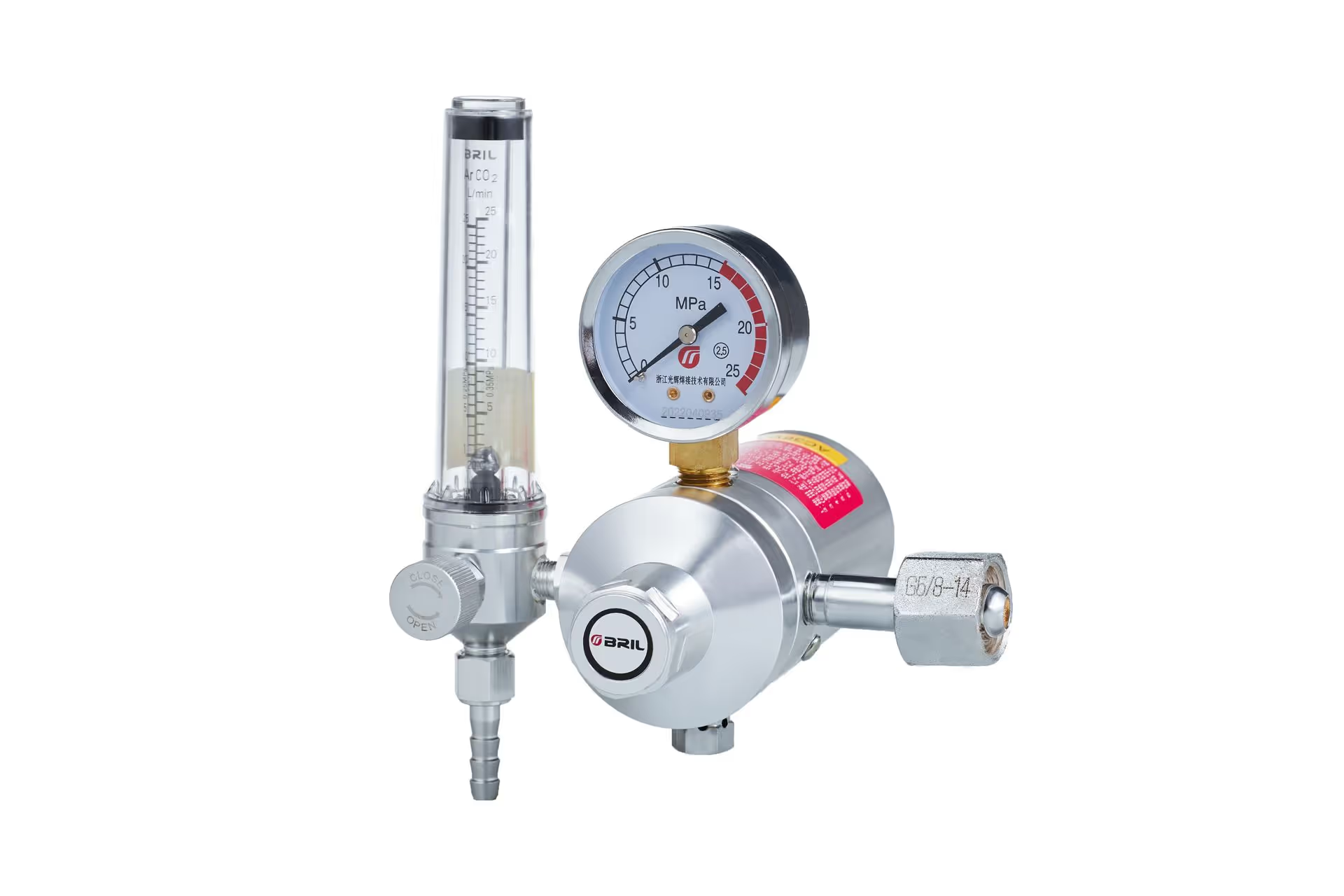
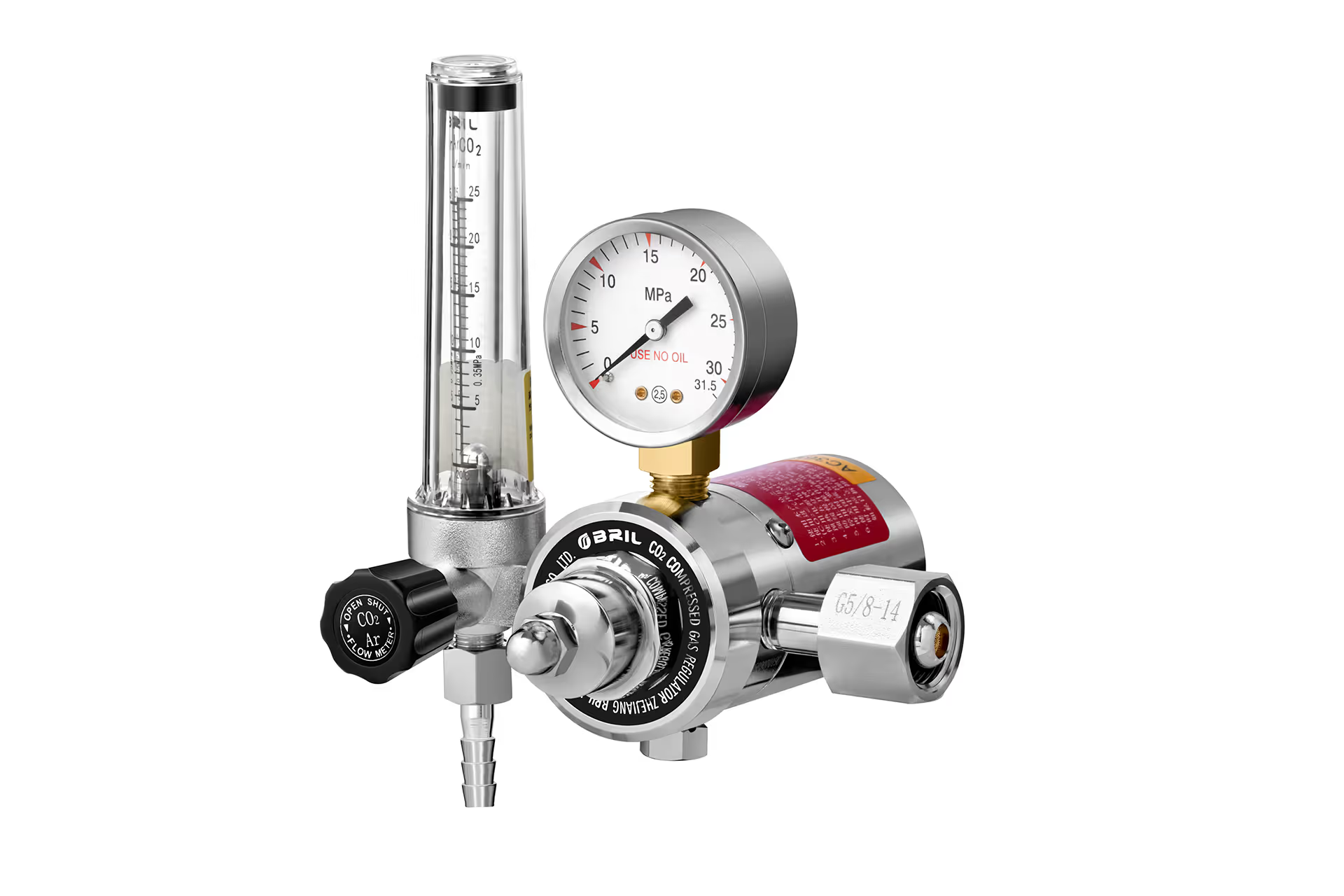
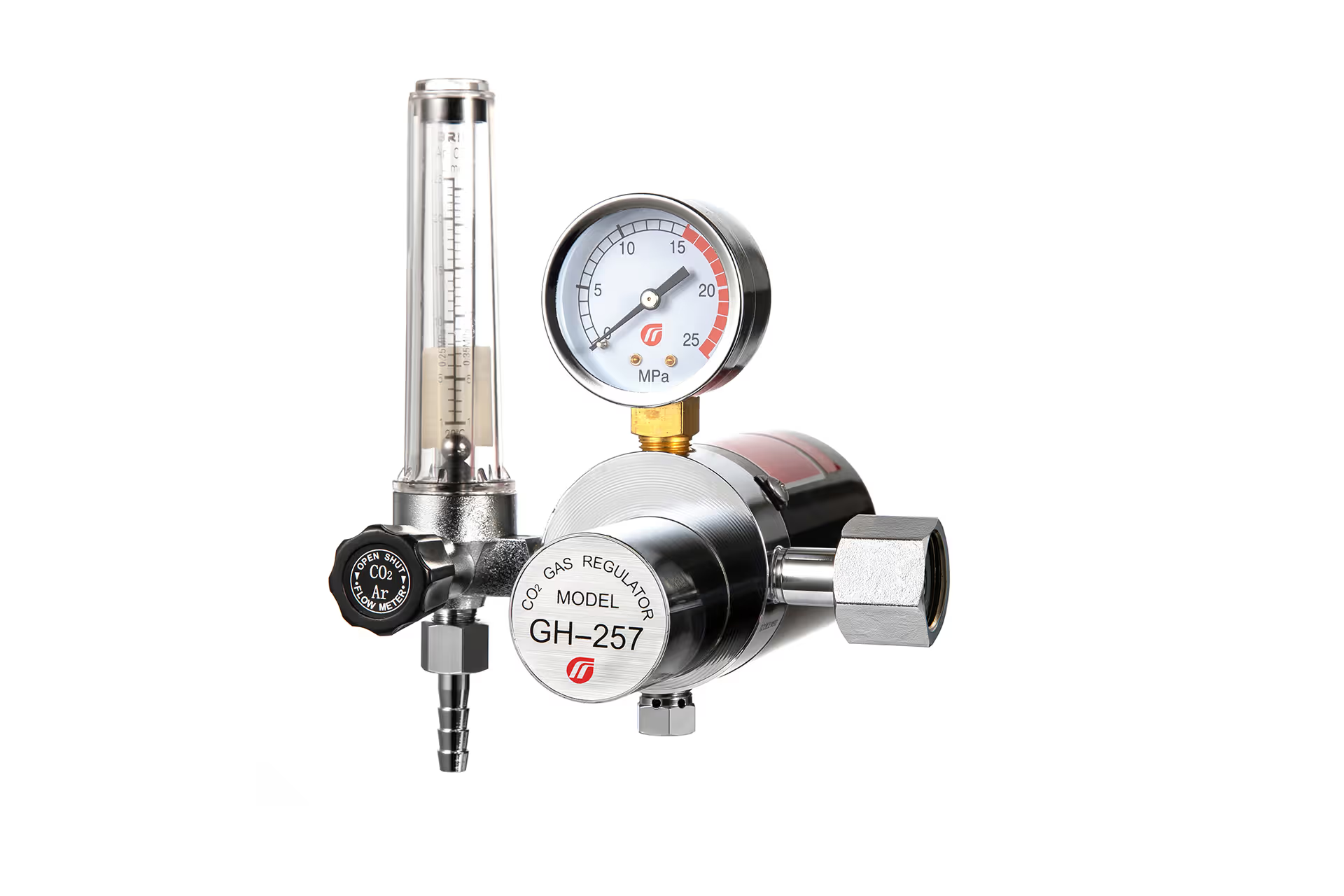
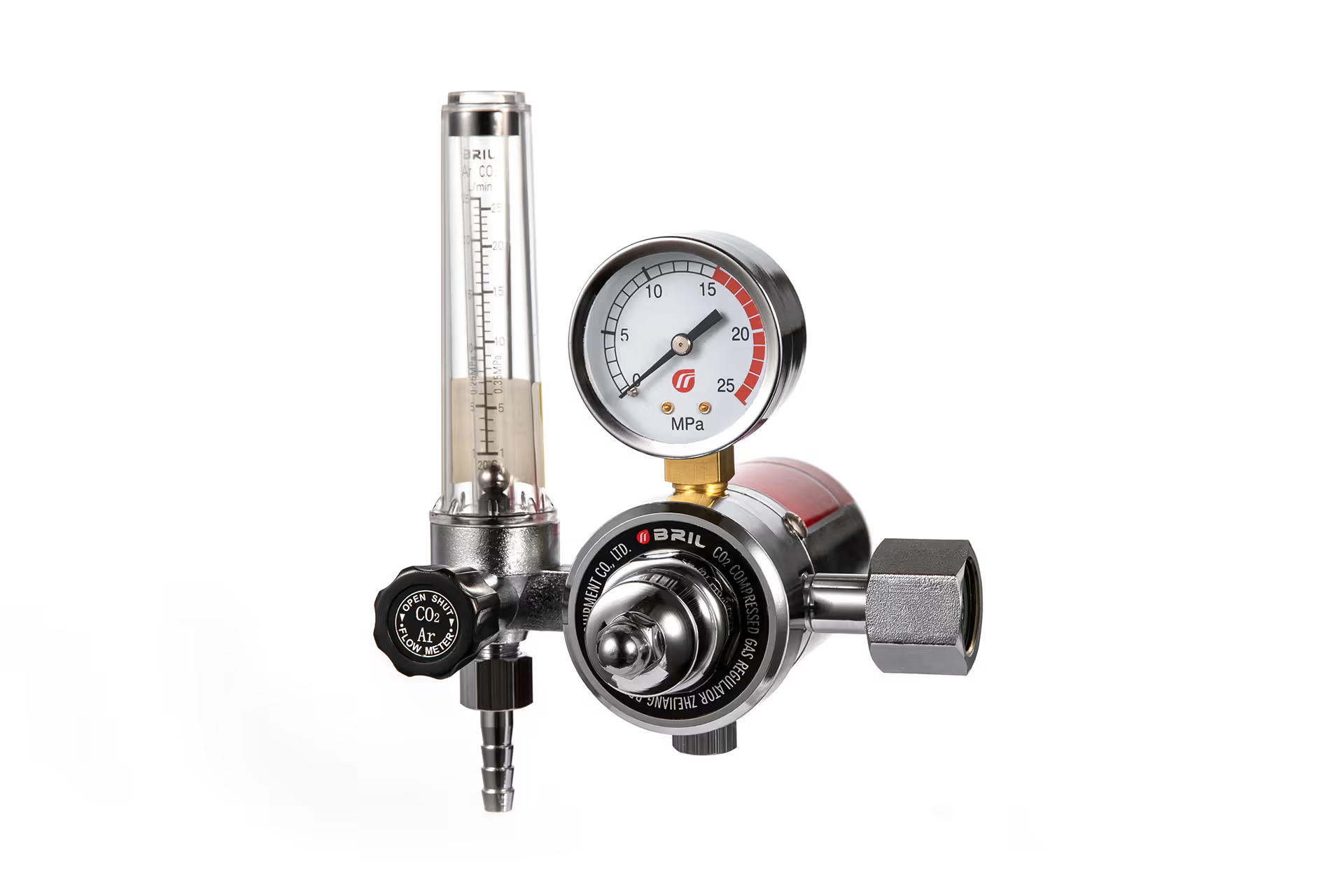
1. Zhejiang Bril Welding Equipment Co., Ltd.—An Overseas OEM/ODM Alternative
Founded: 2002
Manufacturing location: Wenzhou, Zhejiang, China
Market coverage: The company reports serving more than 30 countries and regions
Most relevant purchasing route: OEM/ODM industrial gas regulators for brands, wholesalers, and equipment suppliers
Zhejiang Bril develops, manufactures, and sells industrial gas pressure regulators. Its company profile reports more than 200 employees and over 3,500 square meters of production area. These are company-reported figures, not independently audited production-capacity measurements.
Its stated product scope includes argon regulators alongside CO₂, heated CO₂, oxygen, acetylene, propane, nitrogen, and dual-stage regulators. For distributors building a coordinated welding-gas product range, this breadth can reduce the complexity of managing multiple suppliers.
Bril’s most relevant positioning is as a cost-conscious development and manufacturing option for small and medium-sized brands. Buyers seeking deeper OEM support can discuss:
– Brand identification, dial layouts, packaging, and manuals.
– Cylinder connections and outlet configurations.
– Required inlet pressures, outlet ranges, and flow scales.
– Product-family consistency across different gases.
– Sample revisions and production approval procedures.
These customization items should be confirmed individually; they are not a guarantee that every modification is available at every order volume.
The company’s website reports OEM supply relationships with domestic and international welding-equipment businesses, including a relationship involving Messer-branded product ranges from 2022. Buyers should treat these as supplier statements and request permissible supporting evidence before relying on them commercially. They do not establish that every Messer regulator is produced by Bril.
Bril also states that it holds ISO 9001-related credentials and product-related compliance documentation. Procurement teams should obtain the original certificates and reports, identify the issuing organizations, and check the exact models covered. Accreditation organizations and testing-laboratory accreditation should not be mistaken for product approvals.
For smaller brands, flexibility and communication efficiency are important qualification criteria. Assess Bril through an actual drawing review, sample revision, and quotation cycle rather than assuming that factory-direct communication will automatically be faster.
2. ewo—A German Option for Conventional Welding-Regulator Ranges
Founded: 1914
Location: Stuttgart, Germany
Market focus: Welding equipment, compressed-air equipment, and workshop applications
Customization position: Confirm private-label and nonstandard configuration availability directly
ewo, operated by Hermann Holzapfel GmbH & Co. KG, traces its manufacturing history to 1914. Its public cylinder-regulator range includes argon and carbon-dioxide equipment with single-stage and two-stage options. The company also states that its quality-management system is ISO 9001 certified.
For welding distributors, ewo is a relevant starting point when a recognizable German product range and conventional workshop applications are priorities.
Its published range includes regulator and flowmeter configurations for 200-bar cylinders. Buyers must still verify the exact model’s inlet rating, gas compatibility, flow scale, and connection before ordering; a specification from one series should not be applied to another.
ewo’s public positioning is clearer for catalog products than for extensive private-label development. Buyers should ask whether customization means a selectable standard connection, a special assembly, or a fully branded product.
3. WITT-Gasetechnik—For Central Gas Supply and Higher-Flow Systems
Founded: 1945
Location: Witten, Germany
Market coverage: The company reports supplying more than 100 countries
Customization position: Application-specific gas-control systems and individual solutions
WITT offers spring-loaded regulators, dome-loaded regulators, pressure-regulating stations, and gas outlet points. Its portfolio is particularly relevant when argon supply forms part of a larger production system rather than a standalone welding-cylinder setup.
The company reports a worldwide business, with more than half of turnover generated through exports. Its history began with gas-safety equipment in 1945, and it now supplies a broader range of gas-control and monitoring products.
For procurement teams, WITT is worth evaluating for centralized distribution, variable demand, and integration with other gas-process equipment. Its regulator page explicitly offers individual solutions alongside standard products.
That is not the same as confirming a general private-label program. Distinguish engineered customization from permission to market an existing product under another brand.
WITT states that its company is ISO 9001 certified. Product approvals must be checked separately for the selected regulator or assembly.
4. GCE Speciality / DruVa—For High-Purity Argon and Specialty-Gas Applications
Business origins: DruVa began in 1967
German origin: Eppelheim, Germany
Market focus: Laboratories, semiconductor manufacturing, renewable energy, and gas suppliers
Customization position: Application-specific specialty-gas equipment; private-label terms require confirmation
DruVa’s history dates to 1967, and GCE acquired the business in 1997. The present GCE Speciality positioning developed from this specialty-gas heritage.
This distinction is useful because a welding argon regulator and a high-purity argon regulator solve different purchasing problems.
For ordinary shielding-gas service, buyers may prioritize durability, flow adjustment, serviceability, and cost. For sensitive laboratory or process applications, contamination control, purge arrangements, and the suitability of the complete gas path can become more important.
GCE’s DruVa-related portfolio covers first- and second-stage gas supply, cylinder storage arrangements, tubing layouts, and monitoring equipment. It therefore merits consideration for buyers specifying a gas-delivery system rather than simply purchasing a regulator by outlet pressure.
The 1967 date describes the DruVa business heritage, not the founding date of every current GCE legal entity. Likewise, German origins do not establish the manufacturing country of every current model.
5. Spectron Gas Control Systems—For Documented Precision and High-Purity Control
Founding year: Not established from the official pages reviewed
Market focus: Technical gases, laboratory gases, and high-purity gas systems
Customization position: Configurable product arrangements; OEM branding requires direct agreement
Spectron is a relevant supplier when buyers need detailed technical specifications rather than general claims about pressure stability.
Its Spectrolab FM53 is a two-stage diaphragm cylinder regulator for noncorrosive gases and mixtures up to quality 6.0. Published specifications include a maximum 300-bar inlet pressure, several outlet-pressure options, and six ports for configuration flexibility. Argon suitability must be confirmed for the ordered configuration.
Spectron also publishes specific materials and leak-rate data for other product families. For example, the FE51-SP documentation identifies a 316L stainless-steel body, specified seat materials, and separate atmospheric and seat leak rates. Those figures belong to that model and should not be generalized across the range.
A further purchasing advantage is its explicit discussion of pressure-equipment classification. Spectron’s published documentation explains why certain products fall under sound engineering practice rather than requiring a pressure-equipment CE marking.
Buyers seeking a founding date, factory origin, or certificate scope should request documentary confirmation rather than rely on unverified directory entries.
6. Messer Cutting Systems—For Welding and Cutting Equipment Procurement
Historical roots: 1898
Relevant German operation: Groß-Umstadt
Market focus: International metalworking, welding, and cutting applications
Customization position: Product and integration requirements by agreement; private-label availability not established
Messer Cutting Systems offers pressure regulators within a wider welding and cutting equipment portfolio. Its published CONSTANT two-stage regulator includes versions for argon and CO₂, with a maximum 200-bar inlet pressure and floating-ball flow indication.
This makes Messer relevant to distributors and industrial purchasers already sourcing associated welding or cutting equipment.
Its broader regulator literature describes forged-brass construction and model-dependent filtration and gauge features. Buyers should distinguish these product descriptions from a blanket specification covering the entire range.
Messer’s historical roots reach back to 1898. However, the founding history of the wider business does not prove the production location of an individual regulator.
For origin-sensitive contracts, request the manufacturer identity, country of origin, and applicable documentation for the exact stock code. A German brand, German design, German sales office, and German manufacture are different claims.
Supplier Comparison: Capacity, MOQ, Certification, and Commercial Fit
| Supplier | Primary purchasing fit | Public capacity information | MOQ position | Certification or compliance evidence |
|---|---|---|---|---|
| Zhejiang Bril | OEM/ODM welding-gas product ranges | Reports 200+ employees and 3,500+ m²; annual regulator output not established | Confirm by model and customization | Website reports ISO 9001 and product-related credentials; verify originals |
| ewo | Catalog welding regulators | Model-specific capacity not established | Confirm stock-order and special-order minimums | Company states ISO 9001 certification |
| WITT | Central supply, higher-flow regulation, gas systems | Model-specific capacity not established | Confirm by product or project | Company states ISO 9001 certification; product approvals vary |
| GCE Speciality / DruVa | High-purity gas supply | Model-specific capacity not established | Confirm by configuration | Request current certificates and selected-model documentation |
| Spectron | Precision and high-purity regulation | Model-specific capacity not established | Confirm by configuration | Detailed product data and published PED-classification guidance |
| Messer Cutting Systems | Welding and cutting supply programs | Regulator-specific capacity not established | Confirm through the relevant sales channel | Published model specifications; request current compliance documents |
Technical Buyer’s Guide: Specifying the Right Argon Gas Regulator
Match the Standard to the Application
ISO 2503 addresses cylinder regulators and regulators with flow-metering devices used in welding, cutting, and allied processes. Its scope includes compressed gases up to 300 bar, with specified limitations. The ISO listing states that the 2009 edition was reviewed and confirmed in 2026.
Do not treat this as a universal standard for every high-pressure or high-purity regulator. For example, its scope excludes regulators without flow-metering devices having nominal outlet pressure above 20 bar. Buyers should specify the application and ask the supplier to identify the applicable standards and test evidence.
Specify Materials Beyond “High-Quality Brass”
A purchasing specification should identify:
– Body alloy and permitted substitutions.
– Body manufacturing route and critical dimensions.
– Diaphragm and valve-seat materials.
– Inlet-filter material and specification.
– Surface finish and cleaning requirements.
– Traceability requirements for critical components.
Published manufacturer data illustrates why this matters: Spectron lists different body, diaphragm, and seat materials for different technical-gas and high-purity products. A material description from one model cannot safely be transferred to another.
For incoming inspection, consider material verification where justified by risk and order value. Weight and external appearance alone are weak controls against material substitution or reduced wall thickness.
Distinguish Two Gauges From Two Stages
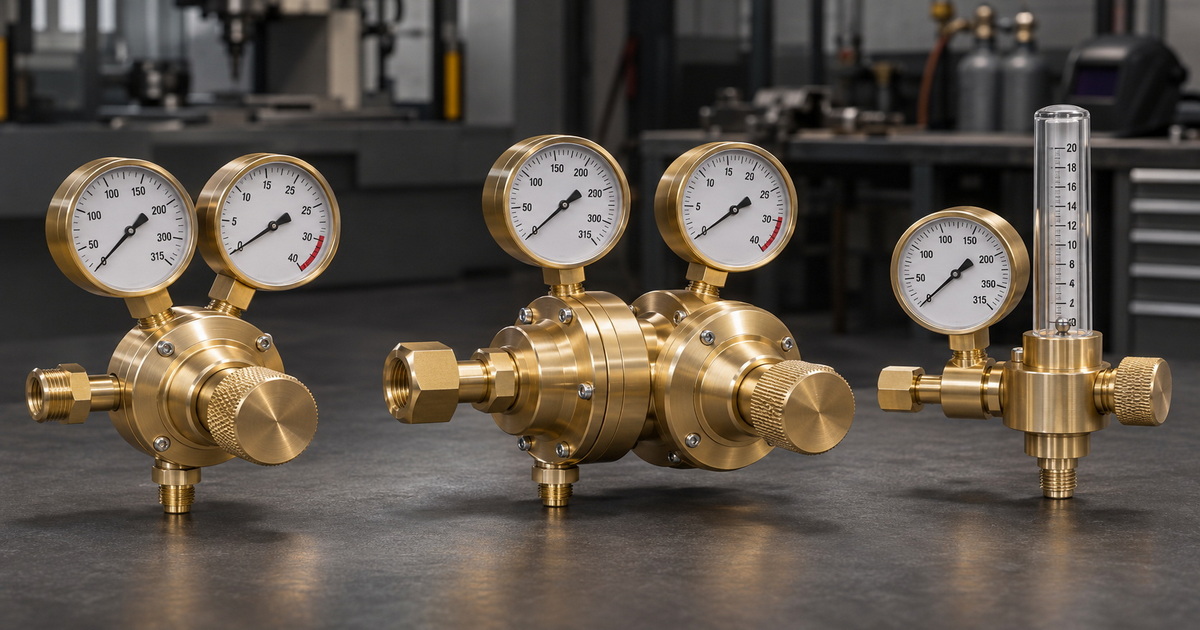
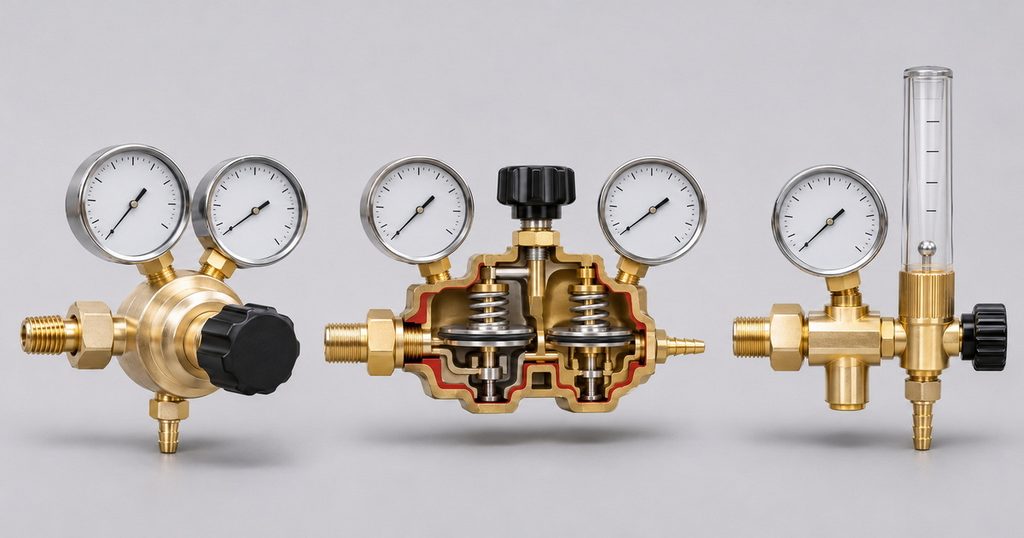
Two gauges do not establish that a regulator has two pressure-reduction stages. Ask for the product designation, sectional drawing, or written construction confirmation.
Manufacturers such as ewo and Spectron explicitly distinguish single-stage and two-stage products. Spectron describes its two-stage FM53 as providing highly stable outlet pressure. Buyers should nevertheless request performance data across their actual inlet-pressure and flow range rather than accept the stage count as a complete performance specification.
Treat CE and RoHS as Applicability Questions
A CE logo is not a universal quality certificate.
The European Commission identifies the Pressure Equipment Directive as legislation covering the design, manufacture, and conformity assessment of pressure equipment within its scope. Classification determines the applicable route.
Some equipment falls under Article 4(3), or sound engineering practice, and must not carry CE marking under that directive. Spectron publishes this distinction for its relevant gas-supply equipment. Other legislation may still require marking on a different product configuration.
For RoHS requests, ask the supplier to explain applicability to the exact assembly rather than accepting a generic material declaration as proof of complete regulatory compliance. Mechanical regulators and electrically heated products should not automatically be assigned the same documentation package.
An Overlooked Procurement Trap: Flow Indication Is Not the Whole System
One of the most useful checks is whether the quoted flow indication remains meaningful in the final installation.
A regulator can display an apparently correct flow while the buyer has failed to specify the gas, calibration pressure, downstream arrangement, or measurement conditions.
Spectron’s FLE32 documentation specifies calibration pressures and gas-conversion factors, and it warns that the complete system configuration must be considered. Its technical-gas regulator tables also distinguish reference-gas flow data from estimated argon performance.
To avoid this problem:
1. State whether the scale is calibrated for pure argon or a particular mixture.
2. Record the specified calibration pressure and reference conditions.
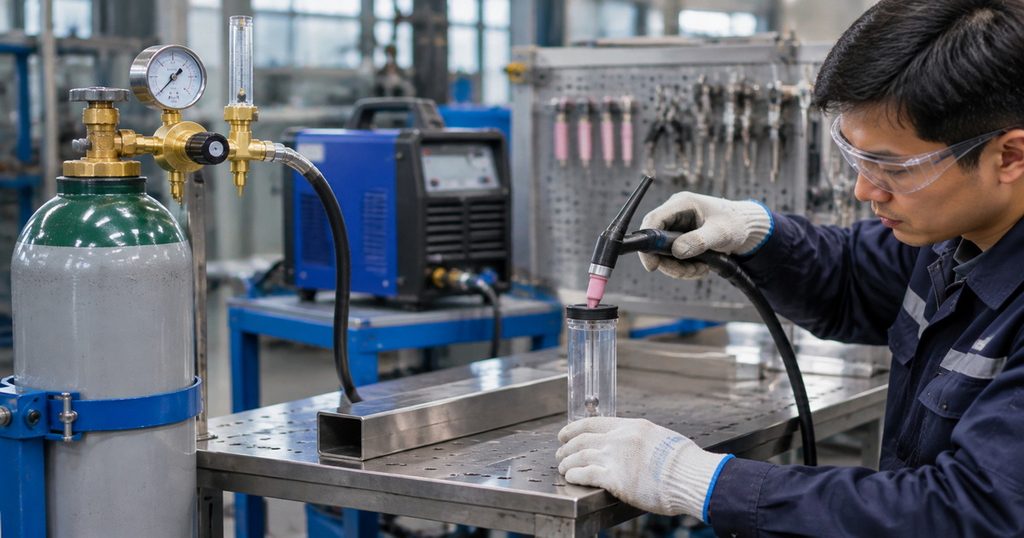
3. Test using the intended hose, fittings, and downstream equipment.
4. Compare indicated flow with an appropriate reference instrument.
5. Include starting, steady-flow, and stop/start behavior in sample approval.
The less visible commercial risk is uncontrolled component substitution after approval. Address it contractually: freeze the approved bill of materials and require written permission before changes to seats, diaphragms, gauges, filters, or body materials.
How to Qualify a Factory and Approve Samples
Step 1: Issue a Controlled Technical Requirement
Provide the gas composition, maximum inlet pressure, required outlet pressure or flow, cylinder connection, outlet connection, operating environment, labeling, packaging, and destination market.
Attach drawings wherever connection compatibility is critical.
Step 2: Verify the Legal Entity and Quality System
Check that the quotation, invoice, certificate, and factory address identify the intended contracting and manufacturing entities.
For certification, compare the legal name, site address, standard, scope, certificate number, and current status. IAF CertSearch provides searches by company name or certificate details, including status and issuing-body information.
Step 3: Approve Performance, Not Just Appearance
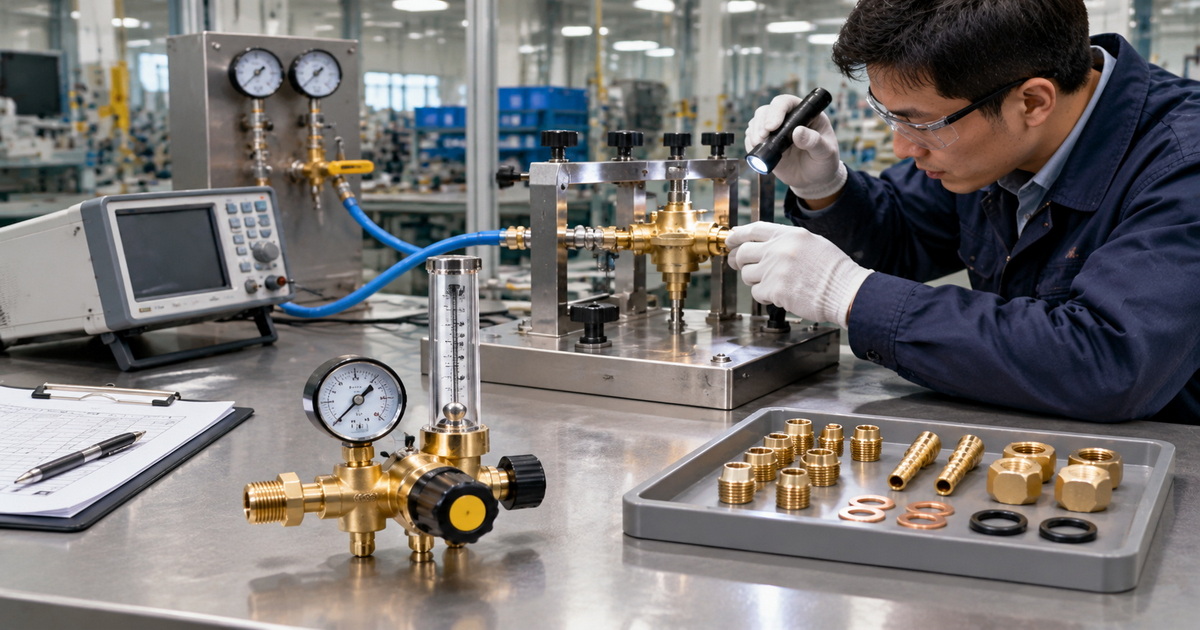
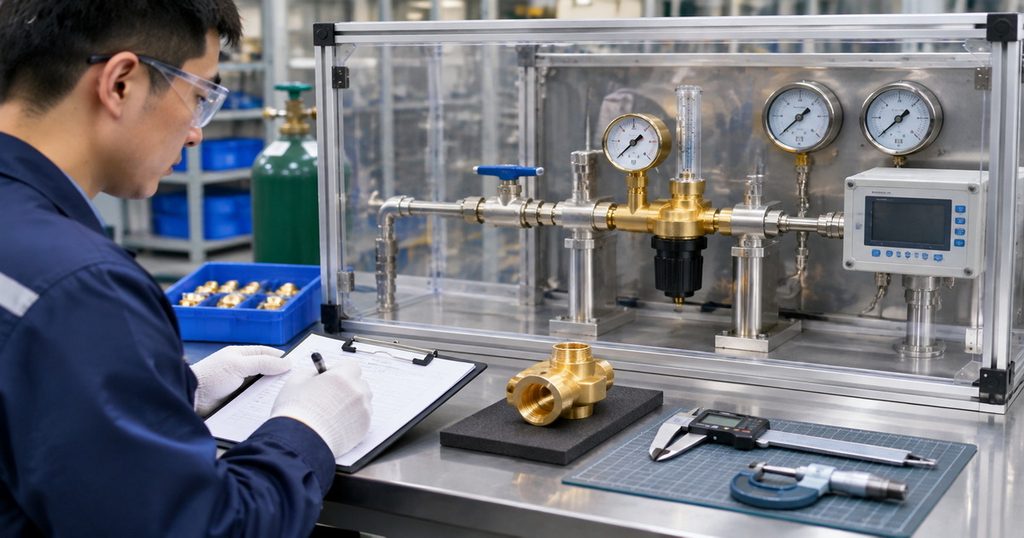
Agree a test plan covering external leakage, seat leakage, pressure-control behavior, flow indication, connections, and marking.
Keep approved samples and record the test conditions. Where testing involves high-pressure gas, use qualified personnel and appropriate facilities.
Step 4: Place a Pilot Order
Use the pilot batch to assess repeatability, packaging protection, documentation accuracy, and delivery performance.
Ask for a production schedule tied to purchased components—not only a promised shipment date.
Step 5: Control Logistics and After-Sales Exposure
Specify protective caps, gauge protection, carton labeling, country-of-origin documentation, and packing inspection.
For overseas OEM orders, define the Incoterm, importer responsibilities, freight-insurance arrangements, replacement policy, and spare-parts supply before shipment. Evaluate landed cost alongside the cost of returns, downtime, and local service.
Conclusion
The strongest supplier choice depends on the purchasing model.
ewo and Messer Cutting Systems merit consideration for conventional welding-equipment sourcing. WITT is relevant to centralized gas supply and larger gas-control systems. GCE Speciality / DruVa and Spectron offer useful starting points for high-purity or precision applications. Zhejiang Bril provides an overseas OEM/ODM route for buyers seeking a customized industrial gas-regulator range.
Before committing, require a defined specification, current documentation, tested samples, a controlled bill of materials, and a realistic production plan.
For a Bril OEM/ODM enquiry, submit your target gas, cylinder connection, pressure rating, flow range, branding requirements, and estimated annual demand. Request a documented sample and quotation proposal so that customization, communication, and commercial fit can be evaluated before a production commitment.
FAQ
1. How can I verify whether a manufacturer’s ISO 9001 certificate has expired or been suspended?
Search the exact certificate number or legal company name through an appropriate verification service and the issuing certification body.
Check current status, expiry information, scope, factory address, and issuing organization. An “Active” record must still match the actual factory and activities you are buying from. CertSearch distinguishes active, suspended, withdrawn, and expired certificates.
If the record cannot be found, contact the issuer directly. Absence from one search result should trigger further verification, not an automatic conclusion that the certificate is fraudulent.
2. Can a regulator legally be sold in Germany without a CE mark?
Yes, depending on its classification and applicable legislation.
Certain pressure equipment falls under the PED’s sound-engineering-practice provisions and must not carry CE marking under that directive. Request the manufacturer’s written classification rationale for the exact model. A missing mark is not automatically noncompliance, just as a visible mark is not automatically proof of compliance.
3. How can we compare regulators when suppliers quote different maximum flow rates?
Require comparable test conditions.
Ask for the gas used, inlet and outlet pressures, reference conditions, and pressure-versus-flow data. A maximum number without these conditions is insufficient. Spectron’s published tables explicitly provide operating conditions and gas-conversion factors, illustrating why nitrogen-based and argon-based figures should not be compared without adjustment.
4. How do we verify that a “German regulator” is actually manufactured in Germany?
Separate brand ownership, design location, seller address, assembly location, and manufacturing origin.
Request a model-specific country-of-origin statement, manufacturer identity, product marking details, and supporting supply-chain records where contractually justified. The suppliers reviewed include international businesses and businesses with German origins; those descriptions alone do not establish the origin of each product.
For origin-critical purchasing, write the requirement into the contract before approving samples.
5. What should an OEM agreement include to prevent quality changes after sample approval?
Include an approved drawing revision and controlled bill of materials, plus a written change-notification requirement.
Define critical materials, gauges, seats, diaphragms, filters, inspection methods, acceptance criteria, traceability, and handling of nonconforming batches. Establish whether changes require documentary approval, new samples, or repeat qualification.
For pressure and flow claims, attach the agreed test conditions. Manufacturer documentation demonstrates that material combinations, leak rates, and flow conditions are model-specific; an OEM agreement should preserve that specificity.
References
1. – Zhejiang Bril Welding Equipment Co., Ltd.—Company profile, manufacturing background, facility information, and supplier-reported qualifications. [chinesewelding]
2. – ewo—Company history and ISO 9001 statement; argon cylinder-regulator range. [ewo]
3. – WITT-Gasetechnik—Company facts, international coverage, regulator portfolio, and quality-management statement. [wittgas]
4. – GCE Speciality—DruVa history and specialty-gas market positioning. [gcegroup]
5. – Spectron—FM53 and FE51-SP product specifications, flowmeter documentation, and pressure-equipment classification. [spectron]
6. – Messer Cutting Systems—Company history and regulator product information. [uk.messer-cutting]
7. – VDMA—Mechanical and plant engineering figures, including 2025 machinery export data published in the 2026 overview. [vdma]
8. – ISO—ISO 2503:2009 scope and 2026 confirmation status. [iso]
9. – European Commission—Pressure Equipment Directive overview and guidance resources. [single-market-economy.ec.europa]
10. – IAF CertSearch—Certificate search and verification guidance. [support.iafcertsearch]
Hot Tags: Argon Gas Regulator Manufacturers, Argon Gas Regulator Suppliers, Argon Gas Regulator Manufacturers In Germany, Industrial Argon Gas Regulators, Welding Argon Gas Regulators, OEM Argon Gas Regulators, Wholesale Argon Gas Regulators, Dual Stage Argon Gas Regulators, High Pressure Argon Gas Regulators, Argon Gas Regulators With Flow Meters