Content Menu
● How to Evaluate an Argon Gas Regulator Supplier
● The Americas Market: Why Regional Suppliers Matter
>> What the Latest Industry Data Actually Shows
● Leading Argon Gas Regulator Manufacturers and Suppliers to Consider
>> 1. Zhejiang Bril Welding Equipment Co., Ltd.: An OEM Alternative for Private-Label Programs
>> 2. Harris Products Group: Established Welding Gas-Control Products
>> 3. Victor: Long-Established Welding Regulator Technology
>> 4. GENTEC / Genstar Technologies: Welding and Broader Gas-Control Integration
>> 5. CONCOA: Precision Gas Delivery and Engineered Systems
● Supplier Comparison: Capacity, MOQ, and Certification Transparency
● Technical Buying Guide: What Determines Regulator Quality?
>> Specify Materials Rather Than Asking for “Premium Brass”
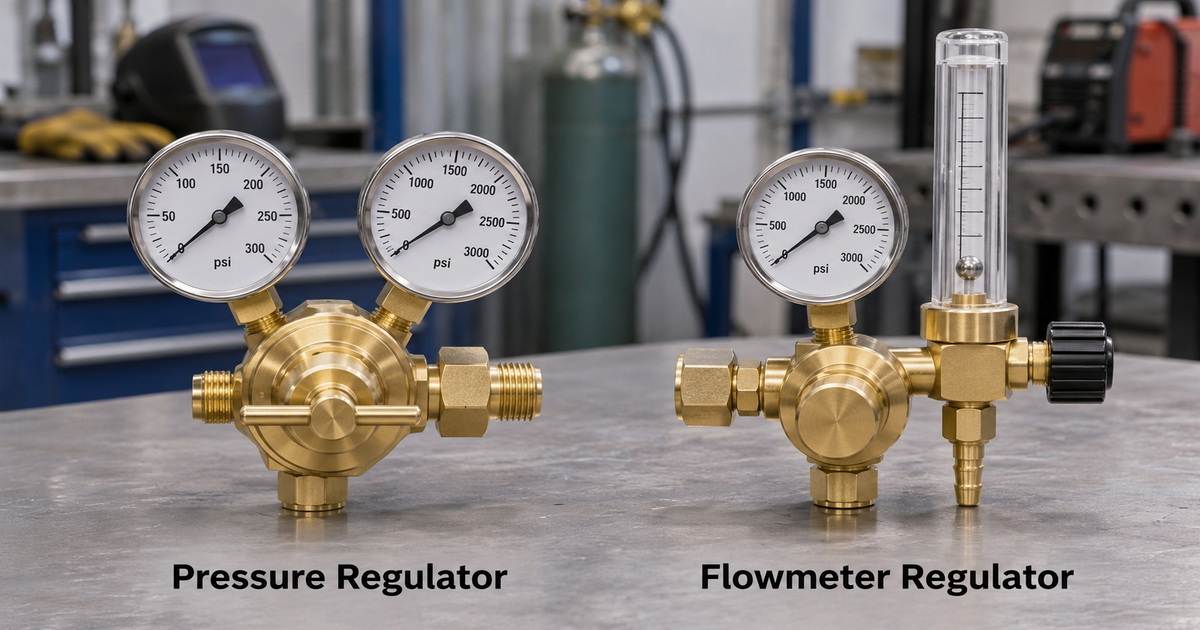
>> Distinguish Single-Stage, Dual-Stage, and Dual-Flowmeter Products
>> Match the Flowmeter to Its Actual Operating Conditions
>> Treat Compliance as a Model-Specific Assessment
● How to Qualify a Factory and Place the First Order
>> 1. Build One Technical Request for Quotation
>> 2. Verify Capacity Against Your Actual Product Mix
>> 3. Approve Samples Under Written Acceptance Criteria
>> 4. Use a Pilot Order Before Scaling
● FAQ
>> 1. How can I check whether a manufacturer’s ISO certificate has expired or been suspended?
>> 2. Can a dual-flowmeter regulator replace a dual-stage regulator?
>> 3. How should I verify an OEM supplier’s claimed monthly capacity?
>> 4. Can I accept one certificate for an entire private-label regulator range?
>> 5. Why might an argon flowmeter show a plausible reading but still deliver the wrong flow?
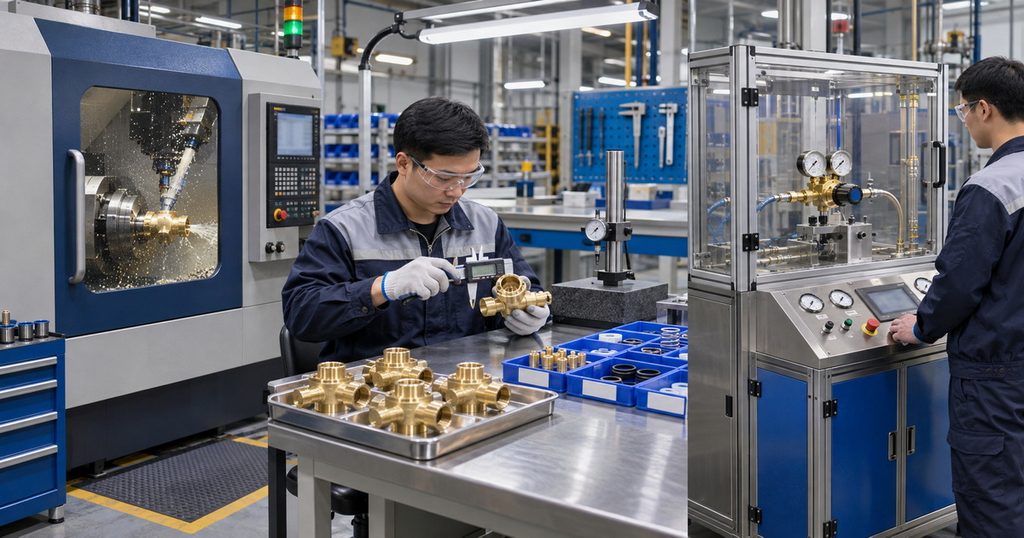
Choosing an argon gas regulator supplier requires more than comparing prices, brass body weight. Professional buyers need to understand how a supplier controls pressure performance, verifies materials, manages production changes, and supports products after delivery.
The Americas offer established welding-equipment brands, industrial gas-control specialists, and distribution networks that can simplify purchasing and technical support. However, a supplier’s American address does not establish the manufacturing origin of every product. Buyers should verify the production site and country of origin for each selected model.
How to Evaluate an Argon Gas Regulator Supplier
| Evaluation area | Evidence buyers should request | Procurement significance |
|---|---|---|
| Factory and quality-system verification | Current certificate, covered address, manufacturing scope, audit access | Establishes whether the quoted factory and certified organization match |
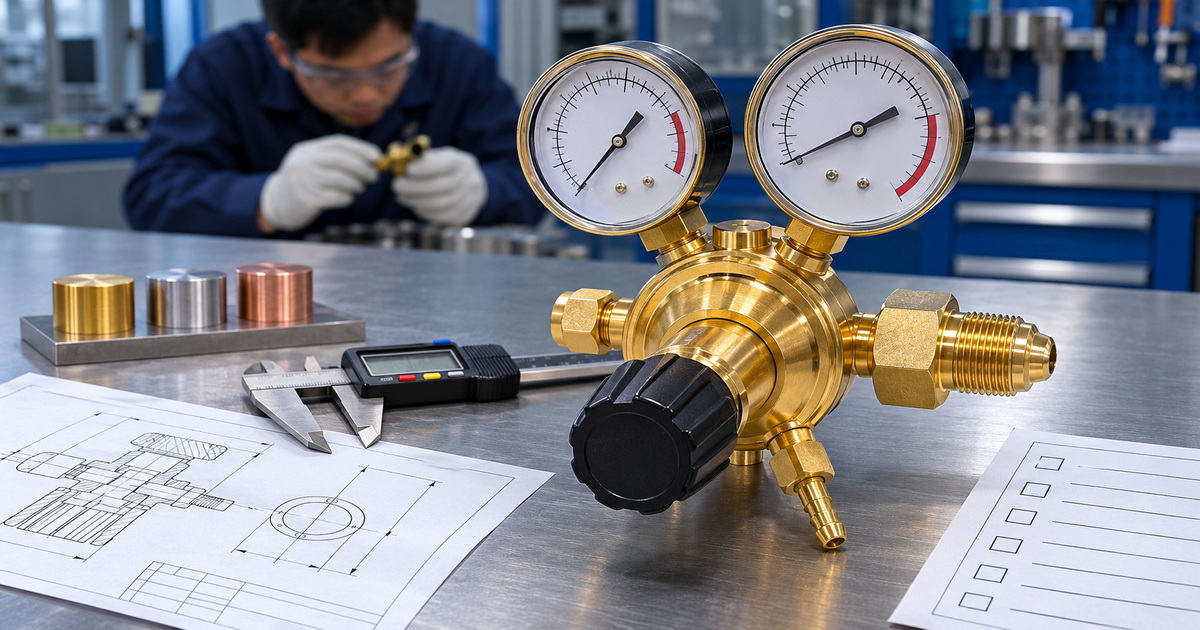
| Engineering capability | Drawings, pressure-flow data, connection specifications, documented design changes | Indicates whether customization extends beyond branding |
| Materials control | Exact brass designation, material records, approved seat and diaphragm specifications | Reduces the risk of substitutions after sample approval |
| Production inspection | Written leak-test procedures, calibration records, acceptance criteria | Makes quality requirements measurable |
| Delivery reliability | Available capacity, current backlog, historical delivery performance | Provides a stronger basis for scheduling than a verbal lead-time promise |
| Product compliance | Model-specific reports, listings, declarations where applicable | Avoids confusing company certificates with product approvals |
| After-sales support | Spare-parts policy, warranty process, failure-analysis procedure | Determines how problems will be resolved after importation |
For welding cylinder regulators, ISO 2503 provides an important technical reference. It covers pressure regulators and regulators with flow-metering devices for welding, cutting, and allied processes, including relevant compressed-gas applications up to 300 bar. ISO confirms that the 2009 edition was reviewed and remained current in 2026. Pressure gauges have a separate reference: ISO 5171:2019. Buyers must still check the scope and suitability of each standard for the selected product.
The Americas Market: Why Regional Suppliers Matter
The Americas are not a single country or a uniform regulatory market. A purchasing program covering the United States, Canada, Mexico, and South America may require different cylinder connections, labeling, languages, distribution arrangements, and import documentation.
For buyers, the strongest reason to consider established American-based suppliers is access to an existing gas-equipment ecosystem: catalog products, technical selection support, distributors, and replacement components.
What the Latest Industry Data Actually Shows
In a September 2026 industry article, the American Welding Society reported that the United States would need approximately 320,500 new welding professionals by 2029, equivalent to roughly 80,000 entrants annually to meet demand and replace retiring workers.
This is welding-workforce data—not an argon gas regulator market-size estimate. Nevertheless, it provides relevant purchasing context: welding remains dependent on equipment that technicians can specify, operate, and maintain consistently.
A precise Americas-wide regulator market value is not established by the sources used here. Buyers should be cautious about reports that combine welding regulators, medical regulators, semiconductor gas systems, and general pressure-control valves into one headline number.
Leading Argon Gas Regulator Manufacturers and Suppliers to Consider
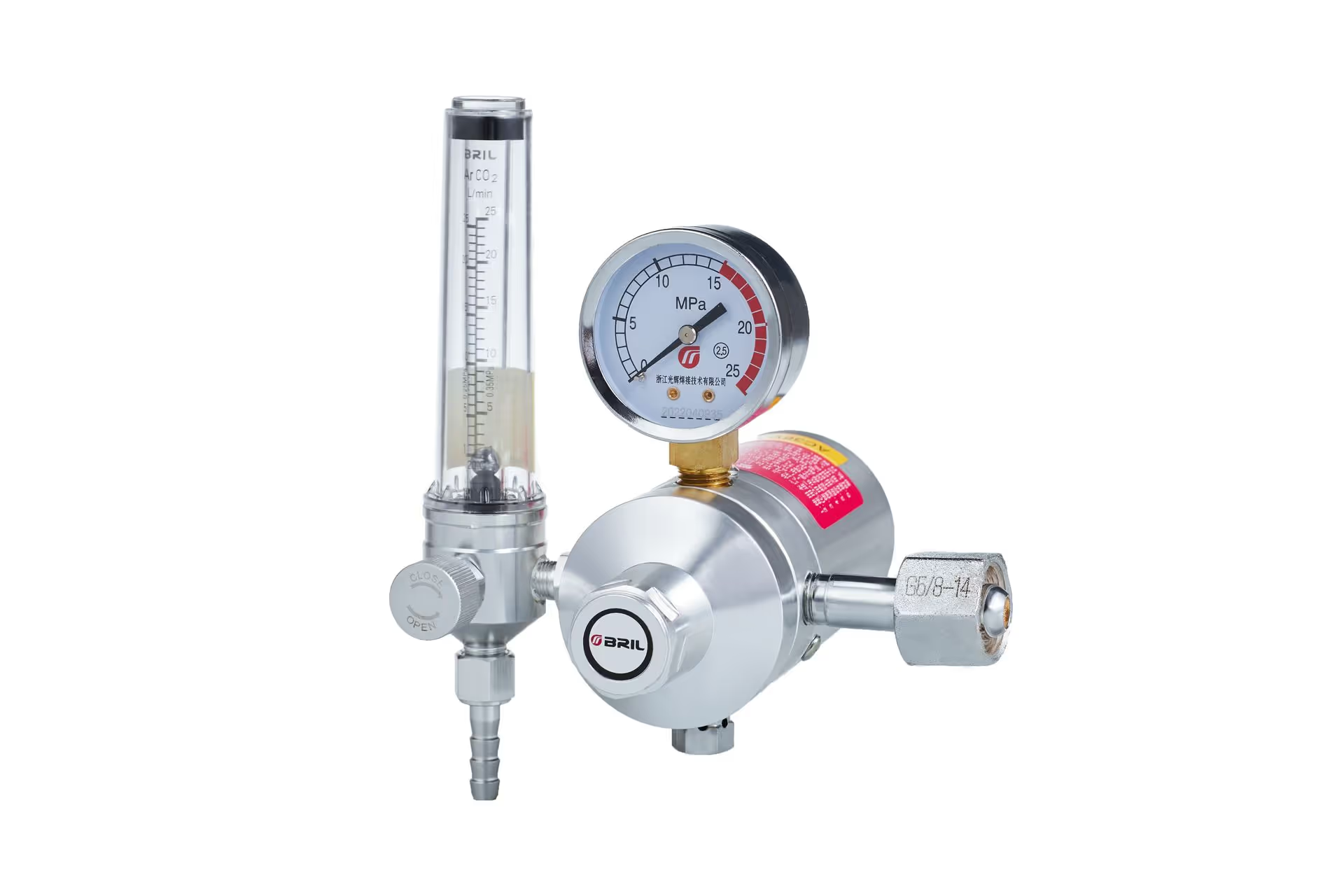
1. Zhejiang Bril Welding Equipment Co., Ltd.: An OEM Alternative for Private-Label Programs
| Company detail | Procurement profile |
|---|---|
| Established | 2002 |
| Location | Wenzhou, Zhejiang, China |
| Market coverage | Company reports serving more than 30 countries and regions |
| Relevant focus | Industrial gas pressure regulators and welding-equipment supply |
| Suitable sourcing model | OEM and ODM discussions for overseas brands, distributors, and equipment manufacturers |
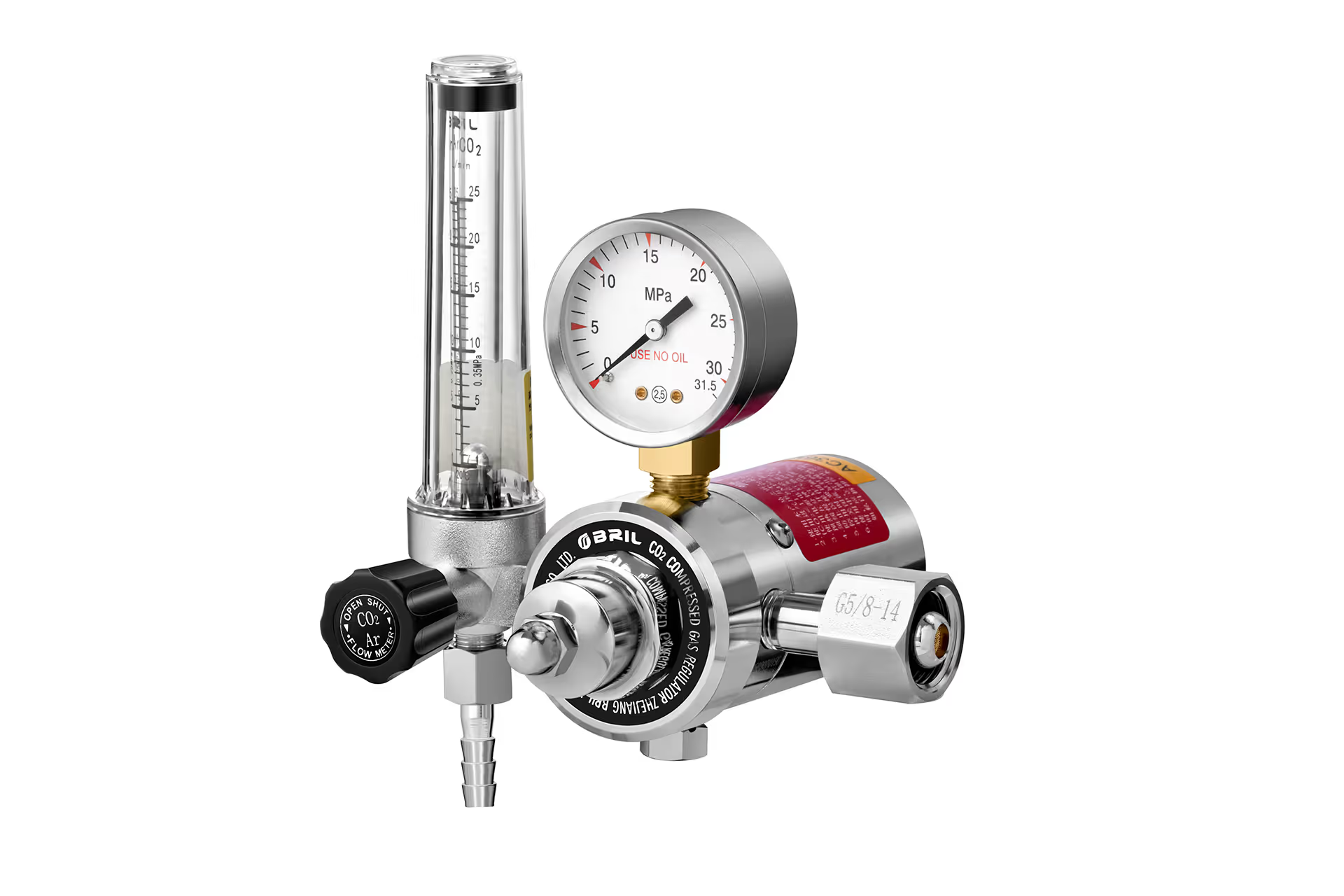
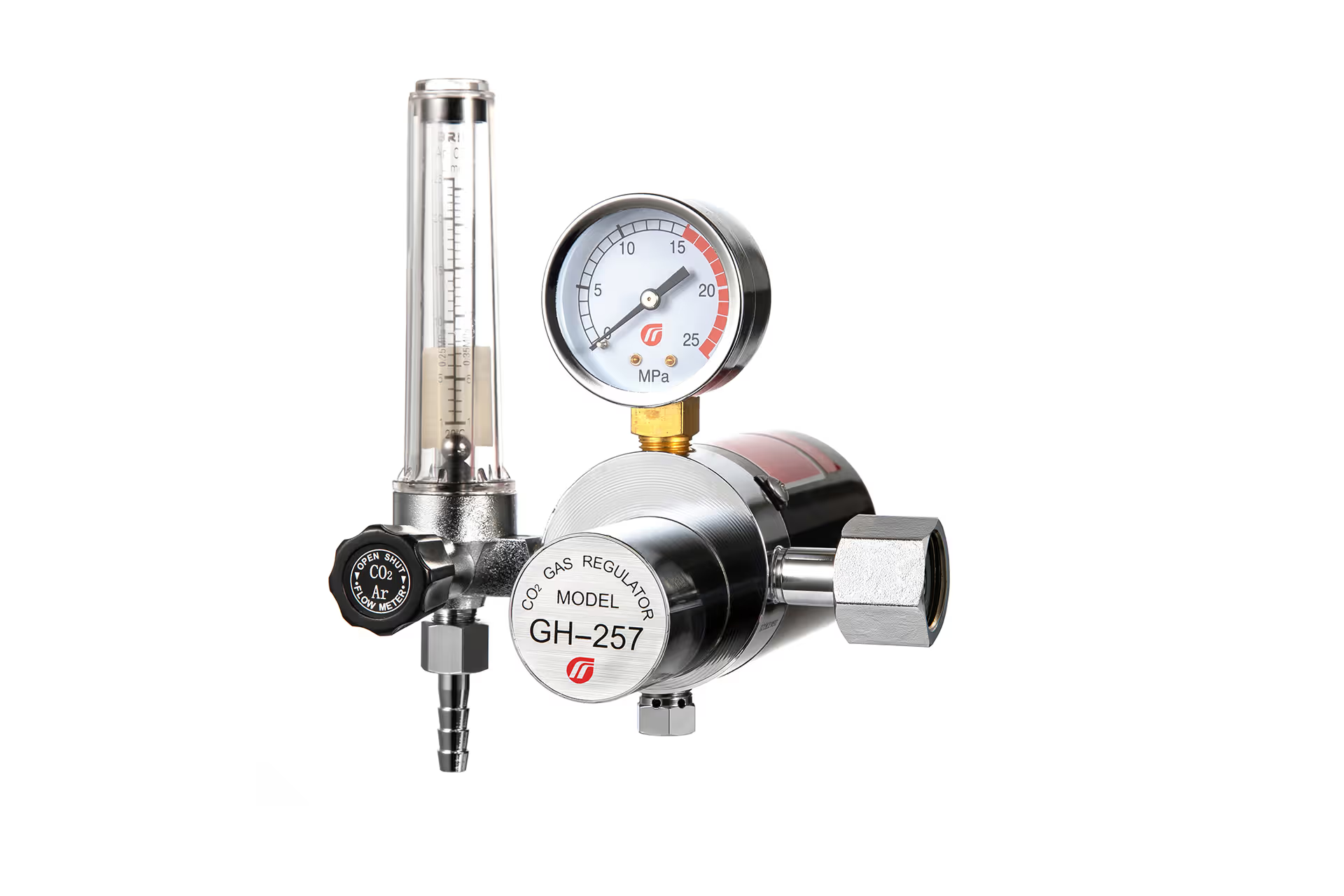
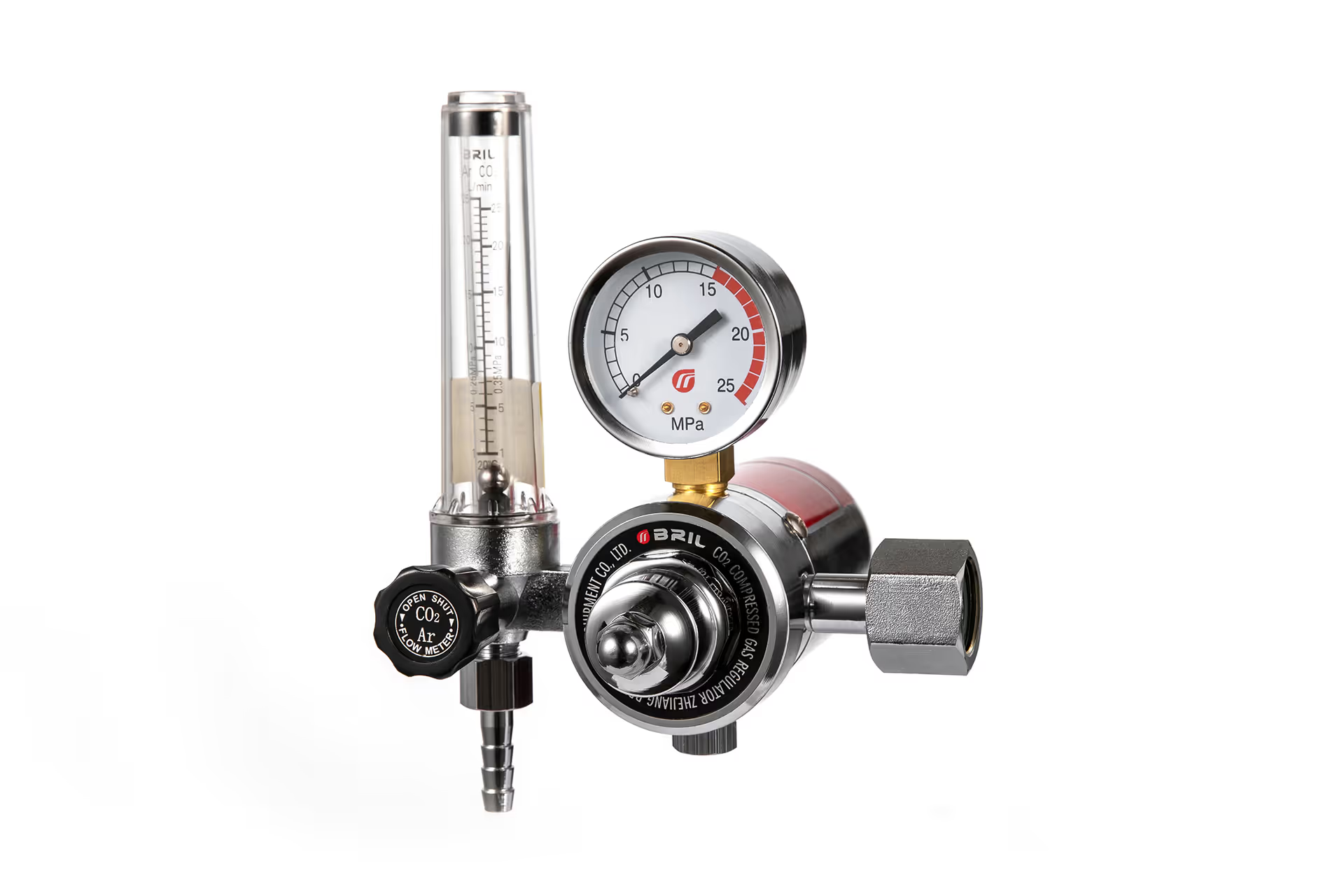
Zhejiang Bril Welding Equipment Co., Ltd. develops, manufactures, and sells industrial gas pressure regulators. Its company profile reports more than 200 employees and over 3,500 square meters of production space. These figures indicate operating scale, but they do not establish monthly argon-regulator output or available capacity for a new order.
Bril is relevant to buyers seeking a value-oriented manufacturing alternative to established branded distribution. Its published profile describes regulator development capabilities, inspection equipment, and supporting production for welding-equipment companies. It also identifies OEM relationships with recognized equipment and gas-industry businesses; these are supplier-published statements rather than independently audited endorsements.
For small and medium-sized brands, the important opportunity is direct discussion of product configuration and private-label requirements. A useful development brief would cover:
– Target inlet connection and maximum inlet pressure.
– Required outlet pressure or argon flow range.
– Gauge scales and preferred units.
– Body finish, labeling, packaging, and instruction languages.
– Replacement parts and warranty arrangements.
– Validation requirements before a production release.
Flexibility and communication efficiency should be evaluated during the quotation and sample stages—not assumed from marketing language. Buyers can test these qualities by requesting a marked-up drawing, a technical response to application questions, and a written sample-development schedule.
Bril’s website states ISO 9001-related and product-conformity credentials. Before purchase, request the actual certificates and reports, checking issuing organizations, validity, scope, factory address, and covered models. References to UKAS, IAF, or CNAS should not be treated as interchangeable product certifications.
Best-fit purchasing situation: a distributor or growing equipment brand that wants to investigate deeper customization and direct factory coordination, while independently confirming compliance and landed cost.
2. Harris Products Group: Established Welding Gas-Control Products
| Company detail | Procurement profile |
|---|---|
| Established | Harris Calorific heritage dates to 1905 |
| American presence | Mason, Ohio, United States |
| Market and applications | Welding, cutting, industrial gas regulation, and specialty gas equipment |
| Customization relevance | Catalog selection and system configuration; private-label terms require direct confirmation |
Harris traces its gas-equipment history to John Harris, who established Harris Calorific in 1905. Its current range includes single-stage regulators, two-stage regulators, flowmeters, flowgauges, and related gas-control equipment.
For argon welding applications, the Model 355-2 flowmeter regulator provides a useful example of the company’s documented product approach. The published kit specification identifies a brass body, an encapsulated seat, a PTFE seat material, and pressure compensation at 20 PSIG. It also specifies vertical mounting and a particular CGA 580 configuration.
These details matter because an argon flowmeter is not simply a transparent tube attached to any pressure regulator. Its calibration and intended operating conditions form part of the measuring system.
Harris lists the referenced Model 355-2 kit as UL listed and identifies CGA E-4 in its certification information. Buyers should verify the exact ordered SKU rather than transferring one model’s listing to an entire product family.
Best-fit purchasing situation: distributors and industrial users seeking established branded equipment with published application details.
OEM caution: the reviewed information does not establish an open private-label manufacturing program. Ask separately about branding rights, special configurations, minimum volumes, and distribution restrictions.
3. Victor: Long-Established Welding Regulator Technology
| Company detail | Procurement profile |
|---|---|
| Established | 1913 |
| Origin | San Francisco, United States |
| Market and applications | Welding, cutting, MIG and TIG shielding-gas equipment |
| Customization relevance | Established catalog configurations; private-label availability not verified |
Victor was founded in 1913 by L. W. Stettner. Its historical product catalog describes the development of welding torches, cutting torches, and gas regulators from the company’s original San Francisco business.
The Victor HRF range illustrates an integrated regulator-and-flowmeter approach for MIG and TIG applications. Published HRF 2400 information identifies machined brass construction, a sintered bronze inlet filter, back-pressure compensation, and model-specific flow-tube calibration. The HRF 2425 listing specifies a 25 PSIG preset configuration and a CGA 580 inlet option.
The procurement lesson is that matching outward appearance does not establish equivalent performance. The internal regulator setting, flow-tube calibration, diaphragm construction, and filtration arrangement all require comparison.
Because the cited catalog is historical, buyers should obtain a current datasheet before specifying an HRF model. Confirm current availability, manufacturing origin, replacement components, and applicable approvals.
Best-fit purchasing situation: welding-equipment distributors and industrial buyers seeking a familiar branded regulator architecture.
OEM caution: brand history does not demonstrate willingness to manufacture another company’s private-label range. Treat customized branding as a separate commercial inquiry.
4. GENTEC / Genstar Technologies: Welding and Broader Gas-Control Integration
| Company detail | Procurement profile |
|---|---|
| Established | 1969 |
| Location | Chino, California, United States |
| Market coverage | Company describes a global business |
| Relevant focus | Industrial, specialty, and medical gas-control equipment |
| OEM relevance | Selected specialty-gas products explicitly identify OEM applications |
Founded in 1969, Genstar Technologies supplies regulators, valves, fittings, welding apparatus, and other gas-control equipment. Its portfolio spans several gas-handling markets rather than welding alone.
The GENTEC 196 Series dual-flowmeter regulator is a useful option to investigate where two independently adjusted gas flows are needed. Its published specifications describe single-stage construction, a 50 PSIG preset regulator, a machined brass body, a bronze inlet filter, and flowmeters calibrated for specified gases.
Importantly, two flowmeters do not mean two pressure-reduction stages. The 196 Series demonstrates why buyers must distinguish dual-output equipment from dual-stage regulators.
GENTEC also publishes gas-saving flowmeter regulators with optional BSP, JIS, and DIN inlet connections. Its specialty-gas catalog identifies OEM applications for selected products, offering a basis for discussing equipment integration. This does not establish unrestricted private labeling across the complete range.
The company publishes quality-system and product-compliance statements, but certificate validity and model coverage still require current documentation. Some downloadable literature contains older certificate references, reinforcing the need to obtain current records rather than rely on catalog wording.
Best-fit purchasing situation: equipment manufacturers and distributors that require welding products alongside broader gas-control capabilities.
5. CONCOA: Precision Gas Delivery and Engineered Systems
| Company detail | Procurement profile |
|---|---|
| Established | 1987, according to distributor-published company information |
| Business identity | Controls Corporation of America |
| Market and applications | Industrial gas delivery, analytical, scientific, and other precision applications |
| Customization relevance | Application-led gas-delivery systems; private-label terms require confirmation |
CONCOA supplies gas-control devices and systems for industrial and specialty applications. An authorized reseller’s company description dates its establishment to 1987; buyers requiring corporate-history confirmation should obtain it directly from CONCOA.
Its technical positioning centers on regulator design and gas-delivery performance. CONCOA describes capsule-seat technology, balanced-stem designs, filtration, and precision springs among its pressure-control features.
The company also publishes welding-related gas-delivery products, including an argon–carbon dioxide mixer, alongside higher-purity and higher-flow equipment. Its website states that gas cabinets are designed, manufactured, and tested under an ISO 9001:2015 quality system. That statement should not be interpreted as an approval for every individual regulator.
CONCOA deserves consideration when the requirement extends beyond a standard cylinder regulator—for example, when a buyer needs to discuss pressure control as part of a larger gas-delivery installation.
Best-fit purchasing situation: industrial users and equipment integrators prioritizing application engineering and documented system requirements.
OEM caution: request a project-specific proposal covering configuration, testing, ownership of drawings, and long-term component support.
Supplier Comparison: Capacity, MOQ, and Certification Transparency
| Supplier | Production-capacity evidence | MOQ information | Published quality or compliance evidence | Main sourcing emphasis |
|---|---|---|---|---|
| Bril | Reports 200+ employees and 3,500+ m²; units per month not disclosed | Not publicly established; request by configuration | Company states ISO 9001-related and product credentials; verify documents | Direct OEM/ODM evaluation |
| Harris | Numerical output not established | OEM MOQ not established; distributor order terms vary | Referenced 355-2 kit lists UL and CGA E-4 information | Branded welding distribution |
| Victor | Numerical output not established | Private-label MOQ not established | Obtain current model-specific documents; cited catalog is historical | Established welding products |
| GENTEC | Numerical output not established | Project and product dependent; confirm directly | Publishes facility certification claims and selected CGA E-4 statements | Welding and gas-system integration |
| CONCOA | Numerical output not established | Engineered-project quantities require quotation | Publishes ISO 9001:2015 quality-system statement for gas cabinets | Precision gas delivery |
Technical Buying Guide: What Determines Regulator Quality?
Specify Materials Rather Than Asking for “Premium Brass”
“Brass body” is not a complete material specification. Likewise, wording such as “class A brass” does not, by itself, give a buyer an unambiguous alloy designation.
Published product information illustrates this limitation: Harris identifies brass construction for the referenced kit, while GENTEC uses “class A brass” in its 196 Series description. Buyers should request a defined material designation and the associated production records before approving equivalence.
A purchase specification should identify:
– Body alloy and manufacturing route.
– Seat and diaphragm materials.
– Inlet-filter construction.
– Surface finish and plating requirements.
– Approved substitutions and change-control procedures.
– Material-verification methods agreed with the factory.
Do not approve a cheaper substitute solely because its finish and weight resemble the original sample.
Distinguish Single-Stage, Dual-Stage, and Dual-Flowmeter Products
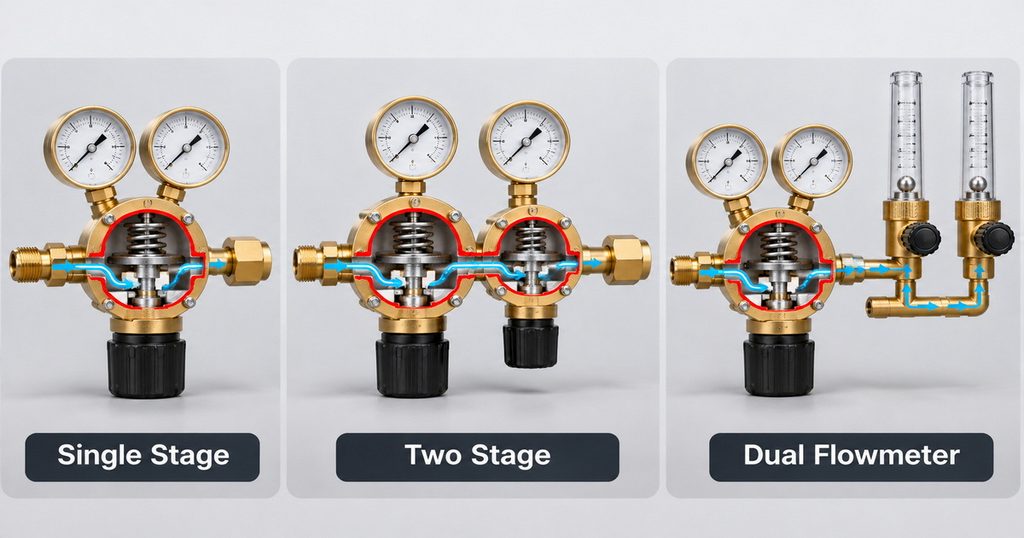
A two-stage regulator reduces pressure through two stages. Harris recommends two-stage designs where more consistent delivery pressure is needed over the life of a cylinder.
A dual-flowmeter regulator supplies two adjustable flow outputs. It may still use a single pressure-reduction stage, as demonstrated by GENTEC’s 196 Series.
For purchasing documents, avoid the ambiguous phrase “double regulator.” Specify the required architecture and attach a schematic or approved drawing.
Match the Flowmeter to Its Actual Operating Conditions
The Harris example is compensated at 20 PSIG, while the referenced GENTEC dual-flowmeter regulator is preset at 50 PSIG. These are model-specific design conditions, not interchangeable settings.
Consequently, buyers should verify:
1. The gas or mixture used for calibration.
2. The pressure associated with calibration.
3. The stated measurement range and accuracy.
4. Required mounting orientation.
5. The complete regulator, tube, float, and valve combination.
An apparently compatible replacement tube may not preserve the original measurement performance.
Treat Compliance as a Model-Specific Assessment
CE marking is not a general quality award, and RoHS is not a universal environmental certificate for all mechanical regulators. European Commission guidance distinguishes pressure-equipment requirements from restrictions applying to electrical and electronic equipment. Applicability depends on the product and legislation involved.
For a purely mechanical argon regulator, request a written applicability assessment rather than a generic “CE/RoHS certificate.” For electrically heated or electronically controlled equipment, additional requirements may need evaluation.
A supplier selling into several countries should provide destination-specific documentation—not one certificate presented as universal authorization.
An Often-Overlooked Procurement Trap: Approving Components Instead of the Complete Measuring Assembly
A regulator can look correct, connect correctly, and still deliver misleading flow indications if the measuring components and operating conditions do not match.
The difference between the published 20 PSIG Harris configuration and the 50 PSIG GENTEC configuration illustrates the underlying risk. Calibration pressure belongs to the complete design; it should not be treated as an incidental setting.
The practical safeguard is to approve an assembly-level specification that fixes:
– Regulator preset or operating-pressure requirement.
– Flow-tube and float identification.
– Calibration gas and units.
– Permitted mounting orientation.
– Relevant valve and connection configuration.
– Acceptance-test conditions.
For private-label purchases, also require written approval before changes to the seat, diaphragm, spring, filter, or measuring components.
This closes a common contractual gap: a purchase order that controls the logo and packaging in detail but says little about the components governing performance.
How to Qualify a Factory and Place the First Order
1. Build One Technical Request for Quotation
Send the same specification to every shortlisted supplier. Include gas service, cylinder connection, maximum inlet pressure, operating range, required flow, units, destination, annual forecast, and intended distribution model.
Ask suppliers to separate standard options from new engineering work. This makes quotations easier to compare.
2. Verify Capacity Against Your Actual Product Mix
Instead of asking only for “monthly capacity,” request:
– Available output for the selected model.
– Current backlog.
– Capacity of the final testing operation.
– Lead time for gauges, forgings, and customized packaging.
– Peak-season arrangements.
– A realistic replenishment schedule.
A factory’s theoretical total output is less useful than its ability to deliver your approved configuration consistently.
3. Approve Samples Under Written Acceptance Criteria
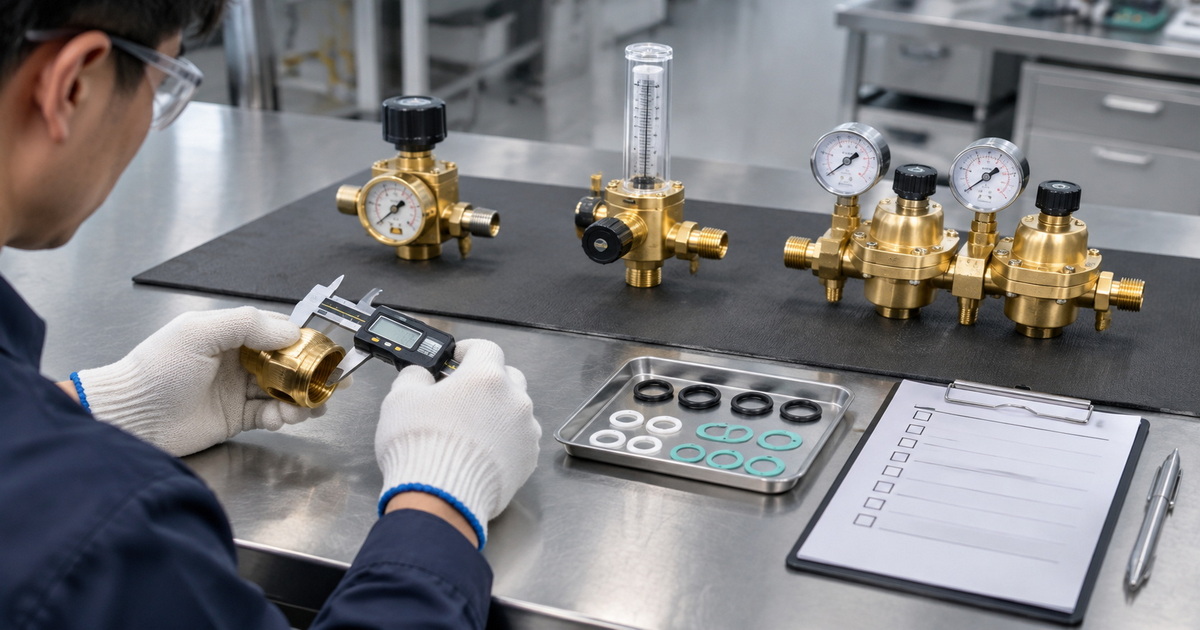
Use a documented protocol covering connection inspection, external leakage, pressure stability, flow indication, and agreed operating conditions.
Any pressurized, endurance, or destructive testing should be performed by qualified personnel using suitable protective facilities. The applicable standard and product risk assessment should determine the final procedure. ISO 2503 provides a relevant starting framework for covered welding-cylinder regulators.
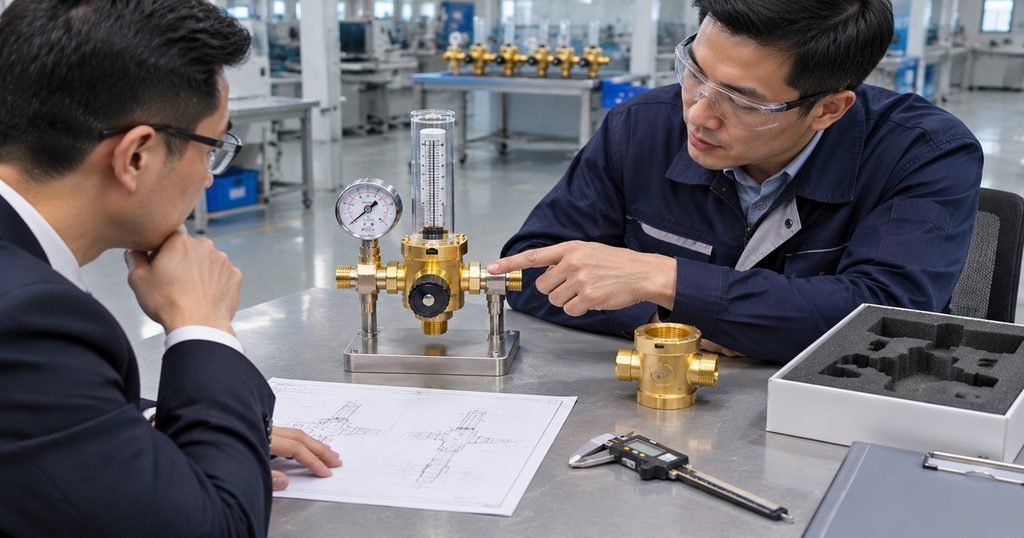
Retain an approved sample, controlled drawings, photographs, and the final component specification.
4. Use a Pilot Order Before Scaling
A pilot shipment should test the supplier’s complete process: production consistency, inspection records, labeling, packaging, documentation, and delivery execution.
For overseas sourcing, compare landed cost rather than factory price alone. Request separate figures for tooling, testing, packaging, transport, duties, and spare parts. Confirm classification, origin, and import requirements with the appointed customs broker.
Conclusion
The right argon gas regulator supplier depends on the purchasing model.
Harris and Victor merit investigation for established welding-product ranges. GENTEC offers welding equipment alongside broader gas-control capabilities. CONCOA is relevant to precision gas-delivery projects. Bril provides a China-based OEM alternative for buyers evaluating private-label development and direct manufacturing collaboration. Their published product and company information supports these different areas of focus, but not a universal ranking.
For a Bril sourcing inquiry, prepare your cylinder connection, inlet-pressure rating, required argon flow range, destination market, estimated annual volume, and branding requirements. Request a written proposal covering sample development, technical documentation, MOQ, production scheduling, and after-sales support before making a volume commitment.
FAQ
1. How can I check whether a manufacturer’s ISO certificate has expired or been suspended?
Start with the legal company name, certificate number, covered factory address, and certification scope. Search an accredited-certificate verification platform such as IAF CertSearch, then confirm uncertain results directly with the issuing certification body.
Check current status—not only the expiry date printed on a PDF. Certificates can be suspended or withdrawn before their stated expiration. A missing database result warrants further investigation rather than an automatic conclusion that the certificate is false.
2. Can a dual-flowmeter regulator replace a dual-stage regulator?
Not automatically. A dual-flowmeter device provides two adjustable flow outputs, while a dual-stage regulator performs pressure reduction in two stages.
GENTEC explicitly describes its 196 Series dual-flowmeter regulator as single-stage. Harris separately recommends two-stage regulators where consistent delivery pressure throughout cylinder use is important. Define whether your application requires two outlets, two pressure stages, or both.
3. How should I verify an OEM supplier’s claimed monthly capacity?
Request a model-specific capacity statement supported by production planning, testing-station availability, current backlog, and a pilot-order schedule.
Do not convert employee numbers, floor area, or total company production into an assumed argon-regulator output. For example, Bril publishes workforce and production-area figures, but the reviewed company profile does not establish a monthly unit capacity for a particular model.
4. Can I accept one certificate for an entire private-label regulator range?
Only if its scope genuinely covers the relevant products, production site, and configurations.
A company’s management-system certificate is different from a product listing or model-specific test report. Harris’s referenced 355-2 kit demonstrates model-specific published listing information; CONCOA’s website separately describes quality-system controls for gas cabinets. Neither type of statement should be expanded beyond its documented scope.
5. Why might an argon flowmeter show a plausible reading but still deliver the wrong flow?
Investigate whether the tube, float, gas calibration, operating pressure, and mounting orientation match the approved design.
Published examples show materially different compensation or preset pressures, and Harris specifies vertical mounting for its referenced kit. Ask the supplier to verify the complete assembly against a suitable reference instrument under agreed conditions rather than replacing components by appearance alone.
References
1. – Bril company profile: founding date, location, manufacturing description, reported workforce, production area, and supplier-published credentials. [chinesewelding]
2. – Harris company history and regulator selection guidance. [harrisproductsgroup]
3. – Harris Model 355-2 flowmeter regulator kit: construction, compensation pressure, mounting, and listing information. [qacd10.harrisproductsgroup]
4. – Victor product catalog: company history and HRF regulator specifications; current specifications require reconfirmation. [weldersupply]
5. – GENTEC company profile, 196 Series specifications, and specialty-gas equipment information. [genstartech]
6. – CONCOA product information and regulator technology; establishment date attributed to an authorized reseller. [concoa]
7. – American Welding Society, September 2026: welding-workforce projections. [aws]
8. – International Organization for Standardization: ISO 2503:2009 and ISO 5171:2019. [iso]
9. – European Commission: harmonised standards and RoHS scope information. [single-market-economy.ec.europa]
10. – IAF CertSearch: accredited-certificate verification. [iafcertsearch]
Hot Tags: Argon Gas Regulator, Argon Gas Regulator Manufacturers, Argon Gas Regulator Suppliers, Wholesale Argon Gas Regulators, OEM Argon Gas Regulators, Argon Flowmeter Regulator, Dual Stage Argon Regulator, TIG Welding Argon Regulator, Industrial Gas Regulator Manufacturers, Custom Gas Pressure Regulators