Content Menu
● Pressure Regulator vs Flowmeter Regulator: The Essential Differences
● How a Pressure Regulator Works in TIG Welding
>> Why Pressure Does Not Equal Shielding Gas Flow
>> When a Pressure-Only Regulator Makes Sense
● How a Flowmeter Regulator Works for TIG Welding
>> Reading an Argon Flowmeter Correctly
● Pressure Regulator vs Flowmeter Regulator: Performance in Practice
>> Shielding Consistency and Weld Quality
● Single-Stage vs Dual-Stage: A Separate Buying Decision
● What Argon Flow Rate Should You Use for TIG Welding?
>> Why Increasing Flow Can Make Problems Worse
● Practical Insight: Diagnose Gas Delivery at Two Locations
>> A Repeatable Verification Procedure
● Practical Insight: Control Gas Surges Between Welds
● Practical Insight: Quantify Gas Savings Before Changing Equipment
● OEM and ODM Purchasing Checklist for TIG Gas Regulators
>> Define Application and Connection Requirements
>> Request Evidence of Performance
● Which Regulator Should You Choose?
>> 1.Can I use a regular pressure regulator for TIG welding?
>> 2.Is a flowmeter regulator always more accurate than a flowgauge regulator?
>> 3.Why does the flowmeter float drop when I stop welding?
>> 4.Do I need a dual-stage regulator for TIG welding?
>> 5.Can one regulator supply torch shielding and back purging?
>> 6.Can I use a CO₂ regulator for argon TIG welding?
Choosing a pressure regulator vs flowmeter regulator for TIG welding comes down to one practical question: do you need to control gas pressure, measure shielding gas flow, or both? A pressure regulator reduces cylinder pressure to a usable level. A flowmeter regulator combines pressure reduction with a visible flow indication, making it easier to set and repeat shielding gas delivery.
For most manual TIG welding stations, an argon flowmeter regulator is the more convenient choice. However, a properly specified pressure regulator paired with a separate flowmeter can perform equally well.
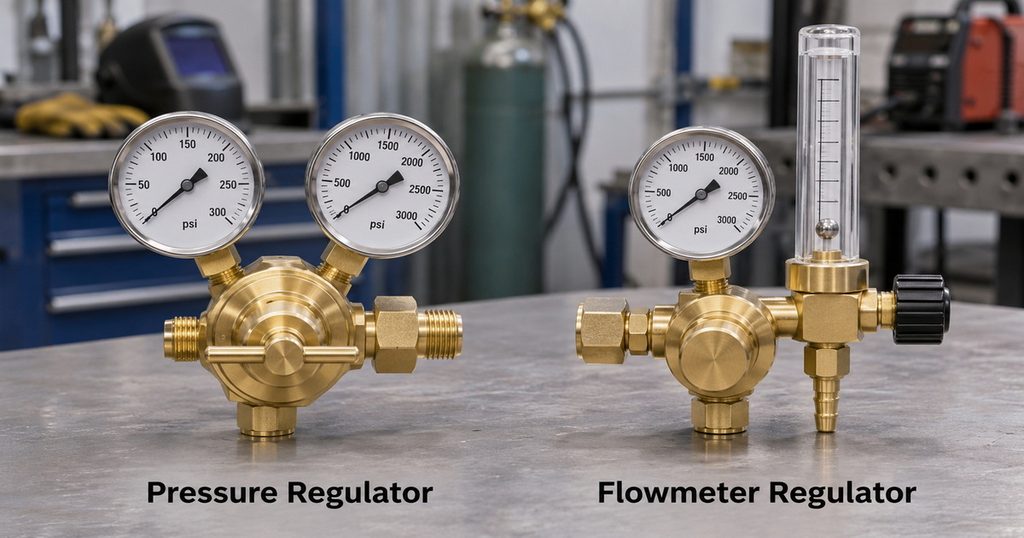
Pressure Regulator vs Flowmeter Regulator: The Essential Differences
| Feature | Pressure-only regulator | Welding flowgauge regulator | Flowmeter regulator |
|---|---|---|---|
| Main function | Reduces and controls delivery pressure | Controls flow through a calibrated pressure-and-orifice arrangement | Reduces pressure and indicates gas flow |
| Typical display | Cylinder and delivery pressure | Cylinder pressure and a dial marked in flow units | Cylinder pressure and a transparent flow tube |
| Common units | PSI or bar | CFH or L/min | CFH or L/min |
| Flow indication | Requires a separate instrument | Inferred from calibrated operating conditions | Indicated by float position |
| Suitable TIG application | Engineered systems with separate flow measurement | Compact, rugged welding setups | Routine manual TIG setup and adjustment |
| Main limitation | Pressure alone does not establish torch flow | Restrictions can affect the indicated-flow relationship | Correct gas calibration and installation are essential |
How a Pressure Regulator Works in TIG Welding
A pressure regulator reduces high cylinder pressure using a valve mechanism balanced by forces from a spring and sensing element, commonly a diaphragm.
The cylinder-side gauge indicates inlet pressure. A delivery gauge indicates downstream pressure. Neither measurement, by itself, tells you how much argon reaches the torch.
Why Pressure Does Not Equal Shielding Gas Flow
Pressure drives gas through the system, but flow also depends on resistance from:
– Hose length and internal diameter.
– Machine solenoid valves.
– Torch passages and fittings.
– Restrictions, contamination, or damaged components.
Consequently, the same delivery pressure can produce different flow rates in different installations.
There is no universal “correct PSI for TIG welding” that substitutes for a flow setting. Follow the welding machine’s inlet requirements and measure shielding gas delivery using suitable equipment.
When a Pressure-Only Regulator Makes Sense
A pressure-only regulator is appropriate when a separate flowmeter, gas-management device, or machine-integrated control handles flow downstream.
This arrangement can suit centralized distribution or engineered production cells. Its success depends on matching every component’s pressure rating and operating requirements.
Buying a pressure-only regulator is therefore not inherently wrong. Buying one without a plan for measuring or controlling flow is the problem.
How a Flowmeter Regulator Works for TIG Welding
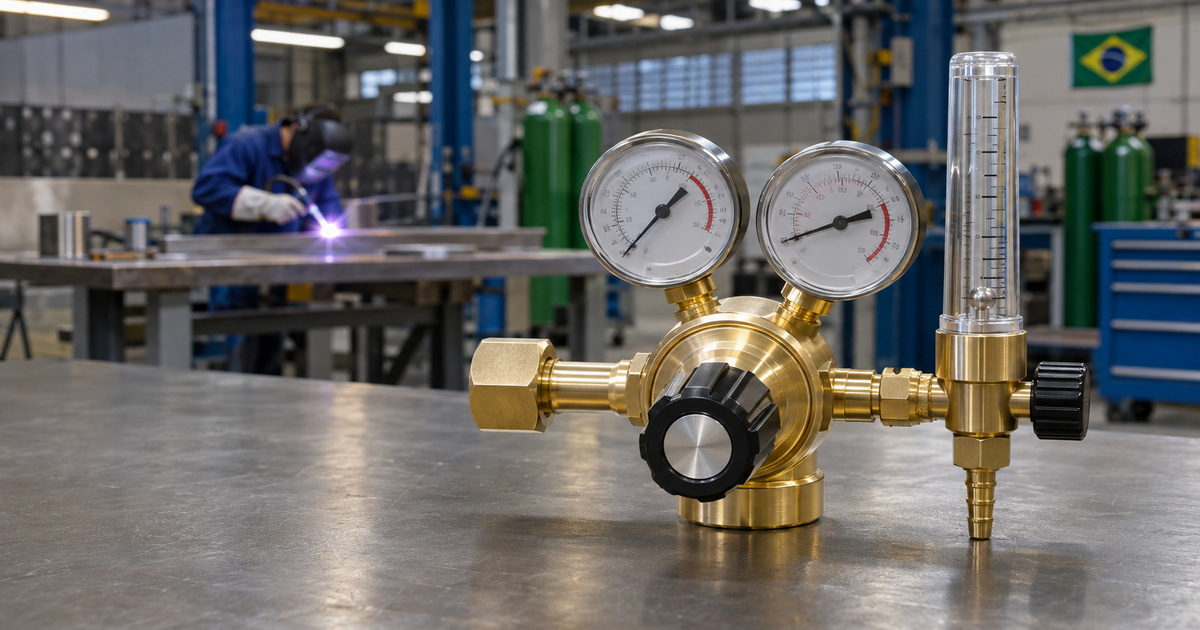
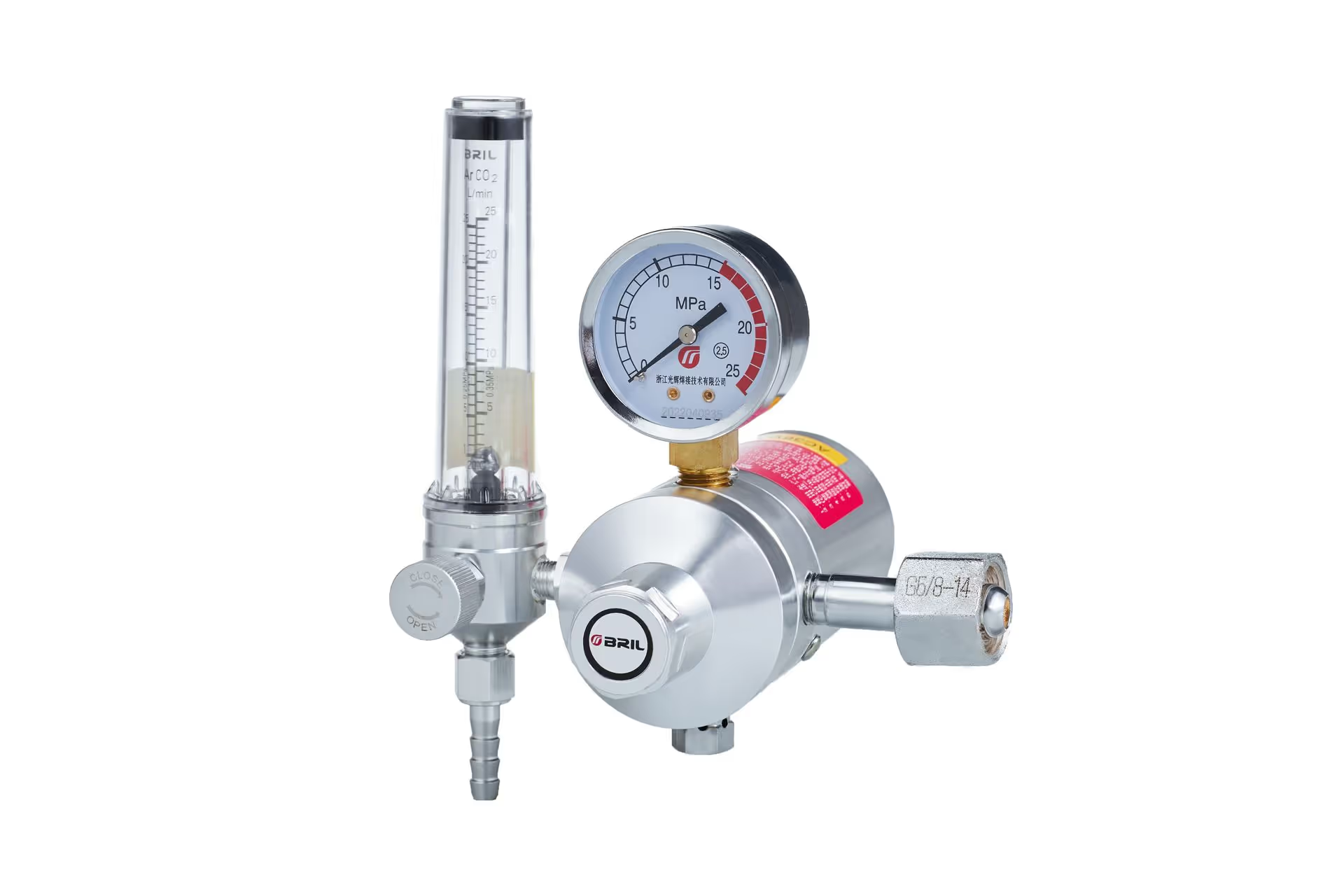
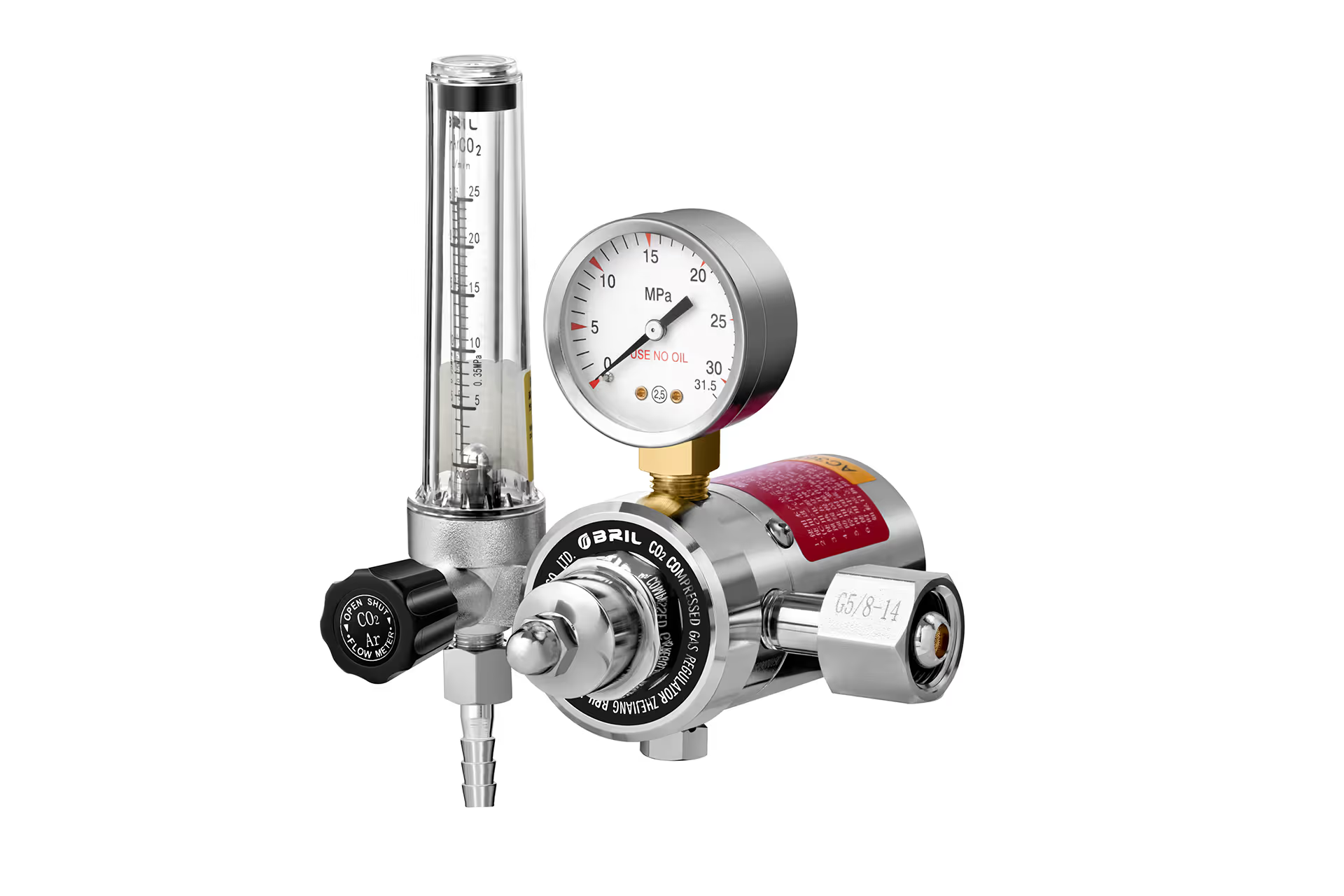
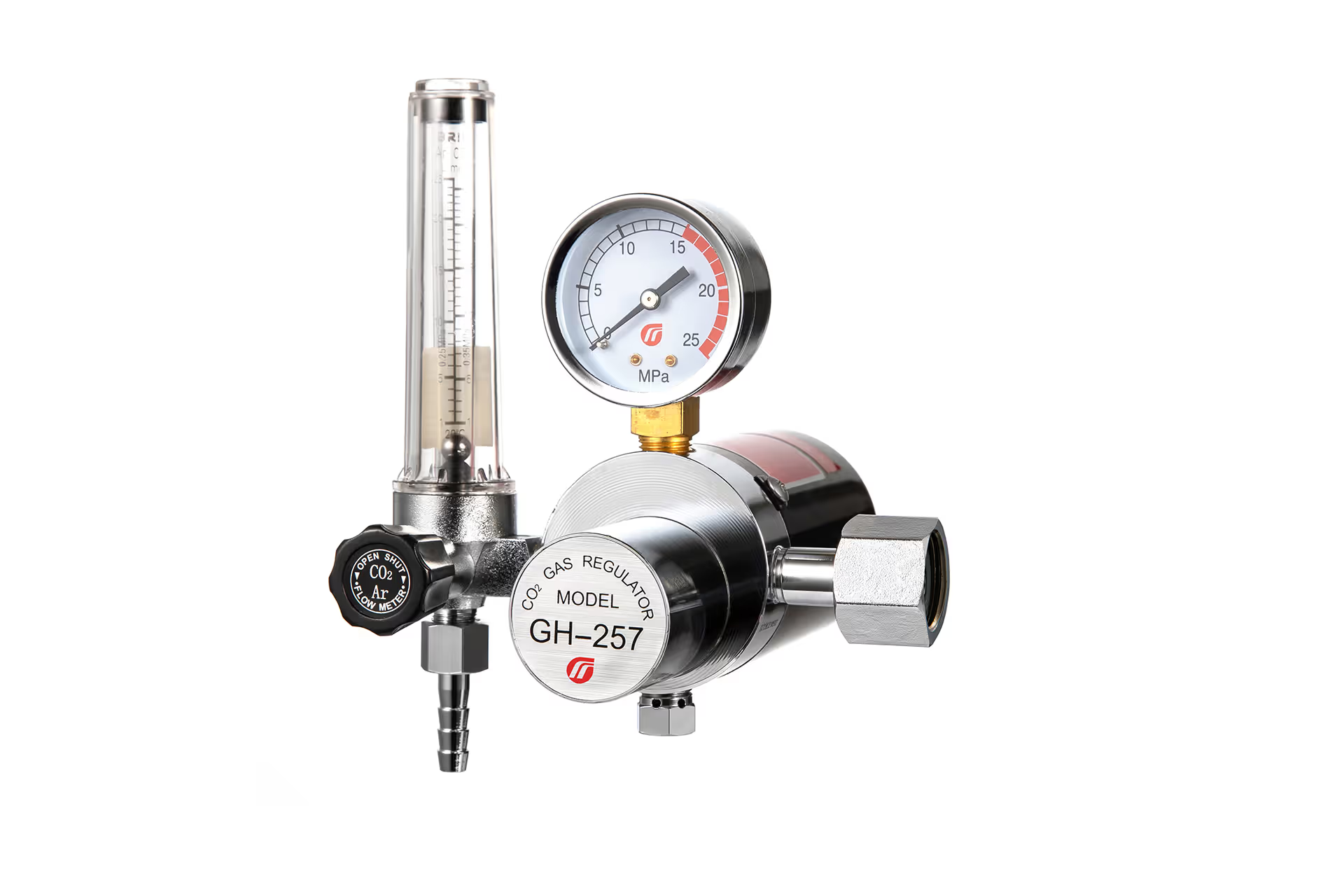
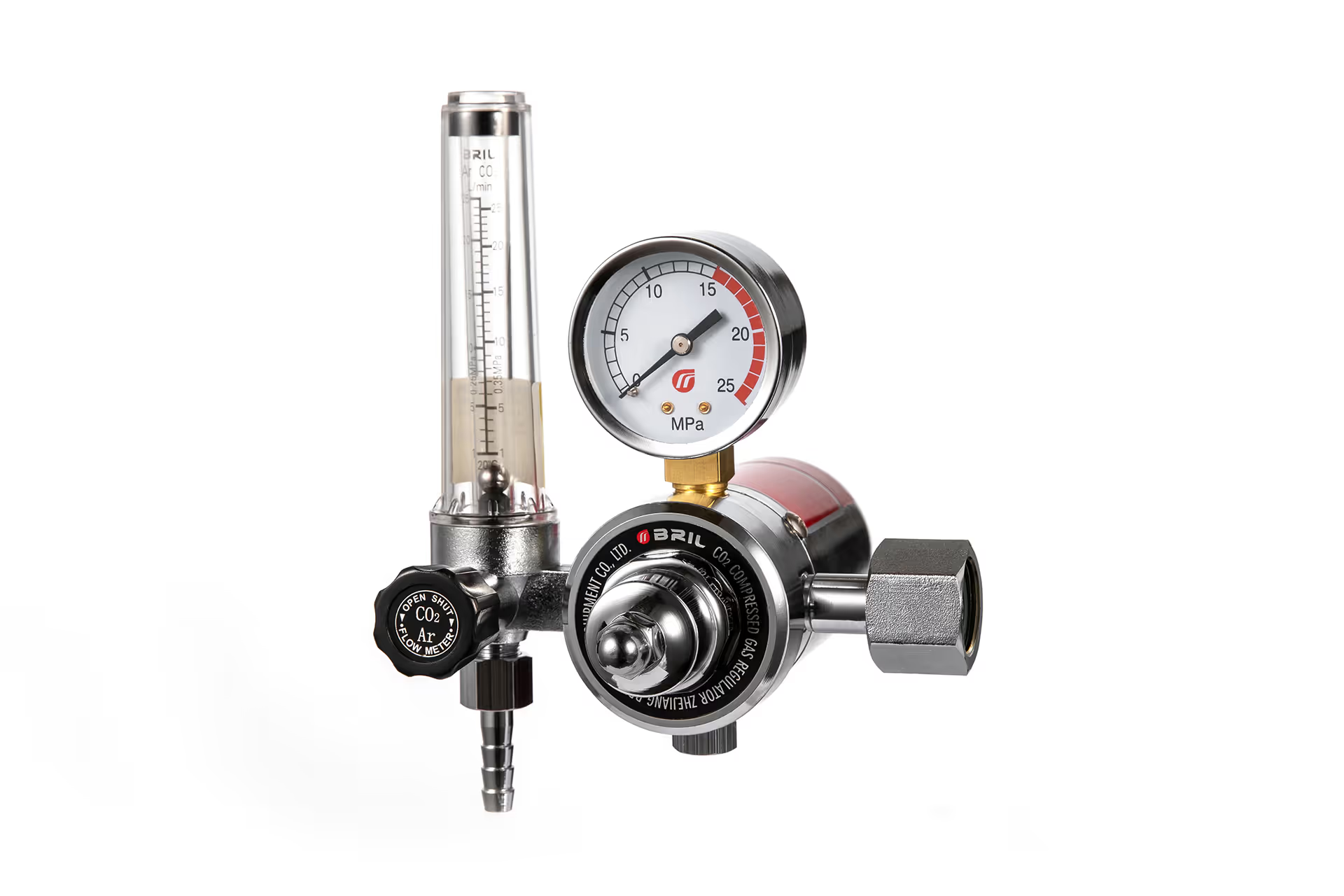
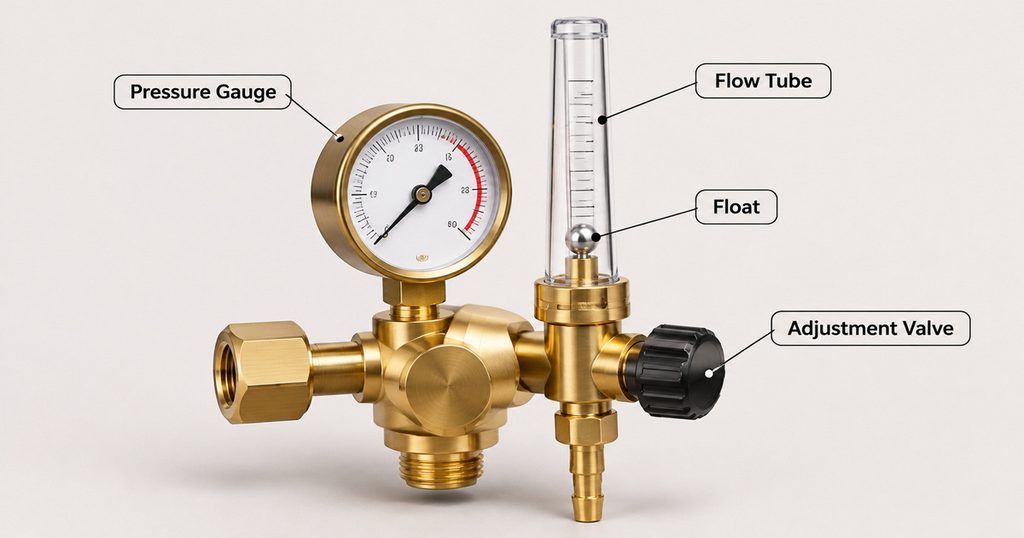
A typical flowmeter regulator combines a pressure-reducing section, a tapered measuring tube, a float, and a flow-adjustment valve.
As gas moves through the tube, it lifts the float. The float’s position corresponds to the marked flow scale under the instrument’s specified conditions.
Many common models use a preset regulated pressure and an adjustable valve to control flow. Designs vary, including pressure-compensated and non-compensated arrangements.
Reading an Argon Flowmeter Correctly
For reliable readings:
1. Use the scale intended for the shielding gas.
2. Mount the instrument in its specified orientation, normally upright.
3. Activate the machine’s gas-test or purge function.
4. Adjust while gas is flowing through the normal delivery path.
5. Read the float at the manufacturer’s specified reference point.
Do not assume every float is read at its top or center. Follow the instructions for that instrument.
Also, a cylinder-mounted flowmeter indicates flow at its installation point. It cannot independently confirm that all indicated gas reaches the torch.
Pressure Regulator vs Flowmeter Regulator: Performance in Practice
Shielding Consistency and Weld Quality
A flowmeter regulator makes it easier to reproduce a documented flow setting. That supports consistent setup, but it does not guarantee a defect-free weld.
Leaks, drafts, poor torch positioning, unsuitable cup geometry, and contamination can compromise shielding despite a normal-looking reading.
Too little flow leaves the weld pool and hot tungsten inadequately protected. Too much can create turbulence that draws surrounding air into the shielding envelope.
The objective is effective shielding, not the highest possible flow.
Ruggedness and Readability
A flowgauge regulator offers a compact dial display without an exposed measuring tube. This can be useful where equipment is moved frequently or subject to impact.
A tube-style flowmeter provides an easily observed flow indication, but it needs protection and correct positioning. Tube guards, legible markings, and access for inspection deserve attention during purchasing.
Neither design wins automatically. Match the instrument to workshop conditions and operator needs.
Cost and Long-Term Value
Compare complete installed systems rather than regulator prices alone.
A lower-cost pressure regulator may still require a separate flowmeter, fittings, installation work, and verification. Conversely, an integrated flowmeter regulator may simplify a straightforward workstation.
The most useful comparison includes:
– Purchase and installation costs.
– Gas consumption.
– Setup time.
– Replacement components.
– Troubleshooting effort.
– Availability of technical support.
Single-Stage vs Dual-Stage: A Separate Buying Decision
“Flowmeter” describes how flow is indicated. “Single-stage” or “dual-stage” describes how pressure is reduced.
These categories are independent.
A single-stage regulator reduces pressure in one step. Its delivery pressure can change as cylinder pressure declines, depending on its design and operating conditions.
A dual-stage regulator reduces pressure in two steps, generally providing more constant delivery pressure as the cylinder empties.
For routine manual TIG work, a well-selected single-stage flowmeter regulator may be sufficient. Dual-stage regulation deserves consideration when pressure variation is unacceptable or cylinders are difficult to monitor.
Do not confuse dual-stage with dual-outlet. Two flow tubes usually provide two independently adjustable gas streams; they do not prove two-stage pressure reduction.
What Argon Flow Rate Should You Use for TIG Welding?
For many ordinary indoor TIG applications, approximately 15–20 CFH, or about 7–9.5 L/min, is a useful starting range. It is not a universal specification.
Cup size, gas lens configuration, tungsten extension, joint access, and air movement all influence the required setting. Other applications may need a different range.
Start with the welding procedure or equipment guidance, then verify shielding under actual conditions.
Why Increasing Flow Can Make Problems Worse
If welds show oxidation or porosity, increasing flow should not be your automatic response.
First inspect:
– Cylinder contents and gas suitability.
– Hose and fitting condition.
– Torch seals and assembly.
– Cup damage or obstruction.
– Nearby fans, extraction airflow, and drafts.
– Tungsten extension and torch angle.
For typical TIG welding, pure argon is a common shielding choice. An argon/CO₂ mixture intended for MIG welding is not an interchangeable substitute.
Practical Insight: Diagnose Gas Delivery at Two Locations
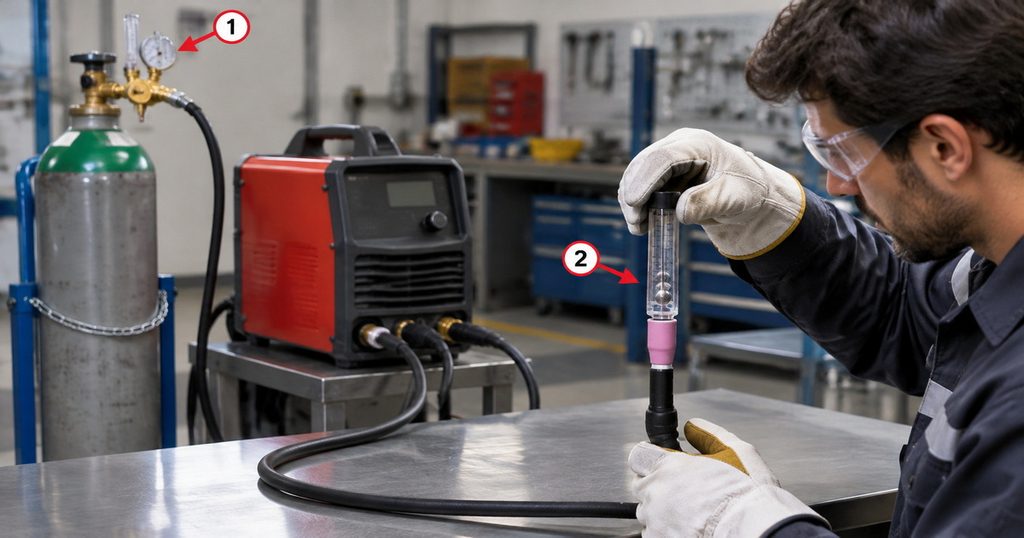
A Repeatable Verification Procedure
1. Inspect the system and confirm component compatibility.
2. Set the desired flow with the machine’s gas-test function active.
3. Check torch delivery using a suitable torch-end flow checker according to its instructions.
4. Compare results under the same operating conditions.
5. Investigate material differences before changing the regulator setting.
6. Record the accepted configuration and settings.
A meaningful discrepancy may indicate leakage, a restriction, an incorrect gas scale, or incompatible measuring conditions.
This procedure turns “the regulator looks normal” into a more complete system check. Remember that torch-end checkers also have operating limitations; use an appropriate instrument rather than treating every reading as interchangeable.
Practical Insight: Control Gas Surges Between Welds
Steady-state flow is only part of TIG gas performance.
When the machine’s solenoid closes, gas can remain pressurized in the upstream hose. At the next opening, the stored gas may produce a brief surge.
Long lines and system pressure can influence this behavior. The result may include wasted gas and disturbed shielding at arc starts.
Practical measures include:
– Keeping hoses no longer than necessary.
– Using manufacturer-approved operating pressures.
– Evaluating purpose-designed surge-control equipment.
– Setting pre-flow for the actual installation.
A dual-stage regulator is not automatically an anti-surge device. Pressure stability and start-up surge control address different operating conditions.
Practical Insight: Quantify Gas Savings Before Changing Equipment
A simple consumption model helps buyers evaluate proposed improvements.
Consider an illustrative workstation reduced from 12 L/min to 9 L/min after shielding performance has been verified. Over 120 minutes of gas-on time, the difference is:
3 L/min × 120 minutes = 360 liters.
This is a calculation, not a measured customer result. It excludes leaks, cylinder residuals, and other losses.
Use total gas-on time—not arc time alone—because pre-flow, post-flow, and purging also consume gas. Never reduce flow solely to meet a savings target without validating weld quality.
OEM and ODM Purchasing Checklist for TIG Gas Regulators
For overseas brands, wholesalers, and equipment manufacturers, a useful specification goes beyond “brass argon regulator with flowmeter.”
Define Application and Connection Requirements
Specify:
– Gas type and intended composition.
– Maximum cylinder or pipeline inlet pressure.
– Machine inlet requirements.
– Flow range and display units.
– Destination-market cylinder connection.
– Outlet connection and hose arrangement.
– Required mounting orientation.
A connector that fits one market may not fit another. Avoid using adapters as a substitute for correct product selection.
Request Evidence of Performance
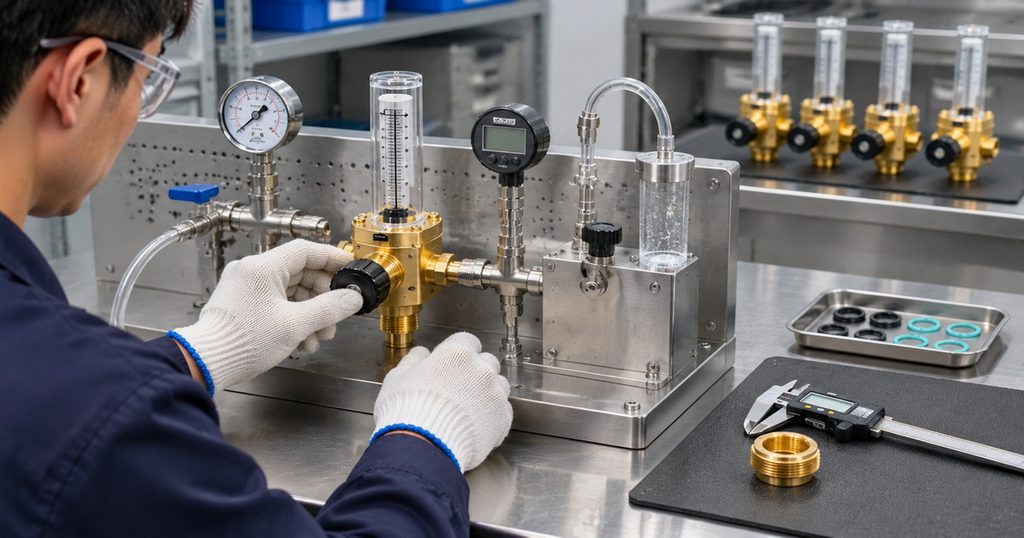
Ask suppliers to define and document relevant acceptance criteria, including:
– External leakage and seat leakage.
– Delivery-pressure behavior.
– Flow indication under stated test conditions.
– Valve adjustment performance.
– Material specifications.
– Traceability and inspection records.
High-quality brass supports a robust product, but material alone does not establish accuracy or stability. Machining, sealing, assembly cleanliness, and testing also matter.
Any claimed compliance should identify the applicable standard and supporting documentation, rather than relying on a generic “international standard” statement.
Which Regulator Should You Choose?
Choose a flowmeter regulator when you want straightforward, visible shielding gas adjustment at a manual TIG workstation.
Choose a welding flowgauge regulator when compactness and rugged handling are priorities and its calibrated operating arrangement suits the installation.
Choose a pressure-only regulator when a separate, correctly specified downstream device measures and controls flow.
For OEM or distributor projects, send us your target market, cylinder connection, shielding gas, flow range, inlet requirements, and branding needs. Our gas-regulator manufacturing and OEM/ODM services can support an application-specific specification, followed by sample evaluation before volume purchasing.
Frequently Asked Questions
1.Can I use a regular pressure regulator for TIG welding?
Yes, provided it is suitable for the gas and pressure involved and works with appropriate downstream flow measurement or control. A pressure reading alone does not establish shielding gas flow.
2.Is a flowmeter regulator always more accurate than a flowgauge regulator?
No. Accuracy depends on design, calibration, gas type, operating conditions, and installation. A flowmeter makes flow easier to observe, but neither arrangement should be judged by appearance alone.
3.Why does the flowmeter float drop when I stop welding?
On many machines, the solenoid closes when the gas cycle ends. Flow stops, so the float drops. Adjust flow while the gas-test function or appropriate gas cycle is active.
4.Do I need a dual-stage regulator for TIG welding?
Not necessarily. It is worth considering when consistent delivery pressure across cylinder depletion is important. Many routine manual applications work well with suitable single-stage equipment.
5.Can one regulator supply torch shielding and back purging?
Yes, with a suitable dual-flowmeter arrangement and sufficient capacity. Each branch needs independent adjustment. Purge requirements must be established separately from torch shielding requirements.
6.Can I use a CO₂ regulator for argon TIG welding?
Do not assume interchangeability. Connections, pressure ratings, calibration, and intended gas service must all match. Select equipment explicitly specified for the shielding gas and application.
References
1. Miller Electric — “Best Practices for Proper Shielding Gas in TIG Welding.” Technical guidance covering shielding flow, turbulence, gas lenses, and long-line start-up surges. [millerwelds]
2. Miller Electric — “Common TIG Welding Problems.” Practical guidance supporting the 15–20 CFH starting range and troubleshooting inadequate gas coverage. [millerwelds]
3. Harris Products Group — “Shielding Gas.” Explanation of flowmeter, flowgauge, and non-compensated flow-control arrangements. [harrisproductsgroup]
4. Harris Products Group — “Two-Stage Regulators.” Explanation of two-stage pressure reduction and improved delivery-pressure consistency as inlet pressure changes. [harrisproductsgroup]
5. Miller Electric — “Argon/CO₂/Helium Medium-Duty Flowmeter Regulator w/ Inert Hose and Fittings.” Product documentation illustrating preset pressure, gas-specific scales, adjustment valves, and surge-protection accessories. [millerwelds]
6. Miller Electric — “Argon/CO₂/Helium Medium-Duty Dual Flowmeter Regulator, 50 PSIG.” Documentation illustrating independently controlled gas streams from one cylinder. [millerwelds]
7. Harris Products Group — “Flowmeter Regulators.” Product information distinguishing pressure-compensated and zero-compensated flowmeter designs. [harrisproductsgroup]
Hot Tags: TIG Welding Gas Regulator, Argon Flowmeter Regulator, Argon Pressure Regulator, Welding Gas Regulator Manufacturer, TIG Welding Flowmeter, Dual Stage Argon Regulator, Dual Flowmeter Argon Regulator, Industrial Gas Pressure Regulator, OEM Welding Gas Regulator, Wholesale Argon Regulators