Content Menu
● Indonesia’s Position in the Argon Gas Regulator Supply Chain
● How the Suppliers Were Selected
● Five Argon Gas Regulator Manufacturers and Suppliers to Evaluate
>> 1. Zhejiang Bril Welding Equipment Co., Ltd.
>> 2. PT Multi Mayaka / MultiPro
>> 3. PT Amcoweld Indonesia / Amcoweld Regional Network
● Comparison Table: Capacity, MOQ, and Certification
● Technical Buyer’s Guide: What Determines Regulator Quality?
>> Specify the Function Before Comparing Prices
>> Define the Brass Grade and Construction
>> Check Standards at Product Level
>> Interpret CE and RoHS Correctly
● Common Procurement Traps—and How to Avoid Them
>> Trap 1: Treating Two Gauges as Proof of Two-Stage Construction
>> Trap 2: Accepting an Unspecified Connection
>> Trap 3: Comparing Quotations with Different Test Scope
>> Trap 4: Allowing Uncontrolled Component Substitution
● An Often-Overlooked Insider Check: The Flowmeter’s Calibration Basis
● Factory Verification, Samples, and Logistics
>> Verify the Actual Production Route
>> Use a Three-Step Sample Process
>>> Step 1: Engineering Sample
>>> Step 2: Performance Qualification
>> Separate Production Lead Time from Delivery Time
● Conclusion: Match the Supplier to the Procurement Model
● FAQ
>> 1. How Can I Check Whether a Supplier’s ISO 9001 Certificate Has Expired or Been Suspended?
>> 2. What Evidence Demonstrates Genuine Two-Stage Construction?
>> 3. Can One Argon Flowmeter Be Used for Argon/CO₂ Mixtures?
>> 4. Does a CE-Marked Regulator Automatically Meet ISO 2503?
>> 5. How Can I Prevent a Good Sample from Being Followed by Lower-Quality Bulk Production?
Choosing an argon gas regulator supplier requires more than comparing prices and gauge designs. Professional buyers need to establish who actually manufactures the regulator, how pressure-control performance is verified, and whether the supplier can support repeat orders without unapproved material or component changes.
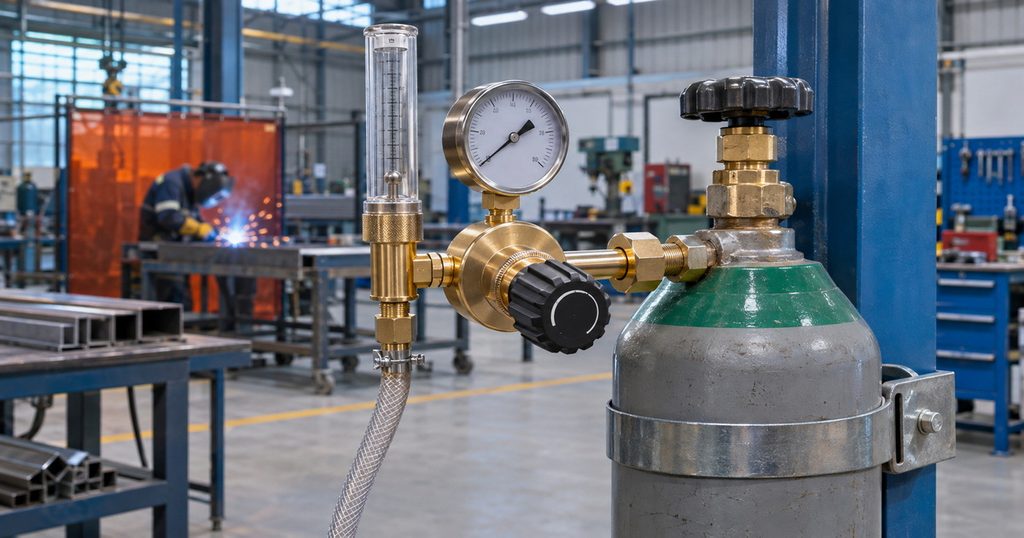
Indonesia offers several sourcing routes: domestic industrial distributors, international welding-equipment channels, regional suppliers, and overseas factories supporting Indonesian importers. These businesses perform different roles. A distributor with local technical support may suit urgent maintenance requirements, while a direct manufacturer may be more appropriate for private-label development.
Indonesia’s Position in the Argon Gas Regulator Supply Chain
Indonesia’s industrial development provides important context for welding-equipment procurement. Metal processing, fabrication, and integrated industrial projects require dependable industrial-gas handling and related technical support.
An Indonesian government investment announcement in 2025 highlighted integrated industrial clusters, including nickel-related operations connecting production with downstream activities. Separately, a September 2026 German-Indonesian Chamber of Industry and Commerce update discussed changing manufacturing conditions and continued government attention to domestic steel competitiveness. These sources establish industrial context; neither provides a standalone market valuation for argon gas regulators.
For buyers, the practical advantage of sourcing through Indonesia is access to domestic distribution, local communication, and project support. For customized products, however, the manufacturing source may still be outside Indonesia.
The distinction matters:
– Local stock availability is not the same as domestic manufacturing capacity.
– A welding-equipment distributor is not automatically a regulator design owner.
– A well-known brand name does not confirm that a specific regulator is immediately available.
– A factory’s general certification does not establish compliance for every model.
Consequently, buyers should evaluate the supply route and the product together—not treat every company in a supplier directory as an equivalent manufacturer.
How the Suppliers Were Selected
The following criteria provide a transparent basis for assessing the shortlist.
| Evaluation area | Evidence buyers should request | Procurement significance |
|---|---|---|
| Business identity | Legal company name, address, manufacturing or distribution role | Establishes who is responsible for production and warranty |
| Product relevance | Argon regulator catalog, model specifications, connection drawings | Prevents selection based only on a broad welding-equipment portfolio |
| Engineering capability | Drawings, revision records, sample-development process | Indicates whether customization extends beyond branding |
| Quality control | Leak-test procedures, pressure-performance records, calibrated inspection equipment | Supports repeatable performance |
| Certification | Current certificates, scope, model-specific reports | Separates documented compliance from general claims |
| Delivery reliability | Written lead times, stock confirmation, historical delivery records where available | Reduces replenishment risk |
| Commercial suitability | MOQ, tooling charges, spare parts, warranty responsibilities | Reveals the complete cost of cooperation |
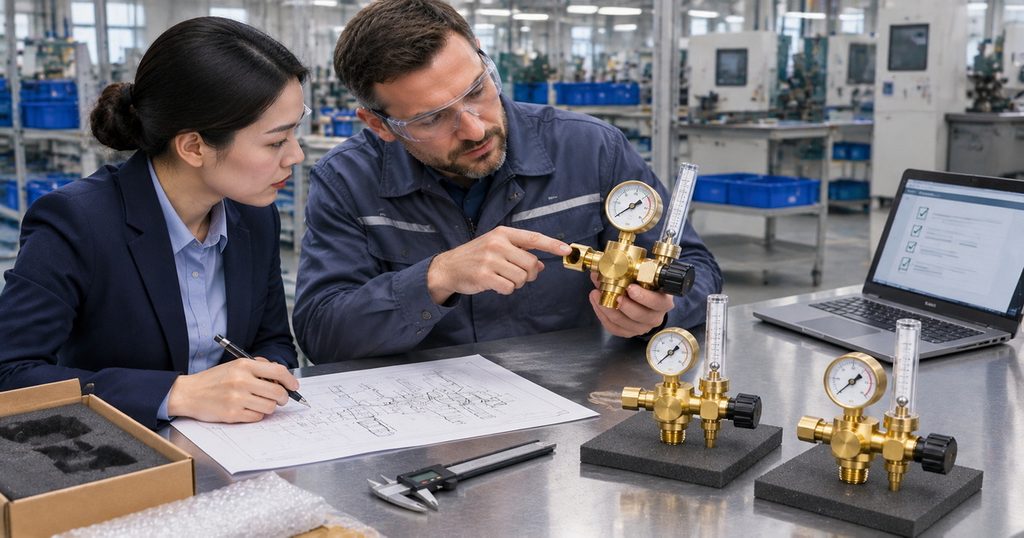
Five Argon Gas Regulator Manufacturers and Suppliers to Evaluate
1. Zhejiang Bril Welding Equipment Co., Ltd.
| Profile item | Details |
|---|---|
| Supplier role | Direct industrial gas regulator manufacturer and OEM/ODM option |
| Founded | 2002 |
| Manufacturing location | Wenzhou, Zhejiang, China |
| Main markets | Domestic China and overseas industrial-equipment customers; company reports serving more than 30 countries and regions |
| Procurement fit | Importers, wholesalers, distributors, welding-equipment manufacturers, and private-label brands |
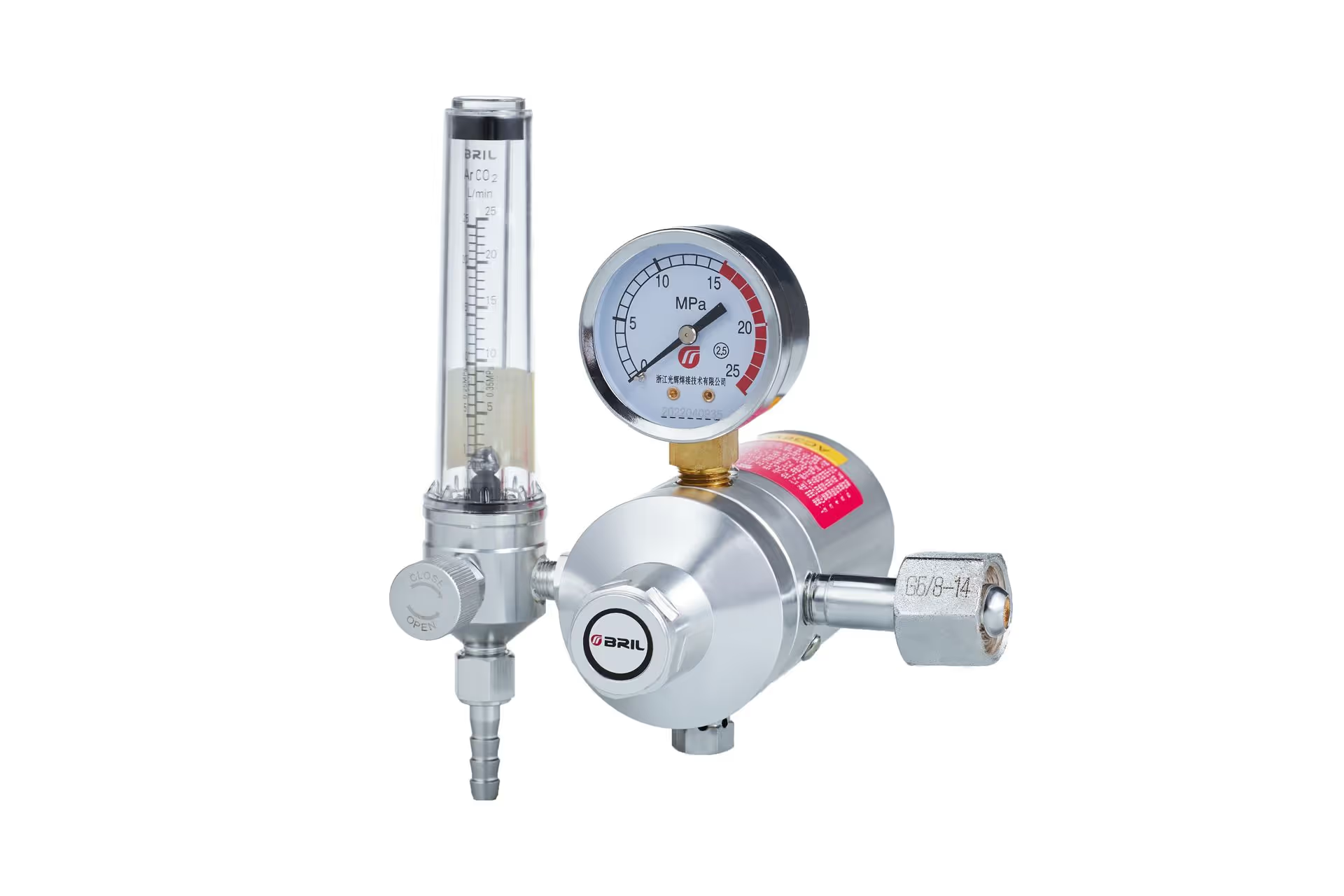
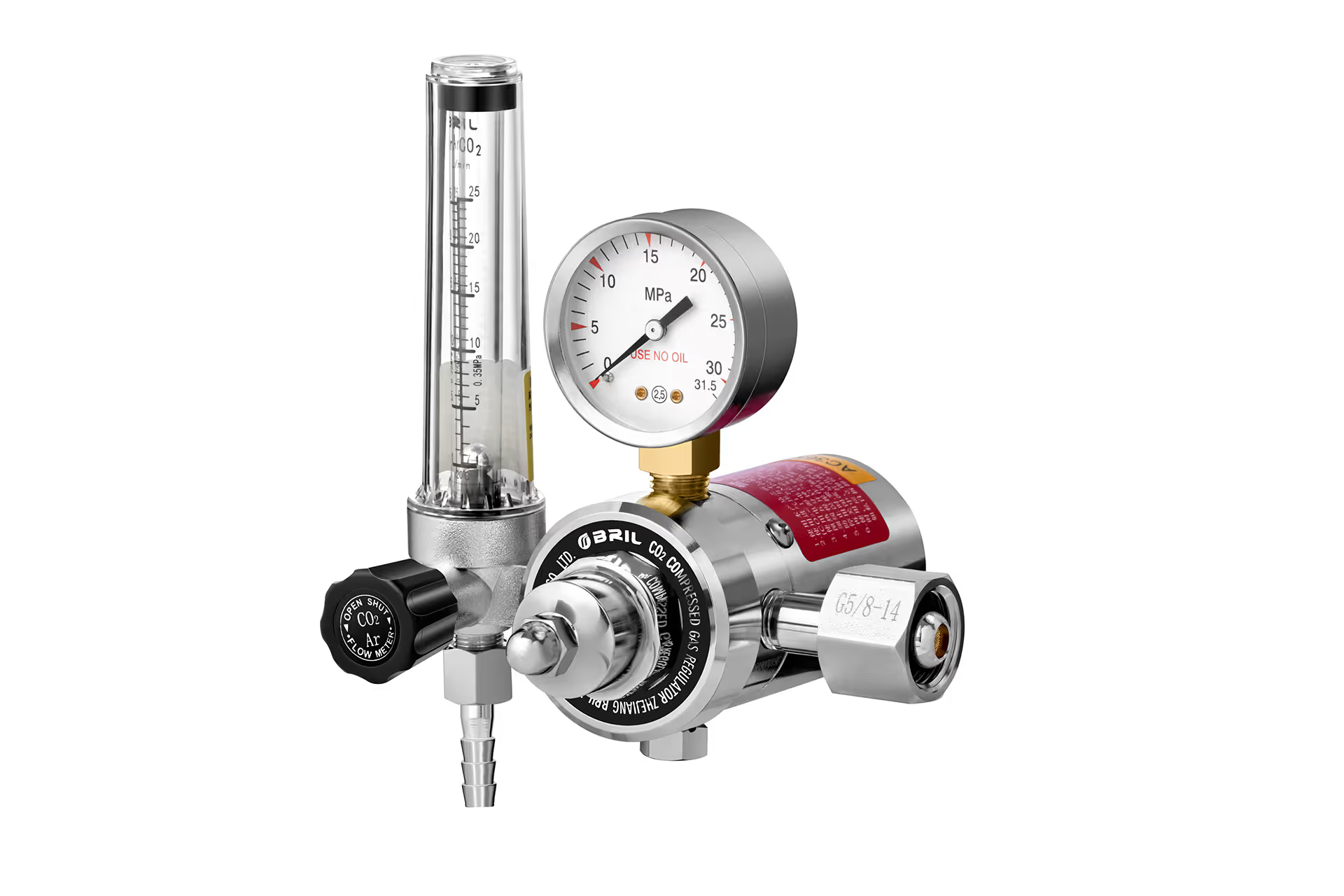
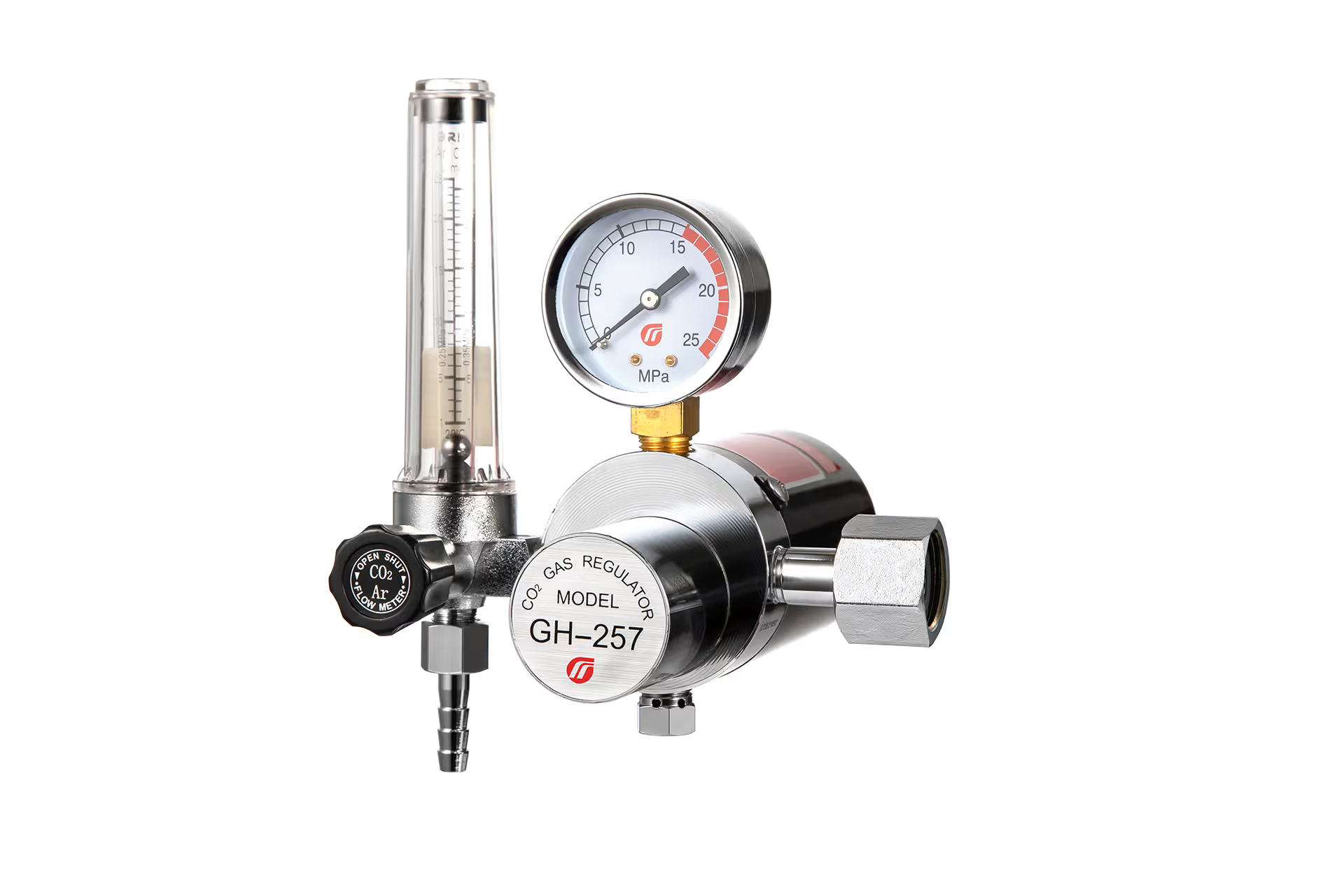
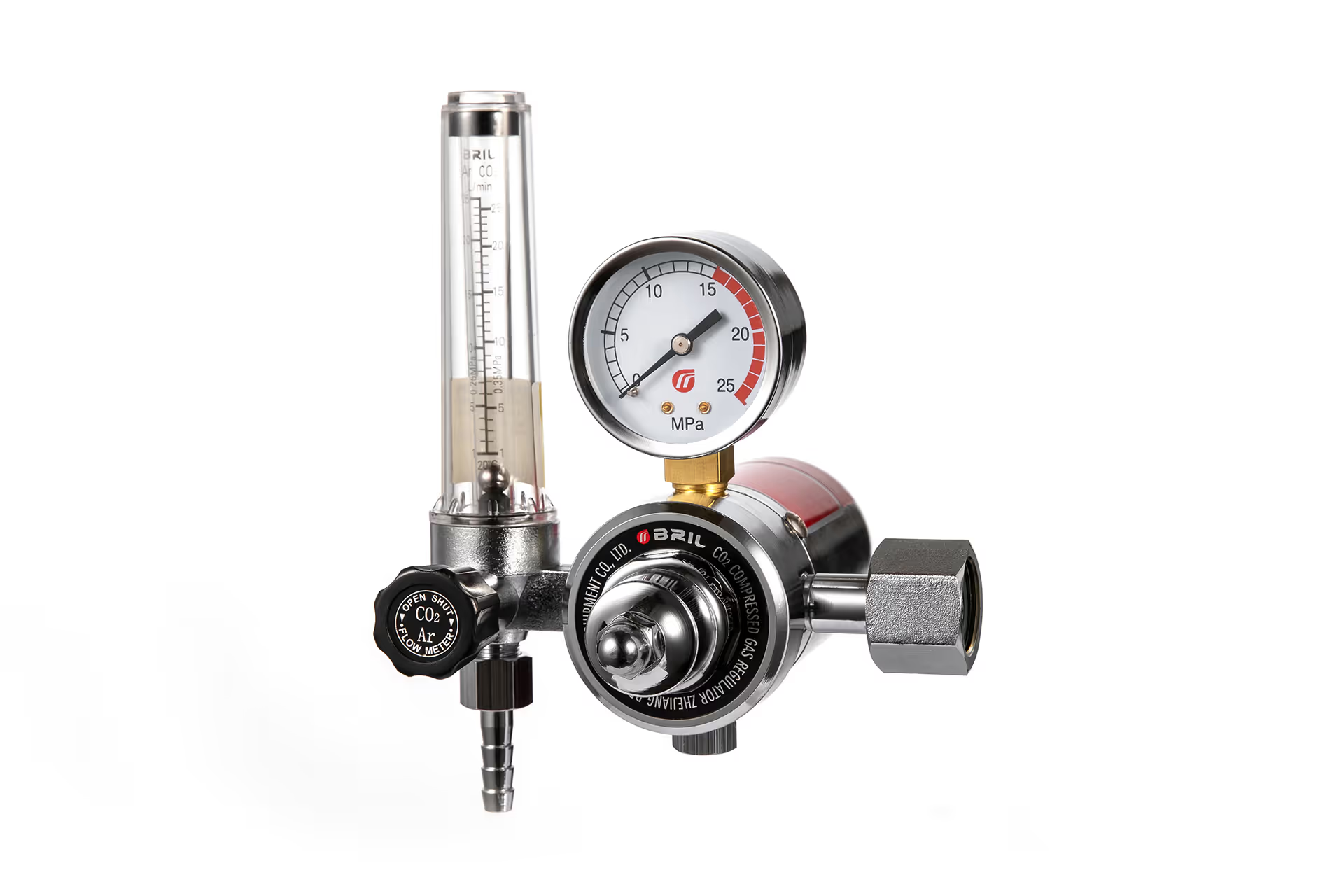
Zhejiang Bril Welding Equipment Co., Ltd. specializes in developing, manufacturing, and selling industrial gas pressure regulators. Its published profile identifies more than 200 employees and over 3,500 square meters of production space. These are company-reported operating indicators, not independently verified annual production figures.
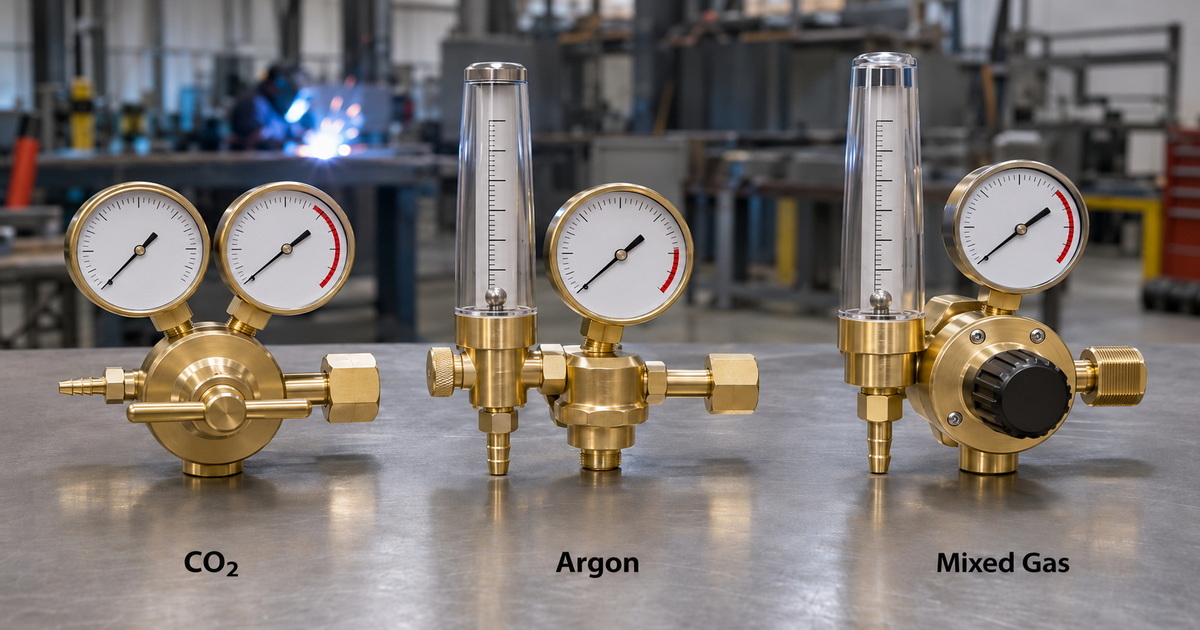
Its product scope, as described for this guide, includes argon regulators, CO₂ regulators, heated CO₂ regulators, oxygen regulators, acetylene regulators, propane regulators, nitrogen regulators, and dual-stage designs.
Bril’s relevance is its manufacturing relationship rather than local Indonesian stockholding. Its company profile describes OEM supply to welding-equipment businesses and identifies international customer relationships. Those references support further qualification, although buyers should verify any partnership claims that materially affect a purchasing decision.
For small and medium-sized brands, Bril is a candidate for a value-oriented sourcing program combining standard regulator platforms with customization. However, comparative cost advantages, flexible order quantities, and response speed should be established through quotations and sample development—not assumed from positioning.
OEM/ODM scope to discuss
A detailed inquiry should cover:
– Inlet and outlet connection configurations.
– Gauge units, dial artwork, and branding.
– Argon flow ranges and calibration conditions.
– Packaging, manuals, and traceability markings.
– Diaphragm, seat, and seal specifications.
– Drawing ownership and approval of engineering changes.
– Spare-part availability and warranty procedures.
The company states that it has ISO 9001 certification and refers to CE- and CNAS-related credentials. Buyers should obtain the underlying documents and clarify the issuing body, accreditation status, test scope, and exact models covered. A reference to CNAS should not be treated as a substitute for reviewing the laboratory report and its accreditation scope.
Procurement recommendation: evaluate Bril when direct technical communication and deeper OEM involvement matter more than immediate local delivery. Test communication efficiency by asking for one consolidated response covering drawings, deviations, testing, MOQ, and delivery milestones.
2. PT Multi Mayaka / MultiPro
| Profile item | Details |
|---|---|
| Supplier role | Indonesian importer and distributor |
| Founded | Exact year not established in reviewed official information; company reports more than 50 years of distribution experience |
| Location | Pulogadung Industrial Area, East Jakarta |
| Main market | Indonesia |
| Procurement fit | Workshops, industrial resellers, distributors, and buyers consolidating standard welding accessories |
PT Multi Mayaka describes itself as an importer and distributor serving industrial, professional, business, and household customers. Its portfolio includes welding equipment and the MultiPro brand. The company also describes a nationwide distribution and after-sales network.
Product relevance is directly supported by MultiPro’s welding regulator catalog. Listed products include the Argon Gas Regulator-129, part number 5.000.129.001, and Argon Gas Regulator ARR-136, part number 5.00B.136.001. The same page lists regulators for several other gases.
The ARR-136 listing specifies “12 PCS/BOX.” That is a packaging quantity, not proof that the purchasing MOQ is twelve units. Buyers should ask separately about carton quantities, minimum order value, and mixed-model orders.
Its core advantage is a domestic distribution structure combined with an identifiable regulator range. The reviewed information does not establish that PT Multi Mayaka manufactures these regulators itself.
OEM/ODM scope: private-label production, internal redesign, and buyer-owned tooling were not confirmed in the reviewed material. Buyers seeking these services should request written clarification before treating this channel as a factory-development partner.
Procurement recommendation: consider MultiPro for established catalog products and domestic replenishment, subject to current stock, technical-documentation, and warranty confirmation.
3. PT Amcoweld Indonesia / Amcoweld Regional Network
| Profile item | Details |
|---|---|
| Supplier role | Welding and cutting equipment supply channel |
| Founded | Regional business states operations since 1995; Indonesian entity’s incorporation year requires confirmation |
| Indonesian presence | PT Amcoweld Indonesia is identified in Batam |
| Main markets | Regional network includes Malaysia, Singapore, Indonesia, and Vietnam |
| Procurement fit | Industrial users seeking branded regulators alongside broader welding and cutting equipment |
Amcoweld’s regional profile describes a welding and cutting equipment business operating since 1995, with regional offices including Indonesia. It also describes technical support, repair services, spare parts, and a broad equipment portfolio. A separate company profile identifies PT Amcoweld Indonesia in Batam.
Regulator relevance is supported by the regional catalog’s Messer Constant 2000 listing. The page identifies argon among the available gas services and describes single-stage and two-stage versions, inlet-pressure options up to 200 or 300 bar, and country-specific connection configurations. It also states compliance with ISO 2503. These are product-family claims; the quotation must identify the actual variant supplied.
The main attraction is access to branded gas-control equipment through a wider welding-equipment network.
OEM/ODM scope: the reviewed evidence supports branded equipment supply, not an assumption that the Indonesian entity offers buyer-owned regulator designs or private-label manufacturing.
Procurement recommendation: confirm whether the quotation, inventory, warranty, and technical support will be provided by the Indonesian business or another regional entity. Regional catalog availability does not establish Indonesian stock.
4. PT Duta Graha Miller
| Profile item | Details |
|---|---|
| Supplier role | Indonesian welding and cutting equipment distributor |
| Founded | 2005 under its present name; company states earlier market activity from 1995 as PT Multisarana Intijaya |
| Main location | Jakarta, with dealer locations identified in Cikarang and Balikpapan |
| Main market | Indonesian industrial projects |
| Procurement fit | Fabricators and project buyers seeking a coordinated welding-equipment supply relationship |
PT Duta Graha Miller describes experience supplying oil and gas, power plants, refineries, pipeline work, fabricators, and other Indonesian industries. Its official company history distinguishes establishment in 2005 from earlier activity under another company name.
Its website presents the business as an authorized Miller welding-machine distributor. Separately, Miller’s official product range includes an argon/CO₂ heavy-duty flowmeter regulator with a stated range of 5–38 liters per minute and a preset outlet pressure of 6 bar. However, the reviewed Indonesian distributor pages do not confirm local availability of that exact regulator.
This makes Duta Graha Miller a relevant inquiry channel rather than a confirmed stockist of every Miller gas-control product.
OEM/ODM scope: the reviewed information supports distribution and industrial-project supply. It does not establish private-label regulator manufacturing or custom internal regulator development.
Procurement recommendation: request an exact manufacturer part number, written supply confirmation, connection details, and warranty coverage. Do not assume that authorization for welding machines automatically covers every gas-control product line.
5. MISUMI Indonesia
| Profile item | Details |
|---|---|
| Supplier role | Industrial component procurement and distribution platform |
| Founded | MISUMI Group founded in Japan in 1963; Indonesian entity’s incorporation year not established in reviewed sources |
| Main market | Indonesian engineering and industrial procurement |
| Product relevance | Indonesian catalog includes NISSANTANAKA argon pressure regulator listings |
| Procurement fit | Buyers who prioritize part-number control and standardized catalog purchasing |
MISUMI’s Indonesian company profile describes its role in supplying industrial engineering components. Its group profile dates the Japanese business to 1963; that date should not be represented as the founding year of the Indonesian operation.
The Indonesian catalog includes the NISSANTANAKA LQ650FAB argon pressure regulator. This supports its inclusion as a sourcing channel for a specified catalog product, rather than as an Indonesian argon regulator factory.
Its practical value is structured purchasing around identified products. Buyers should still verify the original manufacturer’s documentation, connection compatibility, current delivery terms, and any model-specific certification.
OEM/ODM scope: the reviewed regulator listing does not establish private-label development or custom regulator engineering. Catalog procurement and component configurability elsewhere in a platform should not be confused with gas-regulator ODM capability.
Procurement recommendation: consider MISUMI for defined replacement requirements or controlled part-number purchasing, while confirming that the listed configuration matches the actual cylinder and welding system.
Comparison Table: Capacity, MOQ, and Certification
The table below separates published information from items requiring quotation. A supplier’s employee count, warehouse network, or catalog size cannot be converted reliably into regulator output capacity.
| Company | Supply route | Published regulator capacity | Published MOQ | Certification or compliance evidence | OEM/ODM position |
|---|---|---|---|---|---|
| Zhejiang Bril | Overseas direct manufacturer | Annual unit capacity not disclosed; company reports 200+ employees and 3,500+ m² | Not disclosed | Company states ISO 9001 and CE/CNAS-related credentials; verify documents and model scope | OEM relationships described; project details require agreement |
| PT Multi Mayaka / MultiPro | Indonesian importer/distributor | Manufacturing capacity not established | Not disclosed; ARR-136 lists 12 pieces per box | Request model-specific documentation | Not confirmed publicly |
| PT Amcoweld Indonesia / regional network | Regional branded-equipment channel | Not disclosed | Not disclosed | Regional Constant 2000 page states ISO 2503 compliance | Custom branding and design ownership not confirmed |
| PT Duta Graha Miller | Indonesian distributor | Not established as regulator manufacturer | Not disclosed | Request exact regulator documentation and product-line authorization | Not confirmed publicly |
| MISUMI Indonesia | Industrial catalog channel | Not applicable as a claimed local regulator factory | Confirm by part number | Check original manufacturer’s model-level evidence | Regulator private-label service not established |
Technical Buyer’s Guide: What Determines Regulator Quality?
Specify the Function Before Comparing Prices
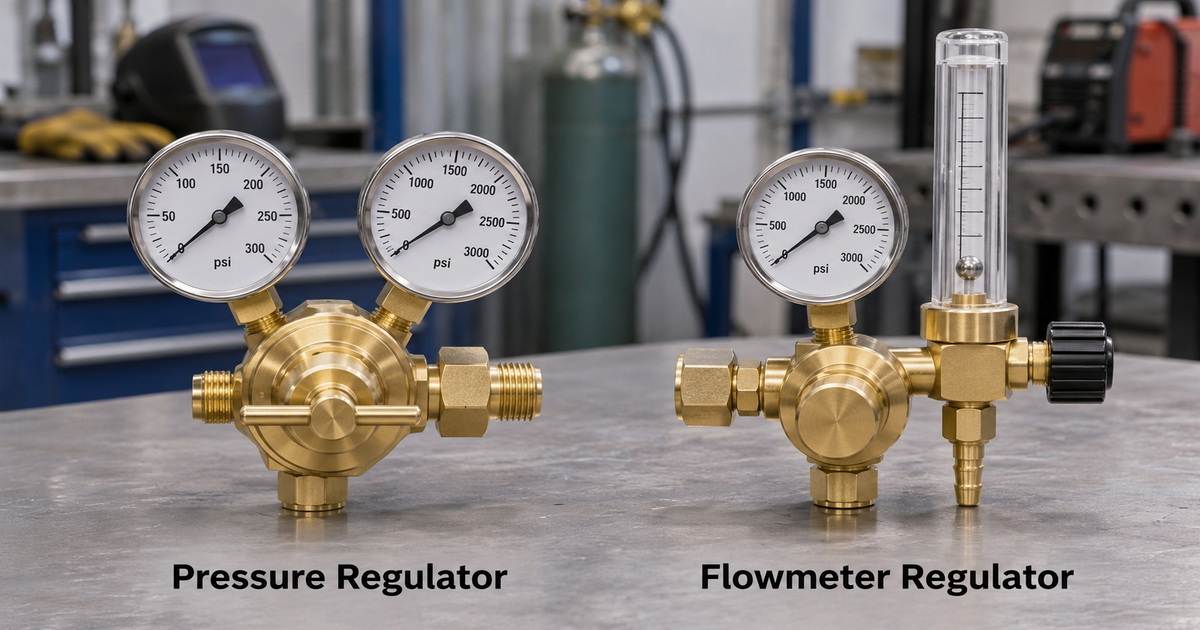
An argon pressure regulator and an argon flowmeter regulator are not necessarily interchangeable purchasing descriptions.
A pressure regulator controls downstream pressure. A regulator with a flowmeter also provides a means of indicating flow. ISO 2503 addresses welding gas regulators both with and without flow-metering devices within its stated scope.
Your inquiry should therefore identify:
– Gas composition: pure argon or a specified mixture.
– Maximum cylinder pressure.
– Required outlet pressure and flow range.
– Single-stage or two-stage construction.
– Cylinder-valve connection.
– Outlet connection and hose arrangement.
– Intended operating conditions.
– Whether one welding torch or multiple outlets will be supplied.
Avoid descriptions such as “standard argon regulator.” The exact gas, connection, and performance requirements must appear in the approved specification.
Define the Brass Grade and Construction
“High-quality brass” is not a complete material specification.
Ask the manufacturer to identify the alloy grade and applicable material standard. Where relevant, request a material certificate linked to the production batch. The drawing should also identify critical dimensions and whether the body is forged, machined from stock, or produced by another process.
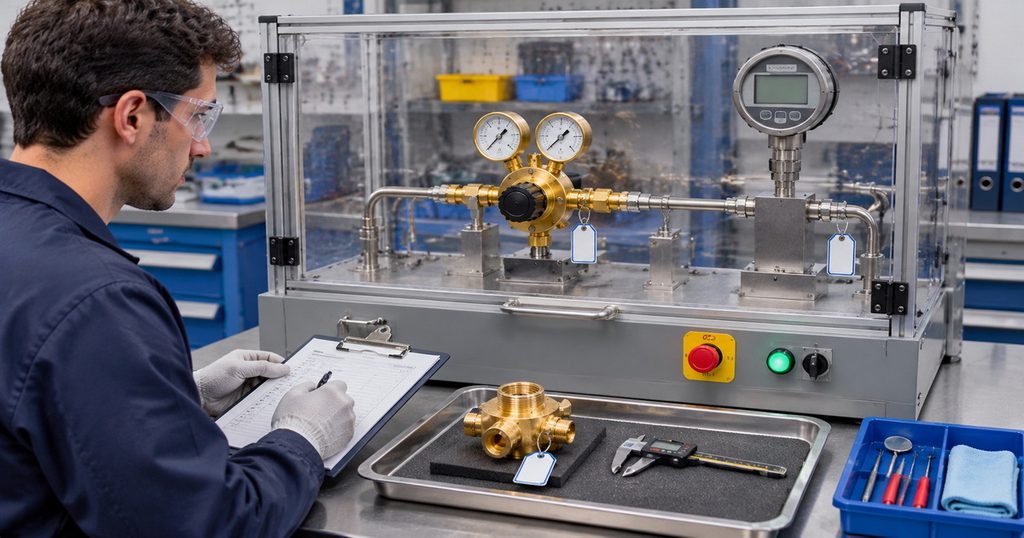
For incoming qualification, establish a documented inspection plan covering:
– Material identification.
– Body and thread dimensions.
– Surface condition and plating.
– Assembly cleanliness.
– Internal and external leakage.
– Pressure-control and flow performance.
A material test cannot replace pressure-performance testing. Conversely, a successful short functional test does not establish that the specified alloy was used.
Check Standards at Product Level
ISO 2503 is directly relevant to welding gas pressure regulators and regulators incorporating flow-metering devices within its scope. The reviewed standard text covers compressed-gas cylinder applications up to 300 bar and includes requirements relating to gas tightness and flow indication. It also identifies ISO 5171 for pressure gauges and flow gauges.
Ask the supplier to identify:
1. The exact standard and edition used.
2. The model and configuration tested.
3. Maximum inlet pressure.
4. Test laboratory and report number.
5. Any limitations, exclusions, or deviations.
Do not accept a standard number printed on packaging as the complete compliance file.
Interpret CE and RoHS Correctly
CE marking is not a universal quality award. European Union guidance explains that it applies only where relevant EU legislation requires it, and that some pressure equipment falls within those rules. The manufacturer must determine the applicable requirements and prepare the necessary conformity documentation.
RoHS concerns restricted substances in electrical and electronic equipment. It should not automatically be demanded as though it were a universal performance certification for every mechanical argon regulator. MISUMI’s own guidance also distinguishes RoHS information from CE conformity.
For a heated CO₂ regulator included in the same sourcing program, assess its electrical features separately. Do not assume that documents for an unheated mechanical regulator cover the heated model.
Common Procurement Traps—and How to Avoid Them
Trap 1: Treating Two Gauges as Proof of Two-Stage Construction
A two-gauge appearance does not establish two-stage pressure reduction.
Ask for a sectional drawing, a written description of the regulating stages, and pressure-performance evidence across the intended inlet-pressure range. Put the approved construction into the purchase specification.
Trap 2: Accepting an Unspecified Connection
Amcoweld’s Constant 2000 catalog identifies multiple connection families, including DIN, CEN, BS, and CGA options. This illustrates why “argon connection” is insufficient as an ordering description.
Request a dimensioned connection drawing and verify it with the actual cylinder-valve specification. Do not approve a purchase solely because an adapter appears to make the parts fit.
Trap 3: Comparing Quotations with Different Test Scope
A low price may exclude inspection records, customized packaging, spare seals, additional testing, or replacement parts.
Use a common quotation sheet. Separate:
– Product price.
– Testing and documentation.
– Tooling and artwork.
– Packaging.
– Freight terms.
– Warranty and replacement obligations.
Trap 4: Allowing Uncontrolled Component Substitution
For repeat orders, require approval before changes to the body material, diaphragm, valve seat, spring, gauge, or flowmeter assembly.
Keep an approved sample and drawing revision. Define which changes require retesting and whether requalification costs fall to the supplier or buyer.
An Often-Overlooked Insider Check: The Flowmeter’s Calibration Basis
A clear flow tube and a moving float can make two regulators look equally convincing. The less visible issue is the calibration basis.
Manufacturer information shows why this matters. One Miller argon/CO₂ flowmeter regulator specifies a preset outlet pressure of 6 bar. Another Miller product description identifies a back-pressure-compensated tube and separate gas scales. These are functional design details, not merely presentation features.
The procurement lesson is straightforward: do not approve a flowmeter only because its float moves smoothly.
Ask the supplier to document:
– Calibration gas.
– Reference pressure and operating conditions.
– Correct float-reading position.
– Permitted installation orientation.
– Accuracy or acceptance tolerance.
– Whether the scale is direct-reading or depends on specified conditions.
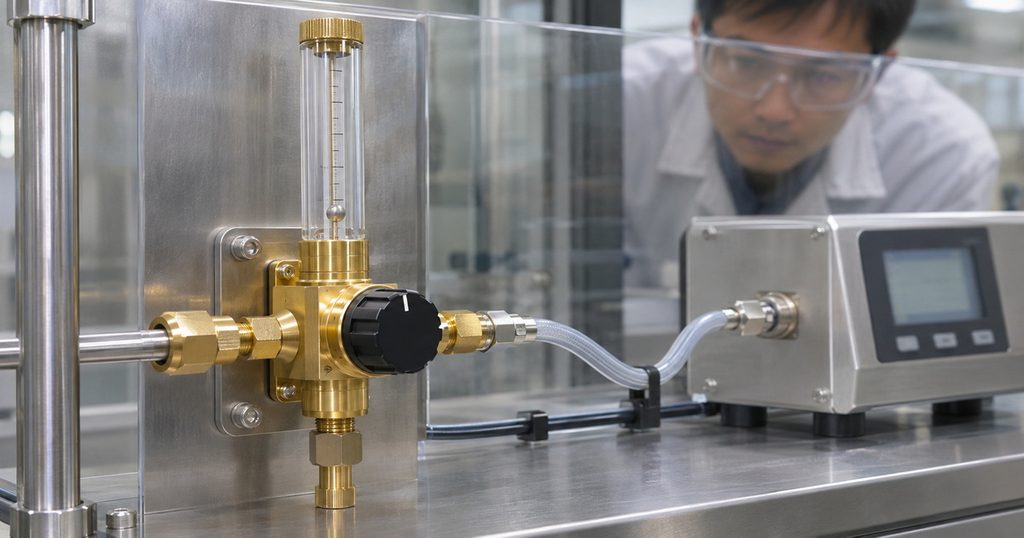
Then compare indicated flow against a suitable reference instrument under the agreed setup.
A useful qualification sequence is:
1. Confirm the test gas and equipment.
2. Check several points across the required operating range.
3. Repeat the measurements.
4. Record the conditions and results.
5. Retain the approved configuration as the production reference.
ISO 2503 includes requirements for flow-indication accuracy, reinforcing the need for a defined test method rather than a visual demonstration alone.
Factory Verification, Samples, and Logistics
Verify the Actual Production Route
For a factory-direct order, establish which operations are performed internally and which are outsourced.
A practical audit request should cover machining, cleaning, assembly, testing, calibration management, traceability, and final inspection. For a distributor, focus instead on original-manufacturer identity, authorization where applicable, incoming inspection, storage, and warranty handling.
Do not penalize a distributor for not being a factory. Evaluate whether its actual role matches your purchasing requirement.
Use a Three-Step Sample Process
Step 1: Engineering Sample
Check dimensions, threads, labeling, adjustment behavior, and connection compatibility against the drawing.
Step 2: Performance Qualification
Use a qualified test provider where necessary to assess leakage, pressure-control behavior, gauge performance, flow indication, and other requirements in the agreed specification.
Step 3: Pilot Order
Confirm that normal production matches the approved sample. Inspect packaging, traceability, documentation, and consistency across the pilot batch.
Release larger orders only after deviations have been closed in writing.
Separate Production Lead Time from Delivery Time
For imported regulators, request distinct dates for:
– Drawing approval.
– Sample completion.
– Production completion.
– Inspection release.
– Shipment departure.
– Estimated arrival.
Ask a customs broker to confirm classification and applicable import requirements for the exact product and destination. Do not assume that all items marketed as “welding accessories” follow identical procedures.
For sea freight, agree on moisture protection, protection of gauges and flow tubes, carton strength, and inspection access. For local purchases, verify whether “available” means physically stocked in Indonesia or obtainable from an overseas warehouse.
Conclusion: Match the Supplier to the Procurement Model
A defensible argon gas regulator shortlist distinguishes manufacturing capability from local distribution and standardized catalog supply.
Zhejiang Bril merits evaluation for direct OEM cooperation and private-label development. PT Multi Mayaka offers an identifiable domestic regulator range. Amcoweld provides a regional branded-equipment route. PT Duta Graha Miller is a project-oriented welding-equipment inquiry channel, while MISUMI Indonesia provides part-number-based catalog sourcing. Their suitability depends on the exact model, documents, stock position, and commercial terms—not the order in which they appear.
For a customized program, send Zhejiang Bril a structured inquiry containing the gas type, inlet pressure, flow requirement, connection drawings, target market, expected order volumes, and documentation requirements.
Request a written technical proposal and sample-validation plan before committing to bulk production. Apply the same discipline to every shortlisted supplier.
FAQ
1. How Can I Check Whether a Supplier’s ISO 9001 Certificate Has Expired or Been Suspended?
Search the certificate number or legal company name in IAF CertSearch, then compare the result with the supplied document.
Review the company name, address, standard, scope, issuing certification body, and current status. The verification service distinguishes active, suspended, withdrawn, and expired certificates. If the record is missing or inconsistent, contact the issuing certification body directly before accepting the claim.
Also confirm that the scope and site address cover the factory producing your order—not merely a related sales company.
2. What Evidence Demonstrates Genuine Two-Stage Construction?
Request a sectional drawing and technical description showing two regulating stages. Do not rely on the number of gauges.
Then require pressure-performance data under agreed inlet-pressure and outlet-demand conditions. The supplier should identify the exact model tested, rather than provide a report for another product in the range.
3. Can One Argon Flowmeter Be Used for Argon/CO₂ Mixtures?
Do not assume interchangeability from appearance alone.
Manufacturer product information includes gas-specific scales and defined operating pressures, demonstrating that the intended gas and configuration matter. Ask whether the scale directly covers your mixture or whether the manufacturer specifies an approved correction method.
If the supplier cannot document the measurement basis, select a configuration explicitly rated for the intended gas.
4. Does a CE-Marked Regulator Automatically Meet ISO 2503?
No. CE marking concerns applicable EU legal requirements, while ISO 2503 provides technical requirements for welding gas regulators within its scope. One does not automatically establish the other.
Request the applicable declaration and supporting technical documents, plus model-specific evidence for any claimed standard compliance.
5. How Can I Prevent a Good Sample from Being Followed by Lower-Quality Bulk Production?
Create a controlled approval package containing:
– Signed drawings and revision numbers.
– Approved material and critical-component specifications.
– A retained sample.
– Inspection methods and acceptance criteria.
– Traceability requirements.
– Written change-control obligations.
– A defined process for nonconforming goods.
For the first production order, use independent inspection where commercially appropriate. The objective is not simply to reproduce the sample’s appearance, but to maintain the approved construction and performance.
References
1. Zhejiang Bril Welding Equipment Co., Ltd. — “About Us”: company history, facilities, reported credentials, and OEM relationships. [chinesewelding]
2. PT Multi Mayaka — “Tentang Kami”: distribution role, product portfolio, and domestic support network. [multimayaka.co]
3. MultiPro — “Welding Gas Regulator”: argon regulator models and packaging information. [multipro-technic.co]
4. Amcoweld — Regional company profile and Messer Constant 2000 cylinder regulator listing. [amcoweld.com]
5. PT Duta Graha Miller — Official company history and distributor website. [dutagrahamiller.co]
6. MISUMI Indonesia — Company profile, group history, and NISSANTANAKA argon regulator catalog listing. [id.misumi-ec]
7. Indonesia Ministry of Investment and Downstream Industry/BKPM — 2025 announcement on integrated industrial clusters. [bkpm.go]
8. German-Indonesian Chamber of Industry and Commerce — September 2026 steel-industry update. [indonesien.ahk]
9. ISO 2503:2009 — Published scope and technical requirements for welding gas regulators and flow-metering devices. [standards.iteh]
10. European Union, Your Europe — Official guidance on CE marking and conformity responsibilities. [europa]
11. IAF CertSearch — Certificate verification process, status definitions, and verification service. [support.iafcertsearch]
12. Miller and associated product documentation — Argon/CO₂ flowmeter operating specifications and gas-scale information. [millerwelds]
13. MISUMI Indonesia — RoHS guidance and distinction from CE conformity. [id.misumi-ec]
Hot Tags: Argon Gas Regulator Manufacturers In Indonesia, Argon Gas Regulator Suppliers In Indonesia, Industrial Gas Regulator Suppliers, Welding Gas Regulator Manufacturers, Argon Flowmeter Regulator Suppliers, Wholesale Argon Gas Regulators, OEM Argon Gas Regulator Manufacturer, Dual Stage Argon Gas Regulator, Brass Argon Gas Regulator, Custom Industrial Gas Regulators