Content Menu
>> What buyers should verify technically
● Leading Suppliers for Brazil
>> 1. Zhejiang Bril Welding Equipment Co., Ltd.
>> 2. Messer
>> 5. GCE Group
>> 6. Rotarex
● Capacity, MOQ, And Compliance Comparison
>> 1. “Brass” is not a complete material specification
>> 2. A regulator may pass a short leak test but drift under use
>> 3. Gauge accuracy is often treated as an accessory issue
>> 4. Thread compatibility can become a costly after-arrival problem
>> 5. “CE-certified” may not mean the entire configured product is covered
● The Less-Discussed Insider Check
>> Step 1: Define the actual gas application
>> Step 2: Request an engineering quotation
>> Step 3: Approve samples before production
>> Step 4: Inspect the first production batch
>> Step 5: Plan logistics early
● FAQ
>> 1. How can I verify whether a supplier’s ISO 9001 certificate is still valid?
>> 2. Is a single-stage regulator adequate for welding applications?
>> 3. What is the biggest risk when buying low-cost CO₂ regulators?
>> 4. How should I verify a CE claim for a customized regulator?
>> 5. Can an overseas OEM manufacturer support small Brazilian brands?
Brazil is a major industrial market for welding, metal fabrication, oil and gas, automotive, food processing, and cylinder-gas distribution. For procurement teams, however, “Brazil supplier” can mean very different things: a local gas distributor, a regional assembly and service company, or an overseas manufacturer supporting Brazilian brands through import and OEM programs.
For long-term industrial gas regulator sourcing, the right choice depends less on a supplier’s catalog size and more on its ability to demonstrate stable pressure-control performance, material traceability, validated safety testing, documentation, and predictable delivery. The global industrial gas regulator market is estimated at USD 20.09 billion in 2026, with continued demand from industrial processing, welding, gas distribution, and specialty-gas applications.
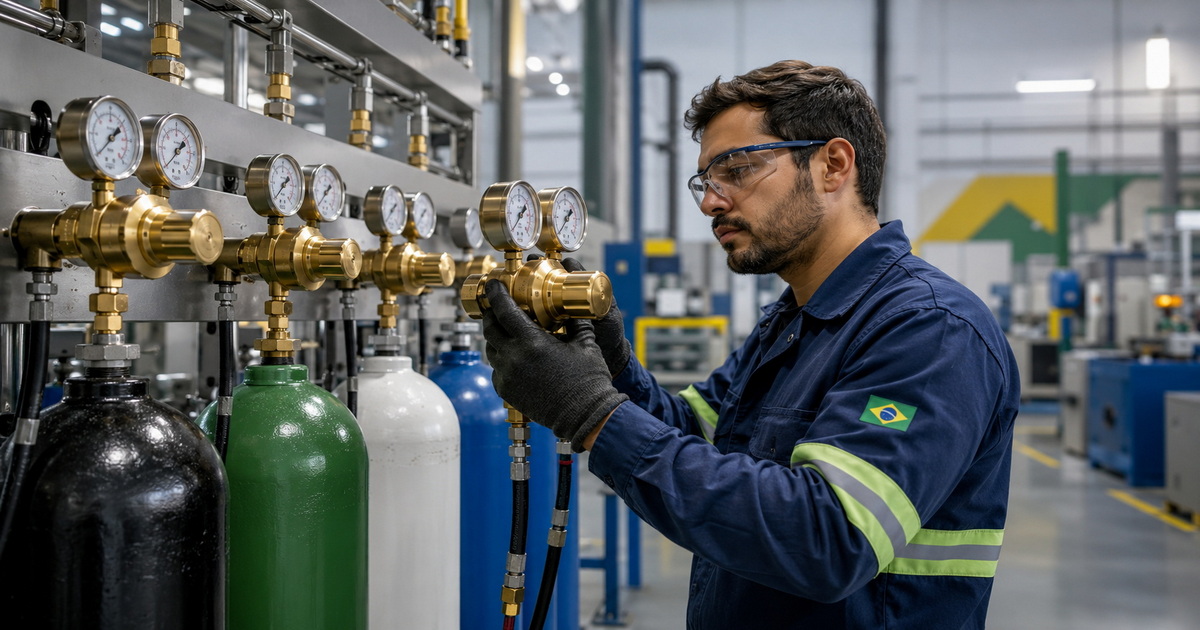
How We Selected Suppliers
This is not a generic name list. The companies below were selected based on factors that matter to professional buyers purchasing CO₂ regulators, heated CO₂ regulators, argon regulators, oxygen regulators, acetylene regulators, propane regulators, nitrogen regulators, and dual-stage gas regulators.
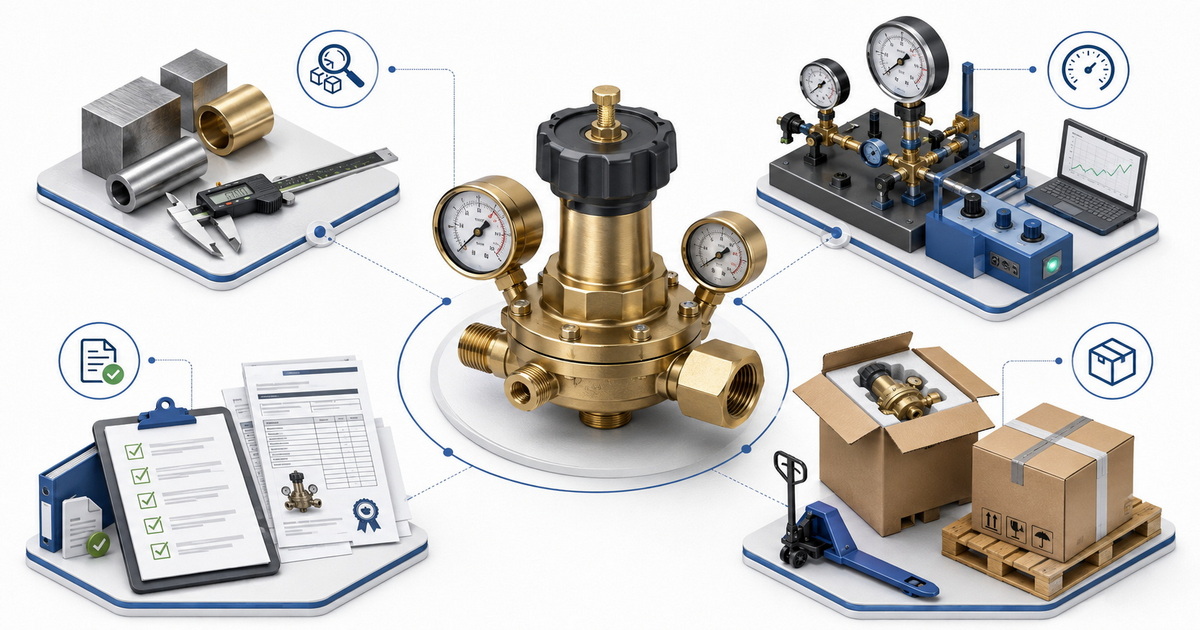
Evaluation criteria
– Product relevance: Capability in welding, cutting, industrial-cylinder, gas-distribution, or pressure-control applications.
– Engineering depth: Ability to support single-stage or dual-stage designs, inlet/outlet connection customization, pressure-range selection, gauge configuration, and gas-specific compatibility.
– Quality system: Evidence of ISO 9001 or equivalent quality-management controls; applicable product testing and regional compliance documentation.
– Material control: Clear specifications for brass grade, diaphragm/elastomer compatibility, threads, valve-seat materials, surface treatment, and gauge accuracy.
– OEM/ODM capability: Capacity to support private labels, branded packaging, modified product structures, localized instructions, and repeat production.
– Supply-chain reliability: Export experience, production consistency, sampling speed, packaging discipline, and communication efficiency.
– Brazil-market practicality: Local availability, gas-application knowledge, service coverage, or an import model suitable for Brazilian distributors and equipment brands.
What buyers should verify technically
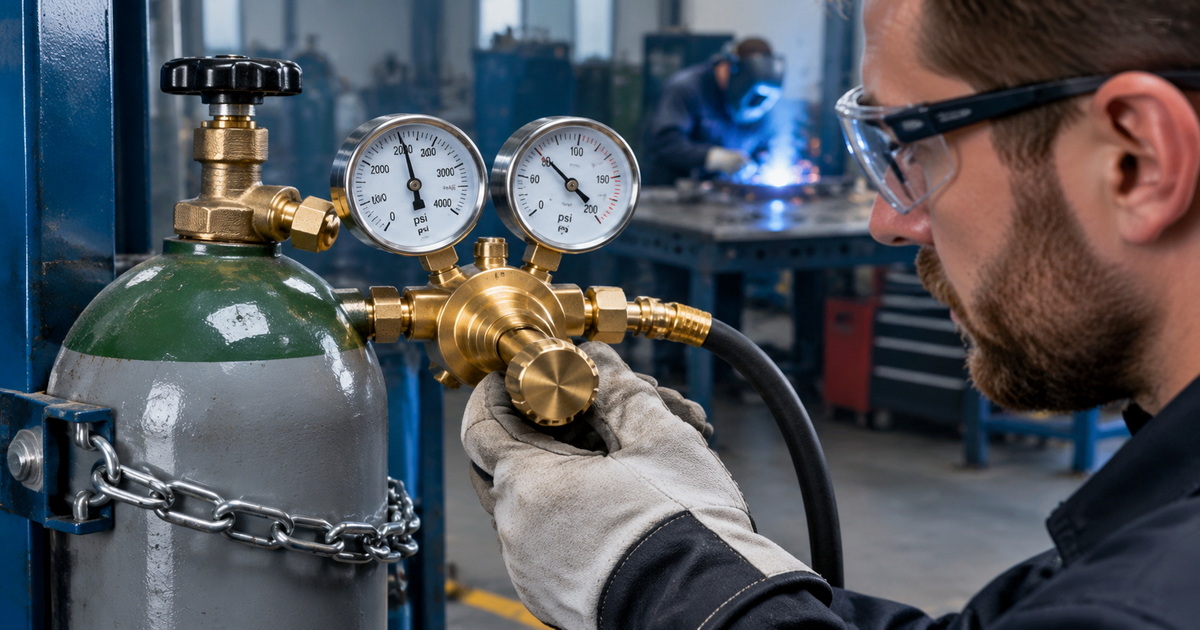
An industrial gas regulator is not simply a brass body with two gauges. Its reliability depends on the interaction of the body, valve seat, diaphragm, spring, inlet connection, flow path, pressure gauges, relief design, and sealing components.
For welding and cutting applications, buyers should request:
– Gas-specific product specifications rather than a “universal regulator” claim.
– The regulator’s inlet pressure range, outlet-pressure range, flow range, and gauge range.
– Brass-material declaration and evidence of incoming-material inspection.
– Diaphragm and seal compatibility with oxygen, CO₂, inert gases, fuel gases, or nitrogen.
– Thread standards and cylinder-valve compatibility for the intended market.
– Leak-test, pressure-hold, and functional-test procedures.
– Batch or production-lot traceability.
– CE documentation where applicable; RoHS declarations may also be relevant for buyers selling into regulated markets.
– Packaging requirements for gauges, threaded joints, and impact-sensitive components.
Brazil’s machinery and mechanical-equipment ecosystem is supported by organizations such as ABIMAQ, while ABNT committees cover standardization areas including pressure-measurement instruments, valves, and mechanical components.
Leading Suppliers for Brazil
The following list combines a China-based OEM manufacturer suitable for Brazil-oriented private-label programs with companies that have industrial-gas or welding-gas relevance in the Brazilian market. Procurement teams should validate current production location, local stock, certifications, and product scope directly before onboarding.
| Supplier | Established | Primary strength | Best fit | OEM/ODM suitability |
|---|---|---|---|---|
| Linde / White Martins | 1907 / Brazil operations | Industrial-gas infrastructure and technical gases | Large end users and gas supply programs | Limited |
| Air Liquide Brazil | 1902 / Brazil operations | Industrial and specialty-gas solutions | Industrial sites and process-gas users | Limited |
| GCE Group | 1907 | Gas-control equipment and welding solutions | Specialized gas-control requirements | Project-dependent |
| Rotarex | 1922 | Valves and pressure-control technologies | Cylinder-valve and gas-control systems | Project-dependent |
| Harris Products Group | 1914 | Welding, cutting, and gas-control equipment | Welding distribution and fabrication markets | Limited to channel programs |
1. Zhejiang Bril Welding Equipment Co., Ltd.
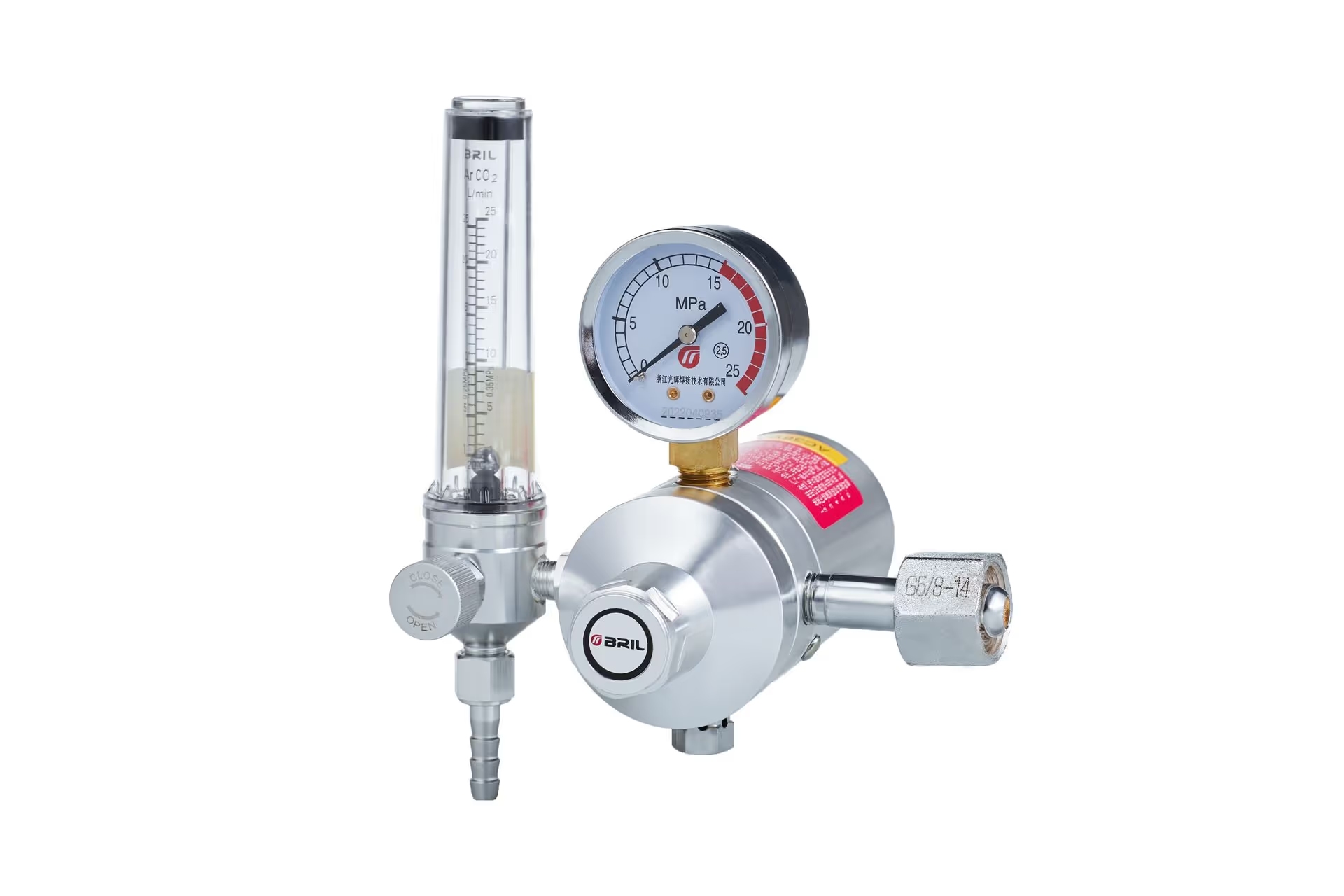
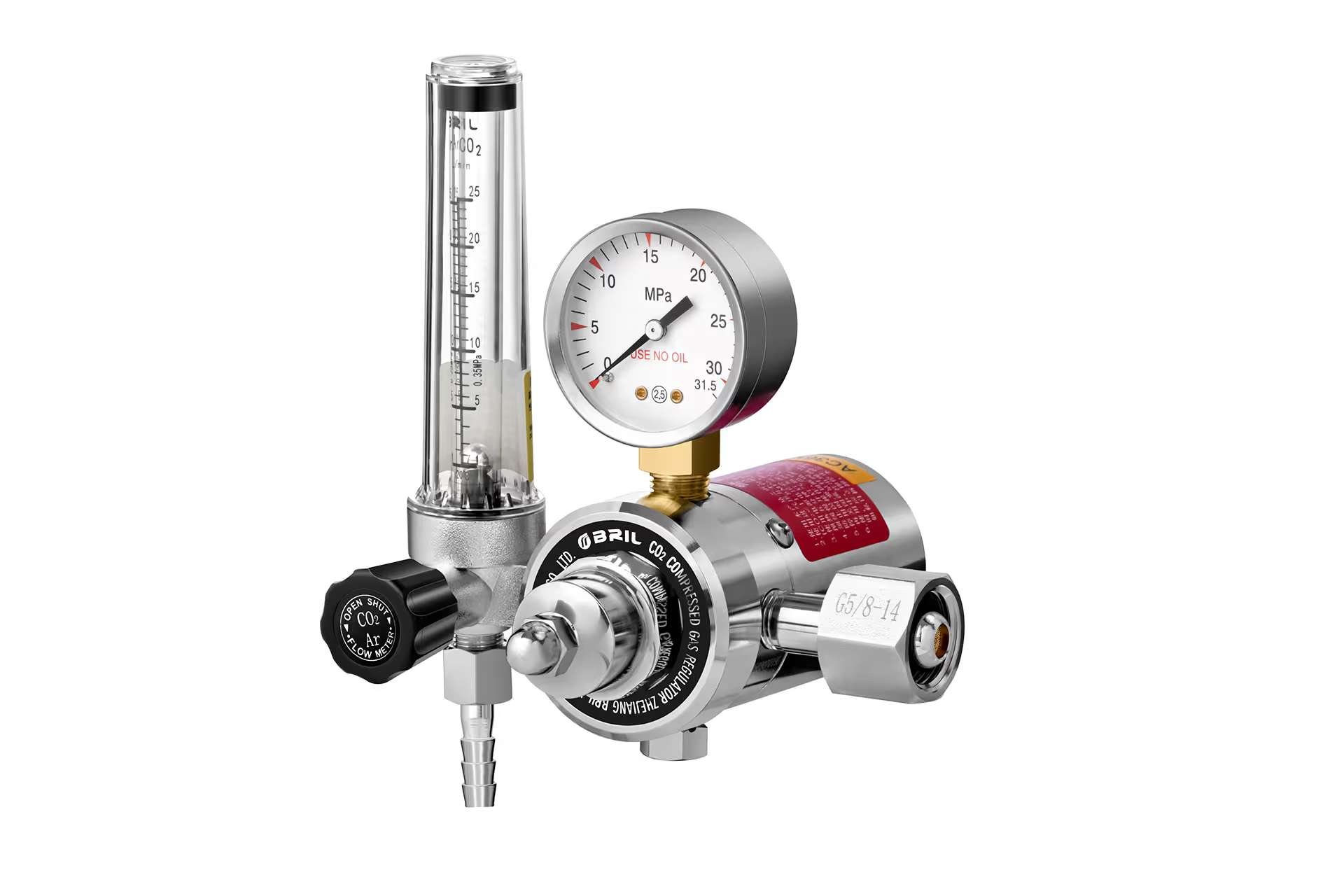
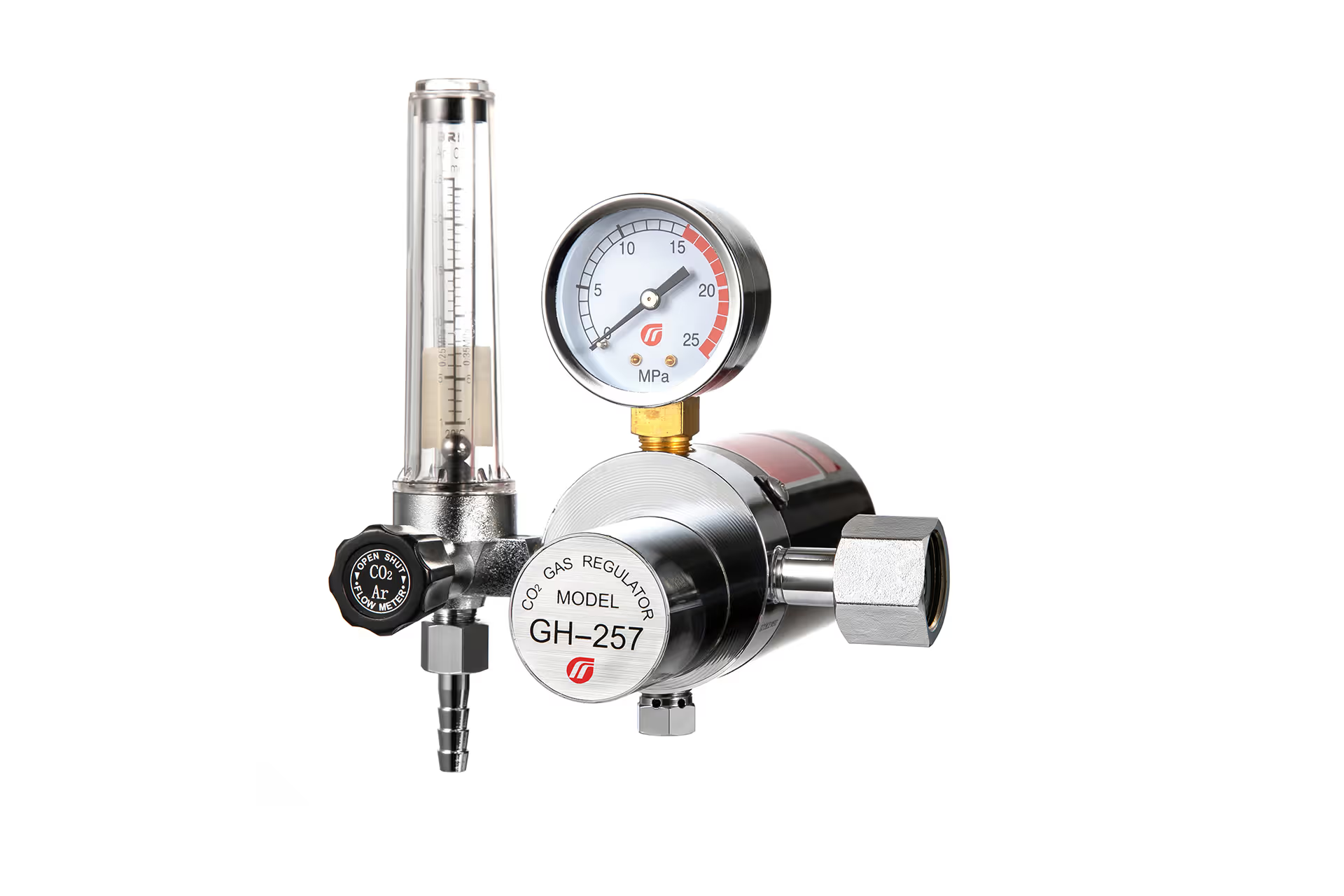
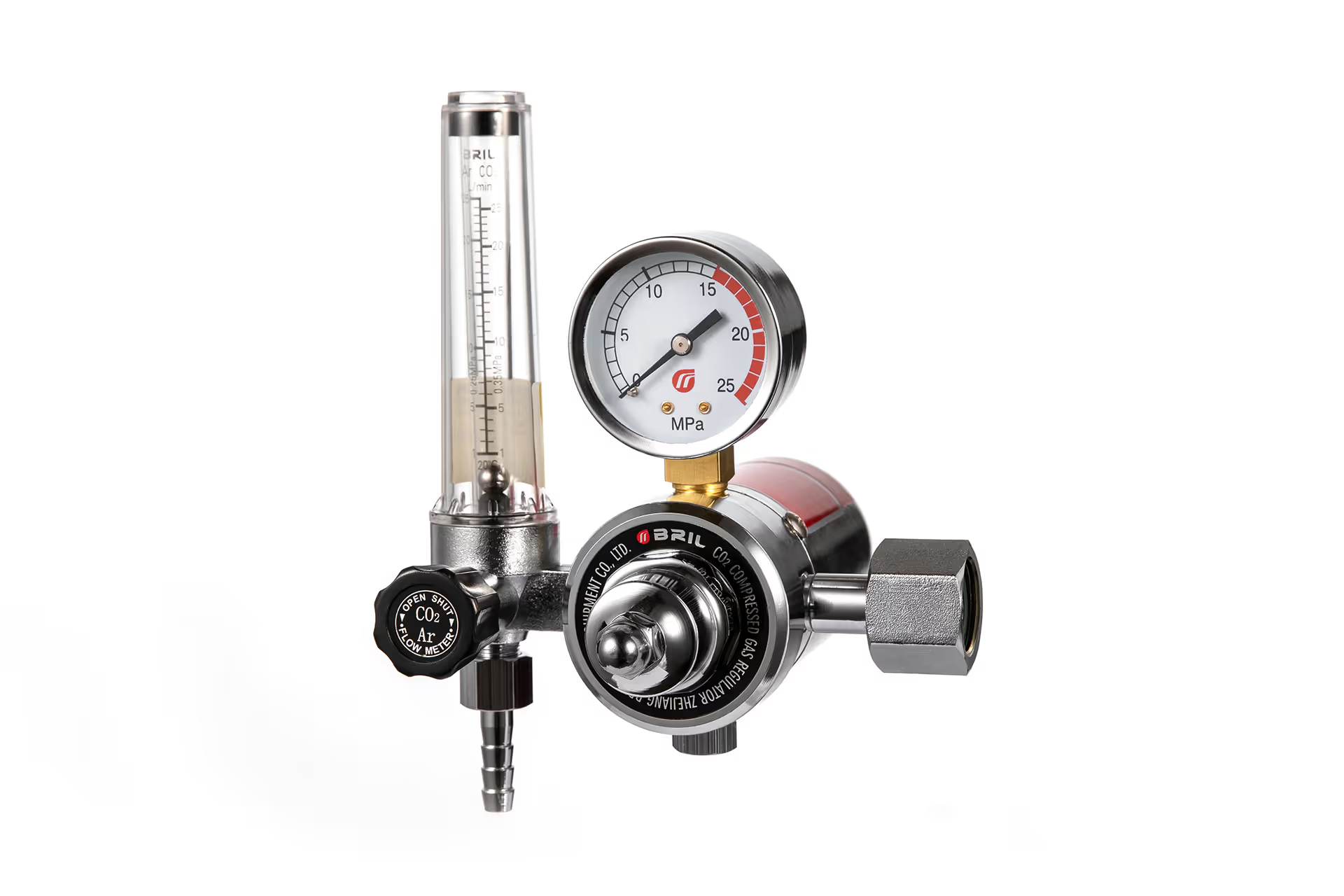
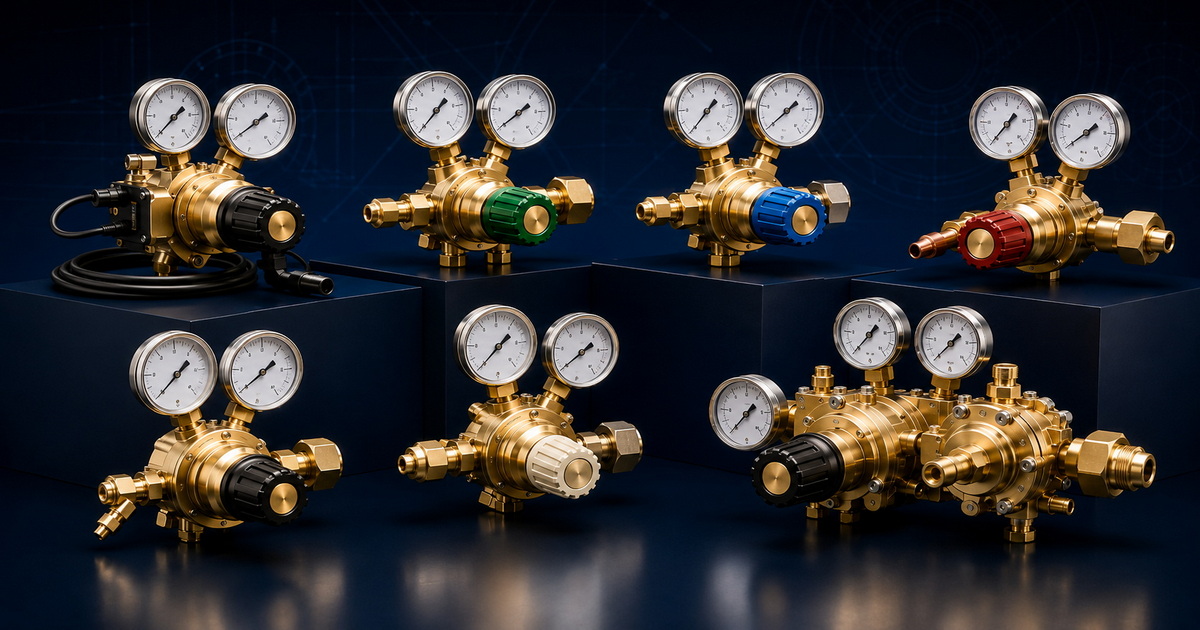
Zhejiang Bril Welding Equipment Co., Ltd. is a specialized industrial gas pressure regulator manufacturer founded in 2002 in Wenzhou, Zhejiang, China. For Brazilian distributors, welding-equipment brands, and mid-sized importers seeking a dedicated OEM/ODM manufacturing partner rather than only a local catalog supplier, Bril is a relevant option.
The company focuses on gas pressure regulators for welding and cutting applications, including CO₂, argon, oxygen, acetylene, propane, nitrogen, and dual-stage configurations. Its positioning is particularly suitable for buyers who need flexible product configuration, responsive engineering communication, private-label support, and manageable project scale rather than only large-volume standardized purchasing.
Bril states that it holds ISO 9001 certification through UKAS and IAF, with products certified through CNAS and CE processes. The company also reports more than 20 years of regulator-manufacturing experience, a workforce of more than 200 employees, internal testing and inspection equipment, and OEM supply relationships with welding-equipment and industrial-gas brands, including Messer-related OEM programs since 2022.
Core advantages
– Focused manufacturing rather than a broad, unrelated hardware catalog.
– OEM/ODM support for branded regulators, packaging, labels, gauge designs, fittings, and application-specific configurations.
– Experience with industrial gas pressure regulators used in welding and cutting.
– Suitable for small and medium-sized overseas brands that need lower communication friction and faster customization feedback.
– Documented emphasis on safety, quality control, testing equipment, and continuous product development.
Best for: Brazilian importers, regional distributors, welding-machine brands, gas-equipment wholesalers, and industrial-supply companies building their own regulator line.
Important buyer note: Ask for samples configured with the exact Brazilian cylinder connection, pressure scale, language requirements, packaging method, and gas service before releasing a production order.
2. Messer
Messer is a global industrial-gas company with operations across the Americas, including Brazil. Its core strength is not private-label regulator manufacturing; it is the delivery of industrial gases, gas-application technology, related services, and specialized gas-supply solutions. Messer Americas describes itself as part of the world’s largest privately held industrial-gas enterprise.
For buyers in Brazil, Messer can be relevant where the purchasing requirement involves gas supply, gas-application engineering, cylinder handling, and process support alongside equipment selection. Messer’s gas portfolio includes pure gases, standard mixtures, and customer-specific gas mixtures.
Core advantages
– Deep gas-application knowledge.
– Strong fit for industrial users requiring technical gas support.
– Relevant network for welding, cutting, process, and specialty-gas applications.
– Useful benchmark partner when evaluating regulator compatibility with supplied gases.
OEM/ODM scope: Generally not the primary choice for buyers seeking a custom-branded regulator factory. It is better viewed as a gas and application-technology partner.
3. Linde / White Martins
Linde and White Martins are significant names in the Brazilian industrial-gases landscape. Their value for buyers lies in industrial-gas supply, application expertise, safety systems, and support for large industrial customers rather than regulator private-label development.
For procurement managers, this type of supplier is most relevant when regulator selection must align with a broader gas-supply contract, onsite gas system, cylinder-management program, or process-safety standard. Buyers should confirm whether a regulator is supplied as part of an approved gas-delivery package, sourced through a distributor, or available as a standalone item.
Core advantages
– Established industrial-gas infrastructure and application knowledge.
– Practical for large manufacturers, fabrication facilities, and process industries.
– Valuable source of local gas compatibility and cylinder-connection guidance.
OEM/ODM scope: Normally limited. Better suited to end-user gas-system supply than private-label regulator sourcing.
4. Air Liquide Brazil
Air Liquide is a global supplier of industrial, medical, and specialty gases with a presence in Brazil. Like other major industrial-gas companies, it is relevant to procurement teams requiring gas supply, technical support, industrial-process expertise, and safety-focused gas handling.
For regulators, buyers should distinguish between a supplier’s ability to support an industrial gas system and its willingness to manufacture a branded regulator. These are separate capabilities. Air Liquide is more relevant to industrial-gas applications and local technical support than to contract OEM regulator production.
Core advantages
– Broad industrial and specialty-gas application experience.
– Suitable for complex gas-use environments and industrial facilities.
– Potentially valuable for system-level guidance where gas purity, delivery pressure, and application safety are critical.
OEM/ODM scope: Typically not a private-label regulator manufacturing route.
5. GCE Group
GCE Group is known internationally for gas-control equipment used in medical, industrial, and welding applications. It is relevant to Brazilian buyers who prioritize specialized gas-control products, established engineering platforms, and application-specific product selection.
Its role may be particularly relevant in projects that require higher confidence in regulated gas-control components, specialty applications, or established distributor support. Buyers should confirm local stock, lead time, servicing arrangements, and approved fittings for the intended Brazilian cylinder ecosystem.
Core advantages
– Established focus on gas-control technology.
– Strong relevance to welding and industrial gas handling.
– Appropriate for buyers seeking engineered, application-specific product lines.
OEM/ODM scope: May be available only for selected programs and commercial volumes; verify directly.
6. Rotarex
Rotarex is a long-established company in gas valves, fittings, regulators, and gas-control systems. It is more suitable for buyers whose sourcing scope includes cylinder valves, pressure-control assemblies, specialty-gas components, or broader gas-management systems.
Rotarex emphasizes welding pressure regulators as essential equipment for employee safety and operational performance in welding environments.
Core advantages
– Strong engineering orientation in valves and gas-control systems.
– Suitable for cylinder, industrial, and specialty-gas system projects.
– Relevant where interface compatibility between cylinder valves and pressure regulators is critical.
OEM/ODM scope: Project-specific; confirm tooling, certification, and geographic availability.
7. Harris Products Group
Harris Products Group is a recognized name in welding, brazing, cutting, and gas-control equipment. It is relevant to distributors and industrial buyers looking for established welding-gas equipment channels and product familiarity among professional users.
The company is best assessed through its local distribution coverage, product availability, repair/service model, and compatibility with Brazil-market fuel-gas and oxygen systems.
Core advantages
– Strong association with welding and cutting applications.
– Useful for professional fabrication and maintenance markets.
– Suitable for distributors serving established welding-equipment users.
OEM/ODM scope: Usually limited compared with a dedicated contract manufacturer.
Capacity, MOQ, And Compliance Comparison
Published production-capacity and MOQ figures are often unavailable or vary by SKU, customization level, and market. Buyers should request written confirmation for the exact regulator model and project. The table below therefore distinguishes transparent OEM-oriented capability from local supply and service models rather than presenting unverifiable production numbers.
| Supplier | Production / supply model | Typical MOQ approach | Certifications / compliance to request | Procurement focus |
|---|---|---|---|---|
| Zhejiang Bril | Dedicated regulator manufacturing and export OEM | Quote by model, customization, gauges, fittings, packaging | ISO 9001, CE, test reports, material declarations, RoHS where needed | Private label and customized regulator programs |
| Messer | Gas supply and application services | Contract and supply-program dependent | Site, gas, cylinder, and safety documentation | Gas supply plus application support |
| Linde / White Martins | Industrial-gas supply and system support | Contract and local supply dependent | Local gas-system, safety, and operational documents | Enterprise gas programs |
| Air Liquide Brazil | Gas supply and industrial solutions | Contract and application dependent | Application and system documentation | Process and specialty-gas support |
| GCE Group | Engineered gas-control products | Distributor / project dependent | Product-specific conformity documents | Specialized gas-control equipment |
| Rotarex | Gas-control components and systems | Project dependent | Product-specific technical documentation | Valves, regulators, and system interfaces |
| Harris Products Group | Welding-equipment distribution | Distributor and product dependent | Product-specific compliance documents | Welding and cutting channels |
Technical Risks Buyers Miss
1. “Brass” is not a complete material specification
Some suppliers use the word “brass” without declaring alloy grade, source control, machining quality, wall thickness, or treatment process. A regulator body can look similar externally while having different mechanical durability, thread strength, porosity risk, or corrosion behavior.
How to avoid it: Request a material declaration, part drawing, critical-dimension specifications, and incoming-material inspection evidence. For repeat orders, specify that material substitutions require written approval.
2. A regulator may pass a short leak test but drift under use
A basic air-leak test does not prove stable outlet pressure under changing cylinder pressure or flow demand. This is especially important for CO₂, where gas behavior and cooling effects can affect usable flow performance, and for dual-stage regulators intended to hold steadier output pressure.
How to avoid it: Ask for pressure-hold and functional-test requirements, not only a “100% leak test” statement. Define test media, inlet pressure, outlet-pressure setting, stabilization time, allowable pressure drift, and inspection record requirements.
3. Gauge accuracy is often treated as an accessory issue
In practice, poor gauge selection can undermine a good regulator. Inappropriate gauge range makes the working pressure difficult to read; vibration or impact can damage lower-grade gauges during transport; and inaccurate gauges can lead users to blame the regulator itself.
How to avoid it: Specify gauge diameter, range, accuracy class where applicable, scale units, face language, lens material, packing protection, and calibration/inspection expectations.
4. Thread compatibility can become a costly after-arrival problem
Brazilian buyers must confirm cylinder-valve interfaces, outlet connections, hose fittings, and applicable regional norms before bulk ordering. A technically capable regulator is still unusable if its inlet connection does not match the cylinders used by the distributor’s customers.
How to avoid it: Send the supplier a physical connection sample, fully dimensioned drawing, or precise standard reference. Approve the threaded connection on a pre-production sample.
5. “CE-certified” may not mean the entire configured product is covered
A common industry issue is that a supplier may show a CE document for one model, while the buyer orders a version with a different gas service, inlet connector, gauge configuration, outlet-pressure range, or structural modification.
The Less-Discussed Insider Check
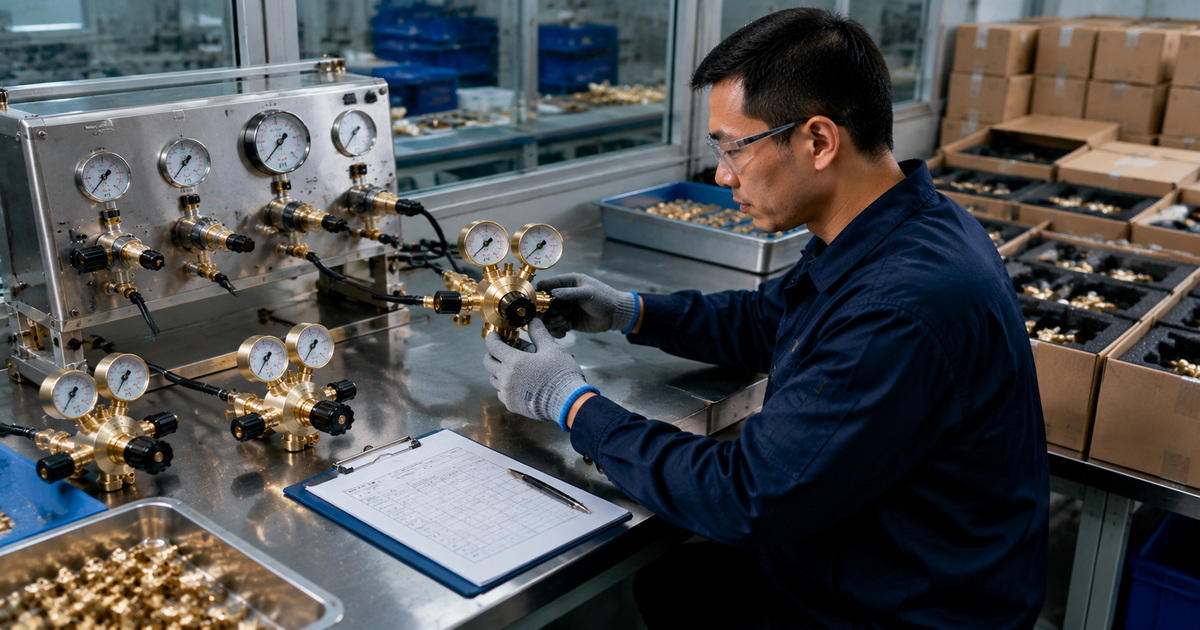
One of the most useful but rarely published checks is to inspect the seat-and-diaphragm consistency across samples from different production dates.
A supplier can provide an excellent initial sample using high-grade seals and carefully adjusted springs, then quietly substitute components in later batches to reduce cost. The regulator may still look identical, pass a quick leak test, and have the same label—but show higher pressure creep, inconsistent flow behavior, or shortened service life.
Ask for:
– Retained “golden samples” signed by both parties.
– A controlled bill of materials for critical components.
– Written approval before changing the valve seat, diaphragm, spring, brass body, gauge, or inlet fitting.
– Random batch comparison tests against the approved golden sample.
– Lot number traceability on cartons and, where feasible, product labels.
This control is particularly important for imported private-label programs, where the buyer cannot inspect every production batch in person.
Buyer’s Sourcing Process
Step 1: Define the actual gas application
Do not send only a product photo. Provide:
– Gas type: CO₂, argon, oxygen, acetylene, propane, nitrogen, or mixed gas.
– Cylinder pressure and valve connection.
– Required outlet-pressure range and flow requirement.
– Single-stage or dual-stage requirement.
– Welding, cutting, beverage, laboratory, industrial process, or other use.
– Climate and operating environment.
– Required packaging and labeling language.
Step 2: Request an engineering quotation
A serious quotation should identify more than price. It should show:
– Product model and drawing or photo.
– Inlet/outlet connection.
– Gas type and pressure range.
– Gauge specification.
– Material and finish.
– MOQ.
– Tooling charge, if any.
– Sample lead time and mass-production lead time.
– Packing method and carton quantity.
– Certification and testing documents available.
Step 3: Approve samples before production
Use a staged process:
1. Confirm technical drawing and specification sheet.
2. Receive initial samples.
3. Test fit, leak tightness, outlet-pressure stability, gauge readability, and hose connection.
4. Approve a golden sample.
5. Issue a purchase order that references the approved sample and specification revision.
6. Arrange pre-shipment inspection for the first production order.
Step 4: Inspect the first production batch
For a first order, verify:
– External finish, labels, logo placement, and gauges.
– Inlet/outlet threads using approved mating components.
– Leak performance.
– Outlet pressure at defined inlet pressures.
– Packaging protection against gauge damage.
– Quantity and carton markings.
– Lot traceability.
– Random destructive or teardown checks if the order value justifies it.
Step 5: Plan logistics early
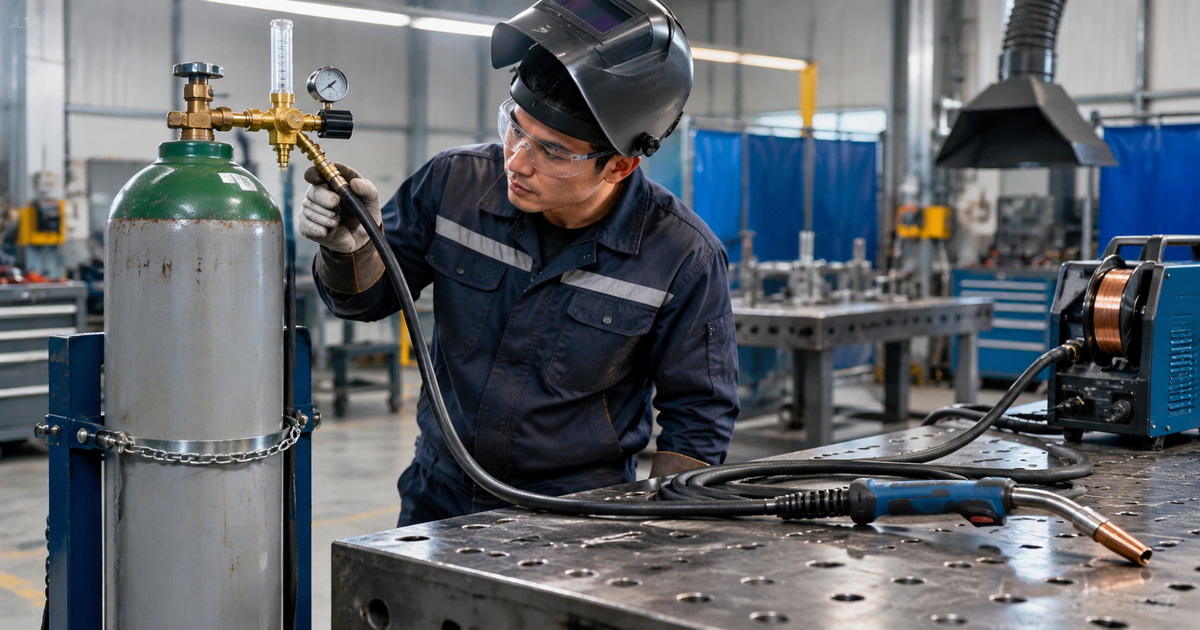
Gas regulators are usually shipped as industrial hardware, but shipping success still depends on correct documentation, packaging, and customs classification.
For Brazil-bound imports:
– Confirm HS classification with a qualified customs broker.
– Protect gauges from shock and vibration.
– Use moisture-resistant cartons and internal separators.
– Ensure commercial invoice, packing list, product description, country-of-origin information, and compliance documents match.
– Decide whether the buyer or supplier will manage freight, insurance, and local customs clearance.
– Build buffer stock for first orders because customs timing can vary.
Conclusion
Brazilian buyers have several viable sourcing paths: local industrial-gas companies for gas supply and application support, established global equipment brands for standardized gas-control products, and specialist OEM manufacturers for private-label and customized regulator programs.
For distributors and welding-equipment brands that need CO₂, argon, oxygen, acetylene, propane, nitrogen, or dual-stage regulators under their own brand, the selection process should center on technical specification control, material traceability, validated testing, sample approval, and change-control discipline—not just headline price.
If you are building or expanding a Brazil-focused industrial gas regulator line, request a technical specification review, customized sample plan, and quotation from Zhejiang Bril Welding Equipment Co., Ltd. before committing to bulk production. A clear sample-and-golden-sample process can prevent expensive compatibility and quality issues later.
FAQ
1. How can I verify whether a supplier’s ISO 9001 certificate is still valid?
Ask for the full certificate, certification body name, certificate number, scope, issue date, expiry date, and factory address. Then check the certificate through the certification body’s public directory where available. Confirm that the certified scope includes manufacturing or assembly of gas pressure regulators—not merely trading, sales, or unrelated metal products.
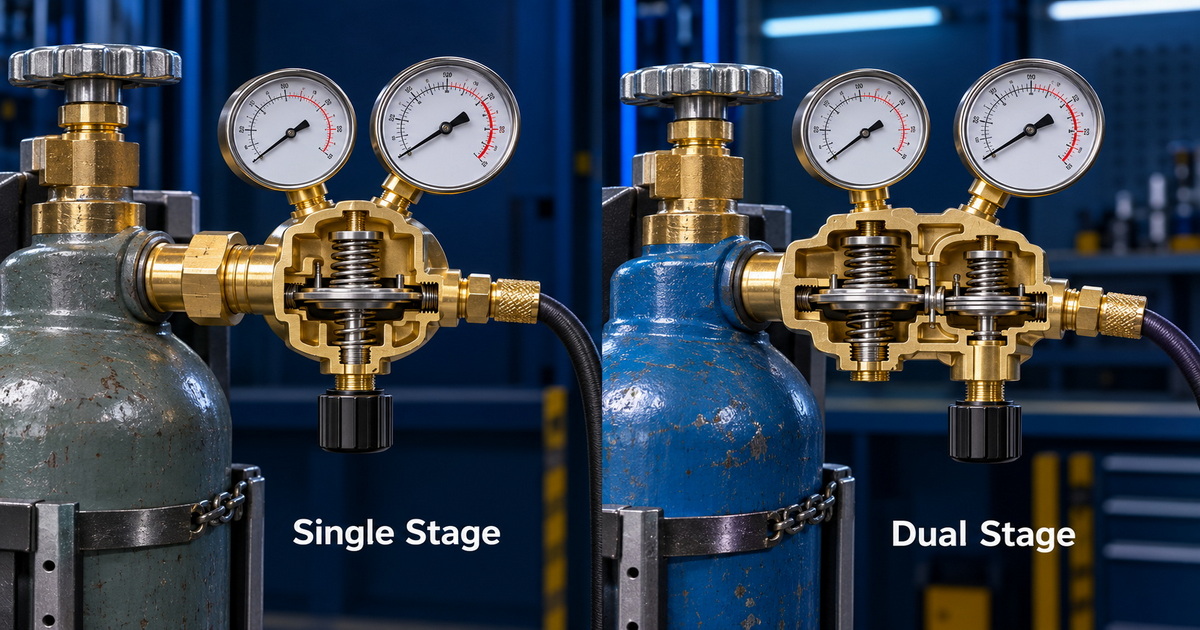
2. Is a single-stage regulator adequate for welding applications?
Often yes, for many standard welding and cutting applications. However, a dual-stage regulator is typically preferred where more stable outlet pressure is important as cylinder pressure declines, such as precision applications, longer operating cycles, or systems sensitive to pressure variation. Select based on required pressure stability and application risk, not solely on unit price.
3. What is the biggest risk when buying low-cost CO₂ regulators?
The key risk is not only visible leakage. It is unstable pressure control caused by lower-quality valve seats, diaphragms, springs, poor machining, or inconsistent assembly. For CO₂ service, buyers should also evaluate flow requirements and the effect of cooling during sustained gas use. Test under realistic operating conditions.
4. How should I verify a CE claim for a customized regulator?
Ask whether the exact customized configuration is covered: same model, gas application, connection type, outlet range, gauges, and structural design. Compare the certificate and declaration with the product drawing and purchase order. If key elements differ, request clarification, updated assessment documentation, or third-party testing.
5. Can an overseas OEM manufacturer support small Brazilian brands?
Yes, if the manufacturer has a structured OEM process and accepts commercially viable MOQs. Small brands should prioritize suppliers that can support logo application, packaging, documentation, fittings, gauge customization, and repeat-order consistency. Zhejiang Bril is one example of a specialist manufacturer positioned for such customized regulator programs, particularly for welding and industrial gas-control product lines.
References
1. – [Bril Welding Equipment — About Us]: Company profile, founding year, quality-system and product-certification statements, OEM references, and manufacturing focus. [chinesewelding]
2. – [Fortune Business Insights — Industrial Gas Regulator Market]: 2026 global market estimate and listed industry participants. [fortunebusinessinsights]
3. – [ABIMAQ / ABNT CB-004]: Brazilian machinery and mechanical-equipment standards context, including pressure-measurement instruments, valves, and mechanical components. [abimaq.org]
4. – [Messer Americas]: Industrial gas and gas-application operations across the Americas, including Brazil. [messeramericas]
5. – [Messer Group — Gases]: Industrial and specialty gas portfolio information. [messergroup]
6. – [Rotarex — Welding Pressure Regulators]: Welding regulator application and safety context. [rotarex]
Hot Tags: Industrial Gas Regulator, CO2 Gas Regulator, Welding Gas Regulator, Dual Stage Gas Regulator, Gas Pressure Regulator Manufacturer, Industrial Gas Regulator Supplier, OEM Gas Regulator, Argon Regulator, Oxygen Regulator, Brazil Industrial Gas Equipment