Content Menu
>> 1. Zhejiang Bril Welding Equipment Co., Ltd. — Flexible OEM Development
>> 2. Victor, an ESAB Brand — Established Oxy-Fuel Range
>> 3. The Harris Products Group — Industrial Product Breadth
>> 4. Western Enterprises — Gas-Control Systems and HVAC Applications
>> 5. Uniweld Products — Oxy-Acetylene and HVAC/R Specialization
>> 6. Goss Inc. — Contractor-Oriented Flame Equipment
>> 7. CONCOA — Documented Heavy-Duty and Dual-Stage Options
● Buyer’s Guide: Verify the Regulator
>> Start with a gas-specific specification
>> Audit materials and the test plan
>> Use the insider check: control substitutions
>> Verify claims, then run a sample order
>> Plan landed cost and logistics
● FAQ
>> 1. How can I tell whether a factory’s ISO 9001 certificate has expired or is outside scope?
>> 2. Is a CE mark or RoHS statement enough to import an acetylene regulator?
>> 3. Can I order one regulator design for both acetylene and propane?
>> 4. Should I specify a dual-stage acetylene regulator?
>> 5. How do I prevent an approved OEM sample from becoming a different production product?
Introduction
A dependable acetylene regulator supplier must do more than deliver a brass-bodied product at an attractive price. For a procurement manager, the real test is whether the manufacturer can repeat the approved design across production lots, document its materials and inspections, supply the correct cylinder connection, and support the product after it enters the market.
This guide compares seven manufacturers and suppliers relevant to buyers in the Americas. Six have a U.S. manufacturing or brand presence; Zhejiang Bril Welding Equipment Co., Ltd. is included first as a disclosed, China-based OEM/ODM option serving overseas buyers—not as a manufacturer located in the Americas. The list is an editorial sourcing shortlist, not a verified ranking by sales, output, or market share.
The regional opportunity is substantial, but broad welding figures should not be mistaken for acetylene-regulator sales. In its October 2025 industry analysis, the American Welding Society (AWS) cited an estimated 771,000 U.S. welding professionals in 2024 and identified the South, Southeast, and Great Lakes as accounting for roughly 60% of the workforce. Those figures provide useful downstream market context; they do not measure demand for acetylene regulators specifically.
The Americas also offer several practical sourcing models. Buyers can work with established U.S. equipment brands, choose specialized U.S. manufacturers for particular applications, or develop private-label products with an overseas factory. The right choice depends on the intended end user, documentation requirements, order volume, customization needs, and total landed cost—not simply the location printed on a carton.

How Suppliers Were Selected
The shortlist favors companies with an identifiable corporate presence and publicly documented acetylene-regulator products or relevant oxy-fuel equipment. It also considers whether a buyer can identify a plausible procurement fit from the available evidence. Public pages do not establish each company’s monthly output, minimum order quantity (MOQ), delivery reliability, or current certification status; those points require direct due diligence.
– Product fit: Evidence of an acetylene-specific regulator or oxy-acetylene equipment range, rather than a generic claim to sell “gas regulators.”
– Engineering clarity: Published information on gas service, pressure range, connection, materials, filtration, diaphragm, or related design features.
– Quality evidence: A willingness to provide model-specific drawings, test results, traceable material records, and applicable conformity documents.
– Commercial fit: Suitability for a catalog purchase, distribution agreement, original equipment manufacturer (OEM) program, or original design manufacturer (ODM) development.
– Repeatability: The ability to maintain approved specifications through production, packaging, and later reorders.
Buyers should distinguish a supplier’s corporate history from the age or manufacturing origin of a particular regulator. “Founded in 1913,” for example, does not mean a current product design has been produced unchanged for more than a century. Likewise, inclusion here does not imply that every company offers private labeling.
For technical screening, ISO 2503:2009 is a relevant reference: its scope includes single- and two-stage cylinder regulators for dissolved acetylene used in welding, cutting, and allied processes. In North America, the Compressed Gas Association’s CGA E-4 is another regulator standard to investigate. Ask the supplier which edition and clauses it claims to meet, and request evidence for the exact model and gas configuration being purchased.
Supplier comparison
The table deliberately leaves unpublished commercial figures as *not publicly disclosed*. A quoted MOQ or output figure without a named model, production period, and source would give buyers false precision.
| Supplier | Published acetylene-related evidence | Production capacity | MOQ | Publicly supported standards or certification information |
|---|---|---|---|---|
| Zhejiang Bril Welding Equipment Co., Ltd. — China; serves overseas buyers | Acetylene configurations and customizable regulator connections appear in its product range | Company reports more than 200 employees and over 3,500 m² of production area; units per month not disclosed | Not publicly disclosed; request by model and customization level | Company claims ISO 9001, CE-related product documentation, and CNAS-linked testing; verify scope and exact model |
| Victor, an ESAB brand — North America | Industrial gas-regulation and oxy-fuel equipment range | Not publicly disclosed | Not publicly disclosed | Request current model-specific conformity evidence |
| The Harris Products Group — United States | Acetylene-specific Model 25GX regulator listing | Not publicly disclosed | Not publicly disclosed | Request current model-specific evidence; do not infer coverage from a brand-wide statement |
| Western Enterprises — United States | Published oxygen-and-acetylene HVAC regulator range | Not publicly disclosed | Not publicly disclosed | Request applicable model documentation |
| Uniweld Products — United States | Published acetylene regulator models and pressure ranges | Not publicly disclosed | Not publicly disclosed | Request applicable model documentation |
| Goss Inc. — United States | Published acetylene regulator range and oxy-fuel outfits | Not publicly disclosed | Not publicly disclosed | Request applicable model documentation |
| CONCOA — United States | Published dual-stage acetylene regulator part numbers | Not publicly disclosed | Not publicly disclosed | Published product specifications include stated conformances; verify relevance to the selected part number |
Bril’s company profile supplies its facility and workforce figures, while its product page lists a GH-181 acetylene variant. The other rows reflect the manufacturers’ published product or company information; the absence of a public MOQ or capacity figure is not a judgment about their ability to supply.
Seven Suppliers to Evaluate
1. Zhejiang Bril Welding Equipment Co., Ltd. — Flexible OEM Development
Founded in 2002, Zhejiang Bril Welding Equipment Co., Ltd. is based in Wenzhou, Zhejiang, China. Its company profile describes a business focused on developing, manufacturing, and selling industrial gas pressure regulators. Bril reports more than 200 employees, over 3,500 m² of production area, and customers in more than 30 countries and regions. These are company-reported indicators of scale, not audited acetylene-regulator output figures.
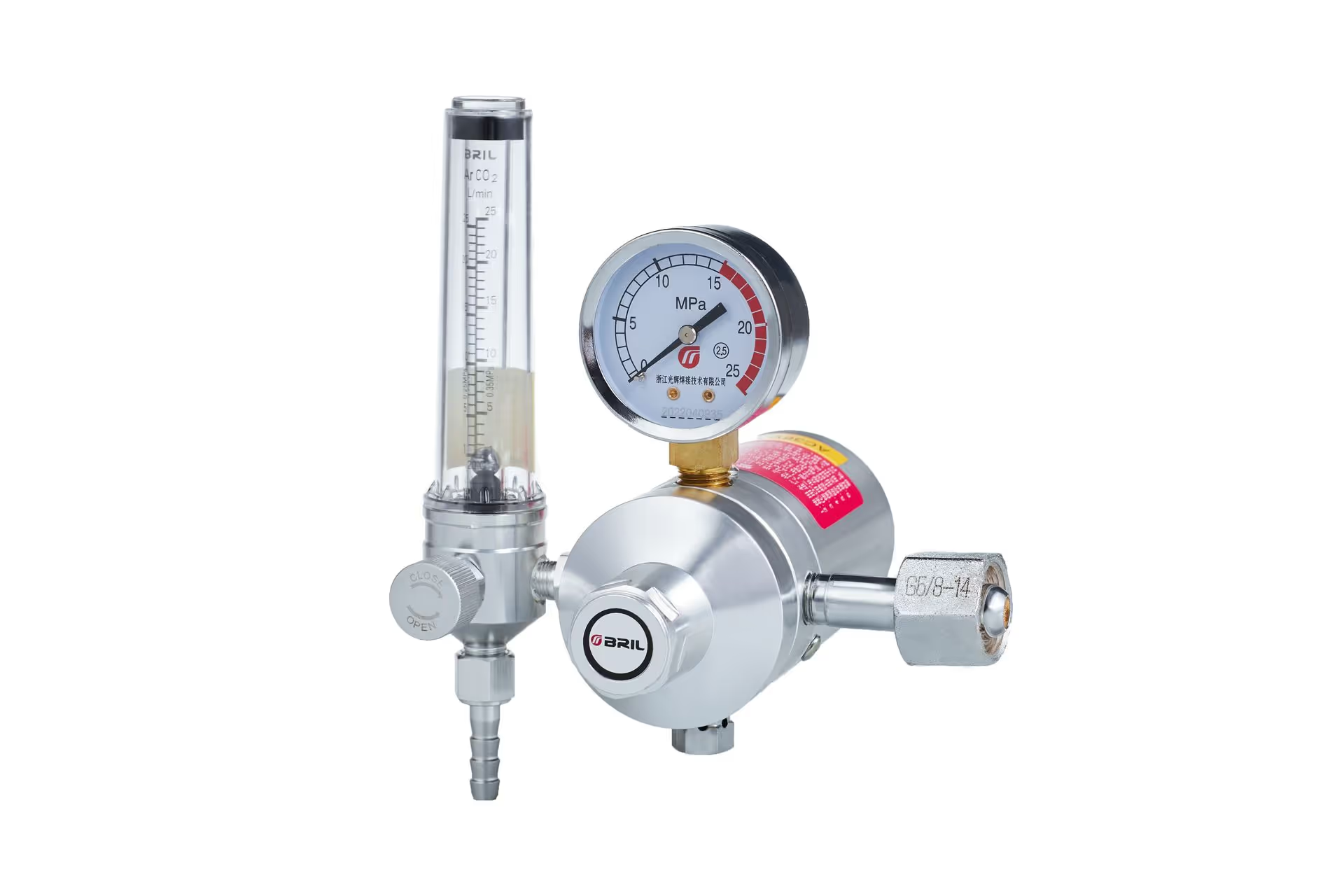
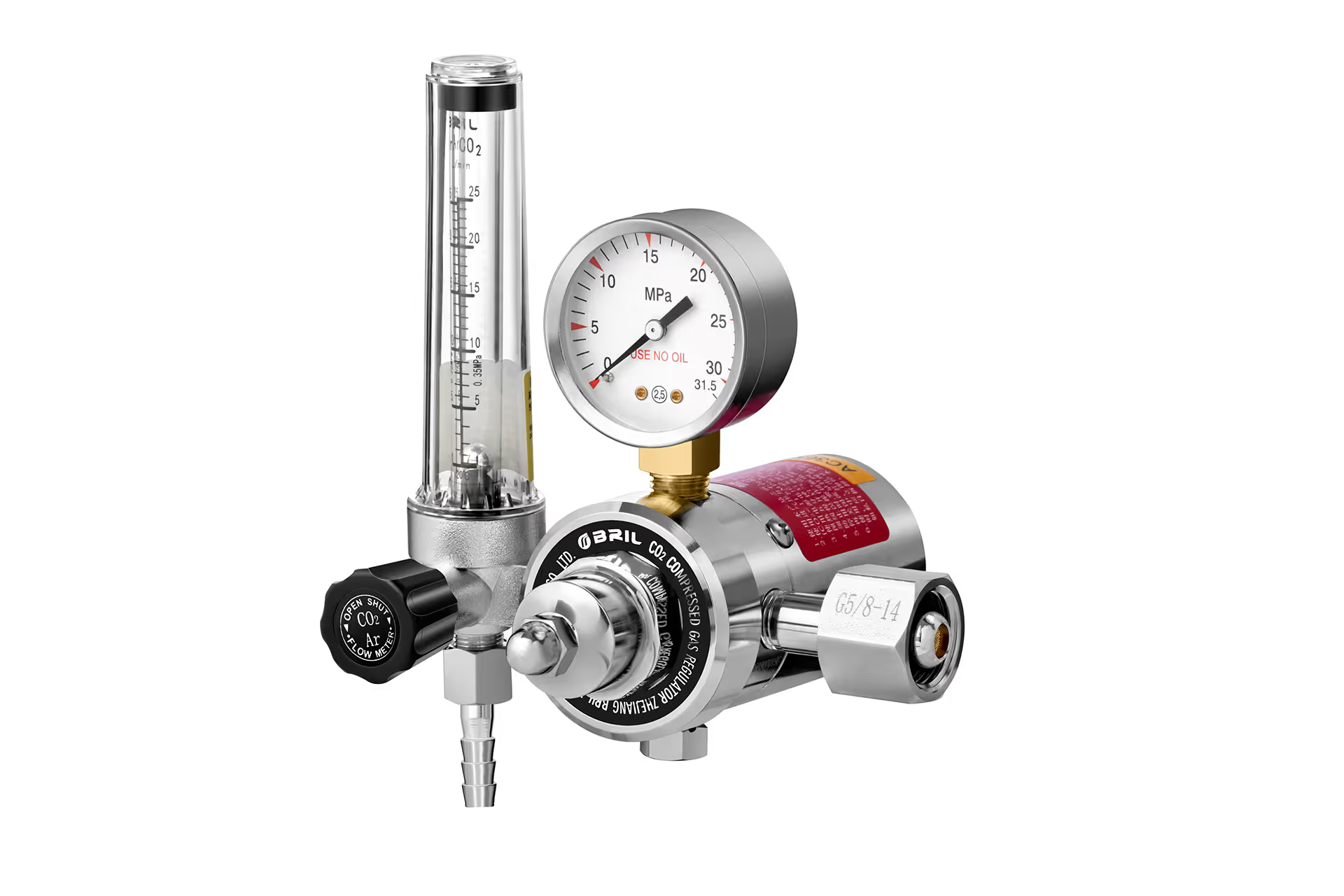
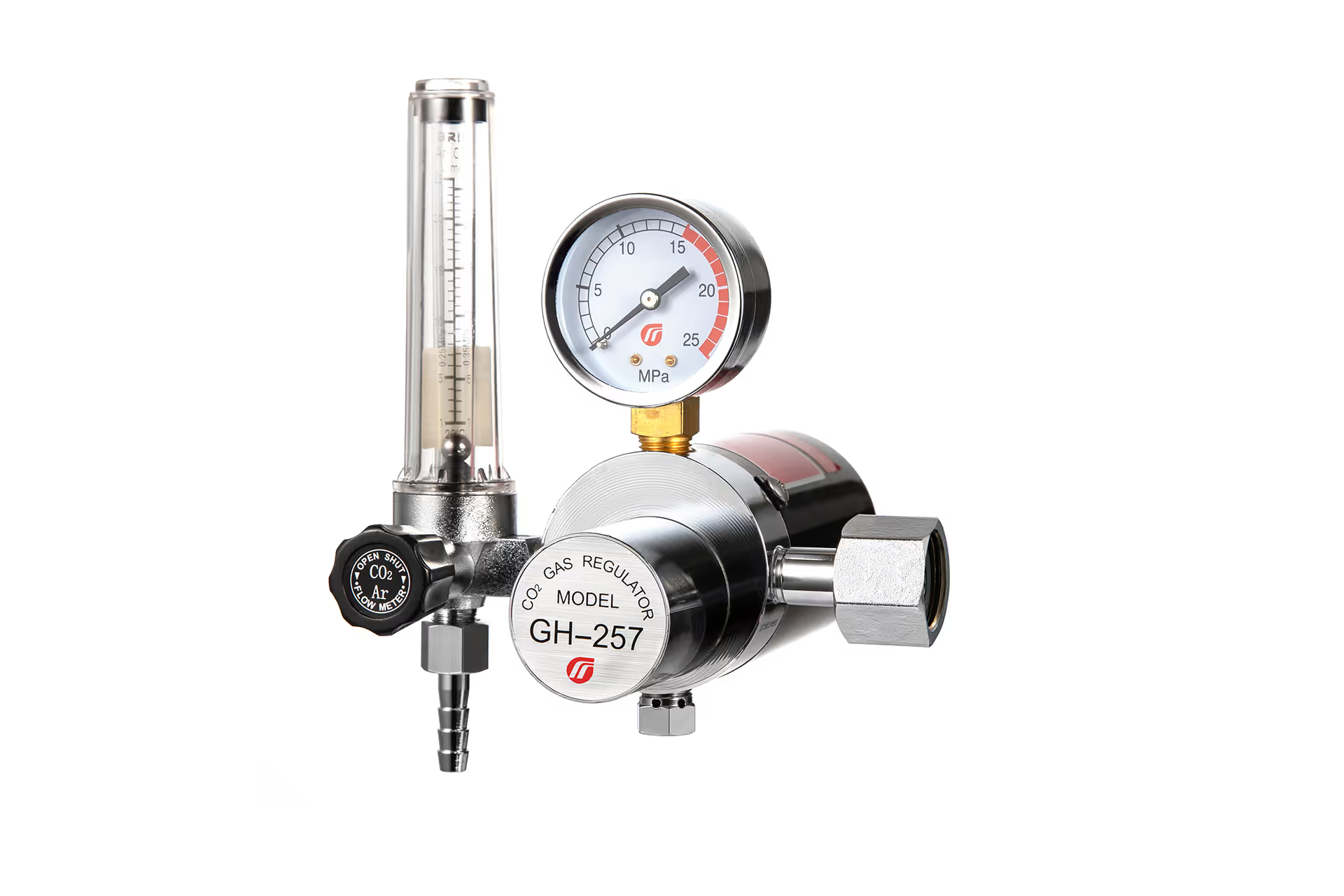
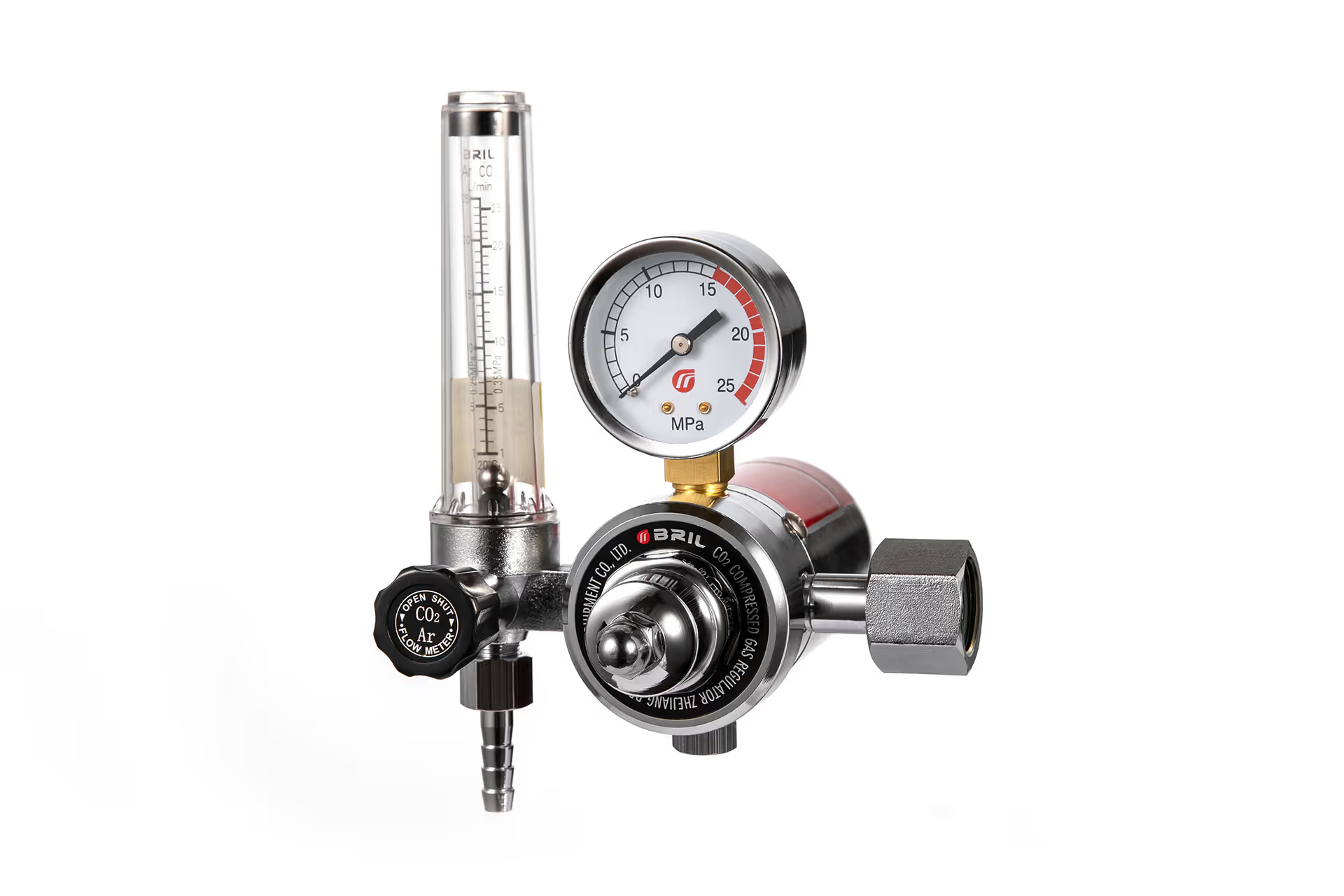
Bril is included because it addresses a different procurement need from a North American catalog brand: a small or midsize overseas welding brand may need to specify its own inlet connection, outlet thread, gauge presentation, labeling, and packaging. Bril publicly offers OEM/ODM customization across industrial gas regulators, including acetylene products. Its GH-181 product table, for example, lists an acetylene version with a CGA 510 inlet and left-hand-thread outlet. That is a useful starting specification, but buyers should confirm the final drawing and approved configuration before ordering.
Its position in Wenzhou gives buyers access to an established Chinese industrial manufacturing base, but geography alone is not evidence of regulator quality. For an OEM project, the more meaningful questions are which components Bril machines or assembles itself, which it sources, and how it controls changes to gauges, seals, seats, and fittings. Bril’s profile states that it has inspection equipment and an ISO 9001 management-system certification claim; its product materials also describe leak, gauge, functional, and visual checks. Request current documents and lot-level records rather than treating website statements as independent verification.
Best procurement fit: Overseas distributors and small-to-midsize brands seeking direct factory communication and a coordinated private-label regulator range. Bril may be a cost-competitive candidate, but this guide has not independently compared its prices or lead times with those of the other suppliers.
OEM/ODM scope to confirm: Gas-specific designs, connections, pressure ranges, gauges, markings, packaging, sample approval, and ownership of any buyer-funded tooling. Bril says it supports these types of customization; the agreed scope, MOQ, test plan, and change-control terms should be written into the purchase specification.
2. Victor, an ESAB Brand — Established Oxy-Fuel Range
Victor traces its founding to 1913. ESAB describes it as a North American-made industrial gas-equipment brand with an established range for oxy-fuel work, and its regulator catalog includes cylinder and broader gas-management products. That makes Victor a logical benchmark when a buyer wants a recognized equipment line rather than an unproven private-label design.
Victor’s principal fit in this shortlist is the professional North American welding and cutting channel. For a distributor, a catalog product may simplify model selection and replacement-part support. For a buyer developing its *own* brand, however, a strong existing brand is not automatically an OEM partner.
Best procurement fit: Established-brand distribution and technical benchmarking for industrial oxy-fuel equipment. OEM/ODM status: Public information reviewed for this guide does not establish an open private-label regulator program; ask an ESAB representative about any available commercial arrangement. Verification priority: Match the proposed Victor part number to its gas service, inlet, outlet, delivery-pressure range, and current manufacturing-origin statement rather than applying brand-level claims to every model.
3. The Harris Products Group — Industrial Product Breadth
The Harris Products Group was formed in 2006 through the combination of Harris Calorific and J.W. Harris; the Harris name has an older oxy-acetylene history. Harris offers industrial pressure-regulation equipment, and its catalog identifies the Model 25GX as an acetylene single-stage regulator. The company’s broader products and distribution presence make it relevant to professional welding-equipment buyers.
For procurement teams, Harris is especially useful when comparing a documented industrial product family against a proposed OEM specification. Gauge format, serviceability, and the exact gas-specific model should all be compared—not merely the appearance of two brass regulators in a photograph.
Best procurement fit: Buyers sourcing an established industrial line through authorized channels. Main markets: Harris operates within the wider welding and gas-equipment market; confirm territory and distribution terms directly for the intended country. OEM/ODM status: The reviewed public materials do not substantiate a generally available private-label program for acetylene regulators. Verification priority: Obtain the current datasheet and conformity information for the exact 25GX variant being quoted.
4. Western Enterprises — Gas-Control Systems and HVAC Applications
Founded in 1952, Western Enterprises says its regulators and related gas-control products are designed and manufactured in Westlake, Ohio, and distributed worldwide. Its company history describes a progression from brass welding fittings into regulators, flowmeters, and manifold systems. Western explicitly identifies gas distributors and OEM partners among the groups it serves.
Western’s published catalog includes oxygen-and-acetylene regulators for HVAC work, alongside gas-control components and manifolds. This combination could suit a distributor that needs compatible accessories or a broader gas-handling program. It should not be assumed, though, that every HVAC acetylene regulator is suitable for every industrial cutting duty cycle; select by the intended torch, cylinder, flow requirement, and applicable connections.
Best procurement fit: U.S.-manufactured gas-control products, HVAC brazing channels, and buyers investigating a broader OEM relationship. Main markets: Western identifies welding, medical, specialty gas, HVAC, and distributor/OEM customers. OEM/ODM scope: Its public company page confirms service to OEM partners but does not publish acetylene-regulator customization limits or MOQs; request those directly.
5. Uniweld Products — Oxy-Acetylene and HVAC/R Specialization
Uniweld Products was established in 1949 and is headquartered in Fort Lauderdale, Florida. It describes itself as a U.S. manufacturer serving welding, HVAC/R, plumbing, and related markets, with distribution facilities in the United States and Canada and sales offices in South America and the Middle East. Its published regulator ranges include acetylene-specific models.
Uniweld is notable for the detail available on certain product pages. Its medium-duty acetylene regulator description identifies a machined brass body and bonnet, reinforced diaphragm, filters, outlet connection, and a 2–15 psig delivery-gauge range. These are useful details for a buyer preparing a like-for-like comparison, although the final approved datasheet must control the order.
Best procurement fit: Distributors serving HVAC/R, brazing, and welding customers who need an established equipment range. Main markets: Uniweld identifies welding, HVAC/R, and plumbing among its markets. OEM/ODM status: Its public company and product information does not establish a general private-label regulator offering; request written confirmation if branding or design changes are essential.
6. Goss Inc. — Contractor-Oriented Flame Equipment
Goss says it has served domestic and overseas customers since 1940 with flame tools and accessories. Its published range includes air-acetylene, oxy-fuel, propane, and nitrogen equipment, while its product listings identify acetylene regulators and oxy-fuel outfits. This makes it worth considering where the customer buys a complete contractor-oriented torch-and-regulator system rather than a regulator alone.
A buyer should keep those applications distinct. A compact air-acetylene brazing setup and an industrial oxy-acetylene cutting outfit can call for different connections, operating characteristics, and accessory specifications. The term “acetylene regulator” on a request for quotation is not sufficient to identify the correct item.
Best procurement fit: Contractor, plumbing, HVAC, and oxy-fuel distribution channels. Main markets: Goss describes service both within the United States and abroad. OEM/ODM status: No general private-label scope or MOQ was substantiated in the reviewed public materials. Ask for the exact regulator datasheet and any proposed branding terms before treating Goss as an OEM candidate.
7. CONCOA — Documented Heavy-Duty and Dual-Stage Options
CONCOA manufactures gas-delivery equipment in Virginia Beach, Virginia and states that products it sells in the Americas and Asia are designed, assembled, and tested in the United States. Its published 8400 Series includes dual-stage acetylene configurations: part numbers with CGA 300 or CGA 510 inlets, a maximum listed delivery pressure of 15 psig, and a left-hand-thread outlet.
That level of part-number detail helps procurement teams separate acetylene service from visually similar regulators for other gases. CONCOA’s catalog also identifies construction details for the 8400 Series, including a forged-brass body and bonnet. Founding year: An authoritative founding date was not confirmed in the sources reviewed for this article, so none is asserted here.
Best procurement fit: Buyers prioritizing published specifications, U.S. assembly and testing, or an industrial gas-control range that includes dual-stage options. Main markets: CONCOA’s stated manufacturing and sales footprint includes the Americas and Asia. OEM/ODM status: Its public material supports discussing engineered gas-control systems, but does not establish a standard private-label acetylene-regulator MOQ or program. Request project-specific terms.
Buyer’s Guide: Verify the Regulator
Start with a gas-specific specification
Send every shortlisted supplier the same request for quotation. Specify the gas, country of sale, cylinder connection, outlet connection, required delivery-pressure range, expected flow, torch or downstream equipment, single- or dual-stage preference, gauge units, packaging, annual forecast, and planned first order. Ask the supplier to identify the complete regulator part number and provide a controlled drawing.
Never substitute an oxygen or alternate-fuel regulator because its fitting appears close enough. U.S. OSHA rules state that pressure-reducing regulators must be used only for the gas and pressures for which they are intended. OSHA also sets a maximum of 15 psig for acetylene use in the circumstances covered by its oxy-fuel welding and cutting standard. Confirm the requirements in the destination market as well; a product listing alone is not an operating instruction.
For example, CONCOA lists a 15-psig maximum delivery pressure for its 8400 Series acetylene variants, while separately listing a higher-pressure *fuel gas* variant. The labels are not interchangeable purchasing categories.
Audit materials and the test plan
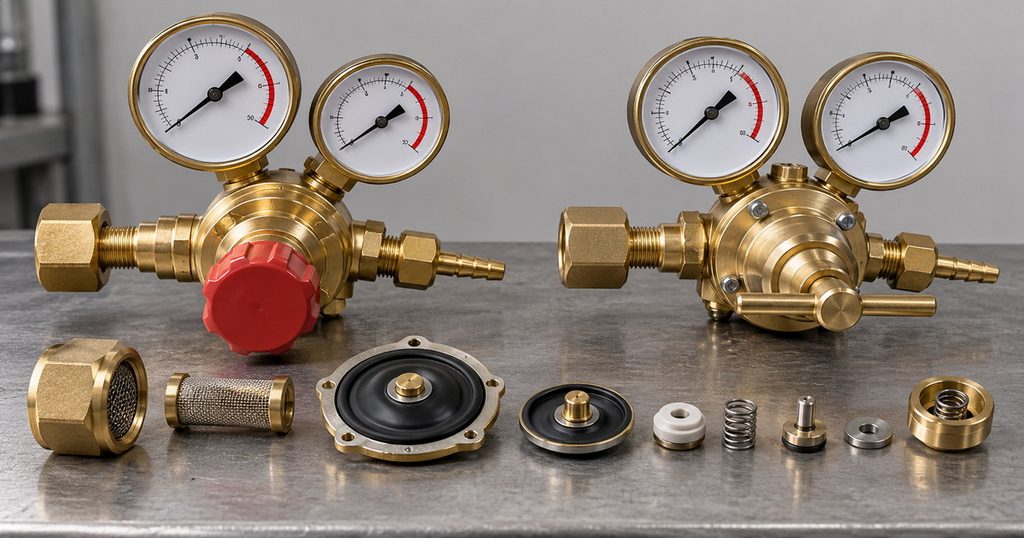
“High-quality brass” is too vague for a safety-critical buying specification. Request the alloy designation, material certificate or supplier declaration, component drawing, and traceability method for every wetted component. Also identify what is actually made from brass: body, bonnet, inlet fitting, and internal parts need not share one material.
A less obvious risk is selecting brass by apparent heft or copper content. More copper is not automatically better for acetylene service. Air Products warns against unalloyed copper in direct contact with acetylene and against alloys containing more than 65% copper, because hazardous acetylides can form. Buyers should obtain an application-specific material review from a qualified engineer rather than using a generic brass-grade claim as proof of compatibility.
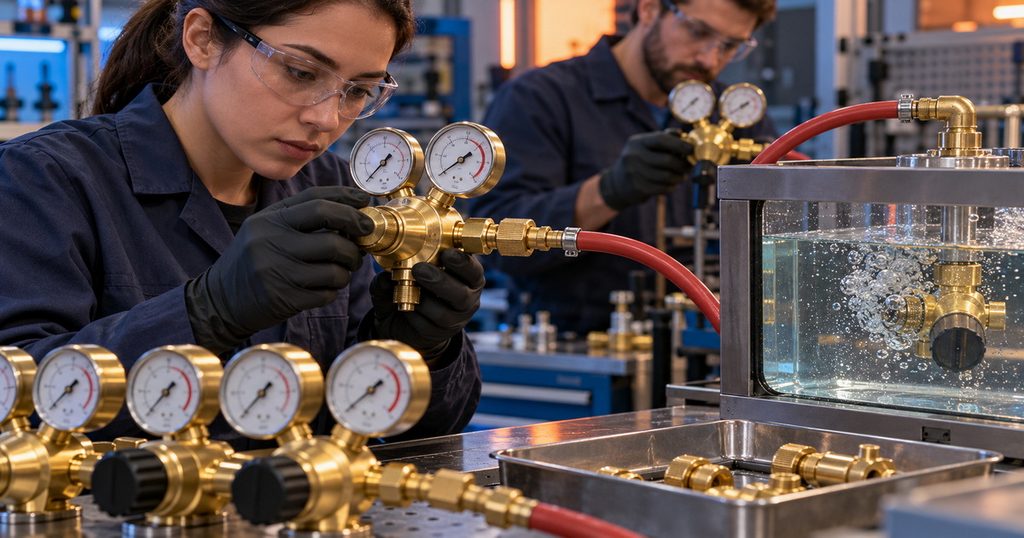
Ask for a written production test plan covering leakage, seat performance, pressure adjustment, gauge checks, and visual inspection. Define which tests apply to every unit, which are sample-based, and what records will accompany each lot. A supplier’s statement that products receive “100% testing” is a question to investigate, not a substitute for acceptance criteria.
Use the insider check: control substitutions
One of the easiest failures to miss in a private-label regulator program is a component substitution after the approved sample. The body and logo may look identical while the seat, diaphragm, inlet filter, gauge movement, or seal supplier has changed. A short incoming visual inspection may never reveal it.
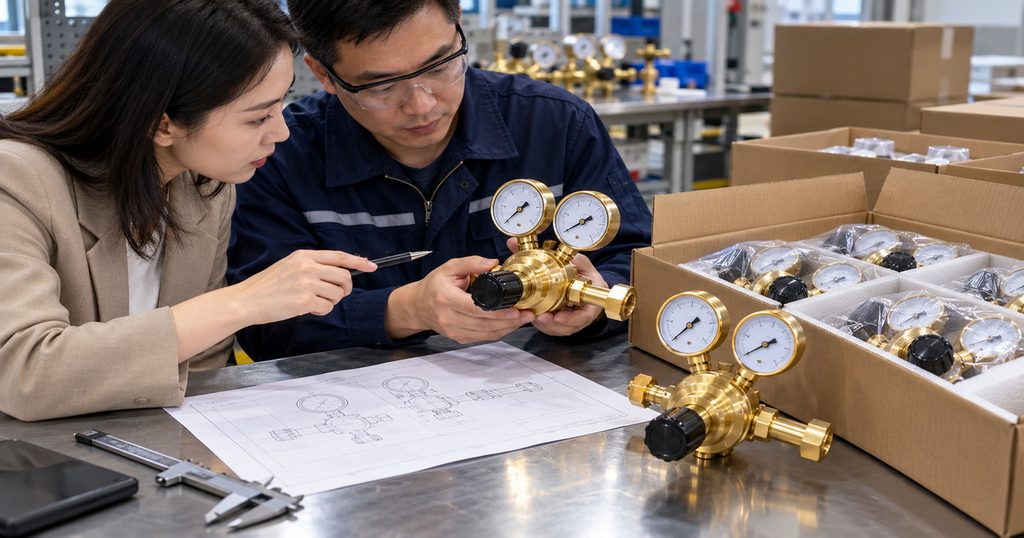
Include an approved bill of materials and revision-controlled drawing in the purchase agreement. Require written approval before any change to wetted materials, pressure-bearing parts, gauges, spring, seal, or fitting supplier. At pre-shipment inspection, compare randomly selected units with the approved sample, review the current parts list, and trace their lot numbers back to inspection records. This is particularly important when the same exterior casting supports several gas-specific variants.
Verify claims, then run a sample order
Request the legal manufacturer name and factory address; compare both with the quotation, certificate, test report, and shipping documents. For an ISO 9001 claim, check certificate number, scope, site, issue and expiry dates, certification body, and accreditation status. ISO points buyers to IAF CertSearch or direct confirmation with the relevant certification and accreditation bodies. A management-system certificate does not certify every acetylene regulator model.
Treat “CE certified” with equal care. The European Commission explains that CE marking is the manufacturer’s declaration of conformity with applicable EU legislation; it is not an EU authority’s blanket approval. Request the exact model’s EU Declaration of Conformity, identified legislation, technical documentation, and any required notified-body information. RoHS primarily concerns electrical and electronic equipment, so a blanket RoHS claim for a purely mechanical regulator also deserves a scope check.
For a new OEM design, approve a drawing before approving a sample. Test the sample against the stated inlet, outlet, gauge, and pressure specifications; then approve a production-representative pre-shipment sample rather than relying only on an early prototype. Agree in advance who pays if the production lot differs from the approved version.
Plan landed cost and logistics
A low unit quote may exclude duties, inspection, replacement parts, product-liability requirements, or corrective-action costs. Compare offers using the same Incoterm and destination. Ask the freight forwarder and customs broker to confirm classification, current duty treatment, origin documentation, packaging, and any destination-market marking rules before shipment.
North American buyers should not assume that sourcing through a U.S., Canadian, or Mexican seller automatically makes a product eligible for United States–Mexico–Canada Agreement (USMCA) treatment. The agreement has rules of origin for qualifying goods; the product’s actual manufacturing origin and documentation matter. A China-made Bril regulator should be evaluated as a China-origin product unless a competent trade review establishes otherwise.
Conclusion
The strongest shortlist depends on the purchasing model. Victor and Harris provide established industrial equipment lines; Western, Uniweld, and Goss address distinct gas-control or contractor channels; CONCOA offers unusually clear published acetylene part-number detail. Bril belongs in the same sourcing discussion for buyers seeking a direct, customizable OEM/ODM relationship, while remaining clearly identified as a China-based manufacturer serving the Americas—not an Americas-based factory.
Before choosing a partner, send a common specification to at least two candidates and compare their model-specific documentation, approved samples, change-control terms, MOQ, lead time, and landed cost. Buyers exploring a private-label range can contact Zhejiang Bril Welding Equipment Co., Ltd. with their target market, acetylene connection standard, pressure range, forecast quantity, and branding requirements to request a documented proposal.
FAQ
1. How can I tell whether a factory’s ISO 9001 certificate has expired or is outside scope?
Ask for the full certificate, not a cropped logo. Match the legal entity and manufacturing address to the factory you are buying from; read the scope for the relevant manufacturing activity; then check the certificate number, status, and certification body through IAF CertSearch or directly with the issuer. An active certificate at a sales office does not, by itself, establish that the production site is covered.
2. Is a CE mark or RoHS statement enough to import an acetylene regulator?
No. First determine which requirements apply to the specific product and destination market. For a claimed CE-marked product, obtain the manufacturer’s EU Declaration of Conformity and the technical basis for it; a voluntary “CE certificate” by itself may not establish legal compliance. RoHS is directed at electrical and electronic equipment, so its relevance to a mechanical regulator cannot be assumed.
3. Can I order one regulator design for both acetylene and propane?
Do not assume so. Even when parts look alike, gas service, outlet-pressure range, fittings, seals, labeling, and the approved test program may differ. Require the supplier to identify and approve a separate gas-specific configuration for each intended use. OSHA requires regulators to be used only for their intended gas and pressures.
4. Should I specify a dual-stage acetylene regulator?
Specify it when your application calls for tighter delivery-pressure control as cylinder pressure changes, but compare the complete regulator and application rather than buying on stage count alone. Confirm that the quoted acetylene part number has the correct inlet, outlet, maximum delivery pressure, flow capability, and documented gas service. CONCOA’s 8400 Series shows why exact variants matter: its acetylene and other fuel-gas options have different published delivery limits.
5. How do I prevent an approved OEM sample from becoming a different production product?
Make the sample approval part of a controlled specification. Keep the signed drawing, bill of materials, component revisions, markings, and acceptance tests together; require notification and written approval of substitutions; and inspect randomly selected production units against that file. Also agree on lot traceability and a corrective-action process before the first commercial order.
References
1. – [American Welding Society, *Where Are the Welders?* (October 2025)] — industry workforce and regional-cluster context. [aws]
2. – [OSHA, 29 CFR 1910.253: Oxygen-fuel gas welding and cutting] — U.S. acetylene pressure and regulator-use requirements. [osha]
3. – [ISO 2503:2009, gas-welding pressure regulators] — published scope covering dissolved-acetylene cylinder regulators. [iso]
4. – [Compressed Gas Association, CGA E-4: Standard for Gas Pressure Regulators] — North American regulator-standard reference. [legacy.cganet]
5. – [ISO, certification verification] — guidance on checking accredited certification claims. [iso]
6. – [European Commission, CE marking] — explanation of the manufacturer’s conformity responsibilities. [single-market-economy.ec.europa]
7. – [Air Products, *Acetylene Safetygram*] — acetylene material-compatibility precautions. [airproducts]
8. – [U.S. International Trade Administration, USMCA overview] — regional trade and origin-rule context; not acetylene-regulator export-volume data. [trade]
Hot Tags: Acetylene Regulator Manufacturers, Acetylene Regulator Suppliers, Acetylene Regulator Wholesale, Industrial Acetylene Regulator Manufacturer, Welding Gas Regulator Manufacturer, Oxy Acetylene Regulator Supplier, Brass Acetylene Regulator Manufacturer, Dual Stage Acetylene Regulator, Acetylene Regulator OEM, Private Label Gas Regulator Manufacturer