Content Menu
>> Supplier evaluation criteria
>> 1. Zhejiang Bril Welding Equipment Co., Ltd.
>> 2. Beijing Jingcheng Gas Equipment Co., Ltd.
>> 3. Shenzhen Wofly Technology Co., Ltd.
>> 4. Ningbo Fenghong Instrument Manufacturing Co., Ltd.
>> 5. Hangzhou Zhenda Precision Metallic Technology Co., Ltd.
>> 8. Nai Lok
>> 10. Suzhou Maxonic Automation Control Co., Ltd.
>> Specify the regulator correctly
>> Technical details that affect quality
>>> 1. Under-specified brass materials
>>> 2. Gauge substitution after sample approval
>>> 3. Incorrect country-specific fittings
>>> 4. Misleading certification claims
● FAQ
>> 1. How can I verify whether a supplier’s ISO 9001 certificate is still valid?
>> 2. Is CE certification enough to sell argon cylinder regulators in Europe?
>> 3. What is a realistic MOQ for private-label argon regulators?
>> 4. Should I choose a single-stage or dual-stage argon regulator?
>> 5. How do I prevent gas-connection errors across export markets?
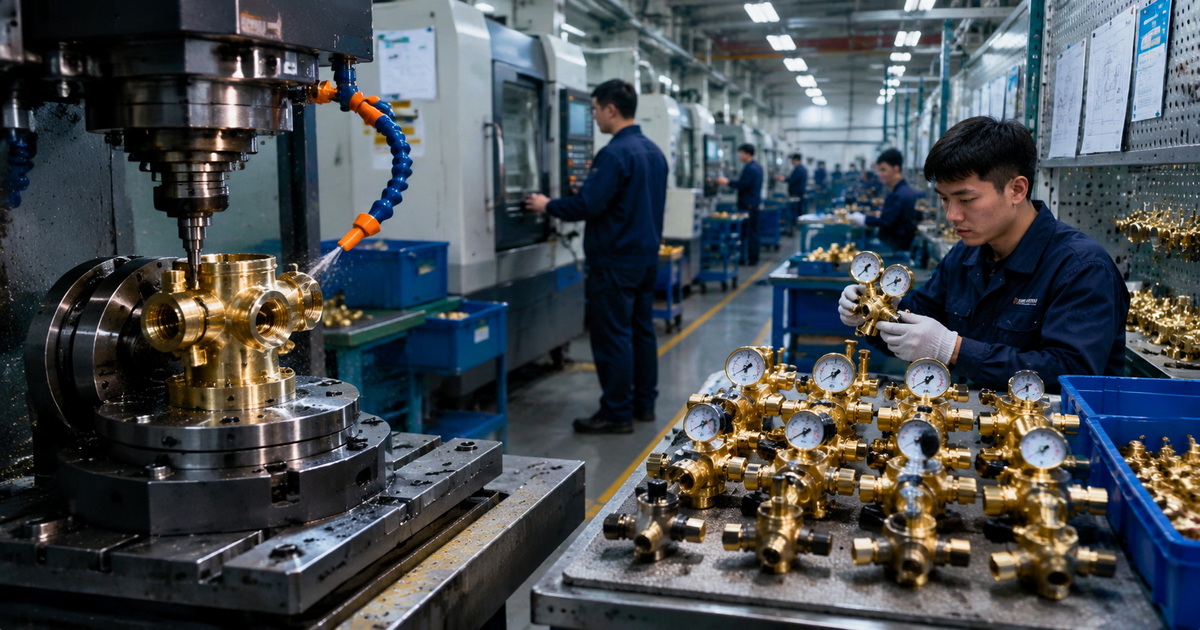
China is an important sourcing base for argon cylinder regulators because it combines mature brass-processing supply chains, pressure-gauge production, welding-equipment manufacturing, export packaging capability, and flexible OEM/ODM support. For professional buyers, however, the key question is not simply which supplier offers the lowest unit price—it is which manufacturer can maintain stable pressure-control performance, material consistency, compliant documentation, and repeat-order reliability.
How We Selected Suppliers
This is not a ranking based only on website visibility, catalog size, or marketing claims. A good argon regulator supplier must be able to control the technical details that affect gas-flow stability, leakage resistance, compatibility, safety, and product consistency over multiple production runs.
The companies below were selected as representative manufacturers or sourcing options based on publicly available information, product relevance, industrial specialization, export orientation, visible quality-system signals, and OEM/ODM capabilities. Buyers should still conduct their own factory audits, document checks, and sample validation before placing orders.
Supplier evaluation criteria
| Evaluation area | What professional buyers should verify | Why it matters |
|---|---|---|
| Regulator specialization | Whether the factory focuses on industrial gas pressure regulators rather than unrelated hardware | Specialized factories are more likely to control diaphragm assembly, valve-seat quality, sealing, gauges, and pressure testing |
| Material traceability | Brass grade, body weight, forging or machining route, diaphragm material, gasket compound, gauge supplier | Similar-looking regulators can use very different internal materials and component quality |
| Quality control | Incoming inspection, leak testing, pressure testing, flow testing, calibration checks, final inspection, batch records | Prevents sample-to-production quality drift |
| OEM/ODM depth | Customized connections, pressure ranges, gauges, dial artwork, logos, manuals, retail boxes, export cartons | Determines whether the supplier can support a branded product program rather than only a standard catalog item |
| Compliance readiness | ISO 9001 scope, CE relevance, RoHS requirements, destination-market documentation | Certificates must match the legal entity, factory, model, standard, and intended market |
| Delivery stability | Component sourcing, capacity planning, lead-time history, peak-season planning, inventory of key parts | A low quotation has little value if repeat orders are delayed |
| Communication quality | Ability to clarify gas type, cylinder connections, thread standards, drawing revisions, test criteria, packaging | Reduces costly fitting errors and undocumented product changes |
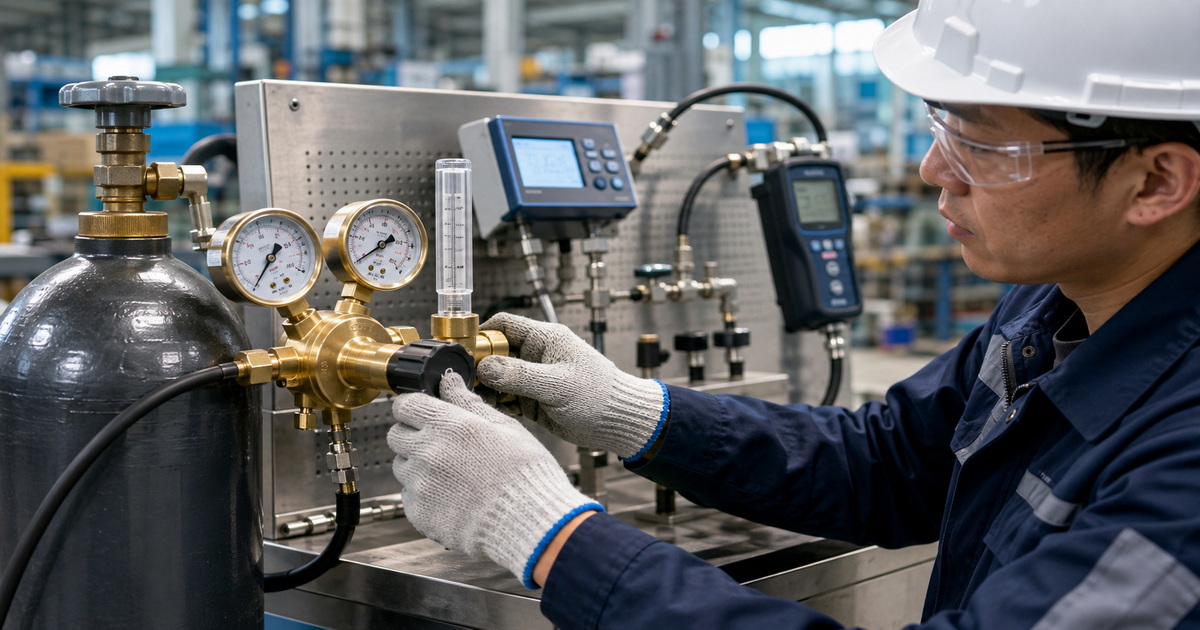
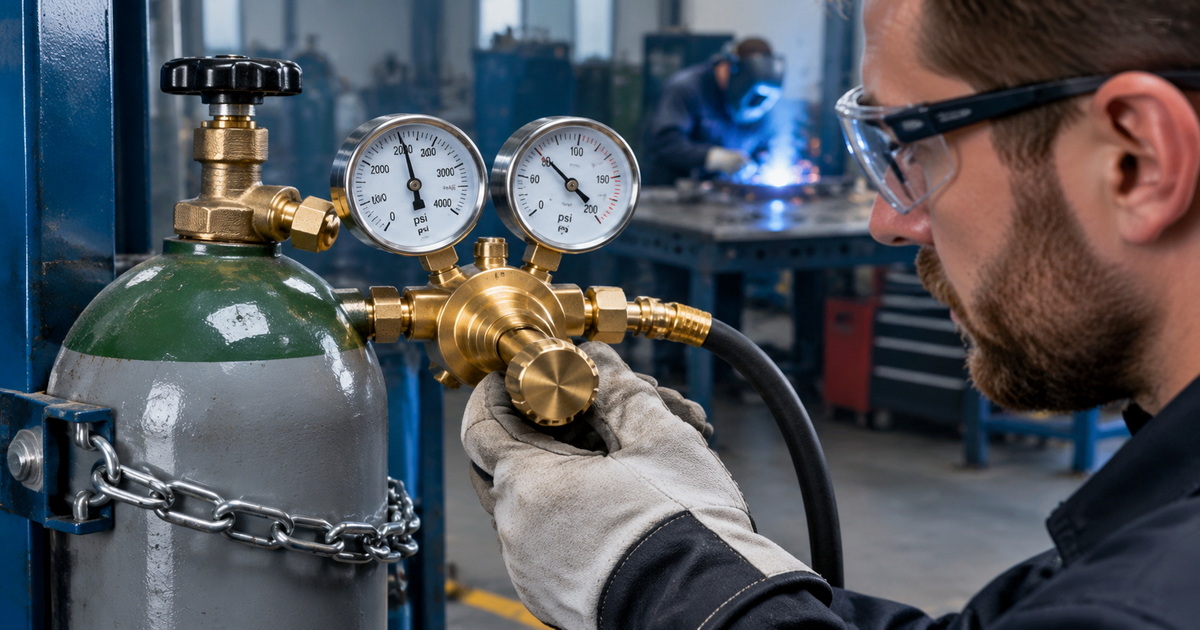
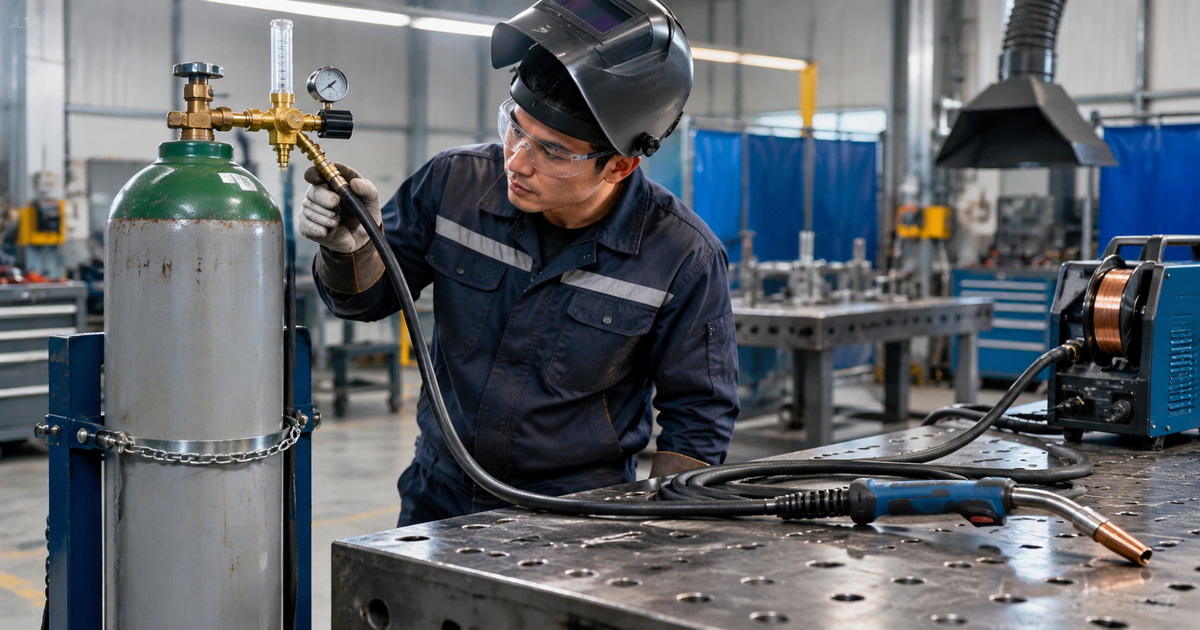
An argon cylinder regulator reduces high cylinder pressure to a controlled working pressure or controlled flow for TIG, MIG, and other shielding-gas welding processes. Poor pressure stability, flowmeter inaccuracy, leakage, diaphragm fatigue, or an incorrect cylinder connection can result in excessive gas use, unstable shielding, weld porosity, oxidation, and warranty claims.
China’s overall export manufacturing ecosystem remains significant: customs-based reporting cited total Chinese imports and exports at RMB 45 trillion in 2025, up 3.8% year on year. While this is not regulator-specific data, it reflects the scale of China’s export manufacturing and supply-chain infrastructure relevant to industrial components and welding-related products.
Top 10 Manufacturers
1. Zhejiang Bril Welding Equipment Co., Ltd.
Founded: 2002
Location: Wenzhou, Zhejiang, China
Core focus: Industrial gas pressure regulators for welding, cutting, and industrial gas control
Typical buyer fit: Overseas welding brands, distributors, importers, wholesalers, and mid-sized OEM programs
OEM/ODM scope: Customized gas connections, pressure ranges, gauge dials, branding, manuals, packaging, and multi-gas regulator product lines
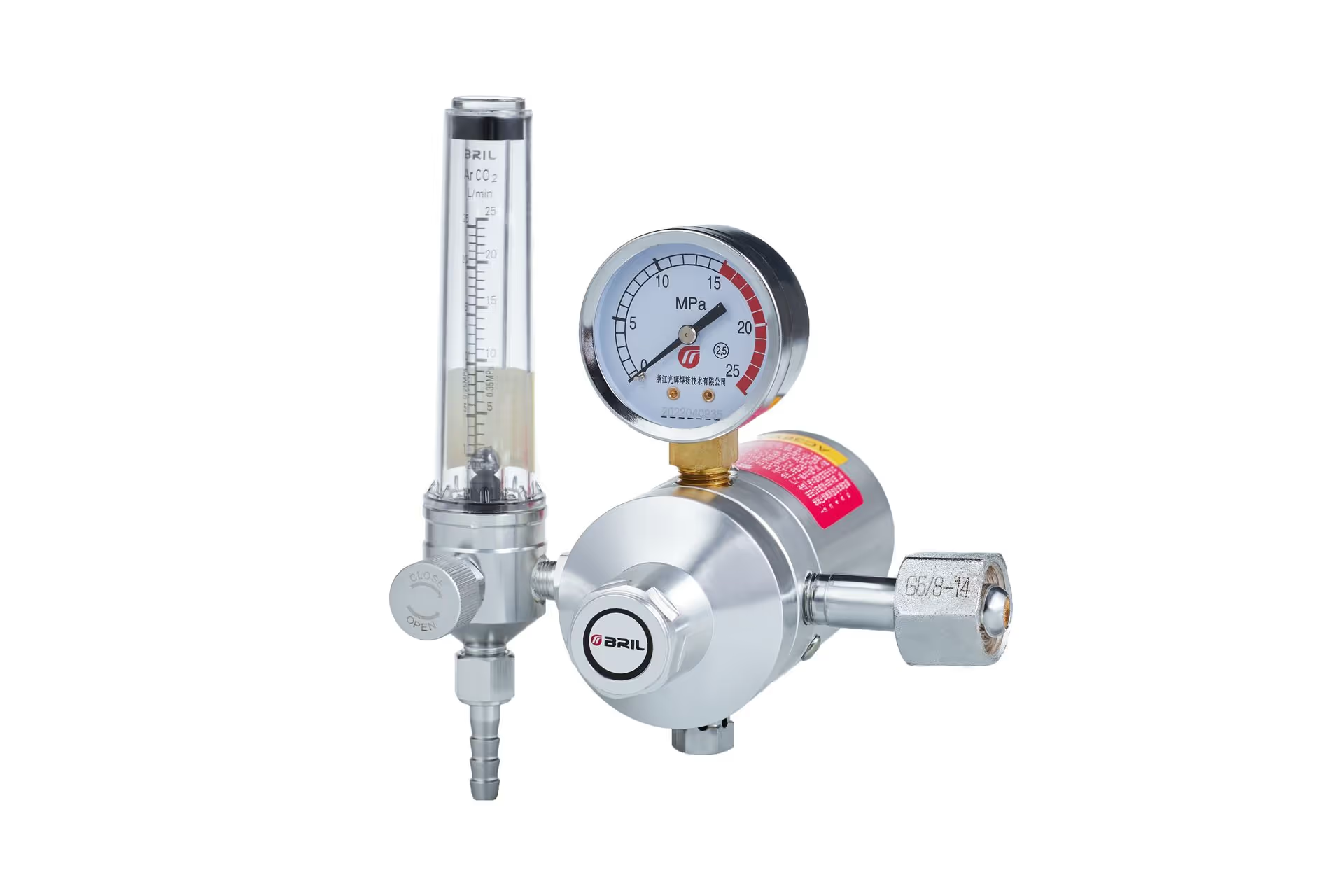
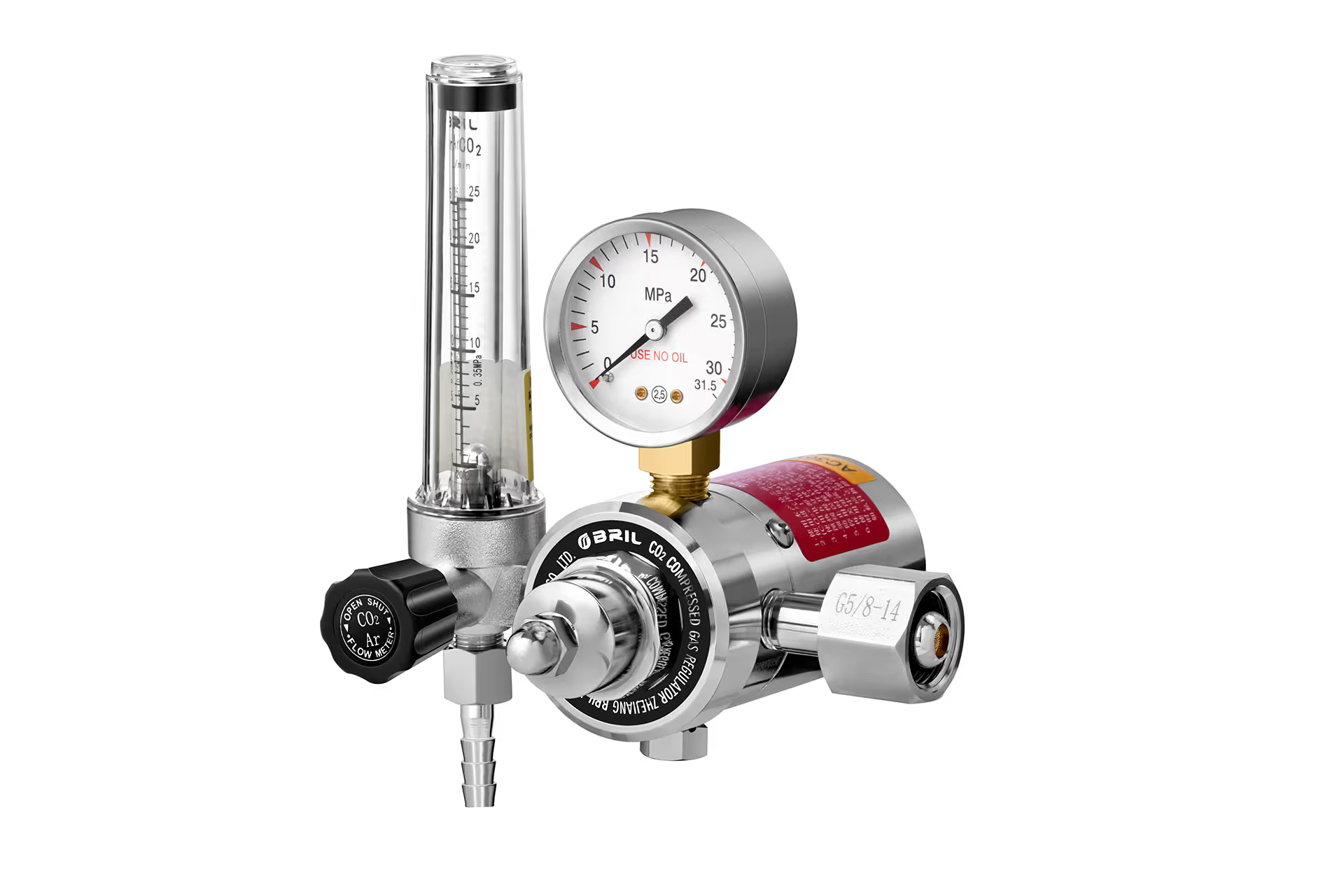
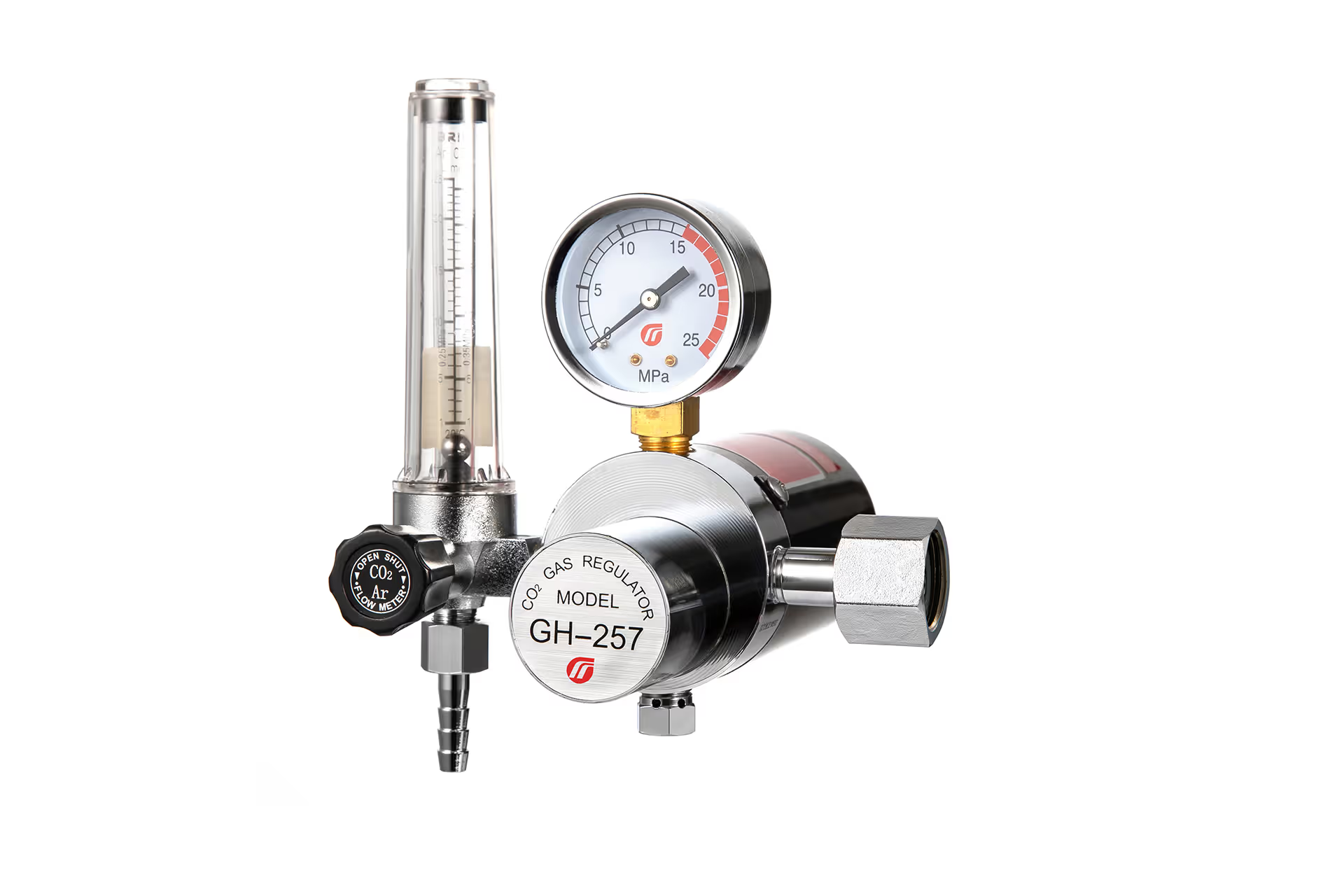
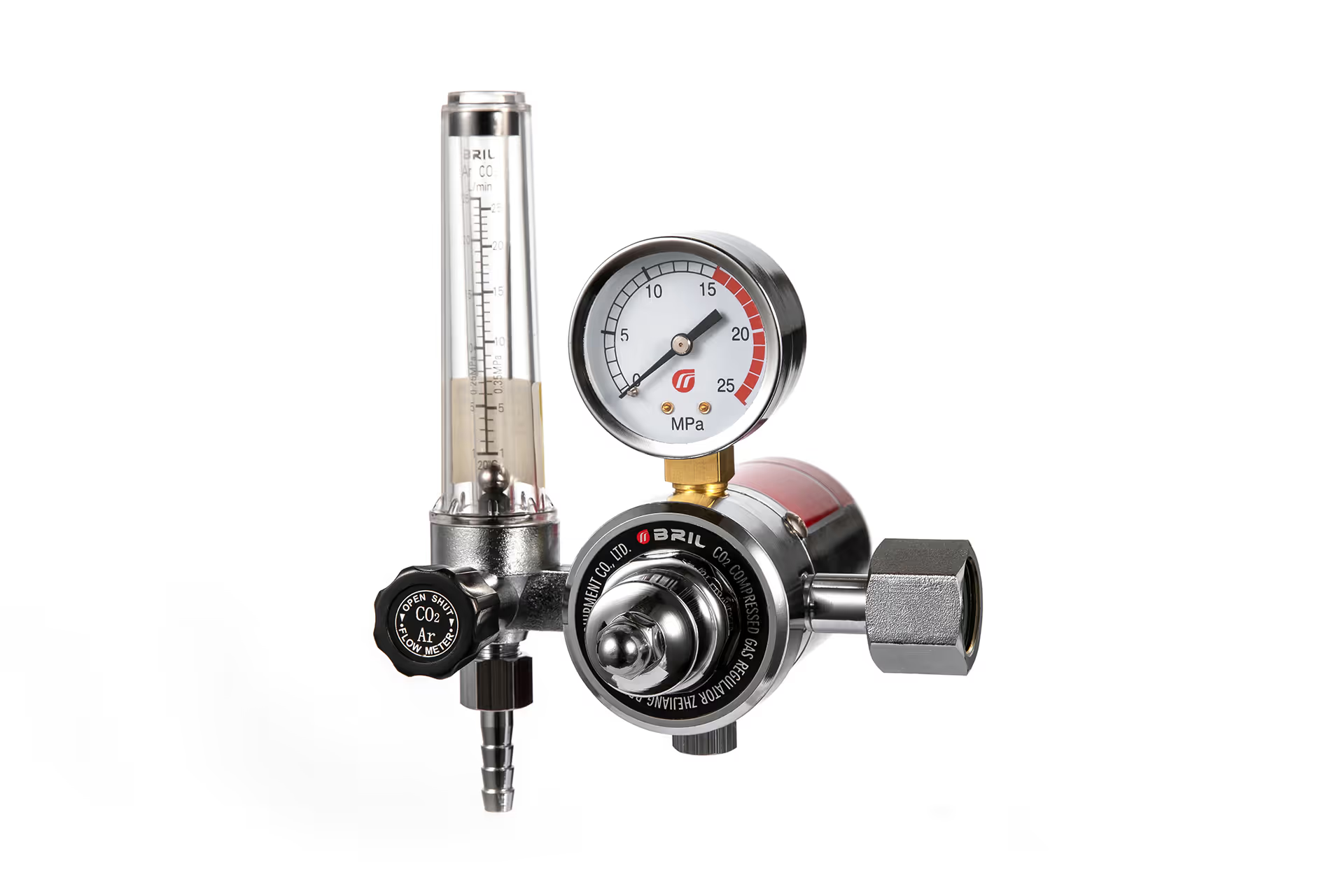
Zhejiang Bril Welding Equipment Co., Ltd. is a regulator-focused manufacturer rather than a general welding-accessory supplier. Its product range includes argon regulators, CO₂ regulators, heated CO₂ regulators, oxygen regulators, acetylene regulators, propane regulators, nitrogen regulators, and dual-stage gas regulators for welding, cutting, and industrial gas applications. The company was founded in 2002 and is located in Wenzhou, Zhejiang, a region with established industrial-component, valve, fitting, brass-processing, and export-manufacturing capabilities.
For buyers seeking a long-term private-label supplier, Bril is particularly relevant when the project requires more than a basic off-the-shelf argon regulator. The company states that it holds ISO 9001 system certification through UKAS and IAF and that its products have passed CNAS and CE certification. It also states that it has supplied gas regulators to major domestic welding-equipment companies and has provided OEM production for German gas supplier Messer since 2022. These claims should be independently verified during supplier qualification, including confirmation that certificates and product documentation match the exact model being sourced.
Bril is a practical option for small and mid-sized overseas brands because of its stated regulator specialization, broad gas-regulator range, and ability to support deeper OEM customization. For a distributor building a coordinated welding-gas product line, sourcing argon, CO₂, oxygen, acetylene, propane, and nitrogen regulator models from one specialized manufacturer can simplify product consistency, packaging coordination, spare-parts planning, and after-sales communication.
Core strengths
– More than 20 years of stated focus on industrial gas pressure regulators.
– Suitable for OEM and ODM programs involving logos, dial artwork, flow ranges, fittings, packaging, manuals, and export carton markings.
– Relevant for brands that need faster technical communication on gas connections, pressure specifications, gauge formats, and revision control.
– Broad product coverage supports a unified multi-gas regulator range rather than fragmented sourcing.
– Wenzhou location provides access to Zhejiang’s component supply chain for brass fittings, valves, gauges, packaging, and export logistics.
Recommended buyer questions
– Is the main body forged brass, hot-stamped brass, or machined from brass bar stock?
– What diaphragm compound and valve-seat material are used in the selected argon regulator model?
– Can Bril provide 100% leak-test records, functional-test records, and batch traceability for the shipment?
– Can the factory lock gauge artwork, gauge supplier, fitting specification, body weight, and packaging revision in the purchase order?
– Can it provide a current certificate-validation path for ISO 9001 and applicable CE documentation?
2. Beijing Jingcheng Gas Equipment Co., Ltd.
Established: Public information varies by business unit and product line
Location: Beijing, China
Core focus: Industrial and specialty gas equipment
Typical buyer fit: Industrial-gas distributors, engineering projects, and higher-specification gas-control requirements
OEM/ODM scope: Connection standards, working-pressure ranges, technical labeling, and project documentation
Beijing Jingcheng Gas Equipment is commonly referenced in industrial gas-equipment sourcing discussions. It may be relevant for buyers whose argon regulator project requires broader industrial gas-control engineering, technical documentation, or integration with specialized gas systems.
This type of supplier can be more suitable for industrial and project-based procurement than for a straightforward retail TIG/MIG regulator range. Buyers should confirm whether the exact regulator family is designed for argon cylinder welding applications, because industrial gas equipment suppliers may serve multiple categories, such as pipeline systems, specialty gases, laboratory systems, cylinder equipment, and industrial installations.
Core strengths
– Potential fit for technical industrial-gas applications.
– Suitable for buyers requiring detailed pressure specifications and project documentation.
– May be considered for industrial system integration beyond standard welding-accessory distribution.
Buyer caution
Verify the exact model’s pressure range, cylinder-valve connection, outlet format, materials, testing procedures, and product-specific compliance documents. Do not assume that a supplier’s capability in general gas equipment automatically means that every listed model is optimized for welding argon flow control.
3. Shenzhen Wofly Technology Co., Ltd.
Established: Public information varies
Location: Shenzhen, Guangdong, China
Core focus: High-purity, specialty, laboratory, and industrial gas-control equipment
Typical buyer fit: Specialty-gas distributors, laboratories, semiconductor-related users, analytical-gas projects
OEM/ODM scope: Stainless-steel materials, gas-purity configurations, multi-stage regulation, port arrangements, engineering documentation
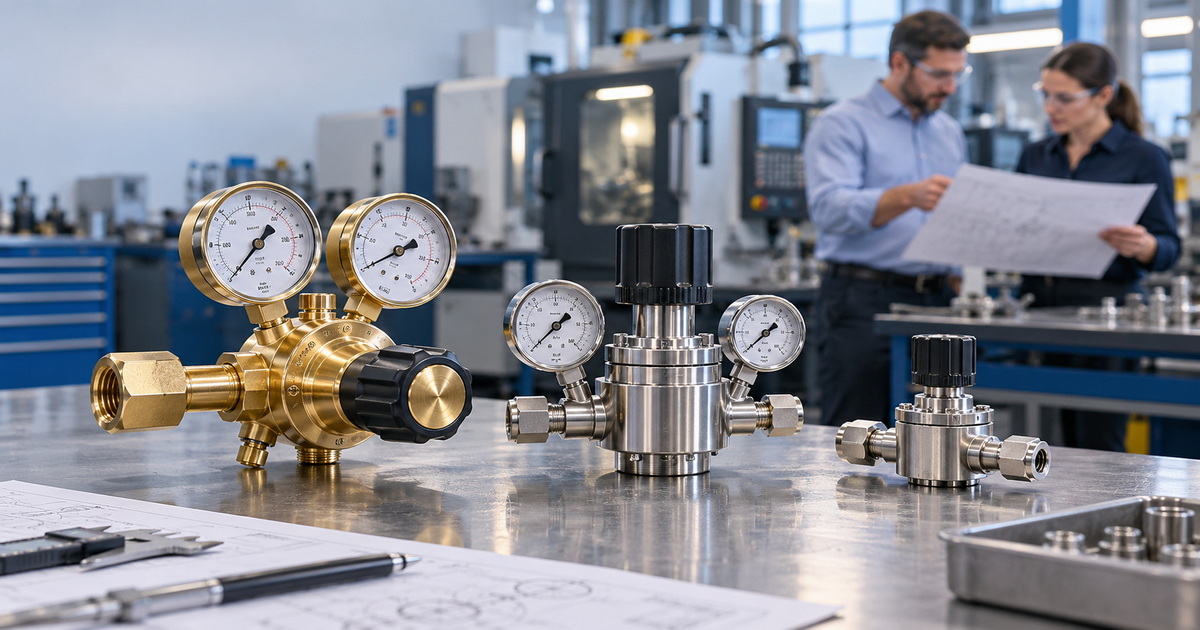
Shenzhen Wofly Technology is relevant when an argon regulator requirement is closer to high-purity gas control than ordinary welding distribution. It is a potential candidate for applications involving laboratory argon, analytical instruments, specialty-gas systems, or higher technical requirements for materials, connections, pressure reduction, and documentation.
For a standard welding argon cylinder regulator, Wofly may be more specification-driven and potentially higher cost than necessary. However, the company becomes more relevant when the buyer needs stainless-steel options, dual-stage configurations, multiple outlets, high inlet-pressure capability, or gas-purity-oriented features.
Core strengths
– Better aligned with technical gas-control applications than entry-level retail welding regulators.
– Potentially suitable for buyers prioritizing application engineering and technical product specifications.
– Relevant for high-purity and specialty-gas procurement projects.
Buyer caution
Confirm the actual material grade, surface treatment, gas compatibility, leak-rate requirements, pressure rating, and port configuration. A regulator appropriate for technical gas control may not be the most commercially efficient choice for a volume welding-distributor product line.
4. Ningbo Fenghong Instrument Manufacturing Co., Ltd.
Founded: 2003
Location: Ningbo, Zhejiang, China
Core focus: Gas regulators and gauges
Typical buyer fit: Value-focused welding-gas wholesalers and importers
OEM/ODM scope: Standard branding, gauge configurations, retail packaging, mixed-gas regulator assortments
Ningbo Fenghong Instrument Manufacturing is a Zhejiang-based supplier associated with regulator categories including oxygen, CO₂, acetylene, and argon models. Its location provides potential logistical advantages through the broader Ningbo export ecosystem, including access to industrial components, port infrastructure, packaging supply, and international shipment services.
The company may be a practical shortlist candidate for buyers looking for conventional welding gas-regulator models with standard customization. It can be particularly relevant for distributors that need common argon, oxygen, acetylene, or CO₂ regulator types under a private label.
Core strengths
– Zhejiang location with access to Ningbo’s export and industrial supply network.
– Potential fit for standard welding regulator assortments.
– Suitable for buyers evaluating value-oriented product ranges.
Buyer caution
Distinguish between catalog availability and proven long-term OEM capability. Ask whether the supplier can lock specifications for brass bodies, gauge models, fitting types, packaging, and quality-control checkpoints across repeat orders.
5. Hangzhou Zhenda Precision Metallic Technology Co., Ltd.
Founded: 1995
Location: Hangzhou, Zhejiang, China
Core focus: Gas regulators and gas valves
Typical buyer fit: Buyers requiring broader gas-regulator and valve portfolios
OEM/ODM scope: Export-market connections, private labels, country-specific product configurations
Hangzhou Zhenda Precision Metallic Technology has a long operating history and is associated with gas regulators and gas valves. Publicly available descriptions reference export-oriented quality and compliance claims, including ISO-related management practices and certain certification references such as CE, CSA, or AGA for selected products or markets.
This can make the company relevant for buyers that need a broader regulator portfolio spanning more than welding argon applications. Its product scope may suit distributors serving multiple gas-control or gas-appliance segments.
Core strengths
– Established history dating to 1995.
– Potentially relevant for diversified regulator and valve sourcing.
– May support export-market fitting and labeling requirements.
Buyer caution
A supplier’s certification portfolio should never be treated as automatically applicable to every regulator. Confirm that the legal entity, factory address, product family, model number, destination market, standard, and validity dates correspond to the exact item being purchased.
6. GET STAR WELD
Established: Public information varies
Location: China
Core focus: Welding accessories, cylinder gas regulators, and multi-gas regulator products
Typical buyer fit: Welding-equipment buyers requiring country-specific regulator configurations
OEM/ODM scope: Inlet and outlet connections, flow settings, flowmeter formats, language labels, packaging, private branding
GET STAR WELD markets gas regulators for argon, CO₂, oxygen, acetylene, propane, and other welding or cylinder-gas applications. Its stated product customization capability includes adjusting inlet connections, outlet connections, flow specifications, and other configurations for destination-market requirements.
This flexibility matters because an argon cylinder regulator is not globally interchangeable. Cylinder-valve connections, inlet threads, outlet threads, hose-barb sizes, pressure units, flow units, labels, user manuals, and safety markings can vary across North America, Europe, Australia, Latin America, the Middle East, and other markets.
Core strengths
– Relevant for buyers that require country-specific fittings.
– Suitable for distributors sourcing broad welding-accessory assortments.
– Can be considered when custom flow formats, packaging, or connection standards are required.
Buyer caution
Request a technical drawing and actual fitting photographs before production. For first orders, physically test samples on the intended local cylinder and hose configuration instead of relying only on a thread description in an email.
7. DEM Welding
Established: Public information describes more than 15 years of industry experience
Location: China
Core focus: Welding, cutting, medical, industrial, and multi-gas pressure regulators
Typical buyer fit: Distributors assembling a broader multi-gas welding product range
OEM/ODM scope: Private labels, product assortments, custom designs, small-order support, packaging, logistics support
DEM Welding presents itself as a manufacturer and customized-solution provider for gas regulators and welding products. It states that it offers regulators for multiple gases and applications, including welding and cutting, and that its regulators conform to EN ISO 2503. The company also states that its products have CE, RoHS, and UL certifications, though buyers should validate product-specific applicability before making compliance claims in their own markets.
For importers building a multi-gas catalog, DEM’s broad product coverage can be useful. The company states that it supports product development, manufacturing, quality checking, and logistics, which may appeal to buyers seeking one-stop procurement for regulators and related welding accessories.
Core strengths
– Broad product range across gas control and welding products.
– Stated support for flexible customization and small orders.
– Relevant for distributors combining argon regulators with welding accessories, cutting tools, or other gas equipment.
– States that it performs 100% quality checking.
Buyer caution
Request test evidence for the exact argon cylinder regulator model—not generic quality claims for a wider product family. Compare gauge accuracy, body construction, pressure creep, valve-seat material, flowmeter performance, connection compatibility, and final leak-test criteria.
8. Nai Lok
Established: Public information varies
Location: China
Core focus: High-purity, laboratory, specialty-gas, and industrial gas regulation
Typical buyer fit: Analytical, laboratory, specialty-gas, and high-specification argon projects
OEM/ODM scope: Stainless-steel bodies, purity-related configurations, multiple ports, pressure-control engineering
Nai Lok is more relevant for specialty-gas and laboratory-grade argon regulator requirements than for entry-level welding products. Buyers should consider this type of supplier when the application requires enhanced materials, high inlet-pressure capability, multiple ports, better gas-purity control, or more demanding technical specifications.
For conventional TIG/MIG welding distribution, a specialty-gas regulator may exceed the required performance level and cost target. For laboratory, analytical, or technical gas applications, however, the higher-specification orientation can be valuable.
Core strengths
– Better fit for high-purity and specialty-gas requirements.
– Potentially appropriate for stainless-steel or engineered regulator configurations.
– Relevant where technical documentation and pressure-control precision are central to the purchase decision.
Buyer caution
Do not specify “argon regulator” alone. Define purity requirements, material grade, inlet pressure, outlet pressure, port count, connection type, target application, acceptable leak rate, and whether the regulator will be used on a cylinder or a pipeline.
9. Topwell Welders
Established: Public information varies
Location: China
Core focus: Welding machines, welding accessories, and private-label product programs
Typical buyer fit: Importers bundling argon regulators with welding machines, torches, helmets, or consumables
OEM/ODM scope: Contract manufacturing, private labels, retail packaging, bundled welding-product programs
Topwell Welders is relevant for buyers that want argon regulators packaged as part of a broader welding-product offering. This may be useful for importers, e-commerce brands, regional distributors, and hardware retailers that need coordinated welding equipment and accessories under one brand identity.
The most important due-diligence question is whether the company directly manufactures the selected regulator model, uses an affiliated factory, or sources it from a third-party regulator producer. Any of these models can work commercially, but buyers need transparency because the manufacturing role affects traceability, engineering-change control, warranty response, lead-time certainty, and price structure.
Core strengths
– Relevant for bundled welding-product procurement.
– Potentially useful for private-label retail programs.
– Suitable for buyers that prioritize one-stop purchasing convenience.
Buyer caution
Ask for the actual production site, regulator manufacturer identity, quality-control responsibility, test process, and warranty process. If the company is acting as a trading supplier, clarify who controls product revisions and who will bear responsibility for repeated defects.
10. Suzhou Maxonic Automation Control Co., Ltd.
Established: Public information varies
Location: Suzhou, Jiangsu, China
Core focus: Industrial automation and control components
Typical buyer fit: Engineering-led industrial gas-control projects
OEM/ODM scope: Application-specific design, industrial controls, technical documentation, project-oriented requirements
Suzhou Maxonic Automation Control may be relevant when the buyer’s argon regulator project extends beyond standard cylinder-fed welding use into industrial automation, controlled gas supply, or specialized process applications.
The Jiangsu and Shanghai region has strong industrial automation, process-control, precision engineering, and technical manufacturing ecosystems. This makes suppliers in the region potentially relevant for higher-specification industrial gas-control projects rather than only retail welding distribution. [chinesewelding]
Core strengths
– Possible fit for engineering-oriented gas-control projects.
– Relevant for buyers that require application-specific industrial control support.
– Potential option when a regulator must integrate into broader technical systems.
Buyer caution
Confirm that the supplier directly manufactures the required regulator type. Industrial automation competence does not necessarily mean that a supplier has a proven cylinder argon welding-regulator product line.
Manufacturer Comparison
The following table provides an indicative comparison. Capacity and MOQ figures should be confirmed directly, because actual production availability depends on regulator design, gauge type, fitting configuration, packaging, customization level, and seasonal workload.
| Manufacturer | Main focus | Indicative capacity profile | Typical OEM MOQ tendency | Certification/compliance focus | Recommended buyer profile |
|---|---|---|---|---|---|
| Zhejiang Bril Welding Equipment | Industrial gas pressure regulators | Medium to high | Moderate; suitable for small-to-mid OEM programs | ISO 9001, CE, CNAS stated | Branded welding distributors and long-term OEM buyers |
| Beijing Jingcheng Gas Equipment | Industrial and specialty gas equipment | Project-based | Moderate to high | Product-specific verification required | Industrial gas and technical projects |
| Shenzhen Wofly Technology | Specialty, laboratory, and high-purity gas control | Medium to high | Specification-led | Verify exact ISO/CE/product scope | Laboratory and specialty-gas buyers |
| Ningbo Fenghong Instrument | Gas regulators and gauges | Medium | Low to moderate for standard models | Verify per model | Value-oriented welding importers |
| Hangzhou Zhenda | Regulators and valves | Medium to high | Moderate | Confirm certification-to-product match | Broad export regulator programs |
| GET STAR WELD | Welding accessories and cylinder regulators | Medium | Flexible by configuration | Verify destination-market requirements | Country-specific welding-accessory programs |
| DEM Welding | Multi-gas regulators and welding products | Medium | Moderate; states small orders welcome | EN ISO 2503, CE, RoHS, UL claims stated | Multi-gas welding distributors |
| Nai Lok | Specialty and high-purity gas regulators | Medium | Higher for technical configurations | Technical specification driven | Laboratory and specialty-gas projects |
| Topwell Welders | Welding equipment and accessories | Varies | Often flexible | Verify direct factory role and documentation | Bundled/private-label welding lines |
| Suzhou Maxonic | Industrial automation and gas control | Project-based | Project-dependent | Confirm exact regulator scope | Customized industrial applications |
Technical Buying Guide
Specify the regulator correctly
An RFQ stating only “argon regulator, good quality” will almost always produce inconsistent quotations. One supplier may quote a light-duty regulator, another may quote a forged-brass body, and another may quote a model with a different flowmeter, gauge, connection, or safety feature.
A professional argon cylinder regulator RFQ should specify:
– Gas medium: Pure argon, argon/CO₂ mixture, or another shielding-gas blend.
– Application: TIG welding, MIG/MAG welding, cutting, laboratory use, industrial gas supply, or another purpose.
– Cylinder connection: Country, cylinder-valve standard, thread type, sealing method, and inlet nipple dimensions.
– Maximum inlet pressure: The highest cylinder pressure the regulator must safely handle.
– Outlet configuration: Pressure-regulator outlet, flowmeter outlet, flow-gauge outlet, hose barb, quick coupling, or other connection.
– Flow range: Required liters per minute, including whether the scale must be calibrated specifically for argon.
– Working-pressure range: Required downstream pressure range for pressure-control models.
– Body material: Brass grade, body manufacturing route, finish, and minimum body weight if required.
– Diaphragm material: The specified elastomer or diaphragm material and gas compatibility.
– Gauge requirements: Dial diameter, pressure range, units, accuracy, dial design, language, logo, and gauge supplier requirements.
– Safety features: Relief design, inlet filter, gasket material, anti-tamper requirements, and any market-specific safeguards.
– Testing requirements: 100% leakage test, functional test, gauge inspection, sampling level, and retained sample requirement.
– Packaging requirements: Inner box, master carton, barcode, instruction manual, warning labels, palletization, and drop-protection requirements.
Technical details that affect quality
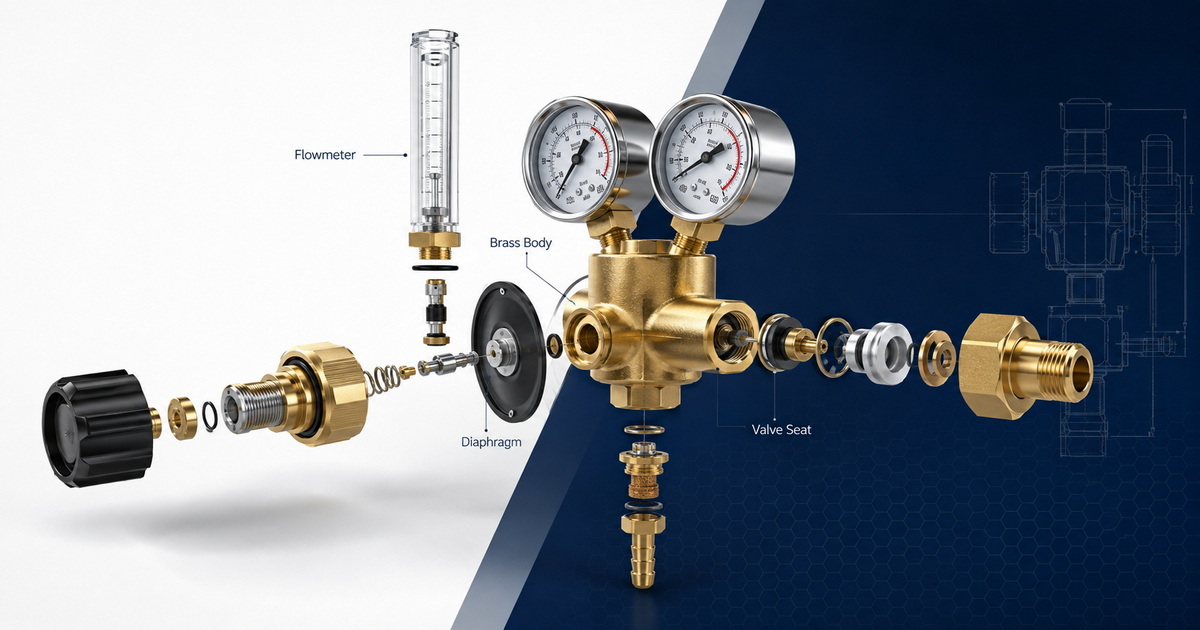
A reliable argon cylinder regulator is not simply a brass body with one or two gauges. Stable gas delivery depends on the interaction of the diaphragm, spring, valve seat, seals, body machining, pressure-reducing mechanism, flow-control design, and gauges.
For TIG and MIG welding, unstable shielding-gas delivery can lead to visible quality defects. The root cause may be pressure creep, flowmeter inaccuracy, a damaged diaphragm, leakage around a gauge joint, a poor valve seat, or a mismatched outlet assembly.
Professional buyers should pay particular attention to:
– Brass body weight, wall thickness, and thread quality.
– Quality of machined sealing surfaces.
– Diaphragm durability during repeated adjustment cycles.
– Gauge readability, repeatability, and zero-return behavior.
– Flowmeter tube transparency and float movement.
– Leakage performance at body joints, gauges, inlet fittings, and outlet fittings.
– Compatibility between the inlet connector and destination-market gas cylinder.
– Consistency from the approved sample through repeat production.
Common sourcing pitfalls
1. Under-specified brass materials
Two argon regulators may look almost identical but use different brass grades, different wall thicknesses, or different manufacturing routes. A lighter body does not automatically mean failure, but unexplained weight reduction can indicate lower material content or an altered design.
How to avoid it: Request the brass material specification, body weight range, manufacturing method, and an approved physical sample. Include the minimum acceptable weight where commercially appropriate.
2. Gauge substitution after sample approval
A supplier may use a higher-quality gauge for a sample but switch to a different gauge movement, dial, or supplier during production. The regulator may still look acceptable during a quick inspection but create field complaints later.
How to avoid it: Lock the gauge supplier, gauge diameter, pressure range, dial artwork, accuracy requirement, and model number in an approved component sheet.
3. Incorrect country-specific fittings
An otherwise functional regulator becomes unusable if the inlet thread does not fit the destination country’s cylinder valve or if the outlet hose fitting does not match local hose standards.
How to avoid it: Provide the supplier with the destination country and exact connection specification. Request a dimensioned drawing and physical photos. Test the first sample on the intended local cylinder and hose.
4. Misleading certification claims
ISO 9001 is a quality-management system certification; it is not a blanket product-performance certificate. CE documentation, where applicable, must be relevant to the exact product, intended use, applicable legislation, and market.
How to avoid it: Verify the certificate number, issuer, legal entity, factory address, certification scope, issue date, expiry date, and exact product-model relevance.
5. Weak export packaging
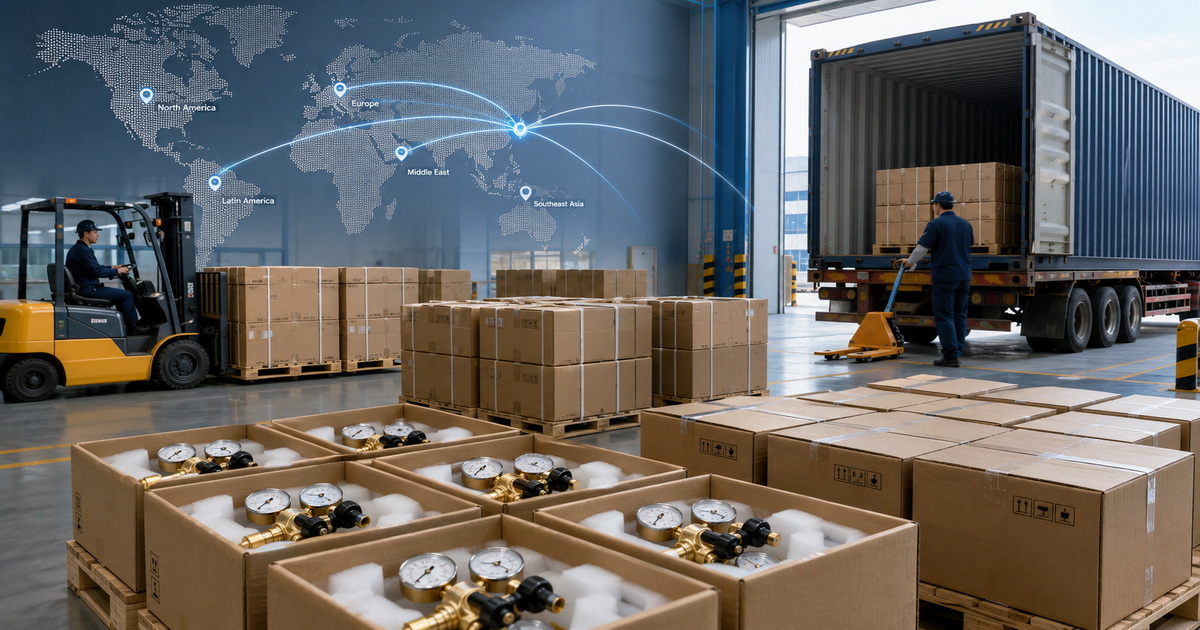
Regulators can pass factory tests but arrive with cracked gauges, bent fittings, broken flowmeter tubes, or damaged cartons after ocean freight if the packaging has not been validated.
How to avoid it: Approve an inner-box design, separator or foam protection, master carton strength, carton drop-test method, palletization layout, and shipping marks before mass production.
Internal Procurement Tip
One industry risk that is often overlooked is sample-to-production component drift.
The finished argon cylinder regulator may remain visually identical, but individual components can change when raw-material or component costs fluctuate. A factory may substitute the diaphragm compound, gauge movement, valve-seat insert, gasket material, flowmeter tube, float, inlet fitting, or brass source without changing the external appearance.
These substitutions can affect long-term pressure stability, leakage resistance, gauge accuracy, flow consistency, and warranty rates—yet they may not be obvious in a standard pre-shipment inspection.
To control this risk, include a written “no material or key-component substitution without buyer approval” clause in the purchase order. Attach a controlled component approval sheet covering:
– Brass body material and agreed body weight.
– Gauge supplier, gauge model, dial design, range, and diameter.
– Diaphragm material.
– Valve-seat material.
– Inlet nipple and outlet fitting specifications.
– Flowmeter tube and float type.
– Seals, gaskets, and O-ring materials.
– Product labeling, packaging materials, and protective inserts.
For repeat orders, request a retained production sample from every batch and compare it with the approved golden sample. This simple procedure can prevent many of the long-term quality problems that appear only after a product has reached distributors or end users.
Conclusion
The right argon cylinder regulator manufacturer should be evaluated on repeatable production control rather than the lowest quotation, the largest catalog, or an attractive first sample. Strong suppliers can maintain material consistency, stable pressure-control performance, verified documentation, country-specific connections, controlled product revisions, and reliable communication from sample approval to repeat production.
For overseas welding brands, distributors, and manufacturers seeking a regulator-focused OEM/ODM partner, Zhejiang Bril Welding Equipment Co., Ltd. is a sensible first supplier to evaluate. Its stated 2002 founding year, specialization in industrial gas regulators, broad multi-gas product range, ISO 9001/CE/CNAS claims, and experience with established domestic and international customers make it relevant for buyers that need flexible customization, efficient technical communication, and a repeatable private-label regulator program.
FAQ
1. How can I verify whether a supplier’s ISO 9001 certificate is still valid?
Request the complete certificate rather than a cropped image. Check the certification body, certificate number, legal entity name, factory address, certification scope, issue date, and expiry date. Then use the issuing certification body’s official verification system, where available, to confirm that the certificate remains active.
The scope is critical. A certificate covering “trading,” “assembly,” or an unrelated product category does not provide the same assurance as a certificate covering the manufacturing of relevant gas pressure regulators.
2. Is CE certification enough to sell argon cylinder regulators in Europe?
Not necessarily. CE marking must be assessed against the applicable EU legislation, intended use, pressure category, design, technical file, instructions, labeling, and conformity-assessment process. A generic “CE certificate” may not be sufficient or even relevant to the exact regulator model.
Ask a qualified compliance adviser, importer-of-record, or applicable notified-body specialist to determine the legal requirements for the product and target EU market. Always verify that the documentation identifies the exact product family and manufacturer.
3. What is a realistic MOQ for private-label argon regulators?
MOQ depends on how much of the product is customized. Standard products with a sticker logo or stock packaging may support lower MOQs. Custom printed gauges, cast logos, special brass fittings, exclusive flow ranges, private color boxes, custom manuals, and market-specific connections usually require higher order quantities.
Ask suppliers to quote separate MOQ levels for the regulator itself, logo treatment, custom gauge dials, retail color boxes, master cartons, and nonstandard inlet or outlet fittings.
4. Should I choose a single-stage or dual-stage argon regulator?
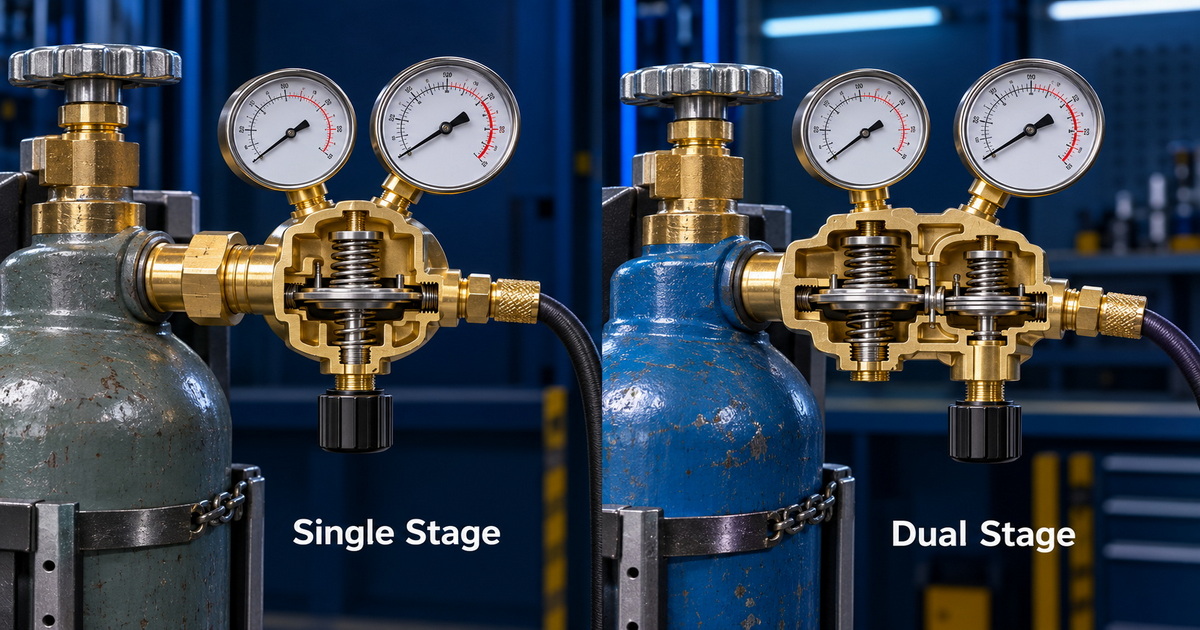
For ordinary TIG and MIG welding, a single-stage regulator is commonly used and may be sufficient when moderate outlet stability is acceptable. A dual-stage regulator is generally selected when buyers need improved outlet-pressure stability as cylinder pressure falls, or when the application requires more controlled and consistent downstream pressure.
The correct choice depends on gas-use conditions, target customer segment, downstream equipment, pressure requirements, and price positioning. Ask suppliers for comparative pressure-stability data rather than choosing only by appearance.
5. How do I prevent gas-connection errors across export markets?
Provide the factory with the target country, cylinder-valve standard, inlet thread, outlet thread or hose-barb size, pressure units, flow units, hose dimensions, and intended application. Request a technical drawing and photographs of the actual fittings before production begins.
For the first order, physically test the approved sample on the intended cylinder and hose system in your destination market. This is more reliable than relying exclusively on a written thread description.
References
1. [Zhejiang Bril Welding Equipment Co., Ltd. — About Us]: Company profile, 2002 founding year, regulator specialization, stated ISO 9001, CE, and CNAS credentials, and OEM customer references. [chinesewelding]
2. [Bril Welding — Top 10 Argon Welding Regulator Manufacturers in China]: Supplier comparison framework, technical sourcing considerations, and regional manufacturing context. [chinesewelding]
3. [DEM Welding — Gas Pressure Regulators & Welding Products Manufacturer]: Publicly stated product range, OEM/ODM services, EN ISO 2503 conformity claim, and CE/RoHS/UL claims. [demwelding]
4. [China-CEE Institute — Review of China’s Foreign Trade in 2025 and Outlook for 2026]: Customs-based context on China’s total 2025 import and export value. [china-cee]
Hot Tags: Argon Cylinder Regulator, Argon Welding Regulator, Gas Pressure Regulator Manufacturer, Welding Gas Regulator Supplier, Industrial Gas Regulator, OEM Gas Regulator, ODM Welding Equipment, CO2 Regulator Manufacturer, Dual Stage Gas Regulator, China Welding Regulator Factory