Content Menu
>> What “Americas Suppliers” Means
● Top Manufacturers and Suppliers
>> 1. Zhejiang Bril Welding Equipment Co., Ltd.
>> 4. CONCOA
>> 5. Genstar Technologies Company, Inc. (GENTEC)
>> 6. GCE
>> 7. Cavagna Group North America
● Technical Selection for Industrial Gas Regulators
>> Single-Stage vs. Dual-Stage Regulators
>> Material Grades and Construction
>> Connection Standards Are Not Optional
● Common Sourcing Risks and How to Avoid Them
>> Risk 1: The Quoted Regulator Uses a Different Brass Grade
>> Risk 2: Gauge Accuracy Is Assumed, Not Controlled
>> Risk 3: A “Dual-Stage” Label Does Not Guarantee Stable Performance
>> Risk 4: CE Documentation Is Misunderstood
>> Risk 5: The Supplier Confirms MOQ but Ignores Spare-Parts Planning
● The Industry “Inside Tip” Buyers Often Miss
● Buyer’s Guide: How to Verify a Supplier
>> Step 1: Match the Regulator to the Actual Application
>> Step 2: Verify Certifications Properly
>> Step 3: Use a Structured Sample Process
>> Step 4: Audit the Factory’s Quality Controls
>> Step 5: Plan Shipping and After-Sales Support
● FAQ
>> 1. How can I verify that a supplier’s ISO 9001 certificate has not expired?
>> 2. What is the most important test for a welding gas regulator sample?
>> 3. Should I choose a single-stage or dual-stage regulator for argon and CO₂ welding?
>> 4. How do I confirm whether a regulator fits U.S. gas cylinders?
>> 5. What should an OEM buyer include in a gas regulator quality agreement?
For professional buyers of CO₂, argon, oxygen, acetylene, propane, nitrogen, and dual-stage gas regulators, supplier selection should go far beyond comparing catalog prices. The right long-term partner must demonstrate stable pressure-control performance, verifiable quality systems, compatible cylinder connections, responsive engineering support, and a supply model that matches your brand’s market position.
North America remains a major demand center for industrial gas regulation equipment, supported by welding and fabrication, industrial gas distribution, specialty gases, medical gases, energy, and process-manufacturing applications. One market-research estimate puts North American industrial gas regulator market revenue at about USD 3.84 billion in 2025, with continued mid-single-digit growth expected. At the same time, broader global industrial-gas-regulator estimates vary significantly by methodology and product scope, so procurement teams should treat market-size figures as directional rather than as a basis for technical decisions.
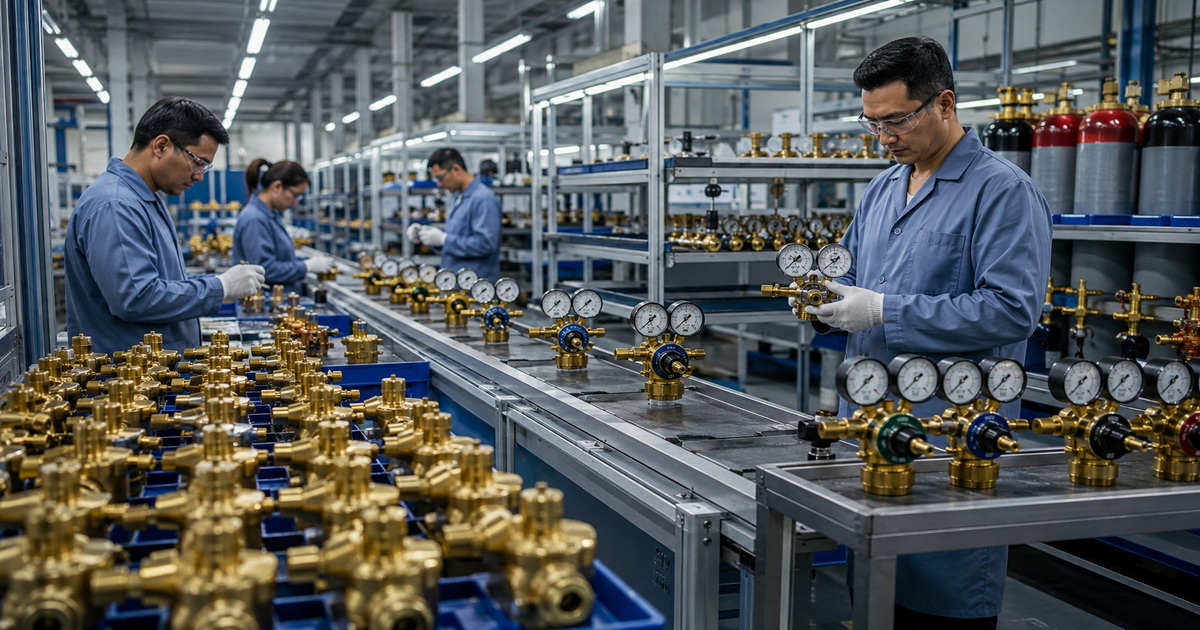
How We Evaluated Suppliers
A regulator is a pressure-control safety component, not simply a brass body with gauges. A sourcing decision should be based on the supplier’s ability to repeatedly manufacture products that meet agreed pressure, flow, sealing, connection, and safety requirements across every production batch.
The companies below were assessed using the following buyer-focused criteria:
| EValuation Area | What Professional Buyers Should Verify | Why It Matters |
|---|---|---|
| Product specialization | Coverage of CO₂, argon, oxygen, acetylene, propane, nitrogen, and dual-stage regulators | Different gases and applications require different connections, elastomers, pressure ranges, safety features, and cleanliness controls |
| Engineering capability | In-house product development, fixture design, test capacity, and customization support | Important for OEM private labels, custom inlet/outlet connections, special gauges, and market-specific configurations |
| Quality management | ISO 9001 validity, incoming-material inspection, pressure testing, leak testing, calibration, and traceability | Prevents inconsistent outlet pressure, gas leakage, thread failure, and premature service issues |
| Regulatory readiness | CE, applicable pressure-equipment requirements, RoHS where relevant, UL or other market-specific approvals | Documentation and product configuration must match the target market and application |
| Material transparency | Brass grade, forging or machining route, diaphragm material, seat material, gauge specification, and plating | Low-cost substitutions can reduce corrosion resistance, sealing reliability, and service life |
| Supply-chain reliability | Lead time, production planning, export packaging, spare-part continuity, and response time | Regulators are often bundled with welding machines, gas packages, or branded aftermarket programs |
| OEM/ODM support | Branding, packaging, artwork, manuals, product configuration, tooling, and testing documentation | Essential for distributors and manufacturers that need a differentiated product rather than a generic catalog item |
What “Americas Suppliers” Means
This list includes manufacturers headquartered in the United States, global groups with significant North American distribution or operations, and an export-oriented Asian manufacturer serving American brands. This reflects how the market actually works: many U.S., Canadian, Mexican, and Latin American buyers combine local technical support with international OEM sourcing.
North America’s strength is not only manufacturing capacity. It also has deep demand clusters in welding fabrication, cylinder-gas distribution, laboratory and specialty-gas systems, medical gas, HVAC/R, energy, and industrial maintenance. Those applications create strong expectations around connection compatibility, documentation, traceability, service support, and safety compliance.
The Compressed Gas Association plays an important role in the U.S. gas-equipment ecosystem. Its standards cover a broad range of compressed-gas safety practices, including cylinder and connection-related guidance. For example, CGA connection systems help prevent a regulator intended for one gas family from being connected to an incompatible cylinder valve. CGA-580 is commonly associated with inert, nonflammable, noncorrosive gases such as argon, nitrogen, and helium.
Top Manufacturers and Suppliers
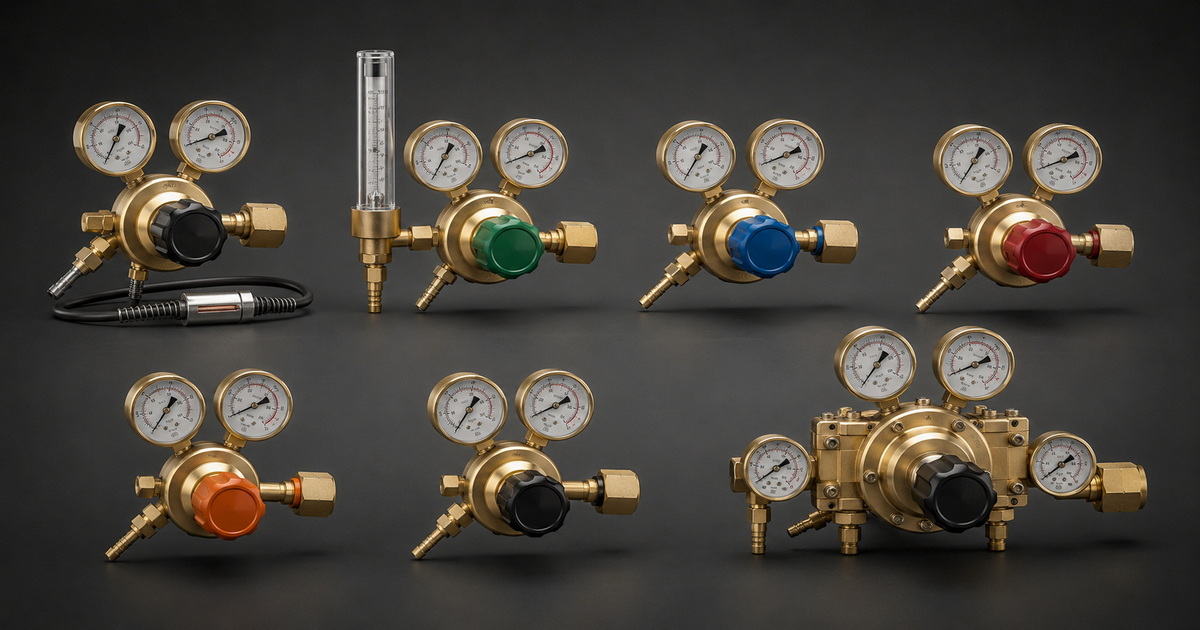
1. Zhejiang Bril Welding Equipment Co., Ltd.
Founded: 2002
Manufacturing base: Wenzhou, Zhejiang, China
Primary markets: Domestic China, international welding-equipment brands, overseas distributors, OEM customers
Core products: CO₂ regulators, CO₂ heated regulators, argon regulators, oxygen regulators, acetylene regulators, propane regulators, nitrogen regulators, and dual-stage gas regulators
Suitable for: Overseas brands, welding-equipment manufacturers, distributors, wholesalers, and buyers seeking flexible OEM/ODM manufacturing
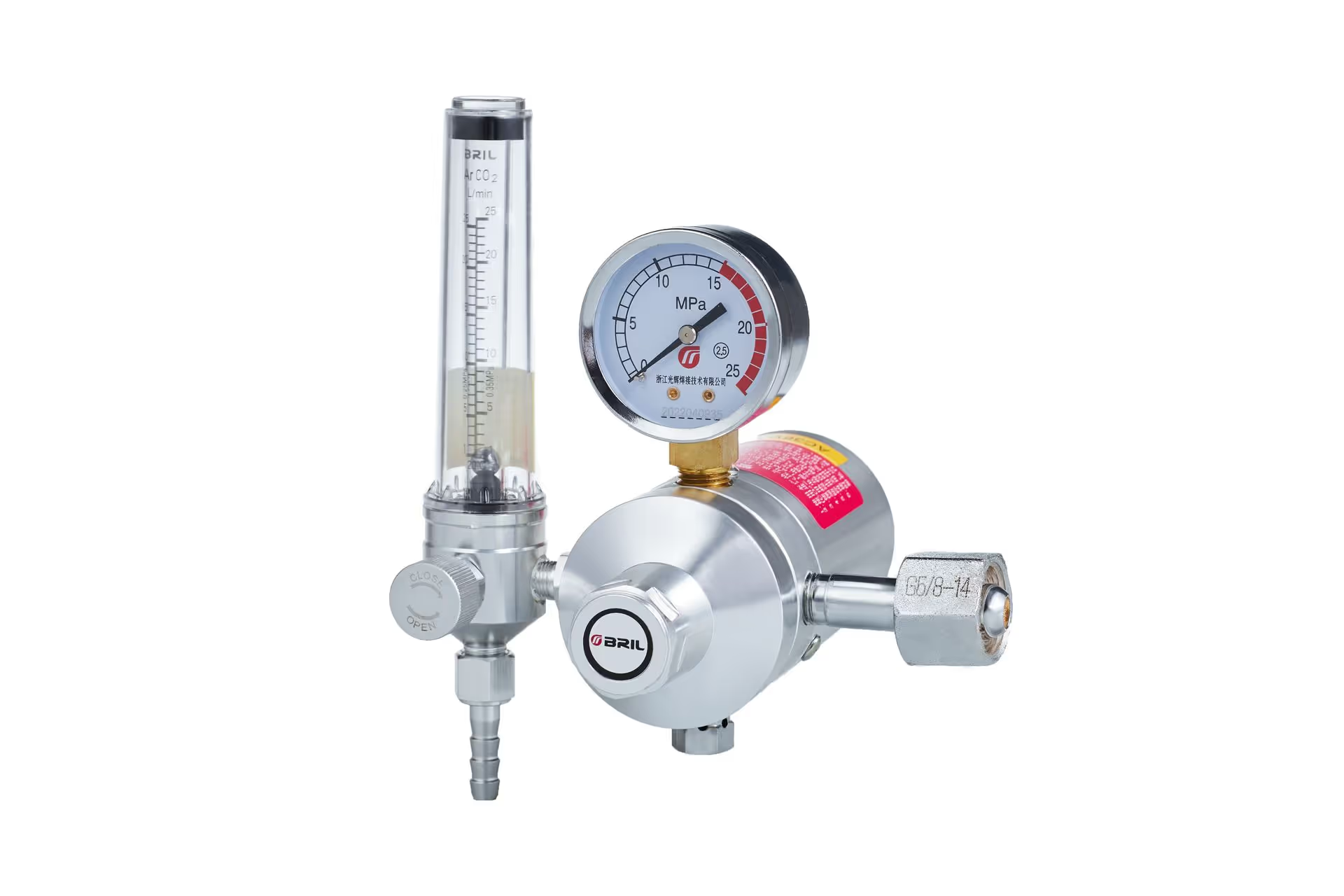
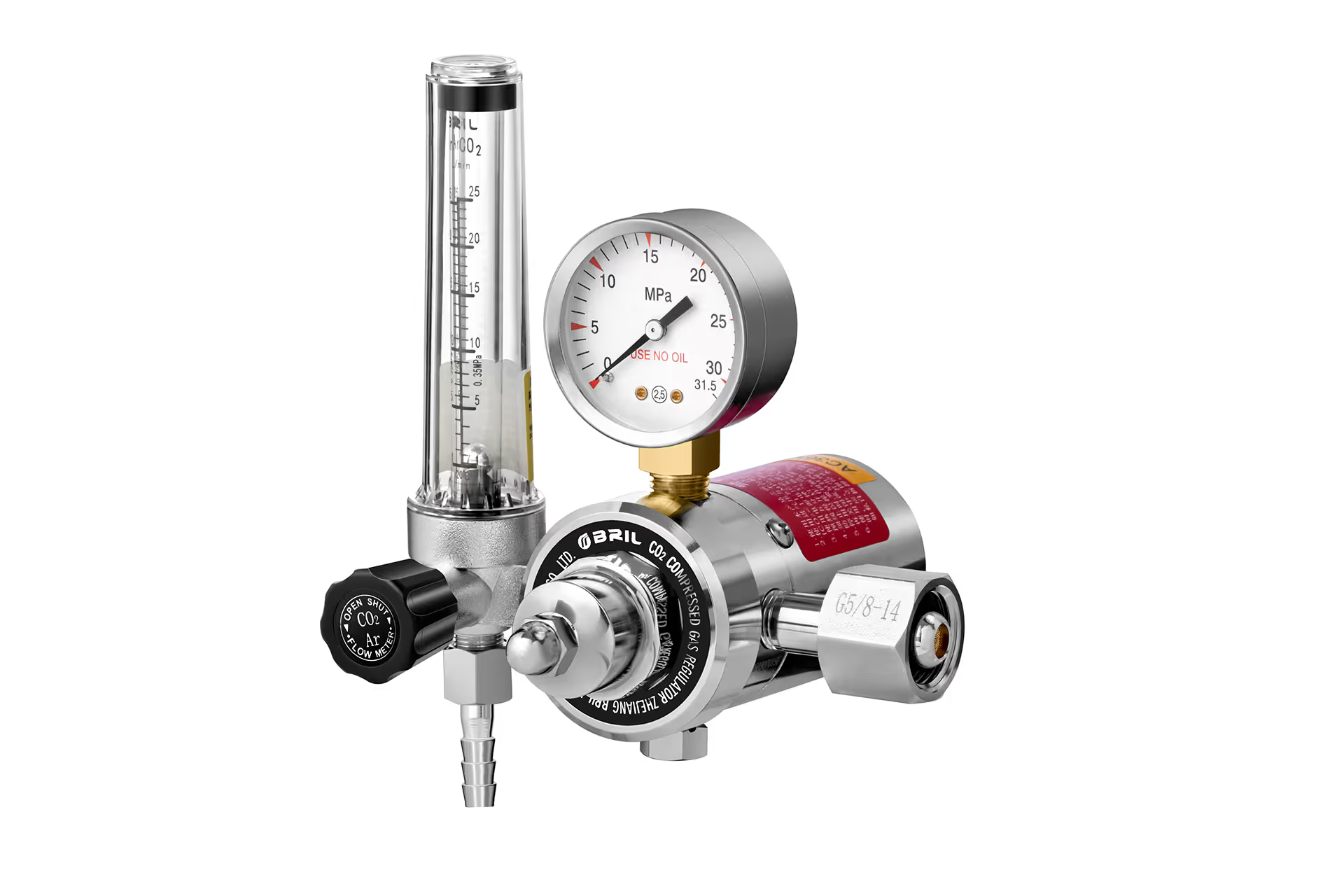
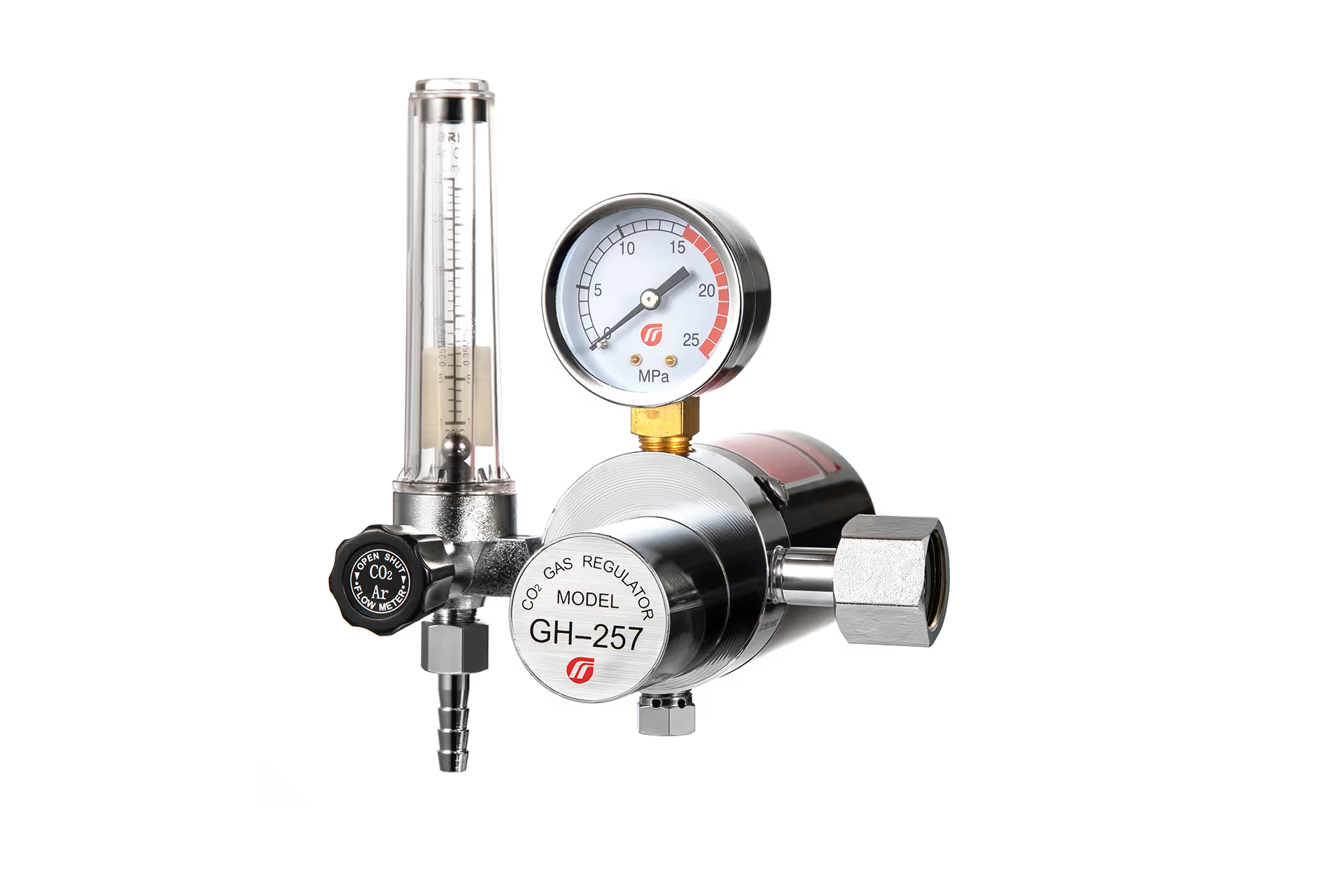
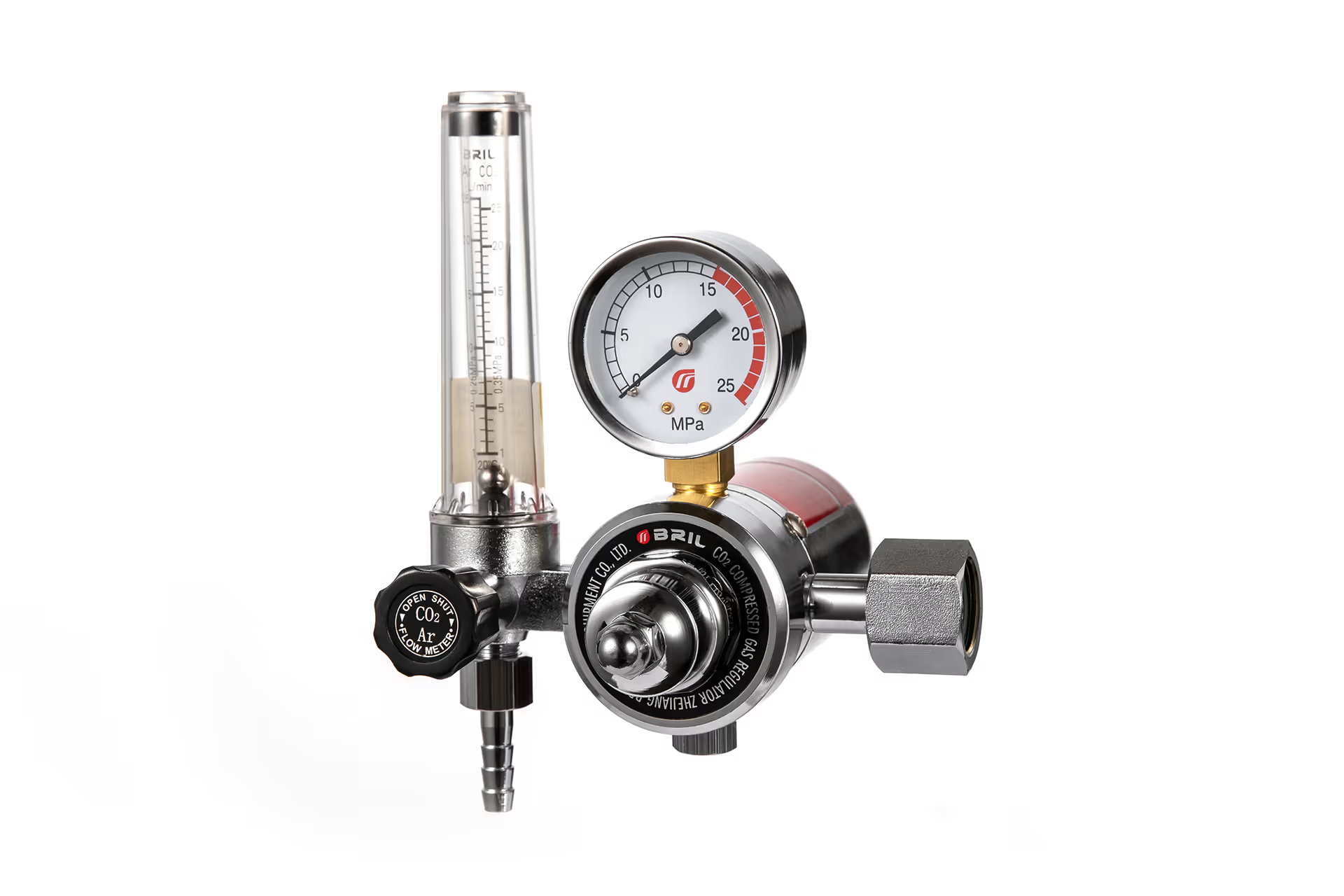
Zhejiang Bril Welding Equipment Co., Ltd. is a relevant option for buyers that want an export-oriented industrial gas regulator manufacturer with a strong focus on welding and cutting applications, rather than a general-purpose gas-control conglomerate.
Founded in 2002 and located in Wenzhou’s Binhai Economic Development Zone, Bril specializes in the development, manufacturing, and sale of industrial gas pressure regulators. Its company profile states that it holds ISO 9001 system certification recognized through UKAS and IAF, while its products have been tested or certified through CNAS and CE channels. Bril also reports a workforce of more than 200 employees and more than 20 years of regulator-manufacturing experience.
For overseas customers, Bril’s strongest proposition is its position between commodity trading suppliers and very large multinational brands. It can be particularly suitable for small and mid-sized welding brands that need:
– A configurable CO₂, argon, oxygen, acetylene, propane, nitrogen, or dual-stage regulator platform
– Private-label branding, color matching, customized packaging, manuals, and carton artwork
– Market-specific inlet connections, outlet threads, gauges, flowmeter layouts, and safety-device configurations
– Efficient communication during sampling, quotation, technical confirmation, and pre-shipment inspection
– A lower-volume entry route before scaling into larger recurring orders
– Manufacturing support for full product-series development rather than purchasing isolated off-the-shelf regulator models
Bril’s published profile also identifies OEM supply relationships with welding-equipment brands, including Panasonic and OTC, and says that it has provided OEM production for Messer product ranges since 2022. These claims should be treated as supplier-provided information; buyers should independently verify whether a proposed model, region, and program scope are relevant to their own purchasing requirements. [chinesewelding]
From a procurement perspective, Bril can be a practical representative of the Zhejiang/Wenzhou manufacturing cluster. Wenzhou is widely associated with dense supplier networks in hardware, valves, fittings, metal processing, electrical components, mold-making, packaging, and export logistics. For regulator buyers, this concentration can support faster component sourcing and customized development, but it does not replace the need for factory audits and batch-level testing.
Best fit: Buyers seeking cost-performance balance, agile OEM development, direct factory communication, customized export packaging, and scalable regulator supply for welding and industrial-gas channels.
Questions to ask Bril during RFQ:
– Which brass grade is specified for the body, bonnet, stem, and fittings?
– Is the body forged, hot-stamped, gravity-cast, or machined from bar stock?
– What is the inlet connection standard: CGA, DIN, BS, JIS, G-thread, NPT, or another local configuration?
– What are the allowable inlet-pressure range, outlet-pressure range, proof-pressure requirement, and relief-valve setting?
– What is the pressure-drop curve at the buyer’s required flow rate?
– What records are supplied for leak testing, gauge calibration, and final inspection?
– Which components can be customized without new tooling, and which changes require a tooling investment?
– Can the factory retain approved golden samples and critical control limits for future production batches?
2. Harris Products Group
Founded: Modern Harris Products Group formed in 2006; heritage brands have earlier roots
Headquarters: Mason, Ohio, United States
Primary markets: Welding, brazing, soldering, cutting, gas distribution, industrial channels
Core strengths: Oxy-fuel equipment, industrial regulators, cutting and welding systems
Suitable for: Buyers seeking an established North American brand with broad welding-channel availability
Harris Products Group is a well-known name in metalworking gas equipment. It is a wholly owned subsidiary of Lincoln Electric and operates in brazing, soldering, welding, cutting, and gas-distribution markets.
The organization was formed through the combination of Harris Calorific and J.W. Harris operations, creating a broader portfolio of gas equipment and welding consumables. A 2024 industry profile reported that the group operated 11 manufacturing facilities in six countries, illustrating the scale behind its distribution and product-support network.
For industrial-gas-regulator buyers, Harris is most relevant where the project requires recognized welding-channel brands, oxy-fuel application knowledge, replacement parts, broad distributor access, and product-family consistency across torches, regulators, flashback protection, tips, and cutting equipment.
Harris is usually not the first choice for a buyer whose main objective is highly flexible, low-MOQ private-label development. However, it can be a strong fit for distributors and end users that prioritize established brand recognition, aftermarket support, standardized product lines, and fast access through North American industrial supply channels.
Best fit: Welding distributors, fabrication companies, maintenance departments, and industrial buyers that value a mature gas-equipment ecosystem and brand continuity.
3. Victor, an ESAB Brand
Founded: 1913
Historic U.S. manufacturing presence: Denton, Texas
Primary markets: Oxy-fuel welding, cutting, gas control, fabrication, industrial distribution
Core strengths: Heavy-duty regulators, oxy-fuel systems, safety-focused gas equipment
Suitable for: Industrial users and distributors requiring established oxy-fuel product platforms
Victor is among the most recognized gas-equipment brands in the Americas. The company’s history dates to 1913, and its founding story centers on the development of safer and more reliable welding and gas-control equipment.
Today, Victor operates as an ESAB brand. Its portfolio includes the Victor EDGE™ Series 2.0, described by ESAB as a heavy-duty, high-capacity single-stage cylinder regulator range. The product positioning is relevant for industrial users requiring durable equipment for demanding welding, cutting, and gas-delivery environments.
Victor is especially strong in oxy-fuel applications, where regulator selection cannot be separated from torch selection, flashback protection, hose configuration, gas type, operator training, and local safety practices. A buyer comparing Victor with a private-label OEM supplier should recognize that the decision is often about business model as much as technical specification:
– Choose a branded Victor platform when you need recognized channel credibility, product continuity, and a system-level welding/cutting portfolio.
– Choose a specialized OEM manufacturer when you need custom branding, tailored packaging, pricing flexibility, and closer control over the product specification.
Best fit: Buyers serving professional welding and cutting markets, especially where oxy-fuel product compatibility and established distribution support are priorities.
4. CONCOA
Founded: 1987
Headquarters: Virginia Beach, Virginia, United States
Primary markets: Industrial, research, laboratory, specialty gas, and medical gas
Core strengths: High-purity regulation, specialty-gas control, gas panels, gas cabinets, engineered delivery systems
Suitable for: Buyers with high-purity, laboratory, analytical, semiconductor-adjacent, and specialty-gas requirements
CONCOA focuses on gas-control systems where pressure stability, gas purity, material compatibility, and system-level design can be more important than basic welding-regulator price. The company is headquartered in Virginia Beach and was founded in 1987.
Its portfolio covers pressure regulators used across industrial, research and specialty gas, and medical markets. Its published product information includes brass barstock cylinder regulators intended for ultra-high-purity inert-gas applications. CONCOA also states that its gas cabinets are designed, manufactured, and tested under an ISO 9001:2015 quality system and to meet applicable requirements such as NFPA 55.
This supplier is important for buyers who need to move beyond general welding applications. When handling specialty, corrosive, toxic, high-purity, analytical, or laboratory gases, the questions become more technical:
– Is the regulator single-stage or dual-stage?
– Is a diaphragm-sealed design required?
– Are wetted materials compatible with the gas and impurity requirements?
– What is the internal surface finish and cleaning process?
– Is the system designed for low dead volume and low contamination carryover?
– Are purge, vent, relief, and alarm interfaces included?
Best fit: Laboratory integrators, gas-distribution specialists, analytical-equipment providers, medical-gas system buyers, and industrial projects requiring engineered gas-delivery solutions.
5. Genstar Technologies Company, Inc. (GENTEC)
Founded: 1969
Headquarters: Chino, California, United States
Primary markets: Industrial gas, specialty gas, medical gas, welding, gas-control systems
Core strengths: Pressure regulators, fittings, valves, welding apparatus, gas-handling devices
Suitable for: Distributors and OEMs needing broad gas-control product coverage from a U.S.-based supplier
Genstar Technologies, commonly associated with the GENTEC name, was founded in 1969 and is headquartered in Chino, California. The company supplies pressure regulators, fittings, valves, welding apparatus, and a wider range of gas-control and gas-handling equipment.
GENTEC is relevant to buyers seeking a broad gas-control supplier rather than a welding-only brand. Its product reach across industrial, specialty, and medical-related gas applications can be useful where a distributor wants to consolidate several product families under one vendor relationship.
The company describes its product approach around high-quality gas-control equipment and notes UL-approved products in its corporate materials. Buyers should verify the exact approval, model number, product configuration, market relevance, and certificate status rather than assuming that a company-level statement applies to every catalog item.
Best fit: North American distributors, equipment builders, and gas-supply companies seeking regulators plus compatible fittings, valves, and broader gas-handling components.
6. GCE
Founded: 1987 as GCE Group; legacy technology roots extend to the early twentieth century
Corporate relationship: Part of ESAB Corporation
Primary markets: Industrial, specialty gas, medical gas, high-pressure gas control
Core strengths: Global gas-control portfolio, specialty-gas solutions, industrial and medical compliance coverage
Suitable for: Large distributors, gas companies, and multinational projects with cross-regional needs
GCE is a global gas-control company with a substantial footprint across the Americas, Europe, and Asia. It became part of ESAB in 2018, and ESAB identifies GCE as a gas-control business focused on pressure and flow control for high-pressure gases across industrial, specialty gas, and medical applications.
GCE itself was formed in 1987 through the merger of gas-equipment activities, while its broader technology lineage includes gas-control businesses that originated during the early development of oxy-acetylene welding and cutting. The company’s global structure makes it useful for purchasing teams seeking aligned gas-control solutions across multiple countries or business units.
GCE is particularly relevant when the purchasing decision includes more than a cylinder regulator. Its broader product categories can support central gas supply, point-of-use control, high-purity gas handling, medical systems, and other specialized gas-management needs.
Best fit: International gas suppliers, medical and specialty-gas distributors, industrial groups, and buyers needing globally aligned product documentation and support.
7. Cavagna Group North America
Founded: Cavagna Group founded in 1949
North American presence: Cavagna Group North America
Primary markets: LPG, industrial gases, high-purity and specialty gases, natural gas, medical gas
Core strengths: Valves, regulators, integrated valve-pressure regulator systems, LPG and industrial-gas solutions
Suitable for: Buyers requiring industrial-gas and LPG-related expertise, particularly for welding, heating, purging, and gas-cylinder applications
Cavagna Group is an Italian-founded global gas-control manufacturer that has operated since 1949 and maintains a North American business presence. Its portfolio spans multiple gas sectors, including LPG, natural gas, medical gas, industrial gas, and high-purity or specialty-gas applications.
For welding and industrial-gas buyers, Cavagna offers single-stage and two-stage regulator concepts for welding, cutting, heating, and purging. The company specifically identifies two-stage industrial gas regulators for applications where more constant outlet pressure is required.
Cavagna is also notable for integrated valve-pressure regulator concepts. Its I-VIPR system is positioned for industrial gases including oxygen, acetylene, and argon/CO₂ mixtures. Such integrated designs may simplify cylinder handling and reduce certain connection-related risks, but they require careful review of cylinder-valve compatibility, local regulations, gas supplier practices, replacement logistics, and operator familiarity.
Best fit: Industrial gas companies, LPG-related distributors, cylinder-system designers, and buyers exploring integrated gas-control configurations.
Supplier Comparison Table
The following comparison is designed to support early-stage supplier shortlisting. “MOQ” and “production capacity” are intentionally not presented as fixed public figures because they vary by regulator model, customization level, packaging, component availability, certification scope, seasonal demand, and commercial agreement. Buyers should obtain written, model-specific quotations.
|
| Manufacturer / Supplier | Main Product Emphasis | Americas Supply Model | OEM / ODM Suitability | Typical MOQ Position | Publicly Referenced Quality / Compliance Information | Recommended Buyer Profile |
|---|---|---|---|---|---|---|
| Zhejiang Bril Welding Equipment Co., Ltd. | Welding and industrial-gas regulators, including CO₂, heated CO₂, argon, oxygen, acetylene, propane, nitrogen, and dual-stage models | Direct export manufacturing from China | High; suitable for private label, packaging, gauge, connection, and product-series customization | Often more flexible for small-to-mid-sized brand programs; confirm by model | ISO 9001, CE, CNAS cited by supplier; buyer should request current documents and product-specific scope | Overseas brands, wholesalers, welding-machine makers, and distributors seeking customized cost-performance products |
| Harris Products Group | Welding, cutting, brazing, gas distribution, industrial regulators | Established North American and global distribution | Usually lower flexibility than a dedicated export OEM; channel-oriented | Quote-dependent; commonly structured around established product lines | Part of Lincoln Electric; broad metalworking and gas-equipment scope | Welding distributors and end users seeking established product families |
| Victor / ESAB | Oxy-fuel regulators, torches, cutting equipment, gas control | Strong branded distribution and industrial channel presence | Primarily branded-product procurement | Quote-dependent | EDGE Series 2.0 positioned as heavy-duty, high-capacity single-stage regulation | Professional welding and cutting users needing recognized brand support |
| CONCOA | Specialty gas, laboratory, high-purity, medical, industrial gas systems | Direct and specialist-distributor channels | Engineered solutions rather than commodity private-label programs | Project and configuration dependent | ISO 9001:2015 system cited for gas cabinets; product-specific validation required | Laboratory, analytical, specialty-gas, and engineered gas-delivery buyers |
| Genstar Technologies / GENTEC | Regulators, fittings, valves, welding apparatus, gas control | U.S.-based supply with global orientation | Potentially suitable for product and system programs; confirm details | Quote-dependent | Company states UL-approved products; verify exact model and certification | Distributors, medical/industrial gas channels, and equipment builders |
| GCE | Industrial, medical, and specialty gas control | Global network across the Americas and other regions | Better suited to global supply programs and engineered gas systems than entry-level private labels | Quote-dependent | Part of ESAB; broad high-pressure gas-control portfolio | Multinational gas companies and specialized system buyers |
| Cavagna Group North America | Industrial gas, LPG, high-purity/specialty gas, integrated valve-regulator systems | North American subsidiary plus global manufacturing | Product-family and technical-project dependent | Quote-dependent | Industrial single- and two-stage regulator applications publicly described | LPG, gas-cylinder, industrial-gas, and integrated-system buyers |
Technical Selection for Industrial Gas Regulators
Single-Stage vs. Dual-Stage Regulators
A common purchasing mistake is to specify a regulator only by gas type. A CO₂ regulator, argon regulator, oxygen regulator, acetylene regulator, or nitrogen regulator must also be selected according to operating pressure, required flow, stability expectation, duty cycle, installation environment, and the consequences of pressure variation.
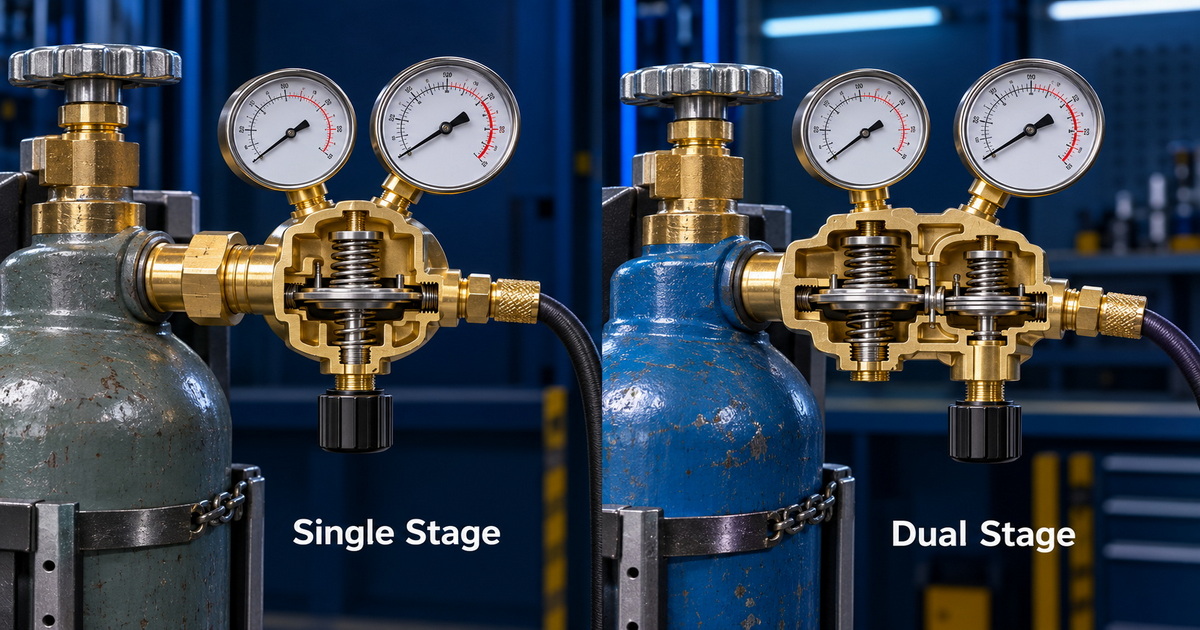
A single-stage regulator reduces cylinder pressure in one step. It is common in welding, cutting, heating, purging, and general industrial work. Its outlet pressure can change as cylinder pressure falls, a behavior commonly known as supply-pressure effect or decaying inlet-pressure effect.
A dual-stage regulator reduces pressure in two stages. It is usually preferred when stable outlet pressure is important as the cylinder empties, such as laboratory, analytical, high-purity, calibration-gas, process-control, or sensitive production applications.
Do not assume that dual-stage automatically means “better.” It typically means more parts, higher cost, different service considerations, and a different performance objective. For a basic MIG welding package, a well-designed single-stage CO₂ or argon/CO₂ regulator may be commercially appropriate. For a high-purity gas line feeding sensitive instrumentation, dual-stage or specialized diaphragm-sealed equipment may be necessary.
Material Grades and Construction
For many industrial cylinder regulators, brass remains a common body material because of its machinability, corrosion resistance, and suitability for many gases. However, “brass regulator” is not a complete technical specification.
Ask suppliers to disclose:
– Exact brass alloy or material standard used for the body, bonnet, fittings, and stem
– Whether the body is forged, hot-stamped, cast, or machined from brass bar
– Diaphragm material and thickness
– Valve-seat material and gas-compatibility limitations
– Filter material and mesh specification
– Relief-valve design and set pressure
– Gauge face diameter, accuracy class, movement type, and pressure range
– Surface treatment, plating, paint, or passivation requirements
– Thread standard and dimensional inspection method
– Leak-test medium, test pressure, holding time, and acceptance criterion
For oxygen service, cleanliness is critical. Hydrocarbon contamination, unsuitable lubricants, incompatible sealing materials, or inadequate cleaning can create serious hazards in oxygen-enriched service. An “oxygen regulator” should therefore be handled as a distinct controlled configuration, not merely the same regulator painted a different color.
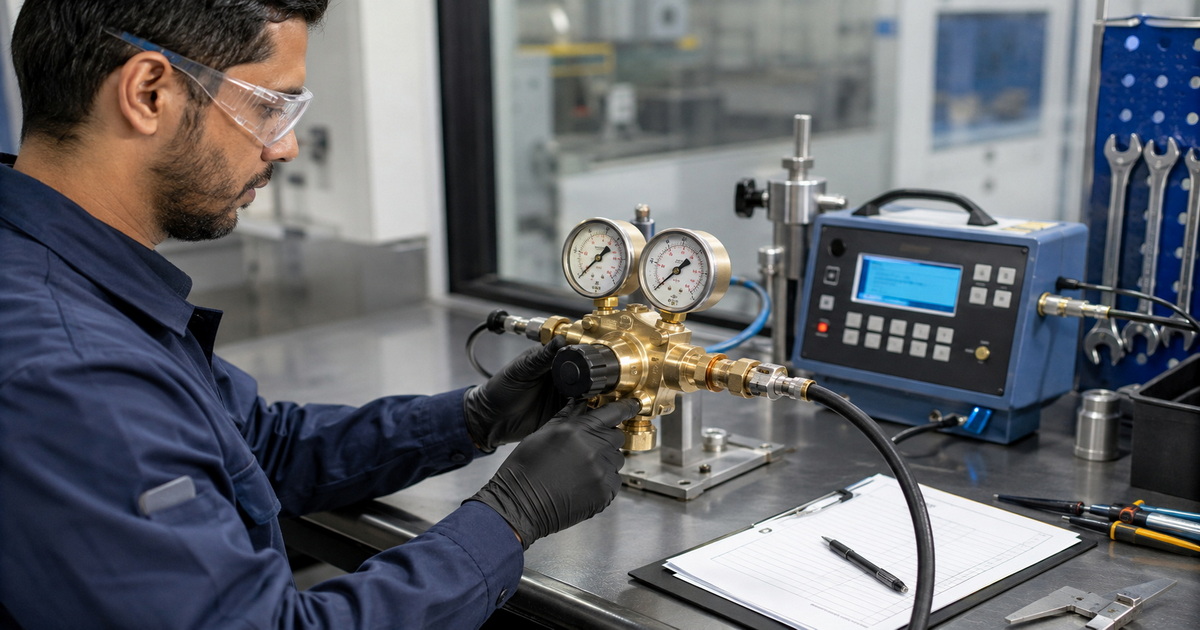
Connection Standards Are Not Optional
In the Americas, regulator inlet connections must match the cylinder-valve outlet standard used by the gas supplier and gas type. CGA outlet connections are designed to differentiate gases and reduce the possibility of incorrect interconnection.
Examples commonly referenced in welding and industrial-gas purchasing include:
| Gas / Application | Common Connection Reference in U.S. Market | Buyer Action |
|---|---|---|
| Argon, nitrogen, helium, some inert-gas mixtures | CGA-580 | Confirm the actual cylinder valve specification with the gas supplier before placing an order |
| CO₂ | CGA-320 | Confirm whether the regulator requires a standard CO₂ inlet nut/nipple configuration and whether heated functionality is needed |
| Oxygen | CGA-540 | Confirm oxygen-clean configuration, gauge range, safety features, and the intended industrial versus medical application |
| Acetylene | CGA-510 | Verify left-hand threading and compatibility with the full oxy-fuel system |
| Propane / LPG | Connection varies by market and cylinder system | Confirm local valve, hose, and regulator requirements with the gas supplier and regulatory authority |
The practical rule is simple: never order gas regulators based only on product photos or generic names. Require a final approved technical drawing or specification sheet showing inlet standard, outlet thread, gauge range, pressure range, gas service, and labeling.
Heated CO₂ Regulators
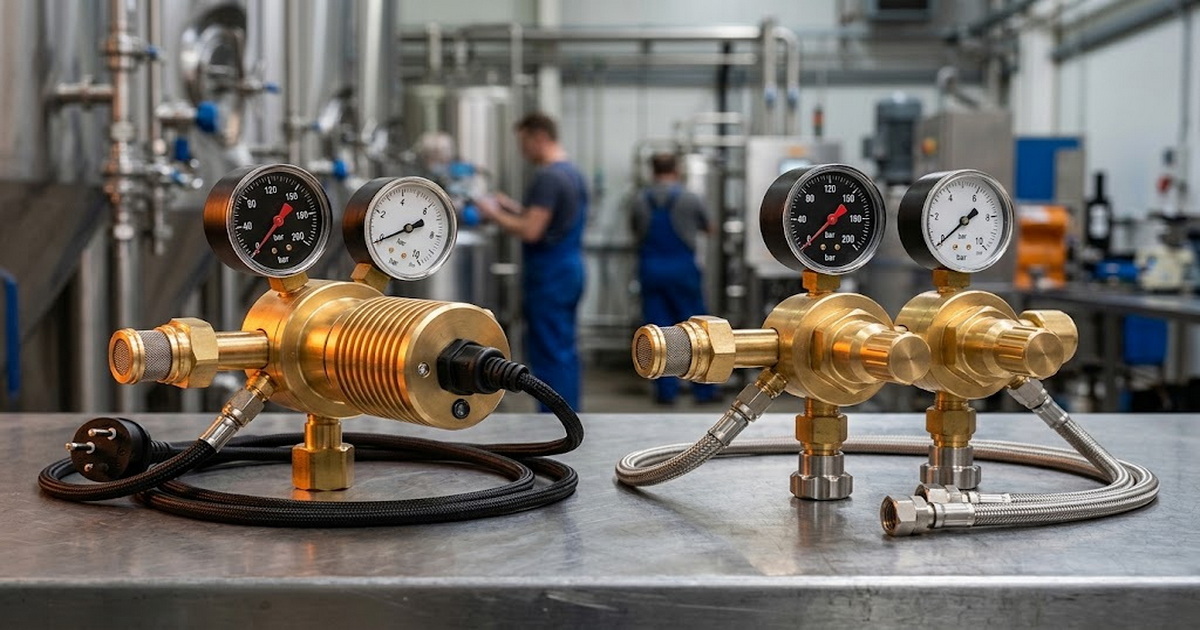
CO₂ can cool significantly during rapid expansion or high-flow draw-off. In MIG/MAG welding, this cooling may contribute to unstable delivery, frost formation, poor flow performance, or interrupted operation in certain working conditions. Heated CO₂ regulators are designed to help maintain more stable operation by warming the regulator or gas path.
However, buyers should verify the full heated-regulator configuration:
– Electrical input voltage and plug format
– Heating power and thermostat strategy
– Over-temperature protection
– Electrical insulation and ingress protection
– Cable strain relief and cold-environment performance
– Compatibility with cylinder orientation and expected duty cycle
– Required approvals for the destination market
– Whether heating applies to the regulator body, gas path, or a separate component
A heated CO₂ regulator may improve usability in demanding welding conditions, but it should not be used to mask an undersized regulator, blocked filter, incorrect gas-flow specification, or poor hose configuration.
Common Sourcing Risks and How to Avoid Them
Risk 1: The Quoted Regulator Uses a Different Brass Grade
A supplier may quote a sample built with a higher-quality brass body, then substitute lower-cost material or a different production route during mass production. The finished regulator can look almost identical while having different mechanical strength, machining consistency, corrosion resistance, or thread quality.
How to reduce the risk:
– Include material grade and manufacturing method in the purchase specification.
– Require material certificates for critical components where commercially justified.
– Retain approved golden samples at both buyer and factory locations.
– Define weight tolerance for the finished regulator body where relevant.
– Use third-party pre-shipment inspection for initial and high-risk orders.
– Request cross-section or material-analysis testing for new supplier qualification when the project value warrants it.
Risk 2: Gauge Accuracy Is Assumed, Not Controlled
A polished gauge face does not demonstrate accuracy. Low-cost gauges may have inconsistent calibration, inadequate vibration resistance, poor pointer return, or inaccurate readings at the operating range that matters most.
How to reduce the risk:
– Specify gauge accuracy class, pressure range, dial size, thread connection, and applicable standard.
– Ask for calibration methods and sampling plans.
– Require the normal working pressure to sit in a readable and useful portion of the gauge scale.
– Verify zero return after pressure cycling.
– Test gauges after simulated shipping vibration and temperature exposure when the product will be exported long distance.
Risk 3: A “Dual-Stage” Label Does Not Guarantee Stable Performance
Some suppliers use product terminology loosely. A regulator advertised as dual-stage should be evaluated by actual pressure-stability performance, internal design, and test data—not only by external appearance.
How to reduce the risk:
– Ask for inlet-pressure-effect data or a pressure-drop curve.
– Define inlet pressure, outlet setpoint, flow rate, ambient temperature, and acceptable outlet-pressure variation.
– Conduct comparison testing from full cylinder pressure through the expected lower operating range.
– Confirm whether the two stages are true pressure-reduction stages rather than a marketing description of a different feature.
Risk 4: CE Documentation Is Misunderstood
CE marking is not a universal “quality certificate.” It is a declaration related to applicable EU legal requirements, and its applicability depends on the product’s classification, intended use, pressure category, electrical features, and market placement. A heated CO₂ regulator, for example, may involve different considerations from a non-electrical mechanical regulator.
How to reduce the risk:
– Request the Declaration of Conformity, not only a logo or certificate image.
– Match the declaration to the exact product model, product family, and intended market.
– Check the issuing body, dates, standards cited, and product scope.
– Obtain test reports when required by the risk level and sales channel.
– Consult a qualified compliance professional for products entering regulated markets.
Risk 5: The Supplier Confirms MOQ but Ignores Spare-Parts Planning
A successful launch can later fail because gauges, diaphragms, relief valves, inlet nuts, heater cords, or repair kits are not available in small quantities. This is especially damaging for distributors selling a branded aftermarket program.
How to reduce the risk:
– Negotiate spare-part availability at the beginning of the project.
– Create a recommended spare-parts list for every regulator family.
– Request a service manual, exploded drawing, and component codes.
– Establish a service-parts MOQ separate from the finished-product MOQ.
– Agree on product-change notification rules before the factory changes a component or sub-supplier.
The Industry “Inside Tip” Buyers Often Miss
Here is a practical issue that experienced gas-equipment buyers know but many online sourcing guides overlook:
The most expensive failures often come from configuration drift, not visible product defects.
A factory may make the same-looking regulator for several markets: one with a CGA inlet, one with DIN inlet, one with a different outlet thread, one configured for oxygen cleaning, one with a different safety-relief setting, and one with a gauge calibrated in another unit system. When product photos, packaging artwork, and SKU names are not tightly controlled, components can be mixed during assembly or packing.
The regulator may pass a basic leak test and still be commercially unusable—or unsafe for the intended cylinder, gas, or market.
To prevent this, create a configuration control sheet for each SKU. At minimum, it should include:
| Control Item | Example |
|---|---|
| Buyer SKU | BRL-CO2-H-320-1/4NPT-US |
| Gas service | CO₂ |
| Inlet connection | CGA-320 |
| Outlet connection | 1/4 in. NPT female |
| Outlet range | 0–60 psi |
| Gauge configuration | Cylinder-pressure gauge plus outlet-pressure gauge |
| Heating configuration | 110–120 V, U.S. plug, defined wattage and protection |
| Safety device | Relief valve setpoint and marking |
| Body material | Named brass alloy / approved source |
| Branding | Approved logo position, color, laser mark, label |
| Packaging | Barcode, carton mark, instruction language, warning labels |
| Inspection | Leak-test condition, functional flow test, appearance criteria |
This document should appear in the purchase order, approved drawing package, inspection checklist, and packaging specification. It is one of the most effective ways to reduce avoidable claims.
Buyer’s Guide: How to Verify a Supplier

Step 1: Match the Regulator to the Actual Application
Before requesting quotations, define:
– Gas type and gas mixture
– Cylinder pressure and valve connection
– Required outlet pressure and maximum flow
– Single-stage or dual-stage requirement
– Operating environment and ambient temperature
– Welding, cutting, heating, purging, laboratory, medical, or process application
– Gauge units: psi, bar, MPa, L/min, CFH, or mixed formats
– Required certifications and destination market
– Brand, packaging, manual, language, and labeling requirements
– Forecast order quantity and launch timeline
An RFQ that says only “CO₂ regulator, please quote” will attract inconsistent offers and make technical comparison impossible.
Step 2: Verify Certifications Properly
Do not rely on a PDF screenshot or a logo printed on a catalog page. For ISO 9001 verification, request:
– Full certificate file
– Certificate number
– Legal company name and factory address
– Scope of certification
– Issuing certification body
– Accreditation mark
– Issue date and expiration date
– Most recent surveillance-audit status, if available
Then compare the legal entity on the certificate with the entity that will issue invoices, receive payments, and manufacture the goods. A trading company’s certificate does not automatically prove that its subcontracted factory has the same system.
For Zhejiang Bril, the company states ISO 9001 certification through UKAS and IAF recognition, plus CNAS and CE-related product credentials. Buyers should request current versions and confirm that the exact regulator model and commercial arrangement fall within the relevant scope.
Step 3: Use a Structured Sample Process
A reliable sample process has three stages:
1. Engineering sample: Confirm fit, function, gas connection, gauge range, pressure setting, and branding layout.
2. Pre-production sample: Confirm the product is made with mass-production tooling, materials, and processes.
3. Golden sample: Seal and retain an approved reference unit for quality comparison during future production.
Test samples under realistic conditions. For example, a CO₂ welding regulator should be tested with the intended gas type, expected flow range, duty cycle, inlet connection, hose type, and ambient temperature—not merely with compressed air at a bench.
Step 4: Audit the Factory’s Quality Controls
A remote video audit or on-site audit should examine:
– Incoming inspection of brass, gauges, diaphragms, seals, springs, fittings, and heaters
– Assembly-line controls and torque procedures
– Leak-test equipment and test parameters
– Functional pressure and flow testing
– Gauge calibration or incoming gauge verification
– Traceability by batch, date, or lot code
– Nonconforming-product segregation
– Final inspection and packing inspection
– Control of product drawings and revision history
– Storage conditions for elastomers, gauges, and finished products
– Records of customer complaints and corrective actions
Ask the factory to show a real inspection record from a recently completed order, with sensitive customer information covered if necessary. A supplier that only shows a clean laboratory but cannot produce actual lot records may have weak production discipline.
Step 5: Plan Shipping and After-Sales Support
For export orders, regulators should be protected from gauge damage, thread impact, moisture exposure, and carton compression. Confirm:
– Individual protective packaging for gauges and fittings
– Thread caps or protectors where needed
– Clear carton markings and SKU segregation
– Moisture protection for sea freight
– Palletization method and maximum stacking limits
– Destination-country labeling and manual requirements
– Spare-parts quantities and service procedure
– Warranty terms and claims process
– Lead-time commitments and acceptable production variation
For U.S. and Canadian import programs, buyers should also coordinate with their customs broker and compliance advisers on tariff classification, country-of-origin marking, packaging rules, and any applicable product requirements before mass production.
Conclusion
The Americas market offers strong options for industrial gas regulators across welding, cutting, industrial gas distribution, laboratory gas, specialty gas, medical gas, and LPG-related applications. Established brands such as Harris, Victor, CONCOA, GENTEC, GCE, and Cavagna offer different strengths in branded equipment, engineered systems, specialty applications, and regional support.
For buyers seeking a flexible manufacturing partner for CO₂ regulators, heated CO₂ regulators, argon regulators, oxygen regulators, acetylene regulators, propane regulators, nitrogen regulators, and dual-stage gas regulators, Zhejiang Bril Welding Equipment Co., Ltd. is worth considering as a direct OEM/ODM option. Its published company information highlights more than two decades of specialization, ISO 9001-related quality-system credentials, CE/CNAS references, and experience supporting established welding-equipment and gas-industry customers.
The right next step is not to select a supplier from a list. It is to issue a clear technical RFQ, validate the exact product configuration, obtain representative samples, audit quality controls, and establish a documented specification that protects your brand throughout mass production.
If you are developing a private-label industrial gas regulator program for the Americas, prepare a detailed inquiry covering your gas type, inlet/outlet connections, outlet-pressure range, flow demand, certification needs, branding requirements, forecast volume, and target market. A technically complete RFQ will produce more accurate quotes, faster sampling, and fewer quality risks.
FAQ
1. How can I verify that a supplier’s ISO 9001 certificate has not expired?
Request the full current certificate, verify the certificate number, legal entity, factory address, scope, issue date, and expiry date, then check the issuing certification body’s public verification channel where available. Also ask for the latest surveillance-audit evidence. Do not assume a certificate held by a trading company applies to the actual factory producing your regulators.
2. What is the most important test for a welding gas regulator sample?
There is no single test. At minimum, conduct leak testing, outlet-pressure adjustment testing, inlet-pressure-effect testing, flow testing at the expected working range, gauge accuracy verification, connection fit testing, and repeated pressure-cycle testing. For a heated CO₂ regulator, add electrical safety, thermal performance, and cold-environment operating checks.
3. Should I choose a single-stage or dual-stage regulator for argon and CO₂ welding?
For many routine welding applications, a properly designed single-stage regulator is sufficient and economically appropriate. Choose dual-stage when outlet-pressure stability over cylinder depletion is critical, or when the application has sensitive downstream equipment. The correct decision depends on your required flow, operating pressure, duty cycle, and acceptable variation—not simply gas type.
4. How do I confirm whether a regulator fits U.S. gas cylinders?
Confirm the cylinder supplier’s valve outlet connection and then require the regulator supplier to state the exact inlet standard in the approved drawing and purchase order. CGA connection standards are used to help match regulators to cylinder valves and reduce incorrect gas connections. Do not rely on phrases such as “U.S. standard” without a defined CGA number.
5. What should an OEM buyer include in a gas regulator quality agreement?
Include the approved technical drawing, material requirements, gas-service configuration, connection standards, gauge specification, test methods, sampling plan, defect definitions, change-control rules, approved component suppliers where needed, labeling and packaging specification, golden-sample rules, warranty process, spare-parts availability, and corrective-action timelines. The agreement should require written approval before any material, component, tooling, gauge, seal, safety-device, or process change.
References
1. – [Compressed Gas Association: Standards and Industry Safety Resources] — CGA develops and promotes standards for industrial, medical, and food gases. [regional.astm]
2. – [CGA Connection Overview] — Explanation of CGA cylinder-valve and regulator inlet connection systems, including CGA-580 use for inert gases. [casrai]
3. – [ESAB Victor EDGE™ Series 2.0 Regulators] — Official product overview for heavy-duty, high-capacity single-stage regulators. [esab]
4. – [Zhejiang Bril Welding Equipment Co., Ltd. Company Profile] — Supplier-provided information on company history, products, quality credentials, and OEM relationships. [chinesewelding]
5. – [CONCOA Pressure Regulators] — Industrial, research, specialty-gas, and medical regulator offerings. [concoa]
6. – [GCE Gas Control Business] — ESAB overview of GCE’s industrial, specialty-gas, and medical gas-control business. [esabcorporation]
7. – [Cavagna Industrial Gas Regulators] — Single- and two-stage regulator applications for industrial welding, cutting, heating, and purging. [cavagnagroup]
8. – [North America Industrial Gas Regulator Market Outlook] — Market estimate and regional outlook. [grandviewresearch]
Hot Tags: Industrial Gas Regulator, CO2 Gas Regulator, CO2 Heated Regulator, Argon Gas Regulator, Oxygen Gas Regulator, Acetylene Gas Regulator, Propane Gas Regulator, Nitrogen Gas Regulator, Dual Stage Gas Regulator, Welding Gas Regulator