Content Menu
● Understanding CO₂ Gas Regulators in Robotic MIG Welding
>> Core role of a CO₂ regulator in MIG welding
>> What makes a CO₂ regulator “heated”?
● Key Technical Differences – Heated vs Standard CO₂ Regulators
>> Freeze‑up and high‑flow performance
>> Flow stability and weld quality
>> Duty cycle and uptime implications
● Operational Risks – Why CO₂ Freezing Matters in Robotic MIG Welding
>> Typical failure modes with standard CO₂ regulators
>> Process impacts of unstable shielding gas
● When a Heated CO₂ Regulator Is the Better Choice
>> Ideal applications for heated CO₂ regulators
>> When a standard CO₂ regulator can still be suitable
● Expert Criteria for Selecting Heated vs Standard CO₂ Regulators
>> Step‑by‑step selection checklist for robotic MIG cells
● Performance, Cost, and Risk – Side‑by‑Side Comparison
>> Practical comparison table for robotic MIG welding
● Industry Data and Market Context for Heated CO₂ Regulators
>> Growth of industrial gas regulators and high‑purity systems
>> OEM/ODM customization trends for robotic welding
● Practical Expert Recommendations for Robotic MIG Users
>> How to optimize your robotic cell with the right regulator
>> Maintenance and inspection best practices
● OEM/ODM Perspective – Custom Heated and Standard CO₂ Regulators for Global Brands
>> Why overseas brands and integrators demand customized gas control
>> How a specialist manufacturer adds value
● Clear Recommendation and Next Step (CTA)
● FAQs About Heated CO₂ Regulators vs Standard CO₂ Regulators
In high‑duty robotic MIG welding, choosing between a heated CO₂ regulator and a standard carbon dioxide regulator directly affects arc stability, spatter, downtime, and total operating cost. This in‑depth comparison examines performance, reliability, and lifecycle economics so welding engineers, integrators, and OEMs can make an evidence‑based decision for continuous robotic applications.
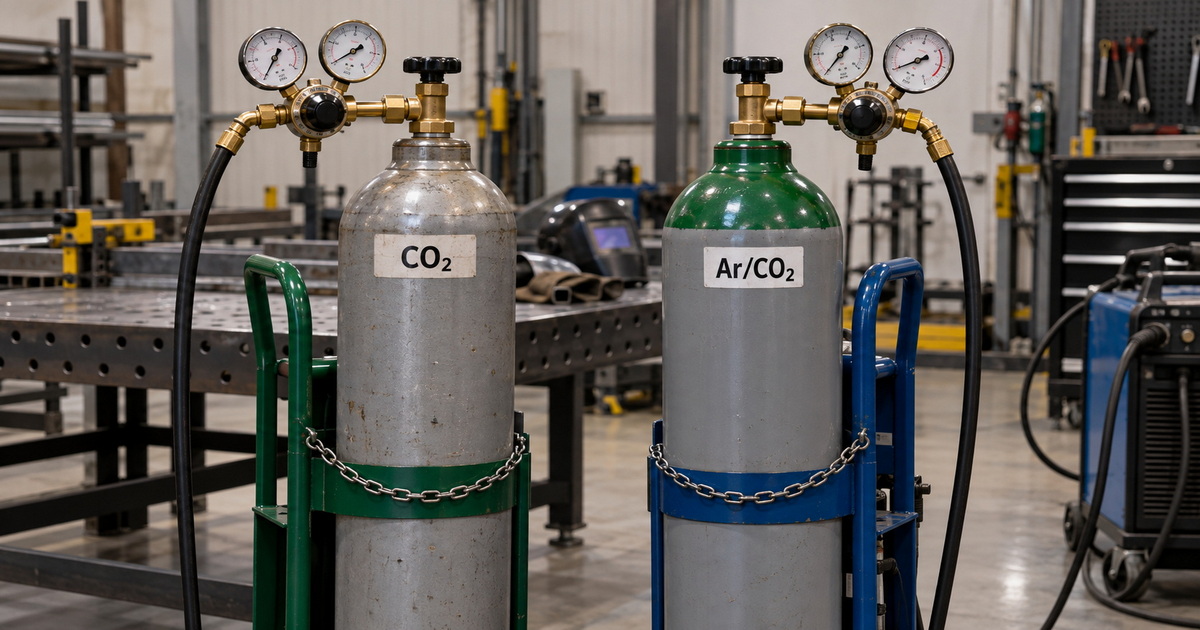
Continuous robotic MIG welding with pure CO₂ or high‑CO₂ mixed gases places extreme demands on gas delivery stability. A heated CO₂ regulator is engineered to prevent freezing and maintain consistent flow at high duty cycles, while a standard CO₂ regulator is optimized for more moderate and intermittent use. [genstartech]
From an industry practitioner’s viewpoint, the real question is not “Which is technically better?” but “Which regulator configuration delivers the most stable arc, least rework, and lowest long‑term cost for your specific robotic welding cell layout, gas mix, and production schedule?”
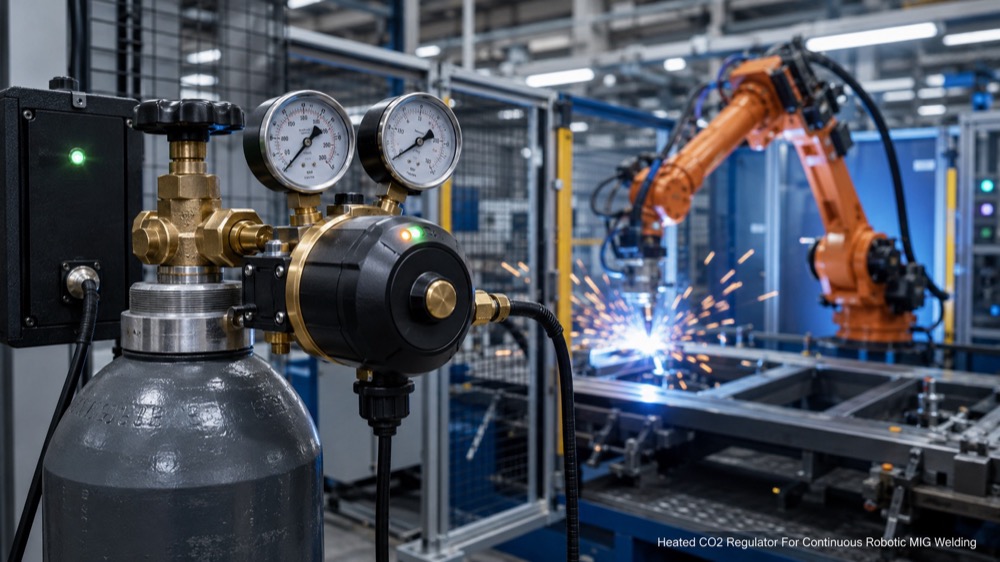
Understanding CO₂ Gas Regulators in Robotic MIG Welding
Core role of a CO₂ regulator in MIG welding
In robotic MIG welding, the regulator must:
– Reduce cylinder pressure (often above 50 bar) to a stable, usable outlet pressure.
– Deliver consistent flow rates (e.g., 15–30 L/min or equivalent SCFH) to the wire feeder and torch. [airgas]
– Maintain pressure stability as cylinders empty and ambient temperature changes. [genstartech]
For robots running multi‑shift production, even small fluctuations in flow or pressure can translate into porosity, lack of fusion, or increased spatter that impacts quality and OEE.
What makes a CO₂ regulator “heated”?
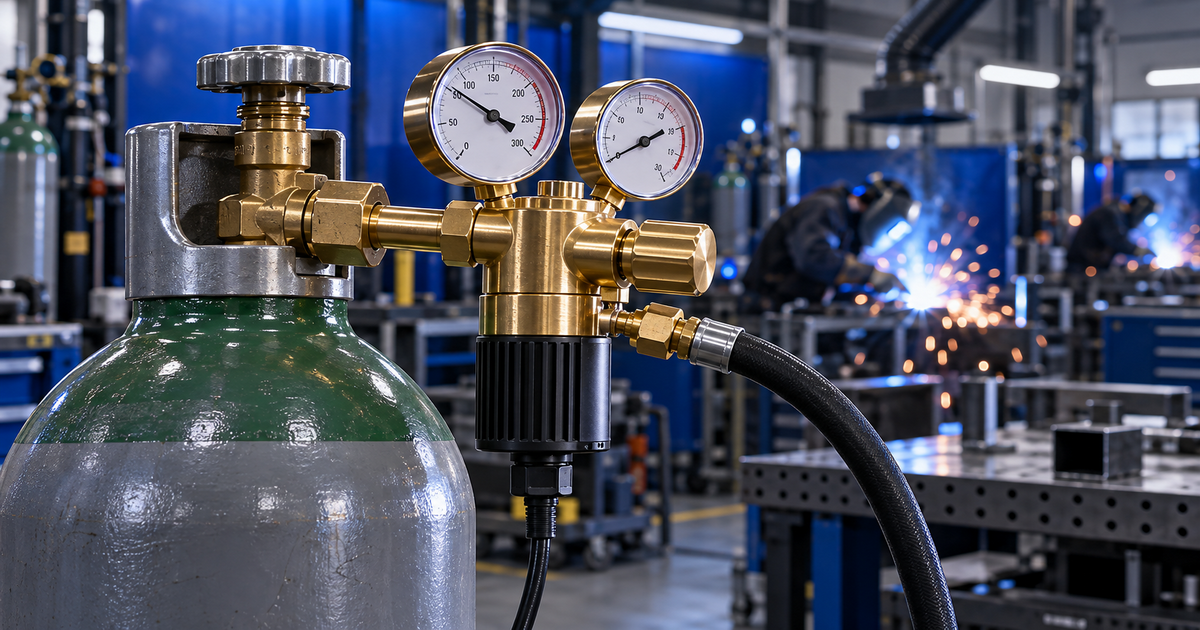
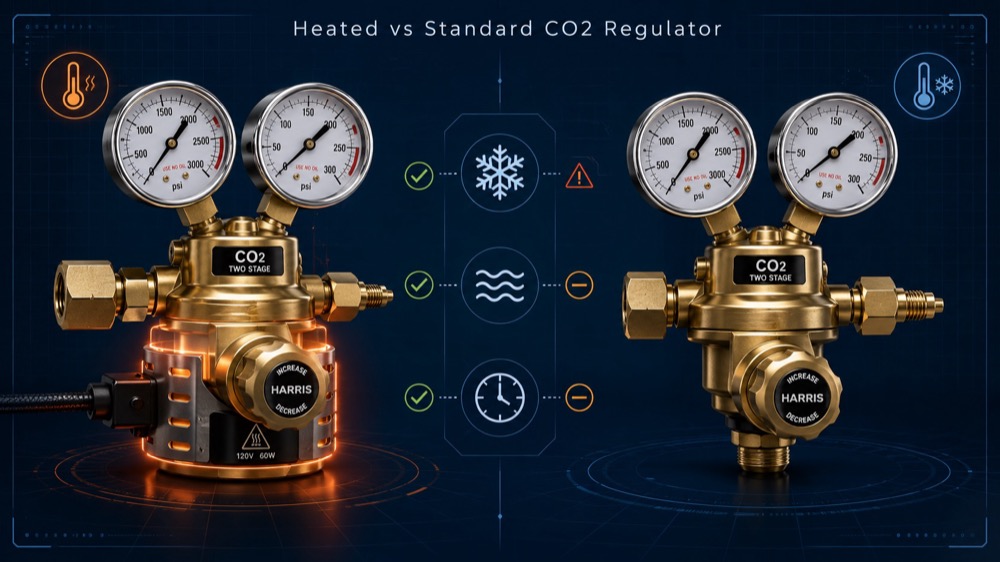
A heated CO₂ regulator integrates an electric heating element or a heated flowmeter body to warm the gas path or regulator body. [ioxygen]
Key design characteristics typically include:
– Electrically heated body or flowmeter to prevent CO₂ from dropping below its freezing point during expansion. [ioxygen]
– Rating for high gas flow (often up to 60–100 SCFH) without ice formation. [airgas]
– Internal safety and control elements to avoid overheating and maintain stable temperatures. [genstartech]
By contrast, a standard CO₂ regulator relies solely on mechanical design and ambient heat transfer, without active heating. This makes it more vulnerable to cold‑induced issues at high flow and duty cycles. [airgas]
Key Technical Differences – Heated vs Standard CO₂ Regulators
Freeze‑up and high‑flow performance
When CO₂ expands from high cylinder pressure to lower outlet pressure, it absorbs heat and the regulator body cools dramatically. At high continuous flow, this can lead to ice formation and regulator freeze‑up. [ioxygen]
– Heated CO₂ regulators are designed specifically to eliminate or significantly reduce this freezing risk at high flow rates such as 60–100 SCFH, even in cold workshops. [genstartech]
– Standard CO₂ regulators may handle moderate flow well but can suffer from ice build‑up, unstable flow, and pressure drop during extended high‑duty welding. [airgas]
For continuous robotic MIG welding, where a cell might run near 100% duty for hours, freeze‑up is more than a nuisance – it becomes a genuine production risk.
Flow stability and weld quality
Robotic MIG welding demands repeatable, consistent shielding gas coverage. Any fluctuation in flow can cause porosity, undercut, or erratic bead shape.
– Heated regulators maintain stable flow across longer cycles, because their internal paths do not choke or partially block with ice. [ioxygen]
– Standard regulators can show transient drops in flow as ice forms, then sudden spikes when ice melts – producing inconsistent weld shielding over time. [genstartech]
From a weld engineer’s standpoint, fewer gas‑related anomalies mean more predictable parameter windows and easier robot program standardization across multiple lines.
Duty cycle and uptime implications
For continuous robotic MIG welding, regulator duty cycle must match robot duty cycle.
– Heated units are built with high duty cycle operation in mind, supporting sustained high‑flow CO₂ withdrawal without forced pauses. [ioxygen]
– Standard regulators may require occasional breaks or cylinder rotation strategies in high‑flow conditions to avoid freeze‑up and pressure instability. [airgas]
In a multi‑robot line, even a single gas‑related stoppage can ripple through upstream and downstream processes, impacting takt time and delivery performance.
Operational Risks – Why CO₂ Freezing Matters in Robotic MIG Welding
Typical failure modes with standard CO₂ regulators
In real‑world robotic welding cells, you may see the following symptoms when a standard CO₂ regulator is pushed to its limits:
– Visible frost on the regulator body and fittings. [genstartech]
– Gradual flow reduction leading to incomplete shielding.
– Erratic pressure gauge readings and audible flow variations at the torch.
– Unexpected robot stops or alarms when gas flow falls below a defined threshold.
These failure modes are often misdiagnosed as wire feeding or power source issues, causing unnecessary troubleshooting and part swapping.
Process impacts of unstable shielding gas
From an expert’s process perspective, unstable gas flow can cause:
– Porosity and rework, especially on thick sections or multi‑pass welds.
– Increased spatter, requiring manual cleaning and reducing cell throughput.
– Variable bead appearance, complicating visual inspection and customer audits.
In high‑volume automotive or structural applications, gas instability can quickly turn into internal quality escapes or external customer complaints, threatening long‑term contracts.
When a Heated CO₂ Regulator Is the Better Choice
Ideal applications for heated CO₂ regulators
Heated CO₂ regulators provide the most value in:
– Continuous or near‑continuous robotic MIG welding (e.g., automotive, appliance, agricultural machinery frames). [ioxygen]
– CO₂‑rich mixtures or pure CO₂ shielding, especially with high flow requirements. [genstartech]
– Cold workshops or outdoor installations, where ambient temperature accelerates freezing. [airgas]
– High‑productivity cells using dual robots or tandem welding torches per station.
In these scenarios, the cost of a heated regulator is quickly offset by reduced downtime and scrap.
When a standard CO₂ regulator can still be suitable
A standard CO₂ regulator remains a rational choice where:
– Gas flow rates are moderate and welding is not continuous. [airgas]
– Shielding gas uses lower CO₂ content mixes, reducing freezing risk.
– The cell operates in a climate‑controlled shop with lower duty cycles.
For many job shops or mixed‑process cells, a well‑selected standard regulator is still cost‑effective and reliable. The key is aligning regulator capacity with actual duty cycle and flow demand. [genstartech]
Expert Criteria for Selecting Heated vs Standard CO₂ Regulators
Step‑by‑step selection checklist for robotic MIG cells
As a welding engineer or integrator, you can use this practical decision workflow:
1. Quantify duty cycle
– Estimate each robot’s welding‑on time per hour (e.g., 70–90%).
– Identify peak production shifts and seasonal variations.
2. Confirm gas mix and target flow range
– Document whether you use pure CO₂ or CO₂‑rich mixes.
– Define typical torch flow rate and any high‑flow mode (e.g., for heavy sections).
3. Assess ambient conditions
– Note whether cells are in a heated hall, semi‑outdoor area, or cold region.
– Capture minimum winter temperature at the regulator location.
4. Review historical issues
– Log any past frosting, pressure instability, or unexplained porosity.
– Check whether operators have reported needing to “tap” or warm regulators.
5. Match regulator type to risk
– If high duty + high flow + low temperature, a heated CO₂ regulator is strongly recommended. [ioxygen]
– If moderate duty + moderate flow + stable temperature, a standard regulator may be sufficient. [airgas]
Following this structured approach helps justify regulator upgrades with clear process and ROI logic, rather than relying on trial‑and‑error.
Performance, Cost, and Risk – Side‑by‑Side Comparison
Practical comparison table for robotic MIG welding
| Factor | Heated CO₂ Regulator | Standard CO₂ Regulator |
|---|---|---|
| Freeze‑up resistance | Designed to prevent freezing at high flow and duty cycles genstartech | Higher risk of freezing at high flow or in cold conditions genstartech |
| Flow stability in continuous use | Very stable over long runs, minimal drift genstartech | Can fluctuate as regulator cools and ices genstartech |
| Suitable duty cycle | Continuous robotic welding, multi‑shift operation genstartech | Intermittent or moderate duty cells |
| Typical applications | Automotive, heavy equipment, high‑volume robotic cells genstartech | General fabrication, lighter production |
| Upfront cost | Higher due to heating elements and controls genstartech | Lower initial investment |
| Downtime and rework risk | Reduced probability of gas‑related stoppages and defects genstartech | Higher risk of unplanned stops and weld rework genstartech |
| Energy consumption | Requires electrical power for heating genstartech | No external power needed |
| Complexity of installation | Needs electrical connection and basic thermal checks genstartech | Simple mechanical installation |
Industry Data and Market Context for Heated CO₂ Regulators
Growth of industrial gas regulators and high‑purity systems
The industrial gas regulator market continues to grow, driven by higher consumption of industrial gases and demand for high‑purity, stable gas control. Analysts project the market to expand by around 3–3.5% CAGR in the mid‑2020s, supported by broader adoption of precision regulators in industrial and energy sectors. [transparencymarketresearch]
Within this context, applications that require high‑flow, stable gas delivery – such as automated welding, cutting, and laser processing – are pushing users toward more specialized regulator solutions, including heated and dual‑stage designs. [finance.yahoo]
OEM/ODM customization trends for robotic welding
Global OEMs and system integrators increasingly look for customized gas regulator solutions, especially for robotic welding cells that combine CO₂, argon, oxygen, and mixed gases across multiple stations. Industry guidance on OEM and ODM partnerships stresses:
– The value of custom engineering and reverse‑engineering capabilities to adapt regulators to specific platforms and conditions. [phocos]
– The importance of aligning with international standards and rigorous inspection systems, including ISO and relevant industrial codes. [mdaturbines]
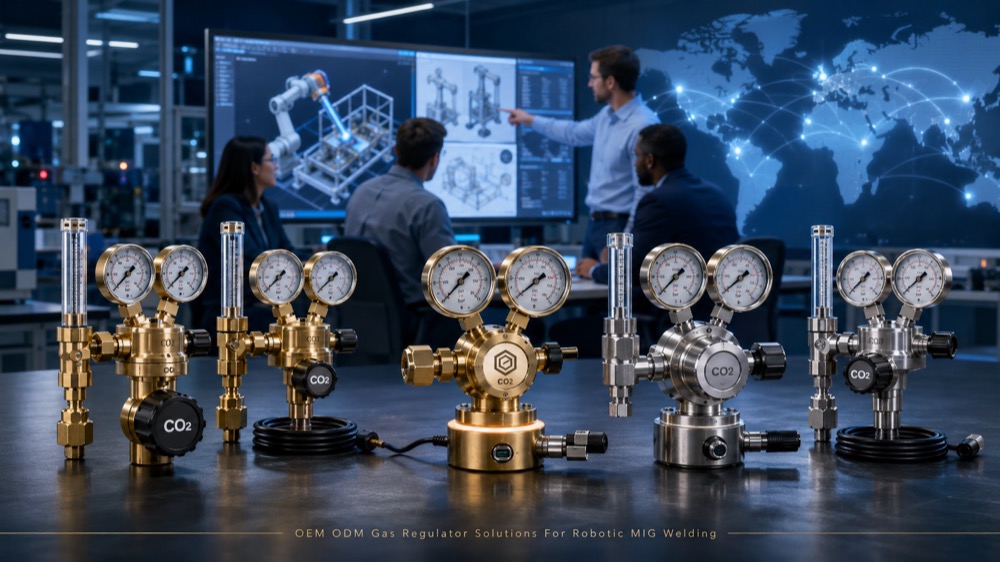
For overseas brands, wholesalers, and integrators, partnering with a specialized gas regulator manufacturer that offers both heated CO₂ regulators and standard CO₂ regulators – plus argon, oxygen, acetylene, propane, nitrogen, and dual‑stage options – enables unified sourcing and simplified technical coordination for global projects. [boc.co]
Practical Expert Recommendations for Robotic MIG Users
How to optimize your robotic cell with the right regulator
From a field engineering perspective, the most effective approach is to treat the gas regulator as a critical component of the welding process, not a commodity. Consider these actionable steps:
– Standardize specifications across all robotic cells (flow range, pressure class, heating requirement). [ioxygen]
– Use dual‑stage regulators for applications requiring extremely stable outlet pressure over full cylinder life, especially with high‑precision components. [boc.com]
– Validate new regulator types through pilot cells, tracking downtime, weld defect rates, and rework hours before and after the change. [mdaturbines]
For overseas brands and distributors, integrating heated CO₂ regulators into your welding packages can be a differentiating feature, particularly for customers operating in cold climates or running multi‑shift robotic production. [phocos]
Maintenance and inspection best practices
Regardless of regulator type, preventive maintenance is essential to sustain performance:
– Implement visual checks for frost, leaks, and mechanical damage at the start of each shift. [genstartech]
– Schedule periodic calibration and leak testing, in line with your internal quality system and applicable standards. [mdaturbines]
– For heated regulators, verify electrical connections and temperature control functions as part of regular inspections. [ioxygen]
Documented, auditable maintenance practices not only protect your welding performance but also support customer and third‑party audits in automotive, construction, and pressure‑equipment sectors. [mdaturbines]
OEM/ODM Perspective – Custom Heated and Standard CO₂ Regulators for Global Brands
Why overseas brands and integrators demand customized gas control
For overseas welding equipment brands, wholesalers, and integrators, one‑size‑fits‑all gas regulation rarely works across markets with different voltages, climate conditions, and gas specifications. Industry guidance on OEM/ODM collaboration highlights that:
– OEM partners benefit from tailor‑made “ready‑to‑go” products that slot directly into their existing platforms. [phocos]
– Strong third‑party providers offer precision machining, tight tolerances, and robust quality systems to ensure consistent performance across high‑volume orders. [mdaturbines]
When applied to robotic MIG welding, this means choosing a gas regulator manufacturer that can:
– Customize heated CO₂ regulator designs for required flow ranges, voltages, and mounting interfaces. [airgas]
– Supply standard CO₂ regulators plus argon, oxygen, acetylene, propane, nitrogen, and dual‑stage regulators under your brand, with consistent brass quality and pressure control. [goreg]
How a specialist manufacturer adds value
A professional gas regulator manufacturer specializing in precision industrial gas control can support overseas partners through:
– OEM and ODM services for branded product lines and private‑label programs. [phocos]
– Strict quality inspection and international standard compliance, ensuring stable performance in welding, cutting, and industrial gas applications worldwide. [transparencymarketresearch]
– Engineering support to select heated vs standard CO₂ regulators for each robotic welding application, based on duty cycle, climate, and process requirements. [genstartech]
This integrated approach allows you to build coherent, high‑performing robotic welding solutions while streamlining sourcing and technical communication across your global network.
Clear Recommendation and Next Step (CTA)
For continuous robotic MIG welding with CO₂‑rich shielding gases, a heated CO₂ regulator is generally the safer and more economical long‑term choice, thanks to its resistance to freeze‑up, stable flow at high duty cycles, and positive impact on weld quality and uptime. [ioxygen]
If your operation runs intermittent welding in a stable, warm environment with moderate flow demand, a standard carbon dioxide regulator can still provide reliable performance at lower initial cost – provided it is correctly specified and maintained. [airgas]
If you are planning or upgrading robotic MIG welding cells and need OEM or ODM‑level support for heated and standard CO₂ regulators, consider partnering with a specialized gas regulator manufacturer that can deliver customized, international‑standard solutions for your brand or distribution network. [finance.yahoo]
FAQs About Heated CO₂ Regulators vs Standard CO₂ Regulators
Q1: Do I always need a heated CO₂ regulator for robotic MIG welding?
A: No. You need a heated regulator when your robotic cells run high duty cycles with high CO₂ flow or operate in cold environments where freezing is likely. For moderate duty and stable ambient temperatures, a well‑specified standard regulator can be adequate. [genstartech]
Q2: How does a heated CO₂ regulator reduce weld defects?
A: By preventing freeze‑up and maintaining stable gas flow, heated regulators help ensure consistent shielding coverage, which reduces porosity, spatter, and other gas‑related weld defects in robotic MIG applications. [ioxygen]
Q3: What extra maintenance does a heated regulator require?
A: In addition to normal leak and function checks, heated regulators require regular verification of electrical connections and heating performance, following the manufacturer’s guidelines and your plant’s quality procedures. [airgas]
Q4: Can I retrofit a heated CO₂ regulator into an existing robotic welding cell?
A: In most cases, yes. Retrofitting involves replacing the regulator and adding a suitable electrical supply for the heater, while verifying compatibility with your gas distribution system and safety standards. [genstartech]
Q5: How do OEM/ODM services help welding equipment brands?
A: OEM/ODM partnerships provide customized, ready‑to‑integrate regulator solutions that meet the brand’s performance, design, and certification requirements, enabling faster market entry and consistent quality across global deployments. [finance.yahoo]
References
1. Phocos – “OEM / ODM Service and Customization 101 (Part 1 of 3)” – Overview of OEM/ODM roles and benefits for customized high‑volume products. https://www.phocos.com/industry-insights/oem-odm-service-and-customization-101-part-1-of-3/
2. Genstar Technologies – “Electrically‑Heated Flowmeter Regulator for CO₂” – Product information on high‑flow, heated CO₂ regulators preventing freeze‑up. https://www.genstartech.com/electrically-heated-flowmeter-regulator
3. Transparency Market Research – “Industrial Gas Regulator Market Size, Shares and Overview 2026” – Market growth drivers and segmentation for gas regulators. https://www.transparencymarketresearch.com/industrial-gas-regulator-market-2018-2026.html
4. ReportLinker / Yahoo Finance – “Global Industrial Gas Regulator Market” – Forecasted market growth and demand drivers for high‑purity regulators. https://finance.yahoo.com/news/global-industrial-gas-regulator-market-150000875.html
5. MD&A – “Thinking Beyond the OEM: 12 Critical Considerations for Choosing a Third‑Party Turbine Service Partner” – Guidance on quality systems, standards, and custom engineering capabilities. https://www.mdaturbines.com/resources/thinking-beyond-the-oem-12-critical-considerations-for-choosing-a-third-party-turbine-serv
6. iOxygen – “Electrically Heated CO₂ Flowmeter Regulator” – Description of heated CO₂ regulator performance and use cases. https://www.ioxygen.com/Electrically-Heated-Co2-Flowmeter-Regulator
7. Airgas / Harris – “Heavy Duty Carbon Dioxide Flowgauge Industrial Regulator” – Example specifications for high‑flow CO₂ regulators for welding. https://www.airgas.com/product/Gas-Equipment/Regulators/Industrial-Gas-Regulators/p/HCL3100220
8. BOC – “Specialty Gas Regulators” – Information on dual‑stage and specialty regulators for precise gas control. https://www.boc.com.au/shop/en/au/gas-welding-heating-cutting-brazing/specialty-gas-regulators
9. BOC – “Dual Stage Specialty Gas Regulators” – Details on dual‑stage regulator benefits and usage. https://www.boc.co.nz/shop/en/nz/gas-regulator/dual-stage-specialty-gas-regulators
10. GO Regulator – “Distributors” – Example of global distribution networks for industrial gas regulators. https://goreg.com/distributors/
Hot tags: Heated CO₂ Regulator, Standard CO₂ Regulator, Robotic MIG Welding, Industrial Gas Regulator Supplier, CO₂Welding Gas Supplier, OEM Gas Regulator Manufacturer, ODM Welding Regulator Solutions, Continuous Welding Gas Control, Dual Stage Gas Regulators, Industrial CO₂Regulator Manufacturer