Content Menu
>> The technical baseline buyers should know
>> Materials and process points to specify
● Ten China sourcing candidates
>> 1. Zhejiang Bril Welding Equipment Co., Ltd.
>> 2. Beijing Jingcheng Gas Equipment Co., Ltd.
>> 3. Ningbo Keryfine Electronic Co., Ltd.
>> 4. Ningbo DSW International Co., Ltd.
>> 5. Jipai Fluid Control Technology (Jiangsu) Co., Ltd.
>> 6. Hongqi Instrument (Changxing) Co., Ltd.
>> 7. Hebei Ruixing Pressure Regulators Co., Ltd.
>> 8. Hangzhou Zhenda Precision Metallic Technology Co., Ltd.
>> 9. Wenzhou Qigao Welding & Cutting Co., Ltd.
>> 10. Changzhou Inwelt Welding Technology Co., Ltd.
● What the comparison really means
● Buyer’s guide: avoid expensive sourcing mistakes
>> 1. Verify the factory, not the PDF
>> 2. Run a three-stage sample process
>> 3. Use an acetylene-specific test checklist
>> 4. The less-discussed trap: “silent equivalence”
>> 5. Plan logistics and documentation
● FAQ
>> 1. How can I tell whether an ISO 9001 certificate has expired or does not cover the factory?
>> 2. Is CE marking enough to sell an acetylene regulator in Europe?
>> 3. What is the most important performance test beyond a simple air leak test?
>> 4. Can I use the same regulator body for oxygen and acetylene to lower tooling cost?
>> 5. What MOQ should I accept for an OEM acetylene regulator?
China is a practical sourcing base for acetylene regulators when the buyer qualifies the specific factory and product, rather than relying on a catalogue claim or a low quotation. The country combines mature brass machining, gauge, valve, die-casting and welding-accessory supply chains, particularly across Zhejiang, Ningbo and Wenzhou, with export-oriented assembly capability. However, “acetylene regulator” is a safety-critical product category: a good oxygen or argon regulator design is not automatically an acceptable acetylene design.
This is a procurement shortlist, not a safety approval or a claim that every company is identical in capability. “Top 10” here means ten China-based candidates with a public presence in gas regulation, welding/cutting equipment or relevant industrial-gas equipment that merit RFQ-stage qualification. Certification, production capacity, MOQ, start year and product approval must be confirmed directly for the exact model, factory address and destination market before purchase.
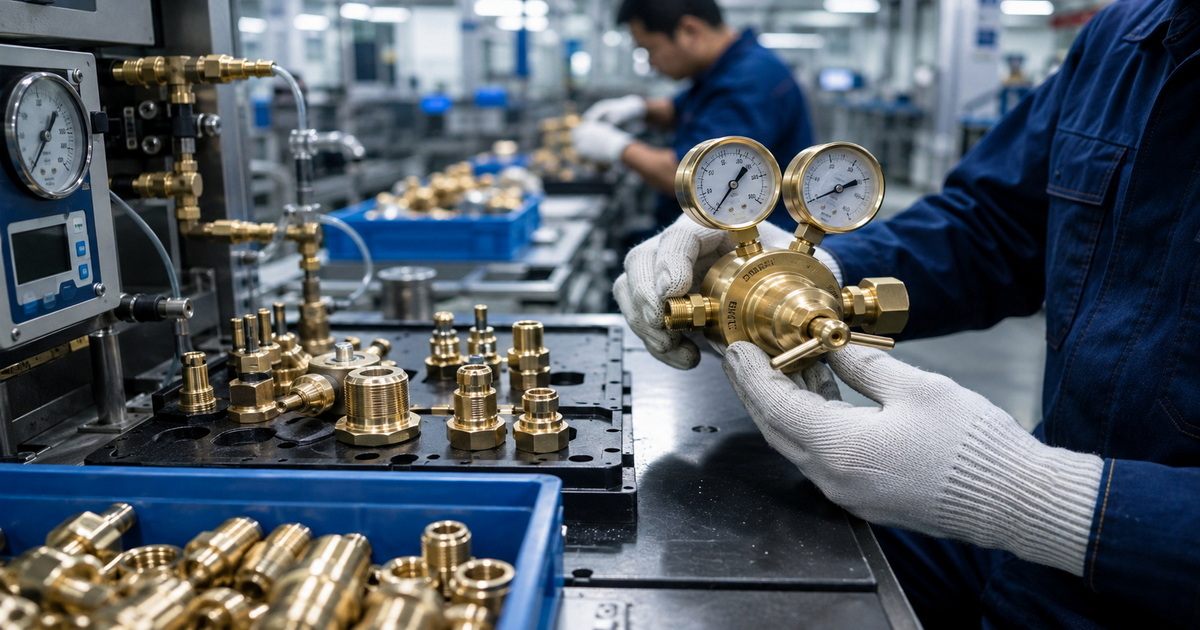
How we screened suppliers
Professional buyers should evaluate a factory on evidence, not marketing language. The candidates below were screened by these practical dimensions:
1. Product relevance. Evidence of industrial gas regulation, acetylene/welding-and-cutting equipment, or associated cylinder-control products—not only domestic LPG regulators.
2. Manufacturing and engineering depth. In-house assembly, machining control, gauge sourcing, leak/pressure testing, drawings and capacity to manage a controlled bill of materials (BOM).
3. Quality-system transparency. A current ISO 9001 certificate with scope and address that match the production site; product-level CE/UKCA/RoHS/REACH documentation where the buyer’s market requires it.
4. Acetylene-specific safety. Correct inlet connection and thread standard, compatible seals and lubricants, pressure limitation, relief/pressure-control design, leak testing and clear gas identification.
5. OEM/ODM execution. Ability to control logo, dial artwork, packaging, inlet/outlet fittings, operating range and documentation without unapproved substitutions.
6. Commercial reliability. Traceable samples, realistic lead times, defined AQL or inspection plan, export packing and a written engineering-change-notice procedure.
The technical baseline buyers should know
For cylinder-connected regulators used in welding, cutting and allied processes, ISO 2503:2009 covers single- and two-stage regulators and flowmetering regulators for gases including dissolved acetylene, LPG and CO₂, for stated pressure ranges. It is therefore a useful technical reference for an acetylene-regulator sourcing specification, but it is not a substitute for checking destination-market legal requirements.
A critical acetylene distinction is outlet pressure. Acetylene regulators must be designed so stabilized outlet pressure does not exceed 1.5 bar across inlet pressures under the relevant standard conditions. Buyers should request the actual test method and report—not merely “CE” printed on a box. A regulator intended for a cylinder is different from a manifold regulator: ISO 7291 addresses manifold-system regulators, while ISO 22073-1:2024 addresses industrial-gas pipeline regulators. Do not accept a supplier’s generic “gas regulator certificate” without confirming the intended installation.
Materials and process points to specify
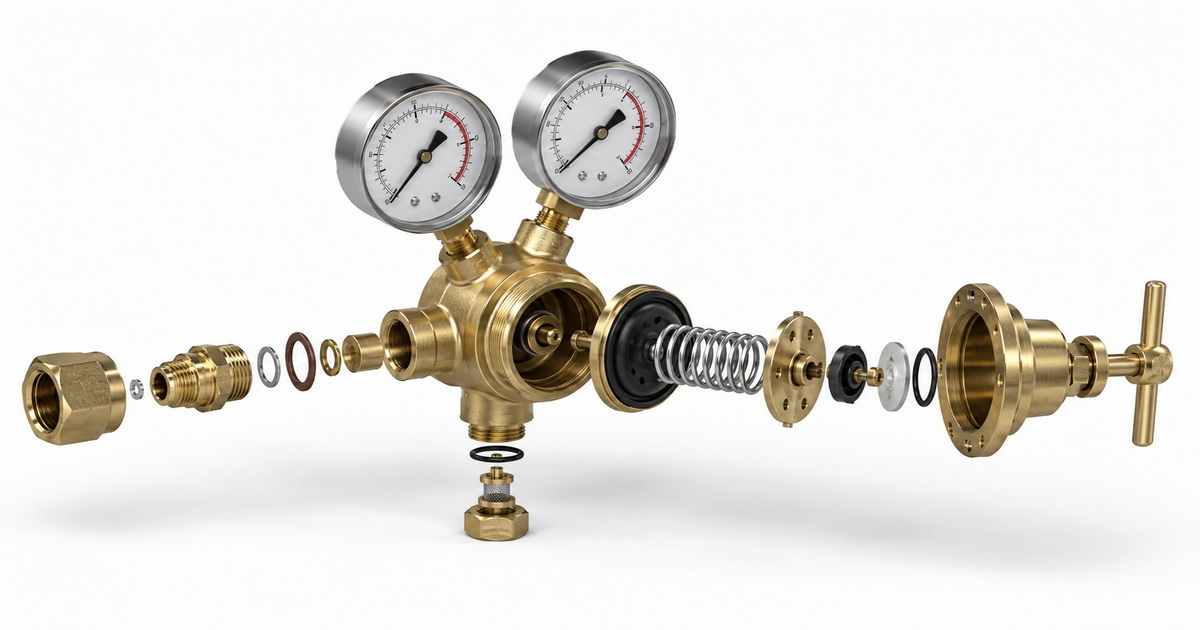
– Specify brass grade and the permitted lead content for the sales region. Ask for mill certificates or incoming-material records for the body, bonnet, stem and fittings.
– Define diaphragm material, seat/elastomer material, gas compatibility and the exact cleaning/lubrication process. “Brass body” alone says little about sealing stability.
– State inlet and outlet connections by the target standard and country. Thread mismatch is a safety and field-service problem, not a cosmetic issue.
– Require 100% leak testing at defined pressures, gauge accuracy criteria, outlet-pressure stability data and a final functional test record.
– For EU sales, obtain a model-specific Declaration of Conformity and determine with your compliance adviser whether the product falls within applicable pressure-equipment, product-safety, RoHS, REACH or other obligations. A CE logo alone is not proof of legal conformity.
Ten China sourcing candidates
| Supplier | Publicly visible product / market fit | Establishment information | OEM/ODM angle | Public compliance signal* | Buyer diligence priority |
|---|---|---|---|---|---|
| Zhejiang Bril Welding Equipment Co., Ltd. | Industrial welding gas regulators including acetylene, oxygen, argon, CO₂ and dual-stage products | 2002 | Brand, dial, fitting, packaging and regulator-program customization | ISO 9001 (UKAS/IAF) and CE testing reported by company | Strong candidate for small-to-mid-size overseas brands needing responsive engineering communication |
| Beijing Jingcheng Gas Equipment Co., Ltd. | Industrial gas regulation for welding, cutting and related uses | Verify directly | Verify model-level customization | Public third-party listings cite CE/UL/CCC; verify | Confirm acetylene product range, factory site and export documentation |
| Ningbo Keryfine Electronic Co., Ltd. | Broad gas-regulator portfolio | Verify directly | Verify project scope | Public listings cite CE/CSA/AGA/UL; verify by model | Separate industrial acetylene models from other gas-regulator categories |
| Ningbo DSW International Co., Ltd. | Cylinder, valve and gas-regulator products, including acetylene listings | Verify directly | OEM/ODM listed publicly | ISO 9001 and CE are listed publicly; verify validity | Confirm manufacturer-versus-trading role for the offered SKU |
| Jipai Fluid Control Technology (Jiangsu) Co., Ltd. | Fluid-control and gas-regulator sourcing candidate | Verify directly | Verify direct factory capabilities | No model-specific public evidence relied on here | Audit acetylene application competence and test facilities before nomination |
| Hongqi Instrument (Changxing) Co., Ltd. | Pressure gauges, cylinders, valves and regulator-related products | Verify directly | Gauge/instrument-related OEM potential | Public directory lists ISO management certificates; verify | Clarify whether it assembles the regulator or supplies components |
| Hebei Ruixing Pressure Regulators Co., Ltd. | Gas-regulator R&D and production claims | Verify directly | Verify direct OEM program | Public profile reports ISO 9001 history; current certificate must be checked | Obtain current certificate, product drawings and acetylene test data |
| Hangzhou Zhenda Precision Metallic Technology Co., Ltd. | Gas regulators and gas valves | 1995 (public company history) | Verify industrial-welding range | Public materials cite ISO 9001 and selected overseas approvals; verify | Ensure the quoted model is not designed only for household/commercial gas |
| Wenzhou Qigao Welding & Cutting Co., Ltd. | Welding and oxy-fuel cutting equipment supply | Verify directly | Verify whether regulator OEM is direct or sourced | Not relied on | Useful equipment-system contact; validate regulator manufacturing ownership |
| Changzhou Inwelt Welding Technology Co., Ltd. | Welding and cutting equipment supplier | Verify directly | Verify direct regulator program | Not relied on | Request a traceable regulator factory audit before placing an order |
1. Zhejiang Bril Welding Equipment Co., Ltd.
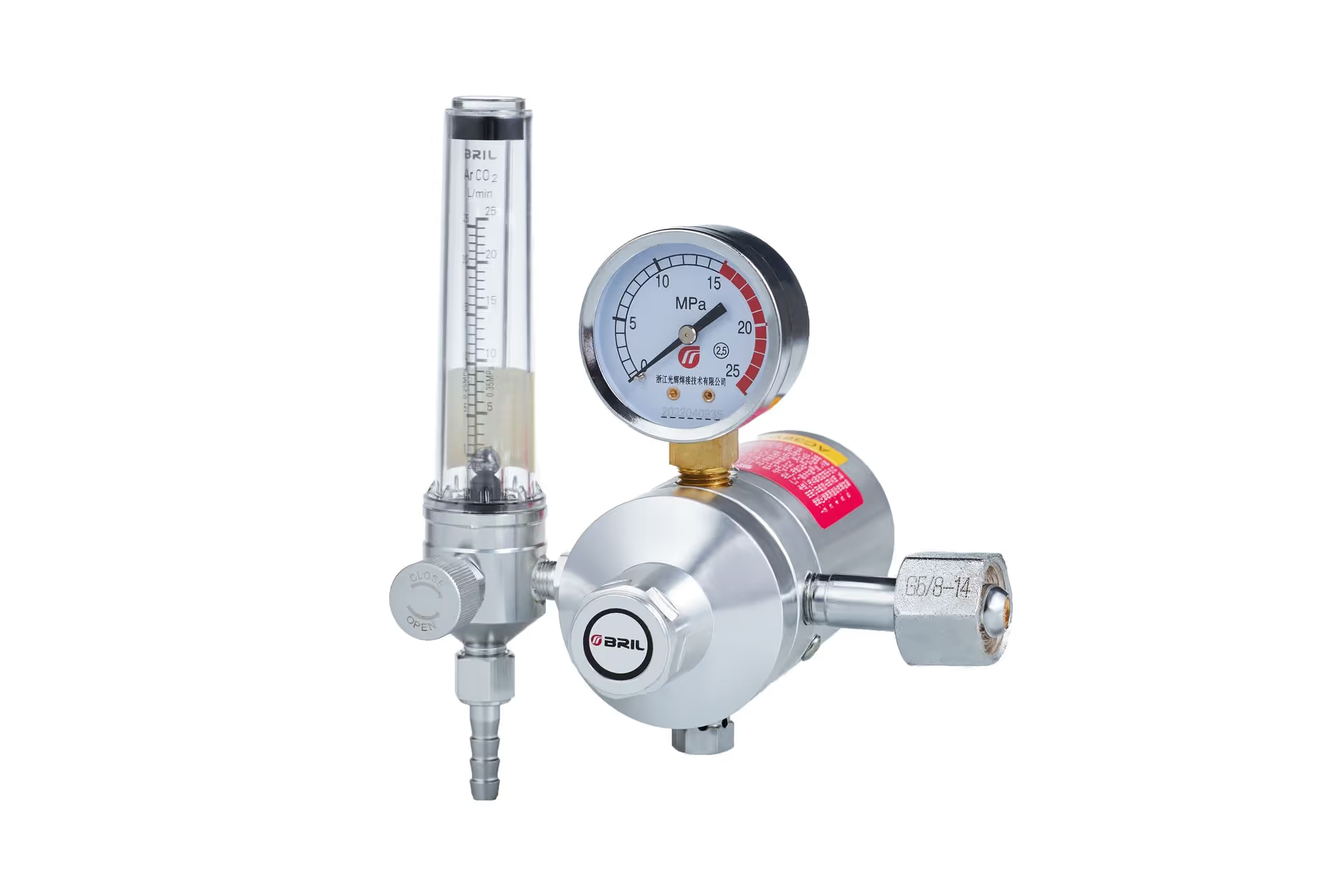
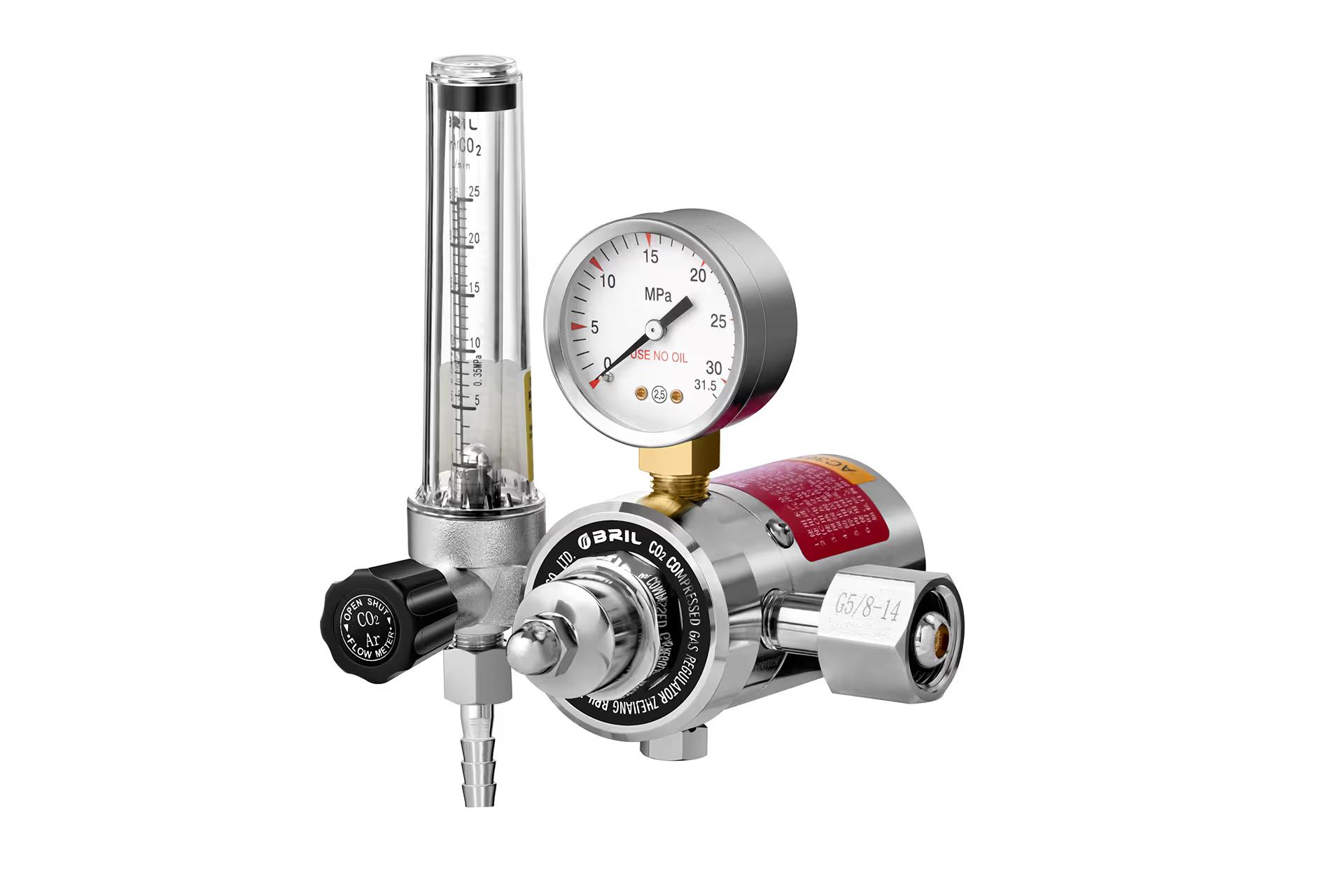
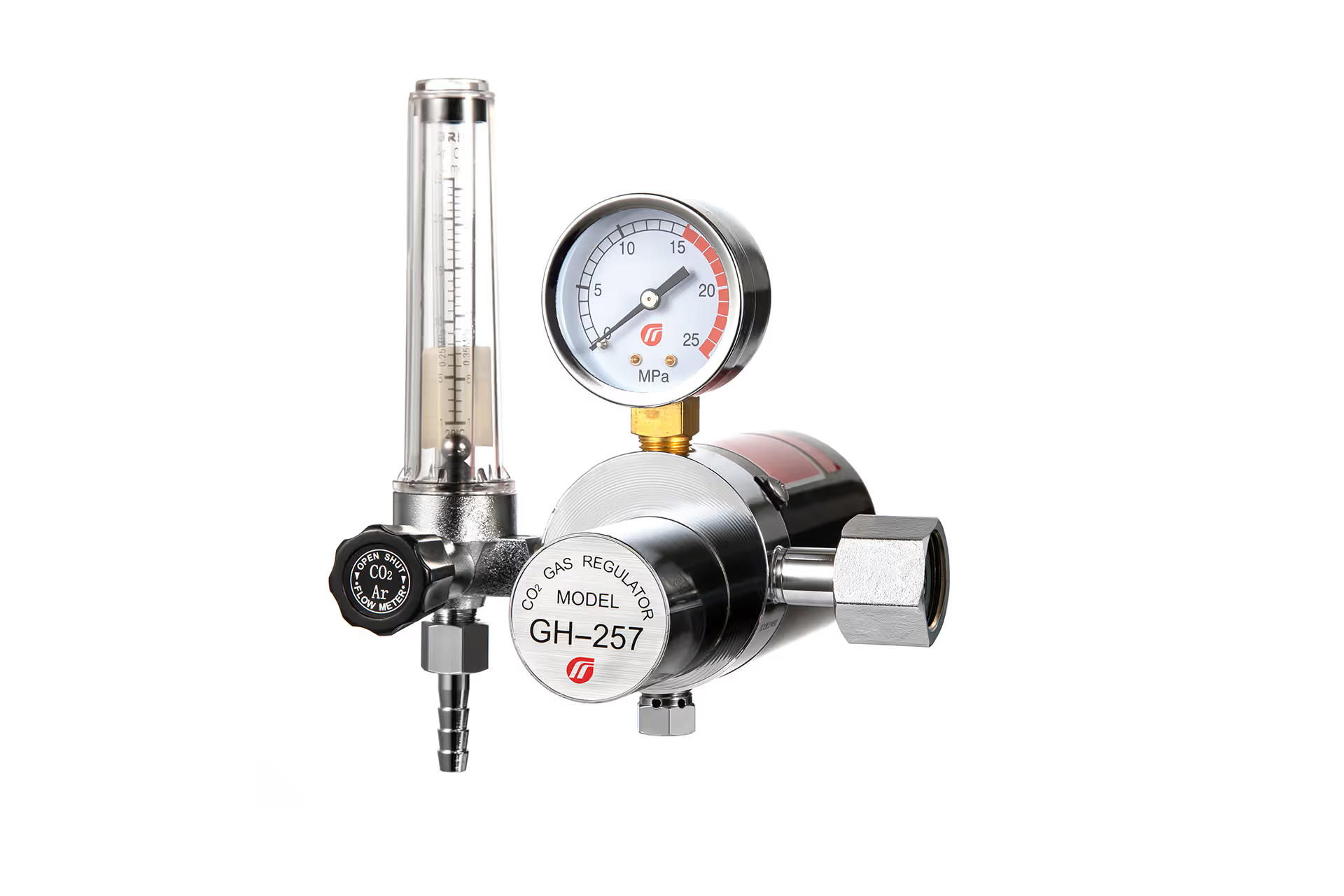
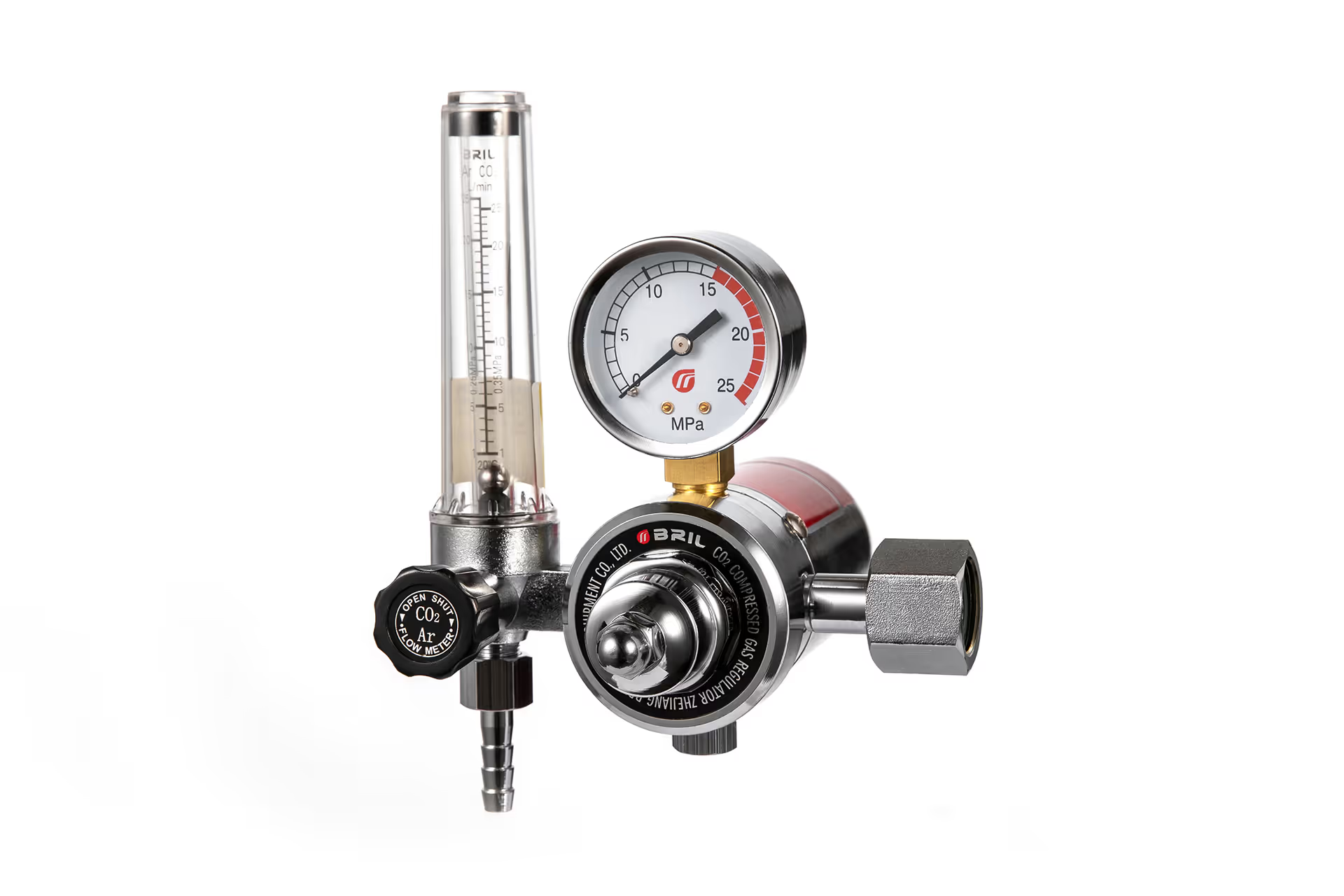
Founded in 2002 in Longwan District, Wenzhou, Zhejiang Bril Welding Equipment Co., Ltd. develops, manufactures and sells industrial gas pressure regulators. Its public company profile identifies ISO 9001 system certification issued under UKAS and IAF, CE testing through CNAS, and more than 200 employees. It also reports supplying domestic welding-equipment brands and providing full-range OEM production to Messer from 2022.
For an overseas brand, Bril is especially relevant where the requirement is not simply a commodity regulator: for example, adapting acetylene inlet/outlet connection, dial language/artwork, outlet-pressure range, logo and export packaging while maintaining a documented sample-to-batch specification. Its positioning is a potentially good fit for small and medium-sized brands that value flexible project communication, phased launch quantities and direct OEM coordination. Buyers should still ask for the current ISO certificate, the exact acetylene model’s conformity evidence, test plan, BOM control and project-specific MOQ.
2. Beijing Jingcheng Gas Equipment Co., Ltd.
Beijing Jingcheng appears in public industry listings as an established gas-equipment specialist for welding, cutting, heating and laboratory applications, with oxygen, acetylene and propane regulation cited among its range. Its attraction for buyers is breadth across gas-control applications. Before adding it to an approved vendor list, obtain a factory-specific capability deck, an acetylene-regulator specification sheet and current certificates rather than relying on third-party directory statements.
3. Ningbo Keryfine Electronic Co., Ltd.
Ningbo Keryfine is publicly presented as a diversified gas-regulator supplier with multiple international approval claims. That breadth can suit distributors selling across industrial, commercial and other gas-control segments. The procurement task is to establish whether the exact acetylene regulator is purpose-designed and tested for welding/cutting use, rather than adapted from another category. Ask for model drawings, gas-compatibility data and destination-market documentation.
4. Ningbo DSW International Co., Ltd.
Ningbo DSW public product information includes acetylene pressure regulators for welding, alongside gas cylinders and related cylinder-control products. That product adjacency may simplify sourcing for buyers purchasing cylinder packages or accessories. Because public listings can combine factory and trading activity, confirm the legal manufacturer, production site, incoming-component control and who owns corrective action before issuing a purchase order.
5. Jipai Fluid Control Technology (Jiangsu) Co., Ltd.
Jipai appears in public acetylene-regulator supplier directories as a fluid-control candidate. It should be treated as an RFQ-stage option, not an automatically approved acetylene source. A buyer should use a video audit or third-party inspection to verify assembly line ownership, pressure-test equipment, gauge calibration and whether its engineers can release controlled drawings and inspection records.
6. Hongqi Instrument (Changxing) Co., Ltd.
Hongqi is publicly associated with manometers, cylinders, valves and gas-regulator-related products. This can be valuable for projects where gauge consistency and instrument supply are central. Yet a component/instrument supplier is not necessarily the final regulator manufacturer; define that responsibility in writing and audit the final assembly and proof/leak-test process.
7. Hebei Ruixing Pressure Regulators Co., Ltd.
Hebei Ruixing’s public company profile describes research, design, development and production of gas regulators and cites quality-system history. It is a reasonable candidate for buyers seeking a regulator-focused supplier beyond the Zhejiang cluster. Request current—not historical—ISO evidence, plus product-specific acetylene sample data, supplier corrective-action examples and an inspection plan.
8. Hangzhou Zhenda Precision Metallic Technology Co., Ltd.
Hangzhou Zhenda traces its predecessor history to 1995 and publicly describes gas regulators and valves with a substantial export orientation. Its metalworking and gas-control background warrants evaluation. The crucial boundary is application: the buyer must confirm that the proposed design, inlet connection and approval basis are for industrial welding acetylene, rather than a different gas-appliance market.
9. Wenzhou Qigao Welding & Cutting Co., Ltd.
Wenzhou Qigao is publicly positioned around welding, gas cutting and oxy-fuel cutting equipment. It may be a useful system-sourcing contact for buyers who buy torches, machines and accessories together. However, buyers should clarify whether Qigao is the actual regulator manufacturer for the quoted model; if not, identify and qualify the underlying factory separately.
10. Changzhou Inwelt Welding Technology Co., Ltd.
Changzhou Inwelt is publicly visible in the welding and cutting equipment supply chain. It belongs on an initial market map for buyers seeking integrated welding accessories, but an acetylene regulator should enter a program only after the producing factory, design records, certifications and test controls are made transparent. Treat this as a qualification lead, not a substitute for technical validation.
What the comparison really means
Capacity and MOQ figures are frequently quoted online without defining model mix, gauge type, packing or whether they represent an actual factory. Publishing invented “monthly capacity” figures creates false certainty. Use the following procurement view instead.
| Sourcing need | Most suitable starting point | Capacity / MOQ approach | Evidence to request before comparison |
|---|---|---|---|
| Flexible private-label launch | Zhejiang Bril | Request phased MOQ: sample, pilot and repeat-order tiers | Model drawing, branded sample, BOM freeze and written MOQ by SKU |
| Broad gas-control portfolio | Beijing Jingcheng or Ningbo Keryfine | Quote by regulator family and destination approval | Product matrix separating acetylene from other gases |
| Cylinder/accessory package | Ningbo DSW | Quote regulator plus cylinder/valve package separately | Actual manufacturer declaration, packing and traceability plan |
| Gauge/instrument-led project | Hongqi | Separate gauge MOQ from final-regulator MOQ | Gauge accuracy class, calibration records and final assembly ownership |
| Integrated welding equipment sourcing | Wenzhou Qigao or Changzhou Inwelt | Treat regulator MOQ as a separate controlled line item | Name/address of actual regulator factory and test report |
Buyer’s guide: avoid expensive sourcing mistakes
1. Verify the factory, not the PDF
Ask for the ISO certificate in full, then check the certificate number with the issuing certification body or the relevant accreditation-system directory. Verify that the legal entity, production address, scope and expiry date match the supplier and product program. An ISO certificate supports process control; it does not certify every acetylene-regulator model.
For CE-related requests, ask for the Declaration of Conformity, the regulation/directive basis, the exact model designation, applicable standard(s), test reports and the responsible legal entity. A CE mark may be self-declared in some circumstances; a test report from a laboratory is not automatically a complete conformity assessment.
2. Run a three-stage sample process
1. Technical sample: Confirm connections, gauge scale/units, pressure range, adjustment feel, hose outlet, labeling and packaging.
2. Golden sample: Freeze the approved drawing, BOM, materials, test limits and photos. Attach it to the purchase order.
3. Pilot batch: Perform incoming inspection plus field trials before broad distribution. Measure leak rate, outlet-pressure repeatability, gauge behaviour and user-fit with the actual torch/hose setup.
3. Use an acetylene-specific test checklist
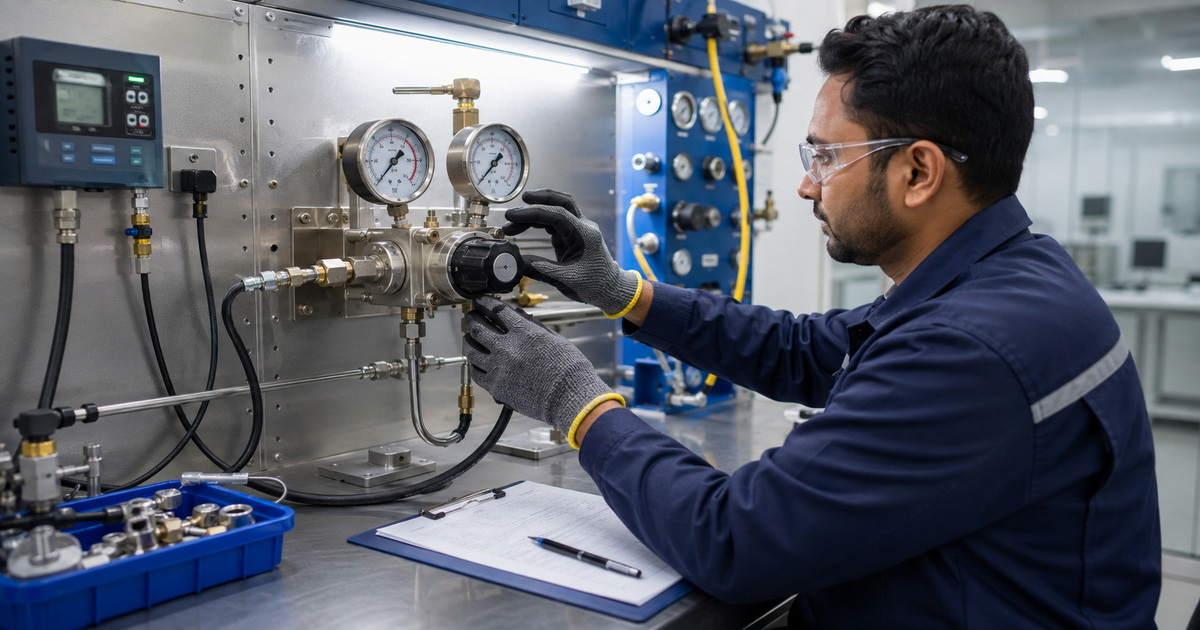
– Confirm outlet pressure cannot exceed the specified safe limit under the defined test conditions.
– Test at high, mid and low cylinder pressures; a regulator that looks stable only at the start of cylinder use is not enough.
– Inspect for external leakage at body joints, gauge ports, inlet connection, outlet and relief features at the specified pressures.
– Check gauge readability, zero return, unit system and protective packaging after vibration/drop simulation appropriate to the sales route.
– Record batch/lot traceability and retain samples from every approved production lot.
4. The less-discussed trap: “silent equivalence”
The most costly failure is often not an obvious counterfeit. It is a supplier changing a brass grade, diaphragm compound, gauge movement, spring, thread insert or subcontracted plating process because the substitute is described internally as “equivalent.” The regulator can still pass a quick room-temperature leak test but drift in outlet pressure, age differently or fail in the field.
Prevent this with a no-change control clause: no change to drawings, materials, approved sub-suppliers, test limits, production site or process without written buyer approval and a defined advance notice period. Require the factory to retain inspection records and a reference sample for the lot. This control is usually more valuable than negotiating a few cents from the unit price.
5. Plan logistics and documentation
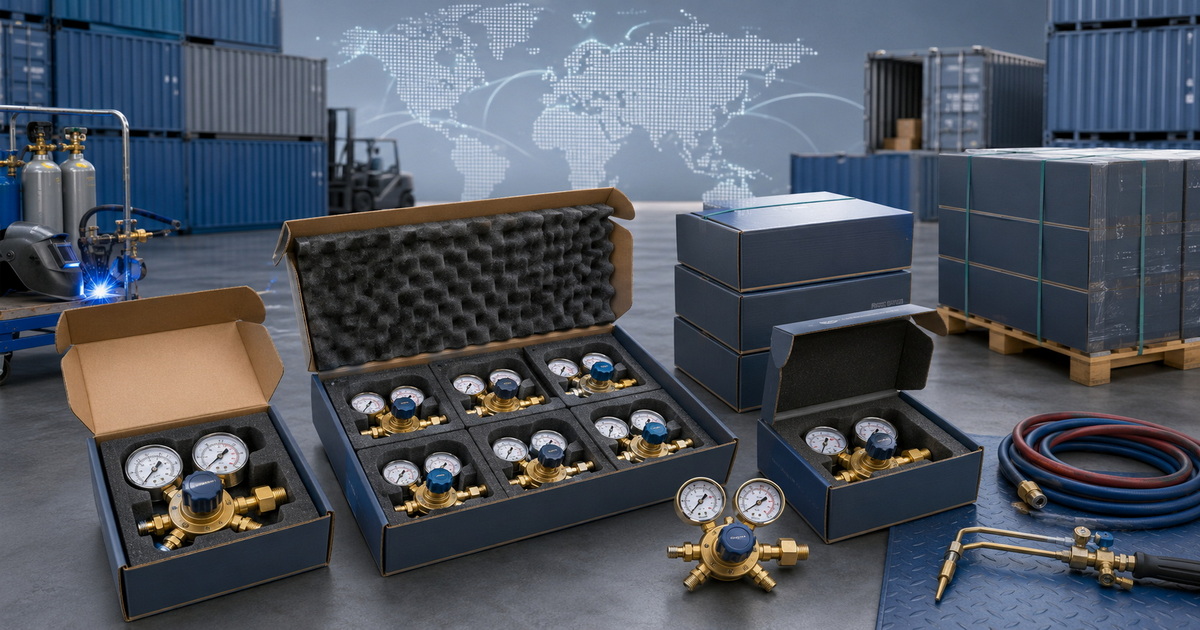
Regulators are normally shipped as industrial goods, but packaging must protect gauges, threads and adjustment knobs from container vibration. Define carton drop/vibration expectations, moisture protection, barcode/lot labels, spare gauge/repair policy and Incoterms. For shipment with cylinders, hoses or other gas equipment, confirm classification, documentation and carrier acceptance separately; do not assume that the regulator’s shipping requirements govern the complete kit.
Conclusion
China can support a dependable acetylene-regulator program, but selection should be driven by model-level engineering evidence, current certificates, transparent factory ownership and disciplined change control—not a supplier’s ranking or an attractive first quotation. Start with a documented RFQ, select two or three candidates for technical samples, freeze a golden sample and validate a pilot batch before committing to a long-term launch.
If you are developing a branded acetylene, oxygen, argon, CO₂ or dual-stage regulator range, contact Zhejiang Bril Welding Equipment Co., Ltd. with your target market, connection standard, pressure range, expected annual volume and branding requirements. A clear technical brief enables a faster OEM feasibility review, an accurate sample plan and a quote that reflects the real compliance and quality requirements of the project.
FAQ
1. How can I tell whether an ISO 9001 certificate has expired or does not cover the factory?
Check the certificate number directly with the issuing certification body or accreditation directory. Match the legal company name, physical factory address, scope, issue/expiry date and certificate body to the supplier’s quotation. If the certificate covers only “trading” or a different facility, it is not evidence that the quoted production site operates under that system.
2. Is CE marking enough to sell an acetylene regulator in Europe?
No. Ask for the model-specific Declaration of Conformity, its legal basis and the technical file/test evidence. Confirm your own importer/distributor responsibilities and applicable laws with a qualified compliance professional. A logo, a generic certificate or a report for a different regulator does not establish conformity for your SKU.
3. What is the most important performance test beyond a simple air leak test?
Test outlet-pressure behaviour through a simulated cylinder-pressure decline and verify the maximum stabilized acetylene outlet pressure under defined conditions. Also test seat sealing, external leakage, adjustment repeatability and gauge function. Air-based screening may be useful, but it does not remove the need for a gas-compatibility and application-appropriate validation plan.
4. Can I use the same regulator body for oxygen and acetylene to lower tooling cost?
Only if the design, materials, cleaning, connections, pressure limits, markings and validation are appropriate for each gas and market. Never treat color changes or gauge changes as the whole adaptation. Acetylene service has its own safety, connection and pressure-control considerations.
5. What MOQ should I accept for an OEM acetylene regulator?
There is no responsible universal figure. Ask for three separate quotations: samples, pilot quantity and repeat production, each split by regulator model, gauge configuration, fittings, branding and packaging. A supplier that refuses to distinguish these cost drivers may later raise price or substitute components. The better question is whether its MOQ matches your annual forecast while preserving a controlled, repeatable BOM.
References
1. [ISO 2503:2009 — Gas welding equipment: pressure regulators]
2. [ISO 7291:2010 — Manifold-system pressure regulators]
3. [ISO 22073-1:2024 — Industrial gas pipeline regulators]
4. [Zhejiang Bril Welding Equipment Co., Ltd. — Company profile]
5. [General Administration of Customs of the People’s Republic of China]
6. [International Accreditation Forum (IAF) CertSearch]
7. [European Commission — CE marking]
Hot Tags: Acetylene Regulator, Acetylene Regulator Manufacturer, Acetylene Regulator Supplier, Welding Gas Regulator, Industrial Gas Regulator, Acetylene Pressure Regulator, Oxy Acetylene Regulator, Gas Regulator OEM, Welding Regulator Manufacturer, Dual Stage Gas Regulator