Content Menu
● Understanding Gas Cylinder Regulators
>> What Is a Gas Cylinder Regulator?
>> Core Functions and Limitations
● Understanding Industrial Pressure Regulators
>> What Is an Industrial Pressure Regulator?
>> Why Industrial Regulators Fit High‑Volume Laser Cutting
● Gas Cylinder Regulator vs Industrial Pressure Regulator: Key Differences
>> Functional Comparison Table for High‑Volume Laser Cutting
● How Laser Cutting Uses Gas – And Why It Matters for Regulators
>> Typical Gases in Laser Cutting
>> Continuous vs Intermittent Operation
● Expert Perspective: When a Gas Cylinder Regulator Is Enough
● Expert Perspective: Why Industrial Pressure Regulators Win for High‑Volume Laser Cutting
● Dual‑Stage and Heated Regulators: A Hidden Differentiator
>> Dual‑Stage Regulation for Pressure Stability
>> Electrically Heated CO₂ and High‑Flow Regulators
● Practical Selection Steps for Laser Cutting Applications
>> 1. Define Your Process Requirements
>> 2. Match Regulator Type to Supply Strategy
>> 3. Specify Materials, Standards, and Safety Features
● OEM/ODM Customization for Laser Cutting Brands
>> Why OEM/ODM Regulators Matter for Overseas Brands
>> Custom Features for High‑Volume Laser Cutting
● Cost and ROI View: Short‑Term vs Long‑Term
● Clear Recommendation for High‑Volume Laser Cutting
● Call to Action: Design Your Regulator Strategy with Experts
● Frequently Asked Questions (FAQ)
Understanding Gas Cylinder Regulators
What Is a Gas Cylinder Regulator?
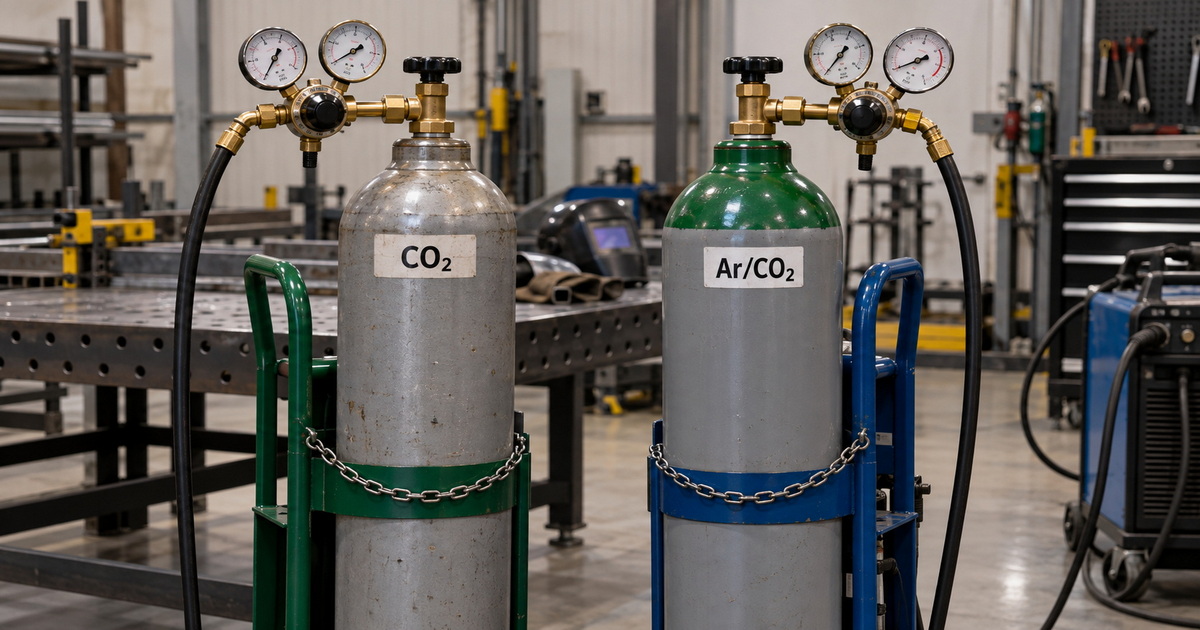
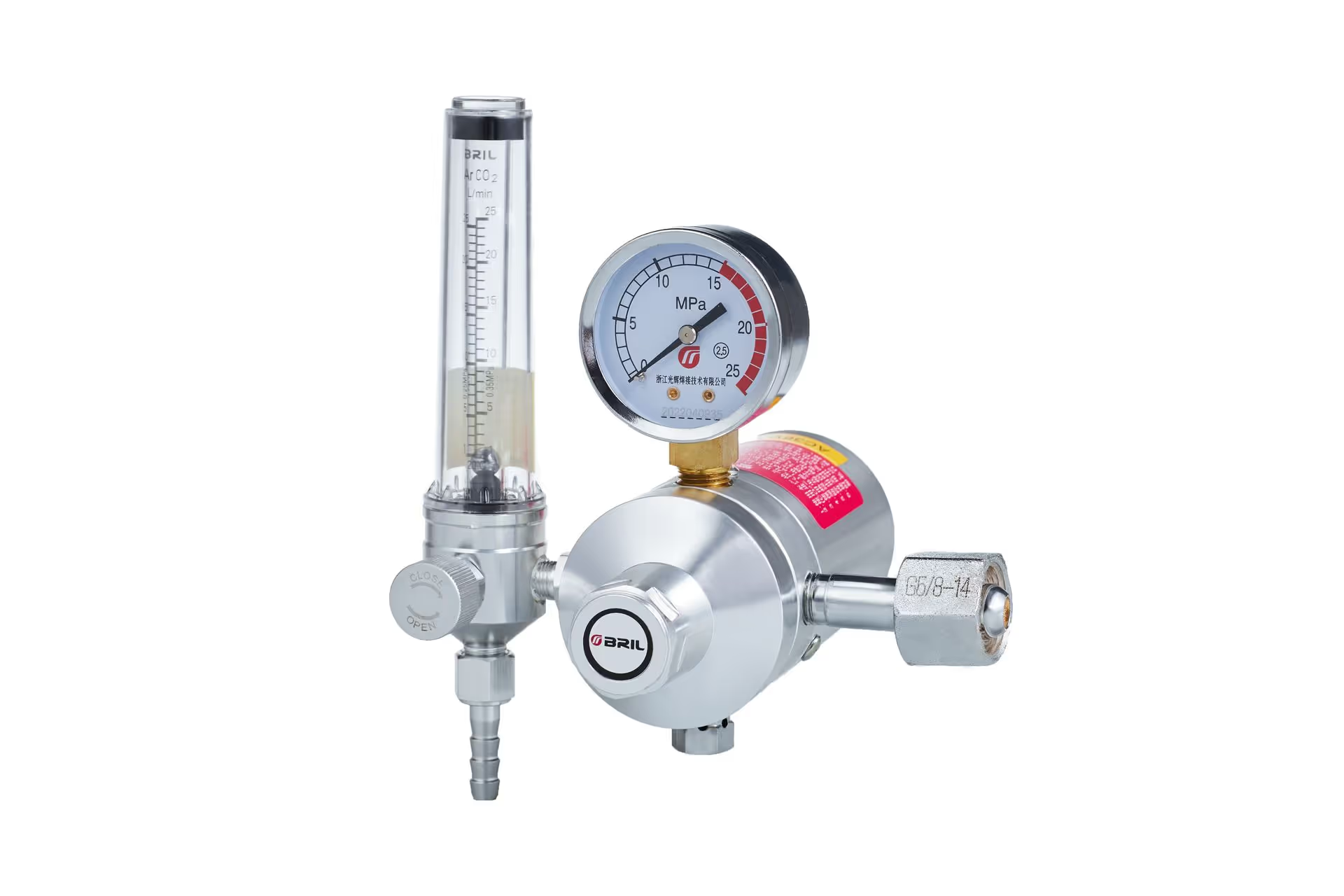
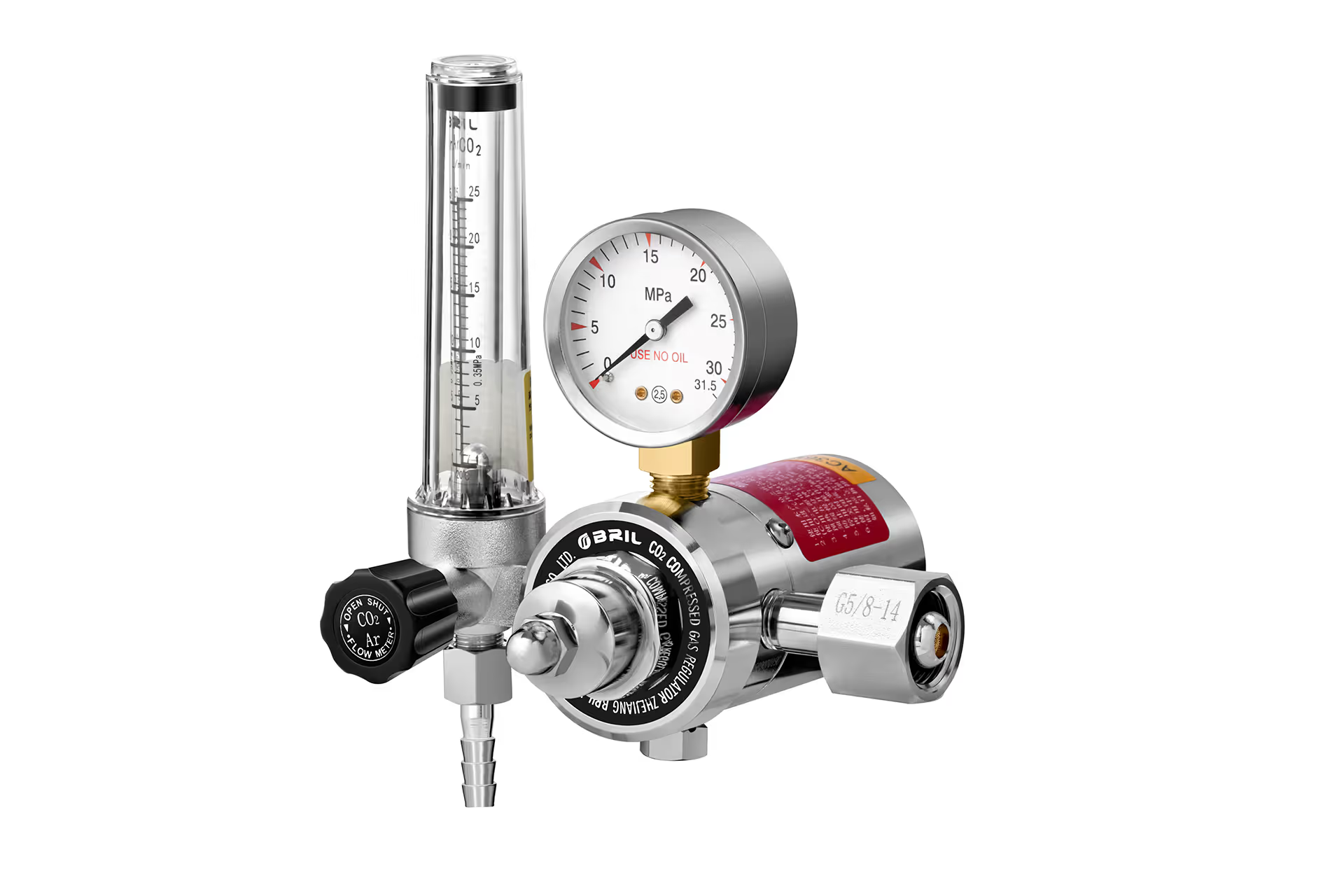
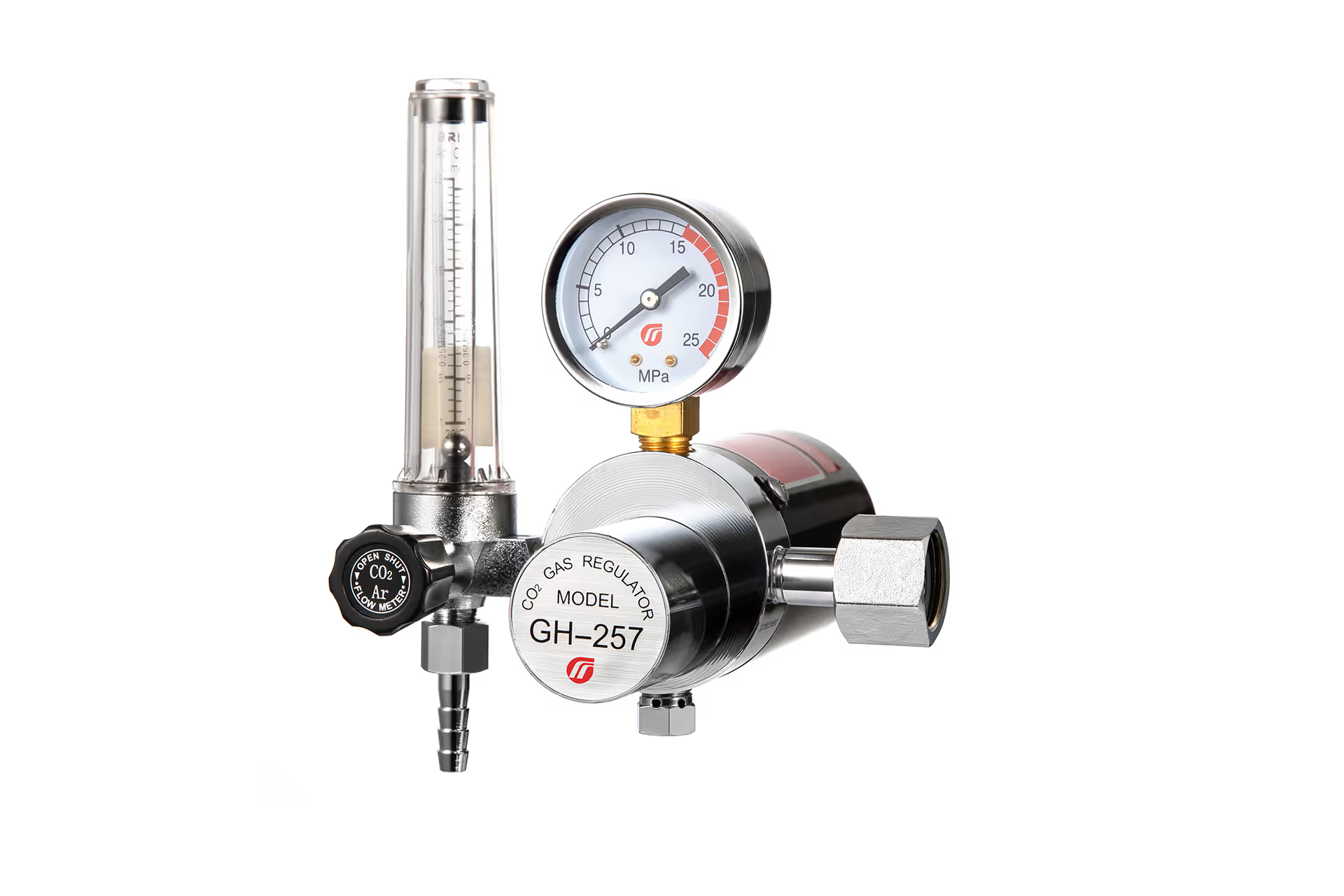
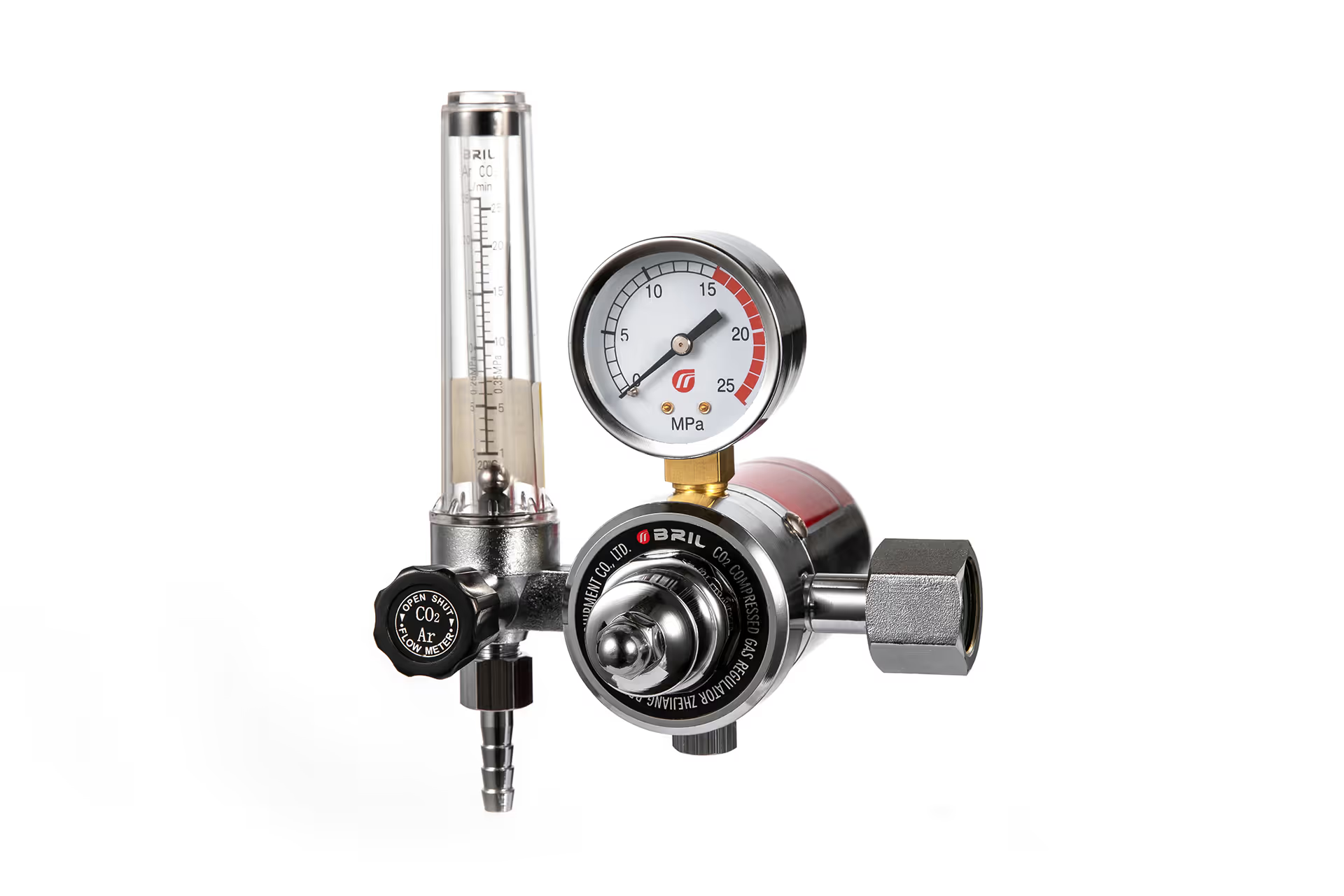
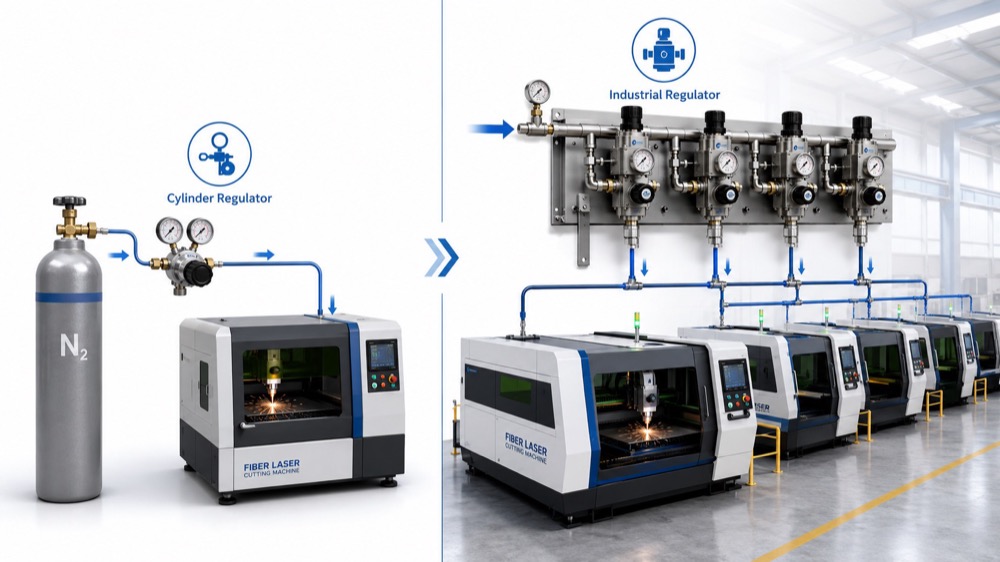
A gas cylinder regulator is mounted directly on a gas cylinder valve to reduce high cylinder pressure down to a safe, usable outlet pressure for the process. It typically includes: [weldingandwelder]
– An inlet connection matched to a specific gas standard (e.g., CGA, DIN, BS)
– A pressure‑reducing mechanism with spring and diaphragm
– One or two gauges for cylinder and outlet pressure
In laser cutting shops, these regulators are commonly used for:
– CO₂, nitrogen, oxygen, argon, and gas mixtures for auxiliary and shielding gases
– General welding and cutting tools around the laser line
– Low‑to‑medium duty equipment that is not running 24/7
Core Functions and Limitations
From a functional perspective, a cylinder regulator must:
– Reduce very high pressure from the cylinder (up to 200–300 bar depending on gas) to a safe outlet range
– Maintain reasonably stable pressure while the cylinder empties
– Provide basic flow control or work with an external flowmeter
However, when you push it into high‑volume, continuous laser cutting, three limitations appear:
1. Droop under high flow – outlet pressure drops as flow increases, leading to inconsistent cutting performance. [airgas]
2. Cylinder pressure decay effect – as the cylinder empties, outlet pressure stability worsens, especially with single‑stage designs. [weldingandwelder]
3. Thermal and freezing risks – for CO₂ and high‑flow gases, fast pressure drop can cause regulator cooling and even freezing without heating. [genstartech]
For occasional cutting or low‑volume fabrication, these limits are acceptable. For 24/7 laser cutting cells, they directly translate into cut edge defects, rework, and machine idle time.
Understanding Industrial Pressure Regulators
What Is an Industrial Pressure Regulator?
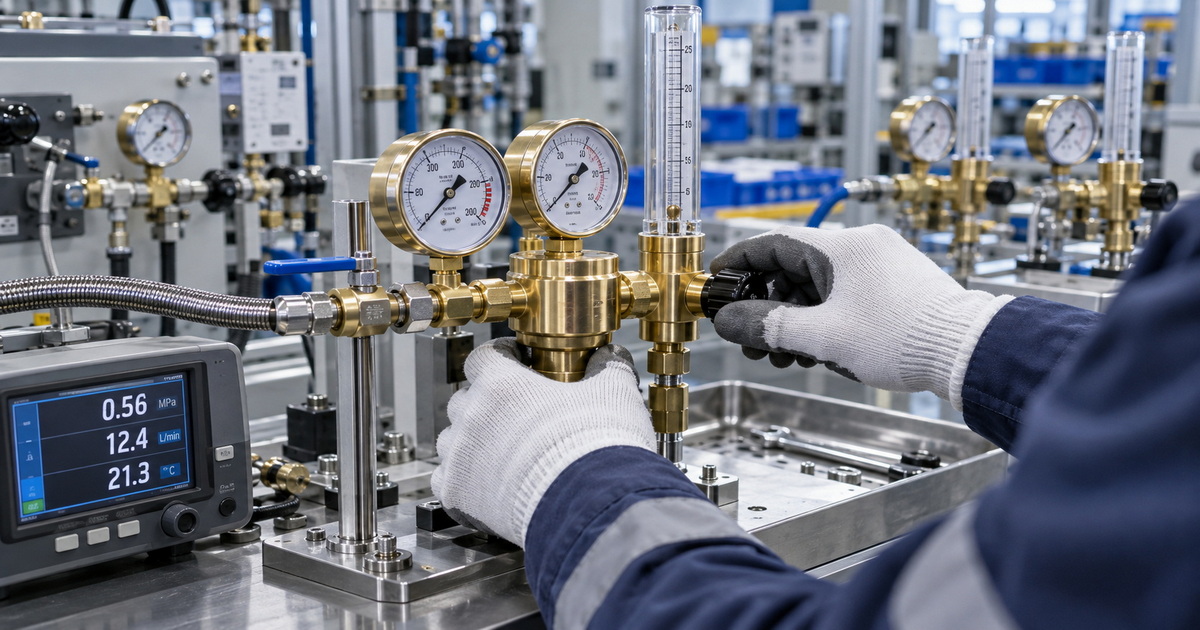
An industrial pressure regulator is designed as part of a fixed gas distribution system, installed downstream of high‑pressure sources (cylinders, bundles, tanks, or central manifolds). It is optimized for:
– High, stable flow rates over long operating periods
– Robust, industrial‑grade materials (brass, stainless steel, high‑performance elastomers)
– Compatibility with advanced gas supply setups and automation
These regulators often include:
– Single‑stage or dual‑stage regulation for ultra‑stable outlet pressure
– Higher Cv (flow capacity) for large laser cutting nozzles
– Options for heated sections, especially for high‑flow CO₂ and mixed gases to avoid freezing and flow fluctuation. [ioxygen]
Why Industrial Regulators Fit High‑Volume Laser Cutting
Laser cutting, especially for thick stainless steel and carbon steel, demands:
– Stable assist gas pressure at the nozzle to keep cut kerf narrow and clean
– High flow rates for nitrogen or oxygen at consistent pressure
– Minimal variation when upstream supply conditions change
Industrial regulators are engineered with these requirements in mind:
– Better pressure stability (low droop) even at high flow rates
– Designed to integrate into manifold and pipeline systems feeding multiple laser machines
– Easier to maintain compliance with safety and quality standards in industrial facilities [boc.com]
For high‑volume operations, they are not just a “better regulator”; they become a critical part of process control.
Gas Cylinder Regulator vs Industrial Pressure Regulator: Key Differences
Functional Comparison Table for High‑Volume Laser Cutting
| Aspect | Gas Cylinder Regulator | Industrial Pressure Regulator |
|---|---|---|
| Installation point | Directly on cylinder valve | In pipeline/manifold downstream of cylinders or bulk tank |
| Typical stage | Single‑stage (laser‑specific dual‑stage less common) | Single‑ or dual‑stage, laser/industrial grade weldingandwelder |
| Flow capacity | Moderate, suited to general welding/cutting | High, designed for continuous high‑volume flow weldingandwelder |
| Pressure stability | Adequate for intermittent use, sensitive to cylinder pressure drop | Highly stable, low droop under varying flow and cylinder conditions weldingandwelder |
| Thermal behavior | Risk of cooling/freezing at high CO₂ flow without heating | Heated or staged options available to prevent freezing and ensure stability |
| Best use case | Small workshops, low‑volume cutting, general welding | 24/7 laser cutting lines, multi‑machine systems, automated production |
| Maintenance model | Replace when worn, lower upfront cost | Planned maintenance, higher durability, long‑term cost optimization |
| Safety and standards | Must match gas type and local standards | Often integrated into engineered gas systems with stricter compliance requirements weldingandwelder |
How Laser Cutting Uses Gas – And Why It Matters for Regulators
Typical Gases in Laser Cutting
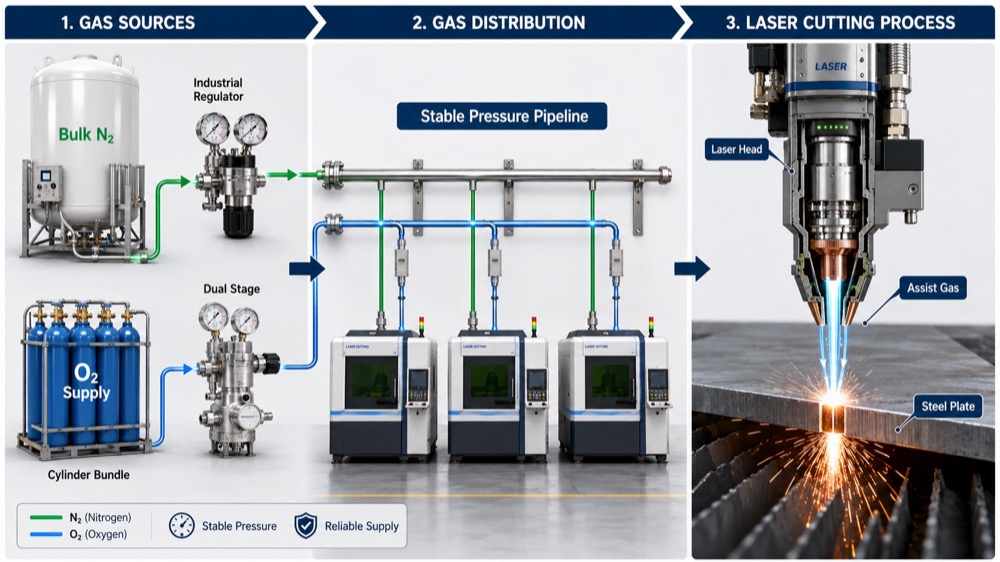
High‑volume laser cutting uses different gases depending on material and process:
– Nitrogen (N₂) – high‑pressure assist gas for stainless steel and aluminum to prevent oxidation
– Oxygen (O₂) – assist gas for mild steel, promoting an exothermic reaction for faster cutting
– Compressed air – cost‑effective option for some materials and thicknesses
– CO₂ and mixed gases – used in certain laser sources or as shielding gases in related operations
Each gas has unique pressure and flow requirements, which place different demands on the regulator. For example, high‑pressure nitrogen cutting can require very high flow rates through the regulator without compromising outlet stability, something standard cylinder regulators may struggle to deliver continuously. [boc.com]
Continuous vs Intermittent Operation
From a process engineer’s perspective, the key question is not just “What gas?” but “How often and how hard will the system run?”
– Intermittent job shop usage
– Short runs, frequent stops
– Occasional cutting of mixed materials
– Gas cylinder regulators on single cylinders can be sufficient
– High‑volume production
– Multiple shifts, near‑continuous cutting
– High thickness or high‑speed cutting programs
– Industrial regulators, often in dual‑stage configurations, linked to bundles or bulk tanks provide better stability, fewer pressure alarms, and smoother cut quality. [boc.com]
Put simply: the more continuous your cutting, the stronger the case for industrial regulators.
Expert Perspective: When a Gas Cylinder Regulator Is Enough
Speaking as a practitioner who has supported smaller fabrication shops, I still recommend gas cylinder regulators in several scenarios:
1. Prototype labs and R&D cells
– Single laser machine, frequent process changeovers
– Moderate gas consumption, high flexibility demand
2. Small job shops
– Limited budget, low daily cutting hours
– Occasional high‑flow jobs but not continuous
3. Backup or emergency setups
– Temporary redundant gas line
– Mobile cutting/welding stations around the plant
In these cases, a high‑quality, single‑stage or dual‑stage cylinder regulator with correct gas connections and pressure range offers a good balance of cost and performance. [airgas]
However, even here, I recommend specifying:
– Brass or stainless‑steel bodies for durability and corrosion resistance
– Reliable gauges and clear markings for operators
– Compliance with relevant standards (e.g., ISO, local safety codes) for safety and auditability [boc.com]
Expert Perspective: Why Industrial Pressure Regulators Win for High‑Volume Laser Cutting
For OEM laser machine builders, integrators, and large factories, my recommendation is almost always to design the gas system around industrial pressure regulators, because:
1. Process quality and repeatability
– Laser cut quality is highly sensitive to assist gas pressure.
– Industrial regulators maintain a stable, repeatable pressure profile, even as upstream conditions change, which directly supports consistent edge quality.
2. Cycle time and throughput
– At high cutting speeds, even slight pressure drops can cause micro‑defects or incomplete cuts.
– Higher flow capacity regulators allow the machine to run at optimal cut speeds without pressure‑related constraints. [airgas]
3. Total cost of ownership (TCO)
– Stable pressure reduces rework, scrap, and downtime.
– Integrating industrial regulators in a structured gas distribution system helps optimize cylinder/bundle usage and minimize gas waste. [boc.com]
4. Scalability and multi‑machine setups
– As you add more laser machines, industrial regulators on manifolds or distribution lines make it far easier to maintain performance across the whole system.
When you design from day one with industrial regulators, you effectively future‑proof the gas supply architecture for growth in production volumes.
Dual‑Stage and Heated Regulators: A Hidden Differentiator
Dual‑Stage Regulation for Pressure Stability
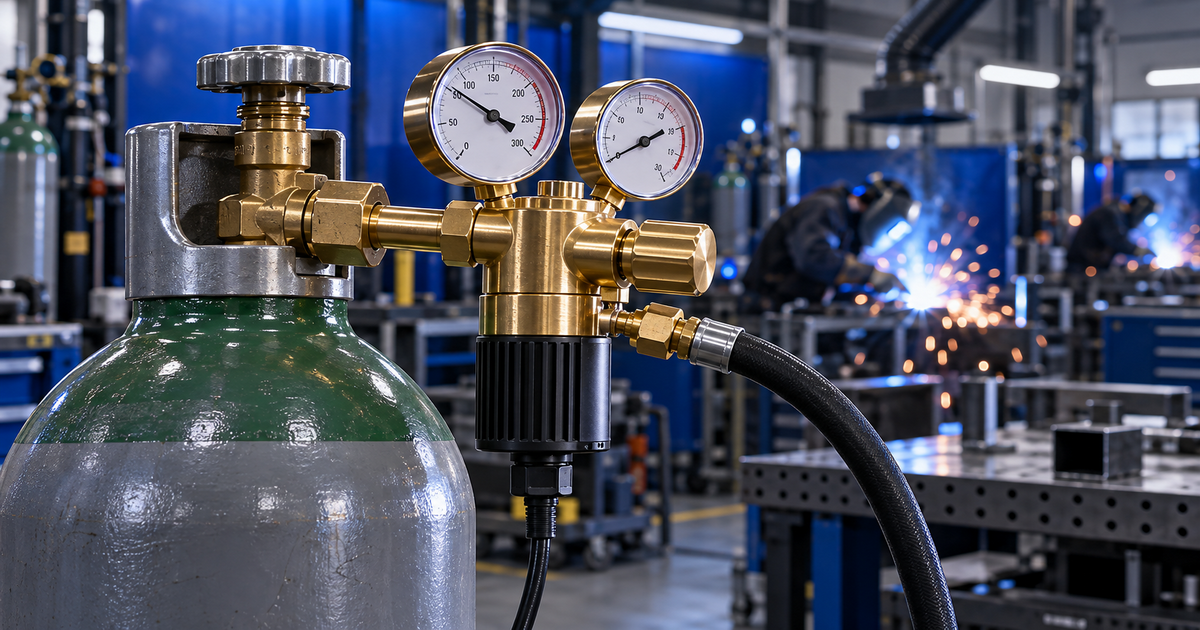
Dual‑stage gas regulators use two pressure‑reducing stages in sequence to keep outlet pressure extremely stable, even as inlet pressure fluctuates. For laser cutting, this matters when: [weldingandwelder]
– You run thick‑plate cutting at high nitrogen or oxygen pressure
– You operate from cylinders or bundles that see significant pressure drop over a shift
– You demand tight tolerances on cut quality for automotive, aerospace, or high‑precision parts
In these scenarios, a dual‑stage industrial regulator can significantly reduce pressure variation at the nozzle, translating into smoother edges and fewer cutting defects.
Electrically Heated CO₂ and High‑Flow Regulators
For CO₂ and certain high‑flow gases, electrically heated regulators are essential to prevent freezing at the regulator body, which otherwise causes pressure instability and flow restrictions. These regulators: [genstartech]
– Apply controlled heat to the gas path to counteract Joule–Thomson cooling
– Maintain steady gas temperature and pressure even under high flow
– Extend regulator life and reduce unplanned shutdowns due to ice buildup
Although heated regulators may seem excessive for basic welding, they are often justified in high‑volume gas consumption environments where even short stoppages are costly.
Practical Selection Steps for Laser Cutting Applications
1. Define Your Process Requirements
Start from the laser cutting process, not from the regulator catalog:
1. List materials and thickness ranges.
2. Identify maximum assist gas pressure and flow for each gas.
3. Clarify expected daily operating hours and shift patterns.
4. Map out current and future number of laser machines.
This gives you a realistic view of flow demand and duty cycle, which directly drives regulator specification. [boc.com]
2. Match Regulator Type to Supply Strategy
Combine process needs with your gas supply strategy:
– Single cylinders, low‑volume → High‑quality gas cylinder regulator may be enough.
– Cylinder bundles / banks → Industrial regulator with higher flow capacity strongly recommended.
– Bulk tank or on‑site generation → Industrial regulators and dual‑stage configurations are effectively mandatory.
For high‑volume laser cutting, most plants benefit from a central gas manifold with industrial pressure regulators feeding each machine or group of machines.
3. Specify Materials, Standards, and Safety Features
For overseas brands and OEMs, pay attention to:
– Body material – brass for general industrial gases, stainless steel for corrosive or ultra‑clean needs
– Seal materials – selected based on gas type and temperature
– Safety compliance – CE, ISO, or other regional standards for industrial gas handling [boc.com]
– Connection standards – CGA, DIN, BS, JIS or custom patterns based on target markets
High‑volume laser cutting lines often go through audits and certifications, so selecting regulators that align with international standards simplifies compliance and documentation.
OEM/ODM Customization for Laser Cutting Brands
Why OEM/ODM Regulators Matter for Overseas Brands
If you are an overseas laser cutting machine brand, wholesaler, or system integrator, you may not want to design gas regulators in‑house. Instead, working with a specialized gas regulator manufacturer offering OEM and ODM services allows you to:
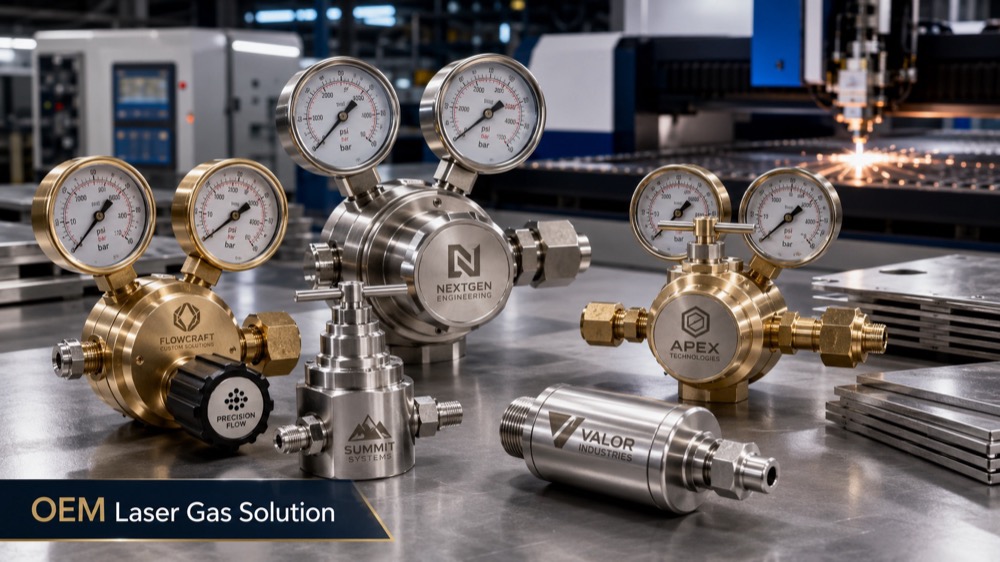
– Co‑develop regulators that match your laser machine specifications and user expectations
– Customize branding, connection interfaces, gauges, and mounting options
– Ensure consistent quality, testing, and certifications across all shipments for different markets [phocos]
This approach helps you focus on your core laser technology while still delivering a professional, integrated gas control solution.
Custom Features for High‑Volume Laser Cutting
As a manufacturer specializing in CO₂ regulators, heated regulators, argon, oxygen, acetylene, propane, nitrogen, and dual‑stage industrial gas regulators, the following OEM/ODM options are especially beneficial for high‑volume laser cutting:
– Dual‑stage industrial pressure regulators tuned to typical laser cutting pressures and flows
– Electrically heated CO₂ and high‑flow regulators for stable performance under intense duty cycles
– Customized manifolds and mounting brackets for easy integration into laser cutting cabinets
– Brass bodies with precision machining for stable performance and long life in industrial environments
– Tailored gauge scales and markings to match operator preferences and regional standards
By partnering early in your machine design, we can help you optimize gas control performance, simplify installation, and differentiate your brand in a very competitive market.
Cost and ROI View: Short‑Term vs Long‑Term
From a cost perspective, gas cylinder regulators are cheaper upfront. Industrial regulators, especially dual‑stage or heated variants, cost more initially. However, from a professional operations standpoint, what matters is:
– Gas efficiency – stable regulation reduces over‑pressurization and wasted gas.
– Cut quality and scrap – fewer re‑cuts and rejected parts.
– Downtime – less interruption due to regulator freezing, pressure alarms, or inconsistent supply.
Over the lifetime of a high‑volume laser cutting line, these factors typically make industrial regulators the more economical choice, even if the equipment price is higher.
Clear Recommendation for High‑Volume Laser Cutting
Bringing all these factors together:
– For small, low‑volume laser cutting operations, a well‑specified gas cylinder regulator can be acceptable, especially when combined with proper gas selection, operator training, and maintenance.
– For high‑volume, multi‑shift, or multi‑machine laser cutting, industrial pressure regulators (often dual‑stage, sometimes heated) are the recommended standard to ensure:
– Stable pressure and flow
– Consistent edge quality
– Reduced gas waste
– Lower total cost of ownership
If you are an overseas brand or manufacturer, integrating OEM/ODM industrial regulator solutions into your machine offering sends a strong message of quality and reliability to your end users.
Call to Action: Design Your Regulator Strategy with Experts
If you are planning a new high‑volume laser cutting line or looking to upgrade from basic gas cylinder regulators, now is the best time to re‑evaluate your gas control architecture.
– Audit your current gas consumption, cutting quality issues, and downtime causes.
– Define your expected production growth for the next 3–5 years.
– Consult with a specialized gas regulator manufacturer capable of supplying CO₂ heated regulators, nitrogen and oxygen industrial regulators, and dual‑stage solutions under OEM or ODM agreements.
By doing so, you can transform your regulator choice from a simple “component purchase” into a strategic lever for productivity, quality, and brand positioning.
Frequently Asked Questions (FAQ)
1. Can I use a standard gas cylinder regulator for high‑pressure nitrogen laser cutting?
You can, but it is not ideal for high‑volume, continuous cutting. Industrial pressure regulators offer better pressure stability and flow capacity, which directly improves cut quality and reduces downtime. [boc.com]
2. Do I really need a dual‑stage regulator for laser cutting?
For thin sheets and low‑volume work, a single‑stage regulator may be sufficient. For thick materials, long runs, and high precision, dual‑stage regulators significantly reduce outlet pressure variation and support more consistent cutting results. [airgas]
3. When is a heated CO₂ regulator necessary?
Heated CO₂ regulators become important when you withdraw CO₂ at high flow rates for extended periods, as this can cause freezing at the regulator. Heating maintains stable gas temperature and pressure, reducing the risk of flow interruptions. [ioxygen]
4. How do OEM/ODM gas regulators benefit laser machine brands?
OEM/ODM regulators allow laser machine brands to offer fully integrated, customized gas control solutions with consistent quality, branding, interfaces, and certifications, without having to develop regulators in‑house. [mdaturbines]
5. What standards should I check when choosing regulators for my laser cutting line?
Look for regulators that match gas‑specific connection standards (such as CGA, DIN, BS) and comply with applicable safety and quality norms (for example, ISO or regional industrial gas standards) to ensure safe, compliant operation. [weldingandwelder]
References
1. Welding & Welder – “The Welder’s Guide to Gas Regulators: Selection, Setup, and Maintenance”
<https://www.weldingandwelder.com/help-and-advice/understanding-gas-regulators-an-introduction-for-welders/> [weldingandwelder]
2. Genstar Technologies – “Electrically-Heated Flowmeter Regulator for CO₂”
<https://www.genstartech.com/electrically-heated-flowmeter-regulator> [genstartech]
3. Harris / Airgas – “Heavy Duty Carbon Dioxide Flowgauge Industrial Regulator”
<https://www.airgas.com/product/Gas-Equipment/Regulators/Industrial-Gas-Regulators/p/HCL3100220> [airgas]
4. BOC – “Specialty Gas Regulators”
<https://www.boc.com.au/shop/en/au/specialty-gas-regulators> [boc.com]
5. Phocos – “OEM / ODM Service and Customization 101”
<https://www.phocos.com/industry-insights/oem-odm-service-and-customization-101-part-1-of-3/> [phocos]
6. I-Oxygen – “Electrically Heated CO₂ Flowmeter Regulator”
<https://www.ioxygen.com/Electrically-Heated-Co2-Flowmeter-Regulator> [ioxygen]
7. MD&A – “12 Tips for Choosing a Third Party Service Partner” (OEM/ODM and manufacturing capabilities perspective)
<https://www.mdaturbines.com/resources/thinking-beyond-the-oem-12-critical-considerations-for-choosing-a-third-party-turbine-serv/> [mdaturbines]
Hot tags: Gas Cylinder Regulator, Industrial Pressure Regulator, Laser Cutting Assist Gas, High Volume Laser Cutting, Dual Stage Gas Regulator, Heated CO2 Regulator, Nitrogen Pressure Regulator, OEM ODM Gas Regulator, Industrial Gas Control System, Laser Cutting Machine Supplier