Content Menu
● Why Consider Turkey for Acetylene Regulator Sourcing?
>> An Established Machinery and Welding-Equipment Ecosystem
>> Local Supply and Factory Customization Are Different Purchasing Models
● Selection Criteria: How This Shortlist Was Developed
● Supplier Comparison: Capacity, MOQ, Certification, and Commercial Fit
● 1. Zhejiang Bril Welding Equipment Co., Ltd.
>> A Specialist OEM Alternative for Buyers Comparing Turkish and Overseas Supply
>> Core Strengths and OEM/ODM Scope
● 2. Yıldız Gaz Armatürleri A.Ş.
>> A Strong Turkish Manufacturing Candidate with Explicit OEM Experience
>> Markets and Customization Fit
● 3. Güneş Gaz Armatürleri / KASWELD
>> A Gas-Equipment Manufacturer Serving Domestic and Regional Customers
>> Core Strengths and Commercial Fit
>> A Documentation Issue Worth Noticing
>> A Broad Welding Supplier for Consolidated Purchasing
>> Core Strengths and Market Reach
● 5. Askaynak / Lincoln Electric Türkiye
>> A Branded Equipment Route Rather Than a Confirmed Turkish Regulator Factory
>> Core Strengths and Product Availability
● Technical Buyer’s Guide: What Makes an Acetylene Regulator Suitable?
>> 1. Specify Acetylene Service, Not Just “Brass Construction”
>> 2. Apply the Correct Pressure Limit for the Destination
>> 3. Use Product Standards Without Confusing Them with Factory Certification
>> 4. Treat CE and RoHS as Applicability Questions
● The Insider Pitfall: A Passing Leak Test Does Not Prove Stable Regulation
● How to Qualify a Supplier Before Placing a Bulk Order
>> Stage 1: Verify the Factory and Documents
>> Stage 2: Approve Representative Samples
>> Stage 4: Confirm Logistics and After-Sales Responsibilities
● Conclusion: Select the Supplier That Matches the Purchasing Model
● FAQ
>> 1. How Can I Verify Whether a Manufacturer’s ISO Certificate Has Expired or Been Suspended?
>> 2. Does a CE Mark Prove That an Acetylene Regulator Meets All European Requirements?
>> 3. Can We Sell the Same Acetylene Regulator in Turkey, Europe, and the United States?
>> 4. How Can We Prevent a Supplier from Changing Materials After Sample Approval?
>> 5. When Should We Request a Dual-Stage Acetylene Regulator?
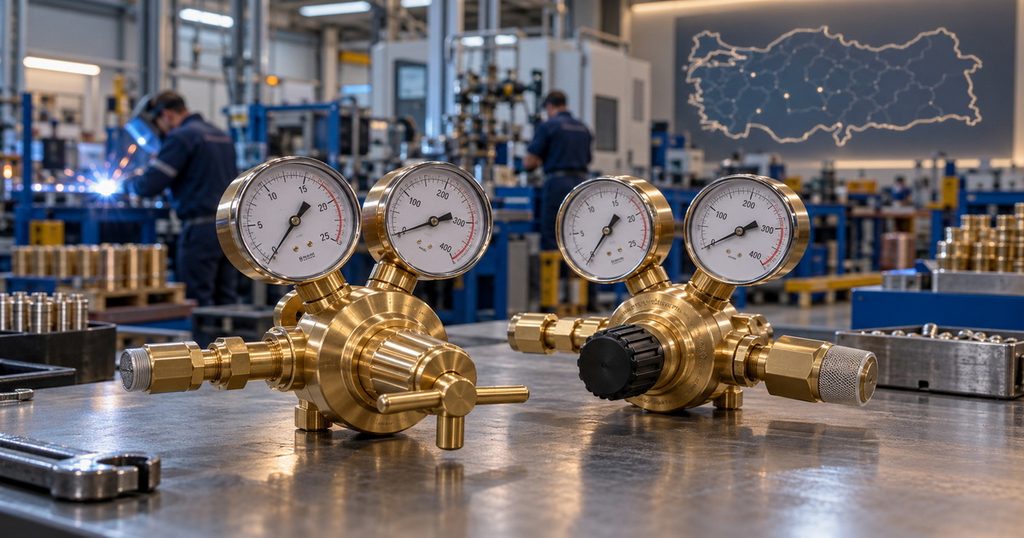
Turkey offers several credible sourcing options for acetylene regulators, oxy-fuel cutting equipment, and industrial gas-control systems. For overseas procurement managers, its appeal lies in established welding-equipment businesses, access to regional distribution networks, and a machinery sector with substantial international trade.
However, selecting a long-term supplier requires more than comparing catalog photographs or quoted prices. An acetylene regulator must provide controlled gas delivery, compatible connections, reliable sealing, and documentation appropriate to its intended market.
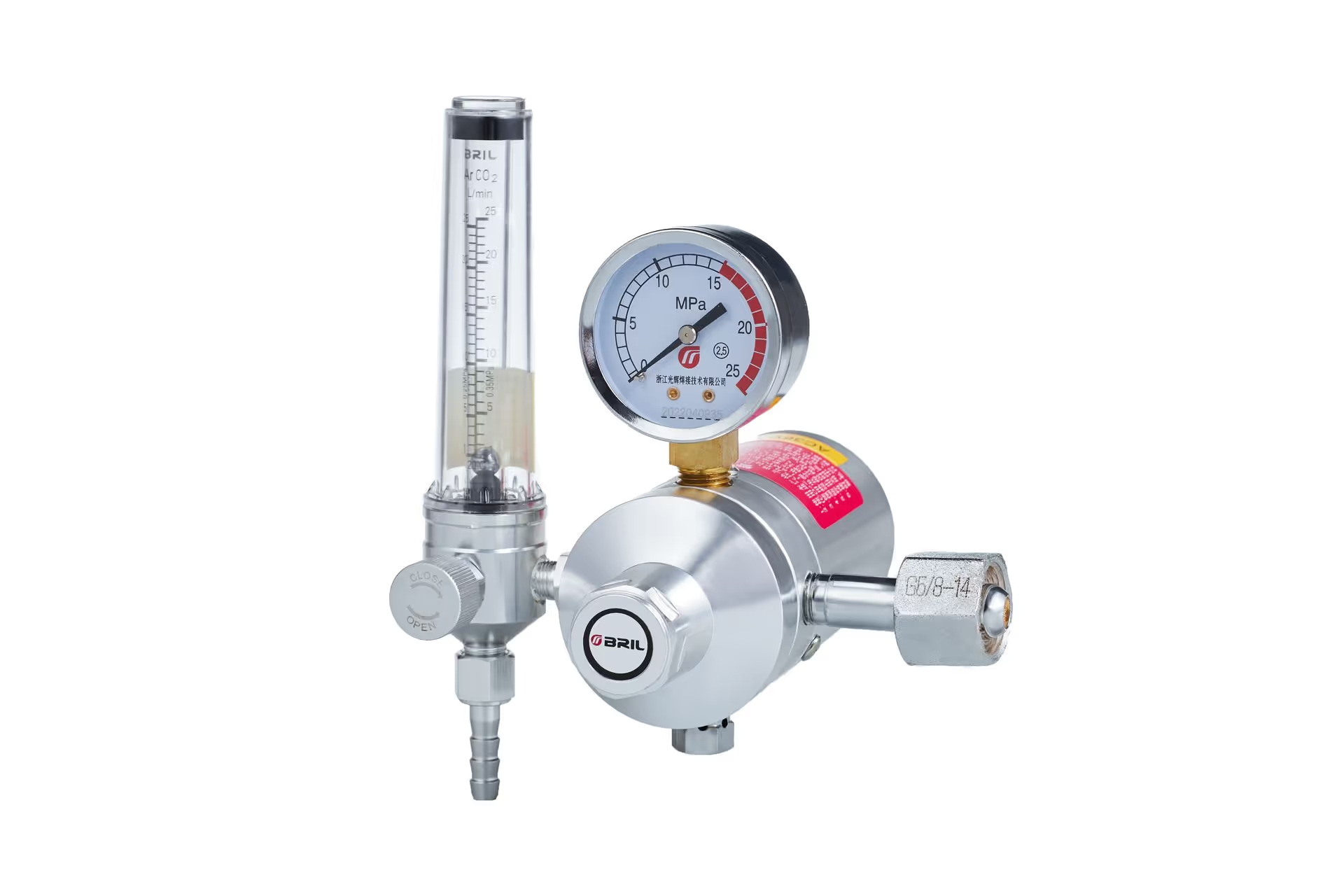
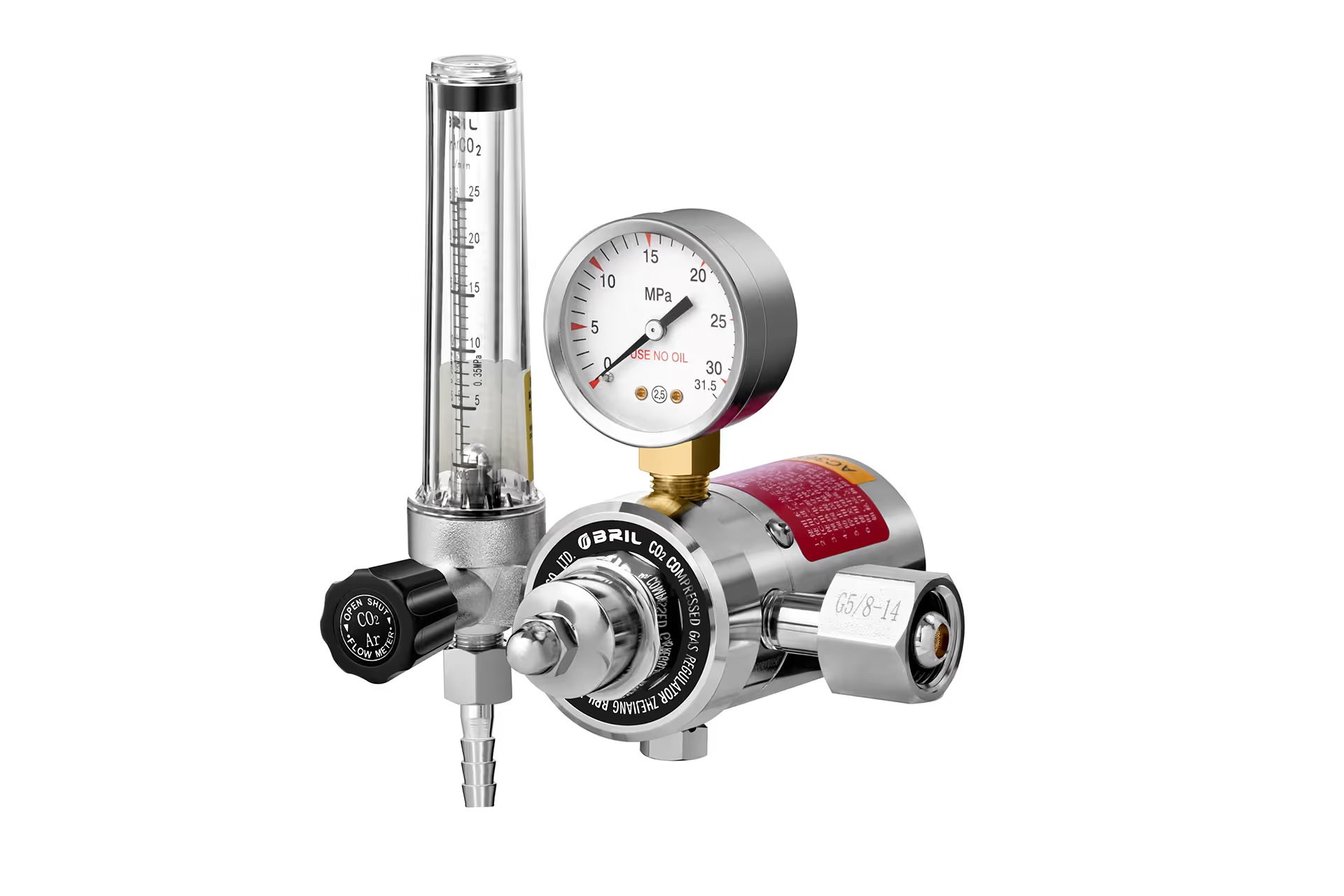
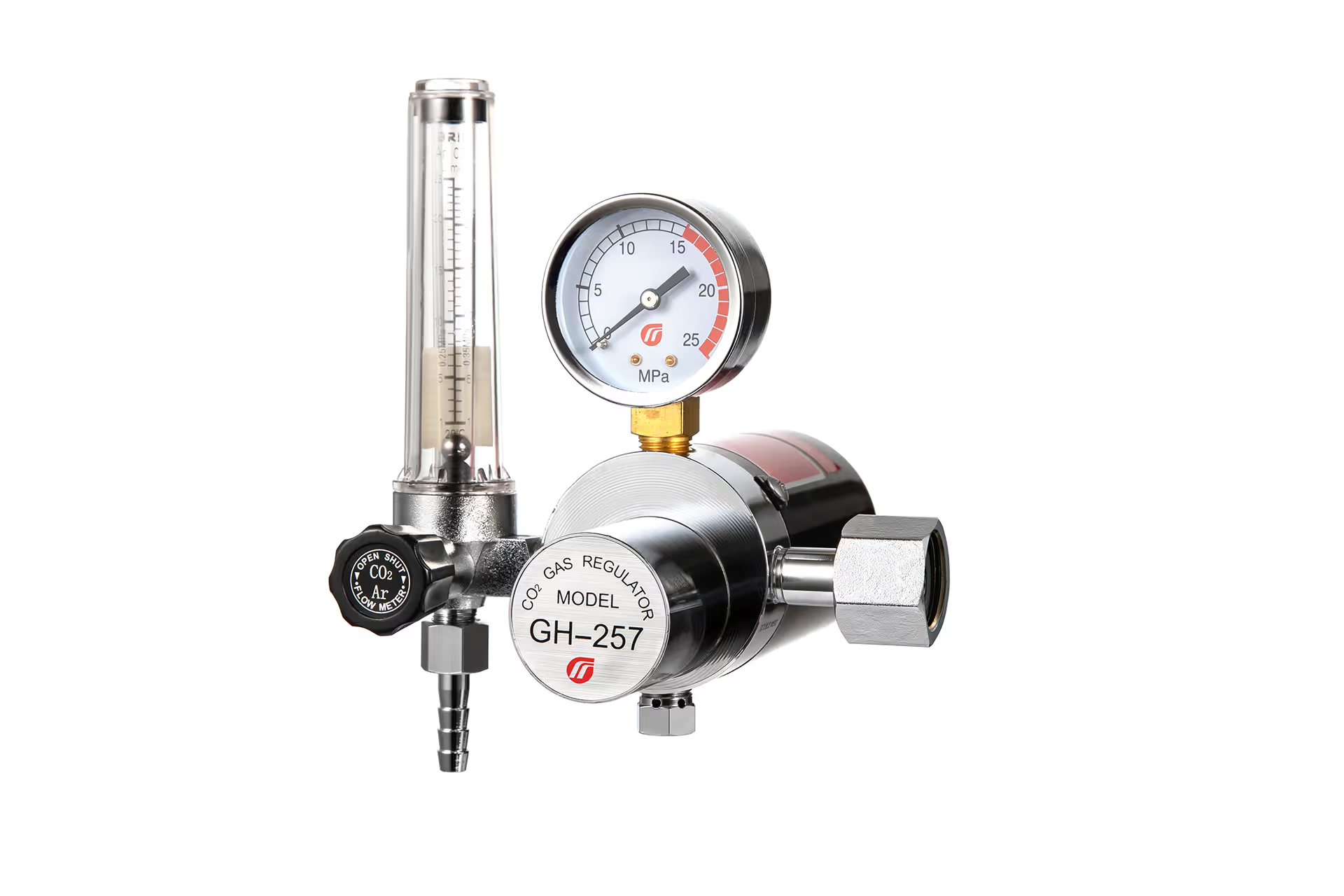
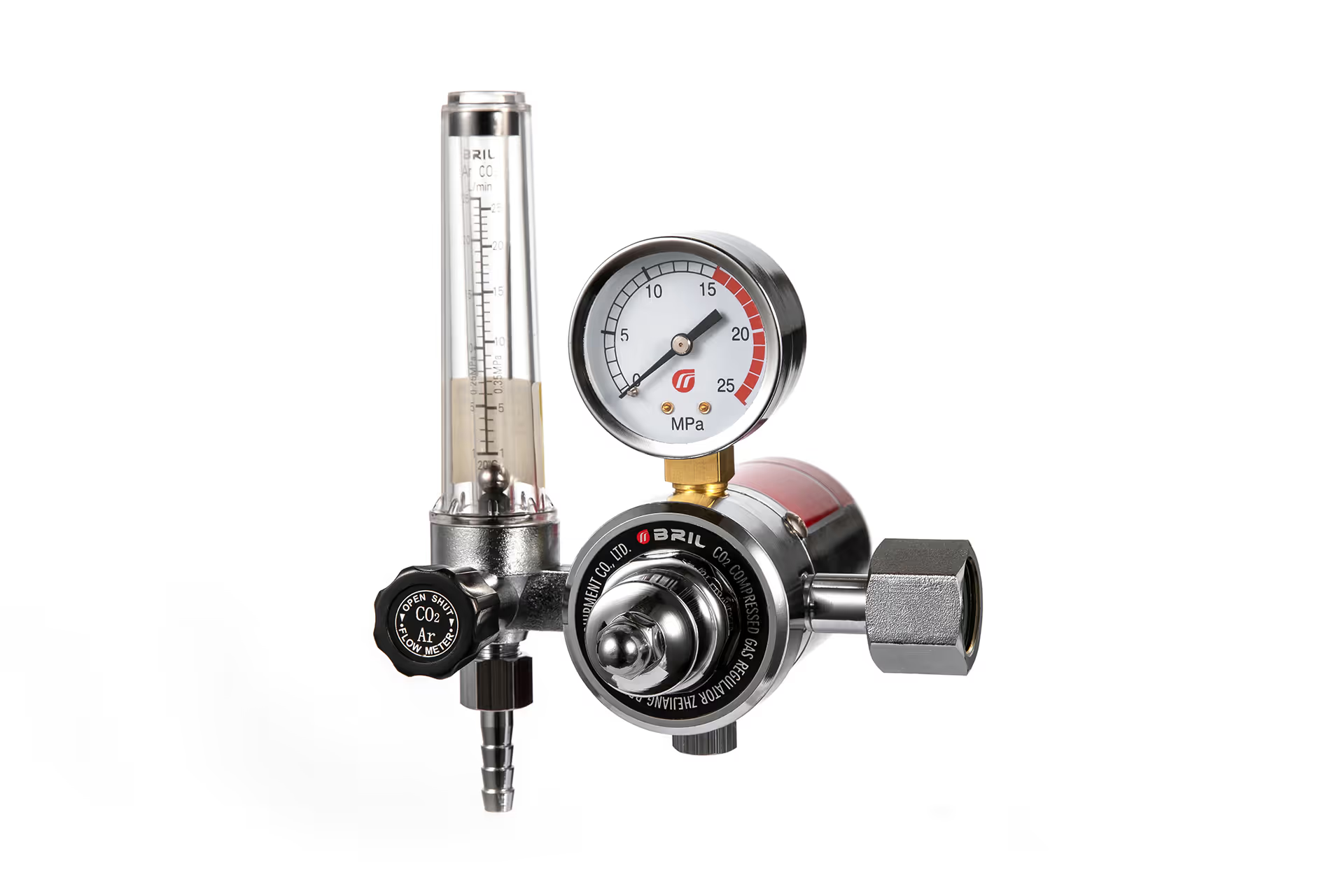
Zhejiang Bril Welding Equipment Co., Ltd. appears first as an international OEM sourcing alternative. It is based in China, not Turkey. Its inclusion provides a useful comparison for Turkish distributors and overseas brands considering specialized regulator production alongside locally available equipment.
Why Consider Turkey for Acetylene Regulator Sourcing?
An Established Machinery and Welding-Equipment Ecosystem
According to Invest in Türkiye, the country’s machinery exports reached $28.7 billion in 2025, with an average export value of $8.1 per kilogram. The same official sector overview states that 54% of machinery exports go to the United States and European Union countries. These figures demonstrate the broader sector’s export orientation; they do not measure acetylene regulator production specifically.
For gas-control procurement, Istanbul is a particularly relevant sourcing location. Yıldız operates a substantial factory there, while Güneş Gaz Armatürleri identifies its headquarters in the city’s Tuzla district. This provides a concrete basis for treating Istanbul as a useful supplier-search hub rather than presenting an unsupported nationwide regulator-manufacturing ranking.
Turkey’s supplier landscape also includes broader welding-equipment businesses such as Gedik and the Askaynak/Lincoln Electric organization. Their role can be valuable when buyers need regulators together with cutting equipment, consumables, accessories, and technical support.
Local Supply and Factory Customization Are Different Purchasing Models
A local equipment supplier may be suitable for replacement purchases, established branded products, or consolidated welding packages.
A specialist regulator factory may be more suitable when the purchasing requirement involves:
– Private-label product development.
– Customized inlet and outlet connections.
– Gauge scales and brand presentation.
– Agreed materials and component specifications.
– Repeat production against a controlled drawing.
– Dedicated packaging and instruction manuals.
Buyers should establish which model they need before requesting quotations. A company that manufactures welding consumables is not necessarily the manufacturer of every regulator in its catalog.
Selection Criteria: How This Shortlist Was Developed
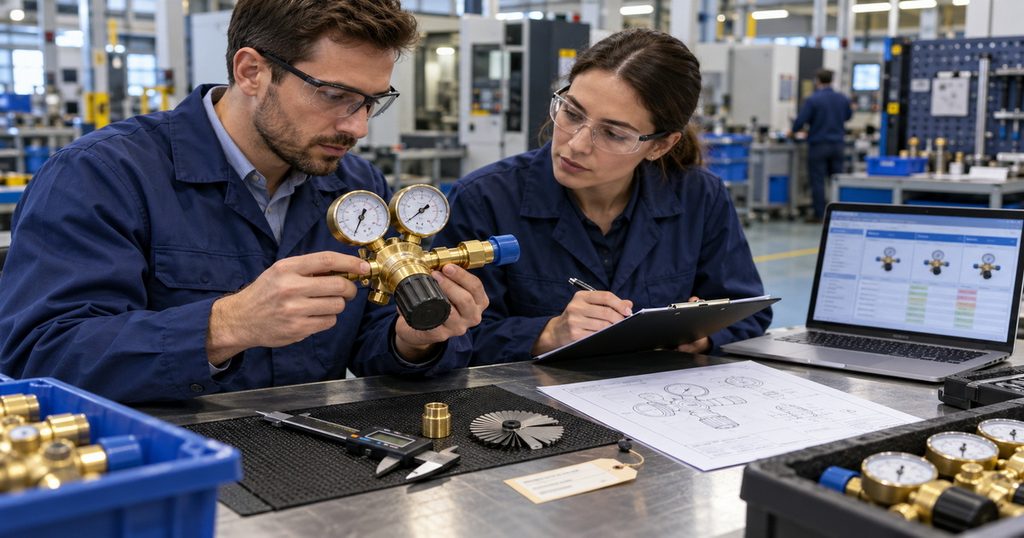
This is an evidence-based procurement shortlist, not a claim that five companies dominate Turkey’s acetylene regulator market by sales or production volume.
The assessment considers the following criteria.
| Evaluation Area | Evidence Buyers Should Request | Procurement Significance |
|---|---|---|
| Manufacturing identity | Legal entity, factory address, production walkthrough, process ownership | Distinguishes a manufacturer from a reseller |
| Engineering capability | Drawings, gas-specific specifications, revision records, development responsibilities | Establishes whether customization extends beyond branding |
| Quality management | Current certificate, certified scope, audit evidence | Shows whether the relevant manufacturing activities are covered |
| Product performance | Model-specific test reports and agreed acceptance limits | Connects the supplied regulator to measurable requirements |
| Delivery readiness | Model-level output, order backlog, component lead times | Establishes realistic capacity rather than theoretical output |
| Commercial support | Sample terms, MOQ, warranty, spare parts, change-notification procedure | Reduces problems after the first shipment |
The public sources reviewed do not establish comparable monthly acetylene regulator output or model-specific minimum order quantities for these businesses. Those fields are therefore marked as undisclosed rather than filled with estimated numbers.
Supplier Comparison: Capacity, MOQ, Certification, and Commercial Fit
| Company | Location and Role | Established | Public Capacity Evidence | MOQ | Certification or Standards Evidence | Principal Procurement Fit |
|---|---|---|---|---|---|---|
| Zhejiang Bril Welding Equipment Co., Ltd. | Wenzhou, China; specialist regulator manufacturer | 2002 | Company reports more than 200 employees and over 3,500 m² of production area; regulator output undisclosed | Request model-specific quotation | Company states ISO 9001 certification and refers to CE and CNAS-related product evidence; documents require verification | Private-label regulator programs and customized product configurations |
| Yıldız Gaz Armatürleri A.Ş. | Istanbul, Turkey; welding and gas-equipment manufacturer | 1979 | Company reports an 18,000 m² enclosed factory; acetylene regulator output undisclosed | Not publicly confirmed | Selected acetylene models state EN ISO 2503 compliance, with TSE and/or APRAGAZ references | Turkish manufacturing, established product ranges, and OEM supply |
| Güneş Gaz Armatürleri / KASWELD | Istanbul, Turkey; gas welding and cutting-equipment manufacturer | 1994 | Monthly regulator output undisclosed | Not publicly confirmed | Website references ISO 9001:2000 and EN approvals; current documentation needed | Welding regulators and related gas-system equipment |
| Gedik Welding / GEKAMAC | Turkey; broad welding-equipment manufacturer and supplier | 1963 | No regulator-specific output identified | Not publicly confirmed | Obtain certificates and reports for the exact supplied regulator | Consolidated welding-equipment procurement |
| Askaynak / Lincoln Electric Türkiye | Turkey; welding-equipment organization and supply channel | 1974 for Askaynak | No Turkish acetylene regulator output established | Not publicly confirmed | Turkish regulator page describes ISO 9001 quality-system production and EN ISO 2503-marked cylinder regulators | Established branded equipment and local commercial support |
The figures and standards statements above come from company sources. They are not independently audited capacity measurements or confirmation that every listed regulator carries the same approvals.
1. Zhejiang Bril Welding Equipment Co., Ltd.
A Specialist OEM Alternative for Buyers Comparing Turkish and Overseas Supply
Founded in 2002, Zhejiang Bril Welding Equipment Co., Ltd. specializes in developing, manufacturing, and selling industrial gas pressure regulators. Its factory is located in Wenzhou, Zhejiang, China. The company reports serving more than 30 countries and regions, with more than 200 employees and over 3,500 m² of production area.
Its regulator portfolio, as described in the supplied company brief, covers acetylene, oxygen, argon, nitrogen, propane, CO₂, heated CO₂, and dual-stage configurations. This breadth makes it relevant to distributors seeking a coordinated gas-control product range rather than a single acetylene model.
Core Strengths and OEM/ODM Scope
Bril’s company profile states that it supplies regulators to domestic and international welding-equipment businesses and has undertaken OEM production for Messer product ranges since 2022. These are company-reported relationships and should be checked through suitable commercial references when material to a purchasing decision.
For smaller and mid-sized brands, Bril is worth evaluating as a value-oriented manufacturing option where the project requires direct factory communication and deeper configuration support.
An appropriate development discussion should cover:
– Brand markings, gauge artwork, and packaging.
– Market-specific connections and pressure units.
– Approved material and component specifications.
– Single-stage or dual-stage platform selection.
– Sample approval, drawing ownership, and revision control.
– Replacement parts and after-sales documentation.
These are proposed qualification topics, not a claim that every modification is available without engineering review.
What Buyers Should Verify
Bril’s website refers to ISO 9001, CE, and CNAS-related certification. Buyers should request the actual documents and identify the issuing certification body, applicable product models, laboratory, test standard, and report scope. UKAS and IAF references concern accreditation arrangements; they should not be treated as substitutes for the named issuer on the certificate.
Its website also promises a quotation response within 24 hours. That is a useful communication benchmark to test during an inquiry, but it does not establish production lead time or engineering-response performance.
Bril’s cost-effectiveness, flexibility, and suitability for a particular small-brand program should ultimately be demonstrated through its quotation, sample quality, customization terms, and total landed cost.
2. Yıldız Gaz Armatürleri A.Ş.
A Strong Turkish Manufacturing Candidate with Explicit OEM Experience
Yıldız was established in 1979 and manufactures welding and cutting equipment in Istanbul. Its company profile reports an 18,000 m² enclosed factory and states that it supplies both domestic and international customers under the YILDIZ brand and through OEM arrangements.
This combination makes Yıldız a relevant candidate for distributors seeking Turkish manufacturing with an established gas-equipment range.
Core Strengths
The company’s catalog includes pressure regulators, central gas-system equipment, flashback arrestors, welding and heating equipment, and cutting sets. Its acetylene regulator pages identify applications in cutting, heating, welding, and industrial gas service.
Selected acetylene models expressly state EN ISO 2503 compliance. One safety-equipped model references TSE and APRAGAZ, while another references TSE. Buyers should preserve these model distinctions instead of extending one approval statement to the entire catalog.
Markets and Customization Fit
Public information identifies Turkey and international markets but does not provide a country-by-country acetylene regulator sales breakdown. OEM activity is explicitly stated; the depth of ODM engineering support still needs clarification.
Ask whether the proposed OEM project uses an existing approved platform or requires design changes. Also confirm MOQ by connection type, branding setup charges, spare-parts availability, and the effect of customization on test-report coverage.
3. Güneş Gaz Armatürleri / KASWELD
A Gas-Equipment Manufacturer Serving Domestic and Regional Customers
Güneş Gaz Armatürleri was established in 1994 as a manufacturer and developer of gas welding and cutting equipment, central gas-line systems, and related components. Its public profile identifies European and Middle Eastern customers alongside domestic and international market activity.
KASWELD is its product brand. Its Turkish website lists pressure reducers, regulators, high-flow pressure reducers, industrial cylinder valves, safety valves, and related welding and cutting equipment.
Core Strengths and Commercial Fit
The company is relevant to buyers seeking a coordinated equipment package rather than sourcing a regulator independently from every accessory.
However, the exact acetylene regulator model, current datasheet, production origin, and available private-label terms should be established before treating it as a qualified supplier for a specific project.
Potential OEM discussions can address branding, connection configurations, packaging, and regulator-and-accessory combinations. Public information reviewed here does not establish an unrestricted ODM service or specific customization MOQ.
A Documentation Issue Worth Noticing
The English company page references ISO 9001:2000. That historical reference is not evidence of a current certificate. Request the present certificate and verify its status, manufacturing address, and scope.
This is a useful screening lesson: an outdated website does not necessarily indicate weak manufacturing, but current purchasing decisions require current evidence.
4. Gedik Welding / GEKAMAC
A Broad Welding Supplier for Consolidated Purchasing
Gedik Welding dates to 1963. The wider Gedik organization states that it reaches more than 100 countries, while its welding-equipment website includes pressure regulators under the GEKAMAC range and an acetylene regulator flashback-arrestor product.
Its principal appeal is procurement breadth: buyers can investigate regulators alongside other welding equipment and consumables.
Core Strengths and Market Reach
Gedik’s public material describes international welding-equipment and consumables activities, including customized welding products and engineering solutions. That broader capability should not automatically be interpreted as proof of in-house acetylene regulator production or regulator-specific ODM services.
For a consolidated distributor order, ask Gedik to identify:
– The exact acetylene regulator model.
– The legal manufacturer and production country.
– Applicable product standards and test reports.
– Compatibility with the proposed flashback arrestor.
– Warranty responsibility and replacement-parts support.
OEM/ODM Boundaries
Private-label availability and regulator redesign capability require direct confirmation. A broad product catalog is commercially useful, but it does not establish that the supplier controls every component drawing or manufacturing process.
Gedik is therefore a reasonable equipment-supply candidate, with regulator factory identity remaining a qualification item.
5. Askaynak / Lincoln Electric Türkiye
A Branded Equipment Route Rather Than a Confirmed Turkish Regulator Factory
Askaynak began operations on March 1, 1974, initially producing covered welding electrodes. Lincoln Electric’s Turkish website also presents a regulator category describing cylinder pressure reducers manufactured within an ISO 9001 quality system and marked to EN ISO 2503.
This makes the organization relevant to buyers investigating established equipment channels in Turkey.
Core Strengths and Product Availability
Lincoln Electric’s wider gas-equipment documentation includes Harris acetylene regulators. However, global catalog availability does not establish Turkish stock, local manufacture, or identical model availability in every market.
Procurement teams should request a Turkey-specific quotation naming the model, manufacturer, origin, conformity documents, service arrangements, and delivery commitment.
Markets and OEM/ODM Fit
The Turkish organization is relevant to domestic equipment supply, while the wider group operates internationally. A specific Turkish acetylene regulator export-market breakdown was not established in the reviewed sources.
Its suitability should be assessed primarily for branded purchasing and local support. Bespoke regulator ODM, private-label production, and Turkish factory customization should not be assumed without written confirmation.
Technical Buyer’s Guide: What Makes an Acetylene Regulator Suitable?
1. Specify Acetylene Service, Not Just “Brass Construction”
A brass body is not sufficient evidence of suitability.
Air Products warns against unalloyed copper, silver, and mercury in direct contact with acetylene and identifies restrictions on certain copper- and silver-rich alloys. Its guidance also states that equipment must be designed for acetylene service rather than substituted from another flammable-gas application.
Request:
– The material designation for gas-wetted components.
– Material certificates or traceable incoming inspection records.
– Confirmation of acetylene-compatible seals and seat materials.
– Identification of coatings and treatments.
– A controlled bill of materials for the approved model.
Where alloy substitution is a concern, agree a suitable verification method with the supplier and inspection laboratory. Visual appearance and product weight alone cannot establish material identity.
2. Apply the Correct Pressure Limit for the Destination
For United States welding and cutting applications, OSHA prohibits acetylene use above 15 psig, approximately 1.03 bar gauge, subject to the regulation’s stated exceptions. This is a use limit, not the pressure of dissolved acetylene stored in an approved cylinder.
Do not present 15 psig as a universal specification for every country and engineered installation. European industrial guidance and specialized manifold designs can involve different limits and safety arrangements.
The purchase specification should identify the destination, application, permitted operating pressure, and downstream equipment requirements.
3. Use Product Standards Without Confusing Them with Factory Certification
ISO 2503 addresses single-stage and two-stage cylinder pressure regulators for welding, cutting, and allied processes, including dissolved acetylene. Its scope is distinct from a company’s ISO 9001 management-system certification.
Ask for the exact standard edition and model-specific evidence. A quality-system certificate does not, by itself, prove that a particular regulator meets product-performance requirements.
4. Treat CE and RoHS as Applicability Questions
The European Pressure Equipment Directive addresses the design, manufacture, and conformity assessment of pressure equipment within its scope. It uses risk-based categories and conformity procedures. Buyers should ask suppliers to explain the proposed regulator’s classification and applicable conformity route rather than accepting an unexplained CE logo.
Likewise, request an applicability explanation for RoHS instead of treating it as a universal mechanical-regulator certificate. If electronics are included, obtain a compliance assessment for that actual configuration.
Environmental documentation and pressure-safety evidence answer different questions; neither substitutes for the other.
The Insider Pitfall: A Passing Leak Test Does Not Prove Stable Regulation
A frequently overlooked procurement issue is accepting a regulator because it passes a static external leak test.
That test does not establish how the regulator controls outlet pressure under demand, how it behaves as cylinder pressure falls, or whether the valve seat maintains the agreed shut-off behavior.
IBEDA’s technical guidance notes that a single-stage regulator’s outlet pressure can rise as the connected cylinder or bundle empties. This illustrates why pressure behavior matters beyond external leak tightness.
A practical sample plan should therefore include agreed checks for:
1. External leakage.
2. Outlet pressure at defined flow rates.
3. Pressure change across the specified inlet-pressure range.
4. Shut-off and lock-up behavior.
5. Adjustment repeatability.
6. Operation with the intended flashback arrestor and downstream equipment.
Have qualified personnel perform gas-system testing under an approved procedure.
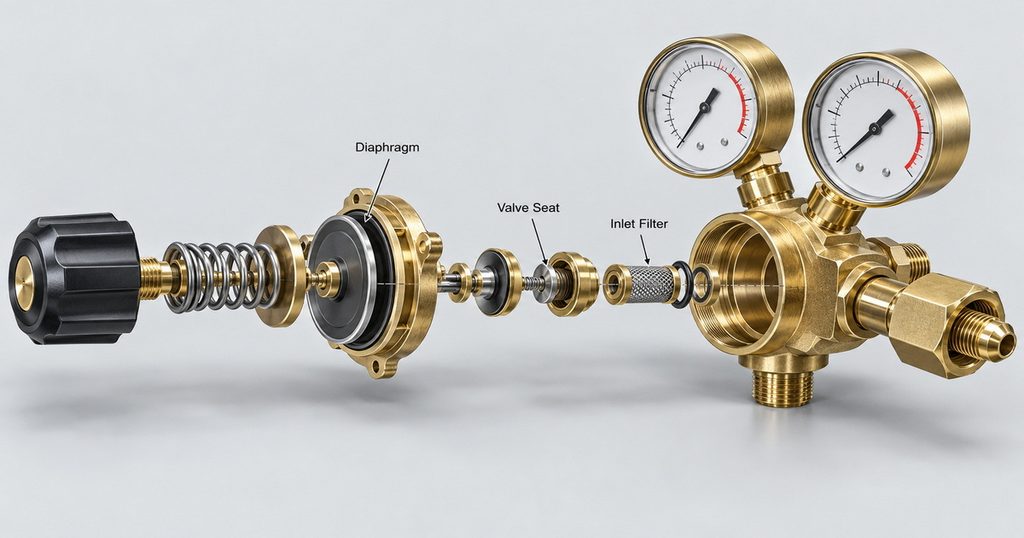
The commercial safeguard is equally important: retain an approved reference sample and prohibit unapproved changes to the seat, diaphragm, spring, body material, gauge, and inlet filter. Otherwise, a good sample can become a poor production shipment through undocumented component substitutions.
How to Qualify a Supplier Before Placing a Bulk Order
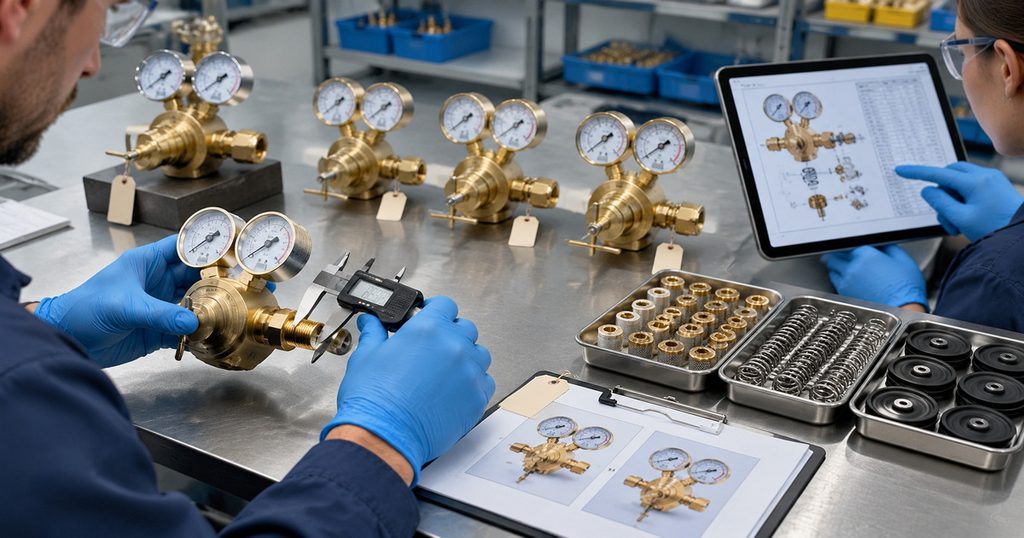
Stage 1: Verify the Factory and Documents
Obtain the legal entity, factory address, current certificates, relevant drawings, and product reports.
Use a live walkthrough or independent audit to establish which processes are actually performed on site. Include machining, assembly, inspection, and packing where relevant.
Stage 2: Approve Representative Samples
Request the configuration intended for production, not merely a similar catalog unit.
The sample request should state:
– Gas and application.
– Inlet connection and cylinder standard.
– Outlet connection.
– Inlet and outlet pressure requirements.
– Required flow conditions.
– Gauge units and artwork.
– Destination-market documentation.
– Packaging and instruction requirements.
Do not approve bulk production until deviations are resolved in writing.
Stage 3: Run a Pilot Order
A pilot lot helps evaluate consistency, marking accuracy, assembly quality, packaging, and delivery communication.
Agree which tests apply to every unit and which are sample-based. Record acceptance limits and the response to failed results before production begins.
Stage 4: Confirm Logistics and After-Sales Responsibilities
Request packed dimensions, carton weights, origin documentation, and the proposed customs classification. Have the importer or customs broker validate classification rather than relying solely on a supplier’s suggested code.
Confirm that shipment descriptions accurately reflect unused regulators without attached gas cylinders. Protect gauges and exposed connections against handling damage.
Finally, establish warranty duration, failure-reporting procedures, spare-parts supply, and responsibility for return freight. A workable service agreement can matter more than a small reduction in unit price.
Conclusion: Select the Supplier That Matches the Purchasing Model
Yıldız and Güneş/KASWELD offer relevant Turkish manufacturing routes. Gedik and Askaynak/Lincoln Electric Türkiye provide broader equipment-supply options, with exact regulator origin and customization capability requiring confirmation.
Zhejiang Bril provides a specialist overseas comparison for buyers developing private-label gas-control ranges. Its suitability should be evaluated through samples, controlled specifications, documented compliance, and commercial responsiveness—not promotional claims alone.
For a customized acetylene regulator project, send Zhejiang Bril Welding Equipment Co., Ltd. a structured inquiry covering your target market, connection standard, operating conditions, annual demand, branding requirements, and required documents. Request a sample plan, model-specific MOQ, production schedule, and itemized OEM proposal before committing to bulk supply.
FAQ
1. How Can I Verify Whether a Manufacturer’s ISO Certificate Has Expired or Been Suspended?
Search by the exact company name or certificate number in the certificate-validation database, then check the status, scope, certified locations, issuer, and accreditation details. IAF CertSearch provides these fields and identifies an active, up-to-date record as valid.
Also confirm the certificate directly with the issuing certification body when necessary. A missing database result warrants investigation; it should not automatically be treated as proof of fraud.
2. Does a CE Mark Prove That an Acetylene Regulator Meets All European Requirements?
No. Buyers need the applicable legislation, classification, conformity procedure, and supporting documents for the exact product.
The Pressure Equipment Directive uses different risk categories and conformity routes. A CE logo without a coherent technical explanation is insufficient purchasing evidence.
3. Can We Sell the Same Acetylene Regulator in Turkey, Europe, and the United States?
Do not assume that one configuration suits all destinations.
Connections, operating limits, markings, instructions, and required evidence must be checked market by market. For example, US welding and cutting use is subject to OSHA’s 15 psig acetylene limit, while some specialized European systems use different engineered arrangements.
A shared regulator platform may be possible, but each market configuration needs a documented review.
4. How Can We Prevent a Supplier from Changing Materials After Sample Approval?
Attach the approved drawing, bill of materials, component specifications, and reference-sample identification to the supply agreement.
Require written approval before substitutions. Use traceable incoming inspection and targeted independent checks where the risk justifies them.
Pay particular attention to gas-wetted alloys, seats, seals, and pressure-control components. Acetylene compatibility makes material control a safety issue, not merely a cosmetic quality issue.
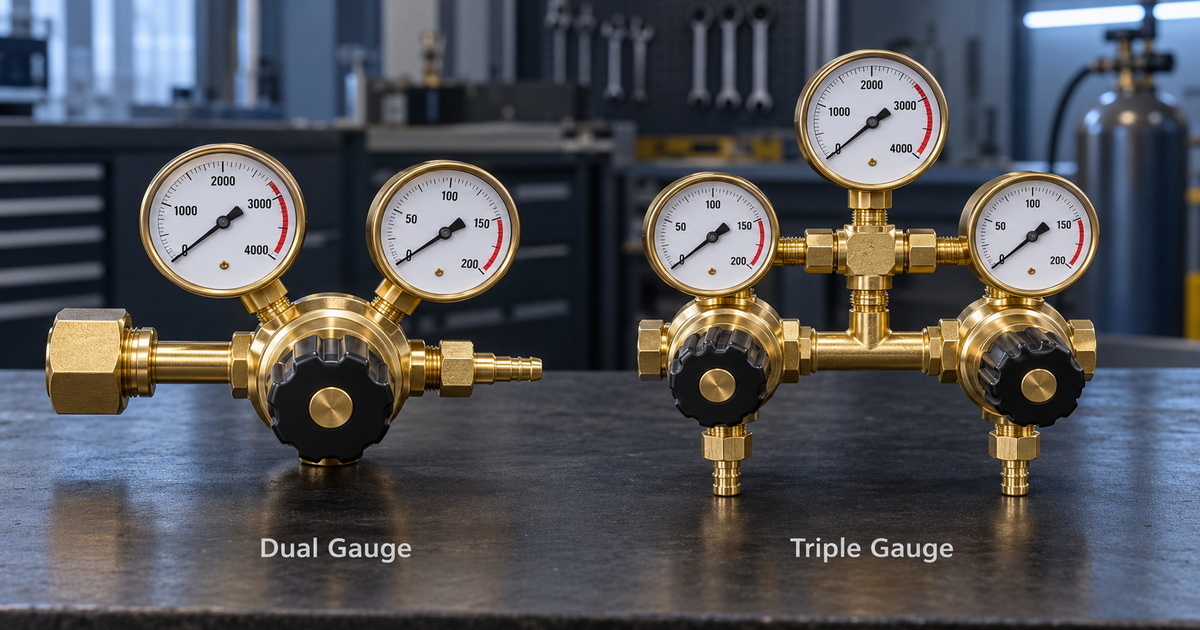
5. When Should We Request a Dual-Stage Acetylene Regulator?
Consider it when the application requires tighter outlet-pressure consistency as inlet pressure changes, but qualify the actual model under realistic operating conditions.
Two-stage design is not permission to exceed the destination’s acetylene-use limits. Nor does it replace appropriate downstream safety equipment. ISO 2503 covers both single-stage and two-stage regulators, while specialized system guidance illustrates the importance of complete system design.
Reference Notes
1. – Zhejiang Bril Welding Equipment Co., Ltd.: company history, factory information, stated certifications, and OEM relationships. [chinesewelding]
2. – Invest in Türkiye: official machinery-sector overview and 2025 export figures; these are sector-wide figures, not acetylene regulator market data. [invest.gov]
3. – Yıldız Gaz Armatürleri: company profile, OEM statement, product range, and acetylene regulator specifications. [yildizgaz.com]
4. – Güneş Gaz Armatürleri / KASWELD: establishment, market description, historical certification statement, and product scope. [gunesgazarmatur]
5. – Gedik: company history, international reach, pressure regulator range, and acetylene safety accessories. [gedik.com]
6. – Lincoln Electric Türkiye / Askaynak: establishment information and Turkish regulator category; wider Harris documentation identifies acetylene regulator products. [lincolnelectric]
7. – ISO: ISO 2503 scope for cylinder pressure regulators used in welding, cutting, and allied processes. [iso]
8. – OSHA: oxygen-fuel gas welding and cutting requirements, including acetylene pressure limits. [osha]
9. – Air Products: acetylene materials compatibility and equipment-safety guidance. [airproducts]
10. – European Commission: Pressure Equipment Directive scope and conformity framework. [single-market-economy.ec.europa]
11. – IAF CertSearch: certificate-status and accreditation verification guidance. [iafcertsearch]
12. – IBEDA: technical guidance on acetylene manifold pressure control and engineered system requirements. [ibeda]
Hot Tags: Acetylene Regulator, Acetylene Regulator Manufacturers, Acetylene Regulator Suppliers, Acetylene Regulator Manufacturers In Turkey, Acetylene Pressure Regulator, Industrial Gas Regulator Manufacturers, Welding Gas Regulator Suppliers, OEM Acetylene Regulator, Dual Stage Acetylene Regulator, Brass Acetylene Regulator