Content Menu
● 1. Zhejiang Bril Welding Equipment Co., Ltd.
>> Why Bril is relevant for German buyers
>> OEM/ODM questions to ask Bril
● 2. WITT-Gasetechnik GmbH & Co KG
● 4. Greggersen Gasetechnik GmbH
● 5. Messer Cutting Systems and the Messer Gas Ecosystem
● 6. Harris Germany and Harris Distribution Channels
>> Limitations for private-label buyers
● Technical Requirements for Acetylene Regulators
>> Key material and construction points
>> Single-stage vs. dual-stage
● Capacity, MOQ, and Certification Comparison
● The Most Overlooked Procurement Risk
● Buyer’s Verification Checklist
● Logistics and Import Considerations
● FAQ
>> 1. How can I verify whether a supplier’s ISO 9001 certificate is still valid?
>> 2. Is CE marking enough to prove that an acetylene regulator is safe?
>> 3. What is the most important test for an acetylene regulator before shipment?
>> 4. Should I choose a single-stage or dual-stage acetylene regulator?
>> 5. How can I detect brass-material substitution without laboratory testing every shipment?
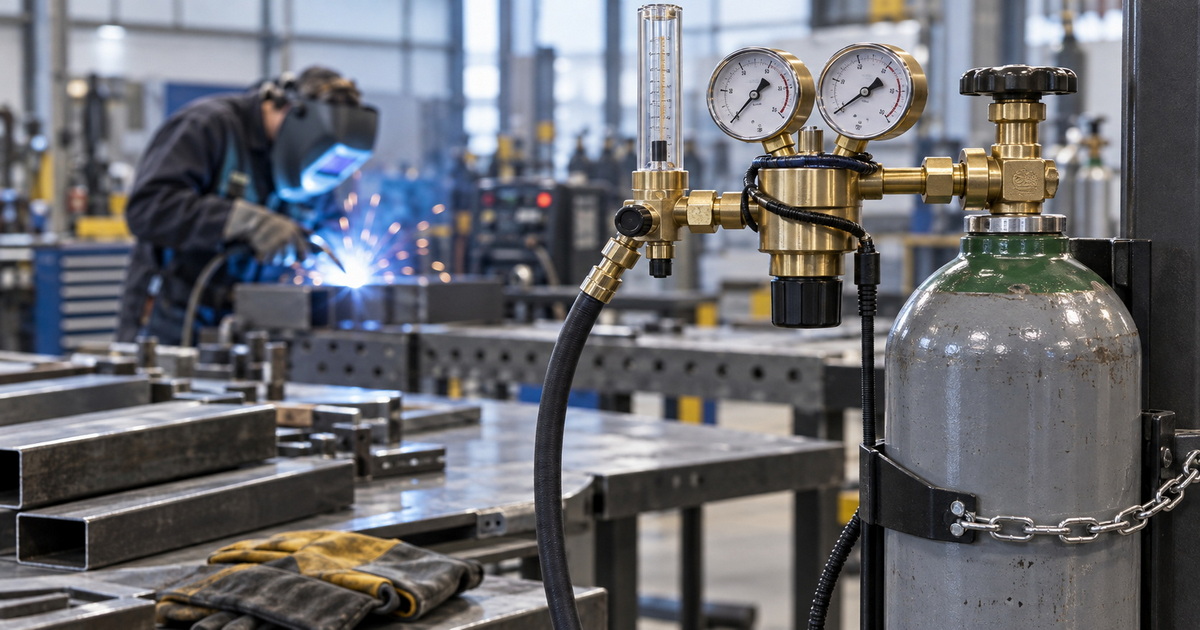
Germany remains one of Europe’s most important markets for oxy-fuel cutting, welding, brazing, flame heating, and industrial gas-distribution equipment. For procurement teams, sourcing an acetylene regulator linked to the German market often means prioritizing documented safety performance, DIN-compatible connections, traceable components, and reliable after-sales technical support.
However, “German supplier” does not always mean “German manufacturer.” Some suppliers manufacture locally; some are German industrial-gas or welding-equipment brands supported by global production networks; others are overseas OEM factories that manufacture to German-market specifications. Professional buyers should distinguish among these models before placing an RFQ.
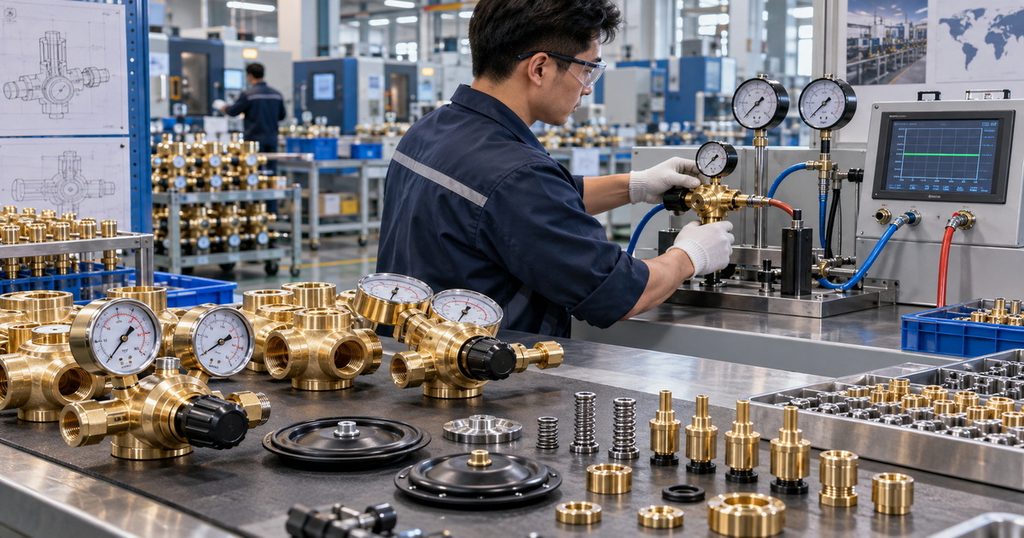
How We Selected Suppliers
A dependable acetylene regulator is not simply a brass body with two gauges. It is a safety-critical pressure-control device used with dissolved acetylene, a gas with different handling and pressure characteristics from oxygen, argon, nitrogen, or carbon dioxide.
For this list, suppliers were assessed using the following procurement-focused criteria:
– Regulatory and product compliance: Evidence of EN ISO 2503, CE-related conformity where applicable, ISO 9001 quality-system control, and compatibility with German/DIN connection requirements.
– Acetylene-specific engineering: Proper low-pressure design, left-hand outlet connections where required, compatibility with acetylene cylinder valves, correct safety-relief configuration, and stable pressure regulation.
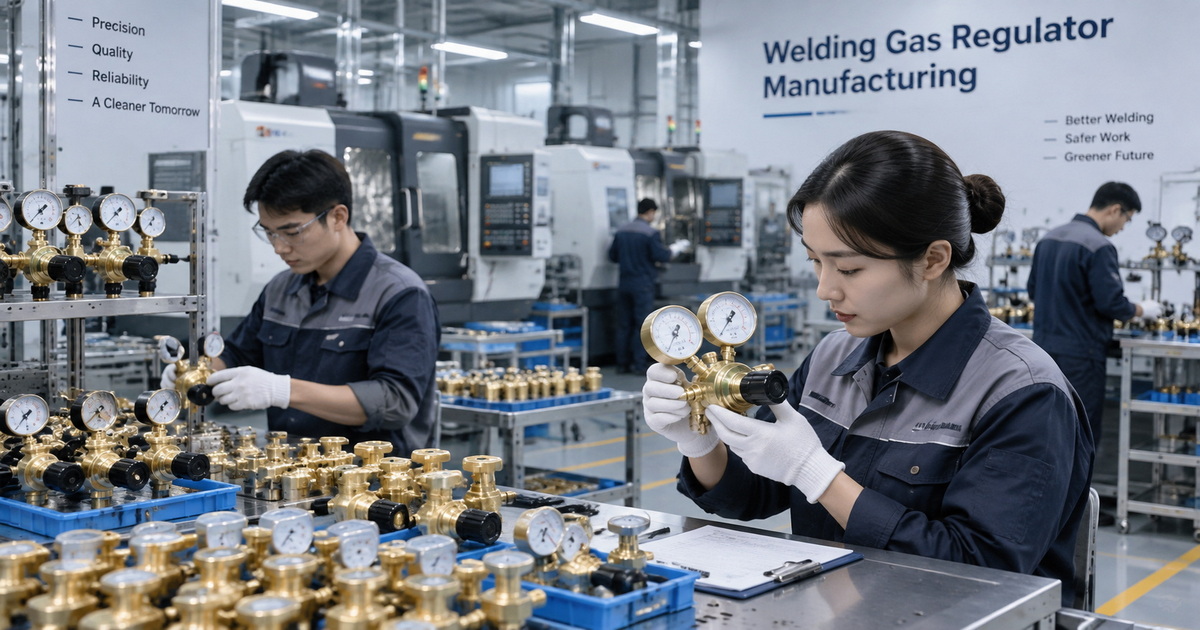
– Manufacturing and quality-control capability: In-house assembly, machining or controlled component sourcing, pressure/leak testing, gauge verification, traceability, and final inspection.
– Product range: Availability of single-stage regulators, dual-stage regulators, cylinder regulators, manifold regulators, flashback-arrestor interfaces, and gas-specific configurations.
– OEM and private-label support: Willingness to support customized inlet/outlet threads, dial faces, packaging, branding, instruction manuals, product colors, and market-specific labels.
– Commercial suitability: MOQ flexibility, communication speed, sample handling, shipment support, and capacity to serve distributors, industrial-gas companies, welding-equipment brands, and private-label importers.
– Transparency: Publicly identifiable technical documentation, stated operating conditions, certifications, company history, and real application focus.
The central technical reference for cylinder regulators used in welding and allied processes is EN ISO 2503. It addresses single-stage and two-stage pressure regulators for gases including dissolved acetylene, compressed gases, LPG, and carbon dioxide, generally for cylinder-connected applications within the stated pressure limits.
Germany also benefits from a mature welding-technology ecosystem. The German Welding Society, DVS, maintains more than 500 technical rules and guidelines related to joining, cutting, and coating technologies, reflecting the country’s strong engineering, safety, and fabrication culture.
Why Source for Germany?
Germany’s advantage is not only its domestic manufacturing base. Its market also combines industrial-gas expertise, mechanical engineering, welding automation, metal fabrication, and strict safety expectations. Important demand centers include the Ruhr industrial region, Baden-Württemberg, Bavaria, Saxony, Lower Saxony, and North Rhine-Westphalia.
For acetylene regulator buyers, this creates several benefits:
– German buyers commonly expect DIN-compatible connections, accurate pressure gauges, durable brass construction, and product documentation in German or multilingual formats.
– Industrial-gas distributors often require stable long-term supply, batch consistency, and traceability rather than only the lowest initial unit price.
– Welding and cutting applications demand gas-specific design. A regulator suitable for argon or CO₂ must not be assumed suitable for acetylene.
– Engineering-led suppliers are more likely to understand manifold applications, flashback protection, pressure stability, gas purity, and maintenance requirements.
– Germany has a robust industrial supply chain for valves, gauges, fittings, hoses, cutting equipment, and gas-safety devices.
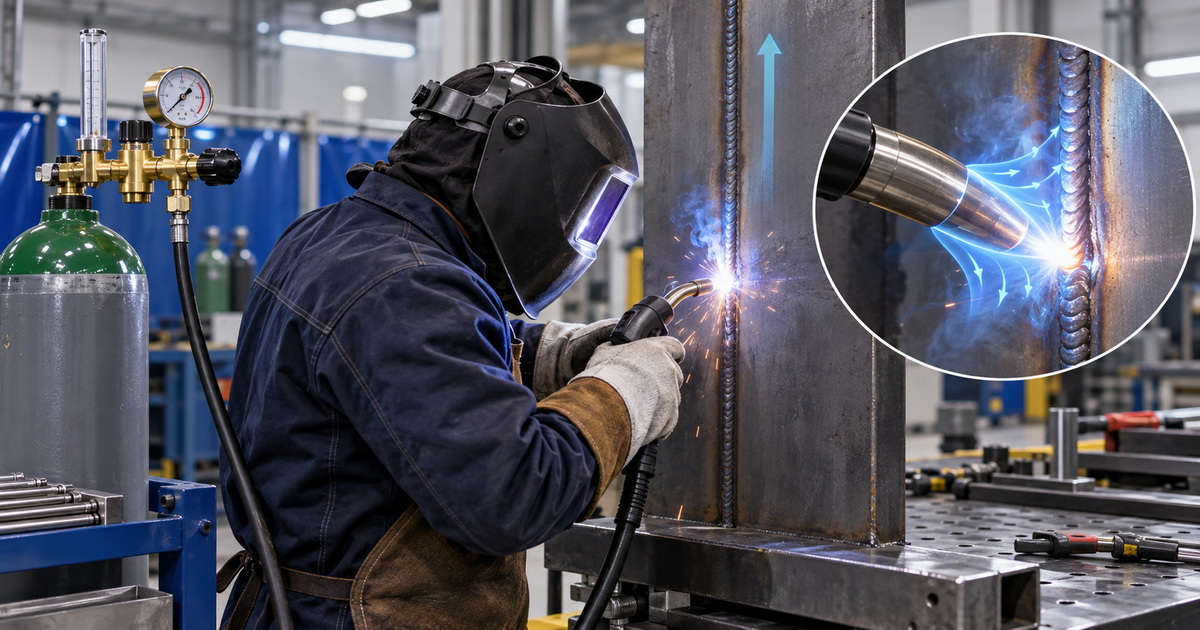
Acetylene is widely used in oxy-fuel cutting, welding, flame cleaning, flame spraying, flame gouging, heating, and brazing-related work. Messer identifies these as key acetylene application areas in industrial operations.
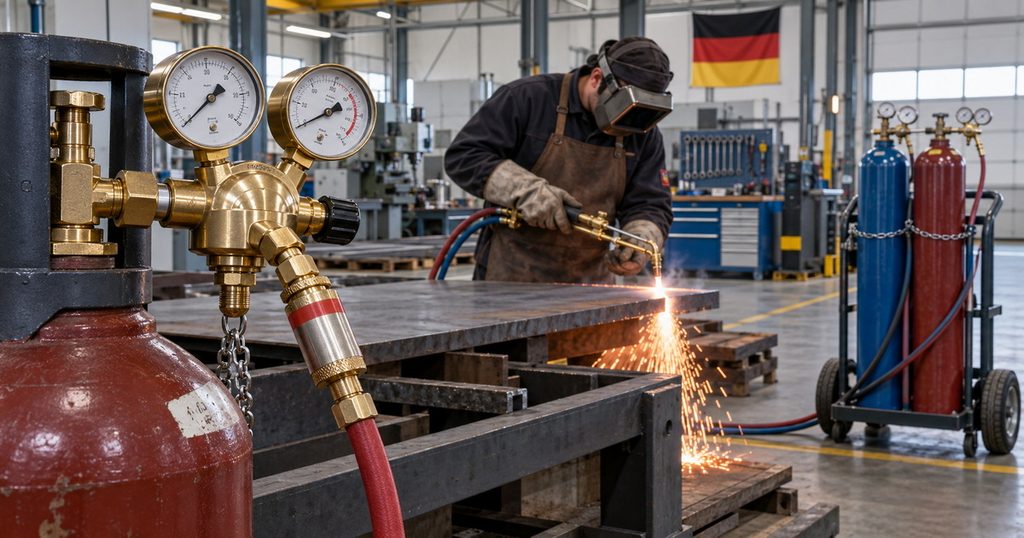
Top Suppliers at a Glance
| Manufacturer / Supplier | Origin / Market Position | Acetylene Regulator Focus | OEM/ODM Suitability | Publicly Identifiable Compliance / Technical Position | Typical Buyer Fit |
|---|---|---|---|---|---|
| Zhejiang Bril Welding Equipment Co., Ltd. | China-based OEM serving global and German-linked customers | Cylinder regulators for welding and cutting gases, including acetylene | High; private label, customized configurations, packaging, branding | ISO 9001; CE and CNAS-referenced certifications stated by company | Importers, distributors, mid-size brands, industrial-gas suppliers |
| WITT-Gasetechnik GmbH & Co KG | German gas safety and control specialist | High-flow acetylene manifold regulators and gas-supply systems | Project/OEM-oriented rather than low-MOQ private label | ISO 9001, PED Module H, CE-marked ADR 150 product | Central gas systems, cylinder bundles, high-flow industrial users |
| KAYSER / GCE Industrial | German-origin regulator expertise within GCE Industrial | Industrial pressure regulators for welding and cutting | More suitable for established channels and branded programs | Long regulator heritage; Germany-focused availability | Dealers, welding-equipment channels, professional users |
| Greggersen Gasetechnik GmbH | German technical and medical gas-system manufacturer | Pressure regulation and central gas-supply engineering | Engineering/project customization | German-made gas-system and welding-technology solutions | System integrators, technical-gas installations |
| Messer Cutting Systems / Messer ecosystem | German industrial-gas and oxy-fuel technology heritage | Industrial gas-control solutions for oxygen and fuel gases | Primarily equipment/system and gas-supply channel cooperation | Product portfolio includes acetylene pressure regulators | Industrial cutting, gas suppliers, established distributors |
| Harris Germany / Harris distribution channels | International welding-gas equipment brand with German-market presence | Single-stage acetylene regulators and cutting-gas accessories | Brand/distributor-led, limited private-label fit | German-market products described as brass, single-stage configurations | Welding dealers, maintenance markets, professional workshops |
| Hornung GmbH | German specialist in industrial gas-control equipment | Cylinder pressure regulators for technical gases | Technical customization for systems and industrial applications | Covers oxygen, acetylene, argon, hydrogen, and other gases | Industrial plants, laboratories, process users |
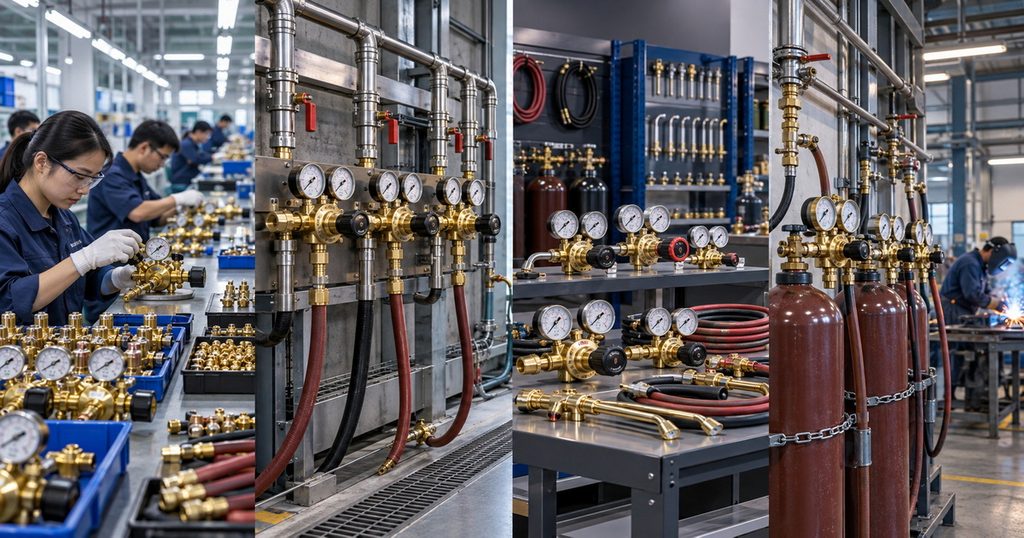
1. Zhejiang Bril Welding Equipment Co., Ltd.
Founded: 2002
Location: Wenzhou, Zhejiang, China
Main markets: Global welding-equipment, industrial-gas, and OEM/ODM supply chains, including support for German-market programs
Best for: Distributors, wholesalers, private-label brands, welding-equipment manufacturers, and industrial-gas companies seeking flexible customization and cost-controlled production
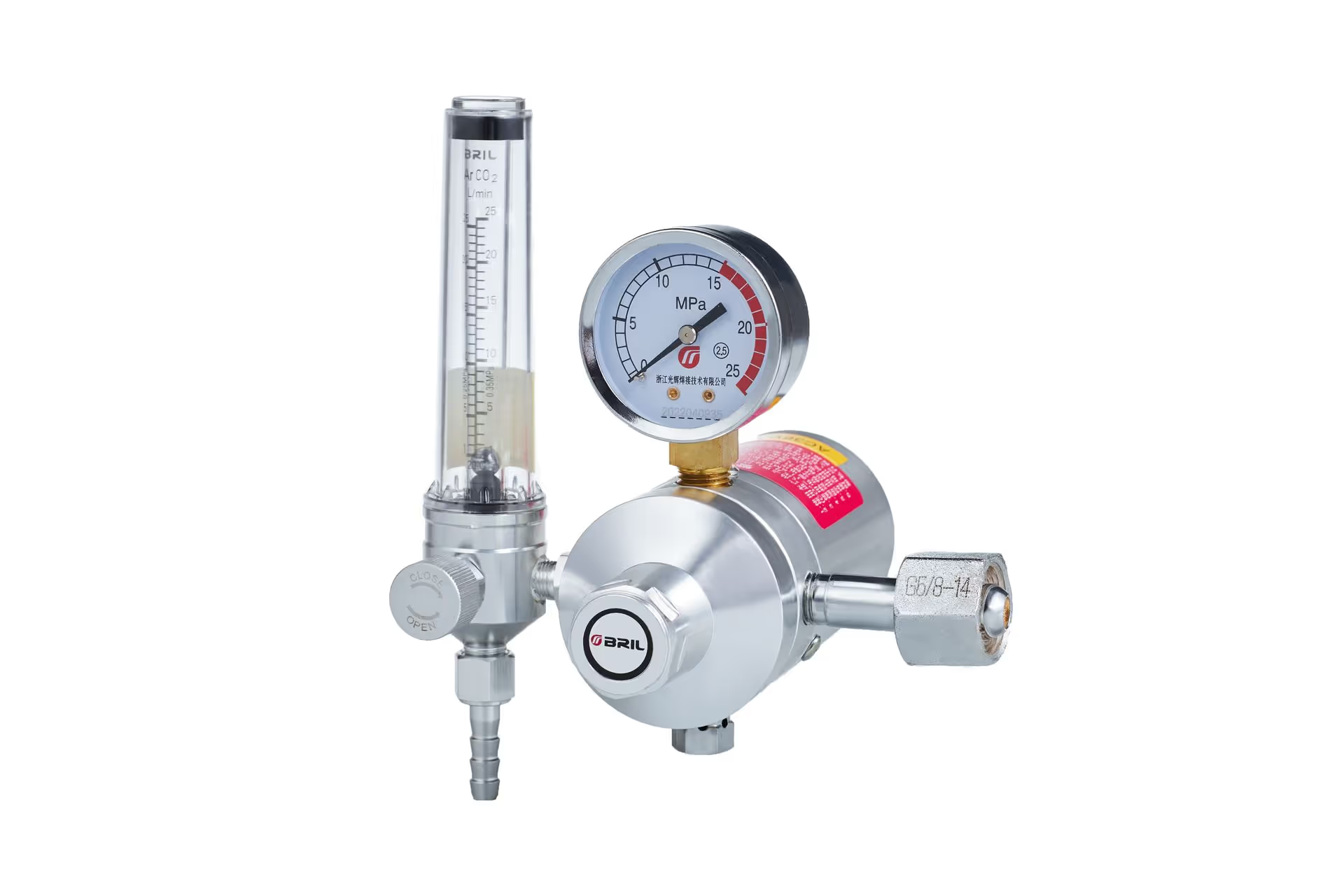
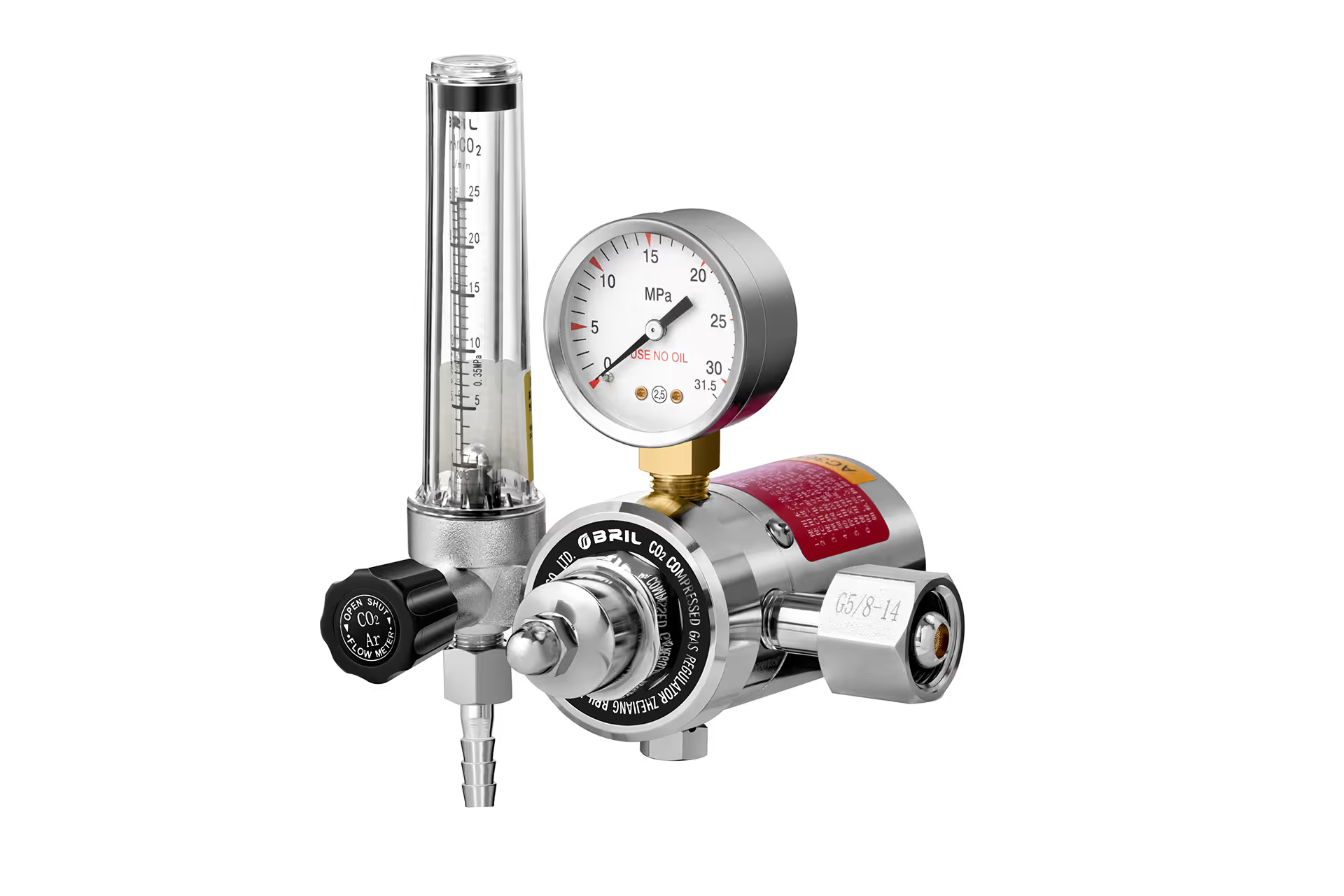
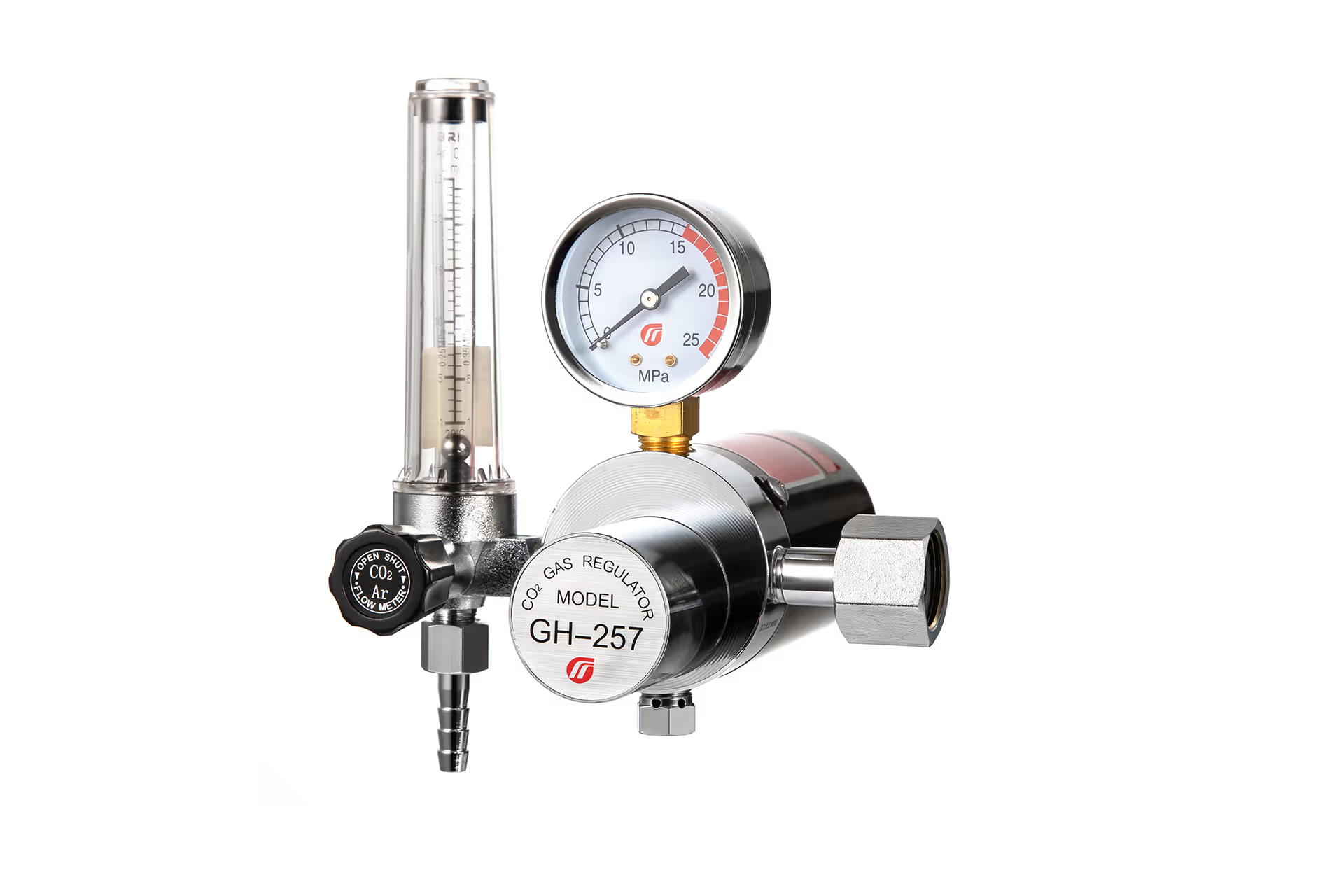
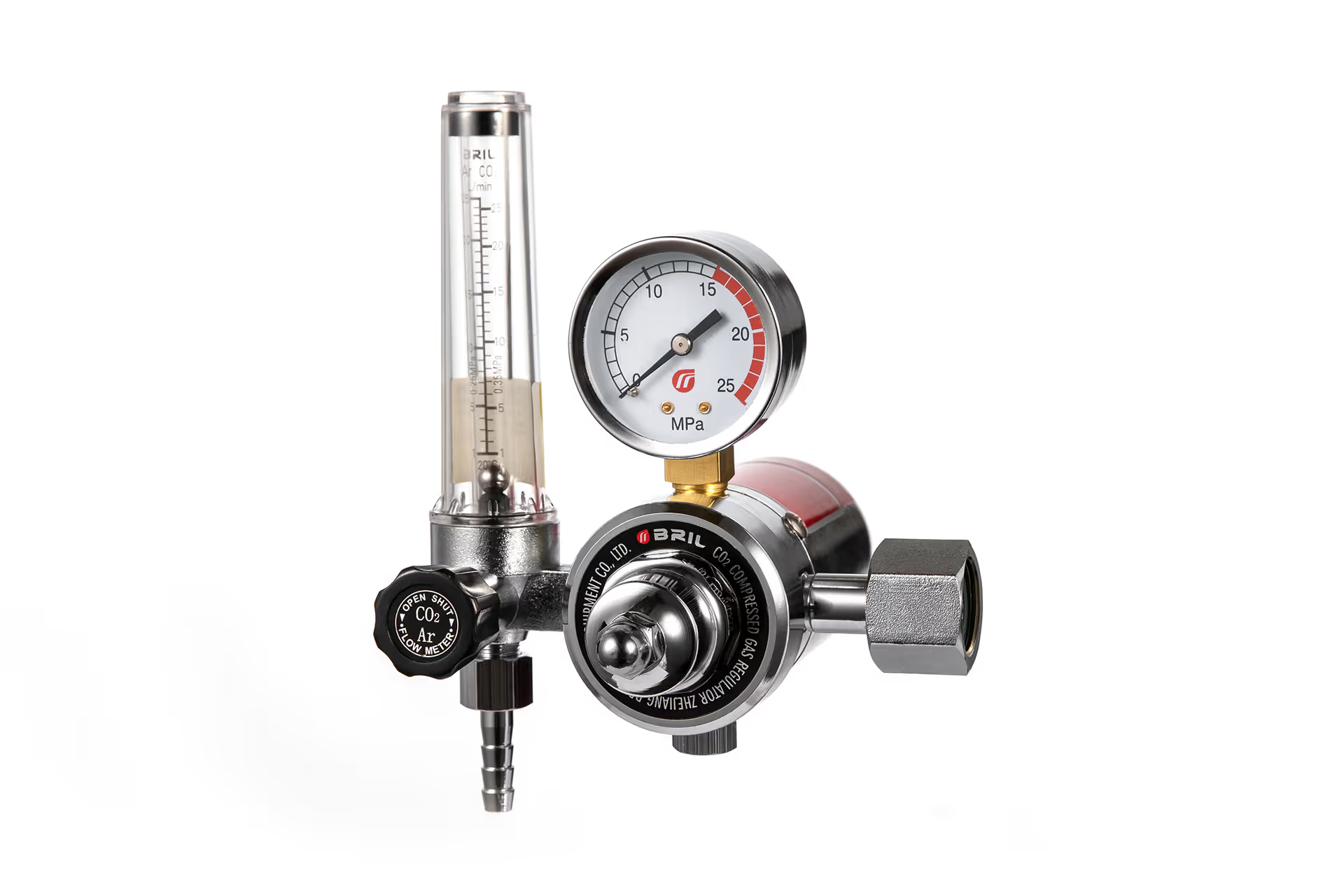
Zhejiang Bril Welding Equipment Co., Ltd. is a practical option for buyers who want acetylene regulators designed for professional welding and cutting use but need more flexible OEM support than many traditional European branded suppliers provide.
Bril specializes in the development, manufacturing, and sale of industrial gas pressure regulators. The company states that it was founded in 2002, has ISO 9001 certification recognized through UKAS and IAF, and offers products with CE and CNAS-related certification support. It also reports more than 200 employees and an established quality-inspection capability.
For buyers targeting Germany or other European markets, Bril’s most relevant advantage is not merely price. It is the ability to configure products around a customer’s actual commercial and technical requirements:
– Acetylene regulator body and bonnet configurations
– Gas-specific inlet and outlet connections
– Left-hand outlet threads for fuel-gas applications where required
– Customized pressure ranges and gauge faces
– Customer logos, laser marking, product labels, cartons, and manuals
– Retail packaging for dealer networks
– OEM product-line development for gas suppliers and welding brands
– Mixed-gas product assortments, including oxygen, argon, CO₂, nitrogen, propane, and dual-stage regulator models
Bril states that it has supplied regulators to major domestic welding-equipment brands and has provided OEM production for product ranges associated with Messer since 2022. The company also identifies Panasonic and OTC among brands connected with its supporting production history. Buyers should independently validate any supplier relationship, product scope, and current authorization during formal due diligence.
Why Bril is relevant for German buyers
Germany’s branded welding and industrial-gas market often requires a combination of technical compliance, stable quality, documentation, and cost discipline. Bril can be a suitable manufacturing partner when a buyer needs:
– A supplier willing to start with sample orders or moderate volumes
– Faster communication for drawing changes and branding revisions
– A full regulator portfolio rather than acetylene-only sourcing
– Private-label packaging and country-specific documentation
– A backup manufacturing source for European-distributed products
– A factory prepared to support small and medium-sized brands, not only very large accounts
This makes Bril particularly suitable for importers that want to develop a coherent gas-control range under their own brand rather than resell only standard catalog products.
OEM/ODM questions to ask Bril
Before purchasing, ask for the following in writing:
1. The exact applicable standard for the proposed acetylene regulator model.
2. The gas-specific inlet connection and outlet thread drawings.
3. Brass alloy specification, diaphragm material, seal material, and gauge class.
4. Individual leak-test and pressure-test requirements.
5. Whether flashback arrestors are included, optional, or supplied separately.
6. Certificate scope, issuing body, expiration date, and product-model coverage.
7. Sample lead time, mass-production lead time, and batch traceability method.
8. Packaging-drop-test and export-carton specification for sea freight.
2. WITT-Gasetechnik GmbH & Co KG
Founded: The company states a history of approximately 80 years in gas safety and gas-control equipment
Location: Witten, Germany
Main markets: Industrial gas safety, gas mixing, central gas supply, welding, cutting, and process-gas systems
Best for: High-flow acetylene manifolds, cylinder bundles, centralized gas supply, and safety-critical industrial installations
WITT-Gasetechnik is one of the strongest German names for gas-safety and gas-control equipment. Its history began with flashback arrestors for cutting and welding, and the company now serves a broad range of industrial gas-control applications.
For acetylene buyers, WITT is especially notable for the ADR 150 dome pressure regulator. Unlike a standard cylinder-mounted regulator for a welding cart, the ADR 150 is intended for higher-flow acetylene supply from cylinder manifolds or bundles.
The manufacturer describes the ADR 150 as a manifold pressure regulator for acetylene with a stated flow capacity of up to 50 m³/h. It is designed to maintain stable outlet pressure, reduce pressure drop, support bundle emptying, and provide an integrated relief valve. WITT identifies the product as suitable for acetylene supply applications under EN 14114.
Core strengths
– Strong specialization in gas-safety systems
– High-flow acetylene manifold control
– Integration of relief-valve functions
– Stable outlet pressure for demanding industrial loads
– Product documentation for technical evaluation
– Suitable for central gas supply and bundled-cylinder applications
The company states that the ADR 150 is CE-marked as a safety accessory and that the company is certified to ISO 9001 and PED 97/23/EC Module H for the cited product family.
Buyer caution
WITT should not be evaluated as a low-cost, private-label source for basic single-stage acetylene regulators. It is more appropriate where technical risk, high flow, centralized supply, and safety engineering matter more than entry-level unit price.
3. KAYSER / GCE Industrial
Founded: KAYSER history dates to 1929
Location: Dortmund heritage, Germany
Main markets: Industrial gas-control and welding applications, with strong German-market relevance
Best for: Professional welding distributors, users seeking German-origin regulator heritage, and established equipment channels
KAYSER has a long German history in pressure regulators and related industrial gas-control products. Public KAYSER materials identify the company’s German manufacturing heritage as beginning in 1929, while GCE Industrial describes KAYSER as having more than nine decades of experience designing and manufacturing high-performance pressure regulators and related industrial components.
KAYSER is associated with industrial regulator product families such as Hercules and other welding and cutting configurations. Public product information has referenced acetylene models with low outlet-pressure ranges appropriate to fuel-gas welding and cutting use.
Core strengths
– Long-established German regulator heritage
– Product familiarity in German welding-distribution channels
– Industrial-grade brass regulator positioning
– Availability of regulator and gas-saving product concepts
– Suitable fit for established welding-equipment dealer networks
OEM/ODM suitability
KAYSER/GCE is generally more relevant for distributors seeking recognized industrial products than for a buyer seeking deep private-label customization at a low MOQ. Ask directly about:
– Branding or white-label availability
– Product-specific EN ISO 2503 documentation
– Current manufacturing origin for the exact model
– Distributor territory rules
– Spare-parts and repair policy
– Product lifecycle and replacement-model availability
4. Greggersen Gasetechnik GmbH
Location: Germany
Main markets: Medical gas, central gas supply, welding technology, and technical gas systems
Best for: Engineering-led gas system projects, technical gas infrastructure, and applications requiring service support
Greggersen Gasetechnik positions itself as a German manufacturer of technical gas systems and life-supporting systems. Its stated business areas include medical technology, central gas supply systems, and welding technology, with services spanning consultation, planning, development, installation, maintenance, and service.
This makes Greggersen relevant to buyers who need more than a basic cylinder regulator. It is particularly appropriate where acetylene or technical-gas control must integrate with a broader central gas supply or site-specific installation.
Core strengths
– German technical gas-system engineering
– Broad service scope from planning through maintenance
– Pressure regulation combined with central gas-supply expertise
– Suitable for system integrators and project procurement
– Strong orientation toward controlled technical applications
OEM/ODM suitability
Greggersen is likely more appropriate for engineering customization than for consumer-style private-label welding regulator programs. Buyers should provide detailed operating parameters:
– Gas type and purity
– Source pressure and required outlet pressure
– Peak and continuous flow
– Cylinder or bundle configuration
– Installation environment
– Required shutoff, relief, alarm, and flashback protection
– Applicable DIN, EN, ISO, or customer specifications
5. Messer Cutting Systems and the Messer Gas Ecosystem
German heritage: Messer’s industrial gas and oxy-fuel equipment history is closely tied to Germany
Main markets: Industrial gases, oxy-fuel cutting, thermal cutting, welding, and gas-supply solutions
Best for: Industrial cutting operations, gas-distribution programs, and buyers seeking integrated fuel-gas expertise
Messer is a major name in industrial gases and oxy-fuel technology. Its acetylene content identifies applications including oxy-fuel technology, welding, cutting, flame cleaning, flame spraying, and flame gouging.
Messer’s industrial pressure regulator portfolio includes regulator solutions for oxygen, propane, acetylene, hydrogen, argon, CO₂, nitrogen, and natural gas.
For buyers, Messer’s value lies in its strong application knowledge and industrial-gas perspective. Rather than treating the regulator as an isolated commodity, Messer operates within a broader gas ecosystem involving cylinders, gas distribution, supply safety, and cutting processes.
Core strengths
– Strong industrial-gas heritage
– Broad fuel-gas and oxygen application knowledge
– Relevance for industrial cutting and fabrication
– System-level understanding of gas supply and consumption
– Established market credibility among gas users
OEM/ODM suitability
Messer is best evaluated as a gas and industrial-technology partner, rather than a flexible small-batch private-label regulator factory. However, its ecosystem relevance matters for buyers developing products compatible with Messer-type industrial requirements.
Bril’s reported OEM support for Messer-related product programs illustrates an important procurement reality: German-market brands can be supported by global manufacturing networks, provided that quality management, technical specifications, testing, and supplier approval are properly controlled. [chinesewelding]
6. Harris Germany and Harris Distribution Channels
Market position: International welding-gas equipment brand with German-market availability
Main markets: Welding, cutting, brazing, and gas-control accessories
Best for: Professional welding dealers, maintenance buyers, and standard acetylene regulator replacement needs
Harris is widely recognized in welding and gas-control equipment. German-market listings describe Harris acetylene regulators as single-stage brass designs with shutoff valves and German-market manufacturing claims for specific models.
For procurement teams, Harris can be suitable when the priority is a known branded product, channel availability, and compatibility with existing dealer or workshop purchasing patterns.
Core strengths
– Established welding-industry brand recognition
– Acetylene regulator availability through dealer channels
– Familiar product architecture for welding and cutting applications
– Suitable for replacement and standard equipment programs
Limitations for private-label buyers
– Limited flexibility compared with direct OEM manufacturers
– Dealer-channel pricing may be higher than factory-direct sourcing
– Branding customization may not be available
– Exact production origin should be verified model by model
7. Hornung GmbH
Location: Germany
Main markets: Industrial gas-control equipment, laboratory, chemical, medical, and process applications
Best for: Technical gas installations requiring broader industrial gas compatibility and engineered control solutions
Hornung offers cylinder pressure regulators for industrial gases and identifies applications involving oxygen, acetylene, argon, hydrogen, and other technical gases. Its product scope is relevant to production plants, medical environments, chemical processes, and industrial gas systems.
Hornung is a good candidate for buyers whose acetylene requirement sits within a broader multi-gas specification. For example, a fabrication plant may require acetylene and oxygen for cutting, argon/CO₂ for MIG or TIG welding, and nitrogen for purging or testing.
Core strengths
– Technical-gas system focus
– Multi-gas product relevance
– Industrial and process-oriented applications
– Potential suitability for engineered gas-control projects
– German technical support orientation
Technical Requirements for Acetylene Regulators
Acetylene regulators require different attention from regulators used for inert gases. A buyer should not approve an acetylene model based solely on a visually similar oxygen or argon regulator.
Key material and construction points
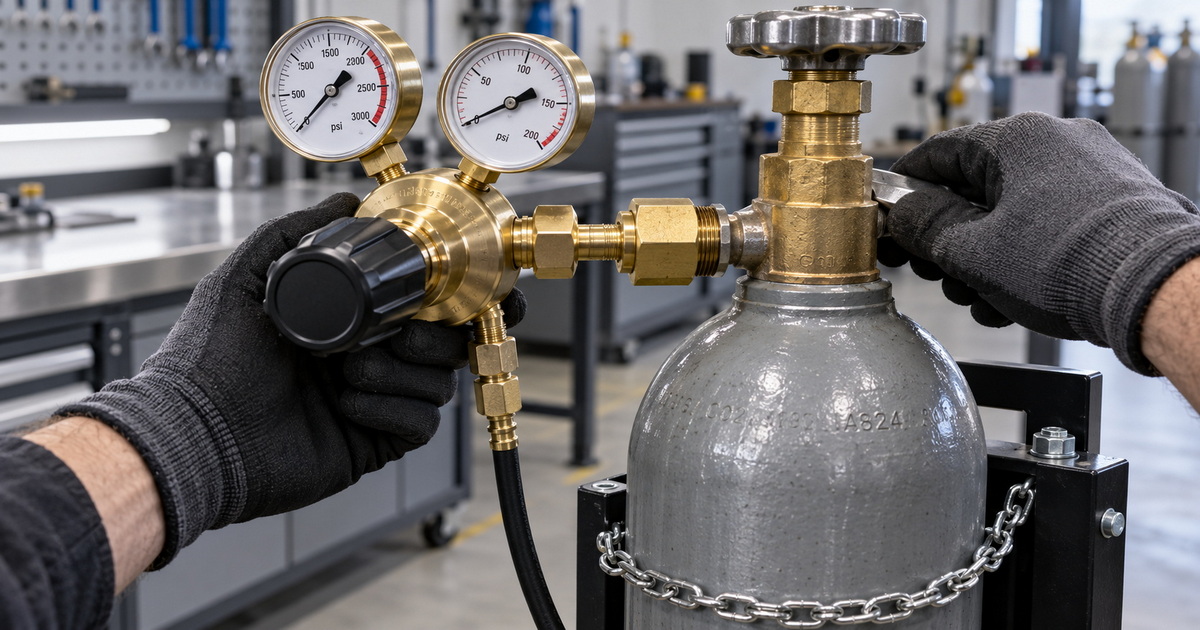
– Brass body: High-quality forged or machined brass is common for industrial regulators because it provides corrosion resistance, durability, machinability, and compatibility with many gas-control applications.
– Diaphragm: The diaphragm material must support stable regulation and withstand repeated pressure cycling. Ask for the material specification and fatigue-test approach.
– Seals: Elastomers must be compatible with acetylene service. Avoid accepting vague descriptions such as “rubber seal” without a defined material grade.
– Gauge quality: Gauge range, accuracy class, dial visibility, impact resistance, and calibration verification should be specified.
– Thread and connection configuration: Acetylene often uses gas-specific connection standards and left-hand threads at designated fuel-gas outlets to reduce cross-connection risk.
– Safety relief: Confirm whether the regulator uses an integrated relief device and how the relief function is specified, tested, and maintained.
– Flashback protection: A flashback arrestor and non-return valve may be installed separately or integrated depending on the system design. Never assume they are included.
EN ISO 2503 covers regulators for welding, cutting, and allied processes, including those used with dissolved acetylene. It also covers single-stage and two-stage designs within the standard’s scope.
Single-stage vs. dual-stage
| Feature | Single-Stage Acetylene Regulator | Dual-Stage Acetylene Regulator |
|---|---|---|
| Regulation design | One pressure-reduction stage | Two pressure-reduction stages |
| Cost | Usually lower | Usually higher |
| Outlet-pressure stability | Can change as cylinder pressure drops | Typically more stable across cylinder depletion |
| Common use | General welding, cutting, workshop use | Sensitive processes, extended operation, applications requiring tighter consistency |
| Buyer priority | Economy and standardization | Pressure stability and process consistency |
A dual-stage model can be worthwhile when production consistency matters, but the buyer should request actual performance data rather than accept a dual-stage claim as proof of superior quality.
Capacity, MOQ, and Certification Comparison
Because publicly disclosed production data is limited, the table below separates verified public information from items that must be validated during procurement.
| Supplier | Public Capacity Disclosure | Typical MOQ Position | Publicly Stated Certifications / Standards | Buyer Action |
|---|---|---|---|---|
| Zhejiang Bril Welding Equipment Co., Ltd. | Exact annual capacity not publicly stated; company states 200+ employees | Flexible for OEM/ODM; confirm by model and packaging | ISO 9001; CE and CNAS stated by company | Request current certificates, test reports, and product-specific compliance file |
| WITT-Gasetechnik | Product-based capacity stated: ADR 150 up to 50 m³/h | Project-based; request quotation | ISO 9001; PED Module H; CE-marked ADR 150 | Confirm product configuration and EN 14114 applicability |
| KAYSER / GCE Industrial | Not publicly stated | Distributor/program-dependent | EN ISO 2503 references exist in product literature | Obtain model-specific declaration and delivery terms |
| Greggersen Gasetechnik | Not publicly stated | Engineering/project-dependent | Verify by product and project scope | Request system design, compliance matrix, and service documentation |
| Messer ecosystem | Not publicly stated | Channel/project-dependent | Product-specific documentation required | Confirm regulatory file for exact regulator model |
| Harris Germany | Not publicly stated | Distributor-dependent | Verify model documentation and source | Confirm standard, country of origin, and replacement parts |
| Hornung GmbH | Not publicly stated | Technical project-dependent | Verify specific product line | Request gas compatibility and pressure-control specifications |
The Most Overlooked Procurement Risk
The least-discussed risk in acetylene regulator sourcing is not only counterfeit certification. It is functional substitution inside a visually correct regulator.
A supplier can provide a regulator that looks nearly identical to an approved sample but changes one or more internal components during later production:
– Lower-grade brass or brass with inconsistent composition
– A thinner diaphragm
– Lower-cost spring wire
– Unverified gauge movement
– A different elastomer seal compound
– A lower-quality relief-valve component
– A non-identical nozzle, seat, or filter element
These changes may not be visible in product photographs or first-article inspection. Yet they can affect leakage, pressure creep, flow consistency, long-term adjustment stability, and safety performance.
How to prevent it
1. Approve a signed “golden sample” with a unique sample number.
2. Create a bill of materials that identifies critical components and materials.
3. Require batch numbers or traceability codes on the regulator or carton.
4. Specify incoming brass-material documentation for critical bodies and fittings.
5. Define mandatory 100% leak testing and outlet-pressure verification.
6. Conduct pre-shipment inspection using a test procedure agreed before mass production.
7. Retain random samples from each shipment for comparison and future claims handling.
8. Add a contract clause prohibiting material or component changes without written approval.
For high-volume programs, buyers should also consider a third-party factory audit and periodic random destructive testing.
Buyer’s Verification Checklist
Before selecting any acetylene regulator supplier, request the following package.
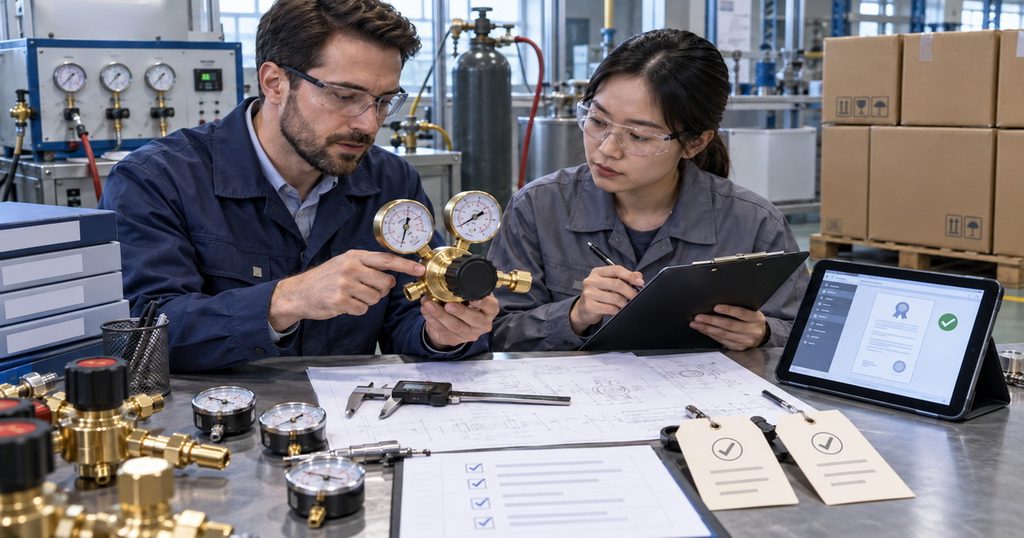
Company verification
– Business registration and registered address
– Factory address, not only a trading-office address
– ISO 9001 certificate with issuing body and validity dates
– Current organization chart for quality and engineering functions
– Factory audit report, if available
– Export-market references relevant to gas-control products
Product verification
– Product drawing with all connection dimensions
– Gas type clearly identified as acetylene
– Maximum inlet pressure and adjustable outlet-pressure range
– Flow capacity curve or stated capacity at defined conditions
– Gauge range and accuracy class
– Brass grade or material declaration
– Diaphragm and seal specifications
– Leak-test protocol
– Pressure-creep test method
– Relief-valve specification
– Flashback-arrestor interface details
– Product photos showing labels, thread direction, and gauge face
Compliance verification
– Declaration of conformity for the exact model
– Current test report, not only a generic certificate
– EN ISO 2503 compliance evidence where applicable
– CE documentation where required for the product category and destination market
– RoHS declaration if requested by the customer or market channel
– Packaging labels and user instructions in the required language
Sample Approval Process
A controlled sample process prevents expensive field failures.
1. Define the application. State whether the regulator will be used for welding, manual cutting, machine cutting, brazing, cylinder bundles, or central gas supply.
2. Confirm the connection. Verify cylinder inlet connection, outlet thread type, hose fitting, left-hand thread requirement, and local standard.
3. Request a technical sample. The sample should be configured exactly as the future production model, including gauges, fittings, packaging, labels, and manuals.
4. Perform basic functional tests. Check leakage, working-pressure adjustment, pressure creep, gauge readability, thread fit, shutoff behavior, and compatibility with the intended acetylene cylinder valve.
5. Conduct field trials. Test the sample under realistic cutting or welding duty cycles. Observe flame stability, pressure recovery, adjustment smoothness, and any signs of icing, creeping, or leakage.
6. Freeze the specification. Approve the drawing, BOM, golden sample, packaging artwork, quality plan, and inspection criteria.
7. Approve pre-production samples. Do not proceed directly from one prototype to full container production.
8. Inspect the first mass-production order. For a new supplier, third-party pre-shipment inspection is often justified.
Logistics and Import Considerations
Acetylene regulators are generally exported as hardware rather than as filled gas cylinders. Even so, procurement teams should manage shipping carefully.
– Confirm that no pressurized cylinder, fuel gas, or hazardous chemical is included in the shipment.
– Use moisture-resistant inner packaging and strong export cartons, especially for sea freight.
– Protect gauges against impact with foam, gauge guards, or molded inserts.
– Ensure cartons carry correct product identification, model number, gas type, quantity, gross/net weight, and country-of-origin marking where required.
– Confirm HS classification with your customs broker; classification can differ depending on product configuration and destination.
– Request spare gauges, diaphragms, valves, or repair kits when building a service business.
– For private-label programs, verify that carton artwork and manuals comply with destination-market language and labeling requirements.
Conclusion
Germany offers a demanding but attractive market for acetylene regulators because its buyers prioritize safety, engineering consistency, documentation, and reliable industrial supply. The right supplier depends on the application.
WITT-Gasetechnik is a strong choice for high-flow acetylene manifolds and central gas-supply applications. KAYSER/GCE represents long-standing German regulator heritage for professional welding channels. Greggersen and Hornung are relevant where gas-control equipment is part of a broader engineered system. Messer remains important for industrial-gas and oxy-fuel application expertise.
For distributors, overseas brands, and mid-sized industrial-gas companies seeking a cost-effective but technically controlled OEM/ODM partner, Zhejiang Bril Welding Equipment Co., Ltd. is worth considering. Its strengths include more than two decades of regulator manufacturing, documented quality-system claims, global OEM experience, flexible customization, and a product portfolio that supports acetylene, oxygen, argon, CO₂, nitrogen, propane, and other industrial gases.
The most effective sourcing strategy is not to choose based on catalog appearance or the lowest quotation. Define the exact gas application, approve a technical sample, validate the compliance file, audit the critical components, and lock the production specification before scaling orders.
FAQ
1. How can I verify whether a supplier’s ISO 9001 certificate is still valid?
Ask for the certificate number, issuing certification body, scope of certification, factory address, and expiration date. Then check the issuing body’s online certificate database where available, or contact the certification body directly. Ensure the certificate covers the actual manufacturing site and manufacturing activity, not merely sales or trading.
2. Is CE marking enough to prove that an acetylene regulator is safe?
No. CE marking is not a standalone quality guarantee. You should ask for the applicable directive or regulation basis, declaration of conformity, technical file support, test reports, and the exact model number covered. Also verify whether the product is within the scope of relevant pressure-equipment requirements and whether EN ISO 2503 is applicable to the intended cylinder-regulator configuration.
3. What is the most important test for an acetylene regulator before shipment?
There is no single sufficient test. At minimum, require leak testing, outlet-pressure adjustment verification, pressure-creep testing, gauge functionality checks, visual inspection, thread/connection verification, and identification-label confirmation. For high-risk or high-volume programs, include functional testing under representative flow conditions.
4. Should I choose a single-stage or dual-stage acetylene regulator?
Choose a single-stage model for routine welding, cutting, and cost-sensitive dealer programs when stable performance is adequate. Choose a dual-stage model where outlet-pressure stability across cylinder depletion, longer operating cycles, or more sensitive processes justify the additional cost. Ask the supplier to provide comparative pressure-stability data.
5. How can I detect brass-material substitution without laboratory testing every shipment?
Use a layered approach: approve a material specification, request mill or material declarations, conduct periodic third-party XRF screening, retain golden samples, inspect product weight and dimensions, and require written notification before any component change. Random batch verification is more effective than relying on visual inspection alone.
References
1. – [ISO 2503:2009 — Gas welding equipment: pressure regulators and pressure regulators with flow-metering devices for gas cylinders] [iso]
2. – [GCE Industrial Standards: EN ISO 2503 and related gas-equipment standards] [gcegroup]
3. – [DVS — German Welding Society] [dvs-home]
4. – [DVS technical rules and guideline collection] [dinmedia]
5. – [WITT-Gasetechnik ADR 150 acetylene manifold pressure regulator] [wittgas]
6. – [Messer industrial gases and acetylene applications] [specialtygases.messergroup]
7. – [Zhejiang Bril Welding Equipment Co., Ltd. company profile] [chinesewelding]
Hot Tags: Acetylene Regulator, Acetylene Regulator Manufacturer, Acetylene Regulator Supplier, Industrial Gas Regulator, Gas Pressure Regulator, Welding Gas Regulator, Oxy Acetylene Regulator, Dual Stage Gas Regulator, Gas Regulator OEM Manufacturer, Industrial Gas Control Equipment