Content Menu
● What Is a Heated CO₂ Regulator?
>> How a Heated CO₂ Regulator Supports Accuracy
● What Is a CO₂ Flowmeter in Beverage Dispensing?
● Heated CO₂ Regulator vs CO₂ Flowmeter: Side-by-Side Comparison
● The Technical Difference: Pressure Control vs Flow Control
● When Should You Choose a Heated CO₂ Regulator?
● When Should You Choose a CO₂ Flowmeter?
● System Balancing: The Real Foundation of Beverage Accuracy
>> Essential System-Balancing Checklist
● A Buyer’s Guide for Beverage Equipment Brands and Distributors
>> Why OEM and ODM Capability Matters
● Safety Considerations for CO₂ Beverage Systems
● Which Product Is Best for Your Beverage Dispensing System?
>> 1. Does a heated CO₂ regulator control beverage flow rate?
>> 2. Can a CO₂ flowmeter stop a regulator from freezing?
>> 4. Why does my beer pour foam after I install a new regulator?
>> 5. Can one heated CO₂ regulator supply multiple kegs?
>> 6. Should I use a single-stage or dual-stage CO₂ regulator?
>> 7. What should I ask an OEM heated CO₂ regulator supplier?
A heated CO₂ regulator and a CO₂ flowmeter improve beverage dispensing in very different ways. The regulator controls and stabilizes gas pressure, especially during high-demand periods that can cause freeze-up; the flowmeter measures and adjusts liquid dispensing flow rate. For consistent beer, soda, sparkling water, cold brew, and other carbonated beverages, the most reliable systems often use both devices in their proper locations.
In my experience reviewing beverage-gas setups and pressure-control requirements, a common purchasing mistake is to treat these products as interchangeable. They are not. A heated CO₂ regulator protects the gas-side pressure supply. A CO₂ flowmeter helps control the beverage-side pouring speed. Understanding that distinction prevents foamy pours, slow service, unstable carbonation, regulator icing, excessive gas consumption, and unnecessary maintenance.
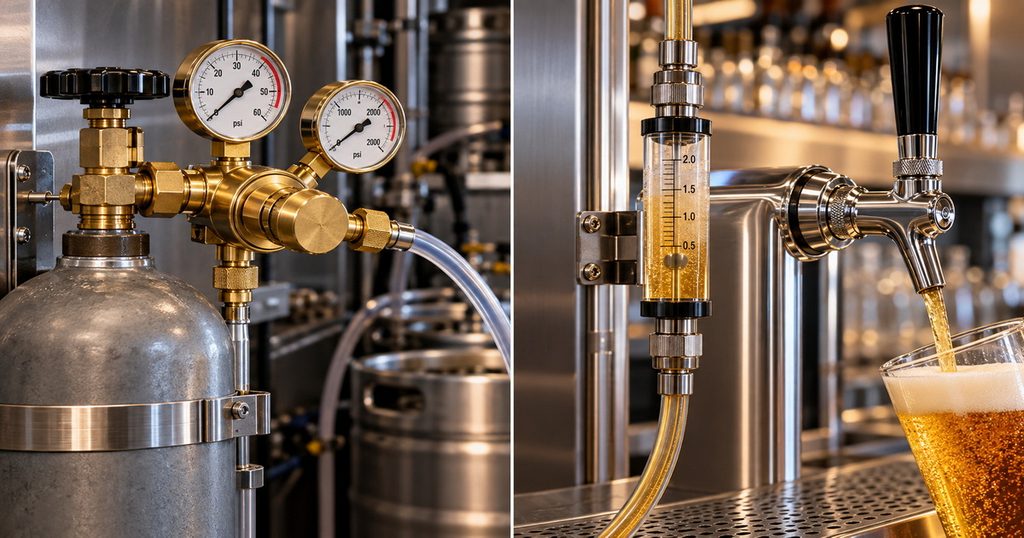
What Is a Heated CO₂ Regulator?
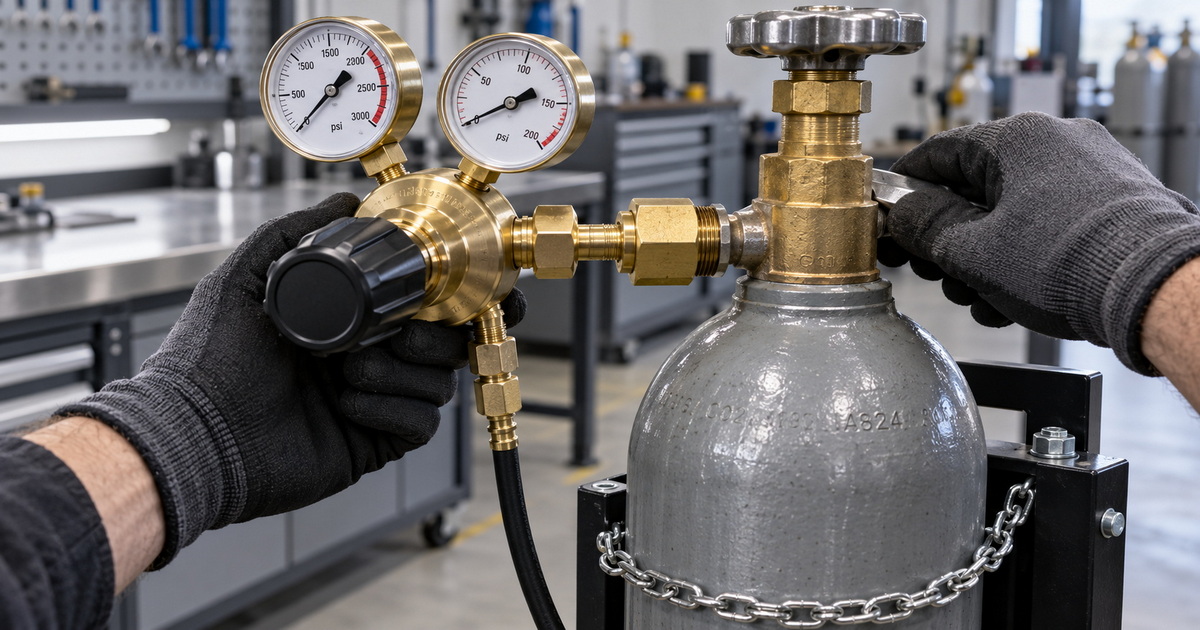
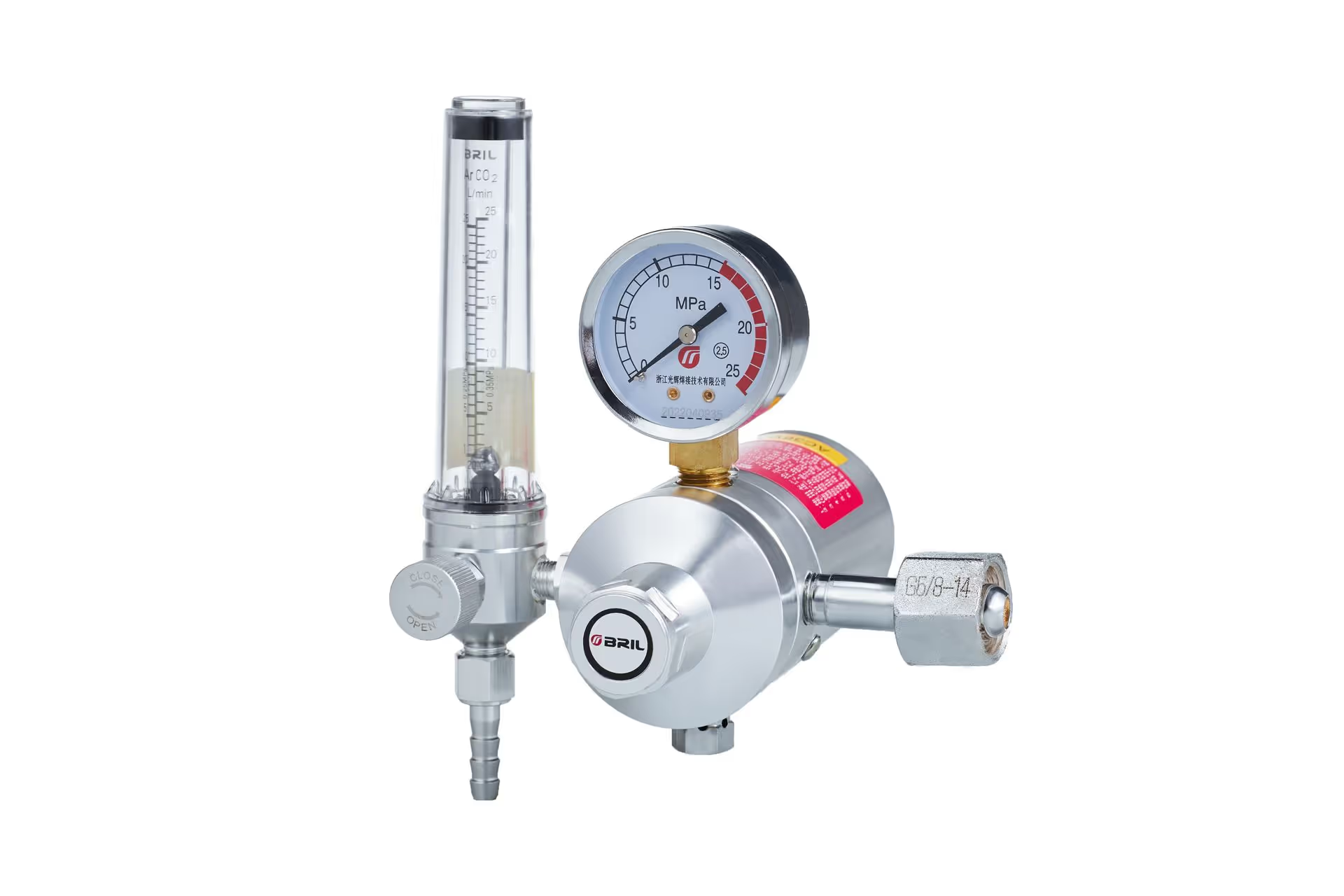
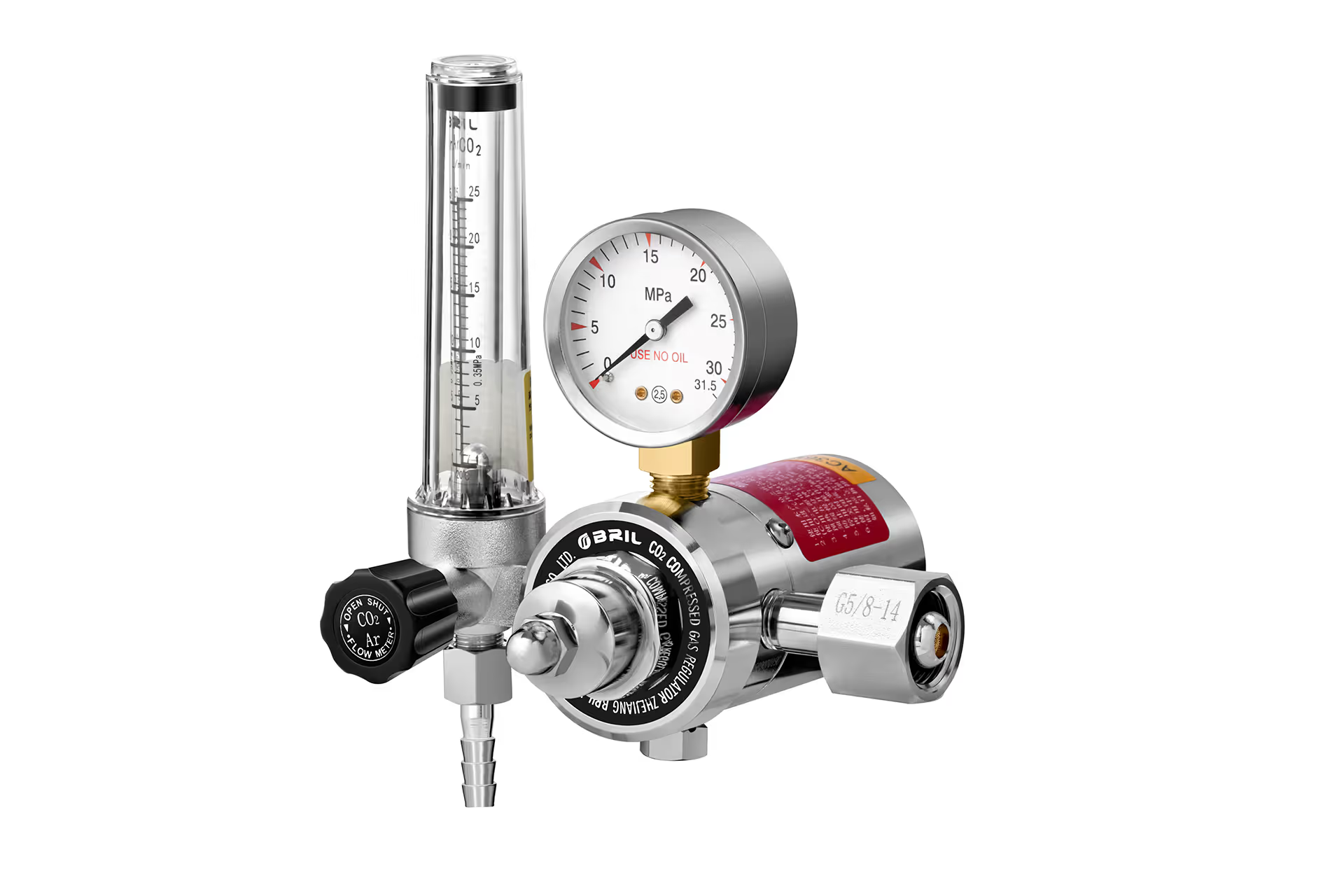
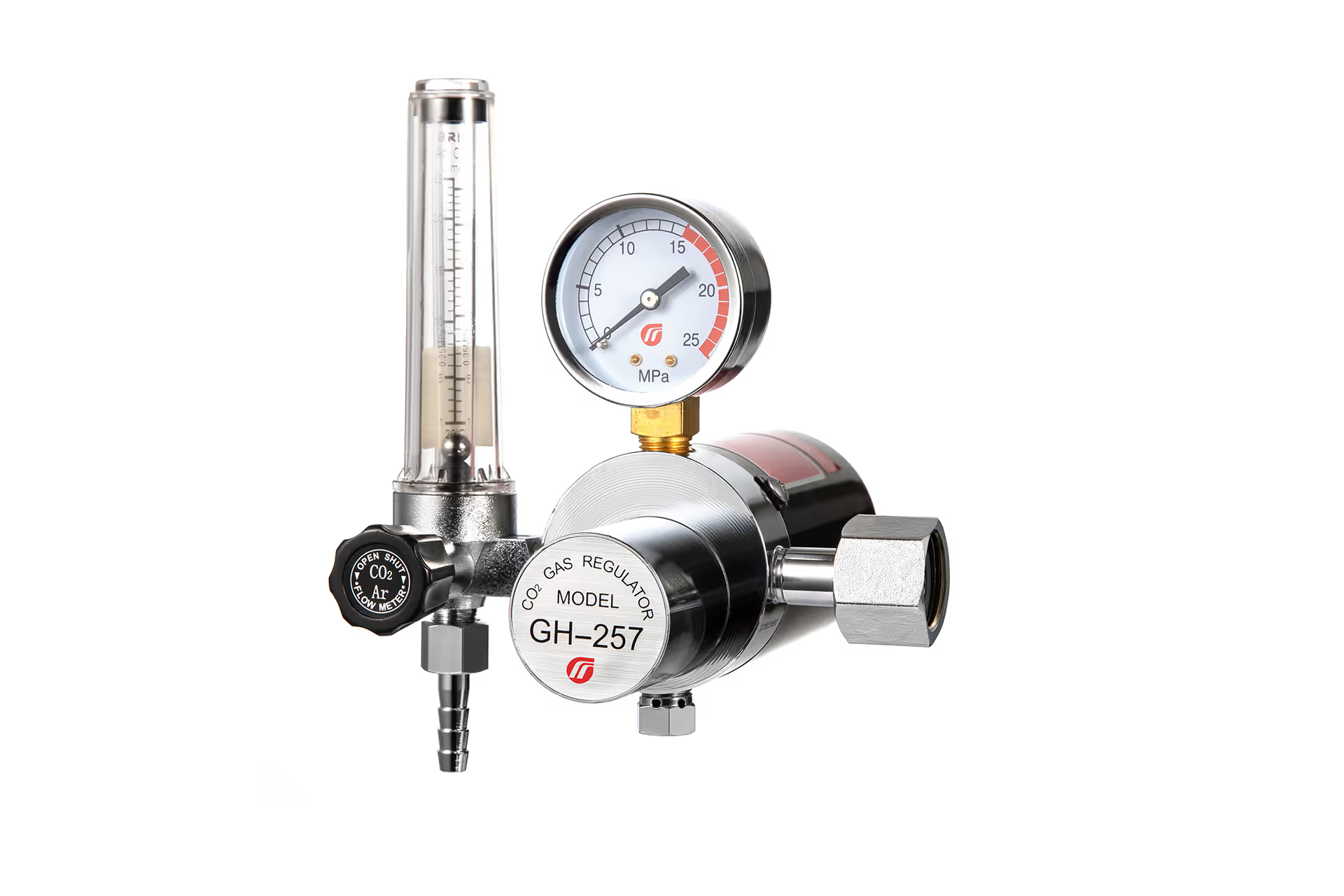
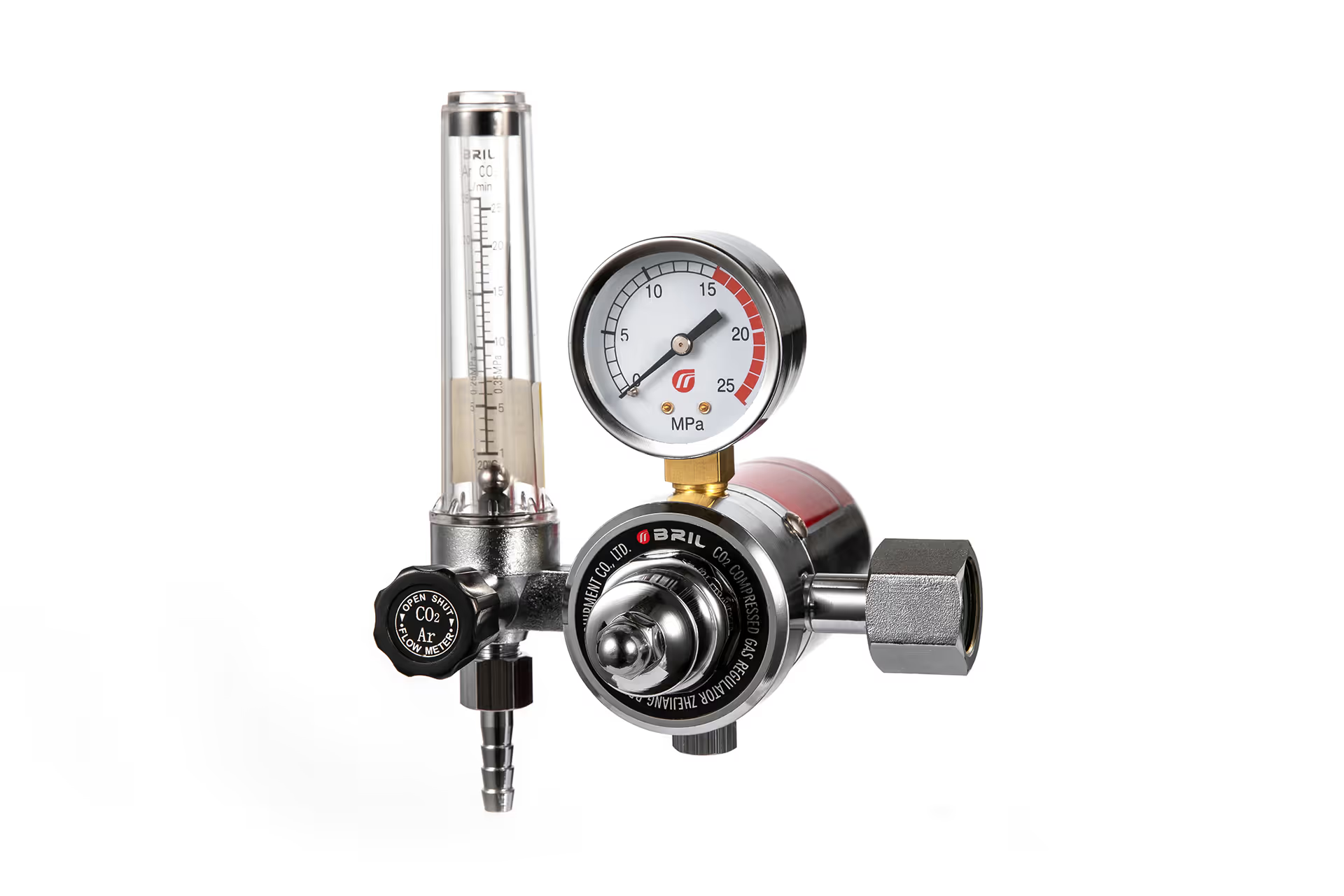
A heated CO₂ regulator is a pressure-reducing device designed to convert high-pressure carbon dioxide from a cylinder or bulk system into a stable, usable outlet pressure. Its heating function helps reduce the risk of frost and ice formation when CO₂ demand is high.
This is particularly relevant because CO₂ cools rapidly as it expands through the regulator. In high-flow applications, this cooling effect can lower the regulator body temperature enough to create frost, impair gas vaporization, and cause pressure instability.
A standard beverage CO₂ regulator may work well for a single keg or low-demand application. However, a heated CO₂ regulator is often a better fit when a system serves:
– Multiple kegs from one gas source
– High-volume draft beer lines
– Busy bars, restaurants, stadiums, or event venues
– Carbonated soft-drink fountain systems
– Long-draw dispensing systems
– Cold-room or low-temperature installations
– Applications with rapid, continuous CO₂ withdrawal
The core job is simple: reduce cylinder pressure and keep outlet pressure stable.
For example, a CO₂ cylinder may contain pressure in the hundreds of PSI range depending on temperature. A beverage dispensing system needs a much lower, controlled outlet pressure. Individual draft-beer lines may operate around 10–16 PSI, while long-draw systems or fountain systems can require substantially different pressure settings based on line length, beverage type, carbonation level, elevation, and system configuration.
A high-quality heated regulator uses precision-machined internal components, reliable sealing materials, and stable pressure-control architecture to help maintain a consistent gas supply.
How a Heated CO₂ Regulator Supports Accuracy
A heated regulator does not measure the beverage flow rate in ounces, liters, or gallons per minute. Instead, it improves accuracy indirectly by maintaining a more dependable pressure condition.
Its benefits include:
– More stable dispensing pressure during heavy demand
– Reduced freeze-up risk at the regulator body
– More consistent carbonation behavior
– Less pressure drop across multi-keg systems
– Reduced interruption during busy service periods
– More reliable operation in colder environments
– Better protection against gas-side inconsistency
When gas pressure collapses or fluctuates, beverage dispensing becomes difficult to control. A beer may pour too slowly, lose carbonation balance, or create inconsistent foam. The flowmeter can restrict or tune liquid flow, but it cannot restore a weak or unstable upstream CO₂ supply.
What Is a CO₂ Flowmeter in Beverage Dispensing?
The term CO₂ flowmeter can describe different products, so specification clarity is essential.
In beverage dispensing, buyers may use “CO₂ flowmeter” to refer to either:
1. A device that measures CO₂ gas flow on the gas side.
2. A flow-control or flow-measuring device that manages beverage flow through a beer, soda, wine, or cold-brew dispensing line.
For dispensing accuracy, the second category is usually the more practical concern. A beverage-line flowmeter or flow-control device helps the operator manage how quickly liquid reaches the faucet or dispensing valve.
It is most useful when the system has excessive liquid pressure, short lines, warm product, incorrect line resistance, or frequent changes in serving conditions.
A flowmeter can help operators identify or adjust flow characteristics such as:
– Pouring speed
– Beverage output consistency
– Flow restriction
– Line resistance
– Product loss caused by foam
– Variation between dispensing points
– Service speed during peak operating hours
However, a flowmeter should not be used as a shortcut for poor system design. If line diameter, line length, serving temperature, pressure setting, or carbonation volume is wrong, the root cause must be corrected.
Flow control manages the symptom at the point of dispense. Proper system balancing manages the cause.
Heated CO₂ Regulator vs CO₂ Flowmeter: Side-by-Side Comparison
| Comparison Factor | Heated CO₂ Regulator | CO₂ Flowmeter / Beverage Flow-Control Device |
|---|---|---|
| Primary function | Reduces and stabilizes CO₂ gas pressure | Measures or adjusts gas/liquid flow, depending on design |
| Installation side | Gas side of the dispensing system | Often beverage side; some models are gas-side instruments |
| Main accuracy benefit | Stable supply pressure | Controlled pouring speed and output consistency |
| Best for | High-demand, multi-keg, cold-room, or high-flow gas systems | Individual taps, inconsistent pours, line balancing support |
| Freeze-up prevention | Yes, this is a key advantage | No |
| Foam reduction | Indirectly, through stable pressure | Directly, when excessive flow contributes to foam |
| Carbonation control | Supports stable carbonation pressure | Does not establish carbonation pressure |
| Typical adjustment | Outlet pressure setting | Flow restriction or flow-rate adjustment |
| Suitable for one keg | Sometimes, but may be unnecessary | Useful if the individual line pours too fast |
| Suitable for multi-line systems | Highly suitable when demand is high | Useful at selected taps or branches |
| Common mistake | Choosing too little capacity for peak CO₂ demand | Using it to compensate for incorrect pressure or line design |
The Technical Difference: Pressure Control vs Flow Control
Pressure and flow are related, but they are not the same.
A regulator controls pressure. Pressure is the force that moves CO₂ through the gas line and maintains the desired pressure inside the keg or beverage vessel.
A flowmeter measures or helps control flow. Flow is the amount of gas or liquid moving through a system over a given period.
In a beverage system, pressure can influence flow. But flow also depends on other factors:
– Beverage temperature
– Carbonation level
– Keg pressure
– Vertical lift from keg to faucet
– Beverage line length
– Beverage line internal diameter
– Line cleanliness
– Faucet condition
– Restrictions in couplers, connectors, or valves
– Dispensing frequency and peak demand
This is why simply turning up CO₂ pressure can create a poor result. Higher pressure may push beverage faster, but it can also increase foam, cause over-carbonation, and raise gas consumption.
Likewise, reducing flow with a flow-control device may slow an overly fast pour. But if the CO₂ regulator is icing and outlet pressure is dropping, slowing the beverage line will not restore stable serving conditions.
A Practical Example
Consider a busy restaurant with eight draft-beer taps connected to one CO₂ cylinder.
During a quiet afternoon, a standard regulator may maintain a stable outlet pressure. During a high-volume evening rush, multiple faucets open repeatedly. The CO₂ withdrawal rate rises quickly. The expansion of gas through the regulator cools the regulator body. Frost develops, gas vaporization becomes less stable, and outlet pressure can become inconsistent.
In this situation:
– A heated CO₂ regulator addresses the gas-supply stability issue.
– A flow-control device at an individual faucet may still be useful if one tap pours too fast.
– Neither device replaces proper system balancing, correct line sizing, or routine sanitation.
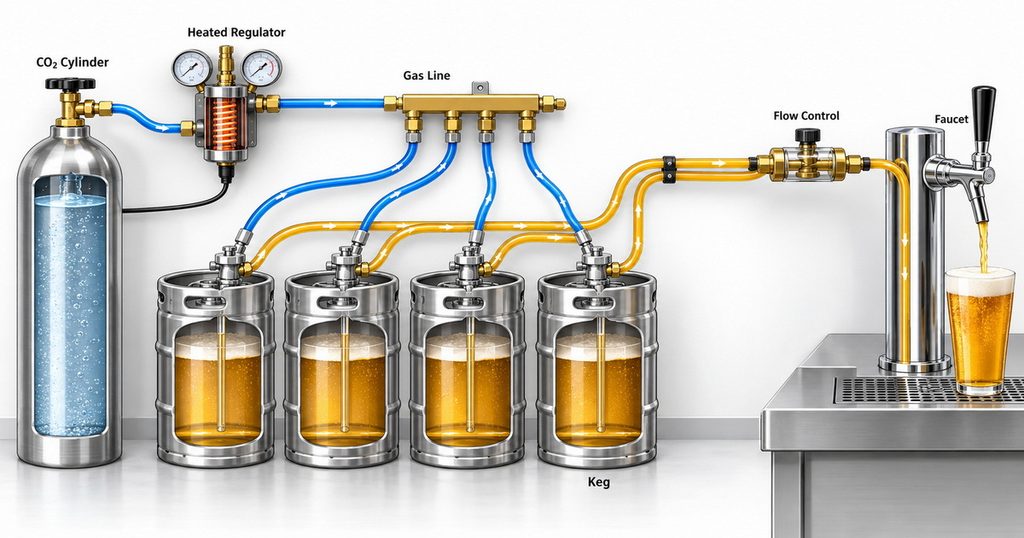
When Should You Choose a Heated CO₂ Regulator?
A heated CO₂ regulator is usually the stronger investment when your main concern is pressure consistency under high CO₂ demand.
Choose this option when you see one or more of the following conditions:
– Frost or ice repeatedly forms on the regulator during active dispensing
– The system supports many kegs or dispensing points
– Beverage service slows down during high-volume periods
– Outlet pressure becomes unstable after repeated pours
– The regulator is located in a cold room or refrigerated environment
– You use CO₂ for high-demand carbonated beverage dispensing
– You operate a long-draw dispensing network
– The gas system serves a restaurant, brewery taproom, stadium, event venue, or large beverage fountain installation
A heated regulator can also be valuable for OEM beverage-equipment manufacturers that need a more robust gas-control component for demanding commercial applications.
For an overseas brand, distributor, or system integrator, the most important specification questions include:
– What is the required inlet connection standard?
– What outlet-pressure range is required?
– What is the expected continuous CO₂ flow demand?
– Is the regulator single-stage or dual-stage?
– What heating method and power requirements apply?
– What are the brass-material, sealing, and corrosion-resistance requirements?
– Is the regulator designed for food-and-beverage gas service?
– What safety-relief and pressure-gauge configuration is required?
– Can the supplier provide private labeling, custom packaging, or OEM/ODM configuration?
Precision manufacturing matters. A regulator with poor diaphragm quality, inconsistent seat geometry, weak springs, or unreliable gauges can create pressure drift even when heating is available.
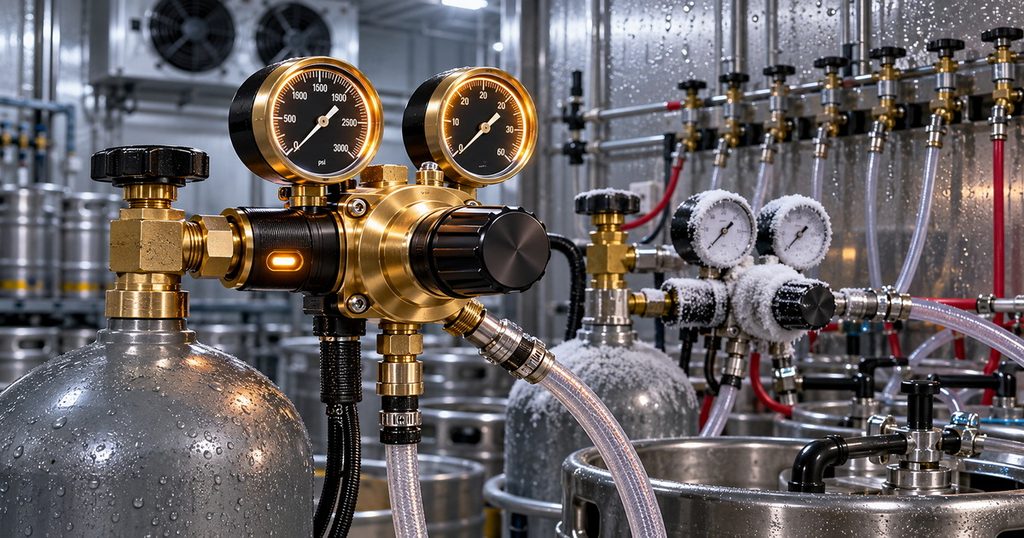
When Should You Choose a CO₂ Flowmeter?
Choose a CO₂ flowmeter or beverage flow-control device when your priority is repeatable pouring performance at the dispensing point.
This can be particularly useful for:
– Fast-pouring draft beer lines
– Short beverage lines with low resistance
– Multi-tap bars with different line lengths
– Premium beverages requiring a controlled presentation
– Cold brew coffee dispensing
– Sparkling-water stations
– Wine-on-tap systems
– Training new staff members
– Reducing product waste from over-foaming
– Troubleshooting one problem faucet without changing the entire gas system
A flowmeter can help standardize the operator’s experience. It may reduce the need for constant faucet-by-faucet adjustment, especially in systems where service speed and visual pour quality affect customer satisfaction.
Still, the right order of troubleshooting is important:
1. Confirm that the beverage is stored at the correct serving temperature.
2. Confirm that the CO₂ regulator output pressure matches the beverage and system design.
3. Inspect the gas line, keg coupler, check valves, and connectors.
4. Clean and inspect beverage lines and faucets.
5. Verify line length and internal diameter.
6. Use a flowmeter or flow-control device to fine-tune the final dispense rate.
This process avoids using a flow-control product as a patch for a pressure, refrigeration, cleaning, or line-design problem.
System Balancing: The Real Foundation of Beverage Accuracy
The best beverage dispensing accuracy comes from system balance, not from a single component.
A balanced system aligns beverage temperature, carbonation condition, gas pressure, line resistance, and faucet performance. When these factors work together, the operator can pour the intended beverage with a stable flow rate, controlled foam, and consistent sensory quality.
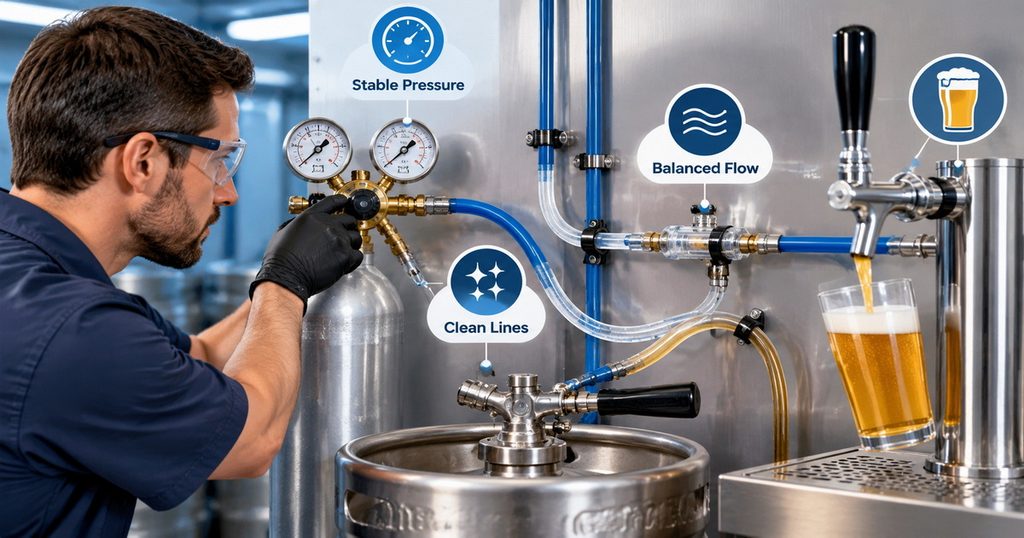
Essential System-Balancing Checklist
– Keep the beverage at a stable serving temperature.
– Match CO₂ pressure to beverage carbonation and system design.
– Use properly sized beverage tubing.
– Confirm sufficient line length to create appropriate resistance.
– Inspect gas hoses for leaks and damaged fittings.
– Use clean, food-compatible tubing and fittings.
– Maintain couplers, faucets, check valves, and manifolds.
– Check gauge accuracy and regulator response.
– Monitor frosting or abnormal temperature changes at the regulator.
– Test pours after changing pressure or flow settings.
For many standard draft-beer systems, serving pressures often fall in the low-teens PSI range. However, there is no universal “correct” setting for every installation. A long-draw system, highly carbonated beer, warm product condition, or elevated faucet may require a different approach.
Never select pressure based only on habit. Select it based on the beverage and the complete dispensing system.
A Buyer’s Guide for Beverage Equipment Brands and Distributors
For distributors, brand owners, and beverage-equipment manufacturers, product selection should go beyond price.
A strong heated CO₂ regulator should be evaluated for:
– Pressure stability across expected flow demand
– Heating efficiency under real dispensing conditions
– Brass quality and machining consistency
– Diaphragm and sealing reliability
– Gauge readability and accuracy
– Pressure-relief protection
– Inlet and outlet compatibility
– Corrosion resistance
– Leak-test and inspection procedures
– Customization capability
– Branding, packaging, and instruction-manual support
– Batch traceability and quality documentation
For a flowmeter or flow-control product, focus on:
– Compatibility with beverage-line material and size
– Maximum working pressure
– Measurement range or flow-adjustment range
– Ease of cleaning and maintenance
– Food-contact material suitability where applicable
– Installation orientation
– Visibility of the scale or indicator
– Repeatability between units
– Compatibility with existing towers, faucets, and fittings
Why OEM and ODM Capability Matters
OEM and ODM capability becomes valuable when a distributor needs more than a generic component.
A professional gas regulator manufacturer can support:
– Custom pressure ranges
– Customized inlet and outlet fittings
– Private-label logos
– Custom dial faces and gauge units
– Product colors and protective covers
– Retail or industrial packaging
– Multi-language manuals
– Product bundles for beverage dispensing kits
– Customized inspection requirements
– Market-specific configuration planning
The goal is not only to source a regulator. It is to create a reliable product platform that fits the target market’s installation practices, customer expectations, and service conditions.
Safety Considerations for CO₂ Beverage Systems
CO₂ is widely used in beverage dispensing, but it must be handled with care. It is colorless and odorless, and it can accumulate in low or enclosed areas because it is heavier than air.
CO₂ can displace oxygen and create a serious hazard in poorly ventilated spaces.
Every commercial beverage system should include appropriate safety practices:
– Secure gas cylinders upright with approved restraints.
– Protect cylinder valves from impact or damage.
– Use compatible regulators and fittings.
– Inspect hoses and connections for leaks.
– Train personnel in correct cylinder handling.
– Provide adequate ventilation in CO₂ storage areas.
– Install CO₂ detection where required by local codes or site conditions.
– Keep cylinders away from excessive heat.
– Never modify safety-relief devices or regulator components.
– Follow local fire, workplace, and compressed-gas requirements.
A heated regulator improves operational stability. It does not eliminate the need for correct ventilation, leak prevention, gas monitoring, or trained personnel.
Which Product Is Best for Your Beverage Dispensing System?
The best choice depends on the failure mode you are trying to solve.
| If Your Main Problem Is… | Better First Choice |
|---|---|
| Regulator frost during peak service | Heated CO₂ regulator |
| Pressure drops during repeated pours | Heated CO₂ regulator |
| One tap pours too quickly | Beverage flowmeter or flow-control device |
| Excessive foam across several taps | Check system balance first; heated regulator may help if gas pressure is unstable |
| Different taps need different pour speeds | Individual flow-control devices |
| Multi-keg system with high CO₂ withdrawal | Heated CO₂ regulator |
| Poor carbonation consistency | Check regulator pressure, temperature, and system balance |
| Slow or inconsistent service at busy times | Heated CO₂ regulator plus full system inspection |
| Need to monitor gas consumption | Gas-side CO₂ flowmeter may be appropriate |
| Need a private-label commercial gas-control product | OEM heated regulator manufacturer |
The most practical answer for many commercial installations is not “heated CO₂ regulator versus flowmeter.” It is heated CO₂ regulator plus properly selected flow control, supported by well-designed tubing, correct operating pressure, scheduled cleaning, and regular leak inspection.
Conclusion
A heated CO₂ regulator and a CO₂ flowmeter solve different beverage-dispensing problems. The heated regulator stabilizes gas pressure and helps prevent cold-related performance issues during high CO₂ demand. The flowmeter manages or measures flow, helping improve pouring consistency at the dispensing point.
If your operation experiences regulator frosting, pressure fluctuations, or unstable service during rush periods, prioritize a precision heated CO₂ regulator. If individual faucets pour too quickly or inconsistently, investigate a beverage flowmeter or flow-control device after confirming that the gas system and beverage lines are properly balanced.
For brands, wholesalers, and equipment manufacturers, a dependable OEM/ODM partner can help configure high-quality brass gas regulators with suitable pressure ranges, fitting standards, gauges, branding, quality controls, and packaging for the intended beverage-dispensing market. Choose a solution based on actual system demand—not on a one-size-fits-all product specification.
Frequently Asked Questions
1. Does a heated CO₂ regulator control beverage flow rate?
No. A heated CO₂ regulator controls and stabilizes CO₂ pressure. It does not directly set the beer, soda, or cold-brew pouring speed. Flow rate is affected by pressure, line resistance, temperature, faucet condition, and beverage-line design.
2. Can a CO₂ flowmeter stop a regulator from freezing?
No. A flowmeter does not heat the gas or prevent rapid cooling inside the pressure regulator. If the regulator freezes during high gas withdrawal, a heated CO₂ regulator, improved system capacity, or a properly engineered vaporization solution may be required.
3. Is a heated CO₂ regulator necessary for a single-keg system?
Not always. A standard regulator is often adequate for a low-demand, single-keg application. A heated model becomes more useful where CO₂ demand is high, service is continuous, or the regulator operates in a cold environment.
4. Why does my beer pour foam after I install a new regulator?
Foam can result from several factors, including warm beer, excessive pressure, insufficient beverage-line resistance, dirty lines, damaged seals, restricted faucets, or poor keg condition. The regulator may be working correctly, but the overall system could be unbalanced.
5. Can one heated CO₂ regulator supply multiple kegs?
Yes, if its capacity, outlet-pressure range, gas-flow performance, and distribution arrangement are suitable for the system. Multi-keg systems commonly use a primary regulator with manifolds or downstream secondary regulators to create different pressure zones.
6. Should I use a single-stage or dual-stage CO₂ regulator?
The better option depends on the application. A dual-stage design can provide enhanced pressure reduction and may be beneficial in applications requiring improved stability. The correct choice should consider inlet pressure, flow demand, required outlet pressure, operating environment, and equipment design.
7. What should I ask an OEM heated CO₂ regulator supplier?
Ask about brass grade, pressure range, continuous flow capacity, heating performance, fitting options, gauge specifications, relief-valve configuration, leakage testing, inspection process, available certifications, customization options, minimum order quantity, packaging, and lead time.
References
1. Micro Matic. “[Regulators and Reducers].” Explains the role of primary and secondary regulators in reducing cylinder pressure for beverage dispensing and providing different pressure zones. [micro-matic]
2. Micro Matic. “[Premium Plus CO₂ Regulator for Beer].” Product information on using a primary regulator to reduce cylinder pressure to usable beverage-dispensing pressure. [micromatic]
3. E-Z Systems. “[CO₂ Regulators].” Explains why heating becomes important at high CO₂ flow rates due to temperature drop during liquid-to-gas conversion. [ezsystemsinc]
4. Genstar Technologies. “[Carbon Dioxide Regulators Freezing].” Discusses freeze-up, heated two-stage regulators, and vaporization under severe CO₂ demand conditions. [genstartech]
5. Wholesale Beer Parts. “[How to Read a CO₂ Regulator].” Provides practical information on regulator gauges, draft-beer pressure ranges, adjustment procedures, line-pressure considerations, and frosting causes. [wholesalebeerparts]
6. Occupational Safety and Health Administration. “[Potential Carbon Dioxide Asphyxiation Hazard When Filling Stationary Low Pressure Carbon Dioxide Supply Systems].” Covers CO₂ accumulation hazards, workplace exposure limits, ventilation, and atmospheric monitoring practices. [osha]
7. National Institute for Occupational Safety and Health. “[NIOSH Pocket Guide to Chemical Hazards: Carbon Dioxide].” Provides exposure-limit information and hazard guidance for carbon dioxide. [cdc]
8. Compressed Gas Association. “[Carbon Dioxide Safety].” Covers CO₂ accumulation, ventilation, monitoring, and safe handling considerations. [cganet]
Hot Tags: Heated CO₂ Regulator, CO₂ Flowmeter, Beverage Dispensing Equipment, Commercial CO₂ Regulator, Draft Beer Gas Regulator, Heated Gas Regulator, CO₂ Pressure Regulator, Beverage Gas Control System, Industrial Gas Regulator Manufacturer, OEM CO₂ Regulator