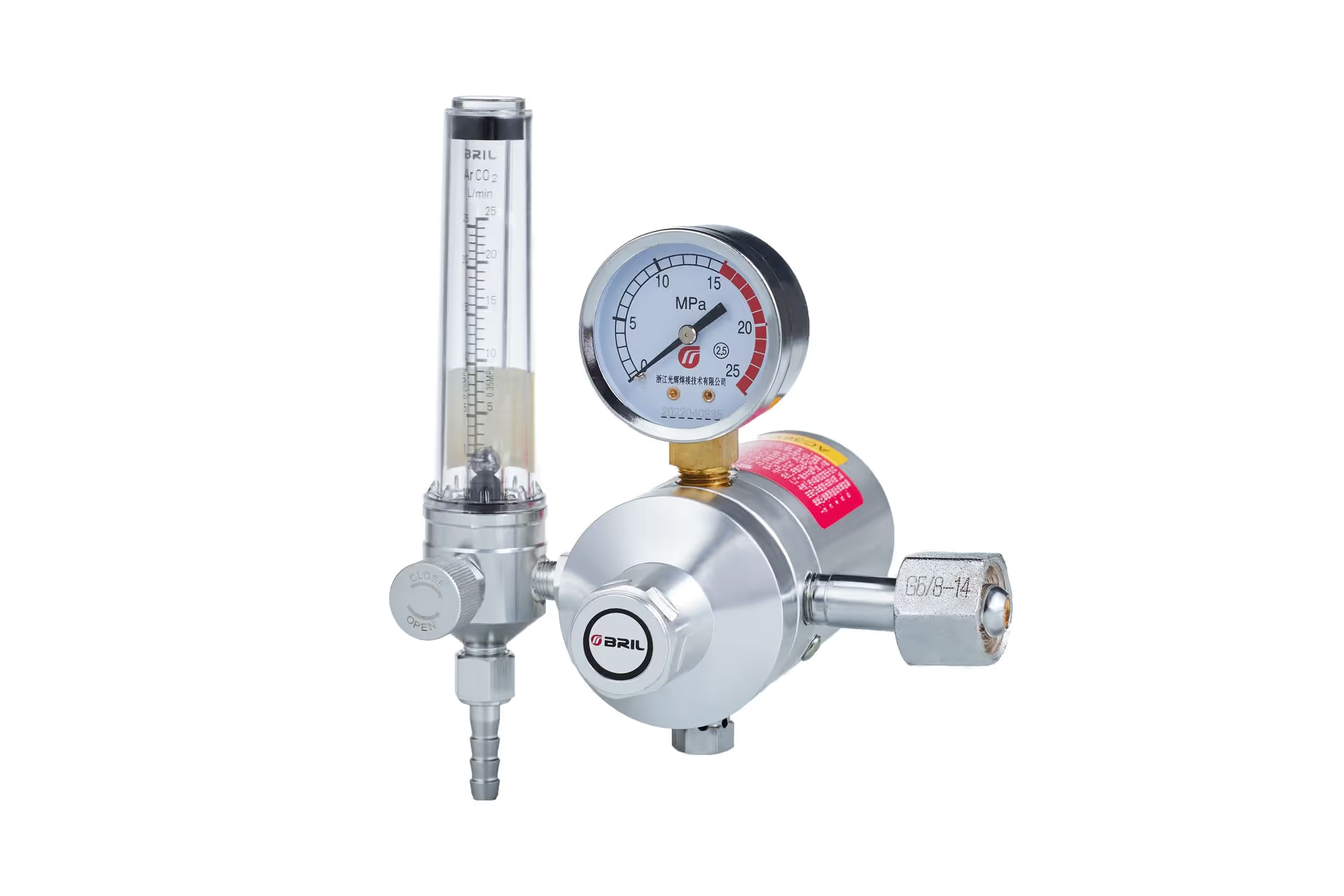
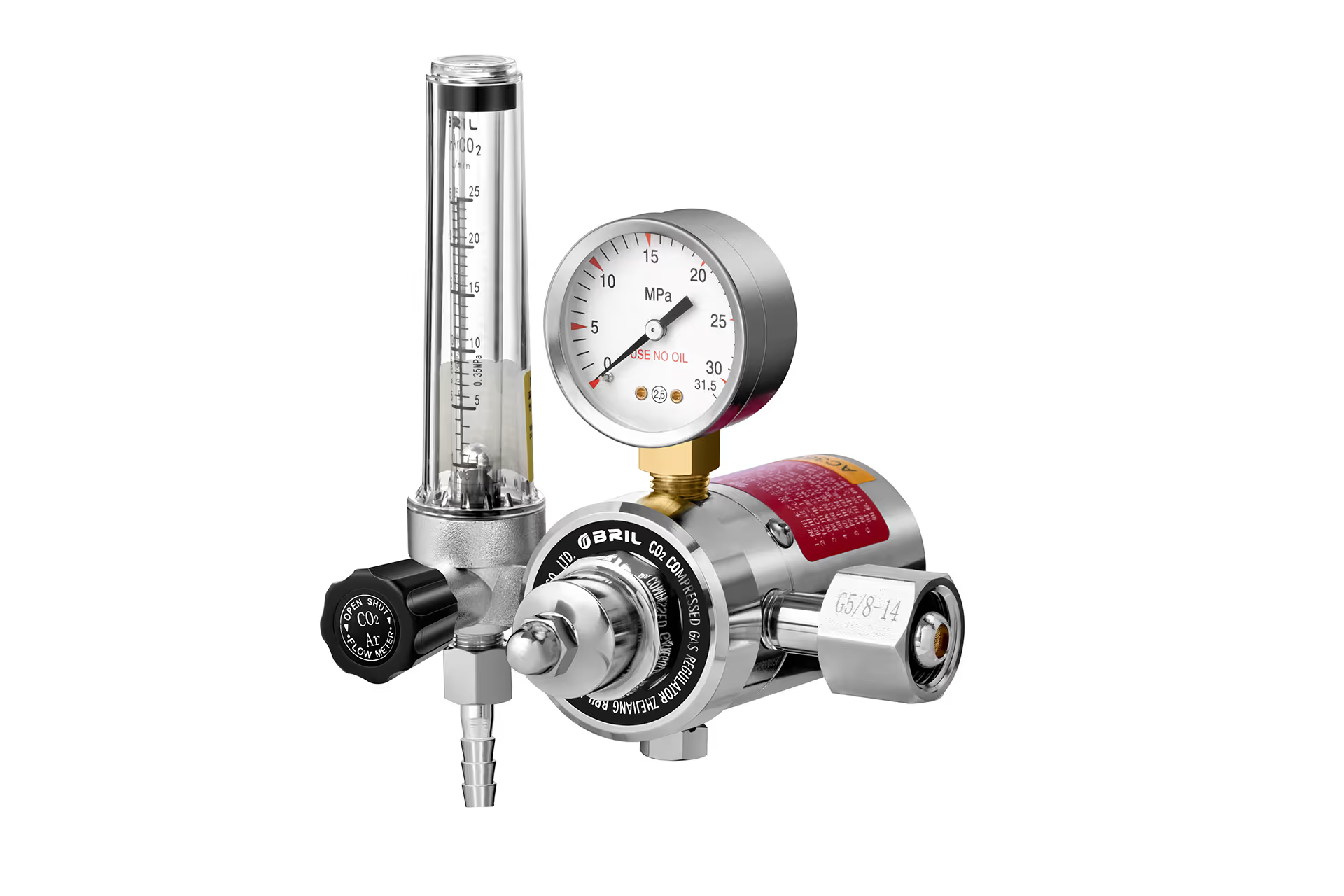
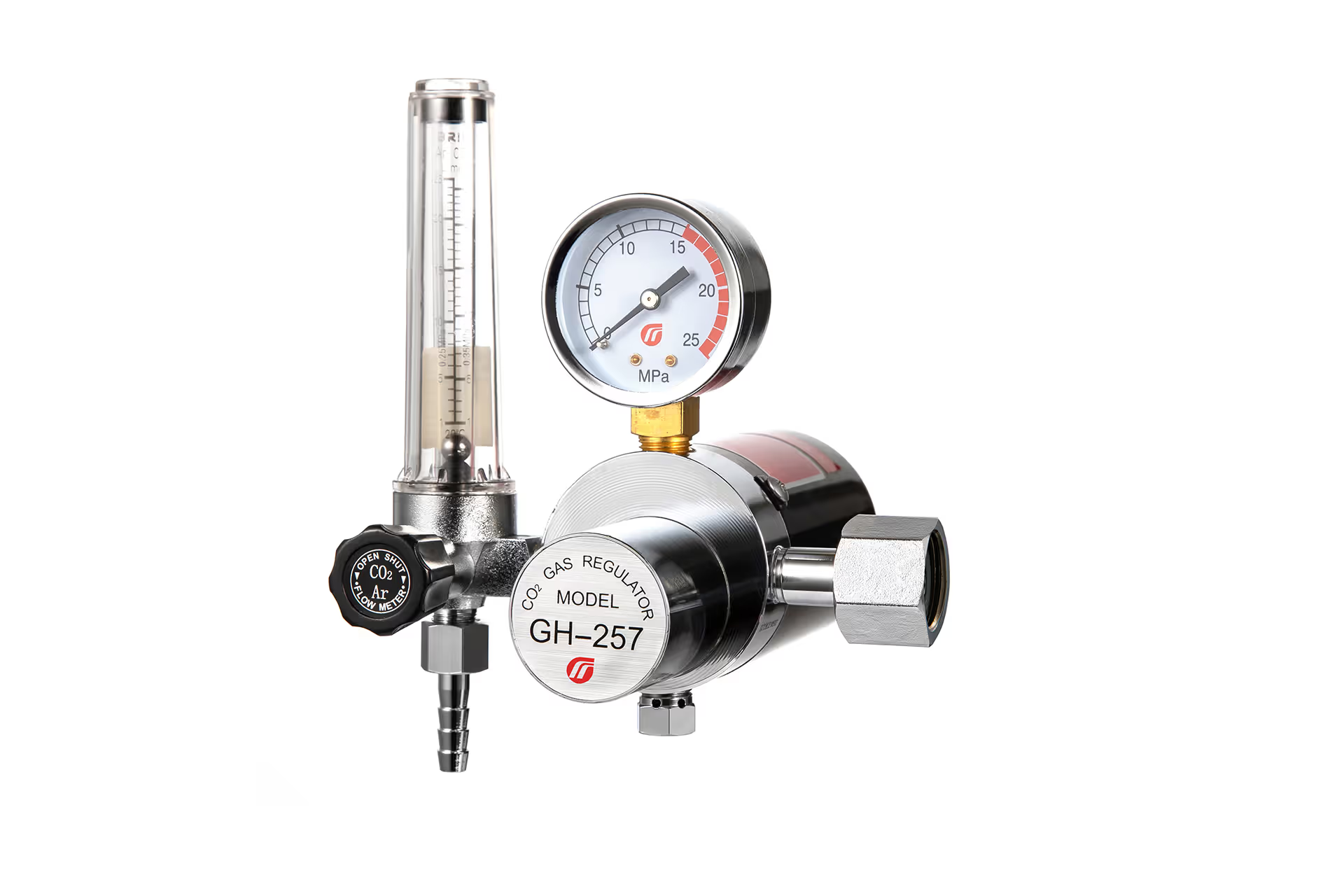
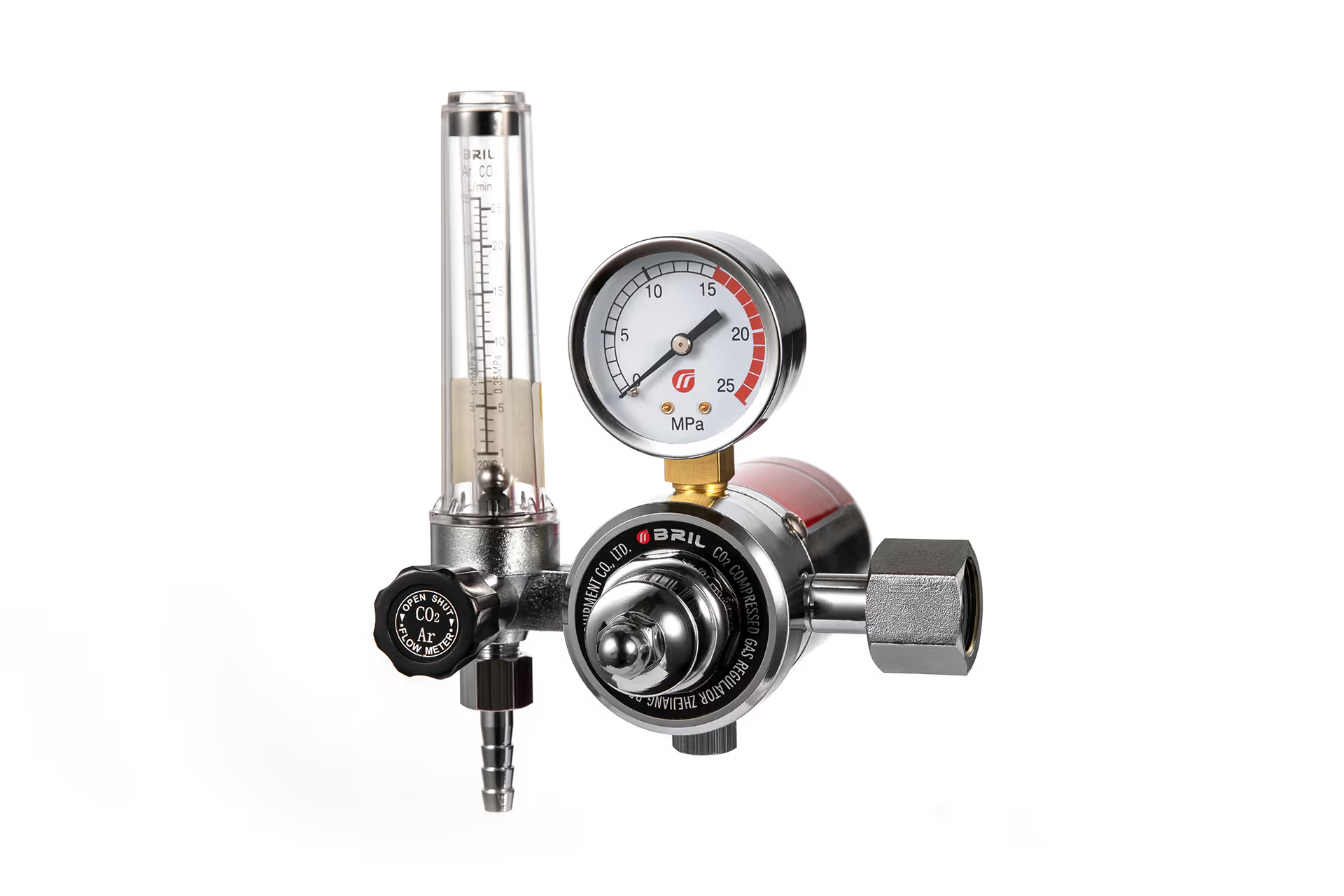
Content Menu
● Why CO₂ Regulators Freeze During Continuous MIG Welding
>> What Regulator Frosting Can Cause
● When Is a CO₂ Heated Regulator Necessary?
>> Use This Practical Decision Table
>> The Most Important Question: What Is Your Actual Duty Cycle?
● Heated CO₂ Regulator vs. Standard CO₂ Regulator
● How to Choose the Right Heated CO₂ Regulator for MIG Welding
>> 1. Confirm Gas Compatibility First
>> 2. Select the Correct Inlet Connection
>> 3. Match Flow Capacity to Real Consumption
>> 4. Evaluate Heating Performance and Electrical Requirements
>> 5. Look Beyond the Heater: Regulator Build Quality Matters
● A Practical Checklist for Preventing CO₂ Regulator Freeze-Up
>> Follow These Steps Before Every Production Shift
● Example: When a Heated Regulator Pays for Itself
● OEM and ODM Heated CO₂ Regulator Solutions
● Request a Heated CO₂ Regulator Quote
>> 1. Do I always need a heated CO₂ regulator for MIG welding?
>> 2. Why does my CO₂ regulator frost while welding?
>> 3. Will a heated CO₂ regulator improve weld quality?
>> 4. Can I use an argon regulator on a CO₂ cylinder?
>> 5. What is the difference between a single-stage and dual-stage gas regulator?
>> 6. Can I warm a frozen CO₂ regulator with a torch or open flame?
>> 7. What should an OEM buyer check before ordering heated CO₂ regulators?
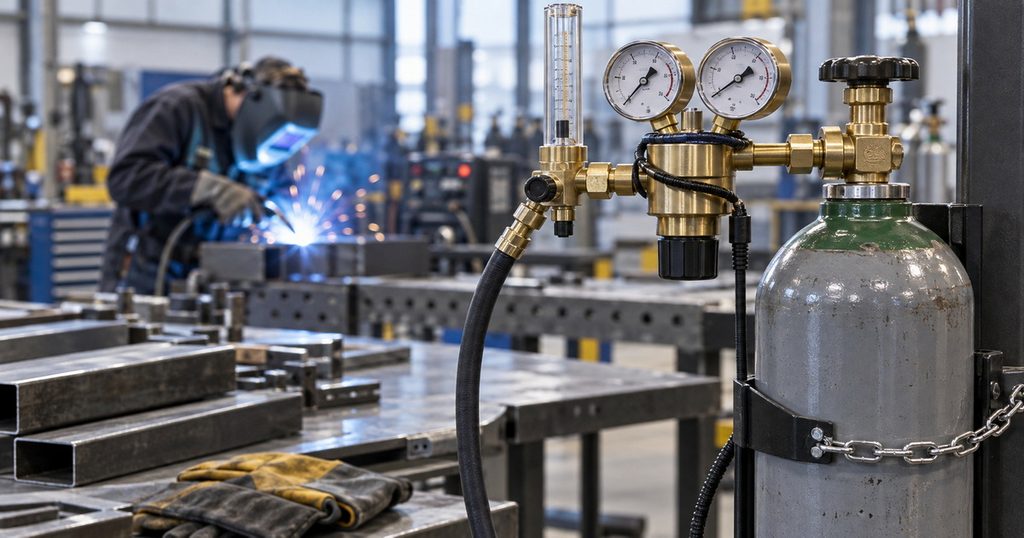
A CO₂ heated regulator is not required for every MIG welding setup. However, for continuous welding with 100% CO₂—especially at higher gas flow rates, long duty cycles, warm and humid conditions, or multi-shift production—it can be essential for preventing regulator frosting, unstable shielding-gas delivery, porosity, and unplanned downtime.
For welding distributors, OEM brands, fabricators, and industrial users, the key question is not simply “Does CO₂ freeze?” It is: Can the regulator maintain stable gas delivery during the actual welding cycle, flow demand, cylinder condition, and operating environment? A correctly specified heated CO₂ regulator helps answer that question with more consistent pressure control and a stronger margin of process reliability.
Why CO₂ Regulators Freeze During Continuous MIG Welding
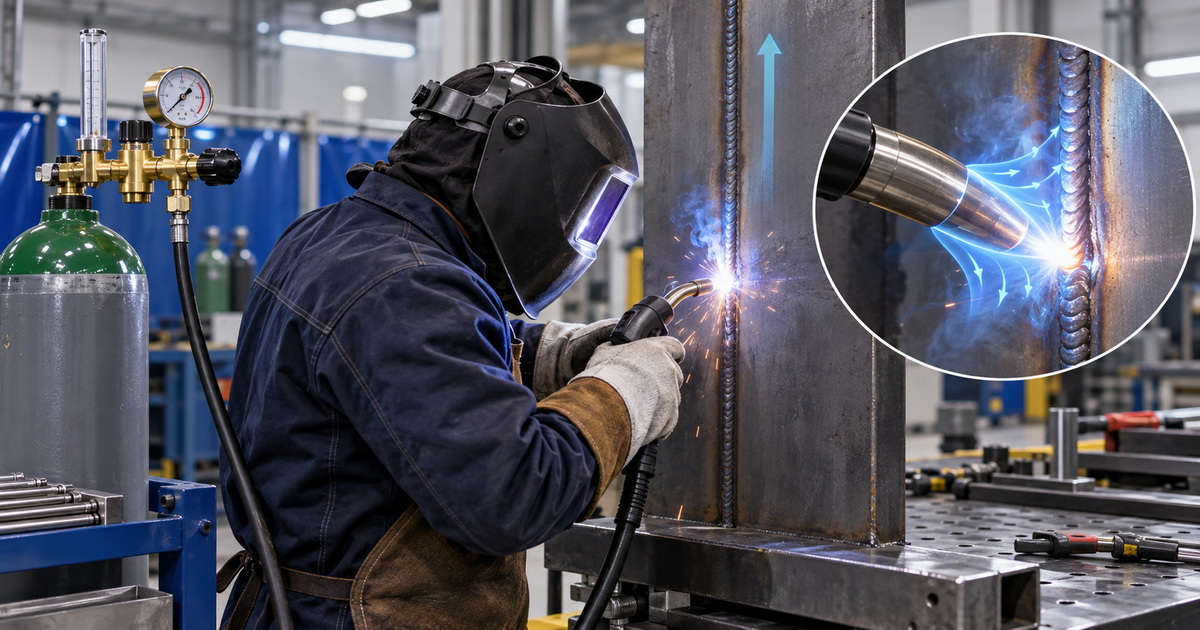
CO₂ is widely used as a shielding gas for MIG/MAG welding because it is economical, readily available, and capable of producing good penetration in many carbon-steel applications. But CO₂ behaves differently from argon and many argon-rich mixtures.
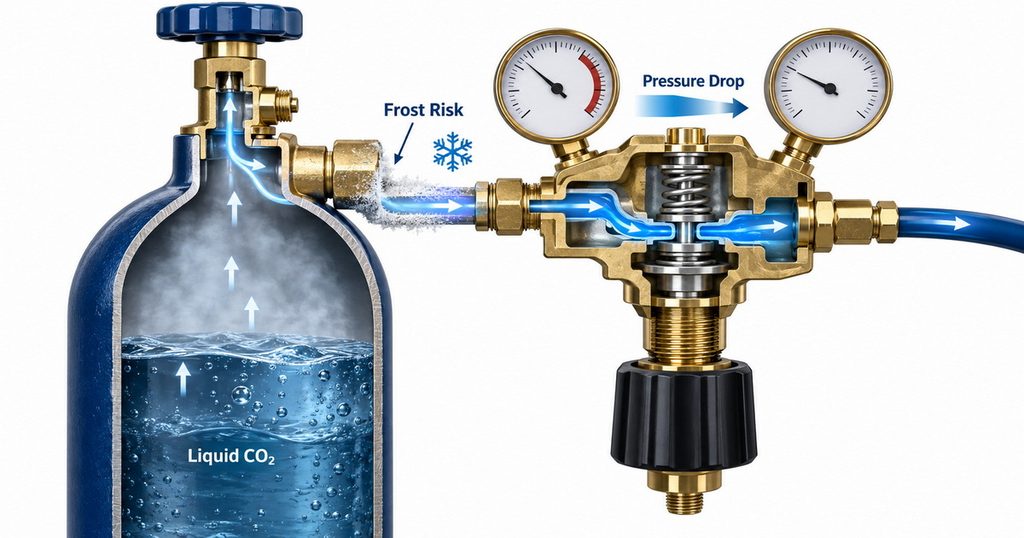
In a CO₂ cylinder, the gas is commonly stored partly as liquid CO₂ and partly as vapor under pressure. When gas is drawn from the cylinder, liquid CO₂ must vaporize to replace the gas being consumed. That phase change absorbs heat. Then, as the gas pressure drops through the cylinder valve and regulator, the gas temperature can decrease further.
Under sustained demand, the regulator body, inlet, valve area, and flow-control components can become cold enough for moisture in the surrounding air to condense and form frost. In more severe cases, ice can interfere with stable gas flow.
This is why a standard regulator may work perfectly during short welds but begin frosting during extended welding cycles.
What Regulator Frosting Can Cause
A frosted CO₂ regulator is not automatically a failure. Light external frost can occur without immediately affecting operation. The concern begins when cooling affects the regulator’s ability to maintain a stable outlet pressure or gas flow.
Potential consequences include:
– Unstable shielding-gas flow
– Inconsistent arc characteristics
– Increased risk of weld porosity
– Inconsistent bead appearance
– Excessive spatter or reduced weld quality
– Interrupted production cycles
– Frequent operator adjustments
– Premature wear or contamination risks for unsuitable regulator designs
For production welding, a gas-control issue can rapidly become a quality-control issue. A welding operator may initially blame the wire feeder, gun liner, contact tip, power source, or welding parameters—while the underlying problem is actually inconsistent CO₂ delivery.
When Is a CO₂ Heated Regulator Necessary?
A heated CO₂ regulator becomes increasingly valuable when gas demand is sustained, high, or operationally critical. It is designed to add controlled heat around the regulator or gas-entry area, reducing the risk that low temperatures will disrupt flow stability.
A heater is often not necessary for light hobby welding, occasional repair work, or intermittent low-flow applications. But it can be a smart investment in industrial MIG welding environments where consistency matters more than the initial cost of the regulator.
Use This Practical Decision Table
| Welding Condition | Heater Usually Needed? | Why It Matters |
|---|---|---|
| Occasional home MIG welding | Usually no | Short arc-on time normally allows the regulator to recover heat from the environment |
| Light repair or maintenance work | Usually no | Gas consumption is intermittent and demand remains relatively low |
| Long weld beads with 100% CO₂ | Often yes | Continuous gas draw can cool the regulator faster than ambient heat can replace it |
| High-volume fabrication | Recommended | Repeated cycles and high daily gas consumption increase frosting risk |
| Automated or robotic welding | Strongly recommended | Process consistency is critical; interruptions can create reject parts and downtime |
| Multiple shifts or continuous production | Strongly recommended | Sustained duty cycles place higher thermal demand on the regulator |
| Warm and humid workshop conditions | Often yes | Moisture in the air makes visible frost and icing more likely |
| High shielding-gas flow demand | Often yes | Greater gas flow can increase cooling across the regulator |
| Low cylinder level or high withdrawal rate | Recommended | Cylinder vaporization capacity may become a limiting factor |
| Argon-rich shielding gas applications | Depends | Argon systems generally have different freezing behavior, but regulator selection must still match the gas and duty cycle |
As a practical industry rule, frosting is more likely when pure CO₂ is used at sustained high flow. One welding-industry guide notes that CO₂ regulator freezing often begins during prolonged use at flow rates above approximately 25 CFH, although the exact point varies with cylinder size, gas purity, ambient temperature, humidity, regulator design, and welding duty cycle.
The Most Important Question: What Is Your Actual Duty Cycle?
Do not select a heater solely based on the maximum rated flow printed on a regulator. Instead, evaluate real working conditions:
1. How long is the arc continuously on?
2. How many welding stations share the same gas source?
3. What gas flow rate is used at the nozzle?
4. Is the shielding gas 100% CO₂ or an argon/CO₂ blend?
5. How warm and humid is the production environment?
6. Does frosting occur only at the end of a cylinder’s service life?
7. Are operators repeatedly adjusting flow due to inconsistent weld appearance?
8. Would even a short gas interruption create scrap, rework, or production delays?
For a small fabrication shop, the answer may be a standard CO₂ regulator with proper maintenance. For a production line welding hundreds of carbon-steel assemblies each day, a heated CO₂ regulator can be a low-cost safeguard against much more expensive disruption.
Heated CO₂ Regulator vs. Standard CO₂ Regulator
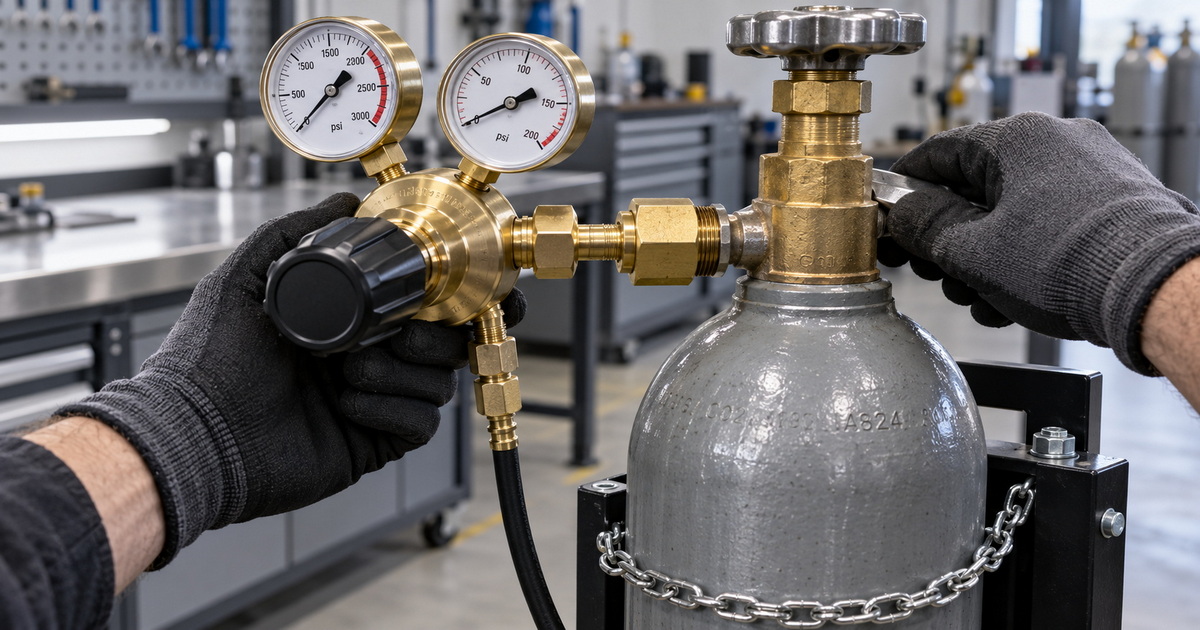
A standard CO₂ regulator reduces cylinder pressure to a usable working pressure or flow level. A heated CO₂ regulator performs the same pressure-control function while adding a heating element or heating mechanism to help offset the temperature drop associated with CO₂ vaporization and pressure reduction.
| Feature | Standard CO₂ Regulator | CO₂ Heated Regulator |
|---|---|---|
| Basic pressure reduction | Yes | Yes |
| Flow adjustment for MIG welding | Yes, depending on design | Yes, depending on design |
| Protection against frosting | Limited | Enhanced |
| Suitable for intermittent welding | Yes | Yes |
| Suitable for extended continuous welding | May be limited | Better suited |
| Recommended for high-throughput production | Depends on conditions | Often preferred |
| Initial cost | Lower | Higher |
| Process stability under heavy CO₂ draw | Can decline if icing occurs | More stable when correctly specified |
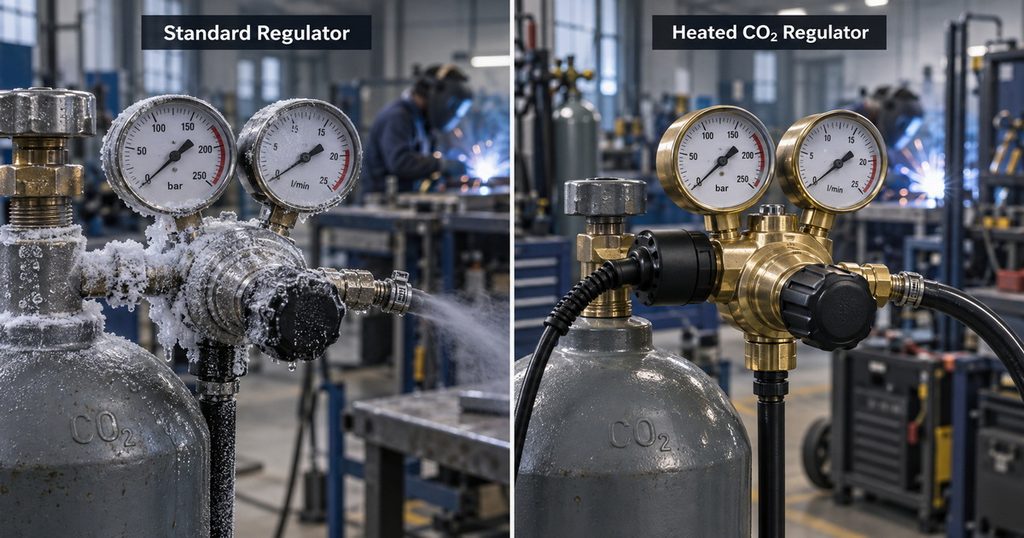
The heater does not replace proper regulator engineering. A reliable industrial CO₂ heated regulator should still include the correct inlet connection, pressure range, internal sealing design, brass body material, gauges or flow-control components, and manufacturing tolerances for the intended gas and application.
For U.S.-market CO₂ cylinders, the inlet connection is commonly CGA-320, while many argon and argon/CO₂ welding-gas cylinders use CGA-580 fittings. Using the wrong regulator, forcing an incompatible connection, or relying on a poorly selected adapter can create leakage, thread damage, and unsafe operating conditions.
How to Choose the Right Heated CO₂ Regulator for MIG Welding
Selecting a CO₂ heated regulator requires more than choosing a product labeled “heated.” The regulator must match the cylinder connection, gas type, outlet requirements, welding process, and duty cycle.
1. Confirm Gas Compatibility First
Use a regulator designed specifically for CO₂ service. A regulator intended only for argon or an argon-rich blend may not be suitable for continuous pure CO₂ use.
A CO₂ regulator should be compatible with:
– 100% CO₂ shielding gas
– Applicable cylinder-valve connection
– Required operating pressure or flow range
– MIG/MAG welding gas hose configuration
– Expected ambient temperature
– Projected gas-consumption rate
Do not treat all welding regulators as interchangeable. Gas-specific connections and regulator designs exist to reduce the risk of attaching an unsuitable regulator to a cylinder.
2. Select the Correct Inlet Connection
Connection compatibility is fundamental. In the United States, CO₂ cylinders commonly use CGA-320 connections, whereas argon and many mixed-gas cylinders commonly use CGA-580 connections.
For export brands and distributors, connection standards may vary by destination market. OEM and ODM suppliers should therefore confirm:
– Country or region of sale
– Cylinder-valve standard
– Nut and nipple specification
– Thread size
– Washer or seal requirement
– Hose fitting type
– Required labeling language
– Applicable certification and product-marking needs
This is especially important for private-label gas regulators. A visually similar regulator may require different fittings for North America, Europe, Australia, Latin America, or other markets.
3. Match Flow Capacity to Real Consumption
Do not overspecify or underspecify the regulator. An undersized regulator may struggle under sustained demand. An oversized configuration can reduce adjustment precision at low operating flows.
Evaluate:
– Maximum required shielding-gas flow
– Typical working flow
– Number of welding guns
– Arc-on time per shift
– Welding process type
– Nozzle diameter
– Drafts or ventilation conditions around the weld zone
– Whether the system uses a single cylinder, manifold, or bulk supply
For many conventional MIG welding applications, shielding-gas settings are often in the range of roughly 15–30 CFH, but the correct setting depends on the welding process, nozzle configuration, wire size, welding position, gas mixture, joint design, and environmental drafts. Use the equipment manufacturer’s guidance and validate coverage through weld-quality monitoring rather than simply raising flow to the highest possible setting.
4. Evaluate Heating Performance and Electrical Requirements
A heated regulator should provide controlled, reliable warming without creating unnecessary safety or maintenance complexity.
Before specifying a model, confirm:
– Heater voltage and power requirement
– Plug type and market compatibility
– Thermostatic or temperature-control design
– Cable length and insulation
– Heater placement around the regulator
– Protection against accidental contact or damage
– Suitability for workshop temperature and humidity
– Serviceability of electrical components
– Required operating instructions and warning labels
A good OEM supplier should be able to customize not only logo and packaging, but also power options, cable configuration, connector type, gauge face design, outlet fittings, pressure range, and documentation for the target market.
5. Look Beyond the Heater: Regulator Build Quality Matters
Heating performance is only one part of the product. For industrial users, the regulator must also deliver stable adjustment, repeatable output, durable threads, dependable sealing, and long service life.
Key quality indicators include:
– High-quality brass body material for strength and corrosion resistance
– Precision-machined internal components
– Stable diaphragm and valve performance
– Clear, readable gauges
– Reliable pressure adjustment
– Gas-compatible seals
– Leak testing and functional testing
– Consistent assembly control
– Traceable quality-inspection procedures
For distributors and overseas brands, product consistency matters as much as individual unit performance. A regulator that works well in a sample test but shows inconsistent adjustment, leakage, or gauge accuracy in mass production can damage customer trust quickly.
A Practical Checklist for Preventing CO₂ Regulator Freeze-Up
A heated regulator is one solution—but not the only control measure. Before replacing equipment, review the complete gas-delivery system.
Follow These Steps Before Every Production Shift
1. Inspect the regulator body, gauges, hose, fittings, and cylinder valve for damage.
2. Confirm that the regulator is approved for CO₂ and that the inlet fitting matches the cylinder valve.
3. Keep oil, grease, dirt, and moisture away from regulator connections. Contamination can interfere with sealing and may be especially hazardous when working with oxidizing gases such as oxygen.
4. Open the cylinder valve slowly while standing to the side of the regulator. Safe regulator-handling practices recommend avoiding the front of the regulator when pressurizing the system.
5. Perform a leak test at the inlet and outlet connections using an appropriate leak-detection solution. If a leak is found, close the cylinder valve and correct the problem before welding.
6. Set shielding-gas flow based on the welding application, not guesswork. Excess flow can waste gas and may contribute to turbulence around the weld pool.
7. Monitor for frost during extended welding cycles. Light frost may be manageable; declining flow stability, erratic weld results, or repeated icing indicate a need for corrective action.
8. Avoid improvised heating methods. Do not use open flames, uncontrolled heating devices, or unsafe electrical equipment to warm cylinders or regulators. Industry safety guidance specifically warns against heating cylinders to raise gas pressure.
9. Close the cylinder valve when the system is not in use and relieve downstream pressure according to your operating procedure. Do not rely on the regulator alone as the primary shutoff method.
10. Remove damaged, leaking, or unreliable regulators from service. Regulators should be serviced, tested, and repaired only by qualified personnel.
Example: When a Heated Regulator Pays for Itself
Consider a medium-volume steel fabrication workshop using 100% CO₂ for MIG welding on structural brackets. Operators weld repeatedly throughout an eight-hour shift. During short jobs, the existing regulator appears normal. During prolonged production runs, visible frost develops around the regulator inlet and flow begins fluctuating.
The team responds by increasing gas flow, assuming the problem is inadequate shielding. This creates greater gas consumption but does not solve the root cause. Welds begin showing intermittent porosity, and operators spend time checking wire feed, consumables, and power-source settings.
A better process would be:
– Confirm the regulator is specifically rated for CO₂ service.
– Conduct a leak test on all connections.
– Verify actual gas flow with a calibrated flow-check device.
– Review duty cycle and gas-demand pattern.
– Inspect cylinder condition and replacement timing.
– Install a heated CO₂ regulator if sustained cooling is affecting stable delivery.
– Record weld-quality results before and after the equipment change.
The value of a heated regulator is therefore not simply “less frost.” The business value can include more repeatable weld quality, less troubleshooting time, lower scrap risk, fewer production interruptions, and stronger confidence in the gas-control system.
OEM and ODM Heated CO₂ Regulator Solutions
For overseas welding brands, industrial distributors, and gas-equipment wholesalers, a dependable CO₂ heated regulator must balance performance, compliance needs, cost targets, and market-specific configuration.
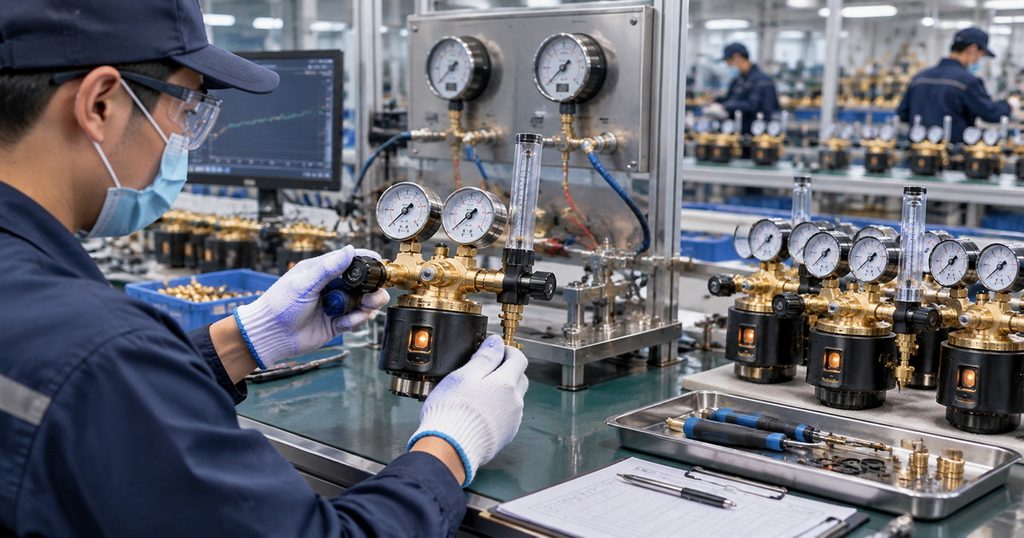
As a professional gas regulator manufacturer and supplier, we support customized gas-control solutions for:
– CO₂ heated regulators for continuous MIG/MAG welding
– Standard CO₂ welding regulators
– Argon regulators
– Oxygen regulators
– Acetylene regulators
– Propane regulators
– Nitrogen regulators
– Dual-stage gas regulators
– Customized industrial gas-control assemblies
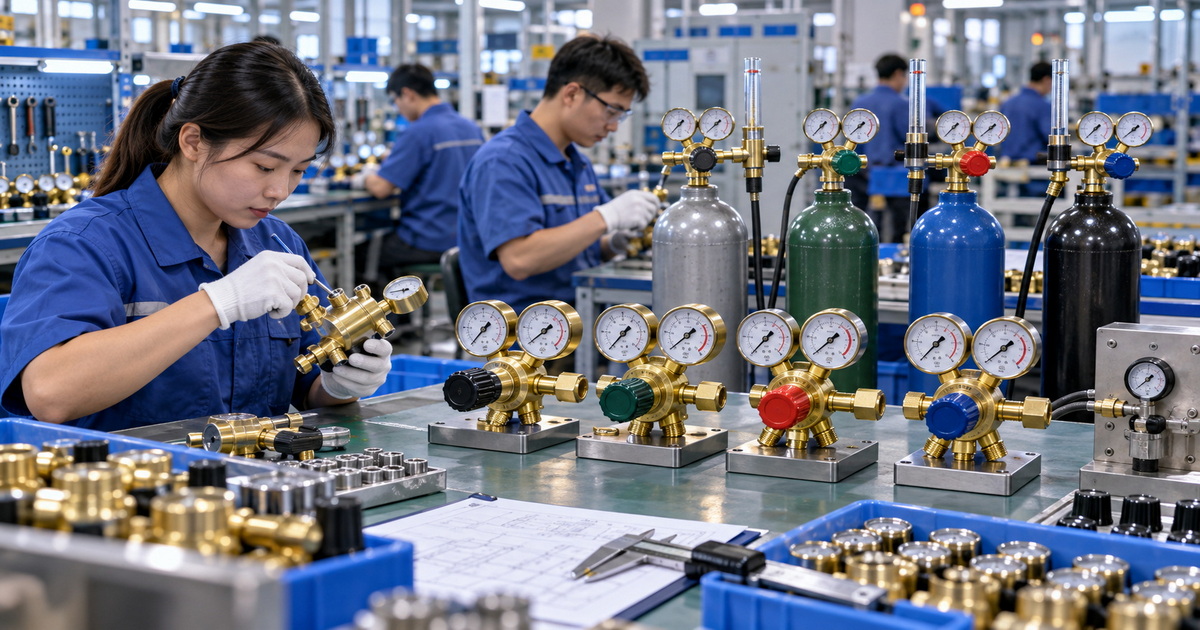
Our OEM and ODM capabilities can support brand owners and distributors with options such as:
– Private-label logos and branded packaging
– Customized inlet and outlet fittings
– Market-specific thread standards
– Pressure-range and flow-range configuration
– Gauge design, dial artwork, and language customization
– Heater voltage and plug customization
– Brass-body and component configuration
– Product manuals, warning labels, and carton specifications
– Sampling, inspection, and mass-production quality control
For industrial applications, stable pressure control begins with the correct regulator design—and continues through material selection, machining accuracy, assembly discipline, leak testing, and final inspection.
Request a Heated CO₂ Regulator Quote
If your welding application involves continuous MIG welding, high CO₂ consumption, automated welding cells, or recurring regulator frosting, choose a gas-control solution designed for your real operating conditions.
Contact us for an OEM or ODM heated CO₂ regulator proposal with customized fittings, pressure range, heater configuration, branding, packaging, and quality-inspection requirements for your market.
Frequently Asked Questions
1. Do I always need a heated CO₂ regulator for MIG welding?
No. A standard CO₂ regulator can be suitable for occasional, low-flow, or intermittent welding. A heated regulator is more beneficial for prolonged welding, high-duty-cycle work, automated welding, high gas demand, humid workshops, and production environments where flow stability is critical.
2. Why does my CO₂ regulator frost while welding?
Frost develops because CO₂ absorbs heat as liquid CO₂ vaporizes in the cylinder and as gas pressure drops through the regulator. If the regulator becomes colder than the surrounding air’s dew or freezing point, moisture can condense and freeze on its surface.
3. Will a heated CO₂ regulator improve weld quality?
It can improve process consistency when regulator freezing or unstable gas delivery is contributing to weld defects. It does not automatically correct problems caused by contaminated gas, leaks, poor welding parameters, damaged consumables, excessive drafts, or incorrect wire-feed settings.
4. Can I use an argon regulator on a CO₂ cylinder?
Only if the regulator and connection arrangement are specifically approved and correctly configured for CO₂ service. CO₂ cylinders commonly use CGA-320 connections in the United States, while argon and many argon/CO₂ mixtures commonly use CGA-580. Never force incompatible connections.
5. What is the difference between a single-stage and dual-stage gas regulator?
A single-stage regulator reduces cylinder pressure in one step and is often suitable for many welding applications. A dual-stage regulator reduces pressure in two stages, helping provide more stable outlet pressure as inlet cylinder pressure changes. Dual-stage designs can be valuable when pressure stability is especially important, although the correct choice depends on the process, gas, flow demand, and system design.
6. Can I warm a frozen CO₂ regulator with a torch or open flame?
No. Never use an open flame or uncontrolled heat source on a gas cylinder or regulator. Do not heat a cylinder to increase pressure. Use purpose-designed equipment, follow the regulator manufacturer’s instructions, and remove unsafe equipment from service.
7. What should an OEM buyer check before ordering heated CO₂ regulators?
Confirm gas compatibility, inlet connection, outlet configuration, flow and pressure range, heater voltage, plug type, gauge requirements, brass material quality, sealing design, test procedures, label requirements, packaging, and destination-market regulations. Ask for drawings, samples, inspection criteria, and production consistency controls before placing volume orders.
References
1. Occupational Safety and Health Administration. [29 CFR 1910.253—Oxygen-Fuel Gas Welding and Cutting]. Covers requirements for welding and cutting equipment, including safe handling of compressed-gas systems. [osha]
2. Occupational Safety and Health Administration. [29 CFR 1926.350—Gas Welding and Cutting]. Includes construction-related requirements for gas cylinders, regulators, and valve-protection measures. [osha]
3. Canadian Centre for Occupational Health and Safety. [Storage and Handling of Compressed Gas Cylinders]. Provides guidance on safe cylinder handling and leak checking at regulator connections. [ccohs]
4. Washington University Environmental Health & Safety. [Compressed Gas Safety Guidelines]. Covers compatible regulators, clean connections, leak checks, safe pressurization, valve closure, and qualified regulator service. [ehs.wustl]
5. AIMS Industrial. [Welding Gas Regulator Guide: Argon, CO₂, Oxygen]. Discusses CO₂ freeze risk during sustained flow and the practical use of heated CO₂ regulators. [aimsindustrial.com]
6. Weld Guru. [MIG Welding Gas Pressure Settings]. Discusses CO₂ regulator freezing and the distinction between CGA-320 CO₂ connections and CGA-580 welding-gas connections. [weldguru]
7. Weld It U. [MIG Welding With 100% CO₂ Shielding Gas]. Explains the cooling effect associated with CO₂ pressure reduction, frosting risk, and the importance of CO₂-compatible equipment. [welditu]
8. National Environmental Trainers. [Compressed Gas Safety]. Provides safety guidance on regulator use, cylinder valves, compatible fittings, and avoiding cylinder heating. [natlenvtrainers]
Hot Tags: CO₂ Heated Regulator, CO₂ Welding Regulator, MIG Welding Gas Regulator, Heated CO₂ Flowmeter Regulator, Industrial Gas Regulator, CO₂ Regulator Manufacturer, Welding Gas Regulator Supplier, OEM Gas Regulator, Dual Stage Gas Regulator, Gas Pressure Regulator