Content Menu
● What You Need Before Attaching a CO₂ Regulator
>> Essential Equipment Checklist
● Verify That You Have the Correct CO₂ Regulator
>> CO₂ Regulator Selection by Application
● Step-by-Step: How to Attach a CO₂ Regulator to a CO₂ Tank
>> 1. Secure the CO₂ Cylinder Upright
>> 2. Inspect the Cylinder Valve and Regulator
>> 3. Close the Regulator Adjustment Knob
>> 4. Remove the Cylinder Valve Protection Cap
>> 5. Confirm the Correct Seal and Connection Type
>> 6. Attach the Regulator to the CO₂ Cylinder Valve
>> 7. Connect the Outlet Hose or Downstream Equipment
>> 8. Stand to the Side and Open the Cylinder Valve Slowly
>> 9. Set the Required Working Pressure or Flow
>> 10. Perform a Leak Test Before Use
● Common Mistakes When Connecting a CO₂ Regulator
>> Using the Wrong Regulator or Adapter
>> Opening the Cylinder Valve Too Fast
>> Forgetting to Back Out the Adjustment Knob
>> Using PTFE Tape Without Manufacturer Approval
>> Moving a Cylinder With the Regulator Installed
● When a Heated CO₂ Regulator Is the Better Choice
● Expert Maintenance and Shutdown Procedure
● Why Regulator Quality Matters for Industrial CO₂ Control
● Need a Reliable CO₂ Regulator for Your Market?
● FAQ
>> 1. Do I need a special regulator for a CO₂ tank?
>> 2. Should I use a washer when attaching a CO₂ regulator?
>> 3. Why is my CO₂ regulator freezing?
>> 4. Can I use an argon regulator on a CO₂ cylinder?
>> 5. How tight should a CO₂ regulator connection be?
>> 6. Why does my CO₂ tank pressure gauge stay high until the tank is nearly empty?
>> 7. Should I open a CO₂ cylinder valve fully?
Attaching a CO₂ regulator to a CO₂ tank is a straightforward task when you use the correct regulator, connection standard, seal, and safety procedure. However, CO₂ cylinders store gas at high pressure, so improper installation can cause leaks, damaged fittings, unstable output pressure, equipment failure, or personal injury.
As a professional manufacturer and supplier of CO₂ regulators, heated CO₂ regulators, argon regulators, oxygen regulators, acetylene regulators, propane regulators, nitrogen regulators, and dual-stage gas regulators, we recommend treating cylinder connection as a controlled safety process—not simply “tightening a nut.” The correct procedure protects the regulator seat, diaphragm, gauges, hose, downstream equipment, and operator.
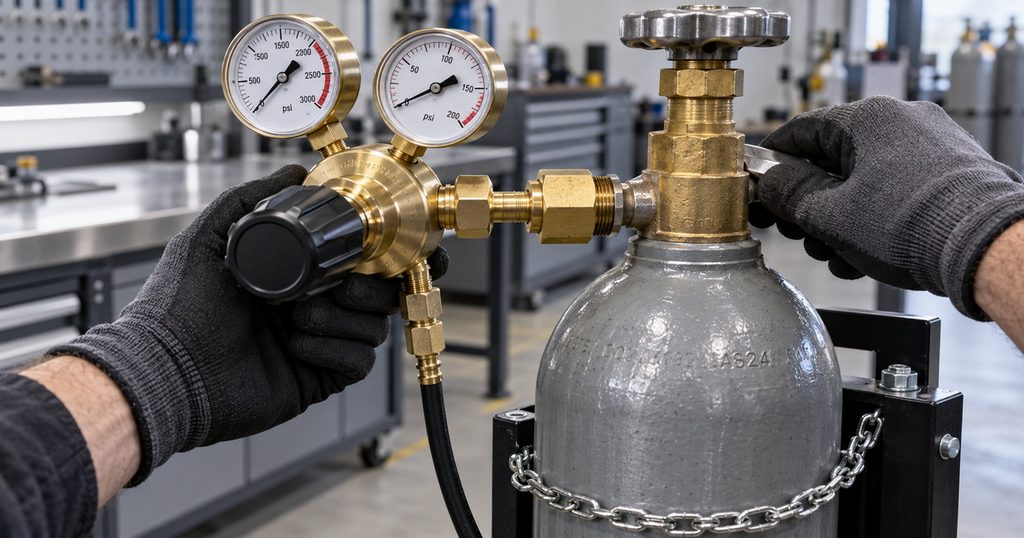
What You Need Before Attaching a CO₂ Regulator
Before connecting anything, confirm that every component is compatible. A regulator may look similar to another gas regulator, but gas-service compatibility, inlet threads, pressure rating, materials, sealing method, and outlet connection can differ.
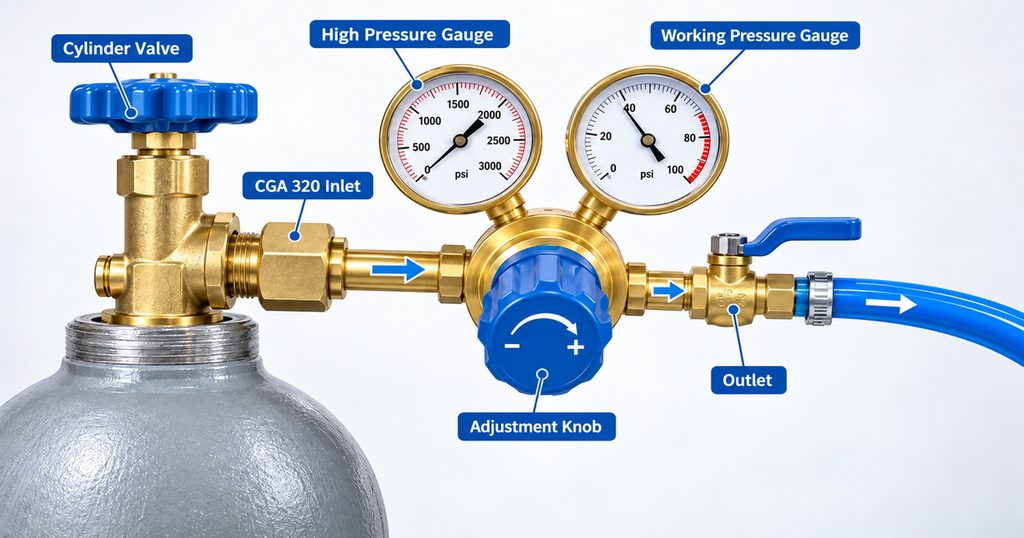
For many North American CO₂ cylinders, the common inlet connection is CGA-320. Industrial CO₂ regulators sold for welding applications commonly use this connection type. However, connection standards can vary by country, cylinder supplier, application, and gas package. Never force a regulator onto a valve that does not match correctly.
Essential Equipment Checklist
Prepare the following items before installation:
– A CO₂-compatible pressure regulator or CO₂ flowmeter regulator
– A CO₂ cylinder that is upright, secured, and within inspection requirements
– The correct cylinder-to-regulator seal or washer, if required by the regulator design
– A suitable regulator wrench or correctly sized spanner
– Approved CO₂ hose, tubing, flowmeter, or downstream equipment
– Leak-detection solution, such as commercially approved leak-detection fluid or mild soapy water
– Appropriate personal protective equipment for the application, such as safety glasses and gloves
– A cylinder cart, chain, bracket, or stand to prevent tipping
A regulator should be selected not only by its inlet connection, but also by its required outlet pressure, flow demand, application, gas purity requirements, and duty cycle. For example, a regulator for a low-flow aquarium system is not automatically suitable for high-demand MIG welding or a continuous industrial process.
Verify That You Have the Correct CO₂ Regulator
The first and most important rule is simple: use a regulator designed for the gas and pressure range involved. Safety guidance consistently states that regulators must be used only with gases and pressures for which they are intended.
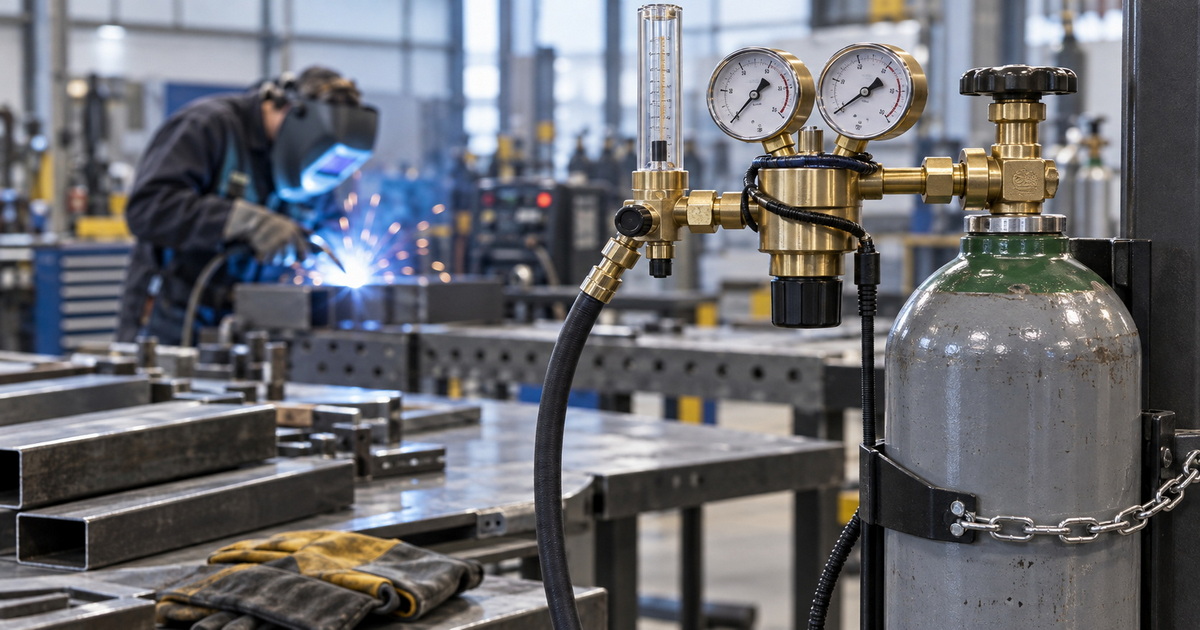
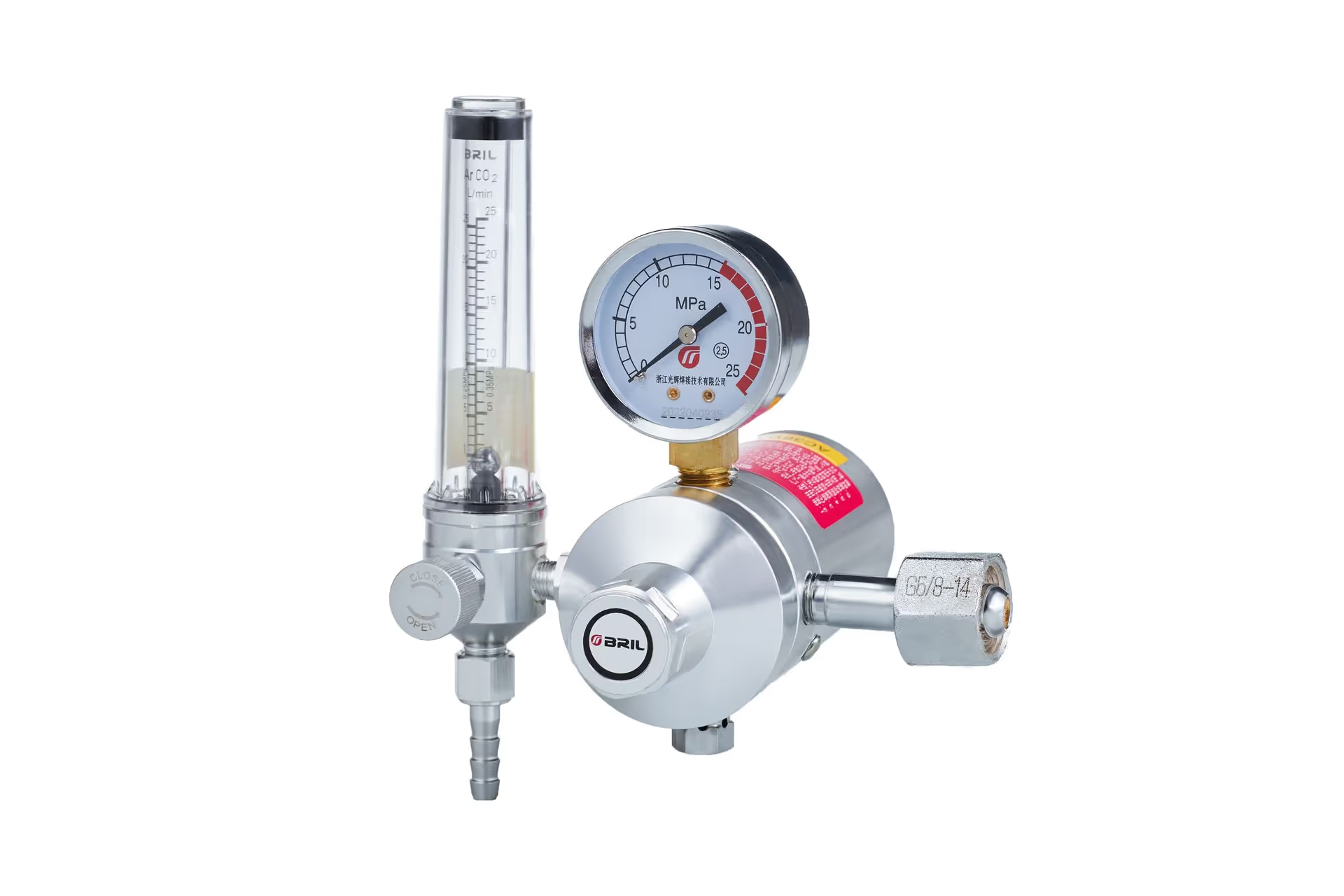
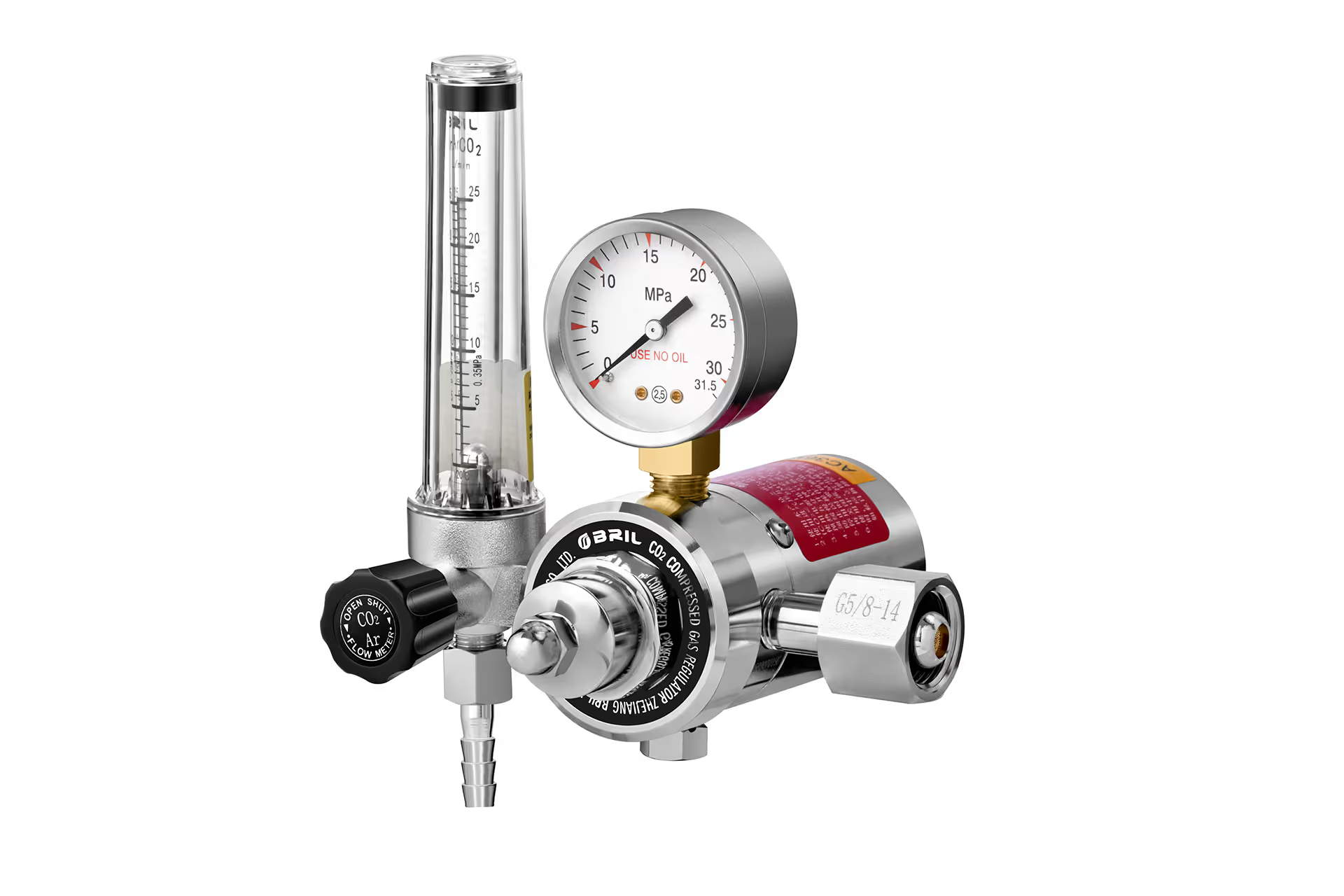
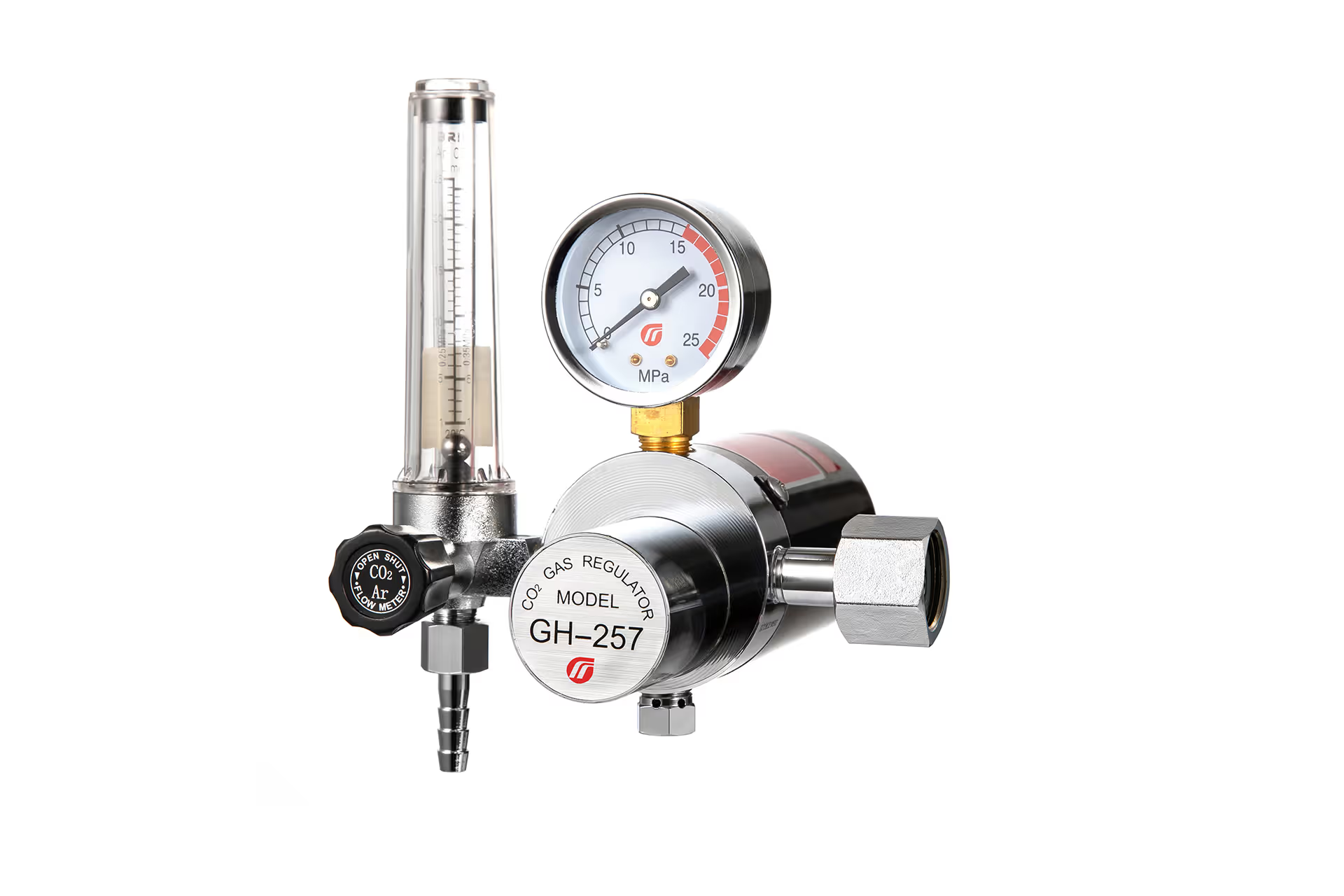
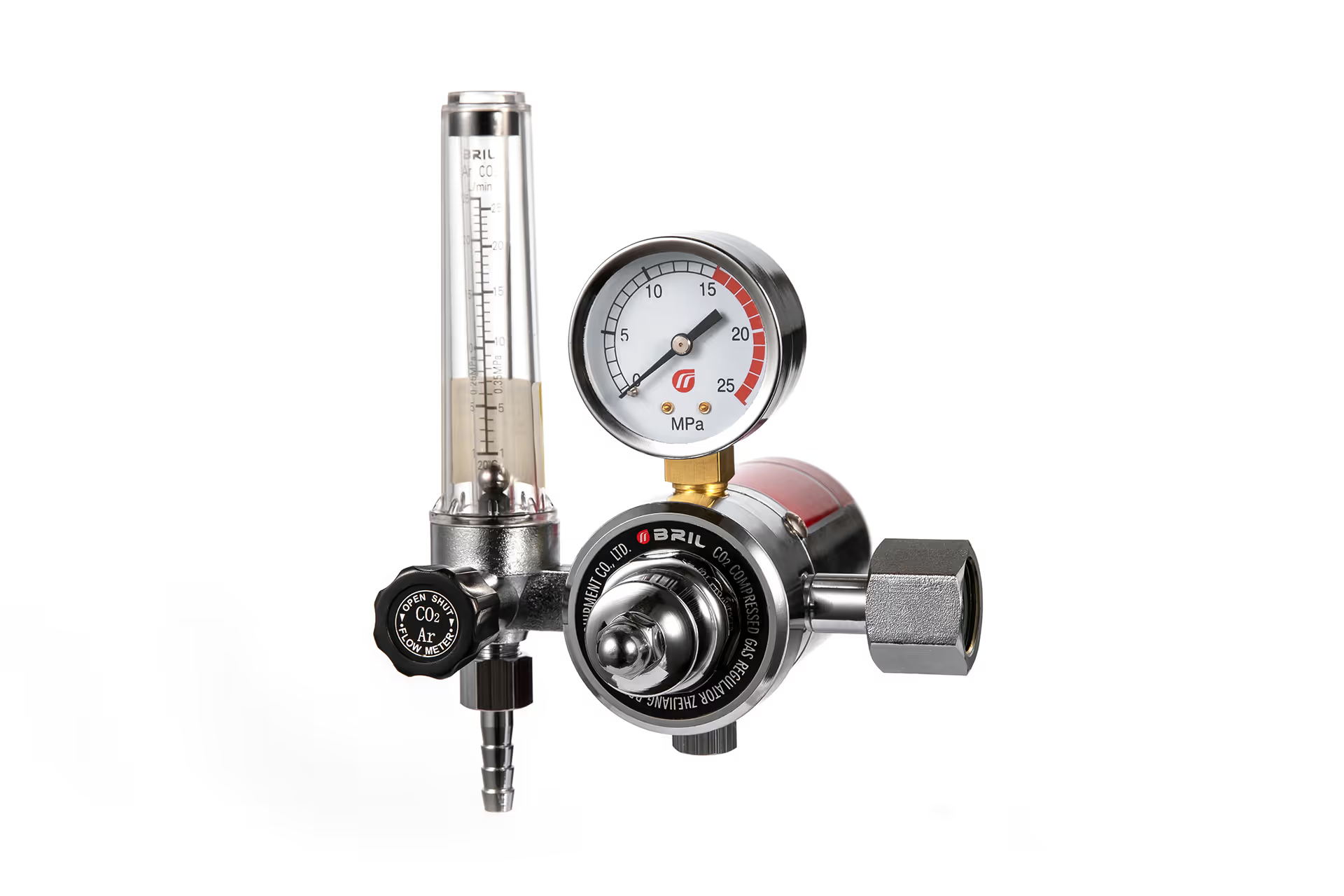
A typical CO₂ regulator reduces high cylinder pressure to a lower, controllable working pressure for downstream equipment. Depending on the system, it may include:
– A high-pressure gauge to indicate cylinder-side pressure
– A low-pressure or delivery gauge to indicate outlet pressure
– A pressure-adjusting screw or knob
– A diaphragm and valve-seat assembly
– A relief device
– A shut-off valve, flowmeter, needle valve, or outlet connector
– A CGA-320 inlet nut for compatible CO₂ cylinders
CO₂ Regulator Selection by Application
| Application | Recommended regulator configuration | Key consideration |
|---|---|---|
| MIG/MAG welding | CO₂ flowmeter regulator or regulator with flow control | Stable shielding-gas flow and suitable outlet connection |
| Beverage dispensing | Low-pressure CO₂ regulator with shut-off valves | Stable serving pressure and food/beverage-compatible configuration |
| Aquarium CO₂ | Precision regulator with needle valve and optional solenoid | Fine, repeatable low-flow adjustment |
| Industrial gas supply | Heavy-duty single-stage or dual-stage regulator | Output stability, flow capacity, duty cycle, and process requirements |
| Liquid CO₂ withdrawal | Regulator specifically rated for liquid-cylinder service | Prevent freezing and regulator malfunction; a heated regulator may be required |
| Laboratory or analytical use | High-purity regulator with appropriate materials and fittings | Gas purity protection, compatibility, and controlled delivery |
For demanding applications, a dual-stage CO₂ regulator can provide more stable delivery pressure as cylinder pressure changes. Single-stage regulators are widely used and cost-effective, but dual-stage configurations are often preferred where precise, consistent pressure control is critical.
Step-by-Step: How to Attach a CO₂ Regulator to a CO₂ Tank
Follow this sequence carefully. Do not rush the process, especially when connecting a new cylinder, replacing an empty tank, or installing a regulator on unfamiliar equipment.
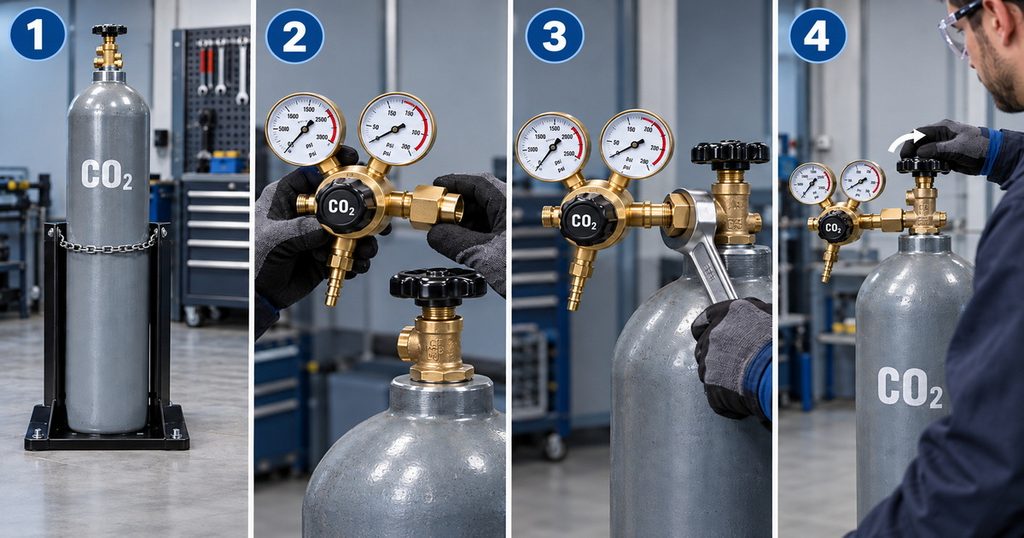
1. Secure the CO₂ Cylinder Upright
Place the CO₂ tank in a vertical position and secure it with a cylinder stand, wall chain, cylinder bracket, or approved cart restraint. The cylinder must not be able to tip, roll, or fall during connection or use.
Workplace safety guidance requires compressed-gas cylinders to be secured in an upright position except during limited handling situations.
Keep the cylinder away from:
– Welding sparks, flames, and direct heat
– High-traffic walkways
– Electrical circuits and grounding paths
– Moisture, corrosive chemicals, and heavy impact hazards
– Enclosed, poorly ventilated spaces where CO₂ could accumulate
Although CO₂ is nonflammable, it can displace oxygen in confined or poorly ventilated areas. Therefore, ventilation and cylinder stability remain essential safety considerations.
2. Inspect the Cylinder Valve and Regulator
Before removing the cylinder cap or connecting the regulator, inspect both sides of the connection.
Check the cylinder valve for:
– Damaged threads
– Oil, grease, dust, paint, or foreign material
– Bent or damaged valve components
– Visible leakage, frost, or unusual odor from nearby equipment
– Missing labels or uncertain gas identity
Check the regulator for:
– Damaged inlet threads or inlet nipple
– Cracked gauges or gauge lenses
– Loose fittings
– Damaged hose connections
– Contamination around the inlet
– A stiff, damaged, or excessively worn adjustment knob
– Missing seals, washers, or O-rings where required
Do not install a dirty, damaged, or incompatible regulator. Guidance for compressed-gas equipment specifically warns against using contaminated or damaged components.
3. Close the Regulator Adjustment Knob
Before opening the CO₂ cylinder valve, back out the regulator adjustment knob by turning it counterclockwise until spring pressure is released.
This step is critical because it prevents an immediate high-pressure surge to the low-pressure side of the regulator. The regulator should begin from a zero-output or minimum-output condition.
Also ensure that the downstream outlet valve is closed, if your regulator includes one.
4. Remove the Cylinder Valve Protection Cap
Only remove the cylinder cap after the tank is stable and ready for connection. Place the cap nearby so it can be reinstalled when the cylinder is removed, stored, or transported.
Cylinder valve protection caps should remain in place until a cylinder is secured and connected for use.
5. Confirm the Correct Seal and Connection Type
Some CO₂ cylinder-regulator combinations require a washer or seal at the inlet connection; others seal through the fitting geometry. Always follow the instructions for your exact regulator and cylinder valve.
For many U.S. CO₂ systems, the regulator uses a CGA-320 connection. Do not assume that an argon, nitrogen, oxygen, acetylene, or propane regulator will connect directly to a CO₂ cylinder, even if the threads appear similar.
If the regulator does not thread on easily by hand, stop immediately. The problem may be:
– The wrong CGA connection
– Damaged threads
– A missing washer or seal
– A cross-threaded fitting
– A non-matching regional cylinder standard
– A regulator designed for another gas or pressure range
Never force incompatible threads. Safety procedures explicitly warn operators not to force connections that do not fit.
6. Attach the Regulator to the CO₂ Cylinder Valve
Align the regulator inlet nut squarely with the cylinder valve outlet. Begin threading the connection by hand to prevent cross-threading.
Once the nut is hand-threaded correctly, use the appropriate wrench to tighten it securely. Do not use excessive force. Over-tightening can damage threads, deform a washer, compromise the sealing surface, or make future removal difficult.
A properly assembled regulator connection should feel secure and stable without placing stress on the gauges, hose, or outlet fittings.
7. Connect the Outlet Hose or Downstream Equipment
Connect the regulator outlet to the intended system: welding machine, torch system, flowmeter, manifold, beverage line, aquarium tubing assembly, laboratory apparatus, or industrial process equipment.
Ensure that:
– The hose is rated for the intended gas and pressure
– The outlet fitting matches the hose or equipment fitting
– Hose clamps or threaded connectors are correctly installed
– The hose is not kinked, crushed, stretched, or routed across sharp edges
– Downstream valves are closed before pressurizing the system
– A check valve is installed when backflow could damage the regulator or contaminate the gas line
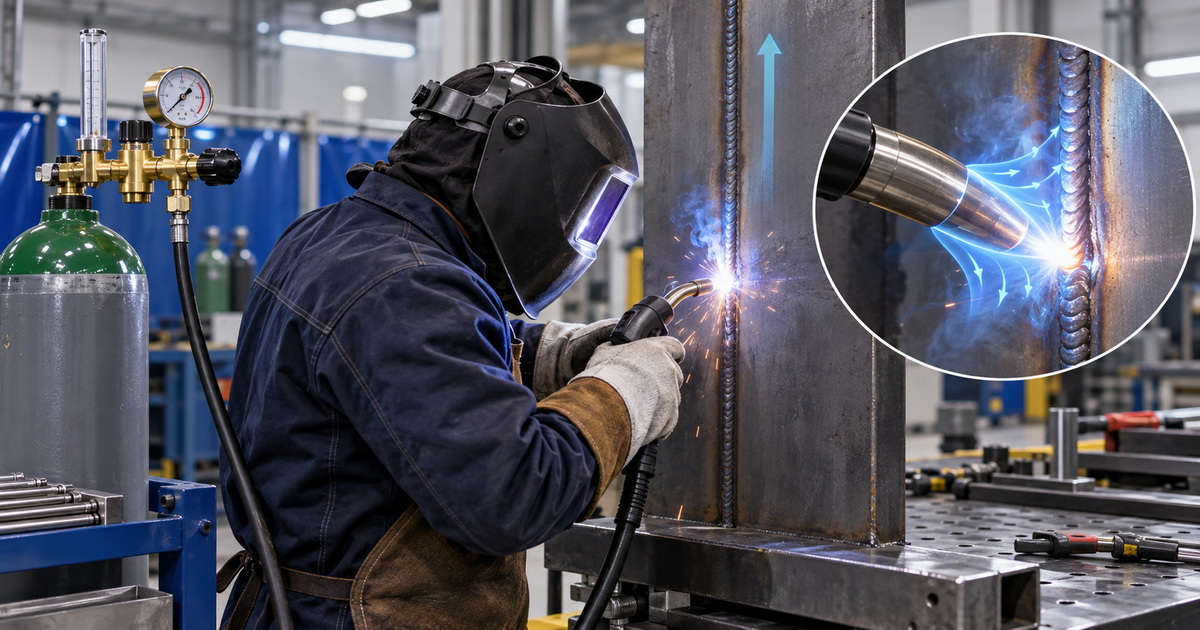
For welding, ensure that the flowmeter, hose, and machine inlet match the required operating specification. For process systems, verify that the regulator’s outlet-pressure range and flow capacity are suitable for actual demand.
8. Stand to the Side and Open the Cylinder Valve Slowly
Position yourself to the side of the regulator. Do not place your face directly in front of the gauges or valve outlet.
Open the CO₂ cylinder valve slowly. Slow opening reduces pressure shock and helps protect the regulator’s internal components. OSHA-related safety guidance also emphasizes opening cylinder valves slowly to avoid damaging the regulator.
Observe the high-pressure gauge as the system pressurizes. Then check the inlet connection carefully for obvious leakage.
For CO₂ cylinders containing liquid CO₂, the high-pressure gauge is influenced strongly by temperature. It should not be treated as a precise fuel-level indicator while liquid remains in the cylinder; pressure can stay relatively steady and then fall more quickly near depletion.
9. Set the Required Working Pressure or Flow
Turn the adjustment knob clockwise gradually while monitoring the delivery-pressure gauge. Stop at the pressure specified by your equipment manufacturer or process requirement.
Do not guess at the correct pressure. The required setting differs substantially by application:
– Welding shielding gas may be set by flow rate, not only pressure
– Beverage systems need a pressure matched to beverage temperature and carbonation requirements
– Aquarium systems require precise, low and stable delivery
– Industrial processes may need a defined pressure tolerance and continuous flow capacity
– Heated CO₂ regulator systems may be needed where high flow or liquid withdrawal creates freezing risk
After setting the pressure, open the downstream shut-off valve or equipment valve slowly and confirm that outlet pressure remains stable under flow.
10. Perform a Leak Test Before Use
Apply leak-detection solution around:
– The cylinder valve-to-regulator connection
– The regulator inlet nut
– Outlet fittings
– Hose connections
– Flowmeter fittings
– Manifold connections
– Any adapters or quick connectors
Watch for bubbles. Bubbles indicate leakage.
If you find a leak:
1. Close the cylinder valve.
2. Release pressure from the regulator and downstream line.
3. Tighten the fitting only if it is known to be compatible and undamaged.
4. Replace a damaged washer, seal, hose, fitting, or regulator component.
5. Repeat the leak test.
6. Remove the cylinder from service if the leak cannot be safely corrected.
Soapy-water testing is a common way to identify bubbles at a leaking joint, while workplace guidance also recommends periodic leak checks and immediate correction of leaks.
Common Mistakes When Connecting a CO₂ Regulator
Most connection problems come from a small number of avoidable errors. Preventing these issues improves safety, reduces gas waste, and protects your equipment investment.
Using the Wrong Regulator or Adapter
A regulator must be compatible with the gas, inlet connection, pressure range, and application. An adapter should never be used casually to “make it fit.” Adapters must be selected carefully because incompatible gases, materials, connections, or pressure ratings can create system hazards.
Opening the Cylinder Valve Too Fast
Rapid valve opening can shock the regulator internals, cause gauge movement, stress the seat assembly, and shorten service life. Always open gradually.
Forgetting to Back Out the Adjustment Knob
If the regulator is already set to a high delivery pressure before the cylinder valve is opened, the system may receive an unwanted surge. Back the adjustment knob out first.
Ignoring a Small Leak
A minor leak can become a major gas-loss problem, cause unstable pressure, create icing, increase refill cost, or lead to downtime. Leak-test every new connection and after maintenance.
Using PTFE Tape Without Manufacturer Approval
Do not automatically apply PTFE tape to regulator inlet threads. Some regulator-cylinder connections use a washer or specific sealing geometry instead. Incorrect tape use can introduce debris into the regulator, interfere with sealing, or create a false sense of security. Follow the equipment manufacturer’s instructions.
Moving a Cylinder With the Regulator Installed
Before moving or transporting a cylinder, close the cylinder valve, depressurize the regulator, remove the regulator where required, and reinstall the protective cap. OSHA guidance notes that regulators should be removed and protective caps replaced before moving or transporting compressed-gas cylinders.
When a Heated CO₂ Regulator Is the Better Choice
A standard CO₂ regulator may freeze or lose stable performance when gas demand is high, ambient temperature is low, or CO₂ expands rapidly. This is especially important in high-duty-cycle welding, heavy industrial use, and certain liquid CO₂ withdrawal applications.
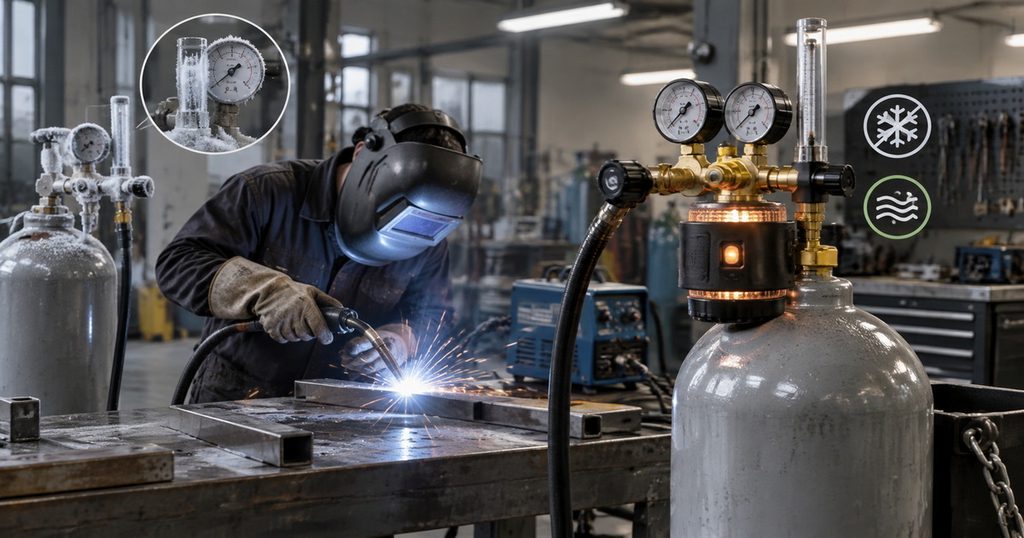
As CO₂ expands, it absorbs heat. Under sustained flow, this cooling effect can cause frost formation around the regulator, pressure instability, reduced flow, or regulator icing.
A CO₂ heated regulator can help maintain stable gas delivery by reducing the risk of freeze-up in demanding operating conditions. Consider a heated design when your operation experiences:
– Long welding cycles or continuous gas consumption
– Large CO₂ cylinders with high withdrawal rates
– Outdoor or cold-environment work
– Repeated pressure drop or flow instability
– Visible frosting on the regulator body
– Industrial equipment that cannot tolerate interruptions
For OEM and ODM customers, the right solution may include customized inlet connections, outlet configurations, pressure ranges, gauge styles, branding, packaging, flow-control components, and heating options based on the destination market and end-use equipment.
Expert Maintenance and Shutdown Procedure
Correct shutdown protects regulator components and reduces unnecessary gas loss.
Recommended Shutdown Steps
1. Close the CO₂ cylinder valve.
2. Allow downstream equipment to stop or close the outlet valve.
3. Release gas pressure trapped in the regulator and hose according to your equipment procedure.
4. Turn the regulator adjustment knob counterclockwise to release spring tension.
5. Verify that the delivery-pressure gauge returns to zero.
6. Inspect for damage, moisture, contamination, or abnormal frost.
7. Store the cylinder upright and secured when not in use.
Before detaching a regulator, close the cylinder valve and bleed the gas from the regulator. This is specifically recommended in compressed-gas safety guidance.
Routine inspection should include gauge visibility, thread condition, seals, hose integrity, outlet fittings, relief-device condition, and pressure-control stability. If a regulator creeps in pressure, leaks internally, has damaged gauges, or cannot maintain stable output, remove it from service and have it inspected or replaced by qualified personnel.
Why Regulator Quality Matters for Industrial CO₂ Control
A regulator is not just a connector. It is the pressure-control device between a high-pressure CO₂ source and your production process.
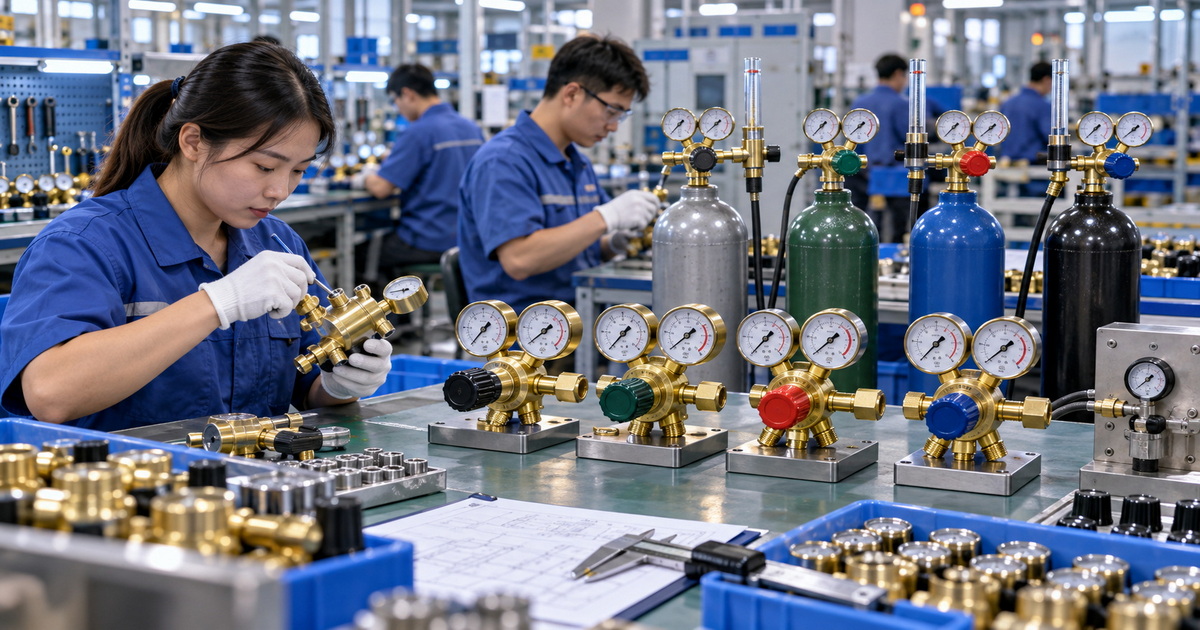
For overseas brands, wholesalers, distributors, and equipment manufacturers, reliable gas-regulator sourcing should consider more than purchase price. Evaluate the manufacturer’s capabilities in:
– Brass material selection and machining quality
– Valve-seat and diaphragm design
– Stable pressure-control performance
– Gauge accuracy and readability
– Leak testing and pressure testing
– Incoming-material inspection
– Assembly consistency
– Traceability and quality documentation
– Customized OEM and ODM development
– Packaging, labeling, and market-specific configurations
For welding, cutting, beverage, laboratory, and industrial-gas applications, stable delivery pressure supports process consistency. A carefully engineered regulator can help reduce gas waste, minimize rework, improve operator experience, and support long-term equipment reliability.
Need a Reliable CO₂ Regulator for Your Market?
If you are sourcing CO₂ regulators, heated CO₂ regulators, dual-stage gas regulators, argon regulators, oxygen regulators, acetylene regulators, propane regulators, or nitrogen regulators, choose a manufacturer that understands both gas-control performance and market-specific customization.
Our team supports OEM and ODM projects for international brands, distributors, wholesalers, and industrial equipment manufacturers. We provide customized gas-control solutions built around reliable brass materials, precision manufacturing, strict inspection, stable pressure control, and application-specific configurations.
Contact us to discuss your regulator specifications, inlet and outlet connections, pressure range, flow requirements, branding, packaging, and target-market standards.
FAQ
1. Do I need a special regulator for a CO₂ tank?
Yes. Use a regulator designed for CO₂ service and matched to the cylinder connection, pressure range, and application. In North America, many CO₂ cylinders use a CGA-320 inlet connection, but you must verify the actual cylinder and regional standard before installation.
2. Should I use a washer when attaching a CO₂ regulator?
It depends on the specific cylinder valve and regulator design. Some CO₂ connections require a washer or seal to create a gas-tight connection, while others use a different sealing arrangement. Check the instructions from the regulator and cylinder supplier, and replace worn or damaged seals before use.
3. Why is my CO₂ regulator freezing?
Freezing is usually caused by rapid CO₂ expansion, high gas flow, low ambient temperature, or liquid CO₂ reaching a regulator not designed for liquid withdrawal. Reduce excessive demand where possible, verify correct cylinder orientation and regulator selection, and consider a heated CO₂ regulator for high-flow or cold-environment service.
4. Can I use an argon regulator on a CO₂ cylinder?
Not directly unless the regulator, connection, pressure rating, and gas-service approval are specifically compatible. Argon and CO₂ often use different cylinder connections. Do not force fittings or use an adapter without confirming the full system’s compatibility and pressure rating.
5. How tight should a CO₂ regulator connection be?
Thread the inlet nut by hand first, then tighten it securely with the correct wrench. Avoid excessive force. Over-tightening can damage threads, washers, and sealing surfaces. Always perform a leak test after tightening.
6. Why does my CO₂ tank pressure gauge stay high until the tank is nearly empty?
CO₂ is commonly stored with liquid CO₂ inside the cylinder. While liquid remains, vapor pressure is strongly affected by temperature and may appear relatively stable. As the liquid is depleted, pressure can decline more rapidly. Therefore, the high-pressure gauge is not always a reliable measure of remaining CO₂ content.
7. Should I open a CO₂ cylinder valve fully?
Follow the cylinder supplier’s and equipment manufacturer’s instructions. The key requirement is to open the valve slowly to avoid pressure shock to the regulator. Do not use excessive force, and always stand to the side of the regulator while opening the cylinder valve.
References
1. Occupational Safety and Health Administration, “Safety of Compressed Gas Cylinders on Portable Carts.” [OSHA interpretation]. Discusses requirements for securing compressed-gas cylinders upright during use and handling. [osha]
2. Occupational Safety and Health Administration, “Movement of Compressed Gas Cylinders with Regulators Installed.” [OSHA interpretation]. Explains OSHA’s treatment of cylinders with regulators installed as connected for use. [osha]
3. OSHA Training Material, “Sheet Metal Safety: Compressed Gas Cylinders.” [Safety document]. Covers slow valve opening, regulator removal, bleeding pressure, and leak response. [obis.osha]
4. Oregon OSHA, “Welding, Cutting and Brazing.” [Regulatory document]. States that pressure-reducing regulators must be used with the gases and pressures for which they are intended. [osha.oregon]
5. University of California, Riverside, “Compressed Gas and Air Cylinder Safety Program.” [Safety program]. Provides guidance on correct regulator selection, avoiding forced connections, standing aside during valve opening, and opening cylinder valves slowly. [ehs.ucr]
6. Airgas, “Harris Model 425-125-320 Heavy Duty Carbon Dioxide Regulator.” [Product specification]. Documents a CO₂ regulator with a CGA-320 inlet connection. [airgas]
7. Airgas, “Harris Model 330-125PSI-CGA320 Heavy Duty Liquid Cylinder Regulator.” [Product specification]. Documents a CO₂ regulator designed for gaseous withdrawal from liquid CO₂ cylinders. [airgas]
8. Airgas, “RADNOR CGA-320 x CGA-580 Brass CO₂ Adapter.” [Product information]. Explains that adapters must be selected carefully to maintain gas and pressure compatibility. [airgas]
9. Green Leaf Aquariums, “The Complete Guide to Planted Aquarium CO₂ Systems.” [Technical guide]. Explains how CO₂ cylinder pressure is affected by temperature and why pressure may remain stable while liquid CO₂ is present. [greenleafaquariums]
Hot Tags: CO₂ Regulator, CO₂ Gas Regulator, CO₂ Regulator Manufacturer, Industrial Gas Regulator, Heated CO₂ Regulator, Dual Stage Gas Regulator, Welding Gas Regulator, CO₂ Cylinder Regulator, OEM Gas Regulator, Gas Pressure Regulator