Content Menu
>> 1. Manufacturing specialization
>> 3. Dual-stage design capability
>> 6. Verification transparency
● Technical Requirements for Dual-Stage Regulators
>> Materials and body construction
>> Two-stage pressure reduction
>> Gauges are not interchangeable
>> Compliance and documentation
>> 1. Zhejiang Bril Welding Equipment Co., Ltd.
>> 2. Hunan Wofly Technology Co., Limited
>> 3. Ningbo Keryfine Electronic Co., Ltd.
>> 4. Shanghai Yanken Industry Co., Ltd.
>> 5. Ningbo Fenghong Gas Appliance Co., Ltd.
>> 6. Suzhou Nai Lok Fluid Technology Co., Ltd.
>> 7. Taizhou Eastar Technology Co., Ltd.
>> 8. Wenzhou Riyi Electromechanical Technology Co., Ltd.
>> 9. Jiangsu Huayan International Trade Co., Ltd.
>> 10. Longtime Industry Co., Ltd.
>> Confusing two gauges with two stages
>> Buying based only on brass appearance
>> Assuming a CE mark covers every model
>> Ignoring oxygen-cleaning requirements
>> Under-specifying the gauges
>> Choosing the lowest MOQ without calculating total cost
● Insider Tip: Test for Pressure Creep
>> Start with an engineering specification
>> Use a three-step sample process
>> Verify the factory, not only the salesperson
● FAQ
>> 1. How can I verify that a supplier’s ISO 9001 certificate is still valid?
>> 2. How do I confirm that a regulator is genuinely dual stage?
>> 3. What should I test in a dual-stage regulator sample?
>> 4. Can one dual-stage regulator be used for CO₂, argon, oxygen, nitrogen, acetylene, and propane?
>> 5. What MOQ should I expect for custom OEM gas regulators?
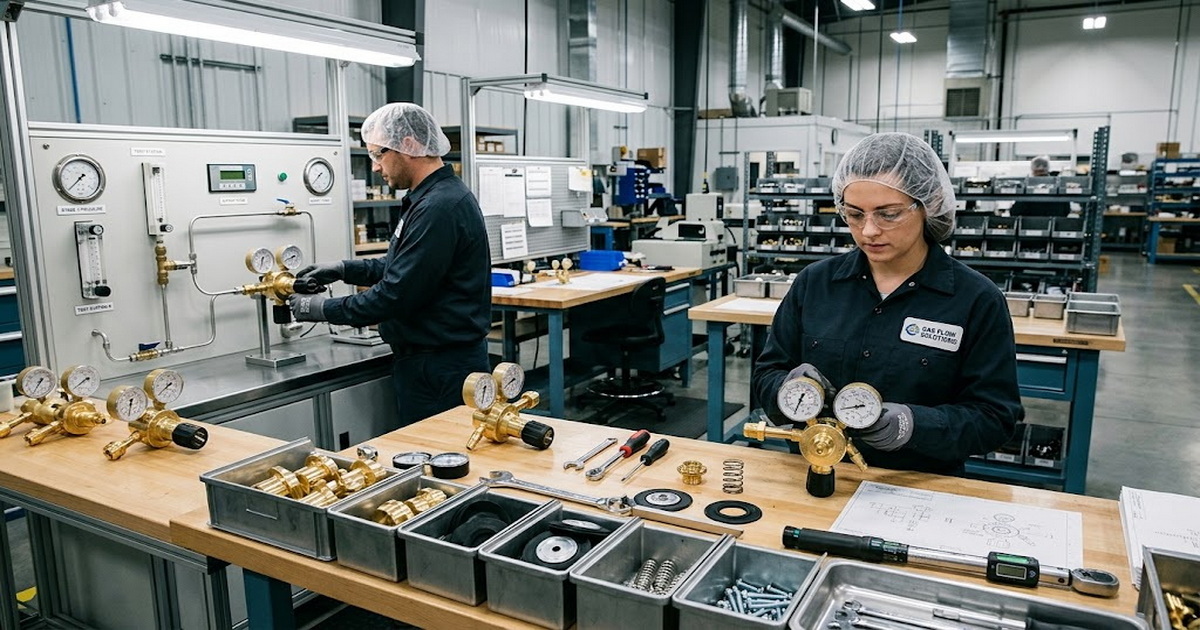
China is a major global sourcing base for industrial gas-control equipment, including dual stage gas pressure regulators used with CO₂, argon, oxygen, nitrogen, acetylene, propane, and mixed shielding gases. For overseas buyers, the key advantage is not simply lower unit cost—it is the ability to combine mature brass-processing supply chains, flexible OEM/ODM manufacturing, private-label packaging, and export-oriented production at different order volumes.
However, a “dual stage regulator” is not a commodity product. Two units that look nearly identical can perform very differently in outlet-pressure stability, diaphragm life, gas compatibility, leakage resistance, gauge accuracy, and safety under cylinder-pressure changes. A professional sourcing decision should therefore go beyond catalog photos and price quotations.
Why China Is a Key Source
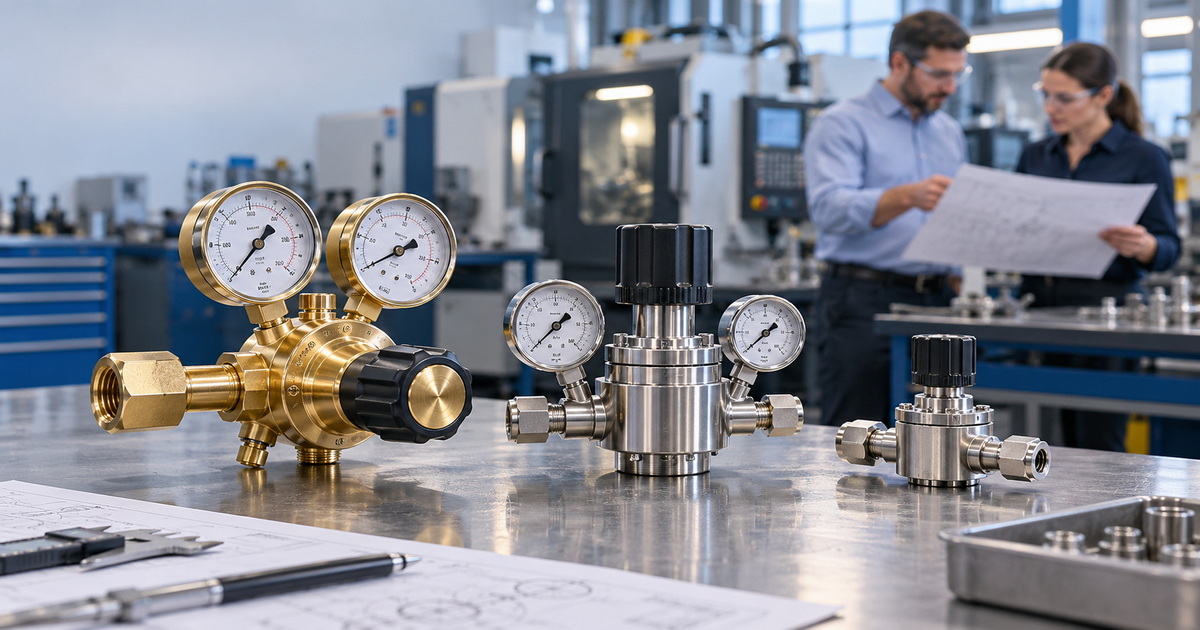
China’s regulator manufacturing ecosystem is concentrated across industrial regions such as Zhejiang, Guangdong, Jiangsu, and selected manufacturing clusters in Shanghai and Shandong. Zhejiang, particularly the Wenzhou area, has long-standing capabilities in valves, gauges, brass hardware, machining, electrical equipment, export packaging, and industrial component assembly.
For dual stage gas pressure regulators, this cluster advantage matters because the product depends on a coordinated supply chain:
– Brass forging or precision-machined brass bodies
– Zinc alloy, brass, or stainless-steel component supply
– Elastomer diaphragms, O-rings, valve seats, and sealing assemblies
– Pressure gauges and flow-meter components
– Surface treatment, plating, laser marking, and private-label packaging
– Gas-tightness, pressure-holding, inlet-pressure, and outlet-pressure test equipment
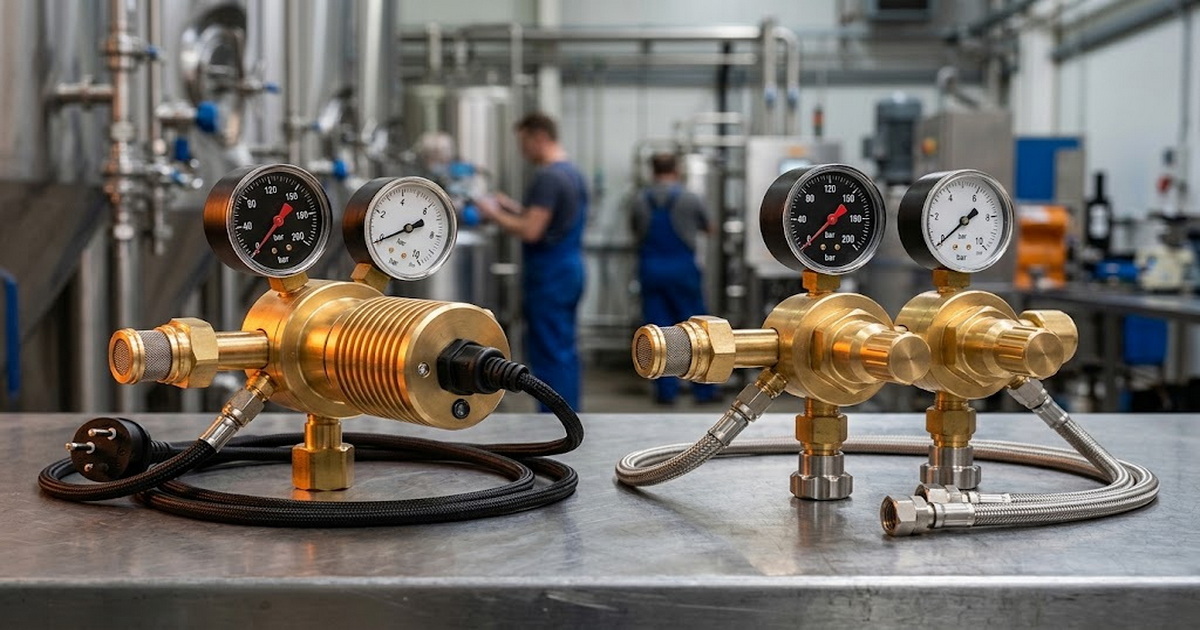
China’s manufacturing value is especially strong for buyers who need a product family—not only one regulator model. A qualified supplier may support CO₂ heated regulators, argon regulators, oxygen regulators, acetylene regulators, propane regulators, nitrogen regulators, flowmeter regulators, and dual-stage gas regulators under one brand or OEM project.
The country’s export-oriented supplier base also gives buyers access to products designed around common international requirements, including ISO 9001 quality systems, CE-related documentation where applicable, RoHS material compliance requests, and customer-specific product inspection procedures. Dual-stage stainless-steel regulators for gases such as argon, nitrogen, CO₂, and oxygen are widely represented in China’s industrial supply market.
How We Selected Suppliers
A reliable regulator manufacturer should be evaluated as an engineering and quality-control partner—not merely as a sales company. The suppliers below were shortlisted according to the following practical criteria.
1. Manufacturing specialization
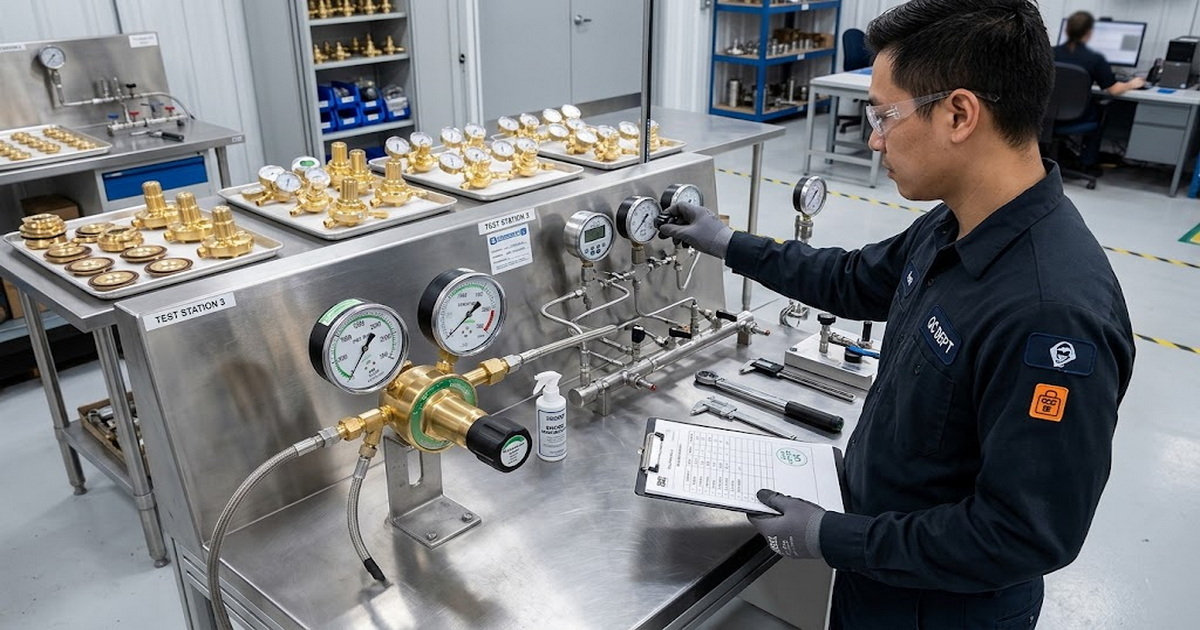
Priority was given to companies with a clear relationship to industrial gas regulators, welding accessories, pressure-control products, valves, instrumentation, or gas-handling systems. A general hardware factory may offer a low quotation, but it often lacks the process control required for stable dual-stage regulation.
2. Quality-system evidence
Buyers should request current copies of:
– ISO 9001 certificates
– Product-specific test reports
– CE declarations or reports where required for the target market
– RoHS and REACH material declarations when selling into the EU
– Incoming-inspection, pressure-test, and final-inspection procedures
– Calibration records for pressure gauges and test benches
An ISO certificate alone does not prove that every regulator meets performance requirements. It does, however, provide an important starting point for evaluating whether the supplier has documented procedures for traceability, inspection, corrective action, and production control.
3. Dual-stage design capability
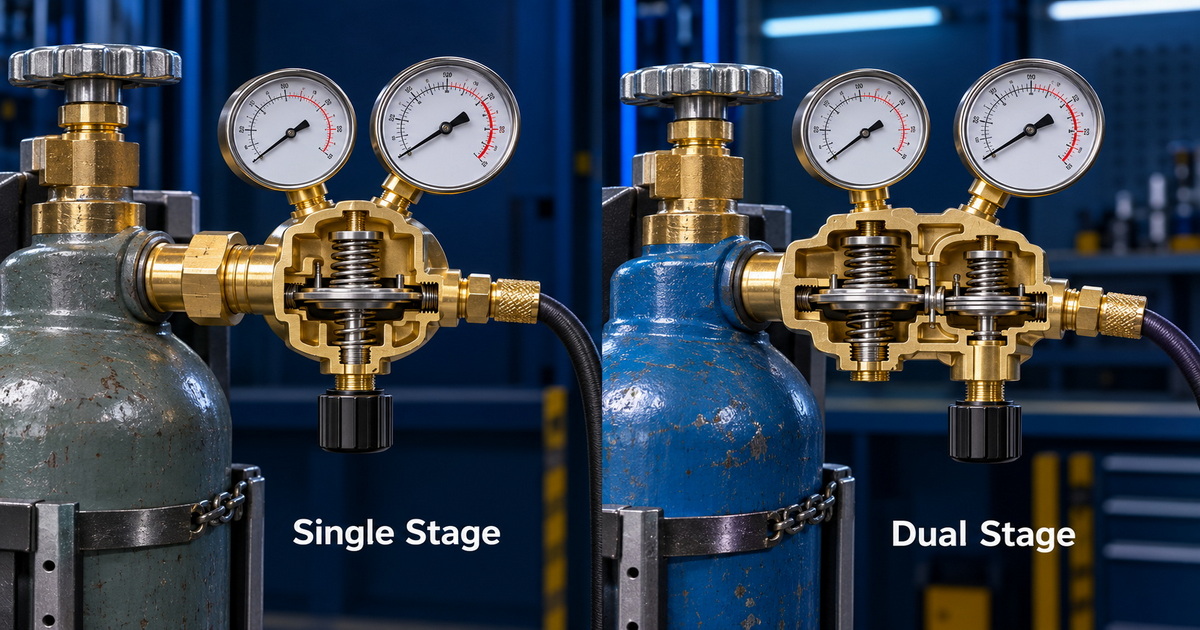
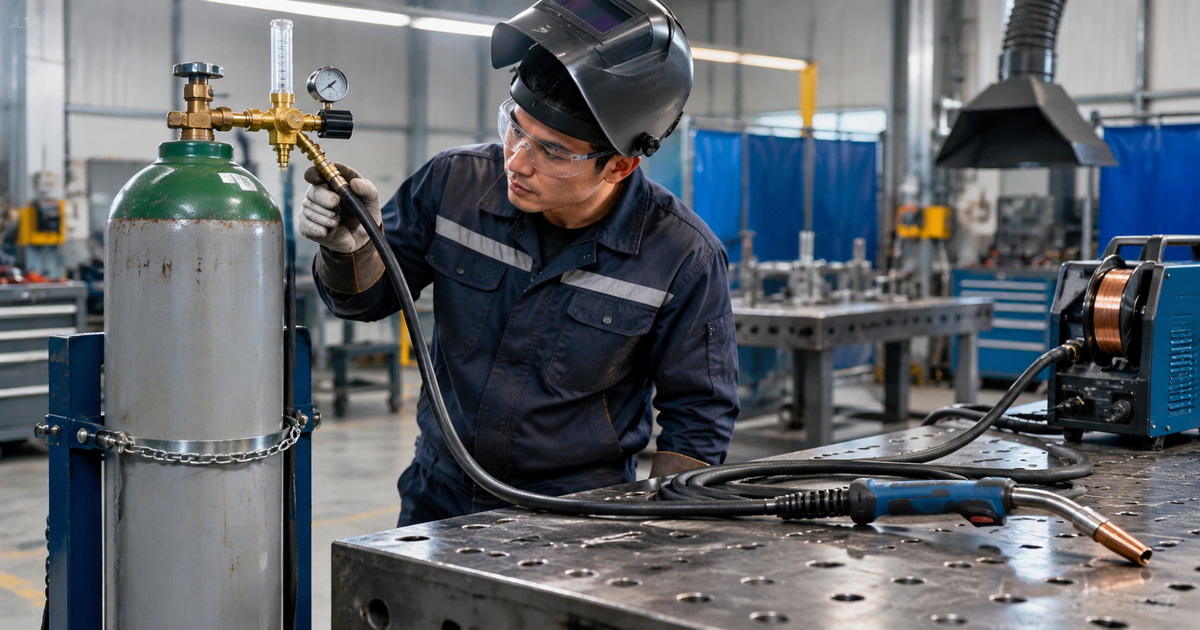
A true dual-stage gas pressure regulator reduces cylinder pressure in two controlled steps. Compared with a single-stage regulator, it generally provides more consistent outlet pressure as the cylinder empties. This is important for applications requiring steadier flow or pressure, including precision TIG welding, laboratory gas supply, analytical processes, laser-related systems, and demanding fabrication environments.
Buyers should ask whether the supplier can define or test:
– Maximum inlet pressure
– Outlet-pressure range
– Delivery-pressure droop
– Pressure creep after shutoff
– Lock-up pressure
– Flow capacity
– Leak-test pressure and duration
– Gas-specific seat, seal, and diaphragm compatibility
– Gauge accuracy class and gauge range
4. OEM and ODM depth
For a serious private-label project, customization should extend beyond printing a logo on the regulator body. The strongest OEM/ODM suppliers can potentially support:
– Custom body marking and laser engraving
– Brand-specific dial artwork
– Regulator color and finish
– Inlet connection and outlet connection changes
– Country-specific cylinder valve interfaces
– Different hose tails, flowmeters, and gauge ranges
– Retail packaging, instruction manuals, cartons, and barcode labels
– Customized testing standards and AQL inspection rules
– Spare parts and after-sales component programs
5. Delivery reliability
For industrial distributors, missed delivery dates can be more expensive than small price differences. Buyers should assess raw-material planning, supplier qualification, production scheduling, finished-goods inventory, packaging capacity, and container-loading experience.
6. Verification transparency
Factories that can clearly explain their materials, inspection flow, test methods, production records, and failure-analysis process are usually lower-risk than suppliers that only provide glossy catalogs.
Technical Requirements for Dual-Stage Regulators
Before comparing manufacturers, buyers should understand the technical factors that separate a durable dual-stage regulator from a low-cost lookalike.
Materials and body construction
Most welding and industrial-gas regulators use brass because brass provides good machinability, corrosion resistance, and compatibility with many common industrial gases. However, “brass body” is not a complete specification.
A buyer should clarify:
– Brass grade and lead-content requirements
– Forged versus die-cast versus machined body construction
– Surface finish and corrosion resistance
– Thread quality and connection tolerances
– Internal seat material
– Diaphragm material
– O-ring compound
– Compatibility with oxygen service, CO₂, argon, nitrogen, acetylene, propane, or other specified gases
For oxygen regulators, cleanliness is especially important. Components must be controlled to avoid contamination by oil, grease, particulate matter, or unsuitable sealing materials. For acetylene and propane applications, gas-specific design, pressure range, and safe connection configuration must be checked separately.
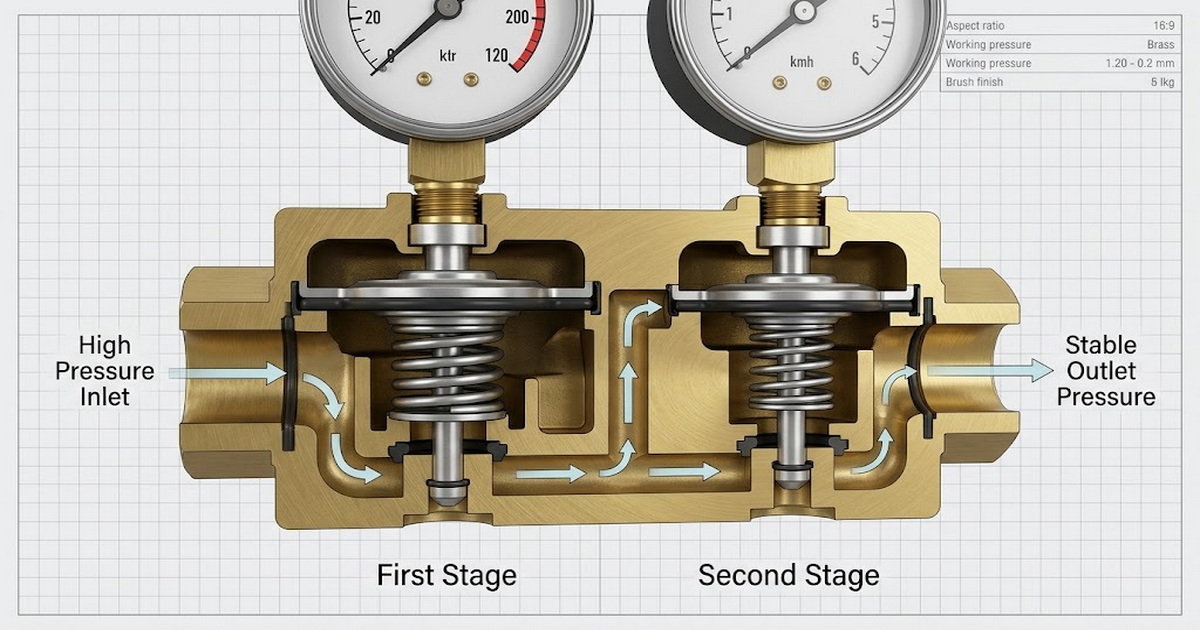
Two-stage pressure reduction
In a single-stage regulator, outlet pressure can shift more noticeably as cylinder inlet pressure drops. A dual-stage regulator uses two reducing mechanisms in sequence to reduce this effect.
This does not mean every dual-stage model is automatically “high precision.” Actual performance depends on spring design, valve-seat consistency, diaphragm sensitivity, machining tolerance, assembly quality, and test criteria. Request a real pressure-performance curve or controlled test data whenever stable outlet pressure is critical.
Gauges are not interchangeable
A common sourcing mistake is approving a sample based on the regulator body while overlooking the gauges. Gauge quality affects the user’s perceived reliability and safety.
Confirm:
– Gauge diameter
– Dial language and units
– Pressure range
– Accuracy specification
– Case material
– Lens material
– Back or bottom connection
– Calibration requirement
– Brand or approved gauge supplier
– Color coding for the gas type and target market
Compliance and documentation
CE marking is not a universal guarantee that a regulator is suitable for every application or market. The required compliance pathway depends on the product, gas type, pressure rating, destination country, and use case.
For EU-bound projects, buyers should clarify whether the regulator falls under relevant pressure-equipment requirements and whether the supplier can provide appropriate technical documentation, declarations, and traceability. RoHS and REACH declarations may also be relevant to branded distribution programs.
Top 10 Manufacturers
1. Zhejiang Bril Welding Equipment Co., Ltd.
Founded: 2002
Location: Wenzhou, Zhejiang, China
Main focus: Industrial gas pressure regulators for welding and cutting
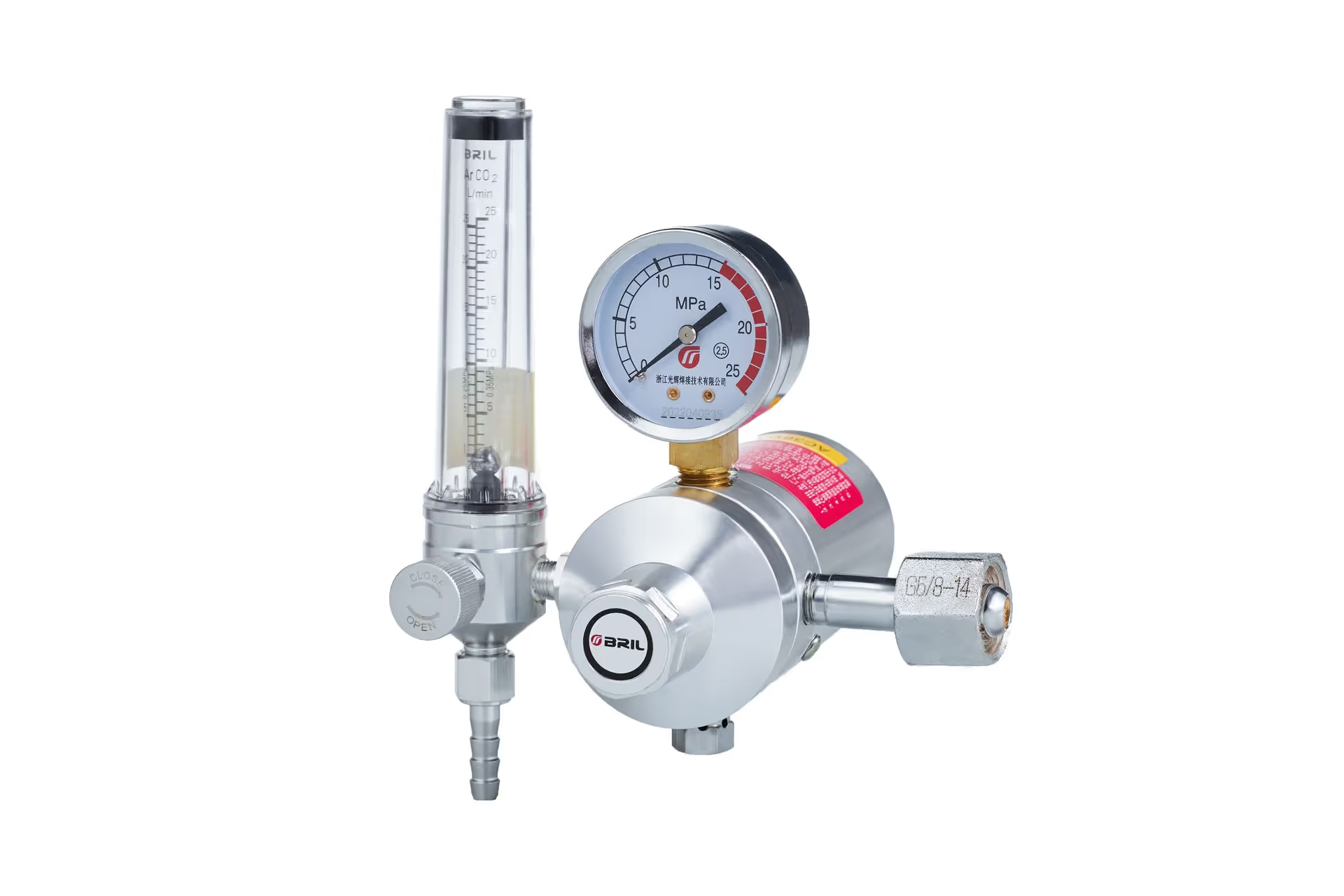
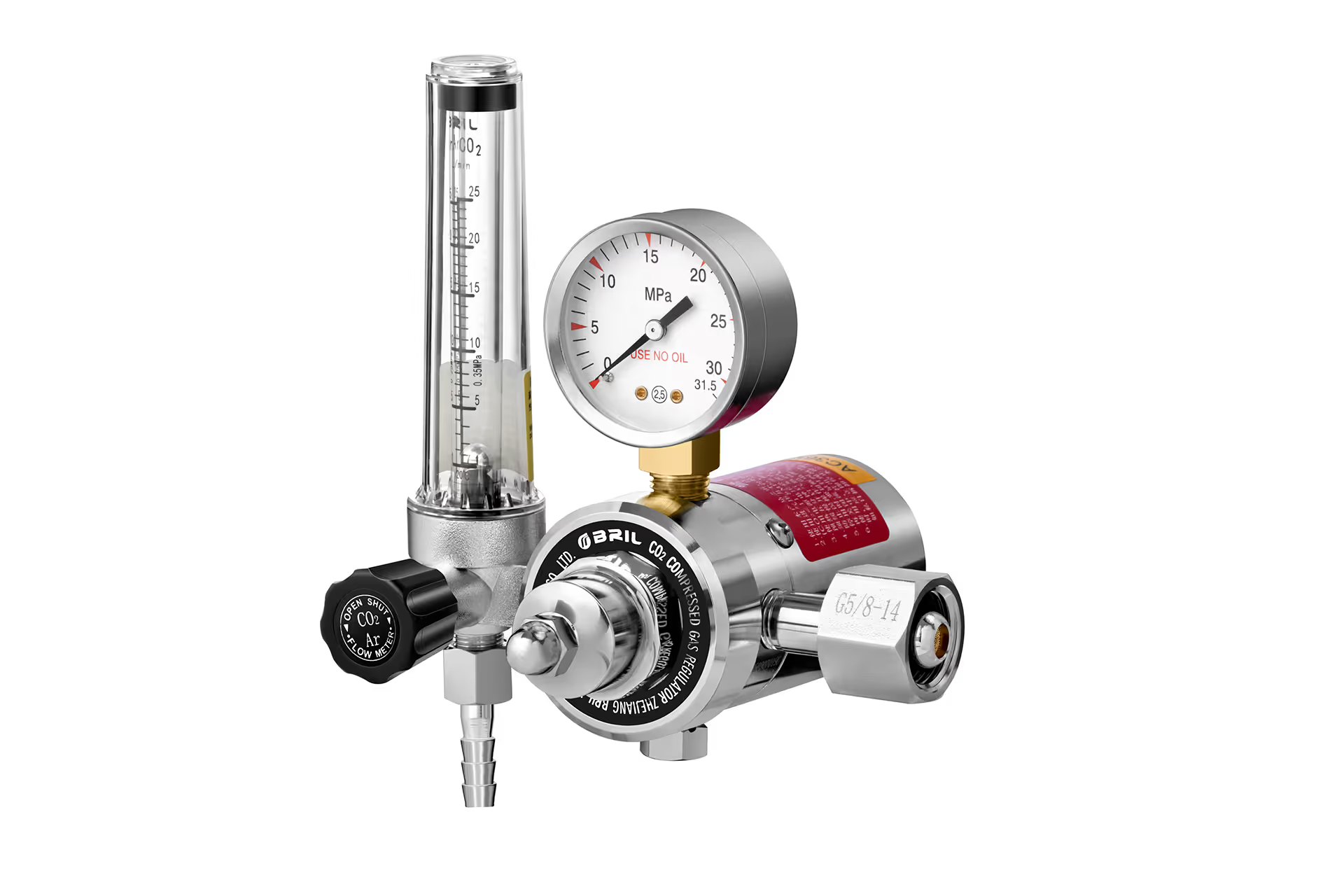
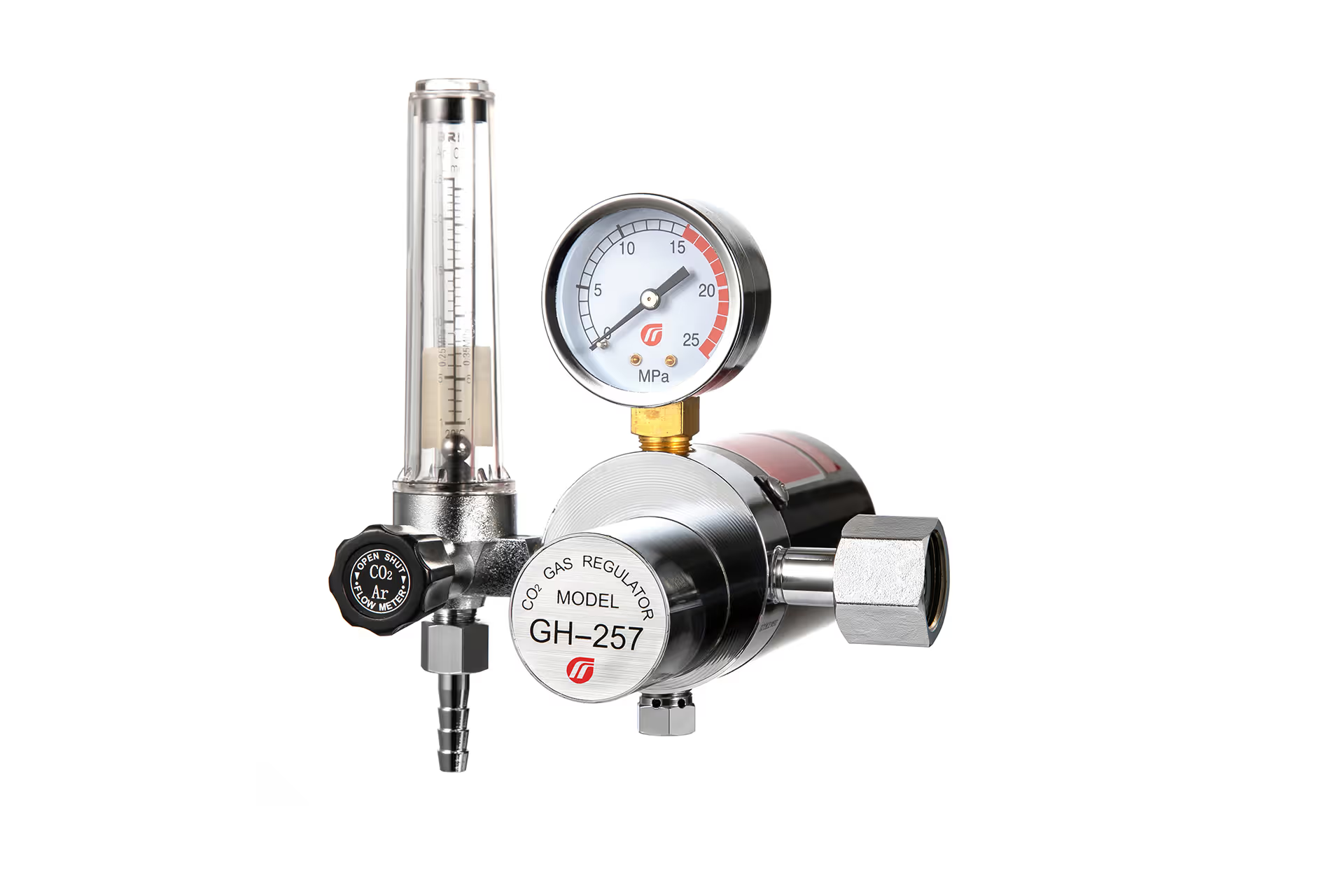
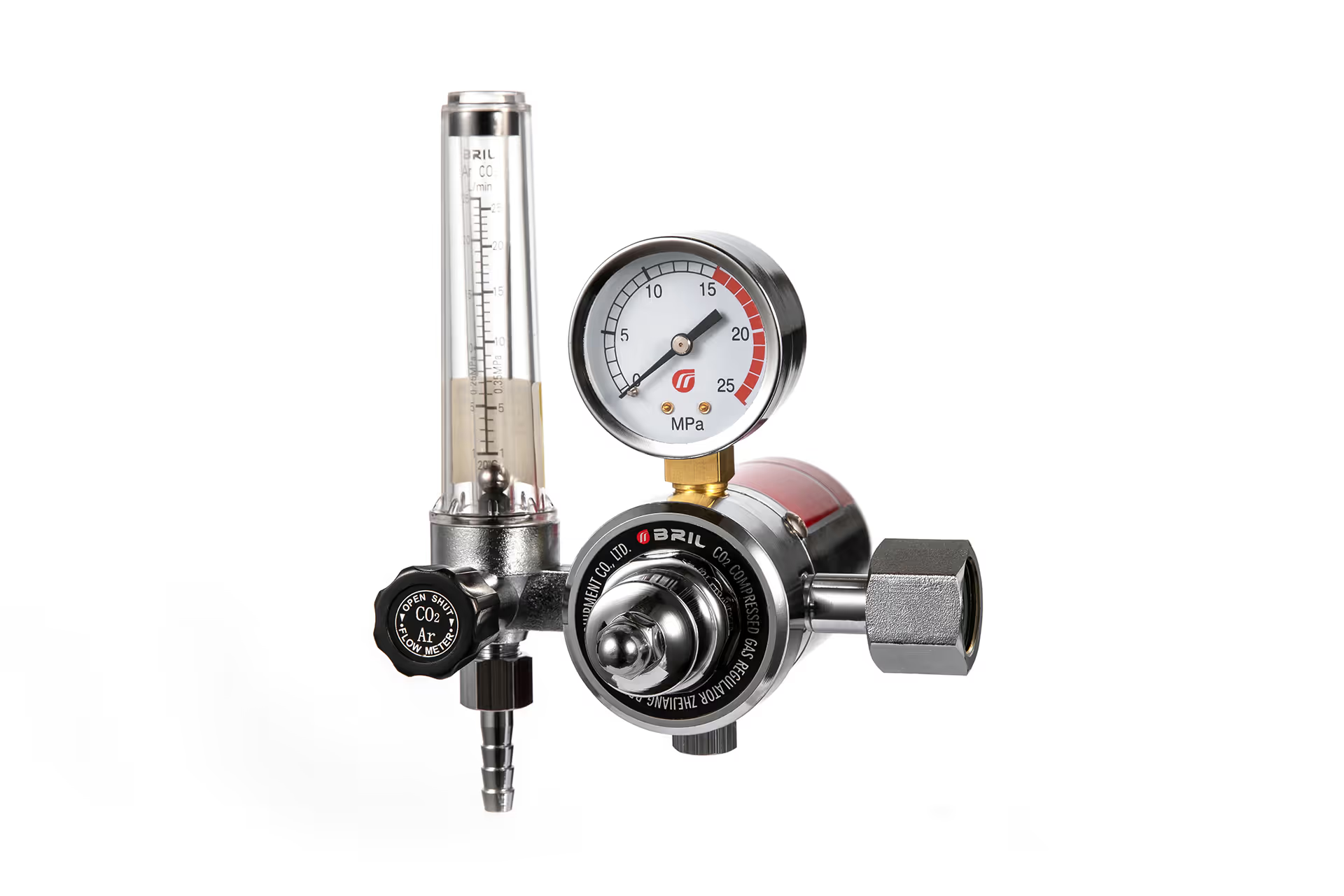
Typical products: CO₂ regulators, CO₂ heated regulators, argon regulators, oxygen regulators, acetylene regulators, propane regulators, nitrogen regulators, flowmeter regulators, and dual-stage gas pressure regulators
OEM/ODM suitability: Strong for overseas brands, wholesalers, distributors, welding-equipment manufacturers, and mid-sized private-label programs
Zhejiang Bril Welding Equipment Co., Ltd. is a practical option for buyers looking for a balance of technical specialization, flexible OEM support, export experience, and cost control. Rather than positioning itself only for very large-volume programs, Bril is especially relevant for small and medium-sized brands that need responsive communication, customized configurations, private-label development, and stable supply without the inflexibility often associated with very large factories.
According to its company profile, Bril was established in 2002 and is located in Binhai Economic Development Zone, Longwan District, Wenzhou. The company specializes in the development, manufacturing, and sales of industrial gas pressure regulators. It states that it holds ISO 9001 system certification through UKAS and IAF, and that its products have passed CNAS-related and CE testing.
Bril’s profile also identifies supply relationships with domestic welding-equipment companies including Shanghai Hugong, Tayor Heavy Industry Group, Hangzhou Kaierda, Shandong Aotai, Shenzhen Jasic, and Shenzhen Riland. It further states that it has supplied OEM production for Messer product lines since 2022, while also naming Panasonic and OTC among overseas brand relationships. These statements should be independently verified by buyers during supplier qualification, but they indicate experience serving professional welding and industrial-gas channels rather than only consumer retail markets.
Why buyers shortlist Bril
– More than 20 years of specialization in industrial gas regulator manufacturing
– Product coverage across multiple industrial gases and welding applications
– Suitable for private-label and custom-packaging projects
– Reported ISO 9001, CE, and CNAS-related compliance signals
– Potentially stronger flexibility for customized or mid-volume projects than a highly standardized mass-production supplier
– Located in Wenzhou, where access to component and export manufacturing supply chains can support faster project coordination
Best fit for: Buyers seeking a capable OEM/ODM partner for dual-stage regulator programs, especially those who require customized connections, branded gauges, packaging adaptation, gas-specific variants, or more hands-on project communication.
2. Hunan Wofly Technology Co., Limited
Location: Hunan, China
Main focus: High-purity gas control, laboratory gas systems, semiconductor and industrial gas components
Typical products: High-pressure regulators, stainless-steel regulators, gas manifolds, valves, fittings, and gas delivery systems
OEM/ODM suitability: Better suited to technically specified projects and higher-purity gas-control applications
Hunan Wofly Technology is commonly associated with high-purity gas regulators, stainless-steel pressure-control components, gas manifolds, and engineered gas-delivery systems. It may be a relevant candidate when the procurement project requires more than standard welding regulators—for example, laboratory gas distribution, specialty gas, high-purity nitrogen, high-purity argon, or controlled gas-panel applications.
The company appears in Chinese industrial regulator factory listings alongside other gas-control suppliers.
Core strength: Technical orientation toward high-pressure, stainless-steel, and gas-system applications.
Buyer consideration: Confirm whether the quoted regulator is designed for welding-grade industrial gas, high-purity gas, corrosive gas, or another service category. A high-end stainless-steel regulator may be unnecessary for ordinary MIG/MAG welding, while a standard brass welding regulator may be unsuitable for high-purity or specialty-gas applications.
3. Ningbo Keryfine Electronic Co., Ltd.
Location: Ningbo, Zhejiang, China
Main focus: Gas regulation and safety-related gas-control products
Typical products: Gas regulators and related components for industrial, commercial, and residential applications
OEM/ODM suitability: Relevant for buyers requiring export-market compliance options and broad gas-control categories
Ningbo Keryfine is often associated with gas regulator production for different market segments. Public supplier-roundup content has referenced CE, CSA, AGA, and UL compliance signals for the company, suggesting it may be worth reviewing for markets with strict entry requirements. Buyers should request the exact certificate number, product model, certificate holder, and validity status because certification may apply only to specific models or product families.
Core strength: Potential emphasis on compliance-focused export programs and multi-market gas-control products.
Buyer consideration: Verify whether the supplier’s expertise is primarily in low-pressure LPG and residential regulators or in high-pressure, dual-stage industrial cylinder regulators. These are materially different product categories.
4. Shanghai Yanken Industry Co., Ltd.
Location: Shanghai, China
Main focus: Industrial gas regulators and gas-control accessories
Typical products: Ammonia, nitrogen, oxygen, and industrial gas regulators
OEM/ODM suitability: Suitable for buyers needing technical communication and sourcing coordination through Shanghai
Shanghai-based suppliers can be attractive to global buyers due to logistics access, trade-service maturity, and engineering communication. Public marketplace data identifies Shanghai Yanken in the industrial gas regulator supply category, including ammonia, nitrogen, and oxygen-related products.
Core strength: Broad industrial gas application potential and access to Shanghai export infrastructure.
Buyer consideration: Determine whether the supplier is the original manufacturer, a trading company, or a hybrid operation. Ask for factory address, production-line videos, in-house testing capabilities, and a clear explanation of which components are manufactured internally.
5. Ningbo Fenghong Gas Appliance Co., Ltd.
Location: Ningbo, Zhejiang, China
Main focus: Gas regulators and gas appliances
Typical products: Acetylene, helium, CO₂, and gas-control products
OEM/ODM suitability: Suitable for buyers looking for multi-gas product portfolios and export-oriented packaging
Ningbo Fenghong is referenced in marketplace supplier content for products associated with acetylene, helium, and CO₂ regulation. Ningbo offers a practical export advantage due to its proximity to Ningbo-Zhoushan Port, which can be relevant for buyers consolidating gas-regulator orders with other Zhejiang-sourced industrial products.
Core strength: Zhejiang-based production and potential coverage of multiple gas categories.
Buyer consideration: Confirm that the model is truly dual-stage. Some catalogs use “two gauge,” “two meter,” or “dual display” language that can be confused with a genuine two-stage pressure-reduction mechanism.
6. Suzhou Nai Lok Fluid Technology Co., Ltd.
Location: Suzhou, Jiangsu, China
Main focus: Instrumentation fittings, valves, high-pressure gas control, laboratory and industrial fluid systems
Typical products: High-pressure regulators, stainless-steel fittings, valves, manifolds, and gas-control equipment
OEM/ODM suitability: Stronger fit for industrial systems, instrumentation, high-pressure, and specialty applications
Suzhou Nai Lok is associated with high-pressure and instrumentation-oriented gas-control products, including stainless-steel regulator systems. Public product listings describe high-pressure laboratory gas regulators with pressure ratings up to 10,000 psig in the company’s product range.
Core strength: Engineering-oriented gas and fluid-control product portfolio.
Buyer consideration: This type of supplier may be more appropriate for laboratory, chemical, high-purity, instrumentation, or semiconductor-adjacent requirements than for cost-sensitive welding accessory programs. Compare total landed cost and product complexity against the actual end use.
7. Taizhou Eastar Technology Co., Ltd.
Location: Taizhou, Zhejiang, China
Main focus: Regulator and industrial component supply
Typical products: Gas regulators and related product categories
OEM/ODM suitability: Potential candidate for buyers sourcing from Zhejiang’s broader hardware and manufacturing base
Taizhou is another Zhejiang manufacturing area with access to machinery, molds, die casting, plastics, hardware, and export manufacturing resources. Taizhou Eastar Technology appears in regulator supplier listings connected to the Taizhou region.
Core strength: Potential cost competitiveness and Zhejiang-region supply-chain access.
Buyer consideration: Conduct deeper technical validation. For a dual-stage industrial regulator project, request evidence of two-stage internal construction, pressure-stability testing, leak-test process, and gas-specific material specifications before relying on catalog claims.
8. Wenzhou Riyi Electromechanical Technology Co., Ltd.
Location: Wenzhou, Zhejiang, China
Main focus: Industrial technology and electromechanical manufacturing
Typical products: Industrial components and related manufacturing categories
OEM/ODM suitability: Potential option for buyers seeking a Zhejiang manufacturer with formal quality and management-system signals
Wenzhou Riyi Electromechanical Technology has appeared on the Zhejiang Manufacturing standards platform with references to certifications and enterprise credentials including IATF 16949, REACH, ISO 14001, and ISO 45001. Those credentials do not automatically establish suitability for dual-stage welding regulators, but they may indicate more developed management-system practices than a basic trading operation.
Core strength: Quality, environmental, and occupational-management signals that may benefit technically controlled OEM programs.
Buyer consideration: Verify product relevance. A company can have strong automotive or electromechanical credentials without having specialized expertise in cylinder gas regulator design.
9. Jiangsu Huayan International Trade Co., Ltd.
Location: Jiangsu, China
Main focus: CNG pressure-reduction systems, gas-regulating and metering skids, gas infrastructure equipment
Typical products: CNG pressure-reduction units, gas regulator stations, skid-mounted pressure-control systems
OEM/ODM suitability: Most suitable for gas infrastructure, CNG, station equipment, and larger engineered projects
Jiangsu Huayan is associated with pressure-reducing units and CNG gas-regulating systems, including modular skids with filters, regulators, heaters, and metering equipment. Public product information references ISO 9001, ISO 14001, CE, and ASME-related compliance claims for certain gas-system products.
Core strength: Larger-scale gas-pressure-reduction equipment and engineered system integration.
Buyer consideration: This supplier is not a direct substitute for a welding regulator specialist. It may be relevant if your project involves industrial gas supply stations, CNG infrastructure, or high-capacity pressure-reduction systems rather than hand-held welding-cylinder regulators.
10. Longtime Industry Co., Ltd.
Location: China
Main focus: High-pressure industrial gas regulators
Typical products: CO₂, nitrogen, oxygen, and industrial regulator categories
OEM/ODM suitability: Potential wholesale and export candidate for buyers requiring high-pressure regulator products
Longtime has been referenced in public supplier-roundup material as a manufacturer focused on high-pressure gas regulators with CE and CSA-related product approval claims for wholesale markets.
Core strength: Potential high-pressure gas regulator specialization and export-market orientation.
Buyer consideration: Obtain the current approval documents and match them to the exact SKU you intend to import. A certificate issued for one regulator series, pressure range, or regional version should not be assumed to cover a different customized model.
Supplier Comparison Table
| Manufacturer | Core Product Focus | Capacity Positioning | MOQ Style | Certifications / Compliance Signals | OEM/ODM Fit |
|---|---|---|---|---|---|
| Zhejiang Bril Welding Equipment Co., Ltd. | Welding and industrial gas regulators, including dual-stage models | Established specialized manufacturer | Flexible for small to mid-sized branded programs, subject to configuration | ISO 9001; CE and CNAS-related testing stated by company | Strong for branding, packaging, gas-specific models, gauges, connections |
| Hunan Wofly Technology | High-purity gas, stainless-steel and laboratory regulators | Engineering-oriented | Usually project-dependent | Verify per model | Strong for technically specified gas-control systems |
| Ningbo Keryfine | Industrial, commercial, and gas-control products | Export-oriented | Quote-dependent | CE, CSA, AGA, UL signals reported in public roundup material; verify per SKU | Suitable for compliance-focused export projects |
| Shanghai Yanken | Industrial gas regulators | Medium | Quote-dependent | CE and ISO signals reported in marketplace content; verify per SKU | Suitable for industrial-gas inquiries |
| Ningbo Fenghong | CO₂, acetylene, helium, and gas regulator products | Medium | Medium-volume oriented | Verify per product family | Suitable for multi-gas product portfolios |
| Suzhou Nai Lok | High-pressure gas and fluid-control systems | Engineering / premium | Project-dependent | Verify per model and market | Suitable for instrumentation and specialty-gas projects |
| Taizhou Eastar | Regulators and industrial components | Small to medium | Quote-dependent | Verify directly | Potentially suitable for cost-focused OEM projects |
| Wenzhou Riyi | Electromechanical and industrial manufacturing | Medium | Quote-dependent | IATF 16949, REACH, ISO 14001, ISO 45001 signals reported; verify scope | Suitable where management-system maturity is important |
| Jiangsu Huayan | CNG and pressure-reduction skids | System-level / large project | Project-based | ISO 9001, ISO 14001, CE, ASME claims reported for certain products | Suitable for CNG and gas-station equipment |
| Longtime Industry | High-pressure industrial gas regulators | Medium | Wholesale/project-dependent | CE and CSA signals reported; verify exact product | Suitable for high-pressure regulator distribution |
Bril states that it has more than 200 employees and has operated for more than 20 years, although buyers should confirm current factory capacity, lead time, and production allocation for the precise regulator series being sourced.
Common Sourcing Pitfalls
Confusing two gauges with two stages
This is one of the most common mistakes in regulator purchasing. A regulator with an inlet gauge and outlet gauge is not automatically a dual-stage regulator. Most standard single-stage regulators have two gauges.
How to avoid it: Request an exploded technical drawing, cutaway image, internal stage description, and pressure-stability test data. Ask the supplier directly: “Does this design use two independent pressure-reduction stages inside the body?”
Buying based only on brass appearance
A polished brass surface does not prove body quality. Low-cost suppliers may use inconsistent brass grades, lighter internal components, inadequate thread depth, poor valve-seat materials, or substandard springs.
How to avoid it: Include material disclosure and incoming-material control in your purchase specification. For high-volume programs, use third-party inspection or laboratory material verification on pre-production and random batch samples.
Assuming a CE mark covers every model
A CE label on packaging or a catalog image does not prove that the exact customized regulator is covered by applicable documentation.
How to avoid it: Match the certificate, report, declaration, model number, rated pressure, gas type, manufacturer name, and certificate validity period to the exact product you will sell.
Ignoring oxygen-cleaning requirements
Using an ordinary regulator design for oxygen service without controlling cleanliness can introduce unnecessary safety risk. Oil, grease, or unsuitable materials are unacceptable in oxygen-compatible applications.
How to avoid it: Require documented oxygen-cleaning procedures, clear segregation from lubricated assembly areas, relevant packaging controls, and lot traceability.
Under-specifying the gauges
A well-made regulator body can be undermined by inaccurate gauges. Cheap gauges can cause customer complaints, return rates, and brand damage.
How to avoid it: Specify gauge diameter, dial artwork, units, pressure range, accuracy, case type, lens material, connection type, and calibration requirement in the purchase order.
Choosing the lowest MOQ without calculating total cost
A supplier offering a very low MOQ may appear attractive, but the project can become more expensive due to tooling, separate packaging charges, air-freight samples, weak quality control, slow revisions, or frequent defect claims.
How to avoid it: Compare total landed cost, including product cost, tooling, samples, inspection, packaging, freight, duty, labeling, warranty reserve, and expected replacement parts.
Insider Tip: Test for Pressure Creep
A useful but under-discussed sourcing check is the pressure-creep test.
Pressure creep occurs when the outlet pressure rises gradually after the downstream outlet is closed. It can result from imperfect valve seating, contamination, poor machining, weak assembly control, or inconsistent internal components. A regulator may appear acceptable during a quick flow test but show pressure creep after several minutes of shutoff.
For sample evaluation, ask the supplier to provide a documented test procedure that includes:
1. Setting the regulator to a specified outlet pressure.
2. Closing the outlet.
3. Holding the system for a defined period.
4. Recording any outlet-pressure rise.
5. Repeating the test across several units, not just one approved sample.
For dual-stage products, this test is especially relevant because buyers are paying for better pressure-control behavior. If a supplier cannot explain how it tests lock-up and pressure creep, treat that as a qualification warning sign.
Buyer’s Procurement Guide
Start with an engineering specification
Before sending RFQs, prepare a concise regulator specification sheet covering:
| Item | Example Requirement |
|---|---|
| Gas type | Argon / CO₂ / oxygen / nitrogen / acetylene / propane |
| Regulator architecture | Dual-stage pressure reduction |
| Inlet pressure | Match cylinder and regional valve standard |
| Outlet pressure | Defined working range |
| Flow requirement | L/min, CFH, m³/h, or application-specific flow |
| Inlet connection | CGA, DIN, BS, JIS, G5/8, W21.8, or local standard |
| Outlet connection | Hose barb, threaded outlet, flowmeter, or quick connector |
| Body material | Brass grade or stainless steel |
| Gauge requirement | Size, units, accuracy, dial design |
| Compliance | ISO 9001 supplier system; CE/RoHS/REACH as applicable |
| Branding | Logo, dial, color, carton, manual, barcode |
| Inspection | Leak test, pressure test, appearance inspection, AQL plan |
| Packaging | Inner box, master carton, pallet, export marking |
A clear specification prevents suppliers from quoting different product grades under the same product name.
Use a three-step sample process
1. Reference sample: Request a standard model to evaluate finish, gauge readability, basic function, packaging, and factory responsiveness.
2. Engineering sample: Request the intended OEM configuration with your connection standard, pressure range, branding, gauge artwork, and packaging concept.
3. Pre-production sample: Approve the final version before mass production. This sample should become the retained “golden sample” for future inspection.
Verify the factory, not only the salesperson
Ask for:
– Business license and factory address
– Live video factory audit
– Production-line overview
– Machining, assembly, and testing areas
– Incoming-material inspection procedures
– Pressure-test and leak-test equipment
– Gauge calibration records
– Current ISO certificate and issuing-body details
– Export packaging area
– Quality complaint and corrective-action process
– Sample and batch traceability method
For higher-value orders, arrange an independent inspection before shipment and include functional testing in the inspection protocol.
Plan logistics early
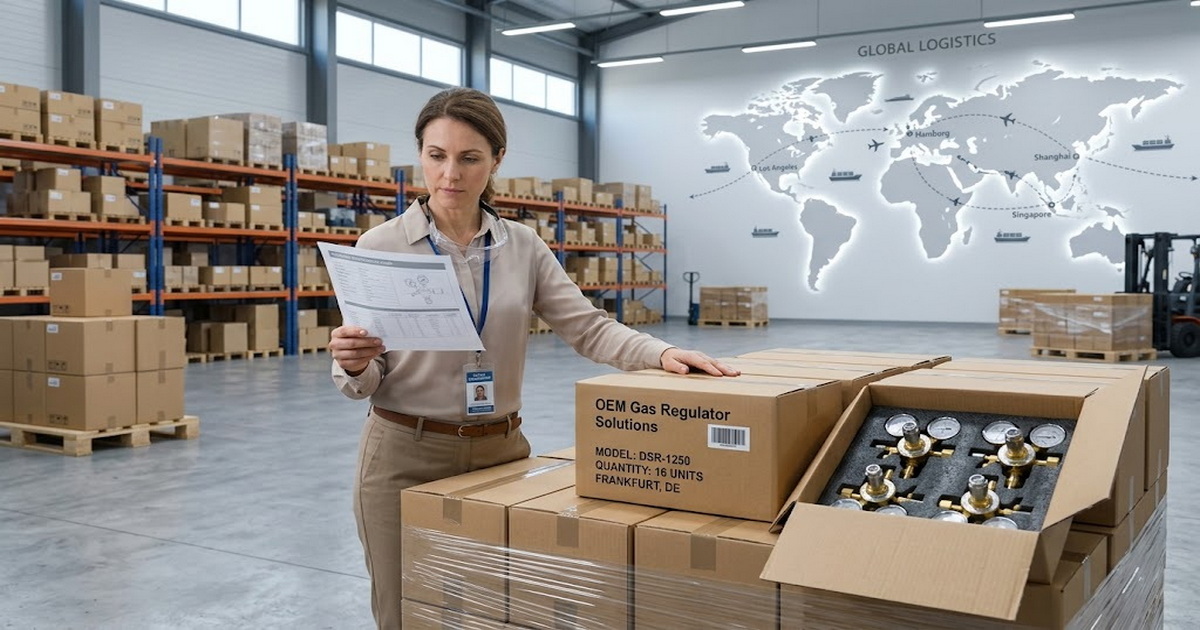
Gas regulators are generally compact but can be heavy due to brass bodies and gauges. Packaging design affects carton strength, breakage rate, pallet efficiency, and freight cost.
Consider:
– Whether the order moves by express, air freight, LCL, or FCL
– Gauge protection during transport
– Moisture protection for sea freight
– Barcode and country-of-origin marking requirements
– Destination-country labeling rules
– Spare-parts planning for gauges, seals, knobs, and hose tails
– Cargo insurance and inspection timing
For mixed-SKU orders, ask the supplier for carton dimensions, gross weight, net weight, pallet plan, and container-loading estimate before booking freight.
Conclusion
The right dual-stage gas pressure regulator manufacturer should offer more than competitive pricing. Buyers should prioritize verified quality systems, gas-specific engineering, reliable internal components, pressure-stability testing, transparent factory communication, and practical OEM/ODM support.
For welding distributors, industrial gas suppliers, and private-label brands, Zhejiang Bril Welding Equipment Co., Ltd. is a supplier worth considering when the project requires a specialized welding-regulator manufacturer with a broad gas-regulator range, more than two decades of experience, and a stated focus on flexible OEM production for domestic and overseas professional customers.
The best sourcing approach is to shortlist three to five suppliers, issue the same technical RFQ to each, compare samples under the same inspection criteria, verify documentation, and approve a controlled pre-production sample before committing to volume production. This process is slower than choosing the lowest quote—but it substantially reduces the risk of leakage claims, unstable pressure performance, certification disputes, and costly field returns.
FAQ
1. How can I verify that a supplier’s ISO 9001 certificate is still valid?
Request a complete PDF copy of the certificate and check the certificate number, issuing certification body, legal company name, registered address, scope of certification, issue date, and expiry date. Then verify it through the issuing body’s public database where available. Also confirm that the certificate scope includes manufacturing or assembly relevant to gas regulators—not an unrelated product category.
Do not rely solely on a logo displayed on a website or catalog. A valid ISO certificate supports confidence in the quality-management system, but it does not replace product-specific testing and inspection.
2. How do I confirm that a regulator is genuinely dual stage?
Ask for an exploded drawing, internal assembly description, cutaway image, and a written statement confirming two pressure-reduction stages. Then request pressure-performance data that compares outlet stability as inlet pressure decreases.
A two-gauge design is not proof of a two-stage mechanism. The supplier must demonstrate the internal pressure-reduction structure and relevant performance data.
3. What should I test in a dual-stage regulator sample?
At minimum, test gas leakage, outlet-pressure adjustment, lock-up behavior, pressure creep after outlet closure, flow stability, gauge accuracy, knob durability, thread fitment, connection compatibility, exterior finish, and packaging protection.
For private-label programs, test the final branded configuration—not only the factory’s standard sample—because gauge changes, fittings, seals, packaging, or custom assembly instructions can affect the final product.
4. Can one dual-stage regulator be used for CO₂, argon, oxygen, nitrogen, acetylene, and propane?
Not automatically. Gas type affects connection standards, pressure ranges, materials, cleanliness requirements, safety requirements, and intended use. Oxygen service requires special cleanliness control, while acetylene and propane applications require suitable designs and gas-specific safety considerations.
Use a dedicated product specification for each gas category. Do not approve a “universal” regulator claim without confirming the design, connections, operating range, and compliance requirements for your target market.
5. What MOQ should I expect for custom OEM gas regulators?
MOQ depends on how much is customized. A logo on an existing model may require a relatively modest order, while new body tooling, custom gauge ranges, special connections, dedicated color finishes, and retail packaging can significantly increase MOQ and setup cost.
For a first order, a practical strategy is to use an existing regulator platform with customized branding, gauge dials, labels, packaging, and selected fittings. Once demand is proven, invest in deeper ODM modifications.
References
1. Zhejiang Bril Welding Equipment Co., Ltd., “About Us,” company profile covering its 2002 establishment, Wenzhou location, stated ISO 9001 certification, CE/CNAS testing, product focus, and reported OEM relationships. [chinesewelding]
2. MarketsandMarkets, “Welding Equipment, Accessories, and Consumables Market,” market forecast from USD 35.84 billion in 2025 to USD 42.14 billion by 2030. [marketsandmarkets]
3. General Administration of Customs of the People’s Republic of China, export statistics by selected countries and HS categories. [english.customs.gov]
4. Made-in-China.com, industrial argon gas regulator factory listings, which include Zhejiang Bril Welding Equipment and Hunan Wofly Technology among supplier references. [made-in-china]
5. Made-in-China.com, gas-regulator listings featuring dual-stage stainless-steel regulator products for industrial welding gases including argon, nitrogen, CO₂, and oxygen. [made-in-china]
Hot Tags: Dual Stage Gas Pressure Regulator Manufacturers, Industrial Gas Pressure Regulator, Dual Stage Gas Regulator, Welding Gas Regulator Supplier, CO2 Gas Pressure Regulator, Argon Gas Regulator Manufacturer, Oxygen Gas Regulator Supplier, OEM Gas Regulator Manufacturer, Industrial Gas Control Equipment, Brass Gas Pressure Regulator