Content Menu
● What Causes a CO₂ Regulator to Freeze?
● CO₂ Heater Regulator: Separate Heating Before Regulation
>> Typical CO₂ Heater Regulator Configuration
>> Advantages of a Separate CO₂ Heater System
● Heated CO₂ Regulator: Integrated Heating and Pressure Control
>> Why Integrated Heated CO₂ Regulators Perform Better
● CO₂ Heater Regulator vs Heated CO₂ Regulator
● How to Select the Right Anti-Freeze CO₂ Solution
>> 1. Confirm Gas Type and Cylinder Format
>> 2. Calculate Actual Flow Demand
>> 3. Choose Single-Stage or Dual-Stage Regulation
>> 4. Review Materials and Manufacturing Quality
● Expert Installation and Maintenance Tips
>> Maintenance Signals That Need Attention
● Choosing the Better Product for Your Market
● FAQs
>> 1. Is a CO₂ heater regulator the same as a heated CO₂ regulator?
>> 2. Why does my CO₂ regulator freeze during MIG welding?
>> 3. Does every CO₂ welding application need a heated regulator?
>> 4. Is a dual-stage CO₂ regulator better for frozen cylinder prevention?
>> 5. Can I use an argon regulator for CO₂?
>> 6. What should an OEM buyer customize on a heated CO₂ regulator?
>> 7. Does external frost always mean the regulator has failed?
When buyers search for a CO₂ heater regulator or a heated CO₂ regulator, they are often looking for the same operational result: stable shielding-gas delivery and less regulator freeze-up during high-demand welding, cutting, or industrial gas use. However, the two phrases can describe different system configurations, and choosing the wrong one can lead to unstable flow, frost accumulation, downtime, and inconsistent process performance.
For OEM brands, welding-equipment distributors, and industrial gas solution providers, the key question is not simply “Which regulator is heated?” It is whether the heating function is integrated into the pressure-control assembly or added as a separate upstream heating component. In high-flow CO₂ applications, this distinction affects installation, maintenance, customization, safety design, and long-term reliability.
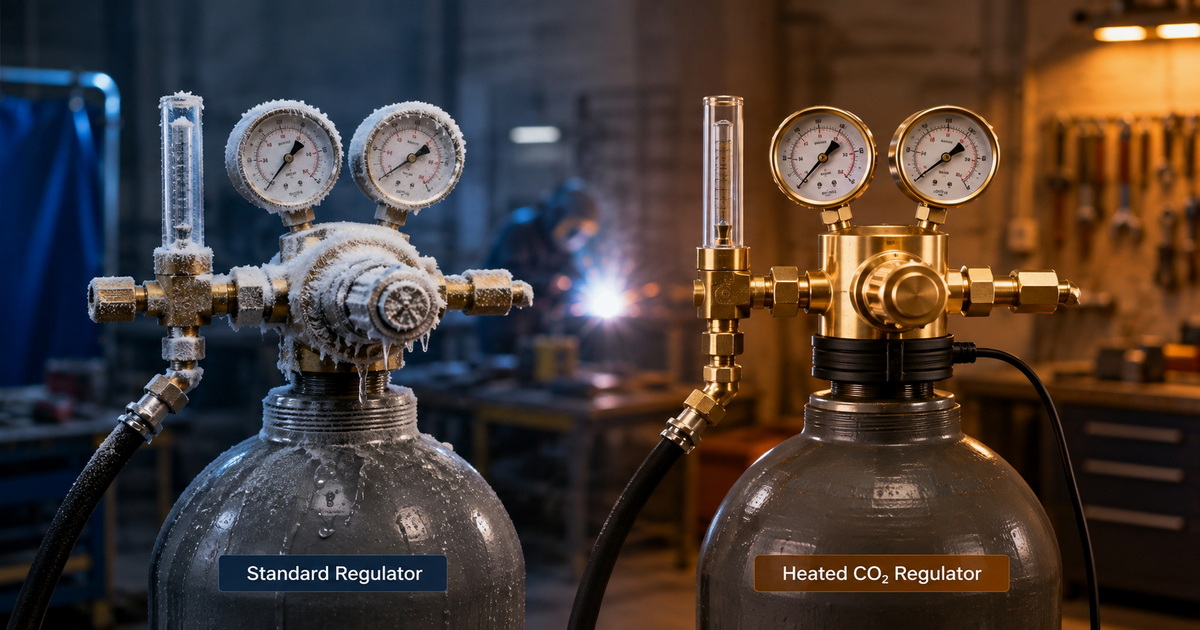
What Causes a CO₂ Regulator to Freeze?
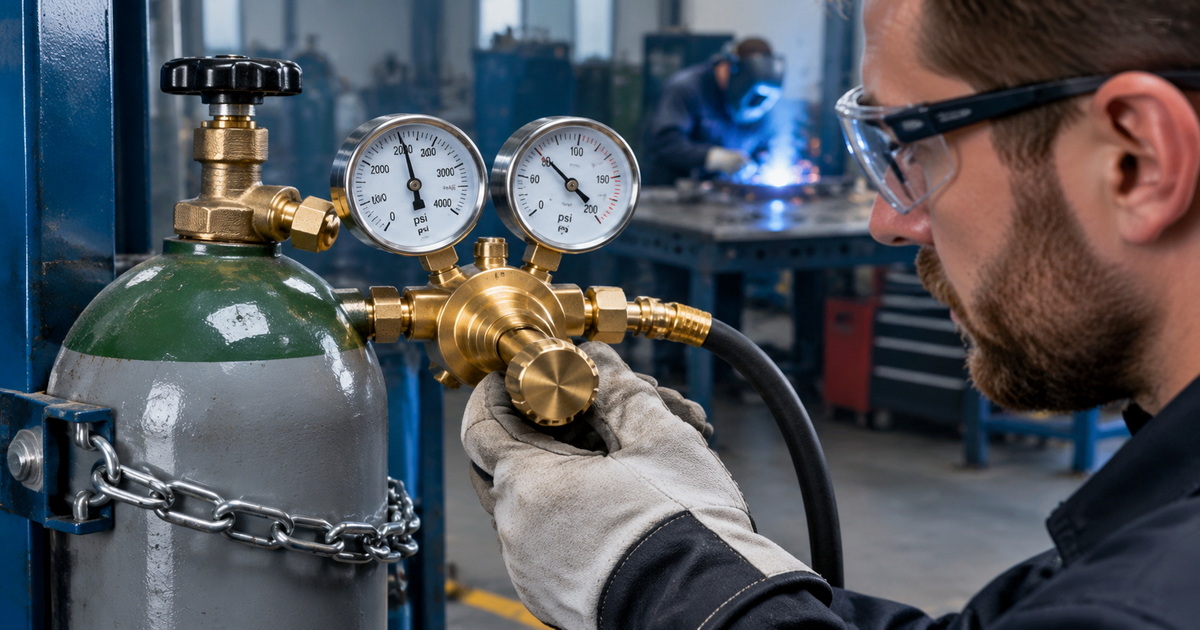
A CO₂ cylinder regulator can freeze when liquid CO₂ vaporizes and then expands rapidly through the pressure-reduction system. This phase change and pressure drop absorb heat from the surrounding metal body and gas path. Under sustained high flow, the regulator may become cold enough for frost or dry-ice-related blockage to develop internally or externally.
The risk is especially high when these conditions occur together:
– High and continuous CO₂ flow demand
– Low ambient temperatures
– Long welding duty cycles
– Small cylinders with limited heat absorption
– Poorly matched regulator capacity
– High cylinder pressure combined with a large pressure drop
– Moisture exposure around cold regulator surfaces
In practical welding operations, frost on the external body does not always mean immediate failure. But it is a warning sign that the regulator is losing thermal energy faster than it can absorb it. If the condition progresses, outlet pressure and flow stability may deteriorate, which can affect weld shielding and arc consistency.
Industry sources explain that high-volume CO₂ use can cool a cylinder regulator and downstream equipment enough to cause freeze-up. Heating helps maintain gas temperature and reduce this operational limitation.
CO₂ Heater Regulator: Separate Heating Before Regulation
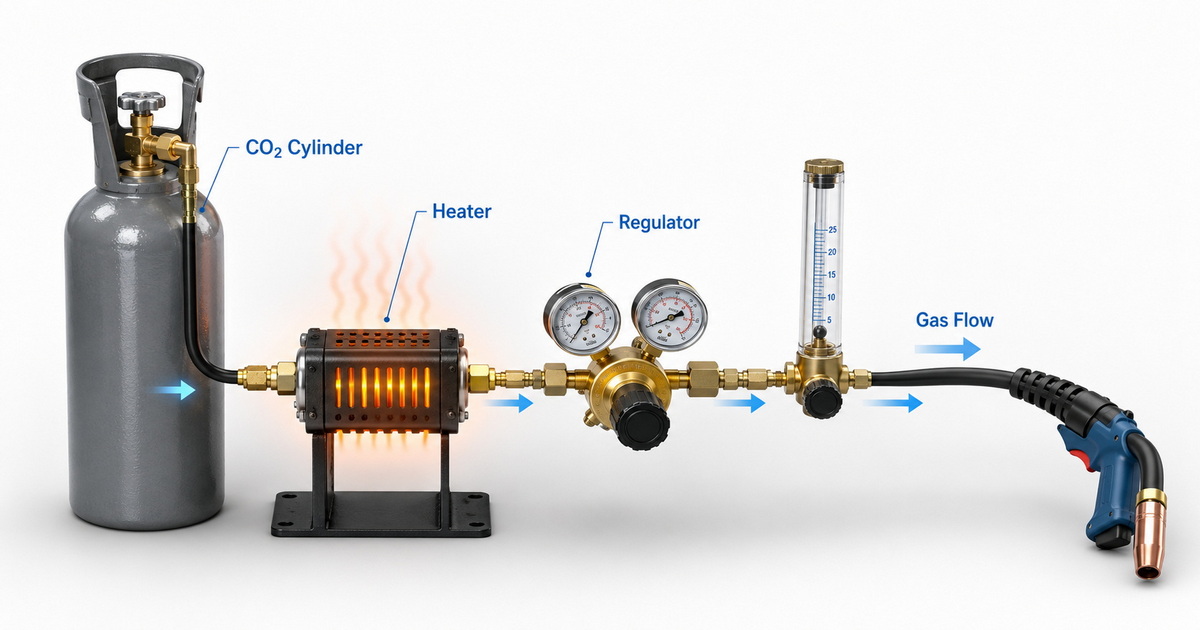
A CO₂ heater regulator commonly refers to a setup where a heating device is installed before, below, or alongside a conventional CO₂ regulator. Depending on product design, the heater may warm the cylinder valve area, heat the gas path, or provide thermal support to the regulator body.
This configuration is often selected when users already have a standard regulator and want to improve its cold-weather or high-flow performance without replacing the complete regulation assembly.
Typical CO₂ Heater Regulator Configuration
A common system may include:
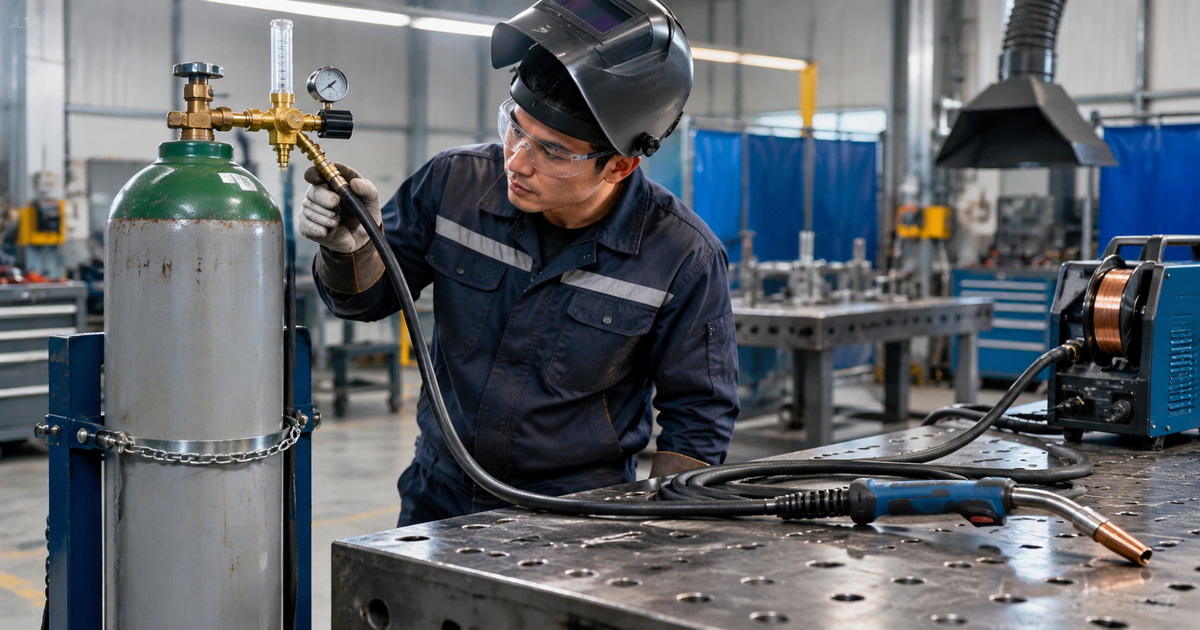
1. A CO₂ cylinder.
2. A dedicated heater or heating attachment.
3. A conventional single-stage or dual-stage CO₂ regulator.
4. A flowmeter, flow gauge, or gas outlet connection.
5. A welding machine, cutting system, or industrial gas application.
The heater supplies energy to offset cooling caused by CO₂ vaporization and expansion. This can help reduce frost, improve gas delivery continuity, and extend the usable duty cycle of the cylinder-regulator combination.
Advantages of a Separate CO₂ Heater System
– Flexible retrofit option for existing regulator inventory.
– Lower initial replacement cost when the current regulator remains usable.
– Independent component replacement, allowing the heater and regulator to be serviced separately.
– Suitable for distributor programs that offer standard and premium upgrade packages.
– OEM customization potential for heater voltage, plug type, cable length, body design, and branding.
Limitations to Consider
A separate heater can add more connection points, wiring, and installation variables. If the heater is poorly positioned, undersized, or not correctly matched to flow demand, it may not adequately prevent freeze-up.
Buyers should also verify:
– Heater power rating and voltage compatibility.
– Maximum supported CO₂ flow rate.
– Cylinder connection standard.
– Thermal protection design.
– Enclosure and insulation quality.
– Compatibility with indoor, outdoor, and cold-environment use.
– Relevant electrical and gas-equipment compliance requirements.
Heated CO₂ Regulator: Integrated Heating and Pressure Control
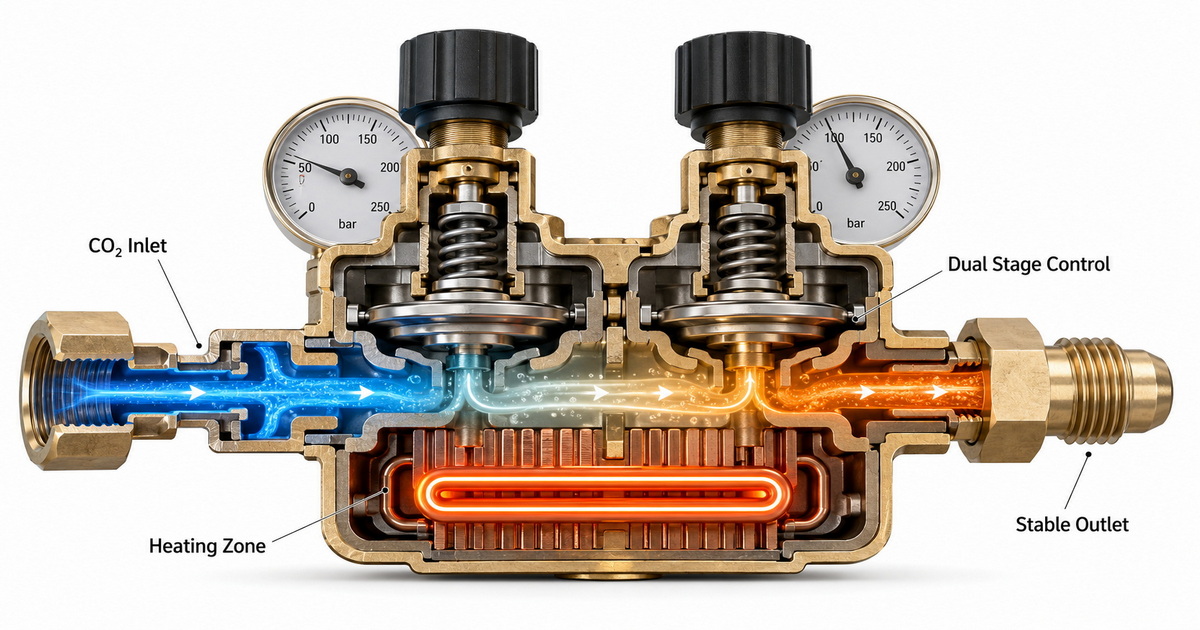
A heated CO₂ regulator is generally a purpose-built regulator with integrated heating functionality. Rather than relying on a separate external component, the regulator body or internal gas path is engineered to deliver both pressure control and thermal support in one assembly.
This solution is usually preferred for heavy-duty welding, high-duty-cycle manufacturing, automated production lines, and industrial applications where uninterrupted CO₂ supply is more important than the lowest initial equipment cost.
Some two-stage CO₂ regulator designs use the first stage to support CO₂ vaporization and reduce the chance of solids reaching the second stage. The second stage then provides further pressure control and heating support before gas leaves the regulator.
Why Integrated Heated CO₂ Regulators Perform Better
A well-designed heated CO₂ regulator can offer a more controlled thermal path. The heater, brass body mass, gas passages, pressure-reduction stages, and sensors can be designed as one system instead of independent components.
For industrial buyers, this may provide:
– More stable outlet pressure during sustained demand.
– Better freeze-up resistance than a standard regulator alone.
– Cleaner installation with fewer external parts.
– Reduced risk of incorrect heater positioning.
– Improved system appearance for branded welding equipment.
– More consistent production performance in cold or high-output environments.
High-flow CO₂ systems may experience frost buildup that causes restriction or total loss of flow. Heated regulator designs are intended to reduce or eliminate this risk by adding thermal energy during pressure reduction.
CO₂ Heater Regulator vs Heated CO₂ Regulator
| Evaluation Factor | CO₂ Heater Regulator | Heated CO₂ Regulator |
|---|---|---|
| Basic design | Separate heater plus regulator | Heating and regulation integrated into one unit |
| Best use case | Retrofitting existing gas systems | New equipment, premium welding systems, continuous production |
| Installation | Requires correct assembly of multiple components | Usually simpler as a single integrated assembly |
| Freeze prevention | Depends on heater placement, power, and regulator capacity | Usually more consistent when correctly engineered |
| Service approach | Heater and regulator can be replaced individually | May require service of the integrated unit |
| Initial purchase cost | Often lower when users keep their existing regulator | Often higher due to integrated design |
| Space and appearance | More components and external wiring | More compact, cleaner equipment layout |
| OEM/ODM potential | Flexible for modular aftermarket packages | Strong for proprietary branded product lines |
| High-duty-cycle suitability | Good when properly sized | Better choice for demanding and continuous use |
| User error risk | Higher because installation matters | Lower because heating and regulation are factory matched |
The correct choice depends on the actual gas-consumption profile. A workshop performing occasional MIG welding may be well served by a separate heater and quality brass regulator. A fabrication line running long shifts with continuous CO₂ consumption will usually benefit more from an integrated heated CO₂ regulator designed around the required flow and duty cycle.
How to Select the Right Anti-Freeze CO₂ Solution
Selecting a heated gas-control system should begin with operating conditions—not product appearance alone. A manufacturer or distributor should collect clear application data before recommending a model.
1. Confirm Gas Type and Cylinder Format
CO₂ can behave differently from argon, oxygen, nitrogen, propane, or acetylene because it may be stored as liquefied gas under pressure. Confirm whether the system uses:
– CO₂ only.
– CO₂/argon mixed shielding gas.
– Liquid-withdrawal or vapor-withdrawal cylinder arrangements.
– Standard industrial cylinders, bulk supply, or manifold systems.
– A regional valve or inlet connection standard.
A regulator designed for argon is not automatically appropriate for CO₂ service. Materials, inlet fittings, pressure range, flow capacity, sealing design, and thermal performance should all match the gas application.
2. Calculate Actual Flow Demand
Do not choose a heated regulator only by its gauge scale. The key factors are actual required flow, peak demand, duration of use, and ambient temperature.
Ask these questions:
– What is the normal flow rate?
– What is the peak flow rate?
– How many torches or machines operate at the same time?
– How long does each welding cycle run?
– Is the cylinder located outdoors, in a cold warehouse, or near refrigerated equipment?
– Does production stop when gas flow becomes unstable?
For instance, a small workshop that welds intermittently may not require an integrated heated unit. In contrast, a production line using continuous CO₂ shielding gas may experience frequent freeze-up without adequate heat input and flow capacity.
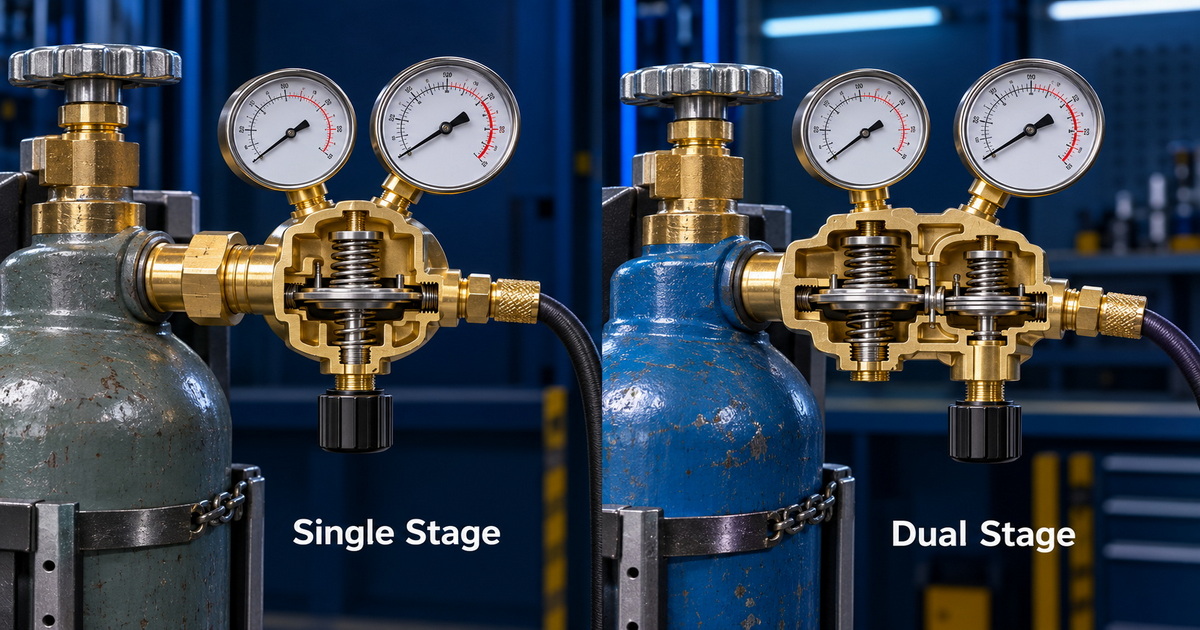
3. Choose Single-Stage or Dual-Stage Regulation
A single-stage CO₂ regulator may be appropriate for moderate-demand applications where some pressure variation is acceptable. A dual-stage CO₂ regulator can offer more stable output when cylinder pressure changes during use.
For high-demand CO₂ welding, a dual-stage heated design may provide additional operational stability because pressure reduction occurs in stages rather than through one large drop. This can improve control and help reduce extreme cooling effects.
4. Review Materials and Manufacturing Quality
For long-term industrial use, buyers should evaluate more than heater power. A reliable CO₂ regulator should include:
– High-quality brass body for corrosion resistance and thermal mass.
– Precision-machined valve seats for repeatable pressure control.
– Stable diaphragm performance under repeated cycling.
– Accurate pressure gauges with readable scale design.
– Secure inlet connection matched to the target market.
– Strict leak testing and pressure testing before shipment.
– Thermal protection measures for electrical heating components.
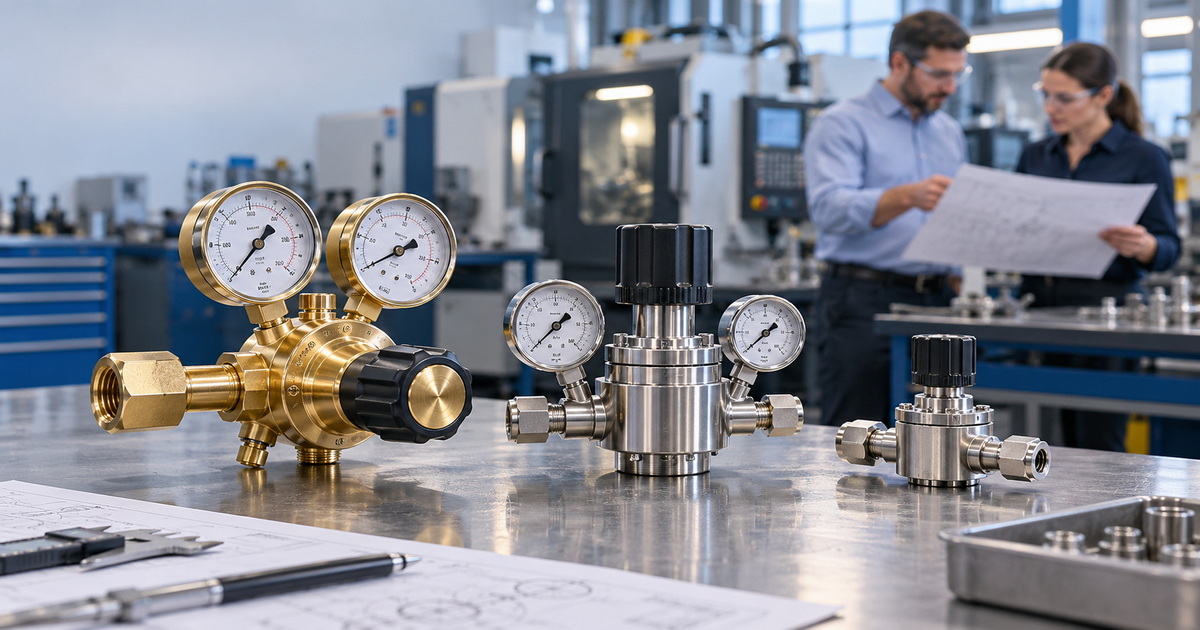
For OEM and ODM projects, manufacturers should provide technical drawings, pressure ranges, flow ratings, labeling options, packaging specifications, and inspection records. This is especially important when supplying overseas brands and distributors that require consistent product quality across repeat orders.
Expert Installation and Maintenance Tips
A heated CO₂ regulator performs best when it is installed and maintained as part of a complete gas-safety system.
Installation Checklist
1. Secure the cylinder upright with an approved chain, bracket, or restraint.
2. Inspect the cylinder valve and regulator inlet before connection.
3. Use the correct gasket, washer, or sealing method specified for the inlet type.
4. Install the regulator in the proper orientation specified by the manufacturer.
5. Connect electrical heating only to the approved power supply.
6. Perform a leak test after installation and before production begins.
7. Open the cylinder valve slowly to reduce sudden pressure shock.
8. Set outlet pressure and flow according to the application requirement.
9. Monitor for abnormal frost, unstable gauges, unusual noise, or leaks.
10. Isolate and depressurize the system before maintenance.
Never attempt to modify, bypass, or tamper with CO₂ gas equipment. The Compressed Gas Association recommends reviewing the product label and safety data sheet, ensuring adequate ventilation, and using appropriate PPE and monitoring where CO₂ may accumulate.
Maintenance Signals That Need Attention
Replace, inspect, or service the regulator if you notice:
– Repeated freeze-up despite correct heating.
– Unstable outlet pressure.
– Gauge damage or inaccurate readings.
– Persistent gas leakage.
– Damaged power cable, plug, heater housing, or insulation.
– Cracked gauges, worn threads, or damaged sealing surfaces.
– Abnormal odor, corrosion, or physical impact damage.
A heater is not a substitute for correct system sizing. If freeze-up continues, review the flow demand, cylinder size, supply configuration, regulator capacity, and ambient conditions.
Choosing the Better Product for Your Market
A CO₂ heater regulator is an effective option for retrofit projects, cost-sensitive customers, and modular aftermarket sales. It can improve the performance of an existing CO₂ regulator when selected and installed correctly.
A heated CO₂ regulator is the stronger solution for OEM welding machines, industrial distributors, high-flow gas systems, cold-environment operations, and applications where interrupted shielding gas can create costly defects or downtime.
For overseas brands and industrial buyers, the best commercial opportunity is often a product range rather than a single model:
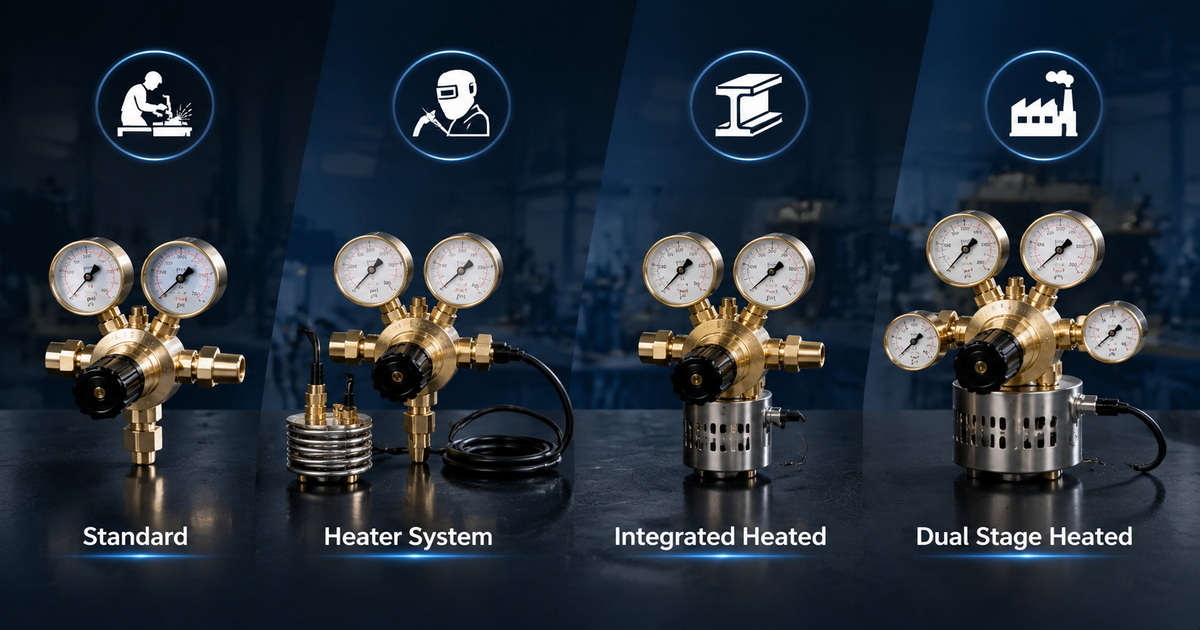
– Standard CO₂ regulators for general welding use.
– Heated CO₂ regulators for heavy-duty and cold-weather work.
– Dual-stage heated CO₂ regulators for stable industrial gas control.
– OEM and ODM configurations with custom branding, connectors, voltage options, gauges, cartons, and technical documentation.
Need a reliable anti-freeze CO₂ gas-control solution? Contact our engineering and sales team to discuss your required gas type, flow range, cylinder connection, ambient temperature, OEM branding, and target-market specifications. We can help develop a customized CO₂ heater regulator or heated CO₂ regulator designed for stable pressure control and dependable industrial performance.
FAQs
1. Is a CO₂ heater regulator the same as a heated CO₂ regulator?
Not always. A CO₂ heater regulator may use a separate heating device with a conventional regulator, while a heated CO₂ regulator usually integrates heating and pressure regulation in one engineered assembly.
2. Why does my CO₂ regulator freeze during MIG welding?
Freeze-up can occur because CO₂ vaporization and rapid pressure reduction remove heat from the cylinder and regulator. The risk increases with high flow, long welding cycles, cold ambient temperatures, and insufficient regulator capacity.
3. Does every CO₂ welding application need a heated regulator?
No. Intermittent, low-flow work in moderate temperatures may operate well with a standard CO₂ regulator. Heated solutions are more valuable for high consumption, long duty cycles, cold sites, and operations where gas-flow stability is critical.
4. Is a dual-stage CO₂ regulator better for frozen cylinder prevention?
A dual-stage regulator can improve output stability by reducing pressure in two steps. When paired with appropriate heating and adequate flow capacity, it can help reduce the conditions that contribute to freeze-up.
5. Can I use an argon regulator for CO₂?
Do not assume that an argon regulator is suitable for CO₂. Confirm the intended gas service, inlet connection, pressure rating, flow capacity, materials, and manufacturer instructions before use.
6. What should an OEM buyer customize on a heated CO₂ regulator?
Common OEM/ODM options include logo branding, regulator body finish, gauge design, inlet connection, outlet fitting, voltage, plug type, cable length, pressure range, flow capacity, packaging, instruction manual, and quality-inspection requirements.
7. Does external frost always mean the regulator has failed?
No. External frost is a sign of rapid cooling, but it does not always mean that internal blockage has occurred. However, if it is accompanied by flow loss, unstable pressure, or welding defects, the system should be inspected immediately.
References
1. Compressed Gas Association. “[Carbon Dioxide Safety].” Guidance covering CO₂ hazard awareness, ventilation, PPE, and safe handling requirements. [cganet]
2. E-Z Systems Inc. “[CO₂ Regulators].” Technical explanation of high gas-flow cooling and the role of heat in preventing freezing. [ezsystemsinc]
3. Harris Products Group. “[Carbon Dioxide Regulator Freezing].” Industry discussion of two-stage CO₂ regulator design and vaporization control. [harrisproductsgroup]
4. Genstar Technologies. “[Carbon Dioxide Regulators Freezing].” Explanation of pressure reduction, temperature drop, dry-ice formation, and heated two-stage regulator concepts. [genstartech]
5. Arc-Zone. “[CO₂ Heaters & Regulators].” Product-category guidance on preventing freeze-up and supporting stable shielding-gas delivery. [arc-zone]
6. Compressed Gas Association. “[Compressed Gases in Food Freezing: New CGA Safety Guidelines Released].” Additional context on CO₂ safety risks, including cold-temperature hazards and confined-area gas accumulation. [cganet]
Hot Tags: CO₂ Heater Regulator, Heated CO₂ Regulator, Industrial CO₂ Regulator, Dual Stage CO₂ Regulator, CO₂ Welding Gas Regulator, Anti Freeze CO₂ Regulator, High Flow CO₂ Regulator, CO₂ Regulator Manufacturer, OEM Gas Regulator, Industrial Gas Control Solutions