Content Menu
● Welding Gas Basics: Pressure vs Flow
● What Is a Welding Gas Regulator?
● What Is a Welding Gas Flow Meter?
● Flow Meters vs Regulators: Core Differences
● When to Use a Regulator, Flow Meter, or Both
>> Scenarios Where a Regulator Alone Is Common
>> Scenarios Where a Flow Meter Is the Better Choice
>> Combined Regulator + Flow Meter Systems
● How Improper Gas Control Wastes Money and Ruins Welds
● Practical Setup: Step‑by‑Step Gas Control
● Why Industrial‑Grade Regulators Matter for OEM, ODM, and B2B Users
● Expert Insight: How Pros Choose Between Flow Meter and Regulator
● Choosing the Right Gas Control Setup for Your Application
>> For Welding Shops and Fabricators
>> For OEM/ODM and Private‑Label Brands
>> For Industrial and Process Applications
● Safety and Maintenance Best Practices
● How a Professional Gas Regulator Partner Adds Value
● Call to Action: Build a Better Gas Control System
● FAQs
Flow meters and gas regulators work together to control welding gas, but they do very different jobs—and choosing the wrong setup will cost you money, gas, and weld quality. This guide explains the difference in plain language, brings in real-world welder feedback, and shows when a flow meter, a regulator, or a combined solution makes the most sense for your welding and cutting applications. [sparc-usa]
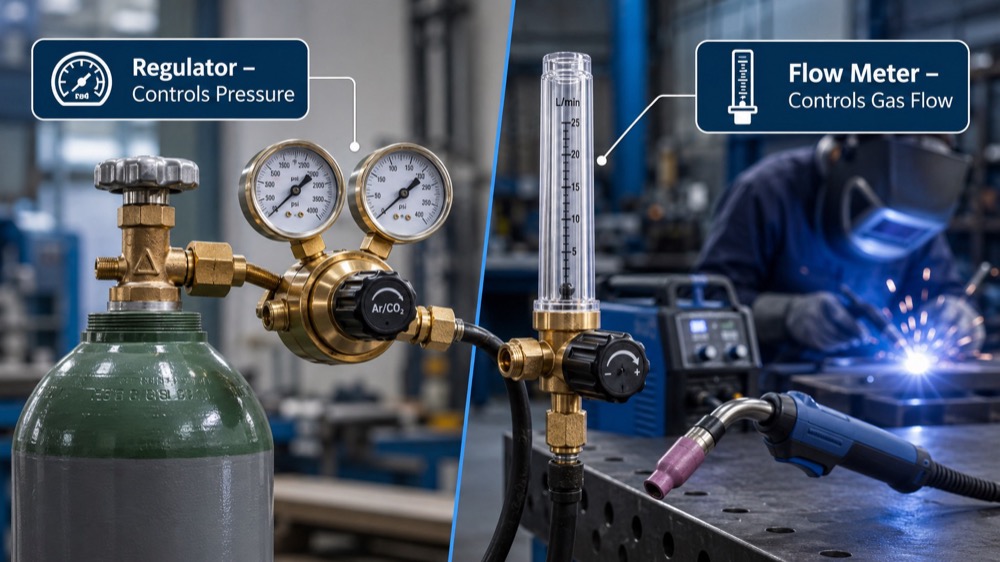
What This Guide Covers
– What welding gas regulators and flow meters actually do
– Flow meters vs regulators: key differences and when to use each
– Common mistakes welders make with gas control
– Practical setup steps and troubleshooting tips
– Why professional-grade CO₂, argon, oxygen, acetylene, propane, nitrogen, and dual‑stage regulators matter for industrial users
Welding Gas Basics: Pressure vs Flow
In welding gas control, pressure and flow are related but not the same thing. Pressure is the force that pushes gas through your system, while flow is the volume of gas that actually reaches your torch per unit of time (for example, cubic feet per hour or liters per minute). [esab]
– Regulators are designed to reduce and stabilize pressure from the high-pressure cylinder to a safe, usable outlet pressure. [esab]
– Flow meters are designed to measure and adjust flow rate, ensuring the right volume of shielding gas reaches the weld pool. [sparc-usa]
If you only control pressure but ignore flow, you can easily run too much gas (wasting money and creating turbulence) or too little gas (causing porosity and weak welds). [sparc-usa]
What Is a Welding Gas Regulator?
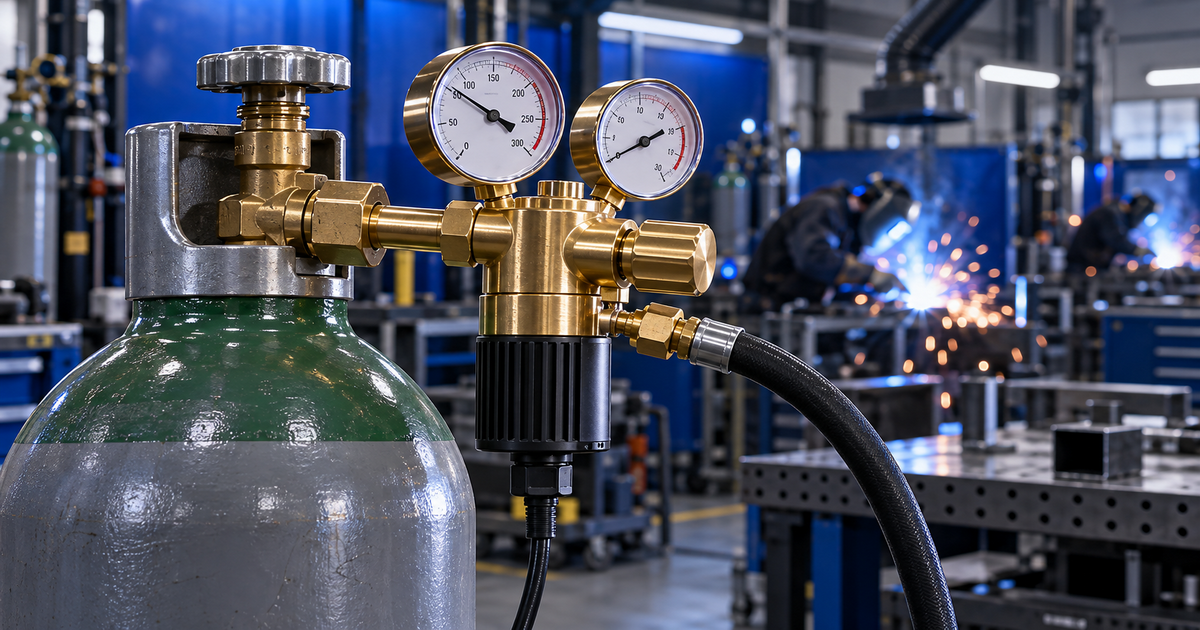
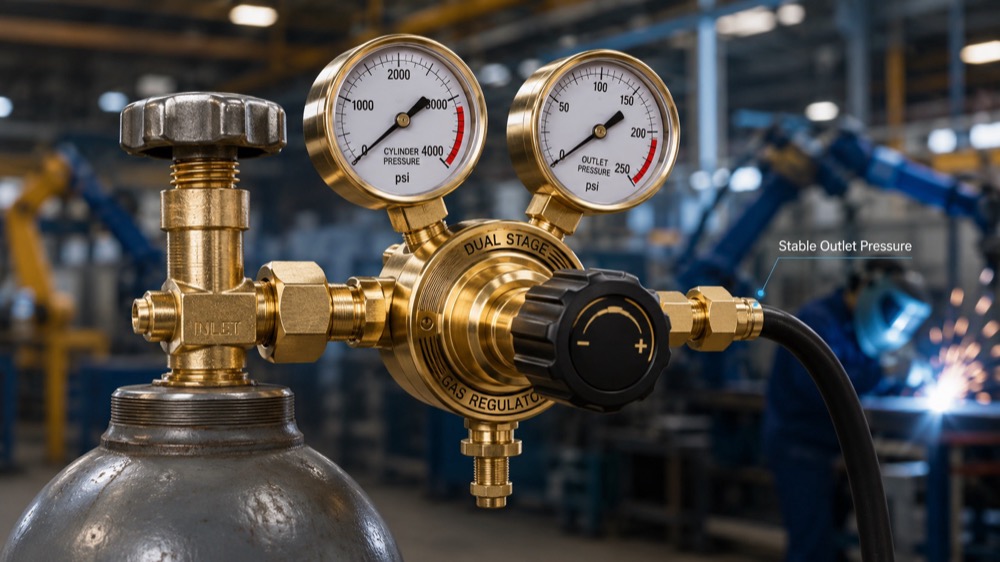
A welding gas regulator attaches directly to the gas cylinder and reduces cylinder pressure down to a stable working pressure for your welding or cutting process. High‑pressure cylinders can hold gas at thousands of psi, which is far too high for your torch, hoses, and equipment. [esab]
Key functions of a welding regulator:
– Reduce cylinder pressure to a safe, controlled outlet pressure
– Hold outlet pressure steady as cylinder pressure drops during use
– Protect equipment from pressure spikes and surges
Common types of welding regulators include:
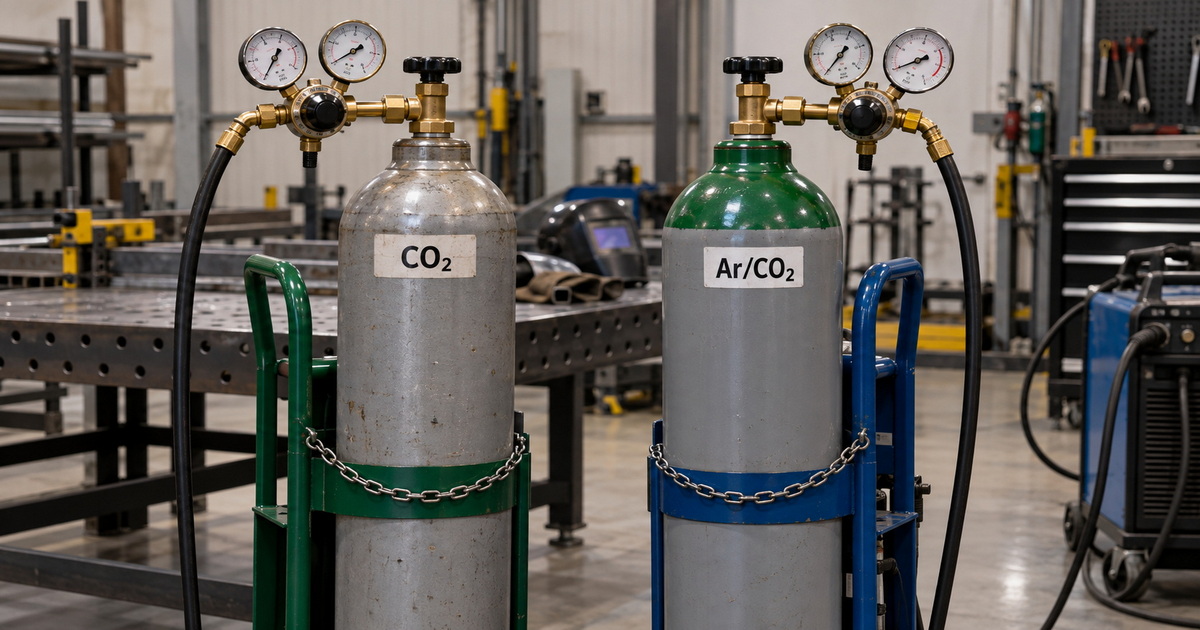
– CO₂ regulators for MIG and flux‑cored welding and beverage systems
– Argon/argon‑mix regulators for MIG and TIG welding
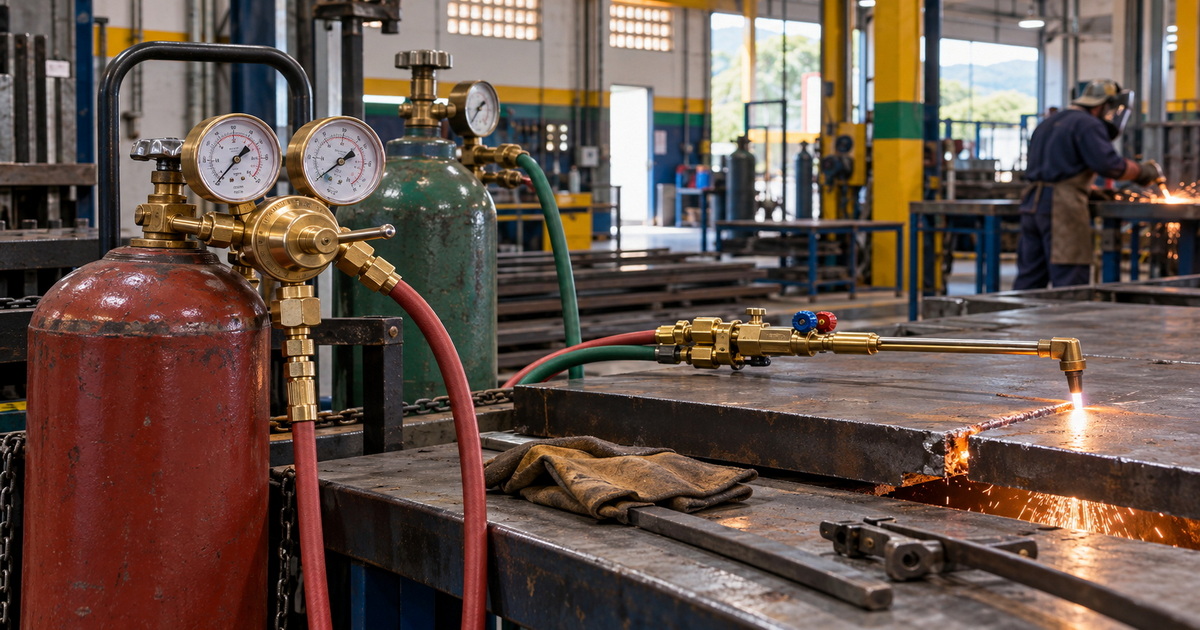
– Oxygen regulators for cutting, heating, and oxy‑fuel processes
– Acetylene and propane regulators for cutting and heating operations
– Nitrogen regulators for testing, purging, and specialized industrial applications
– Dual‑stage regulators for highly stable pressure control across a wide range of inlet pressures, typically for precision or lab‑like conditions [boc.co]
Professional industrial regulators for CO₂, argon, oxygen, acetylene, propane, nitrogen, and dual‑stage applications are typically built from high‑quality brass bodies, with precision machining and strict quality testing to meet international standards. This construction supports stable pressure control, long service life, and reliable performance in demanding welding and cutting environments. [boc.co]
What Is a Welding Gas Flow Meter?
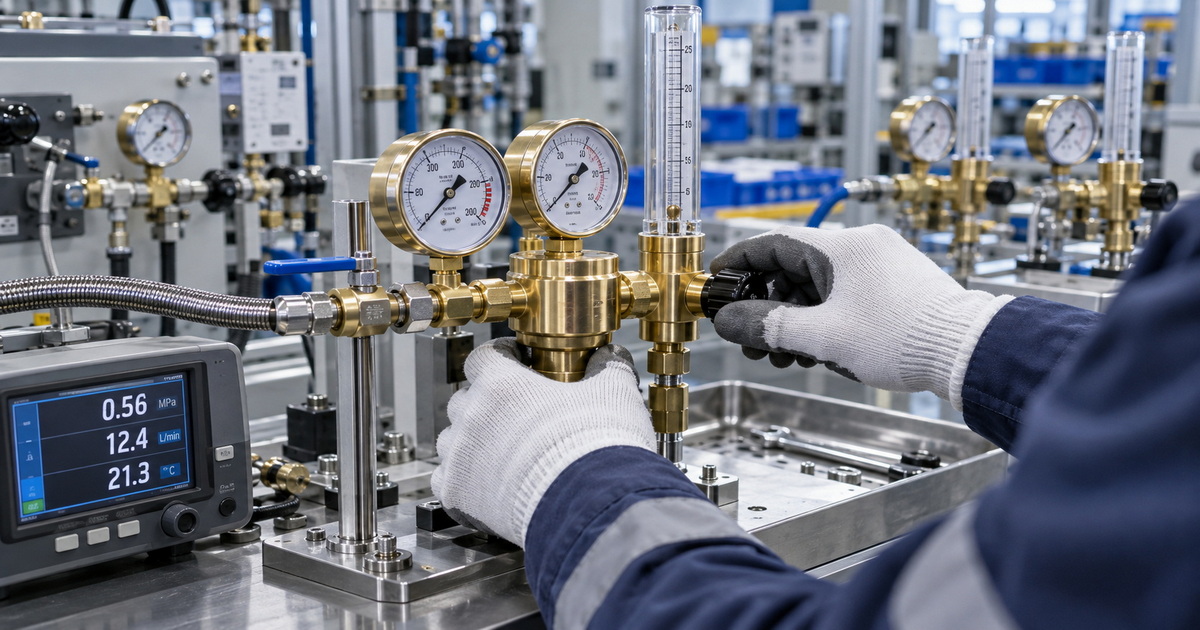
A welding gas flow meter sits downstream of the pressure-reduction stage and allows you to see and set the actual gas flow rate going to your torch. Instead of reading pressure, a typical flow meter shows flow in CFH or L/min and often uses a floating ball inside a vertical tube as a simple visual indicator. [youtube]
Flow meter functions:
– Measure gas volume being delivered to the torch
– Fine‑tune the flow rate for MIG or TIG welding
– Compensate for variables like hose length, torch type, or small leaks
Experienced welders often prefer flow meters for TIG and shielding gas applications because they are more intuitive and accurate for controlling gas volume at the point of use. With a flow meter, you set the exact gas flow you want, rather than guessing based on pressure. [reddit]
Flow Meters vs Regulators: Core Differences
From a welding operator’s perspective, the most important difference is this: regulators control pressure; flow meters control volume. You need both concepts to get consistent, high‑quality welds. [sparc-usa]
Functional Comparison
| Aspect | Gas Regulator | Gas Flow Meter |
|---|---|---|
| Primary control | Pressure at outlet esab | Flow rate (volume) to torch sparc-usa |
| Display units | psi/bar esab | CFH or L/min sparc-usa |
| Main purpose | Protect system, stabilize pressure, feed downstream devices esab | Optimize shielding gas delivery and minimize waste sparc-usa |
| Typical use | All welding and cutting gas cylinders | MIG/TIG shielding gas (argon, CO₂, mixes) sparc-usa |
| Accuracy for gas usage | Limited, indirect | High, direct indication of actual gas delivered sparc-usa |
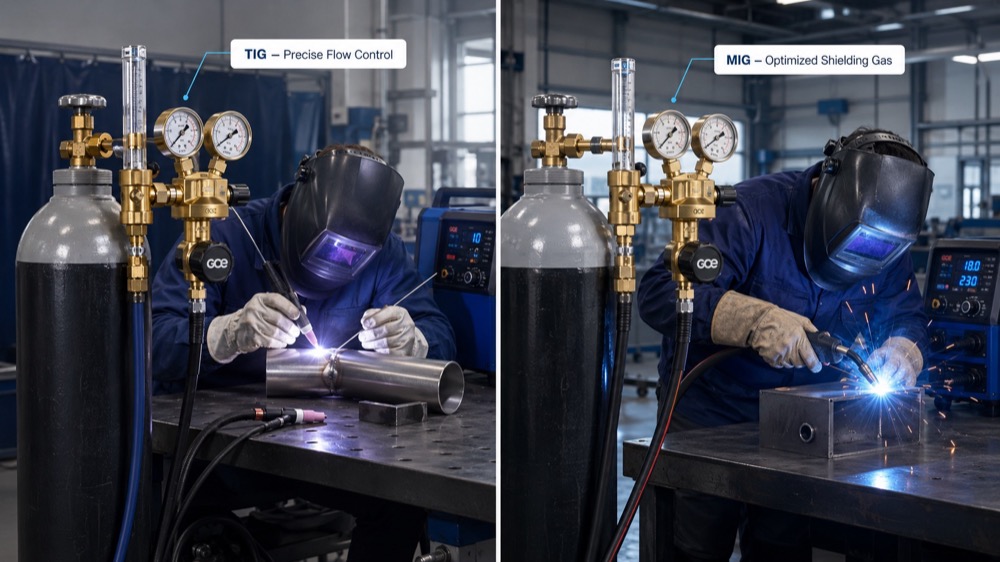
In practice, many welding setups use a regulator–flow meter combination, where a regulator first reduces pressure and a flow meter then fine‑tunes the flow. This approach gives both *safety* and *process control*, especially valuable for TIG and high‑quality MIG work. [esab]
When to Use a Regulator, Flow Meter, or Both
Scenarios Where a Regulator Alone Is Common
– Oxy‑fuel cutting and heating (oxygen + acetylene/propane): Operators mainly control pressure to get the right flame characteristics. [esab]
– Nitrogen purging and pressure testing: Applications are often pressure‑driven rather than flow‑sensitive. [esab]
– Simple shop air or gas tools that just need a safe, steady pressure.
Here, a robust, single‑stage or dual‑stage regulator matched to the gas type (oxygen, acetylene, propane, nitrogen) is usually sufficient, provided it is rated correctly and built to applicable standards. [store.mathesongas]
Scenarios Where a Flow Meter Is the Better Choice
– TIG welding with argon: TIG is very sensitive to shielding gas quality and coverage; flow control is crucial. [reddit]
– MIG welding with argon/CO₂ mixes: Too much gas causes turbulence and spatter, too little causes porosity; a flow meter helps you hit the sweet spot. [sparc-usa]
– Any high‑precision or repeatable welding procedure, such as production lines or robotic welding, where gas usage and bead quality must be consistent.
Experienced welders on professional forums repeatedly note that “TIG should be a flow meter” because flow, not pressure, determines how well the weld area stays shielded. [reddit]
Combined Regulator + Flow Meter Systems
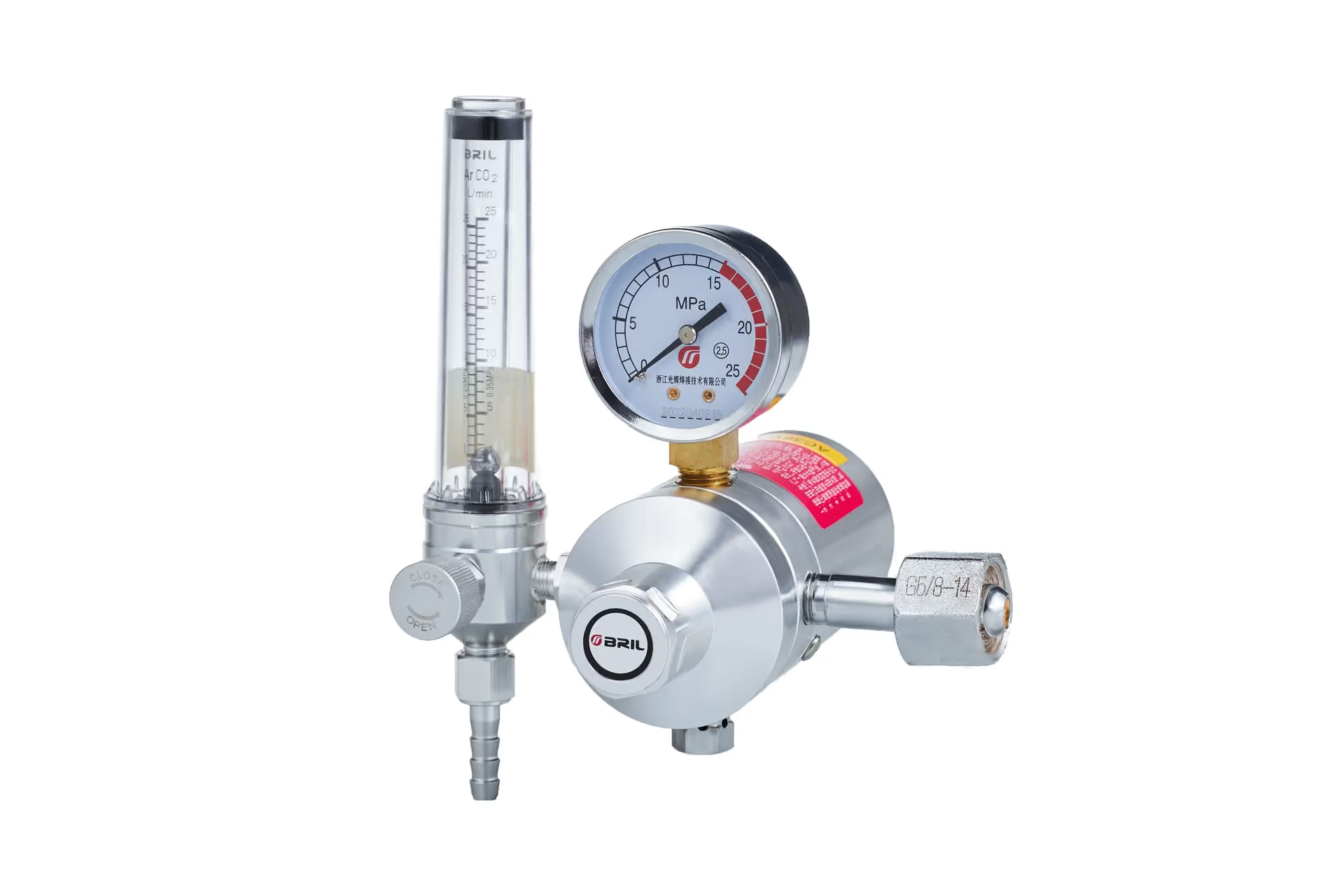
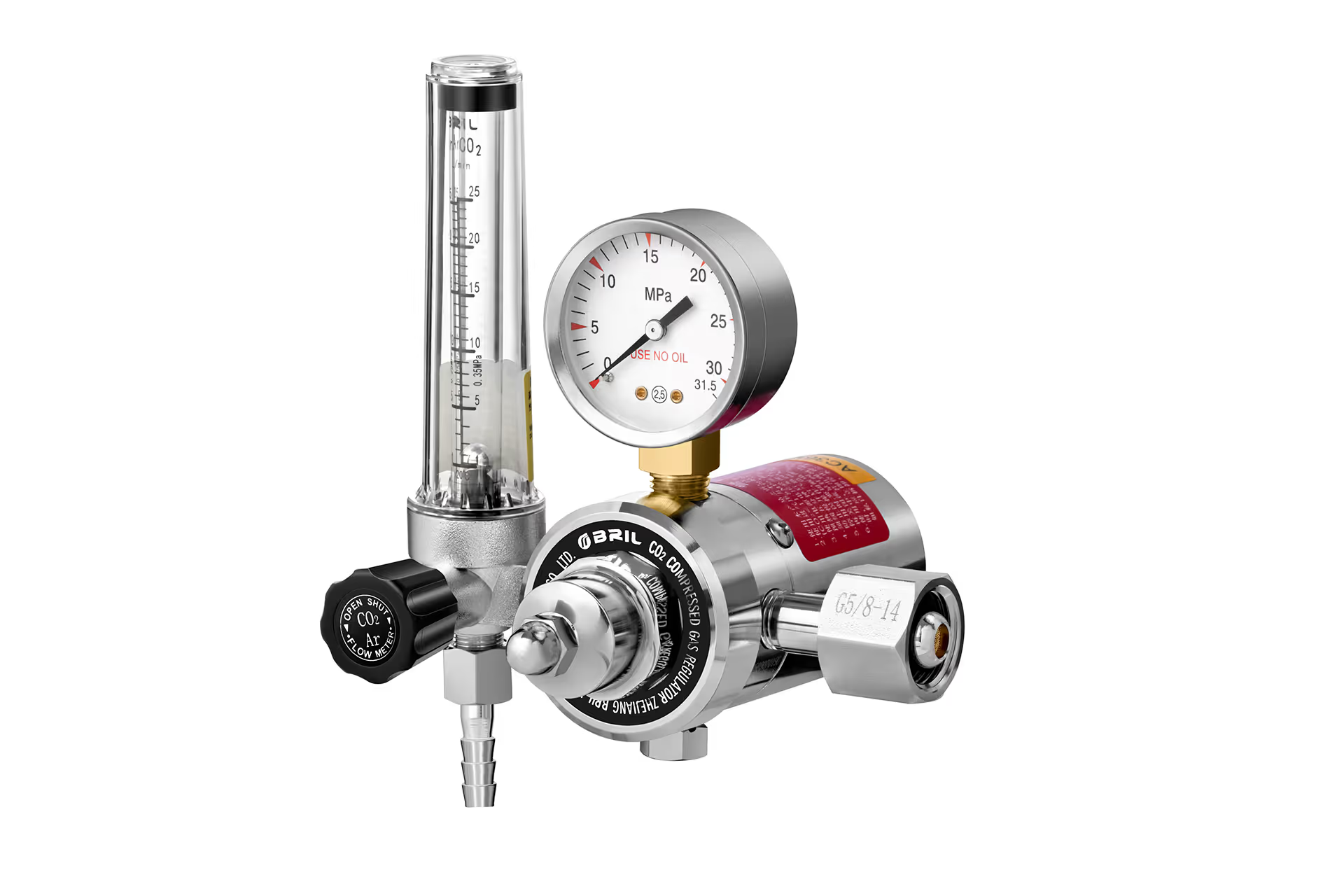
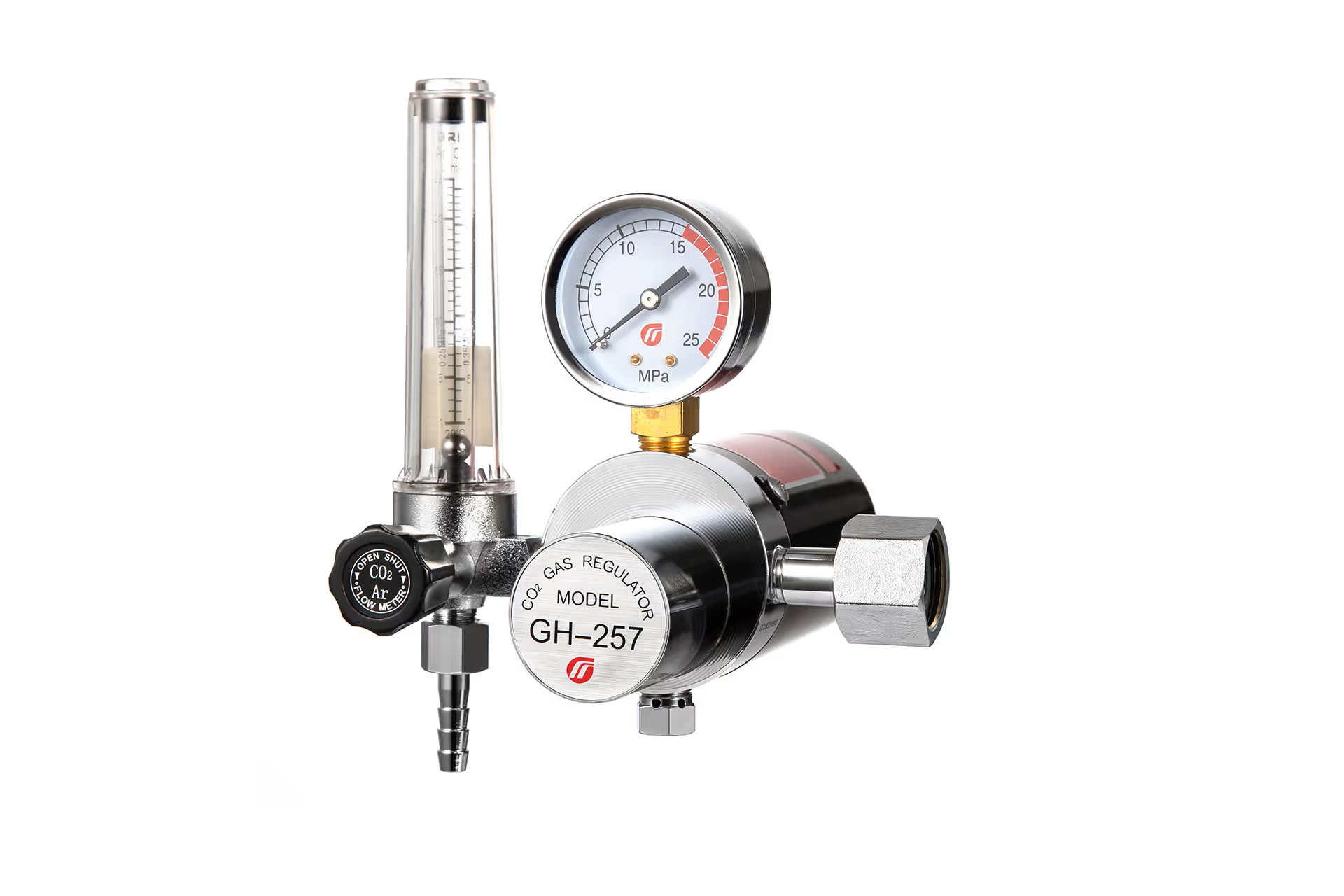
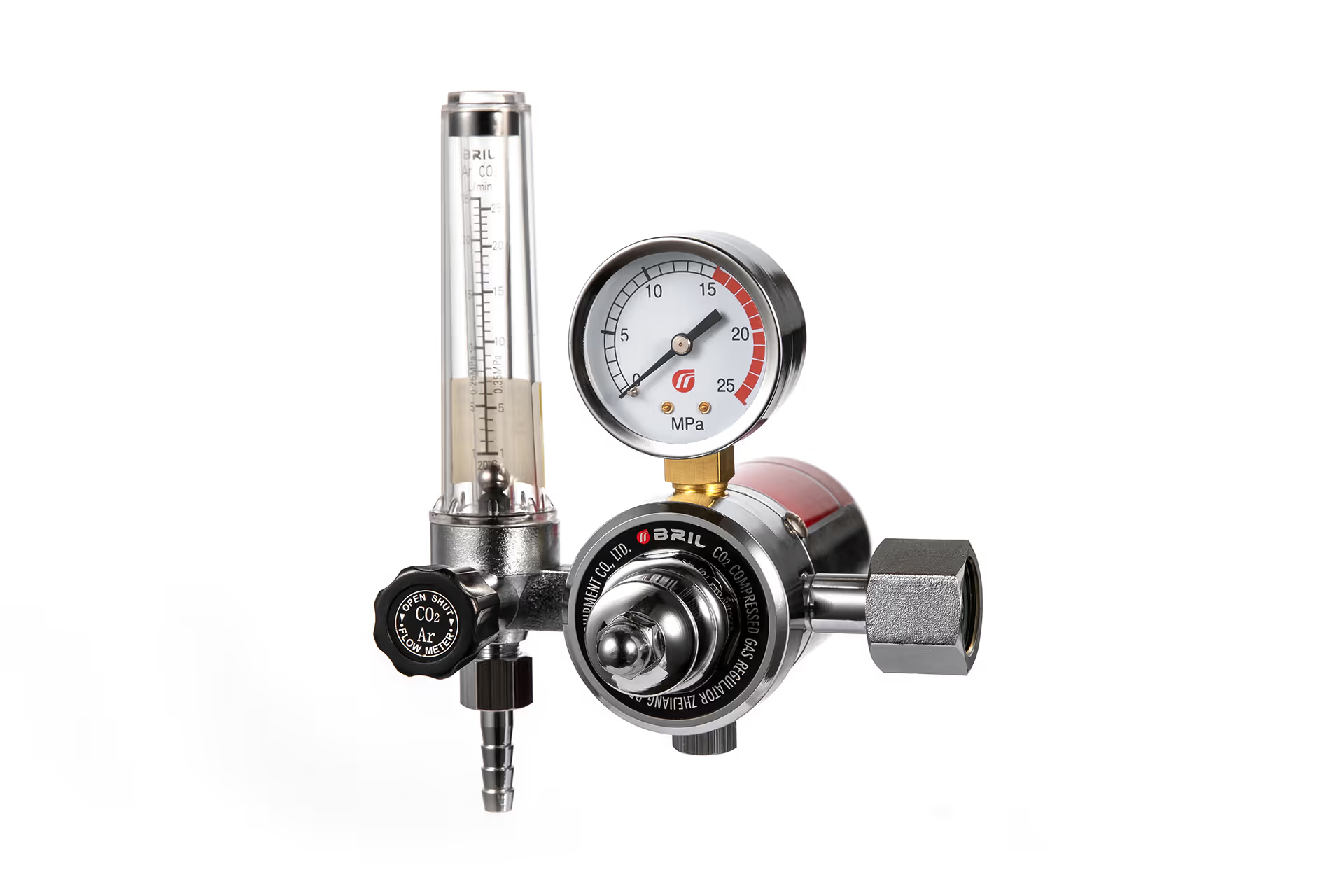
For most modern welding gas setups, the ideal is a dedicated regulator for pressure plus a flow meter for volume. Many brands offer regulator‑flowmeter combos that mount directly on the cylinder: the regulator reduces the pressure, and the integrated flow meter displays and adjusts the flow rate in one compact unit. [youtube]
This combined approach is particularly useful when you:
– Run multiple machines from a single gas bottle
– Need consistent flow for both TIG and MIG
– Want to better track gas usage and cost over time [youtube]
How Improper Gas Control Wastes Money and Ruins Welds
From both user feedback and industry experience, the same gas control problems show up repeatedly:
– Over‑pressure at startup: If the regulator is opened too quickly or set too high, the initial surge wastes gas and can disturb the weld pool.
– Excessive flow rate: Many welders mistakenly “crank up” the gas, but too much flow creates turbulence and actually pulls air into the shielding zone. [sparc-usa]
– Under‑shielding: Too little flow (especially outdoors or in drafts) causes porosity, weak welds, and poor bead appearance. [reddit]
– Inconsistent settings: Relying on pressure gauge “guesses” instead of actual flow leads to inconsistent weld quality from job to job. [youtube]
By using a well‑calibrated regulator and an accurate flow meter, you can stabilize your process, reduce rework, and extend cylinder life—especially in high‑volume production or industrial environments. [sparc-usa]
Practical Setup: Step‑by‑Step Gas Control
Below is a simplified, best‑practice approach used by professional welders and industrial users for shielded processes like MIG and TIG.
1. Select the right gas and regulator
– Match the regulator to the gas type (argon, CO₂, oxygen, acetylene, propane, nitrogen) and pressure rating. [boc.co]
– For precision work or long runs, consider a dual‑stage regulator for more stable outlet pressure. [boc.co]
2. Inspect cylinder, regulator, and hoses
– Check threads, seals, and connections for damage or contamination.
– Keep oil and grease away from oxygen regulators and fittings for safety. [esab]
3. Mount and secure the regulator
– Attach the regulator firmly to the cylinder valve using the correct wrench.
– Make sure the cylinder is secured upright to prevent tipping.
4. Slowly open the cylinder valve
– Crack open the valve slightly first, then fully open according to gas supplier guidelines, to avoid pressure shock.
5. Set the working pressure
– Use the regulator knob to set an appropriate outlet pressure for your process and flow meter requirements.
6. Adjust flow rate using the flow meter
– For TIG, many welders operate around 8–20 L/min depending on joint type, location, and shielding needs, though actual values depend on specific procedures. [youtube]
– For MIG, recommended flow is often higher and may vary by wire type and transfer mode; always consult your WPS or equipment manufacturer.
7. Test and fine‑tune on scrap material
– Check bead appearance, sound, and porosity.
– Fine‑tune flow within a narrow range rather than making large jumps.
8. Monitor performance over time
– Log typical settings for different jobs or materials.
– Watch for gradual drift indicating regulator wear or leaks.
Why Industrial‑Grade Regulators Matter for OEM, ODM, and B2B Users
If you are an overseas brand, wholesaler, distributor, or manufacturer, you are not only responsible for your own weld quality—you are effectively responsible for your customers’ safety and uptime. That is why many professional buyers insist on precision‑manufactured, brass‑body, industrial gas regulators that meet recognized performance and safety standards. [store.mathesongas]
High‑quality regulators and dual‑stage designs help you:
– Maintain stable outlet pressure even as cylinder pressure drops
– Reduce gas surges that lead to wasted shielding gas and inconsistent starts
– Provide long‑term reliability in harsh shop and field conditions
– Meet international expectations for safety, documentation, and traceability [boc.co]
When combined with OEM/ODM customization, you can align regulator performance, branding, and connector standards with the specific needs of your regional market—whether that is North America, Europe, or Asia. This is especially valuable for CO₂ heated regulators, specialized argon or oxygen regulators, acetylene and propane regulators for oxy‑fuel cutting, nitrogen regulators for testing, and dual‑stage models for critical applications.
Expert Insight: How Pros Choose Between Flow Meter and Regulator
Industry trainers and experienced welders tend to follow a few pragmatic rules:
– For TIG and critical MIG applications, they prefer flow meters or regulator‑flowmeter combinations because they want precise, repeatable control over shielding gas volume. [reddit]
– For oxy‑fuel cutting and high‑pressure processes, they prioritize robust regulators matched to gas type and pressure rating, sometimes with additional safety devices like flashback arrestors. [esab]
– For multi‑machine setups, they often use dual‑stage or high‑capacity regulators feeding separate flow meters for each machine, keeping pressure stable and flows individually adjustable. [youtube]
From a cost perspective, flow meters can be slightly more expensive upfront than basic pressure‑style regulator setups, but they often save money over time by reducing wasted gas and rework. Many welders who switch from “pressure only” to a proper flow meter report better control and more predictable gas usage. [reddit]
Choosing the Right Gas Control Setup for Your Application
To help you move from theory to practice, use the quick guide below when specifying equipment or advising customers.
For Welding Shops and Fabricators
– Use regulator + flow meter on all TIG and high‑quality MIG stations.
– Standardize on gas‑specific regulators (argon/CO₂, argon mixes, etc.) with clear color coding to avoid mix‑ups. [boc.co]
– For portable oxy‑fuel kits, choose compact oxygen and acetylene/propane regulators with clear pressure gauges and robust brass construction. [presscon.co]
For OEM/ODM and Private‑Label Brands
– Specify brass regulators and dual‑stage options to meet the expectations of professional users and industrial buyers. [boc.co]
– Offer complete welding gas packages: CO₂ heated regulators, argon and argon‑mix regulators, oxygen, acetylene, propane, nitrogen regulators, plus regulator‑flowmeter combinations.
– Provide clear documentation and user guides that explain pressure vs flow, recommended settings, and common troubleshooting scenarios.
For Industrial and Process Applications
– Use dual‑stage regulators where pressure stability is critical across long cylinder runs or manifold systems. [store.mathesongas]
– For nitrogen testing and purging, prioritize regulators with fine control at low outlet pressures and robust safety margins. [pakoxygen]
– Integrate with monitoring systems where possible to track gas usage and detect abnormal consumption patterns.
Safety and Maintenance Best Practices
Even the best regulator or flow meter will fail early if it is misused or poorly maintained. A few simple habits dramatically extend service life and reduce risk.
– Never use oil or grease on oxygen regulators or fittings, as this can create a fire or explosion hazard. [esab]
– Open cylinder valves slowly to avoid damaging internal regulator components.
– Store and transport cylinders upright and secured, with valve caps in place where applicable.
– Inspect gauges and lenses regularly for cracks or fogging, and replace damaged units promptly.
– Schedule periodic leak checks using approved leak‑detection solution, especially after changing cylinders or moving equipment.
For fleet owners, it often makes sense to adopt a preventive maintenance schedule (for example, annual inspection and functional testing) to ensure regulators and flow meters continue to perform within spec across their entire service life.
How a Professional Gas Regulator Partner Adds Value
If you are sourcing regulators as an overseas brand, wholesaler, distributor, or equipment manufacturer, partnering with a specialized industrial gas regulator manufacturer gives you advantages beyond basic hardware.
You can benefit from:
– Application‑driven engineering: Matching regulator design (single or dual‑stage), materials, and heating options (for CO₂) to your customers’ welding, cutting, and industrial gas use cases.
– OEM/ODM flexibility: Custom dials, logo printing, packaging, connectors, inlet/outlet standards, and country‑specific certifications.
– Tight quality control: 100% testing of pressure stability, leak performance, and safety functions, aligned with international standards.
– Long‑term reliability: Industrial‑grade brass and precision machining that support stable performance even under heavy daily use.
For you and your customers, the real outcome is consistent gas control, fewer failures in the field, and stronger brand trust over time.
Call to Action: Build a Better Gas Control System
If you want your welding or cutting operation to run safer, cleaner, and more efficiently, do not leave gas control to guesswork. Audit your current setup:
– Are you using the right regulator type for each gas?
– Do your critical MIG/TIG stations have proper flow meters or regulator‑flowmeter combos?
– Are your regulators built from industrial‑grade materials and tested to international standards?
If the answer to any of these is “not sure,” it is time to upgrade. Partner with a professional gas regulator manufacturer who can provide customized CO₂, argon, oxygen, acetylene, propane, nitrogen, and dual‑stage regulators plus OEM/ODM support for your brand and market.
FAQs
Q1: Do I really need a flow meter if I already have a regulator?
A: If you are doing TIG or quality‑critical MIG welding, a flow meter is highly recommended because it shows and controls the actual gas volume, which a pressure regulator alone cannot. [reddit]
Q2: Can I use the same regulator for different gases?
A: In general, regulators should be matched to specific gases and service pressures for safety and accuracy; many industrial suppliers provide separate models for CO₂, argon, oxygen, acetylene, propane, and nitrogen. [store.mathesongas]
Q3: Why are dual‑stage regulators more expensive?
A: Dual‑stage regulators use two reduction stages to provide more stable outlet pressure across a wide range of inlet pressures, making them ideal for precision and long‑duration applications. [boc.co]
Q4: How often should I replace my welding gas regulator?
A: There is no single fixed interval, but regular inspection, leak checks, and functional testing are essential; replacement is recommended if there are signs of creep, instability, or physical damage. [esab]
Q5: What flow settings should I use for TIG welding?
A: Many welders report good results in the range of roughly 8–20 L/min depending on joint, position, and shielding needs, but you should always follow your WPS and adjust based on actual weld results. [youtube]
References
1. ESAB, “Understanding the Difference Between Flow and Pressure.” [https://esab.com/us/nam_en/esab-university/blogs/understanding-the-difference-between-flow-and-pressure/] [esab]
2. SPARC USA, “Ultimate Argon Regulator & Flowmeter Guide for MIG + TIG.” [https://sparc-usa.com/blogs/welding-brewing-hvac-and-more/ultimate-argon-regulator-flowmeter-guide] [sparc-usa]
3. Kevin Caron, “How to Use a Flowmeter Instead of a Regulator for Welding.” [https://www.youtube.com/watch?v=psf8Ni_wPjk] [youtube]
4. Reddit r/Welding, “Which is best for TIG, a flow meter or pressure regulator?” [https://www.reddit.com/r/Welding/comments/k5yvuz/which_is_best_for_tig_a_flow_meter_or_pressure/] [reddit]
5. BOC, “Industrial Gas Regulators – Argon, CO₂, Oxygen, Nitrogen, Acetylene.” [https://www.boc.co.nz/shop/en/nz/gas-welding-heating-cutting-brazing/gas-regulator/industrial-gas-regulators] [boc.co]
6. BOC, “Dual Stage Specialty Gas Regulators.” [https://www.boc.co.nz/shop/en/nz/gas-regulator/dual-stage-specialty-gas-regulators] [boc.co]
7. Matheson Gas, “Specialty Gas Equipment – Regulators.” [https://store.mathesongas.com/regulators/] [store.mathesongas]
Hot tags: Welding Gas Regulator Supplier, Industrial Gas Regulator Manufacturer, Co2 Regulator Supplier, Argon Regulator Manufacturer, Dual Stage Gas Regulator Factory, Welding Gas Flow Meter Supplier, Oem Odm Gas Regulator, Industrial Welding Gas Control, Brass Gas Regulator Manufacturer, Co2 Heated Regulator Supplier