Content Menu
● What Is a Welding Regulator?
>> Common Welding Regulator Characteristics
● What Is an Industrial Gas Regulator?
>> Why Manufacturing Plants Need More Than Basic Pressure Reduction
● Welding Regulator vs Industrial Gas Regulator: Key Differences
● Single-Stage vs Dual-Stage Gas Regulators
>> Single-Stage Welding Regulators
>> Dual-Stage Industrial Gas Regulators
● Gas Compatibility: The First Selection Rule
>> Acetylene and Propane Regulators
● How to Select the Right Regulator for a Manufacturing Plant
>> 2. Define the Required Outlet Pressure and Flow
>> 3. Determine the Supply Method
>> 4. Evaluate Pressure Stability Requirements
>> 5. Verify Connections and Standards
>> 6. Consider Maintenance and Replacement Parts
● Practical Manufacturing Example: Robotic MIG Welding Cell
● Safety Practices for Gas Regulator Use
>> Essential Regulator Safety Checklist
● Which Regulator Is Best for Your Application?
● Partner With a Professional Gas Regulator Manufacturer
● FAQ
>> 1. Can I use the same regulator for argon and CO₂?
>> 2. Do I need a heated CO₂ regulator for MIG welding?
>> 3. What is the advantage of a dual-stage gas regulator?
>> 4. Why must oxygen regulators be oil-free?
>> 5. Can I use an adapter when the regulator connection does not fit the cylinder?
>> 6. Is a welding regulator suitable for a gas manifold system?
>> 7. What information should I provide to an OEM gas regulator supplier?
Choosing between a welding regulator and an industrial gas regulator is not simply a matter of matching a regulator to a cylinder. For manufacturing plants, the correct gas pressure regulator affects weld quality, production uptime, gas consumption, operator safety, equipment protection, and compliance with applicable operating procedures.
In practical terms, a welding regulator is usually engineered for point-of-use welding, cutting, brazing, and shielding-gas delivery. An industrial gas regulator is a broader category that may serve welding stations but is also designed for production lines, gas manifolds, laboratory systems, purging, pressure testing, inerting, laser cutting, and other controlled-gas applications. The right choice depends on gas type, inlet pressure, outlet-pressure stability, flow demand, purity requirements, duty cycle, connection standard, and the consequences of pressure variation.
For factories using CO₂, argon, oxygen, acetylene, propane, nitrogen, or mixed shielding gases, selecting the correct regulator configuration is a core part of building a reliable gas-control system.

What Is a Welding Regulator?
A welding regulator is a pressure-control device that reduces high and changing cylinder pressure to a lower, usable outlet pressure or controlled flow rate for welding and cutting equipment.
It is commonly used with:
– CO₂ regulators for MIG/MAG welding
– Argon regulators for TIG welding, MIG welding, and aluminum welding
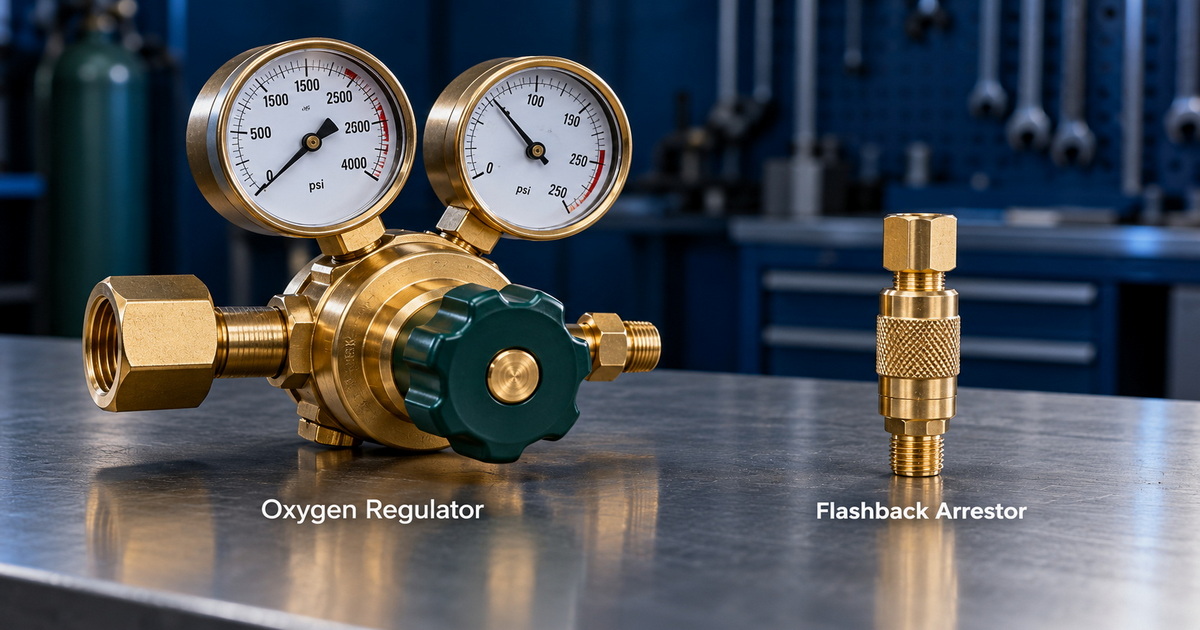
– Oxygen regulators for oxy-fuel cutting and brazing
– Acetylene regulators for gas welding and cutting
– Propane regulators for heating, cutting, and brazing
– Nitrogen regulators for purging, pressure testing, and selected welding support tasks
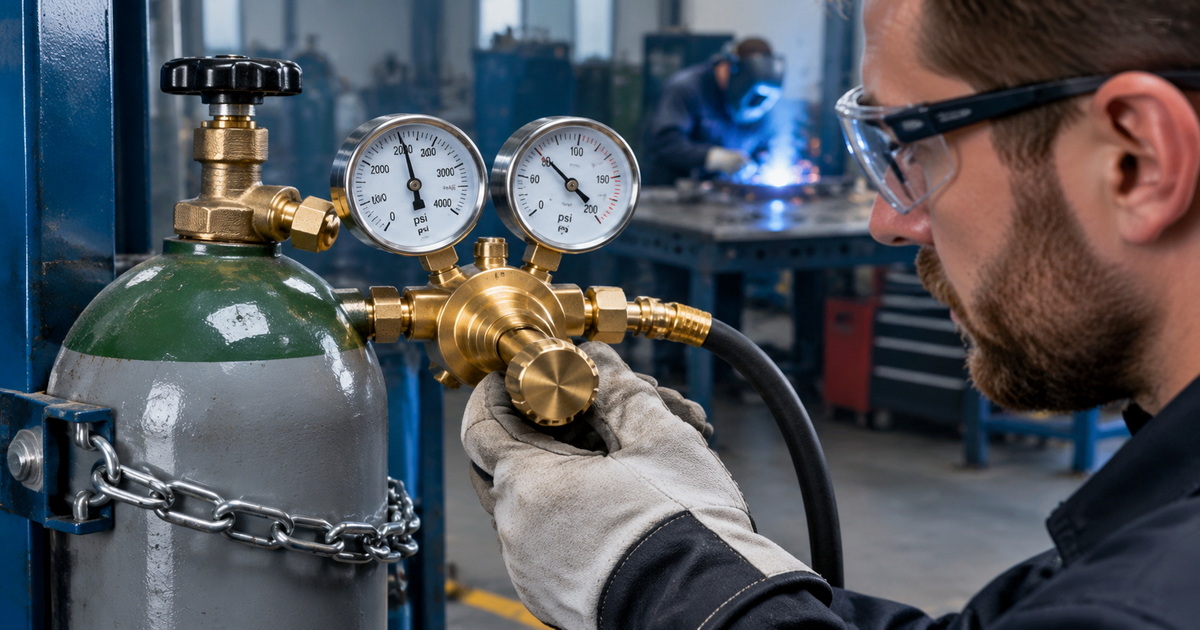
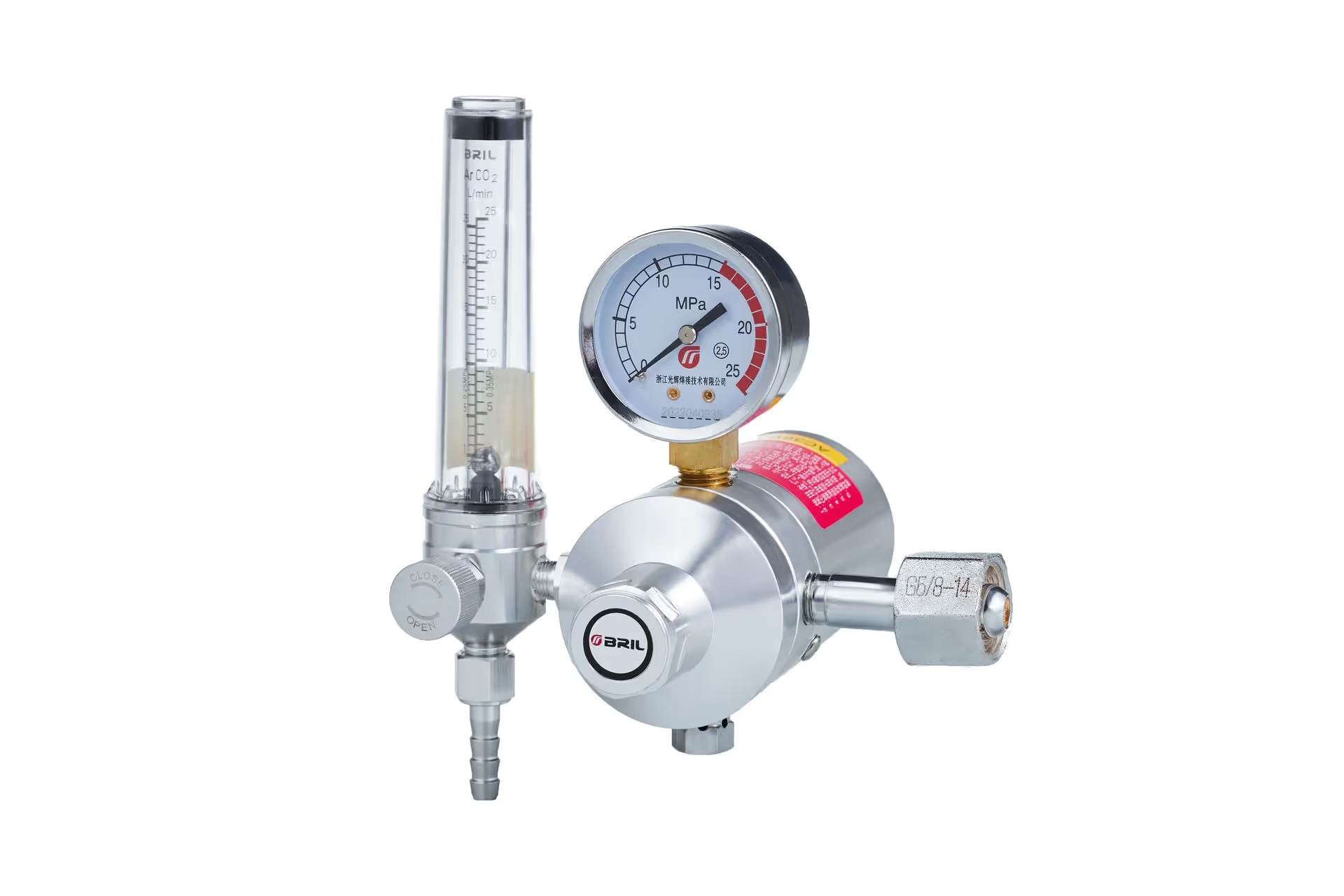
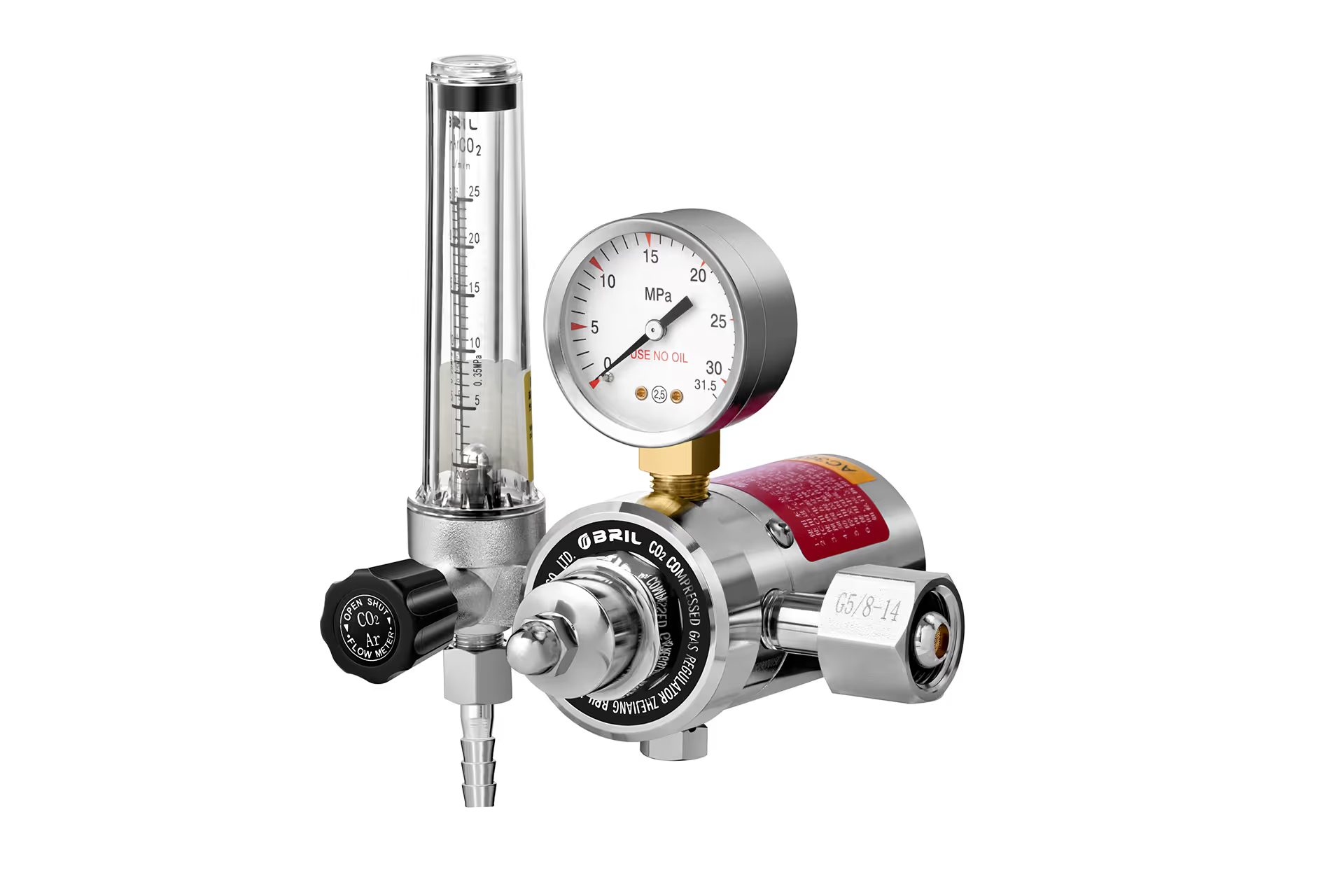
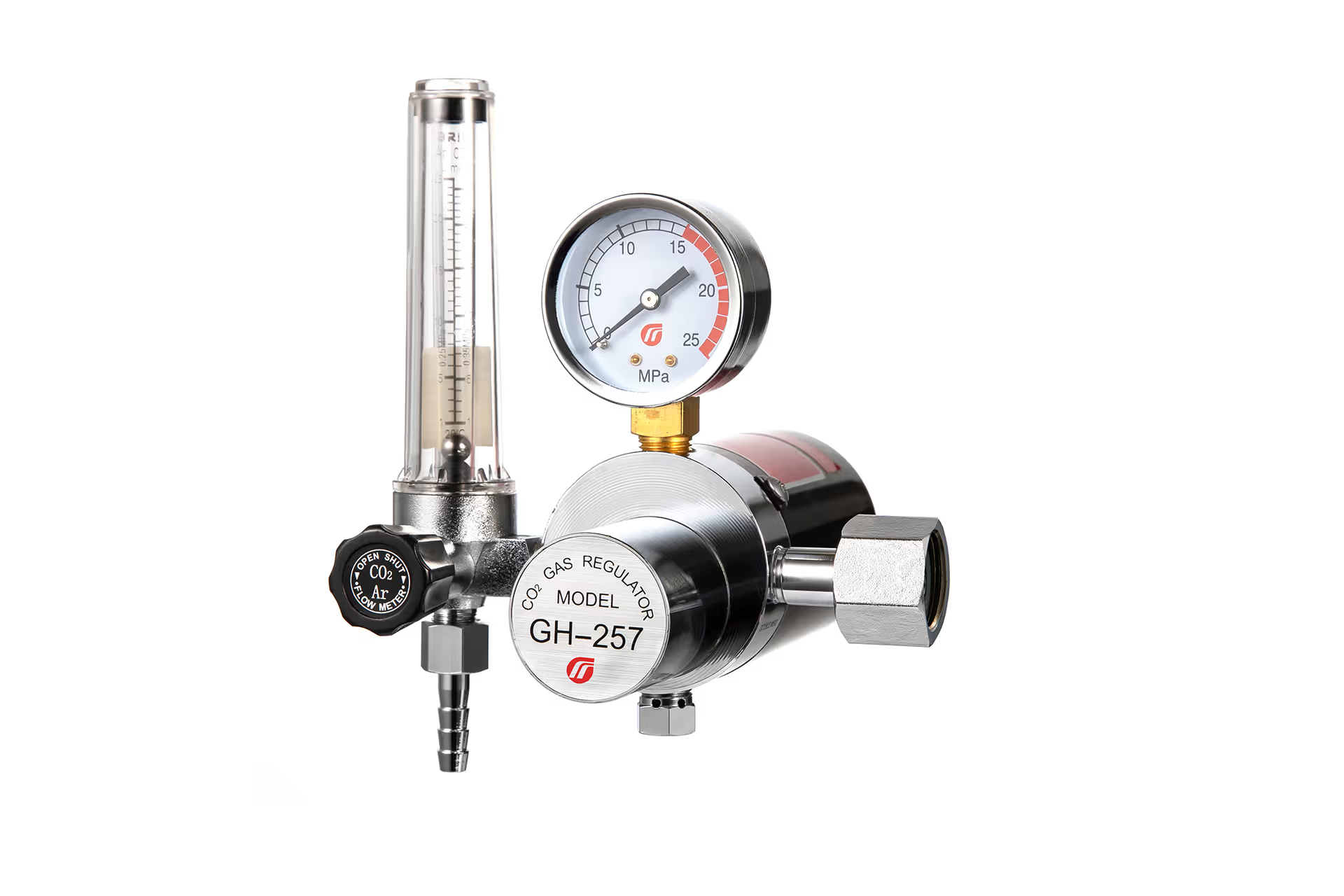
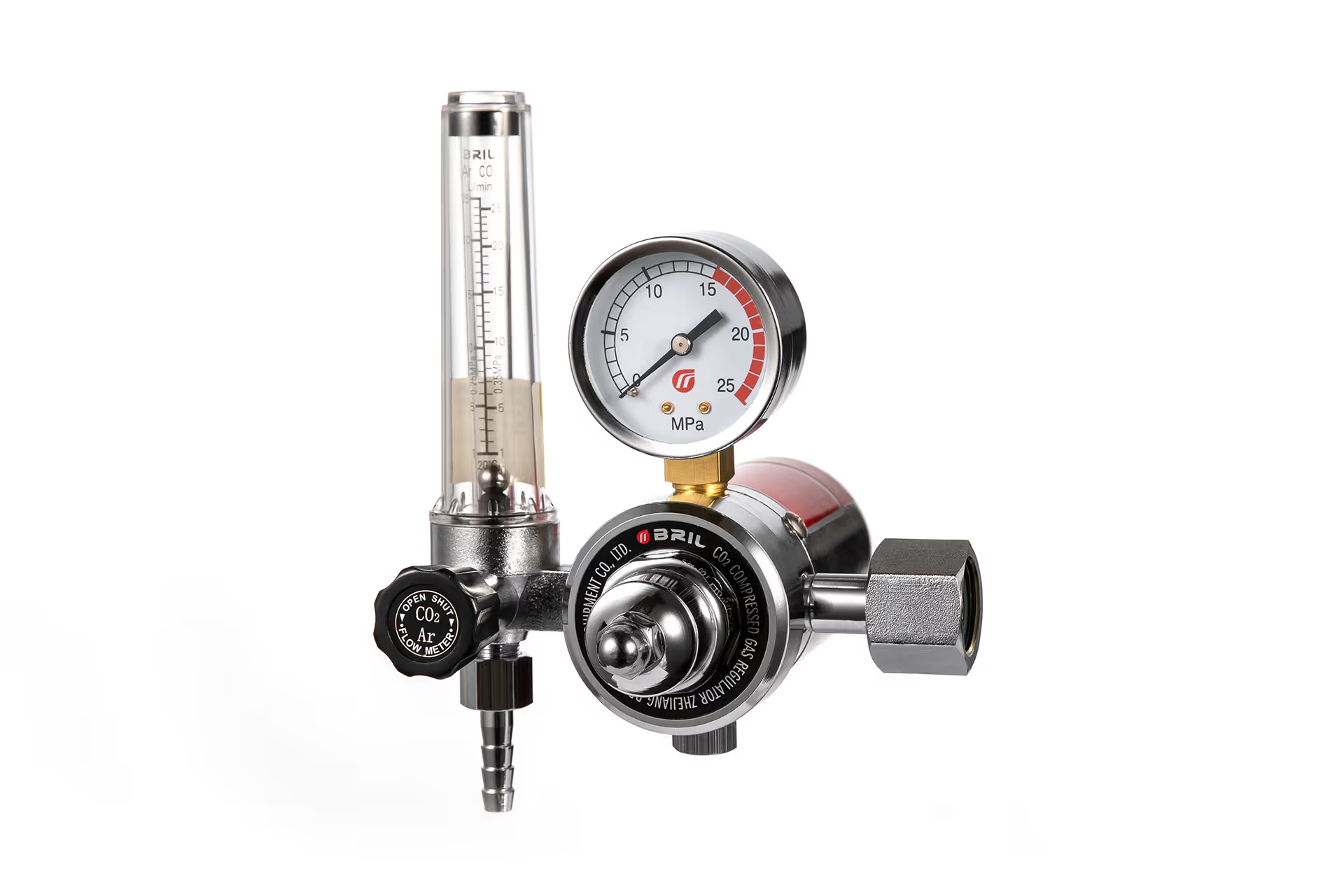
A typical welding gas regulator includes a cylinder inlet connection, high-pressure gauge, outlet-pressure gauge or flowmeter, pressure-adjustment knob, outlet connection, safety-relief system, and internal valve mechanism.
The regulator’s job is not to create gas flow by itself. Instead, it maintains a controlled outlet pressure as gas travels through the hose and into the torch, welding machine, flowmeter, or downstream equipment.
For example, a CO₂ cylinder contains gas at relatively high pressure. A CO₂ welding regulator reduces that pressure to a stable working level so a MIG welding system can deliver shielding gas consistently around the weld pool.
When shielding gas is unstable, weld quality can suffer. Operators may see porosity, excessive spatter, oxidation, inconsistent bead appearance, or reduced arc stability.
Common Welding Regulator Characteristics
Most welding regulators are designed around the needs of fabrication shops and welding cells:
– Portable cylinder-mounted design
– Manual pressure adjustment
– Standard gas-specific inlet connections
– Pressure gauges or flowmeter options
– Moderate flow capacity
– Single-stage or dual-stage construction
– Compatibility with welding hoses and torches
– Brass bodies for corrosion resistance and machining accuracy
ISO 2503 covers single- and two-stage regulators used with cylinder gases in welding, cutting, and allied processes, including compressed gases up to 300 bar, dissolved acetylene, LPG, and CO₂. The standard also addresses regulators with flow-metering devices for applicable welding-related gases. [iso]
What Is an Industrial Gas Regulator?
An industrial gas regulator is a broader pressure-control solution used in manufacturing, processing, testing, automation, gas distribution, and industrial utility systems.
While a welding regulator is a type of industrial gas regulator in the broadest sense, industrial regulators are often selected for more demanding conditions. These may include higher inlet pressures, greater flow rates, stricter pressure-stability requirements, centralized gas supply, multi-station distribution, hazardous gases, automated equipment, or continuous-duty production environments.
Industrial gas regulators may be installed on:
– Individual gas cylinders
– Cylinder banks
– Gas manifolds
– Pipeline stations
– Bulk gas distribution systems
– Automated welding cells
– Laser-cutting systems
– Heat-treatment furnaces
– Leak-testing equipment
– Inerting and purging systems
– Pneumatic process equipment
– Chemical and industrial manufacturing lines
In manufacturing plants, “industrial gas regulator” may refer to a range of designs, including high-pressure regulators, line regulators, manifold regulators, cylinder regulators, dual-stage regulators, dome-loaded regulators, back-pressure regulators, and specialty-gas regulators.
Why Manufacturing Plants Need More Than Basic Pressure Reduction
A regulator in a factory must often do more than reduce pressure. It may need to maintain a narrow pressure range while upstream cylinder pressure falls, compensate for changes in downstream demand, withstand frequent adjustment, support multiple operators, and remain compatible with the chemical and safety characteristics of a specific gas.
For example:
– A nitrogen regulator used for pressure testing may require a higher outlet-pressure range than a shielding-gas regulator.
– An oxygen regulator must be kept free of oil and grease because oxygen service requires strict cleanliness practices. OSHA specifically states that cylinders, valves, couplings, regulators, hoses, and related apparatus used for oxygen-fuel welding and cutting must be kept free from oily or greasy substances.
– An acetylene regulator must be specifically intended for acetylene service and should never be substituted with a regulator designed for oxygen, argon, nitrogen, or CO₂.
– A dual-stage gas regulator may be preferred where stable outlet pressure is critical during long production runs.
Welding Regulator vs Industrial Gas Regulator: Key Differences
The table below explains the main differences between a welding regulator and an industrial gas regulator for manufacturing plants.
| Comparison Factor | Welding Regulator | Industrial Gas Regulator |
|---|---|---|
| Primary purpose | Controls gas for welding, cutting, brazing, and heating | Controls gas for broader manufacturing, process, testing, and distribution applications |
| Typical installation | Individual cylinder at a welding workstation | Cylinders, manifolds, pipelines, gas panels, production equipment, or centralized supply systems |
| Gas types | CO₂, argon, oxygen, acetylene, propane, nitrogen, shielding-gas mixes | Nitrogen, oxygen, argon, CO₂, hydrogen, helium, specialty gases, process gases, and gas mixtures |
| Pressure stability | Suitable for normal workshop welding demand | Can be designed for tighter stability and continuous industrial-duty requirements |
| Flow capacity | Usually sized for one torch or one welding station | Can support higher-flow or multi-point manufacturing systems |
| Design complexity | Generally straightforward and operator-adjustable | May include multiple stages, line regulation, relief devices, gauges, alarms, or automated controls |
| Best for | Manual welding bays, repair shops, fabrication stations, mobile welding | Manufacturing plants, automated lines, manifolds, laser systems, production cells, and high-demand processes |
| Cost level | Often lower initial cost | Can be higher due to performance, capacity, materials, certification, and system integration |
| Selection priority | Gas compatibility, flowmeter type, welding process, portability | Process pressure, flow profile, purity, supply architecture, uptime, safety, and system scalability |
The most important difference is application severity. A welding regulator is optimized for practical welding work. An industrial gas regulator is selected around the complete operating environment.
A plant that uses a single argon cylinder for TIG welding may only need a standard argon flow regulator. A plant operating 20 robotic welding cells from a centralized gas manifold needs a system engineered for flow demand, pressure drop, backup supply, connection compatibility, maintenance access, and stable delivery across the network.
Single-Stage vs Dual-Stage Gas Regulators
One of the most important decisions for both welding and industrial gas control is whether to use a single-stage or dual-stage regulator.

Single-Stage Welding Regulators
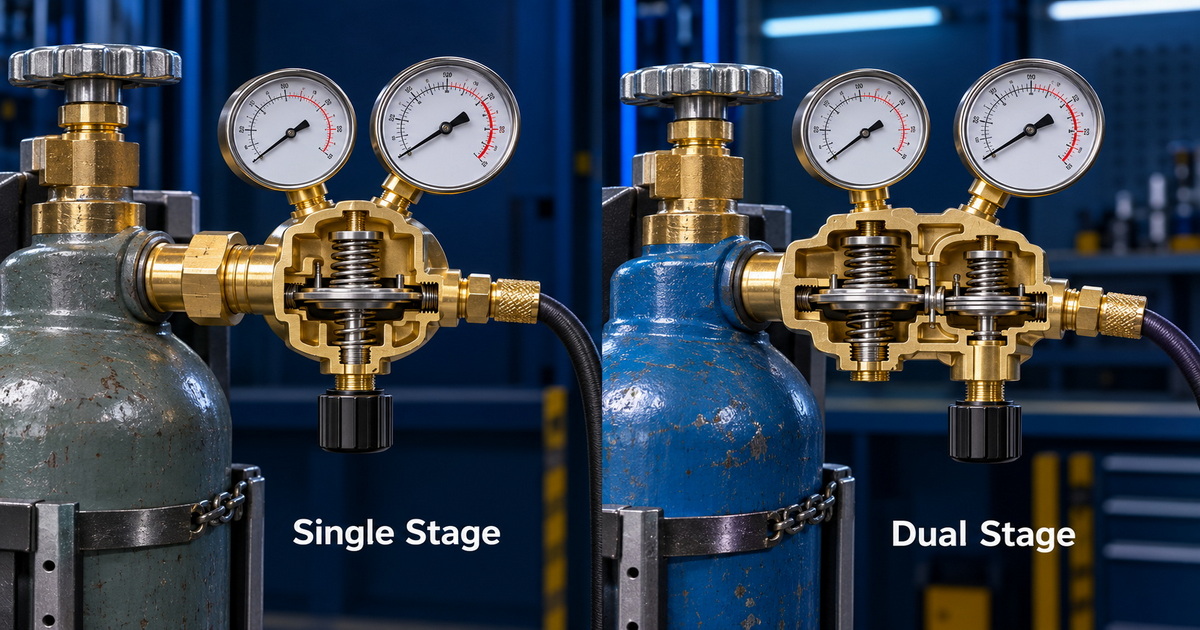
A single-stage regulator reduces pressure in one step. It is widely used in common welding and cutting operations because it is cost-effective, compact, and easy to operate.
However, as cylinder pressure decreases, outlet pressure can change slightly. This is often called supply-pressure effect or inlet-pressure effect.
For many manual welding jobs, this change is manageable. But it can become a concern when the process requires highly consistent pressure or when gas is consumed over long operating cycles.
Single-stage regulators are often a suitable choice for:
– General MIG and TIG welding
– Short-duration fabrication work
– Maintenance welding
– Portable welding carts
– Occasional cutting and brazing
– Low-to-moderate gas consumption
Dual-Stage Industrial Gas Regulators
A dual-stage gas regulator reduces pressure in two controlled steps. The first stage lowers cylinder pressure to an intermediate level, while the second stage reduces it to the final operating pressure.
The main advantage is improved outlet-pressure stability as the cylinder empties.
Dual-stage regulators are often preferred for:
– Long welding cycles
– Automated welding cells
– Continuous production processes
– Precision pressure testing
– Gas purging applications
– Critical shielding-gas delivery
– Laboratory and analytical processes
– Multi-shift manufacturing environments
For a manufacturing manager, the question is not only, “What regulator fits the cylinder?” The better question is, “What pressure variation can this process tolerate?”
If a minor outlet-pressure change could affect production quality, equipment performance, or safety margins, a dual-stage design may deliver better total value despite a higher purchase price.
Gas Compatibility: The First Selection Rule
A regulator must be compatible with the gas it controls. This includes the internal materials, seals, inlet connection, pressure range, pressure-relief design, and outlet fitting.
Using the wrong regulator can create a leak risk, a connection mismatch, material-compatibility issue, pressure-control problem, or serious safety hazard.
Compressed Gas Association connector standards are intended to reduce incompatible gas connections. Regulators should match the correct cylinder connection, and adapters should not be used to force a regulator onto a cylinder with a different CGA fitting.
CO₂ Regulator
A CO₂ regulator is commonly used for MIG/MAG welding, beverage dispensing, greenhouse systems, and industrial CO₂ applications. In welding, stable flow supports better shielding around the weld pool.
CO₂ can cool rapidly during heavy gas withdrawal. In high-demand environments, a CO₂ heated regulator can help reduce the risk of freezing or unstable performance caused by temperature drop during gas expansion.
A heated CO₂ regulator is especially relevant when:
– Gas consumption is high
– Ambient temperatures are low
– Welding runs are continuous
– Large-diameter wire is used
– Multiple shifts operate from cylinder-based supply
– Regulator frosting has caused inconsistent gas delivery

Argon Regulator
An argon regulator is widely used in TIG welding and MIG welding, particularly for stainless steel, aluminum, and nonferrous metals. Many users require a flowmeter because shielding-gas flow is often set in flow units rather than pressure alone.
Argon systems should be selected around:
– Required flow range
– Torch type
– Welding process
– Hose size
– Number of outlets
– Expected duty cycle
– Cylinder or manifold supply
Oxygen Regulator
An oxygen regulator must be intended specifically for oxygen service. Oxygen does not burn by itself, but it strongly supports combustion. Contamination with oil or grease can increase fire risk.
OSHA requires oxygen-fuel gas welding and cutting equipment, including regulators and hoses, to be kept free from oily or greasy substances.
Acetylene and Propane Regulators
Acetylene regulators and propane regulators are intended for fuel-gas service. They must be selected based on the specific gas, operating pressure, fuel-gas hose connection, and applicable cutting or heating equipment.
Fuel-gas regulators should never be interchanged with oxygen regulators.
Nitrogen Regulator
A nitrogen regulator may be used for welding purging, inflation, pressure testing, inerting, process blanketing, and equipment maintenance. Manufacturing buyers should pay close attention to maximum inlet pressure, outlet-pressure range, flow capacity, and whether the system requires a cylinder regulator, line regulator, or a two-stage solution.

How to Select the Right Regulator for a Manufacturing Plant
A strong procurement decision begins with process data, not a catalog image.
Use the following selection process before purchasing a welding or industrial gas regulator.
1. Identify the Exact Gas
Start with the gas name and composition:
– 100% CO₂
– 100% argon
– Argon/CO₂ mixture
– Oxygen
– Acetylene
– Propane
– Nitrogen
– Helium
– Specialty or mixed industrial gas
Do not assume that similar-looking regulators are interchangeable. The gas connection, materials, pressure range, and safety requirements may differ.
2. Define the Required Outlet Pressure and Flow
Ask the equipment team:
– What is the normal operating pressure?
– What is the maximum required flow?
– Is pressure or flow the key control value?
– Does demand fluctuate during operation?
– Will more than one outlet operate at the same time?
– What happens if pressure drops or rises unexpectedly?
For welding, a flowmeter-equipped argon or CO₂ regulator may be more useful than a pressure-gauge-only design. For nitrogen pressure testing, a higher-pressure industrial regulator may be required.
3. Determine the Supply Method
The gas source changes the regulator strategy.
| Gas Supply Method | Typical Regulator Need |
|---|---|
| Single cylinder at one workstation | Standard cylinder-mounted welding regulator |
| One cylinder serving several nearby points | Higher-capacity regulator with distribution planning |
| Cylinder manifold | Manifold regulator and downstream line regulators |
| Central gas pipeline | Station or line regulators near each process area |
| Automated production line | Stable industrial regulator, often with monitoring and backup supply planning |
| High-volume CO₂ welding | CO₂ heated regulator or centralized supply evaluation |
4. Evaluate Pressure Stability Requirements
Choose a single-stage regulator for standard, noncritical work when small changes in outlet pressure are acceptable.
Choose a dual-stage regulator when the process needs more stable pressure throughout the cylinder’s discharge cycle.
5. Verify Connections and Standards
Cylinder valve and regulator connections must match correctly. Gas-specific connector systems help prevent dangerous mismatches. Never use an improvised adapter to make an incompatible regulator fit.
For welding, cutting, and allied processes, ISO 2503 is an important reference point for regulators connected to gas cylinders. For manifold systems used in welding and cutting, ISO 7291 specifies requirements and test methods for pressure regulators in those systems.
6. Consider Maintenance and Replacement Parts
For OEM buyers, distributors, and large factories, regulator serviceability is commercially important.
Look for:
– Clear gauge markings
– Durable brass bodies
– Stable adjustment mechanisms
– Reliable seals and diaphragms
– Accessible repair kits where applicable
– Traceable quality-inspection procedures
– Consistent replacement-part availability
– Custom branding and packaging options
A low-cost regulator that fails frequently can create more downtime, rework, and labor cost than a higher-quality unit with stable long-term performance.
Practical Manufacturing Example: Robotic MIG Welding Cell
Consider a manufacturer operating a robotic MIG welding cell with CO₂ or argon/CO₂ shielding gas.
A basic cylinder-mounted welding regulator may work when:
– One operator uses one station
– The welding duty cycle is moderate
– Cylinder replacement is frequent but manageable
– Small changes in outlet performance do not affect quality noticeably
However, an industrial gas regulation solution becomes more appropriate when:
– Multiple robotic cells operate simultaneously
– Welding runs continuously across shifts
– Gas consumption is high
– Pressure variation affects weld consistency
– The plant wants fewer cylinder-change interruptions
– The facility is moving toward a manifold or centralized gas system
In this case, a dual-stage regulator, a CO₂ heated regulator, or a manifold-based gas-control arrangement can improve operating consistency. The exact design depends on gas demand, cylinder configuration, installation layout, and process risk assessment.
This is where OEM and ODM regulator suppliers can add value. Rather than selling a standard catalog product only, an experienced manufacturer can help define inlet threads, outlet fittings, gauge ranges, body markings, packaging, heating specifications, logo placement, and required gas compatibility for the target market.
Safety Practices for Gas Regulator Use
Even the best welding or industrial gas regulator must be installed and operated correctly.
Essential Regulator Safety Checklist
– Use only a regulator designed for the specific gas.
– Confirm that the cylinder connection and regulator inlet match.
– Keep oxygen equipment free of oil and grease.
– Inspect gauges, threads, seals, hoses, and fittings before use.
– Open the cylinder valve slowly while standing to the side of the regulator.
– Check for leaks using an approved leak-detection method.
– Do not force connections or use unauthorized adapters.
– Close the cylinder valve after work is complete.
– Release pressure from the regulator before removing it from the cylinder.
– Protect regulators from impact during cylinder movement and storage.
OSHA requires the cylinder valve to be closed and pressure released from the regulator before the regulator is removed. OSHA also distinguishes cylinders “connected for use” from cylinders in storage and requires protection for the regulator and cylinder valve when cylinders are moved while connected for use. [osha]
Which Regulator Is Best for Your Application?
The best option depends on the application rather than the product name.
Choose a welding regulator if you need:
– A reliable regulator for a manual welding or cutting station
– CO₂, argon, oxygen, acetylene, propane, or nitrogen control at the cylinder
– Simple adjustment and portable operation
– A flowmeter for shielding-gas welding
– Cost-effective performance for normal workshop duty
Choose an industrial gas regulator if you need:
– Higher flow capacity
– Continuous manufacturing operation
– Multi-station gas supply
– Tighter outlet-pressure stability
– Dual-stage regulation
– Manifold or pipeline integration
– A customized outlet-pressure range
– Specialized material, connection, branding, or OEM/ODM configuration
For many manufacturing plants, the most effective strategy is a combination: welding regulators at individual workstations and industrial-grade manifold or line regulators upstream to stabilize the overall gas supply.
Partner With a Professional Gas Regulator Manufacturer
A reliable gas regulator is a small component with a large influence on safety, process consistency, and production efficiency. Whether your market requires a CO₂ heated regulator for continuous MIG welding, an argon flow regulator for TIG applications, an oxygen regulator for cutting systems, or a dual-stage industrial gas regulator for factory distribution, the product must be matched to the real operating conditions.
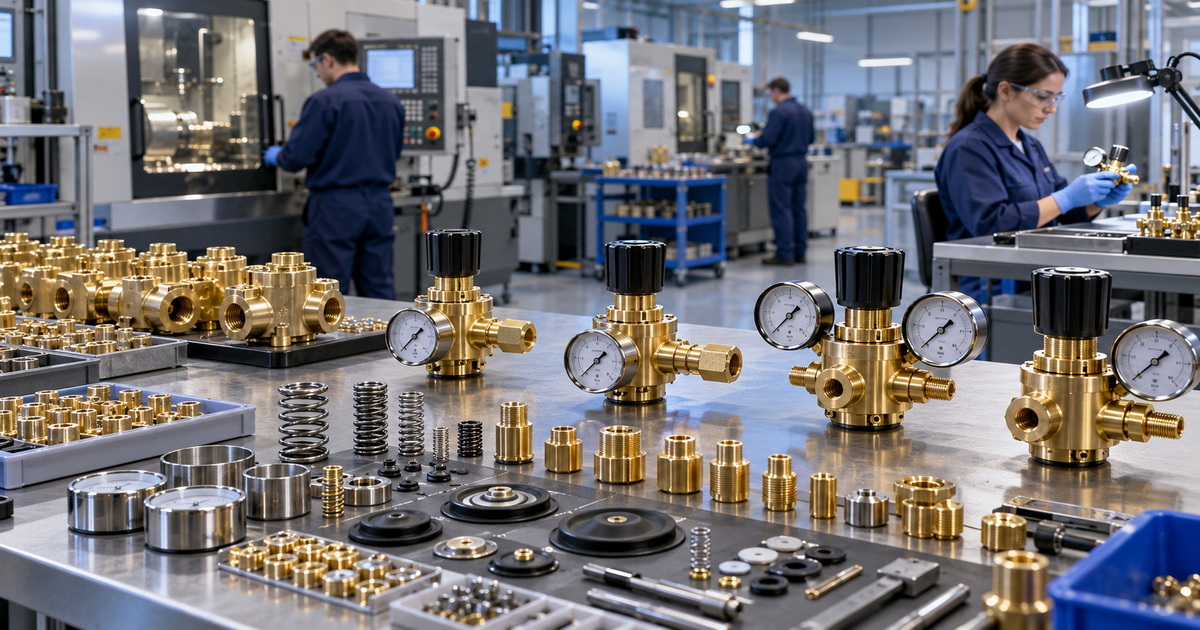
As a professional gas regulator manufacturer and supplier, we provide customized solutions for overseas brands, wholesalers, distributors, welding-equipment manufacturers, and industrial gas-control projects. Our capabilities include OEM and ODM production, customized pressure ranges, gas-specific inlet and outlet connections, logo and packaging customization, precision-machined brass components, strict inspection processes, and stable pressure-control designs.
Contact us today to discuss your CO₂ regulator, argon regulator, oxygen regulator, acetylene regulator, propane regulator, nitrogen regulator, or dual-stage gas regulator requirements. Share your gas type, target market, working-pressure range, connection standard, and estimated order quantity so we can recommend a suitable OEM or ODM solution.
FAQ
1. Can I use the same regulator for argon and CO₂?
Not always. Although some gas mixtures may use compatible connection systems in certain markets, you should confirm the cylinder valve standard, inlet fitting, outlet requirement, flow range, and the regulator manufacturer’s specified gas compatibility. Never assume compatibility based only on similar appearance.
2. Do I need a heated CO₂ regulator for MIG welding?
A heated CO₂ regulator can be useful when gas withdrawal is high, duty cycles are long, ambient temperature is low, or frost formation affects gas delivery. For light or intermittent welding, a standard CO₂ regulator may be sufficient.
3. What is the advantage of a dual-stage gas regulator?
A dual-stage regulator provides improved outlet-pressure stability as cylinder pressure decreases. It is often preferred for continuous manufacturing, automated welding, precision testing, purging, and applications where small pressure changes may affect quality or equipment performance.
4. Why must oxygen regulators be oil-free?
Oxygen supports combustion strongly. Oil, grease, or other combustible contaminants on oxygen equipment can create a serious fire hazard. OSHA specifically requires oxygen cylinders, valves, couplings, regulators, hoses, and associated apparatus to be kept free from oily or greasy substances.
5. Can I use an adapter when the regulator connection does not fit the cylinder?
No. Do not use an adapter to force a regulator onto a cylinder with a different connection. Gas-specific connector systems are designed to prevent incompatible connections, particularly for gases with flammable, toxic, corrosive, or oxidizing hazards.
6. Is a welding regulator suitable for a gas manifold system?
A standard single-cylinder welding regulator may not be sufficient for a manifold system. Manifold applications often require dedicated regulators designed for the expected pressure, flow, number of outlets, and safety requirements. ISO 7291 addresses pressure regulators used in manifold systems for welding, cutting, and allied processes.
7. What information should I provide to an OEM gas regulator supplier?
Provide the gas type, inlet connection standard, outlet connection, working-pressure range, gauge range, flow requirement, regulator type, heating requirement, target country, certification expectations, branding needs, packaging requirements, and estimated annual quantity.
References
1. International Organization for Standardization (ISO). “[ISO 2503:2009 — Gas Welding Equipment: Pressure Regulators and Pressure Regulators with Flow-Metering Devices for Gas Cylinders Used in Welding, Cutting and Allied Processes].” Covers requirements for single- and two-stage pressure regulators used with applicable compressed gases, acetylene, LPG, and CO₂ in welding-related applications. [iso]
2. Occupational Safety and Health Administration (OSHA). “[29 CFR 1926.350 — Gas Welding and Cutting].” Includes requirements related to cylinder valve closure and releasing gas from a regulator before removal. [osha]
3. Occupational Safety and Health Administration (OSHA). “[29 CFR 1910.253 — Oxygen-Fuel Gas Welding and Cutting].” States that oxygen cylinders, valves, regulators, hoses, and related apparatus must be kept free from oil and grease. [osha]
4. Occupational Safety and Health Administration (OSHA). “[Movement of Compressed Gas Cylinders With Regulators Installed].” Explains OSHA’s interpretation of cylinders connected for use and protection expectations during workplace movement. [osha]
5. International Organization for Standardization (ISO). “[ISO 7291:2010 — Gas Welding Equipment: Pressure Regulators for Use in Manifold Systems Used in Welding, Cutting and Allied Processes].” Specifies requirements and test methods for manifold-system pressure regulators. [iso]
6. University of Southern California Environmental Health & Safety. “[Gas Regulators].” Provides guidance on regulator compatibility, maximum cylinder pressure, outlet-pressure range, CGA fittings, and avoiding adapters. [ehs.usc]
7. GCE Group. “[Industrial Gas Regulator Standards].” Summarizes the application scope of ISO 2503:2009 for welding and allied-process regulators. [gcegroup]
Hot Tags:Welding Gas Regulator, Industrial Gas Regulator, CO₂ Regulator, Argon Regulator, Oxygen Regulator, Acetylene Regulator, Propane Regulator, Nitrogen Regulator, Dual Stage Gas Regulator, CO₂ Heated Regulator