Content Menu
● Why Mexico Matters for Gas-Regulator Buyers
>> Technical Baseline Buyers Should Expect
● Leading Suppliers for Mexico
>> 1. Zhejiang Bril Welding Equipment Co., Ltd. — OEM/ODM Regulator Manufacturer
>> 2. Ziroba Industrial S.A. de C.V. — Mexico-Based Gas-Control and Safety Specialist
>> 3. Linde Mexico / Tienda Linde — Industrial Gas and Regulator Distribution Channel
>> 4. Harris Products Group — Welding and Gas-Control Brand Available in Mexico
>> 5. GCE / Authorized Distribution Channels in Mexico — Standardized Gas-Control Solutions
>> 6. Grupo INFRA — Mexican Welding and Industrial Supply Network
>> Choose the Correct Regulator Type
>> Single-Stage vs. Dual-Stage Regulators
>> Brass Quality: What “Brass Body” Does Not Tell You
>> 1. Incorrect Gas Connection
>> 2. Misrepresented Material Grade
>> 4. CO₂ Freeze-Up During Continuous Welding
● An Industry Insider Tip Often Missed Online
● Sample and Factory Verification Process
>> Step 1: Prepare a Technical RFQ
>> Step 2: Verify the Supplier’s Identity
>> Step 3: Order Representative Samples
>> Step 4: Test Under Real Use Conditions
>> Step 5: Approve a Golden Sample and Inspection Plan
● Shipping and Import Considerations for Mexico
● FAQ
>> 1. How can I verify whether a supplier’s ISO 9001 certificate is still valid?
>> 2. Is CE certification enough for an industrial gas regulator sold in Mexico?
>> 3. What tests should be required for a heated CO₂ regulator?
>> 4. What MOQ should I expect for custom-branded regulators?
>> 5. How do I prevent a supplier from changing components after sample approval?
Mexico is an important industrial gas regulator procurement, distribution, and application market rather than a concentrated global manufacturing base for welding-cylinder regulators. For buyers serving automotive, metal fabrication, construction, HVAC, food processing, and export-oriented manufacturing, the strongest sourcing strategy is often to combine Mexico-based stocking, technical support, and after-sales access with a qualified OEM/ODM regulator manufacturer capable of delivering stable quality, branding flexibility, and export-ready documentation.
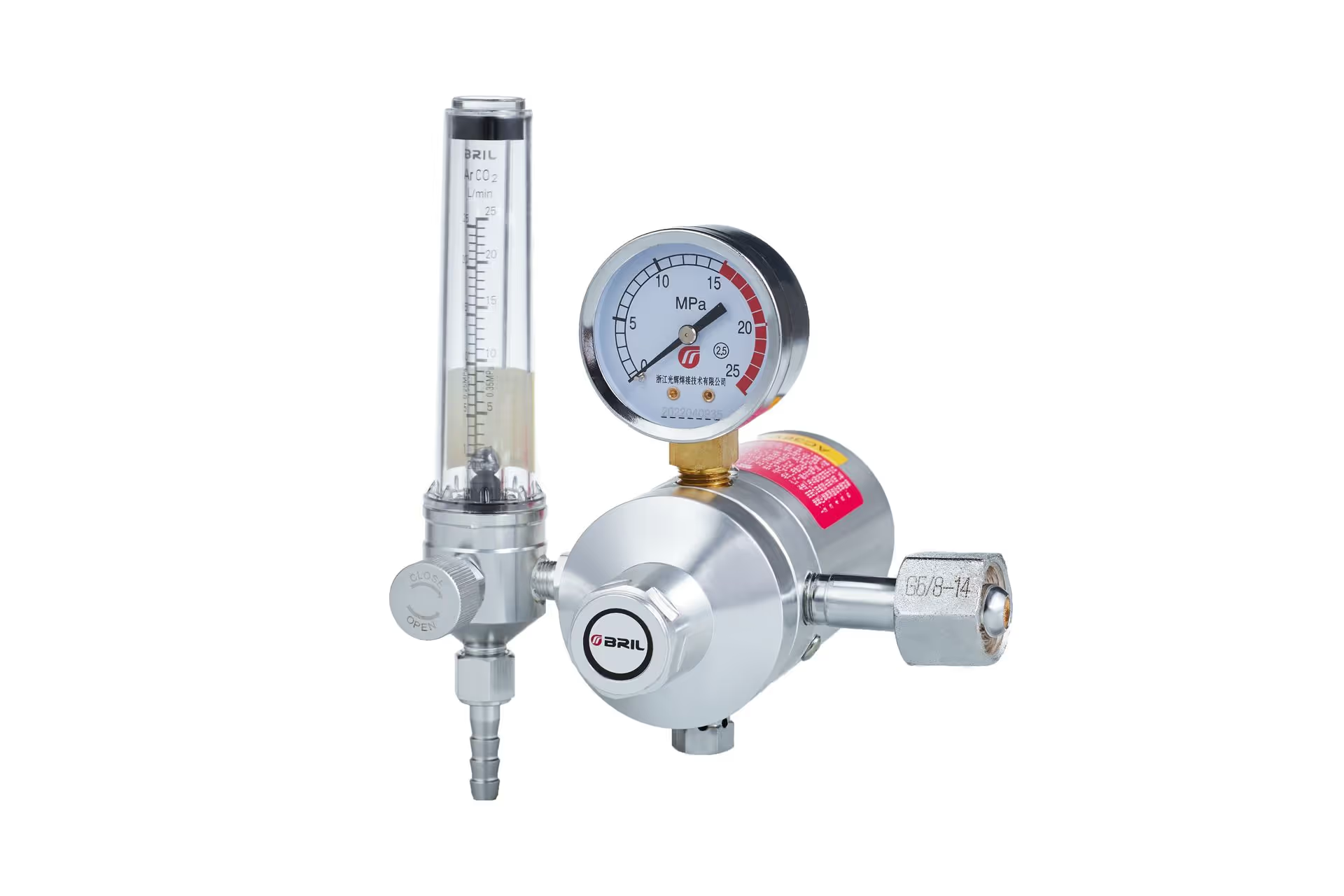
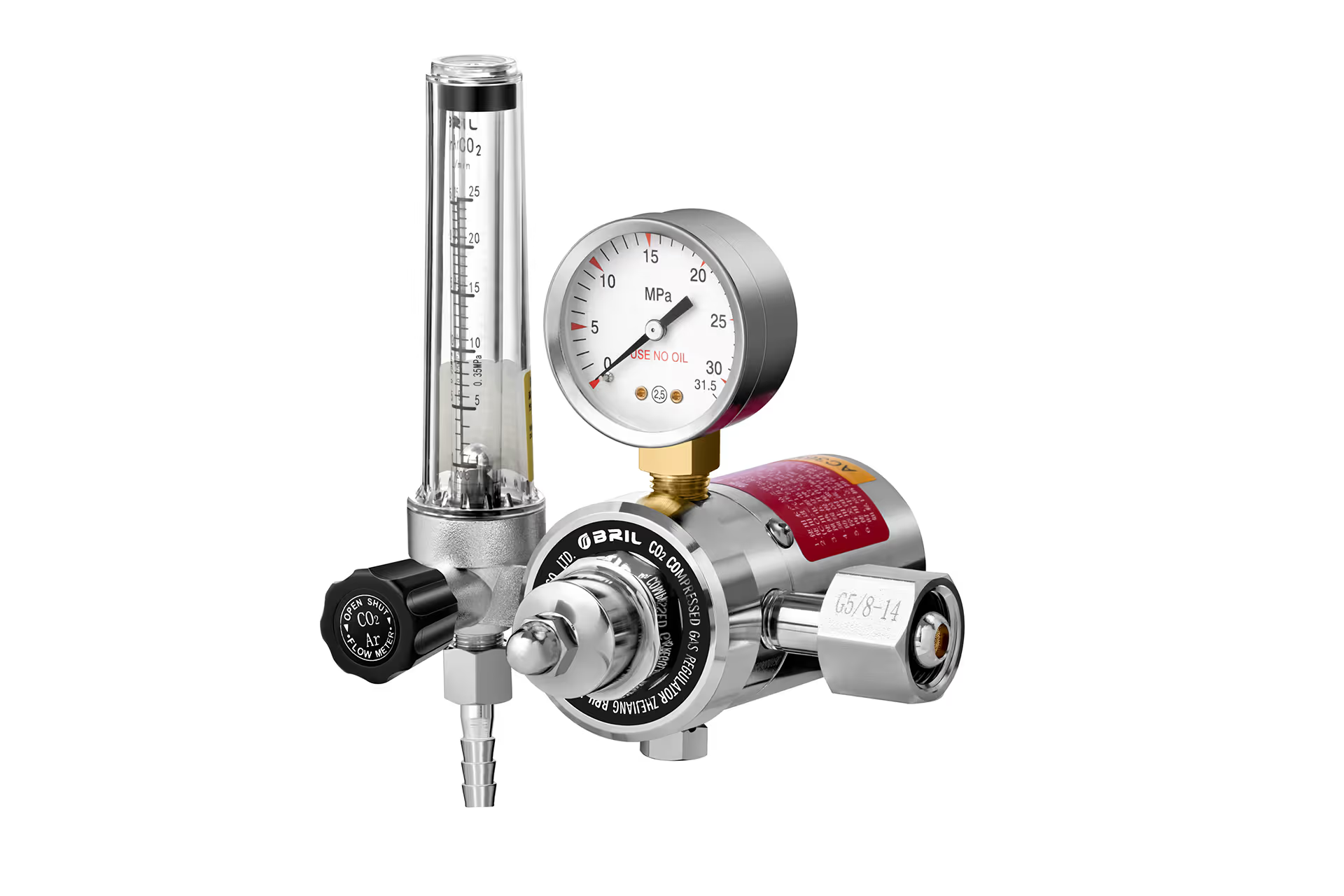
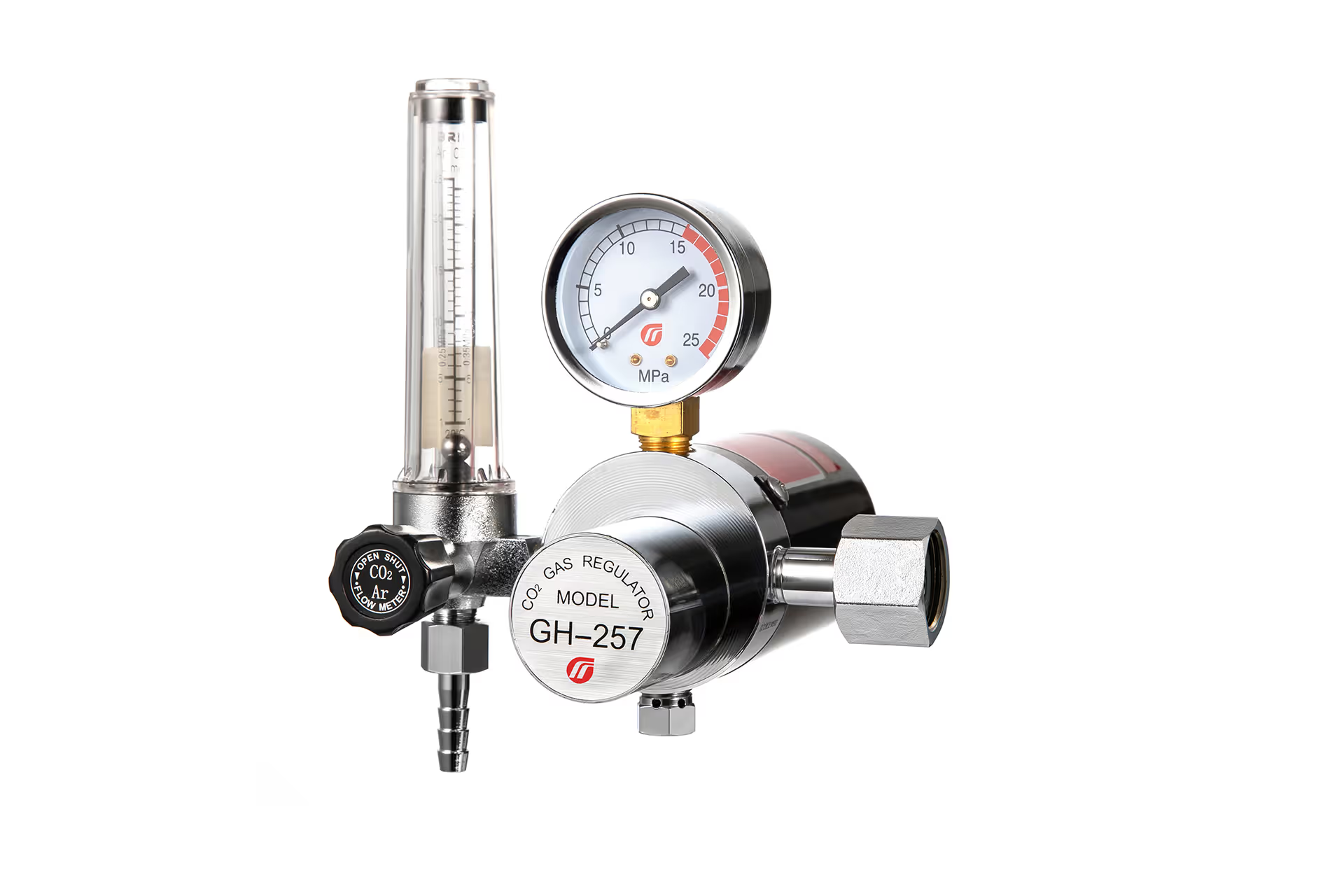
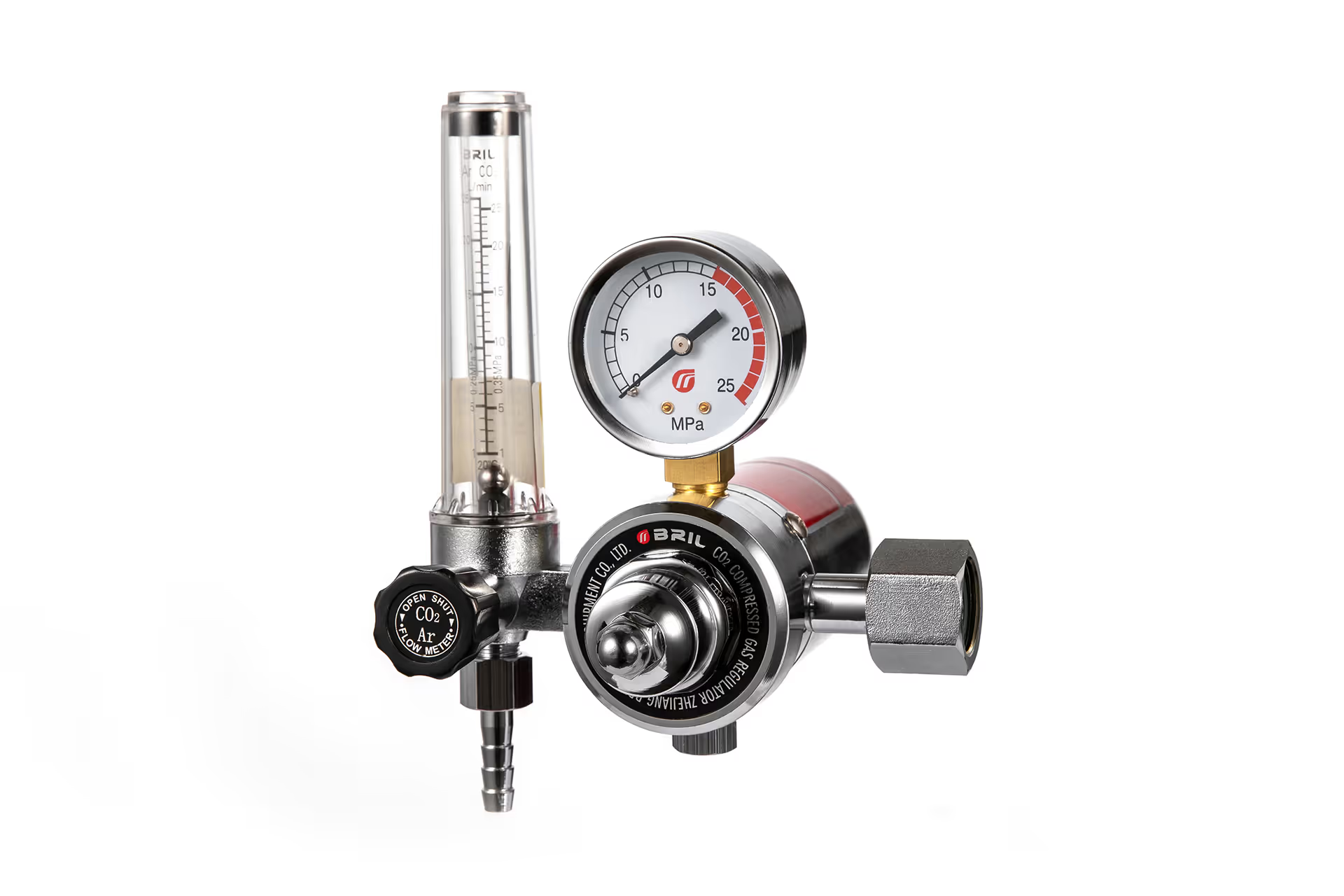
Zhejiang Bril Welding Equipment Co., Ltd. is included first as a specialist OEM/ODM manufacturer for buyers that require private-label CO₂, argon, oxygen, acetylene, propane, nitrogen, heated, and dual-stage regulators.

Why Mexico Matters for Gas-Regulator Buyers
Mexico’s manufacturing economy creates sustained demand for reliable welding and industrial gas-control equipment. Automotive assembly, appliance production, machinery fabrication, construction, energy projects, and cross-border export manufacturing all depend on gas supply systems, welding equipment, and cylinder-based gas control.
Mexico’s official statistics agency, INEGI, tracks manufacturing activity and merchandise exports, including export-manufacturing enterprises and state-level export data. This matters to gas-regulator buyers because demand is concentrated around industrial corridors with high volumes of metalworking and export production, especially northern Mexico, central Mexico, and the Bajío region.

For welding and cutting applications, the relevant industrial clusters generally include:
– Monterrey and Nuevo León: Automotive, steel, industrial machinery, fabrication, and supply-chain manufacturing.
– Baja California: Cross-border manufacturing, medical-device production, electronics, fabrication, and industrial maintenance.
– Querétaro and the Bajío region: Automotive, aerospace-adjacent manufacturing, machinery, and high-value industrial production.
– State of Mexico and Mexico City area: Industrial distribution, gas-control solutions, technical service, and nationwide purchasing networks.
– Jalisco: Fabrication, food and beverage packaging, industrial maintenance, and regional distribution.
For overseas brands, Mexican importers, and regional distributors, Mexico is therefore a market where supplier responsiveness, Spanish-language documentation, stable inventory, correct cylinder-valve interfaces, and traceable safety documentation can be as important as the regulator’s initial purchase price.
How We Selected Suppliers
Selection Criteria
| Evaluation area | What professional buyers should verify | Why it matters |
|---|---|---|
| Manufacturing role | Whether the company is the actual regulator manufacturer, OEM partner, distributor, or gas supplier | Prevents incorrect assumptions about production control and private-label capability |
| Product coverage | Compatibility with CO₂, argon, oxygen, acetylene, propane, nitrogen, inert gases, and dual-stage applications | Gas-specific materials, seals, threads, and pressure ranges are not interchangeable |
| Quality systems | ISO 9001 status, certificate issuer, expiry date, factory scope, internal QC records, and traceability | A valid certificate alone does not prove that a particular regulator model is controlled properly |
| Technical compliance | EN ISO 2503, CE where applicable, RoHS where contractually required, gas-service safety requirements, and market-specific labeling | Welding gas regulators must be assessed by application, destination market, and cylinder connection |
| OEM/ODM capability | Branding, packaging, dial artwork, inlet/outlet configurations, pressure ranges, color coding, manuals, and carton design | Essential for distributors and brands building a differentiated product line |
| Supply reliability | Sample lead time, production lead time, capacity planning, incoming-material control, spare-part support, and shipping records | A regulator line is not commercially viable if replenishment is unpredictable |
| Commercial fit | MOQ, payment terms, customs documentation, product liability arrangements, and after-sales process | Reduces hidden landed-cost and warranty risk |
Technical Baseline Buyers Should Expect
For cylinder regulators used in welding, cutting, and allied processes, EN ISO 2503 / ISO 2503 is a major reference point. The standard covers specified requirements for single- and two-stage pressure regulators, including versions with flow-metering devices, for cylinder gases used in welding and allied processes. It applies to compressed gases and mixtures up to 300 bar, carbon dioxide, dissolved acetylene, LPG, and related use cases within its defined limits.
A technically credible supplier should be able to explain—not merely state—the following:
– Brass grade and composition used for the regulator body, bonnet, stem, and fittings.
– Whether gas-wetted components are appropriate for oxygen service.
– Diaphragm material and compatibility with CO₂, inert gas, oxygen, acetylene, LPG, and nitrogen.
– Seat material, seat design, and expected pressure-control behavior.
– Inlet and outlet connection standards, such as CGA, DIN, BS, or country-specific interfaces.
– Maximum inlet pressure, adjustable outlet-pressure range, and flow capability.
– Test conditions for leakage, pressure creep, outlet-pressure stability, and burst safety.
– Whether the regulator is single-stage or dual-stage and why that design suits the intended application.
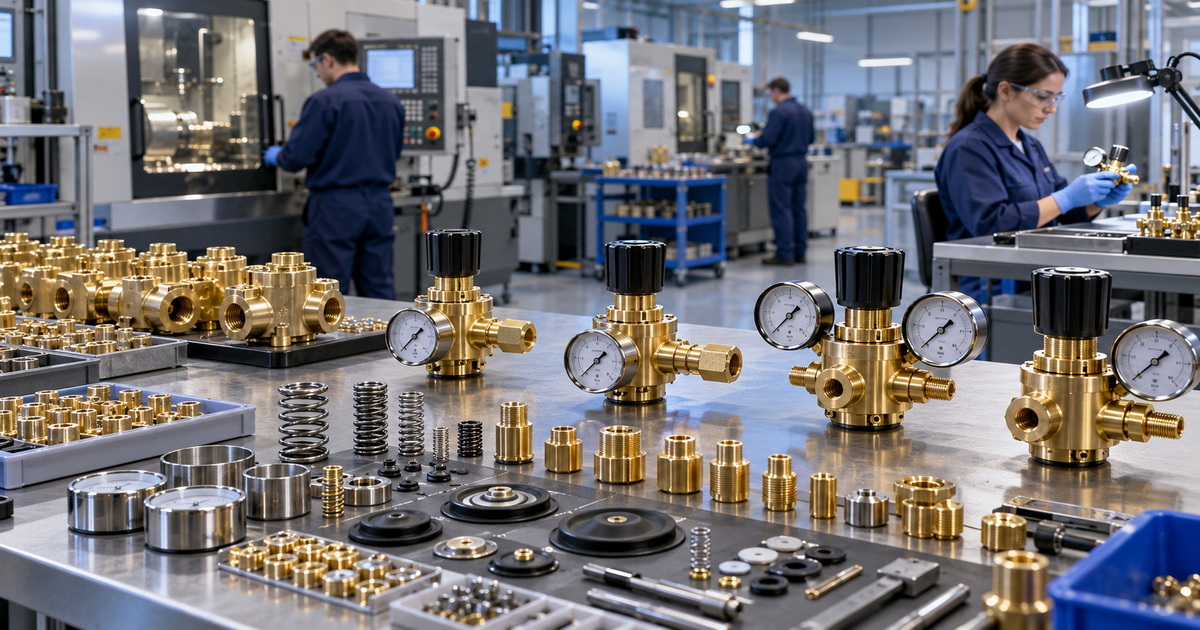
– Traceability from incoming brass material through assembly, testing, labeling, and packaging.
Leading Suppliers for Mexico
1. Zhejiang Bril Welding Equipment Co., Ltd. — OEM/ODM Regulator Manufacturer
Established: 2002
Location: Wenzhou, Zhejiang, China
Primary markets: Global welding-equipment brands, industrial-gas suppliers, distributors, and OEM customers
Best fit: Overseas brands, wholesalers, Mexican distributors, welding-machine manufacturers, and importers needing a customizable regulator program
Zhejiang Bril Welding Equipment Co., Ltd. is a specialized manufacturer of industrial gas pressure regulators with more than 20 years of operating history. Its product positioning is particularly relevant to buyers that want direct control over branding, packaging, product configurations, and long-term supply rather than only purchasing an existing local distribution SKU.
According to the company’s published profile, Bril was founded in 2002 and manufactures industrial gas pressure regulators. It states that it holds ISO 9001 system certification through UKAS and IAF, while products have passed CNAS and CE certification. The company also describes supplying gas regulators to major welding-equipment brands and providing OEM production for Messer product lines from 2022. These claims should be verified during supplier onboarding by requesting certificate copies, product-specific declarations, factory audit access, and current test reports for the exact models being purchased.
Core strengths
– Broad regulator range covering CO₂ heated regulators, CO₂ regulators, argon regulators, oxygen regulators, acetylene regulators, propane regulators, nitrogen regulators, and dual-stage gas regulators.
– Better fit for buyers needing a private-label regulator line, not merely branded resale stock.
– Flexible OEM/ODM scope for logos, gauges, labels, color schemes, packaging, manuals, inlet/outlet connections, pressure settings, and application-specific configurations.
– Suitable for small and mid-sized brands that need closer engineering communication and lower organizational friction than is often available from very large multinational suppliers.
– Experience serving welding-equipment supply chains and industrial gas-control applications.
– More than 200 employees and in-house testing and inspection resources described in the company profile.
OEM/ODM scope to discuss before sampling
– Regulator body style and bonnet appearance.
– Inlet connection for the actual Mexican cylinder-valve standard required.
– Outlet thread, hose tail, quick connector, or flowmeter configuration.
– Gas-specific gauge scales, pressure ranges, and color coding.
– Heated CO₂ regulator voltage, heating element, cable, plug, insulation, and thermal-protection specifications.
– English/Spanish manuals, carton marks, barcode labels, warning labels, and country-of-origin marking.
– Spare gauges, repair kits, diaphragms, valves, and service instructions.

Buyer assessment
Bril is especially relevant when the procurement objective is to develop a proprietary product range with a controlled landed cost. It should not be evaluated only as a low-price option. The more practical value proposition is the combination of regulator specialization, technical customization, OEM flexibility, direct factory communication, and capacity to support differentiated product configurations for distributors that do not meet the high-volume thresholds of larger global brands.
For Mexican buyers, a productive first project is often a controlled sample matrix: one CO₂ heated regulator, one argon/CO₂ flowmeter regulator, one oxygen regulator, one acetylene regulator, and one dual-stage inert-gas regulator. This lets the importer compare assembly consistency, gauge accuracy, connection fit, packaging quality, and local user feedback before expanding the SKU range.
2. Ziroba Industrial S.A. de C.V. — Mexico-Based Gas-Control and Safety Specialist
Established: Public sources describe the business as a Mexican company, but a specific founding year should be confirmed directly
Location: State of Mexico, with commercial presence serving Mexico City and Guadalajara
Primary markets: Mexican and Central American gas-control, safety, welding, cutting, and industrial users
Best fit: Buyers needing Mexico-based technical consultation, safety devices, centralized gas-control systems, and local support
Ziroba Industrial is a Mexican company focused on gas-use control, analysis, and safety equipment. Its published catalog describes regulator offerings aligned with ISO 2503 for oxygen, air, inert gases, and fuel gases, alongside gas-safety products such as flashback arrestors, non-return valves, gas mixers, analyzers, and centralized supply equipment.
Its catalog indicates gas-regulator solutions for high-pressure reduction and identifies certain product variants with flow rates up to 800 Nm³/h, subject to specific model exceptions and variations. This makes Ziroba particularly relevant for buyers whose needs go beyond basic cylinder regulators and extend to system-level gas safety, manifold regulation, food-packaging gas applications, and centralized supply control.
Core strengths
– Mexico-based access for industrial gas-control and safety projects.
– Product scope that includes welding, cutting, gas safety, centralized regulation, and modified-atmosphere packaging-related gas control.
– Public reference to regulators conforming to ISO 2503 for multiple gas categories.
– Potentially useful for end users who need local technical communication, replacement parts, and application guidance.
– Offers a broader gas-safety portfolio beyond the regulator itself.
OEM/ODM relevance
Ziroba appears better positioned as a local technical supplier, integrator, and representative channel than as a publicly documented private-label cylinder-regulator factory. Buyers seeking OEM programs should ask directly about private branding, minimum quantities, local assembly capability, origin of supplied regulators, technical-file availability, and warranty ownership.
3. Linde Mexico / Tienda Linde — Industrial Gas and Regulator Distribution Channel
Established: Linde is a global industrial-gases group; Mexico-specific commercial structure and product availability should be confirmed by location
Location: Mexico
Primary markets: Industrial gas users, welding customers, fabrication shops, and gas-supply customers
Best fit: Buyers requiring branded regulators, local gas compatibility, and integrated gas-supply purchasing
Linde Mexico is relevant because it provides industrial-gas supply infrastructure and a local sales channel for gas-handling equipment, including Harris regulator products. Its online Mexico store lists examples such as the Harris 25GX inert-gas regulator for argon, helium, nitrogen, and mixtures. The listed technical details include 3,000 PSIG inlet pressure, 0–145 PSIG outlet pressure, CGA 580 inlet connection, 9/16″-18 LH outlet connection, and brass construction.
Linde Mexico also lists a Harris 25GX acetylene regulator with a 500 PSIG inlet pressure, 0–15 PSIG outlet-pressure range, CGA 510 inlet connection, and 9/16″-18 LH outlet connection.
Core strengths
– Local buying channel linked to industrial-gas supply requirements.
– Suitable for users that prioritize immediate access to established branded products.
– Product-specific specifications are available for selected items.
– Helpful for replacement purchases, maintenance stock, standardized shop requirements, and industrial buyers that need compatibility with a broader gas-supply relationship.
OEM/ODM relevance
This is primarily a distribution and industrial-gas supply channel, not a typical private-label OEM route. It is better suited to buyers purchasing established branded products than to distributors planning custom branding, custom packaging, or exclusive regulator designs.
4. Harris Products Group — Welding and Gas-Control Brand Available in Mexico
Established: Harris has a long history in welding and gas-control equipment; confirm exact product origin and Mexico supply terms for each program
Primary markets: Welding, cutting, brazing, industrial gas control, fabrication, and maintenance
Best fit: Buyers seeking recognizable branded gas-control equipment and established product families
Harris is a widely recognized welding and gas-control brand whose regulator products are distributed through industrial and gas-supply channels in Mexico, including Linde Mexico listings. The available Mexican product pages demonstrate support for inert gases, acetylene, butane/propane, and argon flowmeter-regulator configurations.
For example, Linde Mexico describes the Harris 355-2 argon flowmeter regulator as combining a pressure regulator and flowmeter in one compact unit, with a flow tube and float designed to be changeable for different gases.
Core strengths
– Established brand recognition in welding and gas-control equipment.
– Multiple gas configurations available through Mexico-based distribution.
– Suitable for buyers that value existing product familiarity and a defined branded offering.
– Relevant to MRO procurement, fabrication shops, and distributor replenishment.
OEM/ODM relevance
Generally limited for smaller buyers. Harris is typically more suitable for branded distribution and channel procurement than for a buyer seeking custom dials, private-label cartons, proprietary regulator bodies, or low-to-mid-volume OEM projects.
5. GCE / Authorized Distribution Channels in Mexico — Standardized Gas-Control Solutions
Established: Global group; local distributor and product availability vary by region
Primary markets: Welding, medical, laboratory, industrial, and specialty gas-control applications
Best fit: Buyers seeking standardized gas-control systems, specialty applications, and documented product families
GCE is a global gas-control supplier with products and standards information relevant to industrial regulators. In Mexico, authorized distribution channels are publicly promoted, and Mexico-based GCE representation has appeared in technical literature.
GCE’s industrial standards documentation references EN ISO 2503:2009 and describes its relevance to single- or two-stage gas welding pressure regulators and pressure regulators with flow-metering devices used for compressed gases, CO₂, dissolved acetylene, and LPG within the standard’s parameters.
Core strengths
– Broad global experience in gas-control equipment.
– Suitable for applications where documented product families and technical standardization are important.
– Potential fit for industrial, specialty-gas, medical, and more demanding gas-control requirements depending on the product line.
– Stronger relevance for buyers who need standard products with a defined technical documentation path.
OEM/ODM relevance
Usually less flexible than a dedicated contract manufacturer. Buyers seeking customization should clarify whether changes are limited to accessories and configuration, or whether the supplier can support private-label programs, custom connections, branded packaging, or special pressure ranges.
6. Grupo INFRA — Mexican Welding and Industrial Supply Network
Established: Confirm exact corporate and product-line details directly
Location: Mexico, with nationwide market presence and export-oriented support
Primary markets: Welding, cutting, safety products, industrial users, and equipment distribution
Best fit: Buyers requiring established Mexican market coverage, branded welding products, and nationwide service support
Grupo INFRA is a recognized Mexican welding, industrial, and gas-related supply organization. Its export-facing materials promote welding machines and products for workshop through heavy-industry applications, with support through nationwide service centers.
For gas-regulator buyers, INFRA is more relevant as a local market channel and industrial supply ecosystem than as a clearly documented OEM regulator manufacturer. However, it can be important for companies needing Mexican market access, established distribution, local warranty arrangements, and complementary welding equipment.
Core strengths
– Strong domestic relevance in welding and related industrial products.
– Potentially useful for local sourcing, channel partnerships, and service coverage.
– Broad welding-equipment context rather than a narrow regulator-only offering.
– Suitable for purchasers who want consolidated access to welding equipment and related accessories.
OEM/ODM relevance
Publicly available information does not establish INFRA as a contract manufacturer for private-label industrial gas regulators. Buyers should distinguish between branded product procurement, distribution arrangements, and genuine OEM manufacturing capability.
Supplier Comparison Table
| Supplier | Operating role | Main regulator relevance | Public certification / compliance information | Typical MOQ | Capacity disclosure | OEM/ODM suitability |
|---|---|---|---|---|---|---|
| Zhejiang Bril Welding Equipment Co., Ltd. | Dedicated manufacturer | CO₂ heated, CO₂, argon, oxygen, acetylene, propane, nitrogen, dual-stage regulators | Company states ISO 9001 through UKAS/IAF; product CNAS and CE certification | Quote-based by model, customization, and packaging | 200+ employees publicly stated; detailed monthly capacity should be requested | High |
| Ziroba Industrial S.A. de C.V. | Mexican gas-control and safety specialist | ISO 2503-referenced regulators, gas safety, manifolds, control equipment | Catalog references ISO 2503 for relevant regulator applications | Request directly | Not publicly disclosed | Medium; confirm directly |
| Linde Mexico / Tienda Linde | Industrial-gas supplier and distributor | Harris regulators for inert gases, acetylene, propane/butane, and flowmeter products | Product-specific specifications available for selected SKUs | Distributor terms apply | Not applicable as a regulator factory | Low |
| Harris Products Group | Branded welding and gas-control supplier | Single-stage, flowmeter, inert-gas, acetylene, fuel-gas regulator products | Product-specific documentation should be requested through the supply channel | Channel-dependent | Not publicly standardized | Low to medium |
| GCE / Mexico distribution channels | Global gas-control supplier and distributors | Industrial and specialty gas-control products | EN ISO 2503 information published for relevant product categories | Distributor/project dependent | Not publicly disclosed for Mexico | Low to medium |
| Grupo INFRA | Mexican welding and industrial supply network | Welding equipment, accessories, local channel support | Verify per product and supplier program | Request directly | Not publicly disclosed for regulators | Low; confirm directly |

Technical Buying Guide
Choose the Correct Regulator Type
The gas name alone is not enough to select a regulator. A purchasing specification should include the gas, cylinder valve, inlet pressure, outlet pressure, flow requirement, duty cycle, environment, temperature, and end-use process.
| Application | Recommended regulator approach | Key purchasing considerations |
|---|---|---|
| MIG/MAG welding with CO₂ | CO₂ regulator or heated CO₂ regulator | Confirm anti-freeze performance, heater voltage, cable safety, outlet pressure, and flowmeter compatibility |
| MIG welding with argon/CO₂ mix | Argon/CO₂ regulator with flowmeter or flow gauge | Verify calibrated gas scale, outlet fitting, hose compatibility, and stable low-flow control |
| TIG welding with argon | Argon flowmeter regulator | Confirm flow tube readability, float accuracy, gas calibration, and low-flow stability |
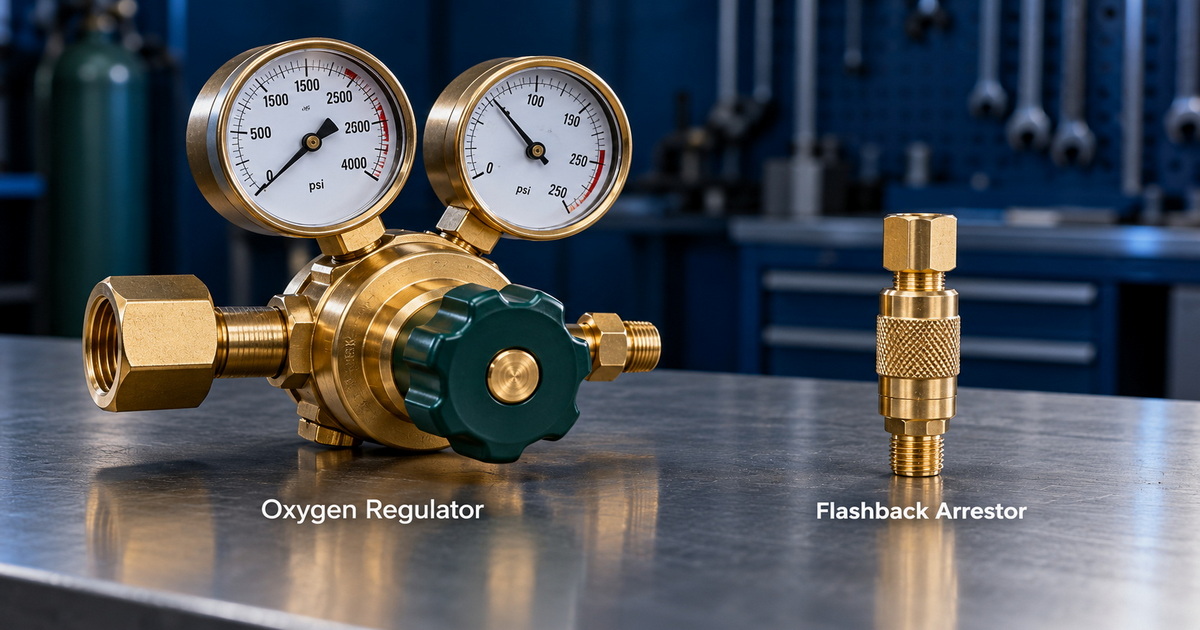
| Oxy-fuel cutting | Separate oxygen and acetylene regulators | Use correct gas-specific inlet threads, pressure range, and flashback-protection strategy |
| Propane or LPG heating/cutting | Propane/LPG regulator | Verify compatibility with fuel gas; do not substitute an acetylene-specific regulator |
| Nitrogen purging or testing | Nitrogen regulator, often higher pressure capability | Confirm outlet pressure range, gauge scale, and pressure creep resistance |
| Precision welding or laboratory gas delivery | Dual-stage regulator | Preferred where stable outlet pressure is needed as cylinder pressure declines |
| CO₂ beverage or food applications | Gas-specific CO₂ regulator and compliant connection requirements | Confirm materials, cleaning controls, local requirements, and non-welding application suitability |
Single-Stage vs. Dual-Stage Regulators
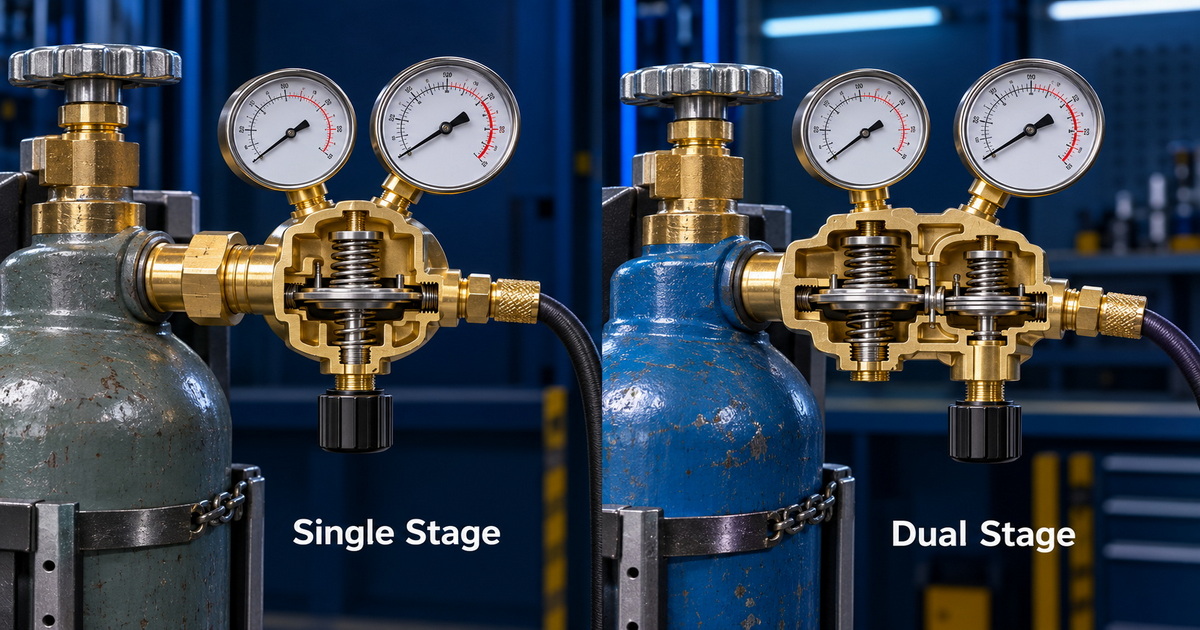
A single-stage regulator reduces cylinder pressure in one pressure-reduction step. It is widely used, cost-effective, and appropriate for many standard welding applications.
A dual-stage regulator reduces pressure in two stages. The practical benefit is better outlet-pressure stability as inlet cylinder pressure falls. It is often preferred for precision gas delivery, long-duration processes, sensitive flow conditions, analytical work, and applications where “supply pressure effect” must be minimized.
However, buyers should not automatically assume that dual-stage means superior for every task. It adds cost and complexity. For standard oxy-fuel, MIG, and general fabrication work, a properly designed and tested single-stage regulator can be the commercially sensible choice.
Brass Quality: What “Brass Body” Does Not Tell You
Many suppliers advertise “high-quality brass,” but that phrase is incomplete. A serious buyer should request the actual material specification and determine where the material is used.
Ask these questions:
– What is the brass alloy designation for the body, bonnet, inlet stem, and outlet fitting?
– Is the material lead content compatible with the intended market and application?
– Are oxygen-service components cleaned and handled to reduce contamination risks?
– Are critical threads machined in-house or outsourced?
– Is each brass lot traceable to a supplier certificate?
– Is the material forged, hot-stamped, machined from bar stock, or cast?
– What controls prevent porosity, micro-cracks, thread damage, and plating defects?
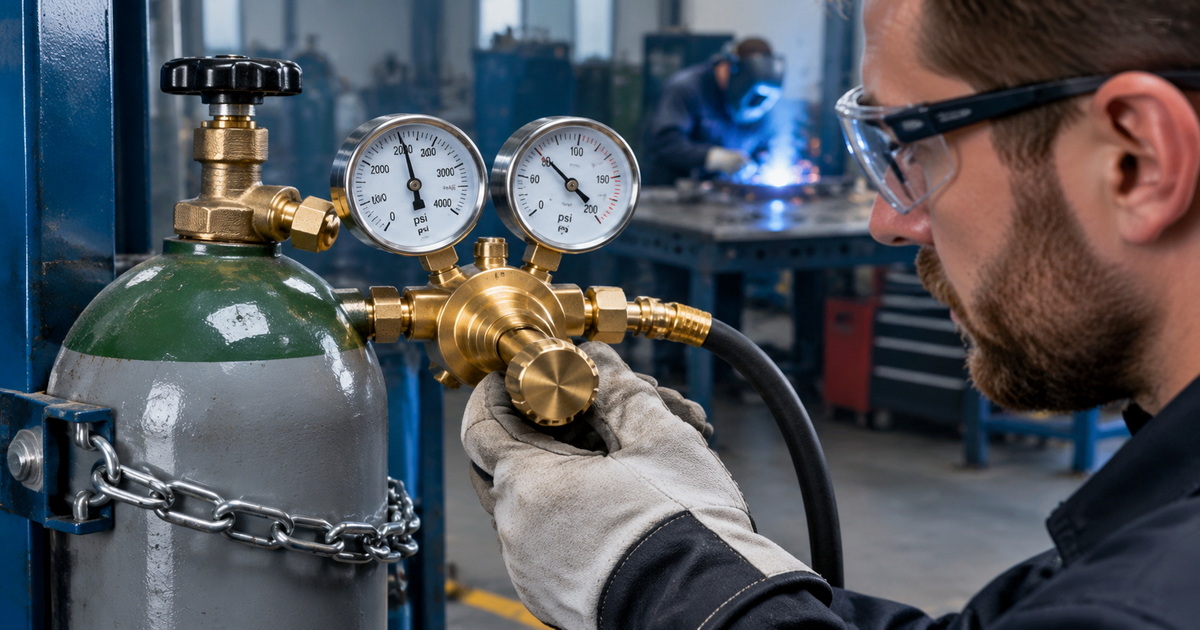
For oxygen regulators, cleanliness and contamination control are as important as material selection. Oil, grease, fibers, machining residues, and unsuitable assembly practices can create a serious safety risk. A quotation that only says “oxygen regulator, brass body” is not an adequate technical specification.
Common Procurement Risks
1. Incorrect Gas Connection
A regulator can appear technically correct while having the wrong inlet fitting for the target market’s cylinder valve. CGA, DIN, BS, and local connection systems are not interchangeable.
How to avoid it: Send the supplier photos, drawings, thread requirements, and a physical sample valve or regulator whenever possible. Include the inlet standard and outlet standard as controlled fields on the purchase order.
2. Misrepresented Material Grade
Some low-cost regulators may use lower-grade brass, thinner wall sections, inconsistent machining, or plated components where solid brass is expected.
How to avoid it: Request material declarations, component drawings, incoming material inspection records, and cutaway samples for major projects. For long-term programs, include a material-change notification clause in the supply agreement.
3. Gauge Accuracy Problems
A regulator may pass a basic leak test but still have inaccurate gauges, poor dial readability, inconsistent zero points, or unstable readings after transportation.
How to avoid it: Define gauge class, range, dial design, scale unit, pointer movement, calibration procedure, and acceptance criteria before mass production.
4. CO₂ Freeze-Up During Continuous Welding
CO₂ expands and cools during pressure reduction. Under high gas consumption or low ambient temperatures, a non-heated regulator can ice up, causing unstable flow or reduced performance.
How to avoid it: For high-duty-cycle CO₂ welding, evaluate heated CO₂ regulators. Confirm heater wattage, voltage, electrical insulation, thermostat or thermal cutout approach, plug type, cable length, and testing procedure.
5. Certificate Misuse
A supplier may show a valid ISO 9001 certificate that applies to a different legal entity, an expired scope, a trading company rather than the factory, or a factory activity unrelated to regulators.
How to avoid it: Verify the certificate number through the issuing certification body. Confirm the legal company name, factory address, scope statement, issue date, expiry date, accreditation marks, and whether the audited site matches the actual production site.
An Industry Insider Tip Often Missed Online
A common but under-discussed failure point is not the body casting or the gauge—it is the seat-and-diaphragm consistency across production batches.
Two regulators can look identical externally and pass a short bench test. Yet, if seat material hardness, spring force, diaphragm thickness, or assembly torque changes from batch to batch, users may see:
– Outlet-pressure creep after the regulator is left pressurized.
– Different knob feel between units.
– Inconsistent flow during long welding cycles.
– Poor repeatability when the cylinder pressure drops.
– Higher return rates that only emerge after several weeks in the field.
This is why a purchasing team should not rely only on a visual inspection or one “golden sample.” Require batch-based testing records and define a production inspection plan.
A useful acceptance protocol includes:
1. Inlet leakage test at the rated inlet pressure.
2. Outlet leakage test at set outlet pressure.
3. Pressure-creep observation after a defined stabilization time.
4. Outlet-pressure repeatability test after multiple adjustment cycles.
5. Gauge reading comparison against a calibrated reference.
6. Flow verification for flowmeter regulator models.
7. Functional testing after vibration or transport simulation where practical.
8. Random destructive review of retained samples for critical component consistency.
Sample and Factory Verification Process
Step 1: Prepare a Technical RFQ
Do not request only “price for argon regulator.” A professional RFQ should include:
– Gas type and gas purity/application.
– Single-stage or dual-stage design.
– Inlet connection and outlet connection.
– Inlet-pressure rating.
– Outlet-pressure range.
– Flow range for flowmeter models.
– Gauge diameter, units, dial language, and logo requirements.
– Body material and finish requirements.
– Heater specification for heated CO₂ models.
– Target market and required compliance documents.
– Packaging type, master-carton details, barcode, and manual language.
– Target order quantity and forecast volume.
Step 2: Verify the Supplier’s Identity
Before requesting production samples, confirm:
– Legal company name and business registration.
– Factory address and actual manufacturing location.
– ISO certificate issuer, scope, status, and expiry date.
– Product test reports for the requested regulator model.
– Export history or reference markets, where commercially appropriate.
– Video walkthrough of assembly, testing, marking, and packing areas.
– Quality-control records and sample traceability process.
Step 3: Order Representative Samples
A representative sample order should reflect the intended commercial line, not simply the cheapest standard unit. For example:
– One CO₂ heated regulator.
– One argon/CO₂ flowmeter regulator.
– One oxygen regulator.
– One acetylene regulator.
– One nitrogen regulator.
– One dual-stage inert-gas regulator.
– One branded packaging and labeling sample.
Step 4: Test Under Real Use Conditions
Bench testing is necessary but insufficient. Test regulators with the intended gas, cylinder, hose, torch, and local work practices. Record:
– Leak performance.
– Gauge accuracy.
– Pressure stability.
– Flow stability.
– Regulator freezing behavior for CO₂.
– Knob ergonomics.
– Connection compatibility.
– Packaging survival after local transport.
– Operator feedback.
– Spare-part interchangeability.
Step 5: Approve a Golden Sample and Inspection Plan
Before mass production, approve a signed golden sample and convert it into a written quality standard. The standard should cover dimensions, material, markings, gauge design, set pressures, test method, packaging, carton drop-test expectations, and allowable defects.
Shipping and Import Considerations for Mexico
For Mexico-bound regulator imports, the purchase decision should be based on landed cost, not factory price alone.
Key items to plan include:
– HS code confirmation with a customs broker.
– Country-of-origin marking.
– Commercial invoice and packing list.
– Bill of lading or air waybill.
– Product descriptions that match the actual goods.
– Palletization and carton-strength requirements.
– Corrosion protection for sea freight.
– Gauge protection during transport.
– Spare-parts allocation for local warranty support.
– Mexican labeling requirements where applicable.
– Importer-of-record responsibilities.
– Customs duties, VAT, brokerage, and inland transport.
– Product-liability and warranty terms.
For a first container order, buyers often reduce risk by shipping a smaller pilot batch by consolidated sea freight or air freight, then validating local sell-through, product returns, and installation feedback before scaling.
Conclusion
Mexico offers a strong industrial demand environment for gas regulators, especially where welding, fabrication, automotive supply, construction, and industrial gas distribution overlap. However, the supply market includes a mix of local distributors, gas companies, system integrators, global brands, and overseas manufacturers—so buyers must clearly distinguish local availability from actual manufacturing control.
For local technical support and established branded procurement, companies such as Ziroba, Linde Mexico, Harris distribution channels, GCE channels, and Grupo INFRA can be relevant options. For brands, wholesalers, and equipment manufacturers seeking deeper control over pricing, product design, packaging, and private-label positioning, Zhejiang Bril Welding Equipment Co., Ltd. represents a practical OEM/ODM option with a focused industrial-regulator product range, stated ISO 9001 and product certification background, and experience supporting established welding and gas-industry customers.
FAQ
1. How can I verify whether a supplier’s ISO 9001 certificate is still valid?
Request the full certificate rather than a cropped image. Check the certificate number, certification body, accreditation mark, legal entity name, factory address, scope of certification, issue date, and expiry date. Then search the certification body’s public certificate database or contact the certification body directly. Also confirm that the factory shown on the certificate is the same site producing your regulators.
2. Is CE certification enough for an industrial gas regulator sold in Mexico?
Not necessarily. CE marking is associated with applicable EU requirements and may be relevant if you sell into Europe or use EU-oriented compliance programs. Mexico-bound products may involve different legal, labeling, customs, safety, or customer-specific requirements. Treat CE as one item in a broader compliance file, not as a universal substitute for product qualification.
3. What tests should be required for a heated CO₂ regulator?
At minimum, specify leakage testing, outlet-pressure stability, heater voltage and power verification, insulation and electrical-safety checks, cable and plug inspection, thermal control behavior, and operational tests under continuous CO₂ flow. Test in conditions that approximate the intended ambient temperature and welding duty cycle. Also require clear instructions stating whether the unit is for CO₂ only and the proper operating sequence.
4. What MOQ should I expect for custom-branded regulators?
MOQ depends on the degree of customization. A logo on a standard regulator may require a relatively modest quantity, while custom body tooling, dedicated gauge dials, special valve connections, retail packaging, heated-regulator electrical changes, or private molds typically require larger commitments. Ask suppliers to separate MOQ by regulator body, gauge face, carton, label, manual, and custom tooling so you can identify where volume requirements originate.
5. How do I prevent a supplier from changing components after sample approval?
Use a controlled golden sample, signed specification sheet, component list, approved artwork, and pre-shipment inspection checklist. Include a written rule that material, diaphragm, seat, spring, gauge, heater, thread, plating, packaging, or sub-supplier changes require written approval before production. For recurring orders, retain reference samples from every lot and conduct periodic third-party inspections.
References
1. – [ISO 2503:2009 gas welding equipment standard overview] for welding pressure regulator requirements and scope. [iso]
2. – [GCE industrial standards information] for EN ISO 2503 application context for gas welding regulators. [gcegroup]
3. – [INEGI Manufacturing Industry statistics] for Mexico manufacturing-sector context. [en.www.inegi.org]
4. – [INEGI International Merchandise Trade Statistics] for official Mexico trade data resources. [en.www.inegi.org]
5. – [INEGI Profile of Export Manufacturing Enterprises] for Mexico export-manufacturing context. [en.www.inegi.org]
6. – [MarketsandMarkets welding equipment, accessories, and consumables market overview], which reports a projected market expansion from USD 34.72 billion in 2024 to USD 42.14 billion by 2030 across welding accessories and consumables categories that include gas regulators and related products. [marketsandmarkets]
7. – [Zhejiang Bril Welding Equipment Co., Ltd. company profile] for published company history, product positioning, and stated certification information. [chinesewelding]
Hot Tags: Industrial Gas Regulator, CO₂ Gas Regulator, CO₂ Heated Regulator, Argon Gas Regulator, Oxygen Gas Regulator, Acetylene Gas Regulator, Propane Gas Regulator, Nitrogen Gas Regulator, Dual Stage Gas Regulator, Welding Gas Regulator