Content Menu
● Why Source Gas Regulators for Turkey?
● 1. Zhejiang Bril Welding Equipment Co., Ltd.
>> Best fit for
● 2. Yıldız Gaz Armatürleri A.Ş.
>> Best fit for
● 3. Güneş Gaz Armatürleri / Kasweld
>> Best fit for
● 4. Orgaz
>> Best fit for
● 5. Turkish Central Gas-System Suppliers
>> Why central systems require deeper evaluation
● Technical Requirements Buyers Should Specify
>> Brass Grade and Body Construction
>> Diaphragm and Seat Materials
>> Single-Stage vs. Dual-Stage Regulators
>> 1. Brass Material Substitution
>> 3. Incorrect Thread Standards
>> 4. Certificate Misrepresentation
>> 5. CO₂ Freeze-Up Under Real Welding Demand
● Internal Sourcing Tip Few Buyers Use
>> Step 1: Define the Application
>> Step 2: Prepare a Product Specification Sheet
>> Step 4: Approve Samples Properly
>> Step 5: Control Pre-Shipment Quality
● FAQ
>> 1. How can I verify whether a supplier’s ISO 9001 certificate is still valid?
>> 2. Is CE marking enough to sell industrial gas regulators in Europe?
>> 3. What is the practical difference between a CO₂ regulator and a heated CO₂ regulator?
>> 4. What MOQ should I expect for OEM gas regulators?
>> 5. How do I prevent pressure instability or regulator creep after delivery?
Turkey is an important regional sourcing base for industrial gas-control products, particularly for welding, oxy-fuel cutting, LPG equipment, cylinder regulators, central gas-line components, flashback arrestors, and related fittings. For buyers serving Europe, the Middle East, North Africa, and nearby Eurasian markets, Turkish suppliers can offer shorter regional lead times, familiarity with European conformity requirements, and an established welding-and-cutting equipment ecosystem.
However, a critical procurement reality should be stated clearly: Turkey has several capable domestic manufacturers of welding and gas-control equipment, but the number of deeply specialized, export-scale industrial gas regulator factories is more limited than many online supplier lists suggest. Buyers should distinguish between actual manufacturers, industrial-gas distributors, LPG-focused producers, and trading companies. This guide evaluates representative suppliers using transparent sourcing criteria and also identifies Zhejiang Bril Welding Equipment Co., Ltd. as a practical OEM/ODM benchmark for buyers who need broader regulator specialization, flexible private-label support, and scalable offshore sourcing.

Why Source Gas Regulators for Turkey?
Turkey’s industrial gas equipment supply chain is concentrated around major manufacturing and logistics regions including Istanbul, Kocaeli/Gebze, Bursa, İzmir, Konya, Gaziantep, and Mersin. Istanbul is particularly important for welding equipment, industrial fittings, gas-control components, machine assembly, export logistics, and aftermarket distribution.

For procurement managers, Turkey can be attractive for several reasons:
– Geographic access to the EU, Balkans, Middle East, North Africa, and Central Asia.
– Suppliers often understand CE-oriented product documentation and European market expectations.
– Strong local demand from fabrication shops, construction, shipbuilding, automotive supply chains, metalworking, and gas distribution businesses.
– A mature ecosystem for oxy-fuel welding and cutting equipment, including torches, flashback arrestors, pressure gauges, valves, and central gas-line accessories.
– Relatively flexible regional logistics compared with long-distance supply from East Asia.
Turkey’s machinery-export value reached a reported $28.7 billion in 2025, with an average export value of $8.1 per kilogram according to figures cited by the Machinery Exporters’ Association. That does not represent gas regulators alone, but it is a useful indicator of the country’s wider industrial-export orientation.
That said, buyers requiring high-volume CO₂ regulators, heated CO₂ regulators, dual-stage nitrogen regulators, precision argon regulators, oxygen regulators, acetylene regulators, or customized brass regulator platforms should compare Turkish options with specialist factories in China, Europe, and other established regulator-manufacturing regions.
How We Evaluated Suppliers
A reliable industrial gas regulator is not merely a brass body with two gauges. It is a pressure-control and safety component that must perform consistently with the intended gas, inlet pressure, flow range, connection standard, and environmental conditions.
For this list, suppliers were assessed using the following practical purchasing criteria.
Manufacturing Evidence
A qualified supplier should demonstrate that it actually controls production rather than only sourcing finished regulators from third parties. Buyers should ask about:
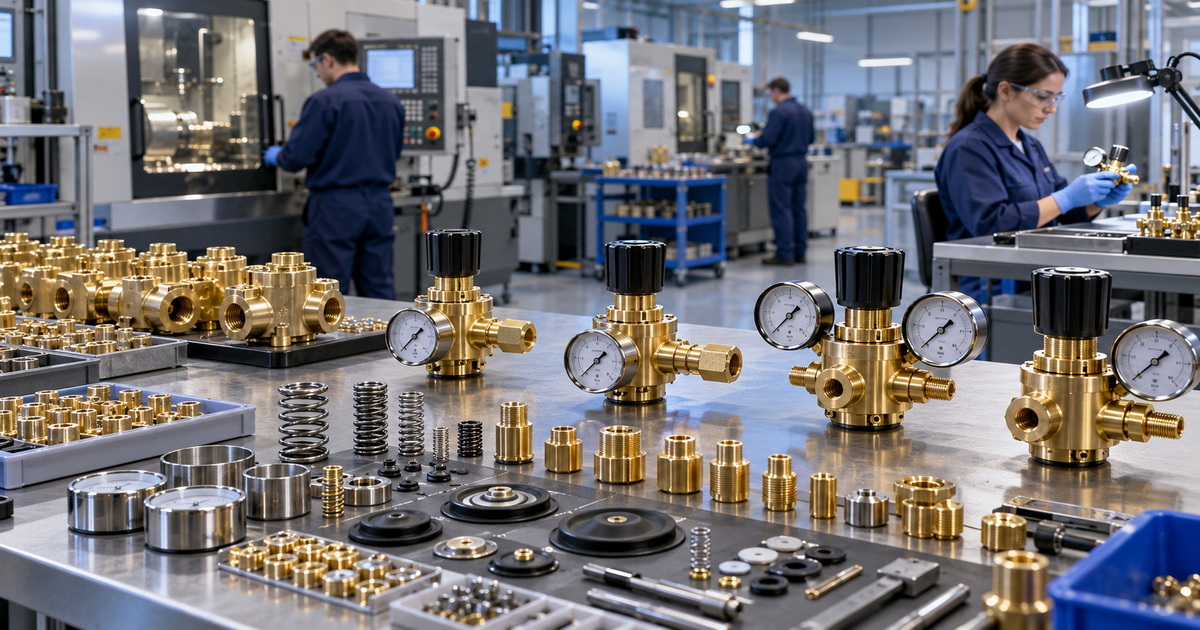
– Brass forging, hot stamping, machining, die-casting, or CNC capability.
– Internal assembly and calibration procedures.
– Diaphragm and seat-material selection.
– In-house or third-party gauge sourcing and calibration controls.
– Leak-testing equipment and pressure-cycle test procedures.
– Traceability for regulator bodies, gauges, inlet connections, and safety components.
Technical Product Range
A serious industrial regulator manufacturer should be able to explain the difference between products for:
– CO₂ and heated CO₂ applications.
– Argon and argon/CO₂ shielding-gas applications.
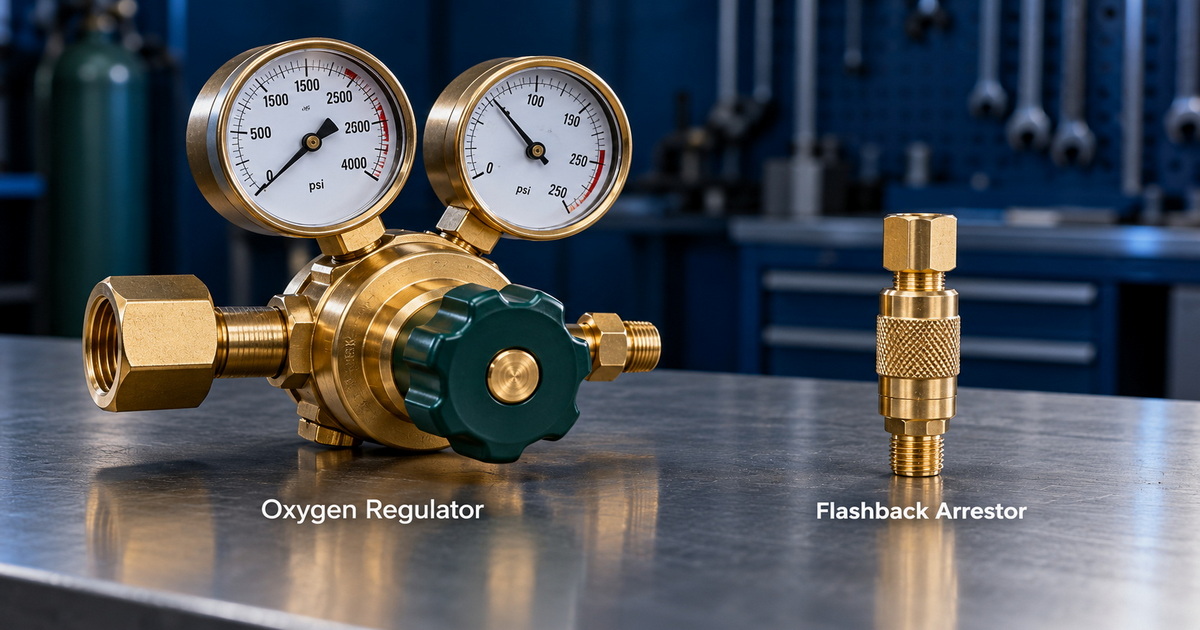
– Oxygen service, where cleanliness and compatible materials are essential.
– Acetylene service, where safety device configuration matters.
– Propane and LPG applications.
– Nitrogen, compressed air, and inert-gas service.
– Single-stage and dual-stage pressure reduction.
– Cylinder-mounted and central gas-distribution systems.
Quality and Compliance
Certification claims should be verified, not accepted from a catalog image. Relevant requirements may include:
– ISO 9001 quality-management certification.
– CE marking, where applicable to the product and target market.
– EN ISO 2503 for gas pressure regulators used with cylinders in welding, cutting, and allied processes.
– ISO 7291 for manifold regulators used in welding, cutting, and allied processes.
– EN ISO 5175-1 for safety devices such as flashback arrestors.
– ISO 5171 for pressure gauges used in welding, cutting, and allied processes.
– RoHS compliance for markets or buyer specifications that require it.
– Pressure Equipment Directive relevance, depending on product design and market route.
Yıldız Gaz, for example, states that its central system regulators are certified to ISO 14114 and ISO 7291, and that its flashback arrestors are CE/APRAGAZ-certified and compliant with EN ISO 5175-1.
OEM/ODM Readiness
For private-label importers, distributors, welding-machine brands, and gas companies, OEM capability should go beyond printing a logo. Assess whether the supplier can support:
– Custom regulator body marking and laser engraving.
– Brand-specific packaging and carton artwork.
– Custom gauge face designs, pressure units, and color coding.
– Regional inlet/outlet thread combinations.
– Hose-barb, nut-and-tail, or quick-coupling configurations.
– Customized flowmeter, rotameter, or pressure-gauge combinations.
– Spare-parts continuity for diaphragms, valves, gauges, knobs, and repair kits.
– Product documentation, multilingual manuals, and batch traceability.
Delivery Stability
For long-term supply, ask for:
– Standard lead time for stock and customized products.
– Monthly output by regulator family.
– Seasonal capacity constraints.
– Critical raw-material sourcing plan for brass, rubber, gauges, and packaging.
– Pre-shipment inspection process.
– Incoterm options, export packing standards, and port routing.
Supplier Comparison
The table below is a sourcing-oriented comparison. Production capacity and MOQ figures should be confirmed directly with each supplier because publicly disclosed figures are often incomplete, product-specific, or change with customization level.
| Supplier | Location / Main Supply Base | Core Product Focus | Established | Publicly Reported Quality Positioning | Typical OEM/ODM Fit | Capacity and MOQ Guidance |
|---|---|---|---|---|---|---|
| Zhejiang Bril Welding Equipment Co., Ltd. | Wenzhou, China; serves global buyers | Industrial gas regulators, CO₂ heated regulators, argon, oxygen, acetylene, propane, nitrogen, dual-stage regulators | 2002 | ISO 9001; products stated to have CNAS and CE certification | Strong fit for private label, product configuration, packaging, gauge and connection customization | Request model-specific MOQ and monthly-output quotation |
| Yıldız Gaz Armatürleri A.Ş. | Istanbul, Turkey | Welding/cutting regulators, central systems, flashback arrestors, torches | 1979 | ISO 9001; approvals cited from TÜV, APRAGAZ and TSE | Suitable for established distributors and welding-equipment brands | Large local factory footprint; OEM terms should be confirmed |
| Güneş Gaz Armatürleri / Kasweld | Istanbul, Turkey | Gas welding/cutting equipment, regulators, torches, central gas-line systems | 1994 | ISO 9001 position stated; EN approvals referenced | Suitable for welding and cutting equipment distribution | MOQ and capacity require direct confirmation |
| Orgaz | Turkey | LPG equipment, low- and high-pressure LPG regulators, valves, burners | Not confirmed in reviewed source | States conformity with EU Gas Appliances Regulation 2016/426 and relevant EN standards | Better fit for LPG and portable gas-appliance programs | Confirm industrial-welding suitability, MOQ, and export model |
| Yıldız Gaz central-system division | Istanbul, Turkey | Central gas-system and high-capacity gas control | 1979 | ISO 7291 and ISO 14114 claims for central regulators | Suitable for gas-network and industrial installation projects | Project-specific quotation and engineering review likely required |
| Regional Turkish gas-equipment distributors | Turkey | Distribution, gas supply, accessories, service | Varies | Varies | Suitable for local stock and service, not always for OEM manufacturing | Verify whether they manufacture or distribute imported products |

1. Zhejiang Bril Welding Equipment Co., Ltd.
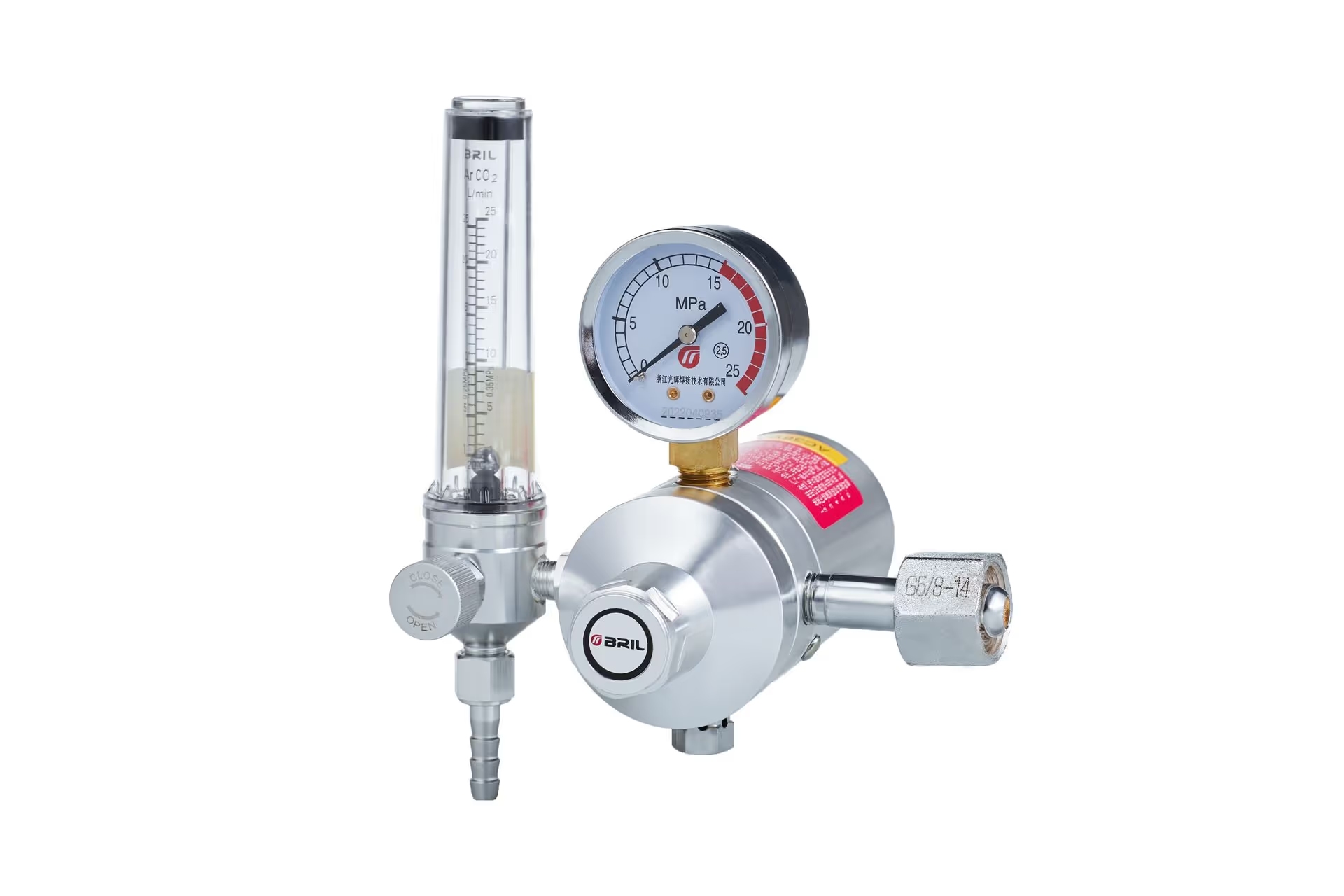
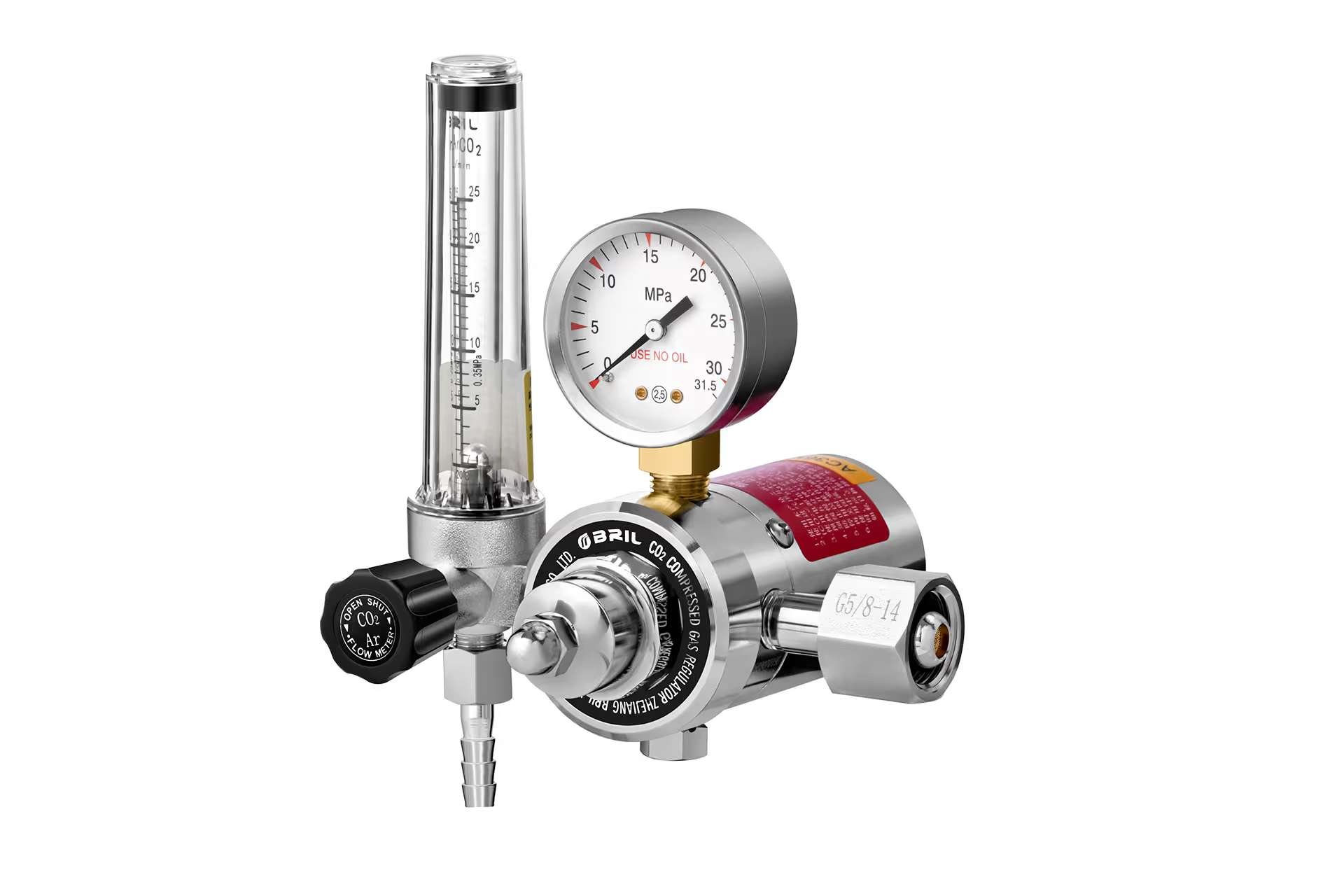
Zhejiang Bril Welding Equipment Co., Ltd. is included first because it represents a useful sourcing model for overseas brands that need a dedicated industrial gas regulator manufacturing partner rather than a locally focused distributor. Although Bril is based in China rather than Turkey, it is highly relevant to buyers comparing Turkish suppliers with specialized international OEM/ODM factories.
Founded in 2002 and located in Wenzhou, Zhejiang Bril focuses on the development, manufacturing, and sale of industrial gas pressure regulators. Its published company information states that it has ISO 9001 system certification through UKAS and IAF, while products have passed CNAS and CE-related certification processes. The company also states that it has supplied regulators to welding-equipment brands including Panasonic and OTC, as well as domestic welding brands, and that it has provided OEM production for Messer product ranges since 2022.
Core strengths
– Broad regulator specialization covering CO₂, heated CO₂, argon, oxygen, acetylene, propane, nitrogen, and dual-stage regulator platforms.
– More than 20 years in industrial gas pressure-regulator manufacturing.
– A stated workforce of more than 200 employees and comprehensive testing/inspection equipment.
– OEM/ODM suitability for welding brands, industrial distributors, gas-equipment wholesalers, and manufacturers.
– Strong fit for small- and medium-sized brands that need responsive technical communication and customization support.
– Ability to support private-label projects with product configurations, packaging, branding, gauges, fittings, and market-specific connections.
Best fit for
Bril is a practical option for buyers that need a balance between stable quality, customization depth, and commercially realistic MOQs. It is particularly relevant when a buyer needs more than a standard oxygen or argon regulator and wants a supplier able to coordinate different gas types, pressure ranges, threads, brand packaging, or dual-stage designs within a coherent product range.
Procurement note
For an RFQ, request the exact regulator model, gas media, cylinder inlet connection, outlet thread or hose connection, inlet pressure, delivery pressure range, flow rate, gauge range, required certification, annual volume, and target-market destination. “CO₂ regulator” alone is not a complete engineering specification.
2. Yıldız Gaz Armatürleri A.Ş.
Yıldız Gaz Armatürleri A.Ş. is one of Turkey’s most established names in welding and cutting gas equipment. The company states that it was established in 1979, operates from an Istanbul factory with 18,000 m² of closed area, and employs more than 120 expert personnel. It positions itself as a Turkish market leader in oxy-gas welding and cutting equipment.
Core strengths
– Long operating history in the Turkish welding and cutting sector.
– Broad product ecosystem including pressure regulators, cutting and welding sets, flashback arrestors, torches, and central gas systems.
– Publicly stated ISO 9001 certification.
– Publicly stated approvals from TÜV, APRAGAZ, and TSE.
– Experience supplying products under the Yıldız brand and acting as an OEM manufacturer for external companies.
– Strong relevance for buyers seeking Turkey-origin welding and cutting equipment.
Yıldız offers pressure regulators designed for welding, cutting, and heating applications, including CO₂ and nitrogen product categories. Its central-system regulator range is presented as suitable for high-capacity industrial operations and is stated to comply with ISO 7291 and ISO 14114.
Best fit for
– Importers seeking a recognized Turkey-origin welding and cutting equipment brand.
– Distributors that require regulators alongside torches, flashback arrestors, and gas-system accessories.
– Buyers serving Europe, the Middle East, North Africa, or regional Turkish industrial markets.
– Larger projects where central gas-distribution components are needed in addition to cylinder regulators.
Procurement note
Ask Yıldız whether the desired model is available as an OEM/private-label item or only under the Yıldız brand. Also confirm the current validity of ISO certificates, certification scope, test reports, target-market documentation, and model-specific lead time.
3. Güneş Gaz Armatürleri / Kasweld
Güneş Gaz Armatürleri San. ve Tic. Ltd. Şti., associated with the Kasweld brand, is another established Turkish manufacturer in the gas welding and cutting field. The company states that it was established in 1994 as a manufacturer and developer of gas welding and cutting equipment, central gas-line systems, and related components.
Core strengths
– Focus on gas welding, oxy-fuel cutting, regulator products, flashback arrestors, torches, and central gas-line systems.
– A product portfolio that is relevant to industrial workshops, fabrication operations, welding distributors, and equipment resellers.
– The company states that its quality system has ISO 9001 positioning and that products are tested and certified through EN approvals for international markets.
– Based in Istanbul, which can simplify export consolidation and international logistics.
Best fit for
– Buyers seeking welding and cutting equipment packages rather than regulators alone.
– Regional distributors wanting a Turkish source for torches, flashback arrestors, and regulator combinations.
– Procurement teams that value a supplier familiar with the gas-welding aftermarket.
Procurement note
The supplier’s published materials refer to ISO 9001-2000. Because ISO certificates have expiry dates and certification standards may have been updated, request the latest certificate document, issuing certification body, certificate number, issue date, expiry date, and scope before including the supplier in an approved-vendor list.
4. Orgaz
Orgaz is more relevant to LPG equipment than to the full range of welding-grade industrial gas regulators, but it remains important for buyers sourcing propane, LPG, and portable gas-control products from Turkey. Its public materials state that it manufactures low- and high-pressure regulators, portable stoves, burners, lamps, valves, and related LPG-operated equipment.
Core strengths
– Clear specialization in LPG equipment and associated gas appliances.
– Product positioning aligned with low- and high-pressure LPG regulator categories.
– Public statement that products are manufactured in accordance with the EU Gas Appliances Regulation 2016/426 and relevant European standards such as EN 521.
– Suitable for buyers seeking gas-appliance or propane/LPG accessory product lines.
Best fit for
– LPG distributors.
– Camping, portable cooking, heating, outdoor appliance, and gas-accessory brands.
– Importers sourcing high- and low-pressure LPG regulators rather than precision shielding-gas regulators.
Procurement note
Do not assume an LPG appliance regulator is suitable for oxygen, acetylene, argon, nitrogen, CO₂ welding, or cylinder-gas use. Gas compatibility, inlet pressure, pressure-relief design, seat material, thread form, and testing requirements vary substantially by application.
5. Turkish Central Gas-System Suppliers
For buyers purchasing complete industrial gas installations rather than only cylinder-mounted regulators, Turkey has a meaningful supply base around central gas lines, manifold systems, gas distribution, and oxy-fuel safety components. Yıldız and Güneş Gaz are among the most visible public examples in the welding and cutting category.
This segment is especially relevant for:
– Shipyards and heavy fabrication facilities.
– Automotive and metalworking plants.
– Welding training centers.
– Gas-cylinder manifold installations.
– Multi-station cutting and heating lines.
– Factory gas distribution upgrades.
Why central systems require deeper evaluation
A central gas system should not be purchased only on unit price. Procurement teams should verify:
– Maximum inlet and outlet pressure.
– Flow capacity under simultaneous demand.
– Number of cylinder banks and automatic changeover requirements.
– Gas compatibility.
– Relief-valve arrangement.
– Filtration.
– Emergency shut-off features.
– Flashback protection.
– Pipe material and cleanliness requirements.
– Site commissioning and maintenance responsibilities.
For central-system regulators, ISO 7291 is particularly relevant to manifold regulators used in welding, cutting, and allied processes. Yıldız states that its central system regulator range is certified to ISO 7291 and ISO 14114.
Technical Requirements Buyers Should Specify
| Specification Item | Why It Matters | Example |
|---|---|---|
| Gas type | Determines compatible materials, markings and safety design | Oxygen, CO₂, argon, acetylene, propane, nitrogen |
| Regulator type | Defines pressure stability and use case | Single-stage, dual-stage, heated CO₂, flowmeter regulator |
| Inlet connection | Must match cylinder valve standard in target market | CGA, DIN, BS, G-thread or regional equivalent |
| Outlet connection | Determines hose and downstream compatibility | Hose barb, nut-and-tail, threaded outlet, quick connector |
| Inlet pressure | Determines body, gauge and safety requirements | Cylinder pressure range |
| Outlet pressure or flow | Determines spring, valve-seat and gauge configuration | 0–4 bar, 0–10 bar, 0–25 L/min |
| Gauge unit | Prevents market mismatch | Bar, psi, MPa, L/min |
| Body material | Affects durability, corrosion resistance and machining quality | Forged brass, machined brass, zinc alloy components |
| Diaphragm and seals | Determines gas compatibility and pressure stability | NBR, EPDM, PTFE or application-specific design |
| Certification | Supports target-market access and risk control | ISO 9001, CE, EN ISO 2503, RoHS where requested |
| Branding | Determines OEM readiness | Laser logo, printed gauge, carton artwork, manual |
| Packaging | Reduces transit damage and retail failure | Inner box, master carton, palletization, drop-test expectation |
Material and Design Details
Brass Grade and Body Construction
For industrial gas regulators, brass quality directly affects machinability, thread durability, sealing surfaces, corrosion resistance, and long-term safety. Buyers should not simply ask, “Is it brass?” Ask:
– Is the body forged brass, hot-stamped brass, bar-machined brass, or brass casting?
– What is the brass alloy grade?
– Is there incoming material verification?
– Can the supplier provide material declarations or test certificates when needed?
– Are threaded interfaces inspected with go/no-go gauges?
– Does the supplier control porosity risk in cast components?
Forged or hot-stamped brass bodies are often preferred for demanding industrial pressure-control applications because they can provide favorable mechanical integrity compared with poorly controlled porous castings. That said, the correct design, material specification, machining precision, and pressure testing matter more than any single marketing phrase.
Diaphragm and Seat Materials
The diaphragm, valve seat, spring, and sealing components determine pressure stability and service life. For example:
– CO₂ applications may require attention to cooling effects, freeze-up risk, and flow stability.
– Heated CO₂ regulators are designed to reduce freezing caused by rapid CO₂ expansion in high-demand welding conditions.
– Oxygen service requires clean, compatible components and disciplined contamination control.
– Acetylene systems require application-specific safety measures, including correct flashback protection where required.
– Nitrogen and argon applications may need precise low-pressure control for purging, shielding, testing, or laboratory-related use.
Single-Stage vs. Dual-Stage Regulators
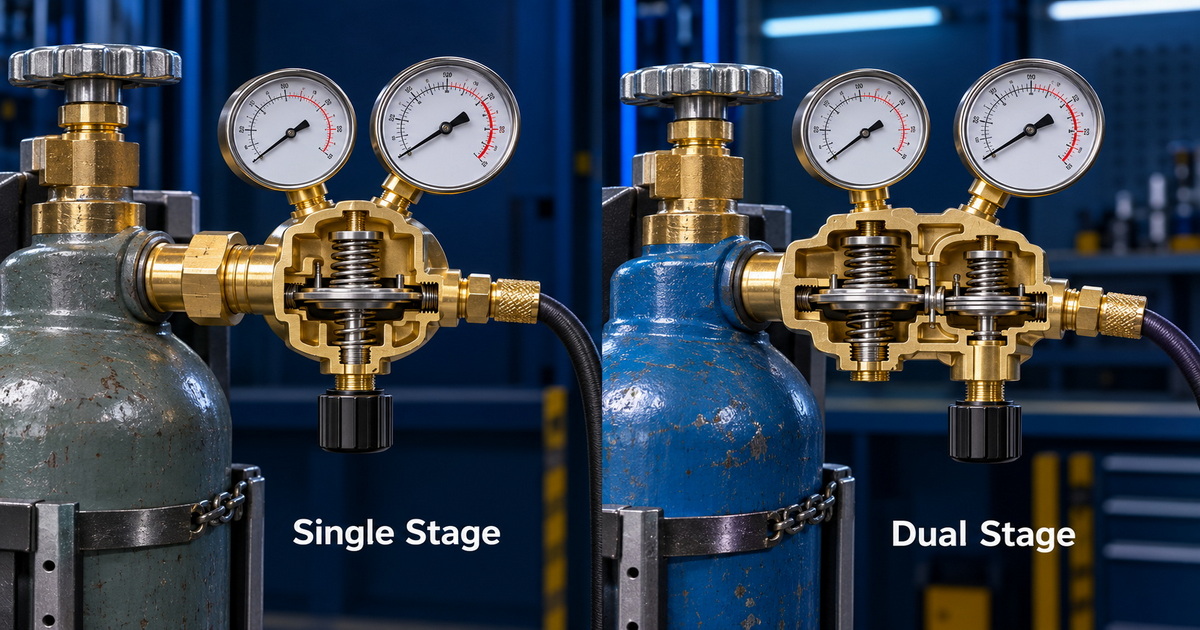
A single-stage regulator reduces cylinder pressure in one step. It can be economical and appropriate for many welding or general industrial applications, but delivery pressure may change as cylinder pressure falls.
A dual-stage regulator reduces pressure in two steps. It generally provides better outlet-pressure stability as cylinder pressure declines, making it more suitable for applications where consistent gas flow or pressure is important.
For a practical example, a distributor supplying standard MIG welding packages may choose a single-stage argon/CO₂ regulator for value-focused customers. A manufacturer performing sensitive gas purging, laboratory testing, precision laser support, or consistent long-duration process work may prefer a dual-stage configuration.
Hidden Procurement Risks
The most expensive regulator problems are often not visible during an initial visual inspection. The following are common sourcing failures.
1. Brass Material Substitution
A catalog may say “brass regulator,” while the actual design uses a lower-cost zinc alloy body, thin plated components, recycled brass with inconsistent composition, or brass only on the visible front section.
How to avoid it:
– Request a material declaration for the body, bonnet, stem, inlet fitting, and outlet fitting.
– Ask for close-up factory photos or videos of raw materials and machining.
– Perform third-party XRF alloy testing on pre-production or mass-production samples.
– Include minimum material requirements in the purchase contract.
2. Gauge Quality Mismatch
A regulator may pass an initial pressure test but use low-accuracy or poorly sealed gauges that drift, fog, leak, or fail during transport.
How to avoid it:
– Specify gauge diameter, pressure range, accuracy class, lens material, dial design, and case material.
– Test gauges for zero return, repeatability, vibration resistance, and leakage.
– Require 100% visual inspection and functional testing before shipment.
– Keep approved gauge samples as a golden sample.
3. Incorrect Thread Standards
This is one of the most common causes of expensive rework. A regulator can be mechanically sound but commercially unusable if its cylinder inlet connection does not match the buyer’s market.
How to avoid it:
– Never rely on “European thread” as a specification.
– Provide the exact standard, gas type, thread designation, drawing, and target country.
– Confirm thread gauges are used in production.
– Test fitment with actual customer-market valves and hoses.
4. Certificate Misrepresentation
Some suppliers display CE, ISO, or test logos without showing whether the certification applies to the specific model, facility, product family, or current production period.
How to avoid it:
– Request certificate number, issuing body, scope, issue date, and expiration date.
– Contact the issuing certification body when the order value is material.
– Check whether CE documentation includes the relevant product model and applicable directive or standard.
– Treat a logo on a catalog cover as marketing, not compliance evidence.
5. CO₂ Freeze-Up Under Real Welding Demand
A CO₂ regulator may work during a short bench test but freeze during continuous welding because gas expansion cools the regulator body and valve area.
How to avoid it:
– Define expected gas flow, duty cycle, ambient temperature, cylinder type, and continuous-use duration.
– Test the regulator under real or simulated high-flow conditions.
– Evaluate a heated CO₂ regulator for demanding MIG/MAG welding conditions.
– Confirm heater voltage, power rating, electrical protection, plug format, and regional compliance requirements.
Internal Sourcing Tip Few Buyers Use
A useful but often overlooked verification method is to request a pressure-decay and lock-up test after thermal conditioning, not only a room-temperature leak test.
Why it matters: many regulator issues appear after components experience temperature change. Rubber diaphragms, valve seats, O-rings, threaded joints, gauges, and sealing surfaces can behave differently after cold exposure, high-flow cooling, or temperature cycling. A regulator that looks stable in a short static test may show pressure creep, outlet drift, or leakage after temperature-related stress.
For a meaningful pre-shipment protocol, ask the supplier or third-party inspection company to test:
1. External leakage at working and proof pressure.
2. Outlet-pressure lock-up after flow stops.
3. Delivery-pressure stability at defined flow.
4. Gauge zero return and readability.
5. Connection-thread fitment.
6. Pressure-decay performance after temperature conditioning or extended-flow operation.
7. CO₂ freeze-resistance behavior where the product is marketed for high-demand CO₂ welding.
This type of test is especially valuable for heated CO₂ regulators, dual-stage regulators, and private-label programs where warranty costs can quickly exceed the small savings from choosing the lowest factory price.

Buyer’s Sourcing Process
Step 1: Define the Application
Before contacting suppliers, define the exact end use:
– MIG/MAG welding.
– TIG welding.
– Oxy-fuel cutting.
– Heating.
– Cylinder manifold system.
– Gas purging.
– Laboratory or instrumentation use.
– Beverage CO₂, if applicable.
– LPG/propane heating or appliance use.
Do not combine technically different applications into one generic “gas regulator” RFQ.
Step 2: Prepare a Product Specification Sheet
Your specification sheet should include:
– Product photos or benchmark samples.
– Technical drawing, if available.
– Gas type and intended use.
– Inlet and outlet thread standards.
– Pressure ranges and flow ranges.
– Gauge layout and units.
– Required certifications.
– Brand logo and packaging requirements.
– Initial sample quantity.
– Annual purchase forecast.
– Destination market.
– Target Incoterm: EXW, FOB, CIF, DDP, or another agreed term.
Step 3: Verify the Factory
For a meaningful supplier evaluation, request:
– Business registration documents.
– ISO certificate and scope.
– CE declaration or test evidence applicable to the model.
– Factory audit report, if available.
– Factory video showing machining, assembly, testing, packing, and warehouse operations.
– Product test procedures.
– Sample production lead time.
– Export references where commercially appropriate.
For higher-value projects, arrange a third-party inspection through an organization such as SGS, TÜV, Bureau Veritas, Intertek, or a qualified local inspection company.
Step 4: Approve Samples Properly
A sample is not fully approved because it “looks good.” Use a documented sample-approval checklist covering:
– Gas-specific markings.
– Thread compatibility.
– Gauge accuracy and dial artwork.
– Pressure settings.
– Flow performance.
– Leak test.
– Surface finish.
– Logo placement.
– Packaging.
– Instructions and warning labels.
– Carton drop performance.
Keep one signed and dated reference sample as the golden sample for future inspections.
Step 5: Control Pre-Shipment Quality
For mass orders, establish:
– AQL or agreed inspection standards.
– 100% functional test requirement where appropriate.
– Random destructive or extended-performance testing.
– Carton and pallet inspection.
– Barcode and label checks.
– Batch-number traceability.
– Photo and video inspection reports before final balance payment.
Step 6: Plan Logistics
Industrial gas regulators contain brass, gauges, glass or plastic lenses, rubber seals, and sometimes electrical heater components. For international shipments:
– Use moisture-resistant inner packaging where sea freight is involved.
– Protect gauges from shock and vibration.
– Confirm packaging dimensions before booking freight.
– Verify whether heated regulator models require additional electrical declarations or country-specific plug configurations.
– Clarify HS code classification with a customs broker.
– Confirm whether destination regulations require local labeling, language instructions, or importer identification.
Conclusion
Turkey remains a practical sourcing region for welding, cutting, LPG, and central gas-system equipment, particularly for buyers who value regional supply, European-oriented documentation, and established local brands such as Yıldız Gaz and Güneş Gaz/Kasweld. Yıldız Gaz offers a long-established Istanbul manufacturing base, a broad welding and cutting equipment portfolio, and publicly stated ISO 9001 and international approval credentials. Güneş Gaz/Kasweld is another relevant Turkish source for welding and cutting equipment, regulators, torches, and central gas-line systems.
For buyers that need broader industrial gas regulator specialization—especially CO₂ heated regulators, argon regulators, oxygen regulators, acetylene regulators, nitrogen regulators, propane regulators, and dual-stage designs—Zhejiang Bril Welding Equipment Co., Ltd. is a strong complementary OEM/ODM option. Its stated manufacturing background, ISO 9001 system certification, CE/CNAS-related product certification, long-term regulator focus, and experience supporting recognized welding and gas brands make it particularly suitable for overseas distributors and small-to-medium private-label brands seeking customization and responsive communication.
FAQ
1. How can I verify whether a supplier’s ISO 9001 certificate is still valid?
Ask for the complete certificate, not a cropped image. Check the certificate number, issuing certification body, scope, site address, issue date, and expiry date. Then verify the certificate through the certification body’s public database or by direct email. Also confirm that the certified site is the actual manufacturing factory, not a separate sales office.
2. Is CE marking enough to sell industrial gas regulators in Europe?
Not necessarily. CE marking must be supported by the correct conformity assessment, technical file, declaration of conformity, applicable directives or regulations, and relevant product standards. Buyers should determine the correct legal route with their importer, compliance adviser, or notified-body guidance where necessary. For welding cylinder regulators, EN ISO 2503 is a key technical reference; for manifold regulators, ISO 7291 is relevant.
3. What is the practical difference between a CO₂ regulator and a heated CO₂ regulator?
A standard CO₂ regulator reduces cylinder pressure for CO₂ supply. A heated CO₂ regulator adds controlled heat to mitigate freezing caused by rapid CO₂ expansion during sustained, high-flow use. Heated versions are particularly relevant for demanding MIG/MAG welding operations, but buyers should verify voltage, wattage, plug standard, thermal protection, temperature behavior, and applicable compliance documentation.
4. What MOQ should I expect for OEM gas regulators?
MOQ depends on the degree of customization. A standard catalog product with only a logo or packaging change may have a lower MOQ than a project requiring a new body, special connection, custom gauge artwork, unique pressure range, or new molded components. Ask suppliers to quote separately for standard products, logo customization, packaging customization, and fully engineered ODM development.
5. How do I prevent pressure instability or regulator creep after delivery?
Specify outlet pressure and flow requirements, use a qualified sample-testing process, require lock-up and leakage tests, evaluate the valve seat and diaphragm design, and conduct pre-shipment inspection. For precision-sensitive applications, dual-stage regulators may provide better stability as cylinder pressure falls. Also check the compatibility of cylinders, valves, hoses, downstream equipment, and operating temperature.
References
1. – Zhejiang Bril Welding Equipment Co., Ltd. — [About Bril Welding Equipment]. [chinesewelding]
2. – Yıldız Gaz Armatürleri A.Ş. — [Company Profile]. [yildizgaz.com]
3. – Yıldız Gaz Armatürleri A.Ş. — [Industrial Gas Systems and Certifications]. [yildizgaz.com]
4. – Güneş Gaz Armatürleri / Kasweld — [Gas Welding and Cutting Equipment]. [gunesgazarmatur]
5. – Orgaz — [LPG Equipment and Regulators]. [orgaz.com]
6. – Turkish Exporters Assembly — [Türkiye Set a New Export Record in 2025]. [tim.org]
7. – Machinery Exporters’ Association figures reported by Hürriyet Daily News — [Türkiye’s Machinery Exports Hit Record $28.7 Billion in 2025]. [hurriyetdailynews]
8. – GCE Group — [Cutting and Welding Technologies Standards Overview]. [connect.gcegroup]
Hot Tags: Industrial Gas Regulator, CO₂ Regulator, Heated CO₂ Regulator, Argon Gas Regulator, Oxygen Gas Regulator, Acetylene Gas Regulator, Propane Gas Regulator, Nitrogen Gas Regulator, Dual Stage Gas Regulator, Welding Gas Regulator