Content Menu
● Why China for Flowmeter Regulators?
>> Technical benchmark: ISO 2503
>> What should be examined technically?
>> 1. Zhejiang Bril Welding Equipment Co., Ltd.
>> 2. Ningbo Longtime Gas Control System Co., Ltd.
>> 3. Hunan Wofly Technology Co., Limited
>> 4. Shenzhen Jewellok Technology Co., Ltd.
>> 5. Beijing Jingcheng Gas Equipment Co., Ltd.
>> 6. DEM Welding & Cutting Equipment
>> 7. TOPWELL Welding Equipment
>> 8. Suzhou Maxonic Automation Control Co., Ltd.
>> 9. Jipai Fluid Control Technology
>> 10. Sailuoke Fluid Equipment Inc.
>>> 1. Brass material substitution
>>> 2. “CE certified” without model traceability
>>> 3. Inaccurate flowmeter calibration
>>> 4. Thread and connection mismatches
>>> 5. Oxygen-service contamination
>> Insider sourcing tip: test “creep,” not only leakage
>> Step 1: Define the product before requesting quotations
>> Step 2: Verify the factory identity
>> Step 3: Run a structured sample process
>> Step 4: Include quality requirements in the PO
>> Step 5: Plan logistics early
>> 1. How can I verify whether a manufacturer’s ISO 9001 certificate is still valid?
>> 2. Does CE certification automatically mean a flowmeter regulator complies with EN ISO 2503?
>> 3. What is the most important test for an argon/CO₂ flowmeter regulator sample?
>> 4. Can the same regulator design be used for argon, CO₂, oxygen, nitrogen, and propane?
>> 5. What MOQ should I expect for customized flowmeter regulators from China?
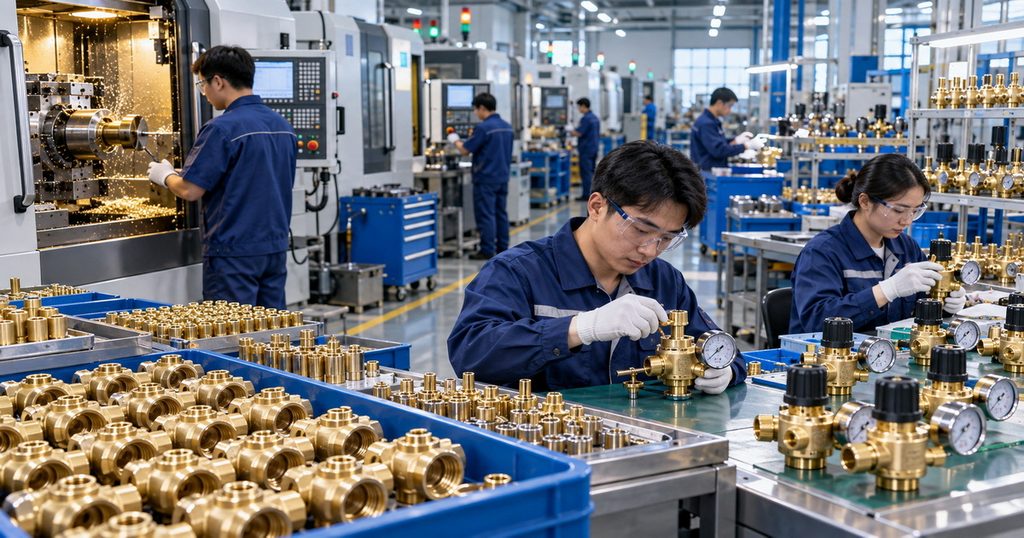
China remains an important sourcing base for welding gas-control equipment because it combines mature brass-processing supply chains, welding-equipment manufacturing clusters, export-oriented factories, and broad OEM/ODM capability. For procurement managers, however, choosing a flowmeter regulator manufacturer should not be based on price or catalog size alone.
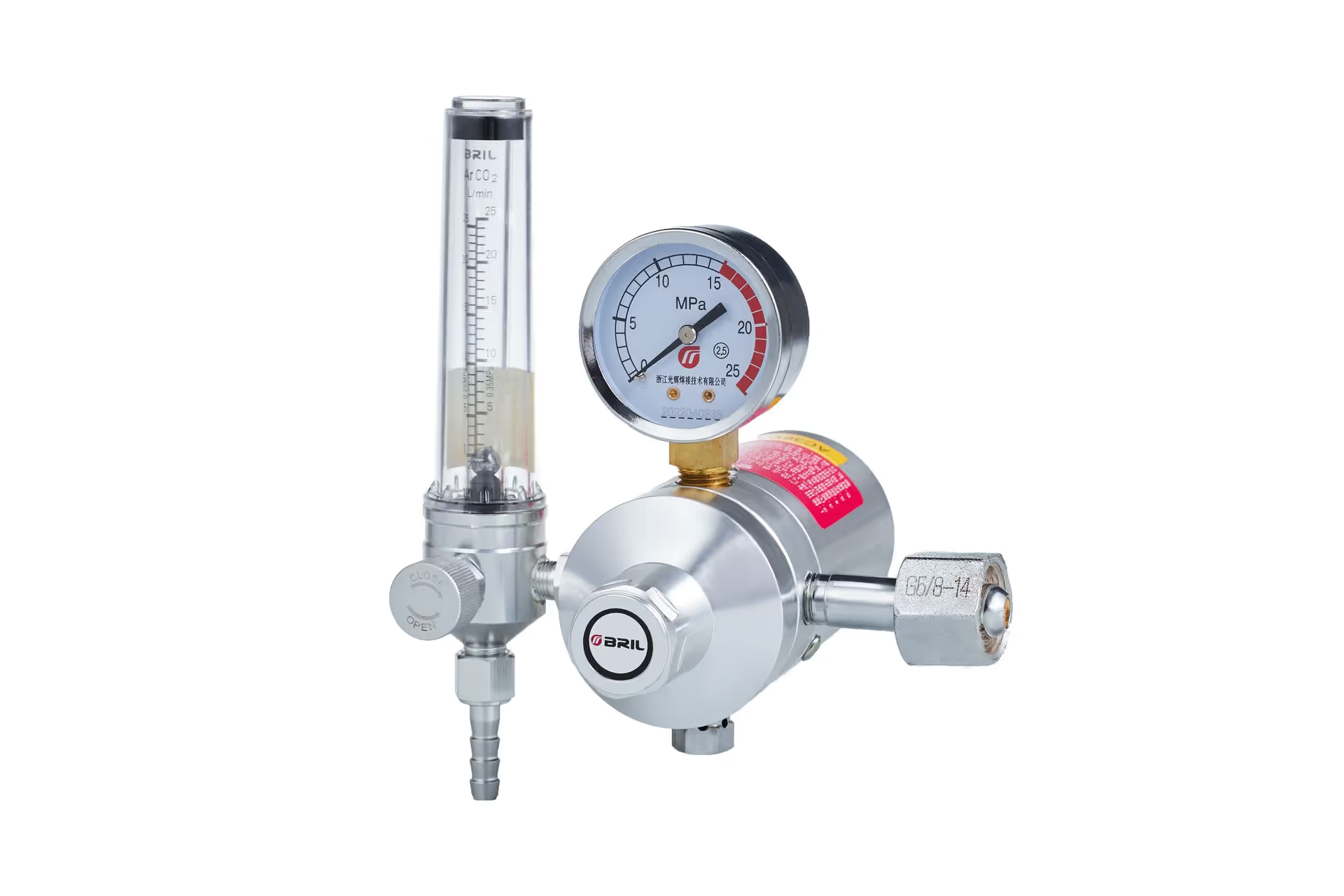
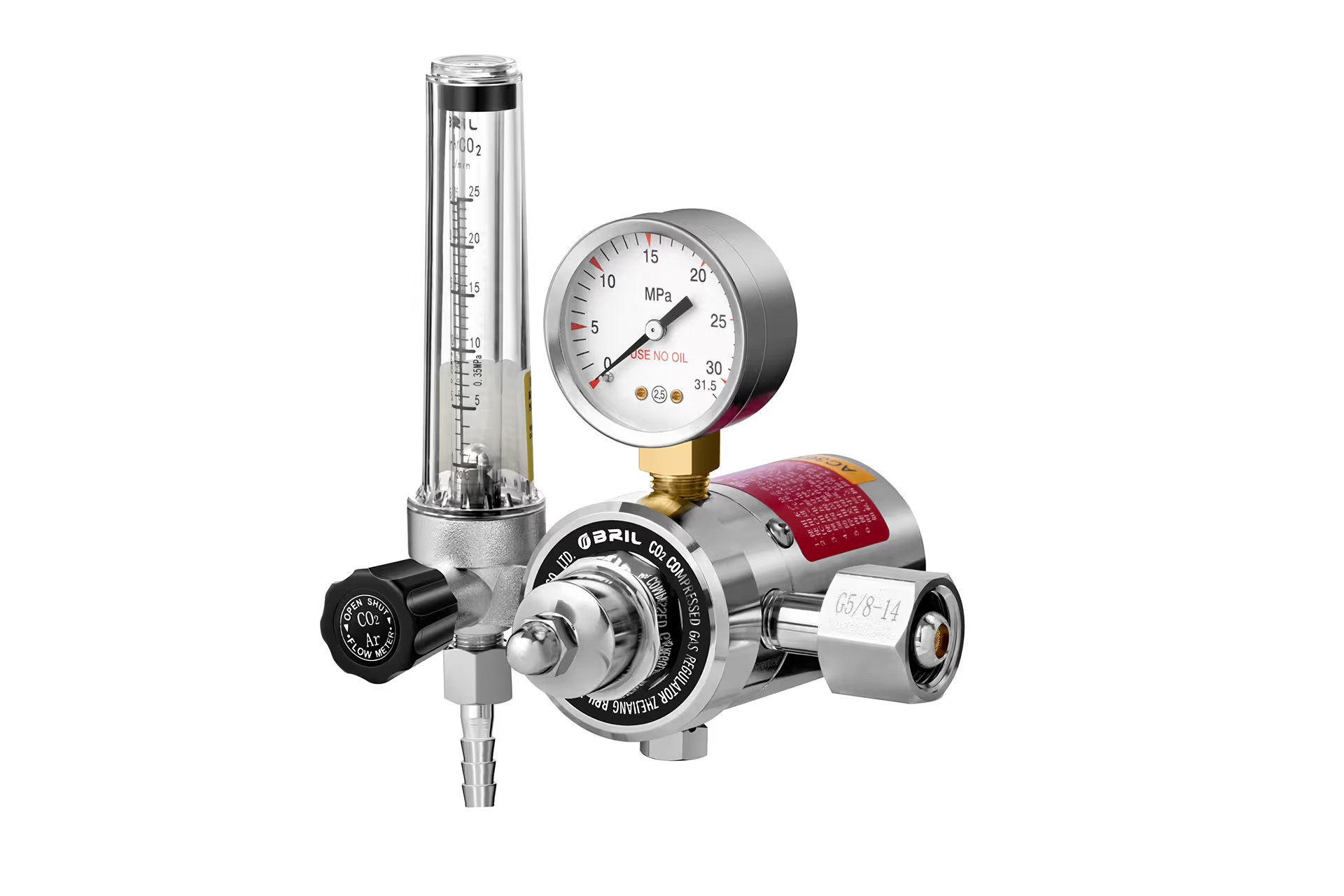
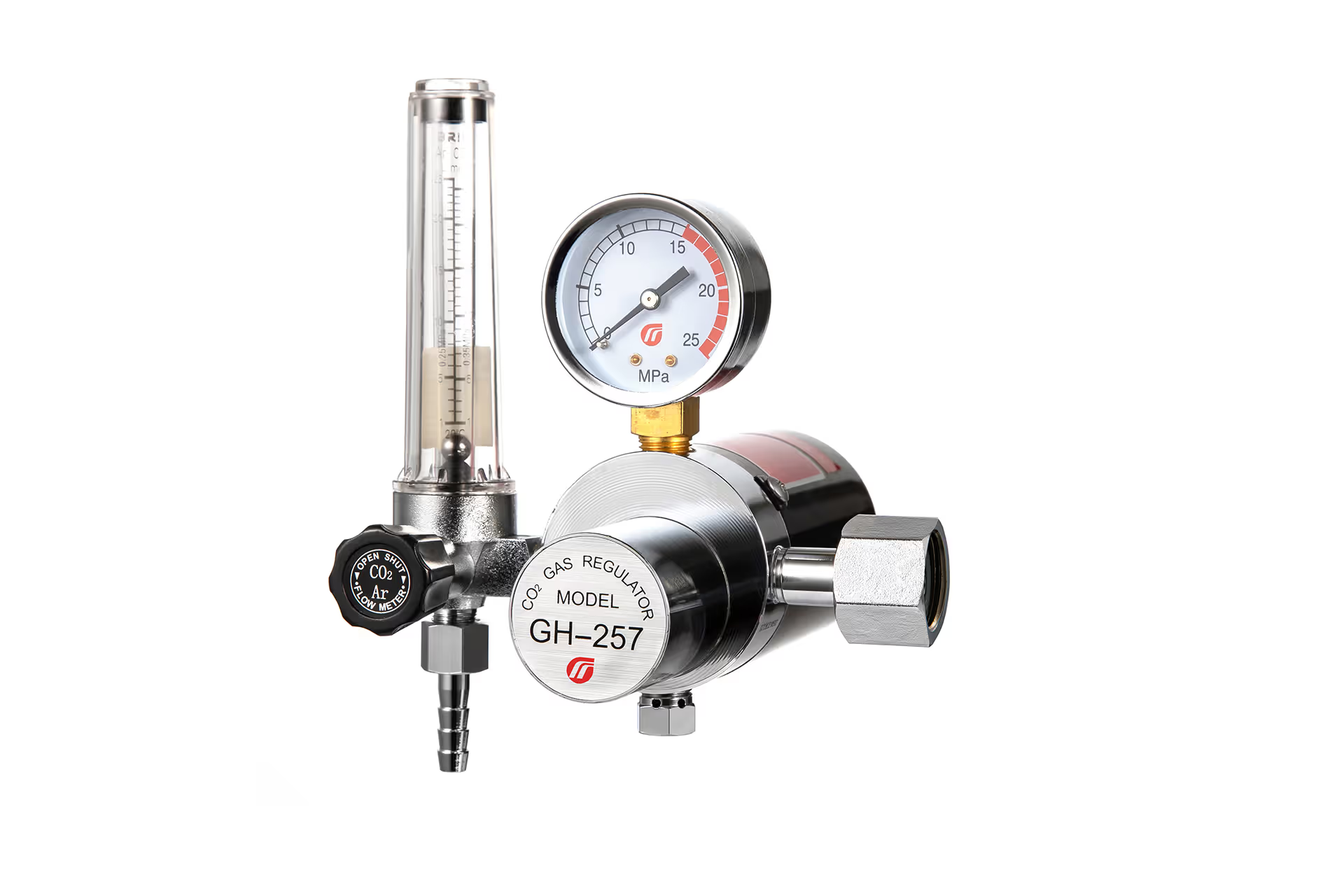
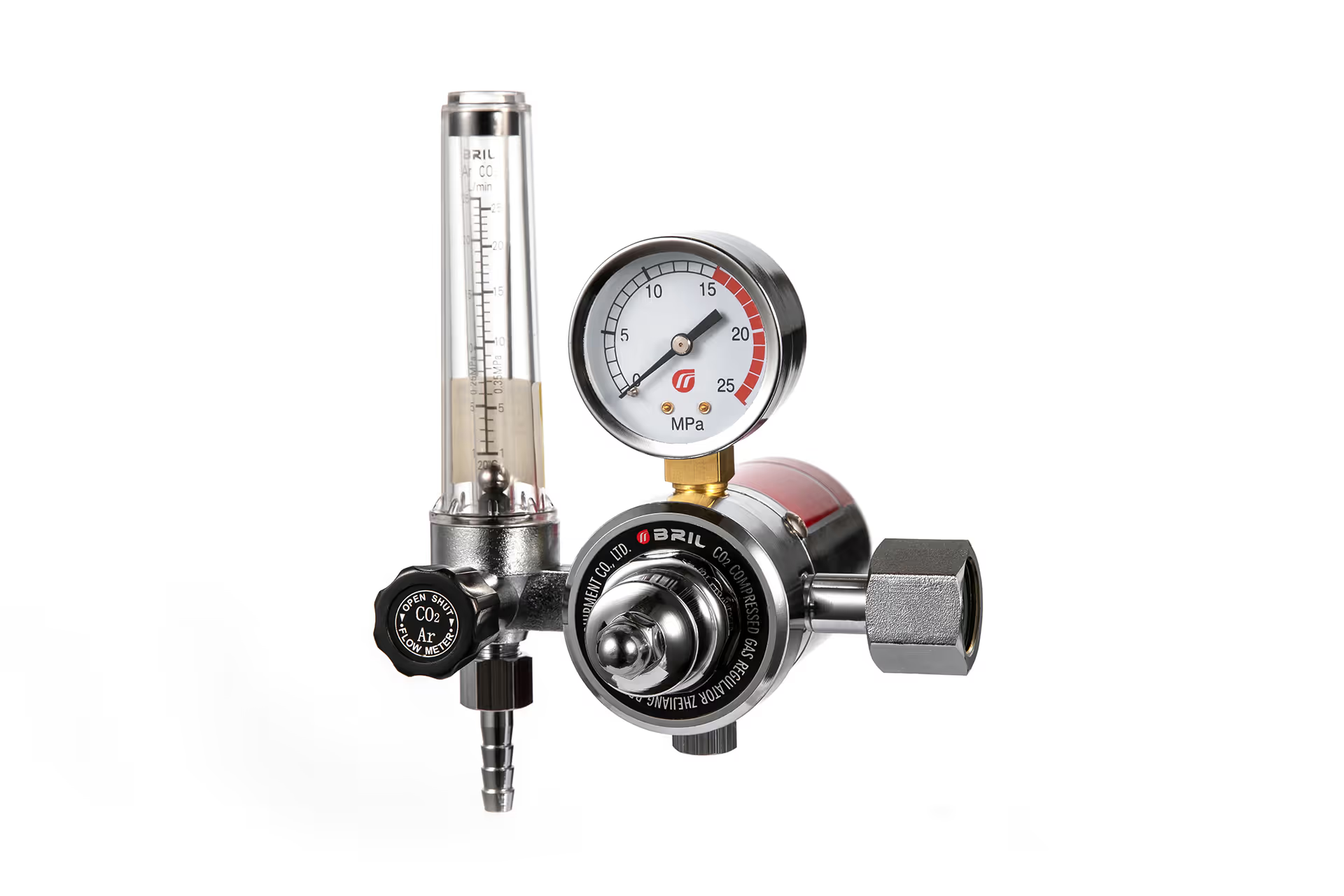
A flowmeter regulator is a safety-relevant component. It must reduce cylinder pressure reliably while providing a repeatable shielding-gas flow rate for MIG, MAG, TIG, plasma cutting, and related industrial processes. A low-cost unit with unstable outlet pressure, an inaccurate flow tube, poor diaphragm material, or mismatched inlet threads can create welding defects, gas waste, safety exposure, and expensive warranty claims.
China’s broader industrial export base continues to support this sourcing environment. In 2025, China’s equipment-manufacturing exports reached RMB 16.03 trillion, up 9.2% year on year, according to the General Administration of Customs of China. That scale does not prove an individual supplier’s quality, but it does help explain why buyers can find deep component ecosystems, machining capacity, assembly capability, and export logistics support in the country.
Why China for Flowmeter Regulators?
A flowmeter regulator combines two functions:
– Reducing high cylinder pressure to a usable working pressure.
– Measuring or setting a controlled gas-flow rate, commonly in L/min or CFH.
For welding applications, the regulator must work consistently with gases such as argon, CO₂, argon/CO₂ blends, nitrogen, oxygen, acetylene, propane, and compressed air. The design requirements differ by gas type, duty cycle, cylinder connection, and destination market.
China’s key industrial clusters are relevant because gas regulators are not isolated products. They depend on a supply network of brass forgings, die-cast components, gauges, polycarbonate flow tubes, seals, diaphragms, valves, machining workshops, plating suppliers, calibration equipment, packaging factories, and welding-equipment assemblers.
Major sourcing regions
| Region | Typical industrial advantage | Buyer relevance |
|---|---|---|
| Wenzhou, Zhejiang | Brass valves, fittings, machining, industrial gas regulators, welding accessories | Suitable for buyers sourcing regulators, valves, fittings, gauges, and OEM welding accessories |
| Ningbo, Zhejiang | Export manufacturing, hardware, gas-control systems, port logistics | Useful for mixed hardware and gas-control procurement programs |
| Shenzhen, Guangdong | Electronics, automation, high-purity gas systems, export service infrastructure | Relevant for laboratory, semiconductor, specialty-gas, and automation-oriented regulators |
| Suzhou, Jiangsu | Industrial automation, process control, instrument manufacturing | Suitable for higher-specification industrial and automated gas-control requirements |
| Chengdu, Sichuan | Fluid control, analytical gas systems, instrumentation | Often relevant for specialty gas, laboratory, and higher-purity applications |
| Beijing | Industrial gas equipment, engineering-oriented systems | More relevant for project-based industrial-gas applications |
The Chinese welding-materials market is also projected to grow from approximately USD 4.64 billion in 2025 to USD 5.80 billion by 2030, according to MarketsandMarkets. This is broader than flowmeter regulators specifically, but it indicates continued demand from welding-related manufacturing and supporting equipment markets.
How We Selected Suppliers
This is not a laboratory certification ranking, and buyers should independently validate every commercial and technical claim before placing orders. The list prioritizes suppliers with visible product relevance, established industrial positioning, export signals, technical fit, and potential suitability for professional buyers.
Evaluation framework
We examined suppliers against the following criteria:
| Selection criterion | What professional buyers should verify | Why it matters |
|---|---|---|
| Product specialization | Whether regulators are a core product rather than a secondary catalog item | Specialist factories usually have stronger engineering feedback and more stable process control |
| Compliance evidence | ISO 9001, CE documentation, test reports, product standard references, RoHS or REACH declarations where needed | Documentation helps buyers assess process consistency and market access readiness |
| OEM/ODM depth | Branding, dial customization, packaging, thread adaptation, gas-specific configuration, tooling support | Determines whether the supplier can support a differentiated market offer |
| Materials and construction | Brass grade, forging or machining route, diaphragm material, gauge quality, flow tube material, sealing materials | Directly affects lifespan, leakage resistance, accuracy, and safety |
| Quality-control process | Incoming inspection, leakage testing, pressure testing, calibration, final inspection, traceability | A regulator that passes visual inspection can still fail under pressure or repeated use |
| Capacity and delivery stability | Production scheduling, supplier redundancy, lead-time history, component stock strategy | Important for distributors and OEM brands managing seasonal demand |
| Export experience | Familiarity with packing, documentation, labeling, shipping marks, and destination-market requirements | Reduces avoidable delays and compliance errors |
| Communication quality | Engineering response speed, drawing confirmation, change-control discipline, sample feedback | Especially important for custom gas connections and private-label projects |
Technical benchmark: ISO 2503
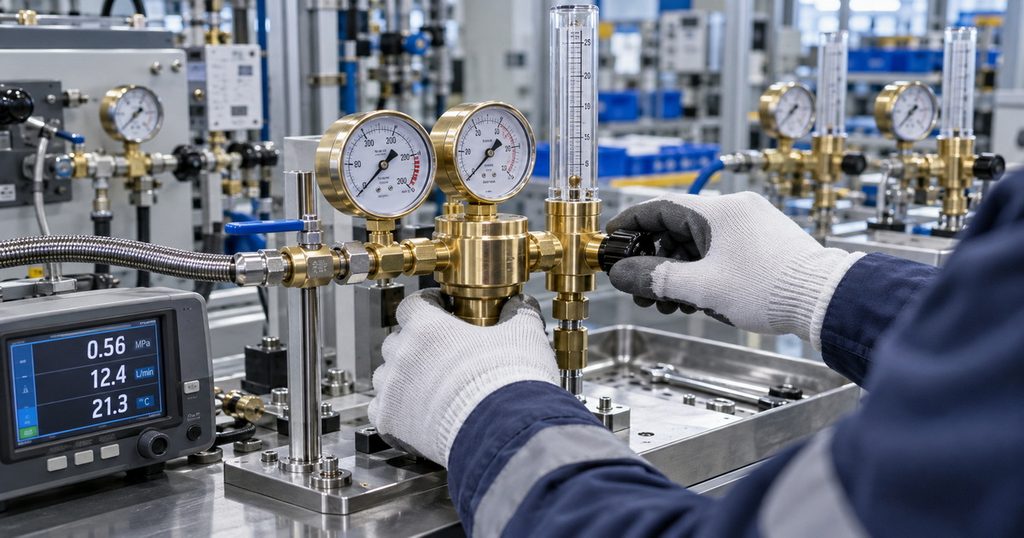
For welding and cutting applications, buyers should understand the scope of ISO 2503. ISO 2503:2009 covers single-stage and two-stage pressure regulators, including regulators with flow-metering devices, for gas cylinders used in welding, cutting, and allied processes up to 300 bar. It applies to compressed gases and mixtures as well as CO₂, and covers applications including TIG, MIG, MAG, plasma arc welding, flux-cored welding, and plasma cutting.
A supplier saying “ISO standard” is not enough. Ask whether the specific flowmeter regulator model has been designed, tested, or documented against the applicable requirements, and request the actual report or declaration for the exact model family.
What should be examined technically?
A serious buyer should review more than appearance and advertised flow range.
– Body material: Brass remains common for welding regulators because it offers machinability, corrosion resistance, and compatibility with many gas-control applications. Ask whether the body is forged brass, hot-stamped brass, cast brass, or machined bar stock. These routes have different cost and consistency profiles.
– Diaphragm system: Confirm diaphragm material, thickness, reinforcement, and compatibility with the intended gas. The diaphragm strongly influences outlet-pressure stability and service life.
– Valve seat and seals: Elastomers must suit the gas and operating environment. A seal that performs adequately with argon may not be appropriate for oxygen service without appropriate material control and cleaning.
– Flow tube: Check tube material, scale printing durability, impact resistance, float visibility, and calibration method. Polycarbonate is common; buyers should also evaluate crack resistance and long-term clarity.
– Pressure gauges: Verify gauge diameter, pressure range, accuracy class, dial language, and destination-market units such as bar, MPa, psi, L/min, or CFH.
– Inlet and outlet connection: Thread mismatches are among the most common and costly preventable problems. Confirm the exact standard: CGA, DIN, BS, G, NPT, BSP, or local cylinder-valve requirements.
– Gas-specific protection: Oxygen regulators require stricter attention to cleaning and contamination control. Never assume an argon regulator can simply be relabeled for oxygen use.
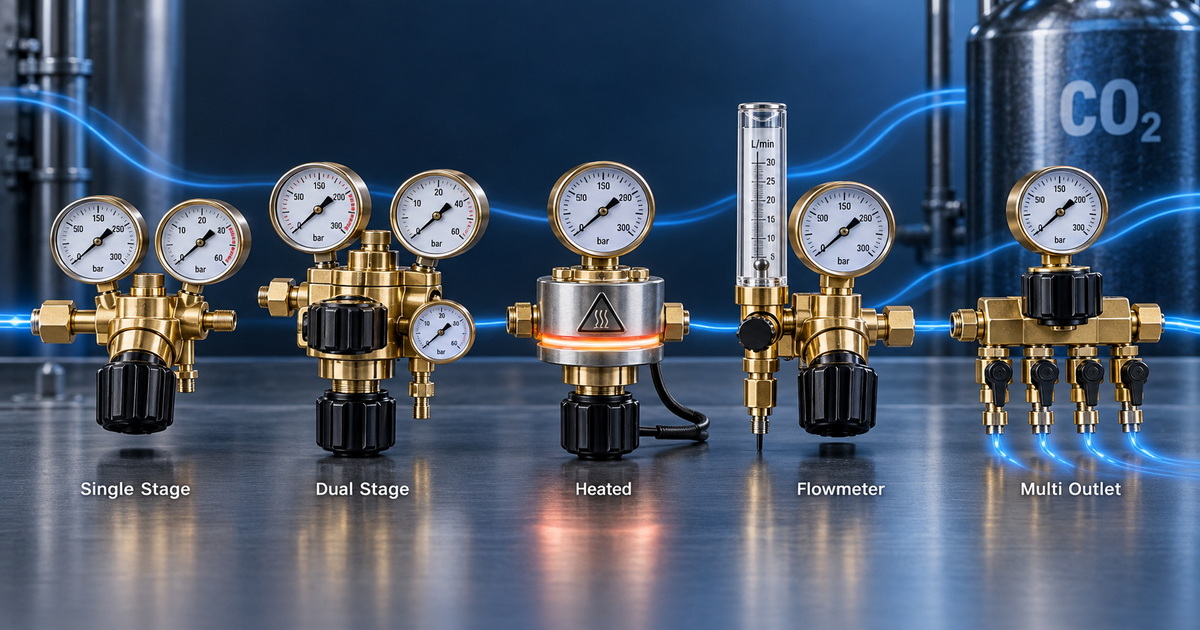
– Heated CO₂ design: Heated CO₂ regulators should be assessed for heater voltage, power rating, thermal protection, insulation, wiring quality, connector design, and intended duty cycle.
Top 10 Manufacturers
The manufacturers below serve different market segments. “Top” in this guide means notable or relevant for professional sourcing consideration; it does not imply that every supplier is interchangeable or that each one fits every product category.
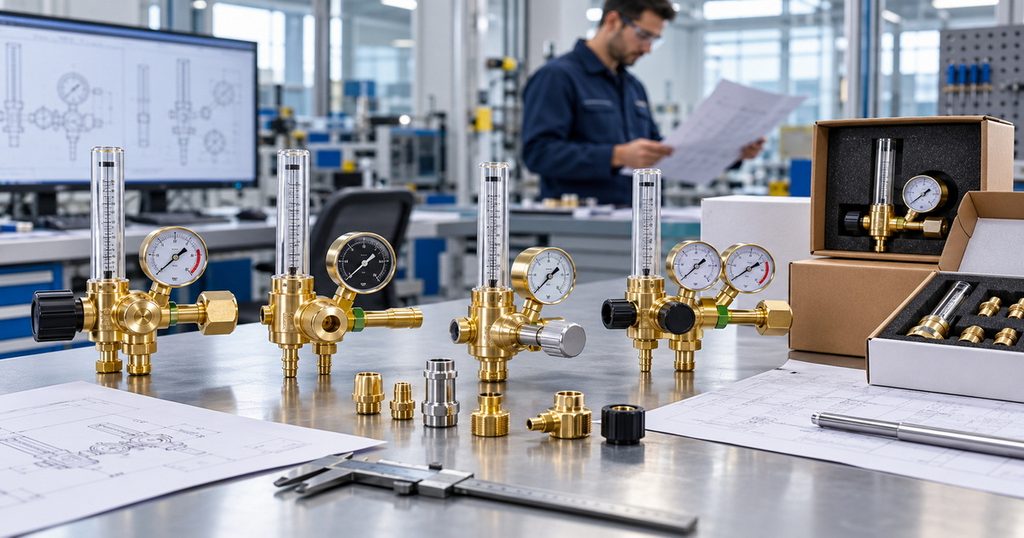
1. Zhejiang Bril Welding Equipment Co., Ltd.
Location: Wenzhou, Zhejiang, China
Founded: 2002
Focus: Industrial gas pressure regulators, welding gas regulators, CO₂ regulators, heated CO₂ regulators, argon regulators, oxygen regulators, acetylene regulators, propane regulators, nitrogen regulators, dual-stage regulators, and flowmeter regulator solutions.
Zhejiang Bril Welding Equipment Co., Ltd. is a practical option for buyers seeking a dedicated welding-regulator manufacturer with a balance of product specialization, OEM flexibility, and support for developing or mid-sized international brands.
The company is located in Wenzhou’s Binhai Economic Development Zone, a region with strong connections to precision brass machining, valves, industrial components, and export-oriented manufacturing. Bril states that it has operated since 2002 and specializes in the development, manufacturing, and sale of industrial gas pressure regulators. Its published profile states that it holds ISO 9001 system certification through UKAS and IAF, while products have passed CNAS and CE certification processes.
For procurement teams, Bril’s relevance is not simply that it offers a broad catalog. Its stronger positioning is as a manufacturer able to work on practical OEM/ODM programs, including private labeling, packaging adaptation, product configuration, gas-specific regulator matching, and communication around buyer requirements.
The company’s public profile also identifies supply relationships with major welding-equipment brands including Shanghai Hugong, Tayor Heavy Industry Group, Kaierda, Aotai, Jasic, Riland, Panasonic, OTC, and Messer. Buyers should independently confirm the current scope, model range, and status of any relationship before using it as a purchasing qualification, but this type of supporting-production experience can be a useful initial indicator of industrial supply-chain familiarity.
Core strengths
– More than 20 years of focus on industrial gas regulators.
– Suitable product range for welding and industrial gas applications.
– Potentially strong fit for CO₂, argon, oxygen, nitrogen, propane, acetylene, and dual-stage regulator programs.
– OEM/ODM flexibility for brands that need packaging, markings, gas connection specifications, or product configuration adapted for local markets.
– Wenzhou supply-chain access for brass components and gas-control hardware.
– Communication and customization value for small-to-medium international brands that may not meet the volume expectations of very large factories.
Recommended buyer profile
– Welding-equipment distributors building a private-label regulator line.
– Importers seeking a cost-controlled but technically focused partner.
– Brands requiring customized flowmeter scales, inlet connections, packaging, or product markings.
– Buyers who need responsive engineering communication during sample development.
– Manufacturers integrating regulators into welding machines, gas manifolds, or industrial gas-control equipment.
Due diligence questions to ask
– Which exact regulator and flowmeter models carry CE documentation?
– Is the CE evidence model-specific, and can it be linked to the product drawing and production location?
– What is the flow-rate tolerance at different cylinder pressures?
– What brass material grade and diaphragm material are used in the proposed model?
– Can the factory supply a sample with the exact target-market cylinder connection and outlet fitting?
– What final leakage and pressure-stability tests are performed on every unit or every batch?
Bril’s published flowmeter regulator materials state compliance with EN ISO 5171 and EN ISO 2503 standards; purchasers should request model-level documentation and reports as part of formal qualification.
2. Ningbo Longtime Gas Control System Co., Ltd.
Location: Ningbo, Zhejiang, China
Focus: Gas regulators for industrial, commercial, and wholesale export markets.
Ningbo Longtime Gas Control System is relevant for buyers looking for gas-regulator sourcing in the Ningbo region, particularly where export logistics, hardware supply chains, and regulator product variety are part of the sourcing equation.
The company presents itself as a professional Chinese gas-regulator manufacturer and states that it provides CE- and CSA-approved gas regulators for wholesale customers. Such claims can be valuable for buyers targeting regulated markets, but the approval scope must be verified model by model because one certification does not automatically cover every version, gas type, fitting, or private-label configuration.
Core strengths
– Ningbo-based export manufacturing environment.
– Broad gas-regulator positioning.
– Potential relevance for wholesale-oriented buyers.
– Publicly stated CE and CSA approval claims.
– Potentially useful for distributors wanting an established regulator product range.
OEM/ODM suitability
Likely suitable for buyers requiring standard-model adaptation, private labeling, packaging, or market-specific connection configurations. Ask early about annual volume, tooling fees, artwork approval process, and exclusivity conditions.
3. Hunan Wofly Technology Co., Limited
Location: Hunan, China
Focus: Gas control systems, pressure regulators, valves, gas manifolds, and specialty gas applications.
Wofly is generally more relevant to buyers needing gas-control solutions beyond conventional welding flowmeter regulators. Its portfolio positioning typically suits projects involving laboratory gas systems, high-purity gas control, specialty gas distribution, pressure-reduction stations, and related fluid-control assemblies.
This makes Wofly a useful comparison point when the buyer’s requirement has moved beyond a basic argon/CO₂ welding regulator and into multi-stage, high-purity, or engineered gas-distribution applications.
Core strengths
– Broader gas-system orientation.
– Potential fit for laboratory, analytical, specialty gas, and industrial pipeline projects.
– Engineering relevance when buyers need manifolds, valves, and regulators as an integrated solution.
– Suitable for more technically specified purchases.
OEM/ODM suitability
Better suited to project customization, system integration, and specification-led products than entry-level retail welding-regulator programs. Buyers should carefully define purity class, pressure range, gas compatibility, leakage requirements, and material specifications.
4. Shenzhen Jewellok Technology Co., Ltd.
Location: Shenzhen, Guangdong, China
Focus: High-purity gas systems, specialty gas regulators, valves, fittings, and semiconductor or laboratory gas applications.
Shenzhen Jewellok is positioned toward specialty-gas and high-purity gas-control products. For buyers in semiconductor support, laboratories, analytical systems, medical gas, research environments, or high-purity industrial processes, this is a different value proposition from standard welding flowmeter regulators.
The company is more likely to be relevant when procurement priorities include low leakage, material traceability, specialty fittings, stainless-steel construction, pressure-control precision, and system-level integration.
Core strengths
– Specialty-gas and high-purity orientation.
– Shenzhen-based ecosystem for electronics, automation, and export business.
– Potential fit for stainless-steel regulator systems and engineered gas panels.
– More relevant for technical buyers than mass-market welding-accessory buyers.
OEM/ODM suitability
Appropriate for technically complex projects where documentation, gas compatibility, and component-level specifications are more important than the lowest unit cost. For welding-focused distributors, confirm whether product architecture and pricing align with the intended commercial segment.
5. Beijing Jingcheng Gas Equipment Co., Ltd.
Location: Beijing, China
Focus: Industrial gas equipment, pressure regulators, and engineered gas-control products.
Beijing Jingcheng is a name buyers may encounter when researching industrial gas equipment and higher-level gas-control applications. Its positioning is generally more industrial and engineering-led than purely consumer or light-duty welding-accessory-oriented.
For buyers serving industrial gas companies, engineering contractors, cylinder-filling operations, or large manufacturing facilities, a supplier with broader gas-equipment experience may be worth assessing alongside more specialized welding-regulator factories.
Core strengths
– Industrial-gas equipment orientation.
– Potential relevance for project-based gas-control requirements.
– Suitable for buyers whose requirements extend beyond single-cylinder welding regulators.
– May be useful for larger-volume or engineered industrial applications.
OEM/ODM suitability
Ask whether the supplier supports branded regulator programs or mainly supplies standardized equipment and engineering projects. Large industrial manufacturers may have higher MOQs or less flexibility for smaller private-label programs.
6. DEM Welding & Cutting Equipment
Location: China
Focus: Welding and cutting equipment, torches, accessories, and integrated gas-control products.
DEM is relevant as a welding-equipment-oriented supplier rather than a regulator-only manufacturer. Buyers sourcing a broader package—such as welding torches, cutting equipment, consumables, regulators, and accessories—may benefit from assessing integrated suppliers.
Its main advantage for some buyers is procurement consolidation. The trade-off is that buyers should verify whether flowmeter regulator design, calibration, and quality-control depth are handled internally or sourced from a specialist regulator manufacturer.
Core strengths
– Welding and cutting product ecosystem.
– Potential to bundle regulators with torches and other accessories.
– Useful for distributors aiming to assemble a broader welding-product catalog.
– May simplify supplier management for mixed product orders.
OEM/ODM suitability
Potentially suitable for branded welding-accessory programs. Require a clear bill of materials, sample approval process, and identification of the actual regulator manufacturing source if the product is not produced in-house.
7. TOPWELL Welding Equipment
Location: China
Focus: Welding systems, gas-control accessories, welding machines, and related equipment.
TOPWELL is relevant for buyers who view a flowmeter regulator as one part of a wider welding-system purchase. This kind of supplier can be useful for importers that want a unified product family, coordinated packaging, and catalog-level consistency across machines and accessories.
However, a bundled supplier should still be evaluated with the same technical rigor as a specialist gas-regulator factory. The purchasing team should request pressure-drop data, flow calibration information, leakage-test procedures, and materials details for the regulator model itself.
Core strengths
– Broad welding-system relevance.
– Potential packaging and branding consistency across product categories.
– Suitable for buyers seeking one-source procurement for entry- to mid-level welding equipment.
– Possible benefit for private-label welding product lines.
OEM/ODM suitability
Best for buyers building a complete welding brand. Confirm the degree of customization available for regulators separately from welding-machine branding.
8. Suzhou Maxonic Automation Control Co., Ltd.
Location: Suzhou, Jiangsu, China
Focus: Industrial automation, valves, process control, instrumentation, and gas-control applications.
Suzhou Maxonic is more relevant where industrial automation and process-control logic overlap with pressure regulation. It may be less suitable for simple retail-grade argon flowmeter regulators, but more relevant for procurement teams seeking industrial components, process valves, automated control elements, or higher-specification applications.
Core strengths
– Industrial automation orientation.
– Potential relevance for factory gas systems and process applications.
– Suzhou manufacturing ecosystem supports instrumentation and automation sourcing.
– Potential fit for specification-based and project-led procurement.
OEM/ODM suitability
Buyers should expect project-led discussion, technical drawings, and application engineering. MOQ and lead time may be less favorable for low-volume welding-accessory programs but more suitable for industrial projects.
9. Jipai Fluid Control Technology
Location: Jiangsu, China
Focus: Fluid-control components, valves, gas-control equipment, and industrial fittings.
Jipai Fluid Control Technology is a relevant option for buyers that require regulator-related components, valves, fittings, and industrial fluid-control products in addition to finished regulators. The company may be particularly relevant when a procurement program includes custom gas-control assemblies or requires component sourcing for OEM integration.
Core strengths
– Fluid-control product orientation.
– Potential compatibility with custom valve, fitting, and regulator assembly needs.
– Useful for industrial buyers who need components as well as finished products.
– Potentially suitable for technical customization.
OEM/ODM suitability
Clarify whether the supplier has established finished flowmeter regulator platforms or whether the project would require development work. The answer affects tooling, validation timelines, and target unit price.
10. Sailuoke Fluid Equipment Inc.
Location: Chengdu, Sichuan, China
Focus: Instrumentation fittings, valves, fluid systems, gas-control products, and higher-specification industrial applications.
Sailuoke is more closely associated with instrumentation and fluid-system components than commodity welding regulators. It should be considered when buyers need products for analytical, petrochemical, laboratory, process-control, or high-reliability industrial applications.
For a buyer purchasing standard welding argon/CO₂ flowmeter regulators in high volume, this may not be the lowest-cost option. However, for applications that demand stronger material control, instrumentation-style fittings, and engineered fluid-system capability, it can be an important supplier category to evaluate.
Core strengths
– Instrumentation and fluid-system emphasis.
– Suitable for technical gas and liquid control applications.
– Potential relevance for high-reliability or system-integration projects.
– Stronger fit for industrial specification buyers than mass-market retail buyers.
OEM/ODM suitability
Most suitable for technical programs with clear specifications, drawings, pressure classes, material requirements, and verification plans.
Supplier Comparison Table
| Manufacturer | Main focus | Estimated order profile | Typical MOQ approach | Certification/compliance signals to verify | OEM/ODM suitability |
|---|---|---|---|---|---|
| Zhejiang Bril Welding Equipment | Welding gas regulators, flowmeter regulators, CO₂ heated regulators, dual-stage regulators | Small-to-medium and medium-to-large branded programs | Flexible by model and customization level | ISO 9001, CE, CNAS-related product testing claims; request model-specific documents | High for private labels, packaging, markings, gas-specific configurations |
| Ningbo Longtime Gas Control System | Wholesale gas regulators | Medium-volume distributor orders | Usually model and export-market dependent | CE and CSA claims; verify scope and certificate validity | Medium to high for standard private-label programs |
| Hunan Wofly Technology | Specialty gas systems and regulators | Technical/project orders | Usually project-based | System and component documentation should be reviewed per application | High for engineered gas-control systems |
| Shenzhen Jewellok Technology | High-purity and specialty gas control | Technical and higher-specification orders | Often specification-driven | Material, leak-rate, and gas compatibility records are especially important | High for specialty and high-purity gas projects |
| Beijing Jingcheng Gas Equipment | Industrial gas equipment | Industrial and project orders | Often medium to large, depending on model | Industrial-gas standards and actual product reports | Medium; confirm private-label flexibility |
| DEM Welding & Cutting Equipment | Welding equipment and accessories | Mixed welding catalog orders | Commonly bundled by product range | Verify regulator-specific quality documents | Medium for complete welding-product ranges |
| TOPWELL Welding Equipment | Welding systems and accessories | Distributor and private-label packages | Often broader SKU-based MOQ | Confirm regulator-specific CE/test records | Medium for branded welding product lines |
| Suzhou Maxonic Automation Control | Automation and process control | Technical, industrial, and project orders | Often higher or project-based | Industrial process and application documents | Medium to high for industrial projects |
| Jipai Fluid Control Technology | Valves, fittings, fluid control | Components and custom assembly orders | Depends on component and tooling needs | Confirm finished-regulator test scope | Medium to high for component integration |
| Sailuoke Fluid Equipment | Instrumentation and fluid systems | Higher-specification industrial orders | Project-based or specification-led | Material traceability and pressure/leakage documentation | High for engineered industrial applications |
Hidden Sourcing Risks
The most expensive quality problems rarely appear in a supplier’s catalog photos. A regulator may look identical externally while using lower-grade brass, thinner diaphragms, inconsistent springs, inaccurate gauges, recycled flow tubes, or unverified seals internally.
Common procurement traps
1. Brass material substitution
A supplier may describe the body simply as “brass” without disclosing its grade, lead content, forging process, or porosity-control method. In low-cost manufacturing, buyers may encounter recycled-material variation, inconsistent machining behavior, or lower corrosion resistance.
How to reduce the risk
– Request the brass grade and applicable material certificate.
– Ask whether the body is forged, hot-stamped, cast, or machined from bar stock.
– Compare body weight and wall thickness across approved samples.
– Require incoming-material records for long-term projects.
– Inspect for porosity, plating defects, thread quality, and machining burrs.
2. “CE certified” without model traceability
A CE mark on a carton or product body does not, by itself, tell you whether the exact product configuration was assessed. Changes to the inlet connection, electrical heating assembly, gas service, pressure range, or product structure can affect compliance obligations.
How to reduce the risk
– Ask for the declaration, test report, model number, issue date, test laboratory, and applicable directives or standards.
– Match the product photo and drawing to the documents.
– Confirm whether your private-label version remains within the evaluated configuration.
– For heated CO₂ regulators, check electrical safety documentation separately from mechanical regulator documentation.
3. Inaccurate flowmeter calibration
A flowmeter regulator can have an attractive transparent tube and printed scale but still produce inconsistent flow. Flow readings can be affected by pressure, gas density, temperature, tube geometry, float design, mounting angle, and calibration condition.
How to reduce the risk
– Define the calibration gas: argon, CO₂, or mixed gas.
– Define the test pressure and ambient conditions.
– Require a calibration method and acceptance tolerance.
– Test repeatability at low, medium, and high setpoints.
– Test at different cylinder-pressure levels to identify pressure-decay effects.
– Do not assume an argon-calibrated scale is accurate for CO₂ without confirmation.
4. Thread and connection mismatches
This problem is common because different countries use different cylinder-valve connections. A regulator may physically resemble the required model while having the wrong inlet thread, sealing face, nut design, or outlet fitting.
How to reduce the risk
– Send a dimensional drawing or physical mating sample.
– Specify the exact connection standard in the purchase order.
– Include thread gauges and go/no-go inspection requirements where practical.
– Approve a pre-production sample before bulk production.
– Confirm the gas identification and connection marking on the regulator body and packaging.
5. Oxygen-service contamination
This is an industry issue that is often under-discussed in general sourcing articles. A regulator intended for oxygen service requires controlled cleaning and handling because oils, grease, particles, or inappropriate lubricants can create serious safety risks in oxygen-enriched environments.
How to reduce the risk
– Treat oxygen models as a separate product qualification program.
– Ask for oxygen-cleaning procedures and prohibited-lubricant controls.
– Confirm material and seal compatibility.
– Require clean, sealed packaging after final inspection.
– Do not relabel a standard inert-gas regulator as an oxygen regulator without documented technical validation.
Insider sourcing tip: test “creep,” not only leakage
One of the most useful but frequently overlooked tests is an outlet-pressure creep test.
A regulator can pass a short leakage test but still allow outlet pressure to rise slowly after the downstream valve is closed. This can happen because of seat leakage, inconsistent sealing, contamination, spring behavior, or poor assembly control.
Ask the supplier to perform a defined creep test:
1. Set the regulator to the target outlet pressure.
2. Close the downstream outlet.
3. Observe the low-pressure gauge over a defined time period.
4. Record the pressure rise and acceptance limit.
5. Repeat the test across several sample units.
This test can reveal quality issues that are not visible in a static soap-bubble leak test. For distributors, it can prevent returns caused by unstable gas delivery and inconsistent welding performance.
Buyer’s Verification Guide
Step 1: Define the product before requesting quotations
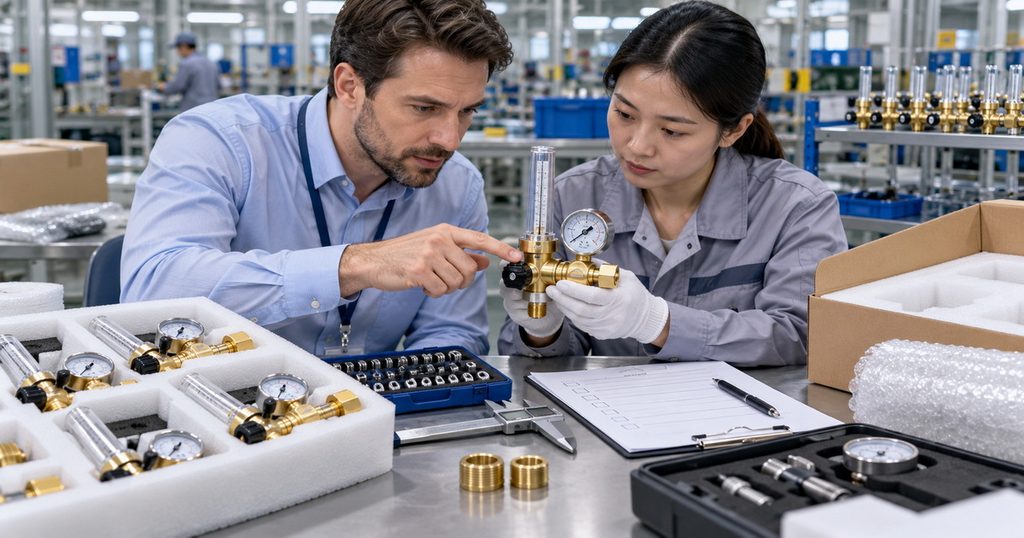
Do not send only a product image and ask for “same quality.” Prepare a technical request sheet covering:
– Gas type: argon, CO₂, argon/CO₂ mixture, oxygen, nitrogen, acetylene, propane, or another gas.
– Inlet pressure range.
– Outlet pressure range.
– Flow range and units: L/min, L/h, CFH, or m³/h.
– Single-stage or dual-stage configuration.
– Inlet thread and outlet connection.
– Gauge range and dial units.
– Flow tube and float material.
– Required standard or compliance target.
– Brand, label, dial artwork, packaging, manuals, and language.
– Required order quantity and estimated annual volume.
– Target market and shipping destination.
A detailed request reduces ambiguity and makes supplier quotations more comparable.
Step 2: Verify the factory identity
Before discussing price aggressively, verify that the factory you are communicating with is the party that actually controls production.
Request:
– Business registration details.
– Factory address and production-site photos or live video inspection.
– ISO certificate copy.
– Certification body name, certificate number, expiry date, and scope.
– Evidence that the registered address matches the manufacturing address.
– Factory audit report, if available.
– Production equipment list relevant to the regulator: machining, assembly, pressure testing, calibration, leakage testing, and final inspection.
For ISO 9001 verification, check the certificate number, scope, covered site, issue date, expiry date, certification body, and accreditation body. An ISO certificate may be legitimate but still not cover the actual factory or the product activities being quoted.
Step 3: Run a structured sample process
A professional sample process should have at least three stages:
| Sample stage | Purpose | What to evaluate |
|---|---|---|
| Initial technical sample | Confirms product architecture and general quality | Dimensions, threads, materials, gauge readings, flow range, appearance |
| Customized pre-production sample | Confirms the buyer’s OEM/ODM configuration | Branding, packaging, labels, connections, instructions, artwork, markings |
| Pilot production sample | Confirms mass-production consistency | Leakage, creep, flow repeatability, cosmetic consistency, packing integrity |
Do not approve mass production based only on photos or a single showroom sample. Sample testing should reflect the actual intended application.
Step 4: Include quality requirements in the PO
Your purchase order should include measurable requirements, not vague phrases such as “high quality” or “same as sample.”
Include:
– Approved sample reference number.
– Product drawing and revision number.
– Gas type and connection standard.
– Brass material and critical component requirements.
– Pressure and flow performance requirements.
– Leakage and creep-test method.
– Packaging configuration.
– Labeling and carton-mark requirements.
– Inspection level and acceptance criteria.
– Nonconformance handling.
– Spare-parts or warranty policy.
– Change-control requirement: no material, supplier, component, or process change without written approval.
Step 5: Plan logistics early
Flowmeter regulators may contain transparent tubes, gauges, electrical heaters, and precision-machined brass components. Packaging needs to protect against impact, vibration, moisture, and pressure on cartons during sea freight.
Key logistics points:
– Confirm whether the heated CO₂ regulator has electrical components requiring special documentation.
– Use inner protection for gauges and flow tubes.
– Require drop-test or carton-strength verification for larger export programs.
– Confirm HS classification with your customs broker.
– Specify palletization, moisture protection, carton markings, and spare-part packing.
– For urgent trial orders, compare air freight and express options, but calculate the total landed cost rather than unit price alone.
– For sea freight, account for production lead time, port congestion, consolidation time, and destination customs clearance.
Conclusion
Selecting a China flowmeter regulator manufacturer is a technical sourcing decision, not just a catalog comparison. The right partner should demonstrate stable pressure-reduction performance, suitable material control, documented testing, accurate flowmeter calibration, reliable thread compatibility, consistent production quality, and the ability to support your brand’s market requirements.
For buyers seeking a dedicated welding and industrial-gas regulator manufacturer with a practical OEM/ODM approach, Zhejiang Bril Welding Equipment Co., Ltd. is worth evaluating early in the sourcing process. Its long-term focus on industrial gas pressure regulators, Wenzhou-based manufacturing foundation, stated ISO 9001 and CE-related compliance credentials, and support for customized regulator programs make it particularly relevant for overseas distributors, welding brands, and manufacturers building a differentiated product line.
The most reliable procurement path is simple: define the technical specification, verify certificates, request product-specific documentation, test samples under real operating conditions, inspect pilot production, and only then scale purchasing volume.
Frequently Asked Questions
1. How can I verify whether a manufacturer’s ISO 9001 certificate is still valid?
Ask for the full certificate copy, then check the certificate number, issuing body, accreditation body, scope, manufacturing address, issue date, and expiration date. The factory address on the certificate should match the actual site producing your regulators. You should also verify the issuing certification body through its official verification channel or the relevant accreditation database. A valid ISO 9001 certificate supports confidence in the quality-management system, but it does not replace product-level testing or incoming inspection.
2. Does CE certification automatically mean a flowmeter regulator complies with EN ISO 2503?
No. CE marking and EN ISO 2503 are related to different aspects of compliance and should not be treated as interchangeable statements. ISO 2503 defines technical requirements for gas-welding pressure regulators and regulator/flowmeter devices within its scope. Buyers should request documentation for the exact model, application, gas type, and configuration being purchased. ISO 2503 covers regulators with flow-metering devices for welding, cutting, and allied processes up to 300 bar, including compressed gases and CO₂.
3. What is the most important test for an argon/CO₂ flowmeter regulator sample?
There is no single test that replaces all others, but a combination is essential: inlet leakage, outlet leakage, outlet-pressure creep, flow repeatability, gauge accuracy, thread fit, and full-duty operation. For MIG/TIG applications, test flow at low, medium, and high settings with the intended gas or a properly defined equivalent test method. Also confirm that the flowmeter reading remains stable as cylinder pressure decreases.
4. Can the same regulator design be used for argon, CO₂, oxygen, nitrogen, and propane?
Not automatically. Different gases can require different inlet connections, pressure ranges, seals, materials, safety controls, cleaning requirements, and labeling. Oxygen service deserves special attention because contamination control is critical. CO₂ may require heated-regulator options in certain duty cycles to reduce freezing-related performance issues. Propane and acetylene applications also have distinct safety and connection requirements. Buyers should specify gas service clearly rather than requesting a generic “universal regulator.”
5. What MOQ should I expect for customized flowmeter regulators from China?
MOQ depends on whether you are selecting a standard product or creating a customized version. Standard models may support lower trial quantities, while custom gauges, new brass bodies, proprietary connection structures, special packaging, colored finishes, or new tooling usually require higher volumes. A good approach is to negotiate in stages: small technical sample order, pilot order, then annual-volume pricing after product validation. Avoid selecting a supplier only because it accepts a very low MOQ if that supplier cannot maintain component consistency in later mass production.
References
1. – [ISO 2503:2009 — Gas welding equipment: Pressure regulators and pressure regulators with flow-metering devices for gas cylinders used in welding, cutting and allied processes]. ISO states that the standard covers single- and two-stage regulators, including flow-metering versions, for compressed gases and CO₂ used in welding-related applications up to 300 bar. [iso]
2. – [Zhejiang Bril Welding Equipment Co., Ltd. — About Us]. Company profile covering founding year, location, regulator specialization, ISO 9001 claim, CNAS/CE-related claims, and stated OEM supply relationships. [chinesewelding]
3. – [Zhejiang Bril — Flowmeter Regulator]. Product page referencing flowmeter regulator applications and EN ISO 5171/EN ISO 2503 compliance claims. [chinesewelding]
4. – [General Administration of Customs of the People’s Republic of China — 2025 Foreign Trade Release]. Official 2025 export data and equipment-manufacturing export figures. [customs.gov]
5. – [MarketsandMarkets — China Welding Materials Market]. Market projection for China’s welding-materials sector from 2025 to 2030. [marketsandmarkets]
6. – [China Council for the Promotion of International Trade Machinery Sub-Council]. Industry trade-promotion context for China’s machinery sector. [en.chinamachine.org]
Hot Tags: Flowmeter Regulator, Gas Regulator Manufacturer, Welding Gas Regulator, CO2 Flowmeter Regulator, Argon Flowmeter Regulator, Industrial Gas Regulator, Dual Stage Gas Regulator, OEM Gas Regulator, Welding Equipment Supplier, Gas Pressure Regulator