Content Menu
● Industrial CO₂ Regulator vs High Flow CO₂ Regulator: Key Differences
● What Does an Industrial CO₂ Regulator Do?
>> Where General-Purpose Industrial Regulators Fit
● What Makes a High Flow CO₂ Regulator Different?
>> High Flow Does Not Mean High Pressure
● Compare Pressure Stability, Not Just Maximum Flow
>> Separate Capacity From Stage Count
● CO₂ Cooling: Why High Flow May Require Heating
>> When to Consider a CO₂ Heated Regulator
>> Heating Does Not Replace Supply-System Engineering
● Sizing a Multi-Station CO₂ Supply
>> What the Calculation Does—and Does Not—Tell You
● Materials and Manufacturing: What Buyers Should Verify
>> Confirm the Applicable Standard
● A Practical Acceptance-Test Plan for Distributors and OEM Buyers
● Choosing an OEM or ODM CO₂ Regulator
● Which CO₂ Regulator Should You Choose?
>> 1. Is a high flow CO₂ regulator always an industrial regulator?
>> 2. Can a standard industrial CO₂ regulator supply multiple welding stations?
>> 3. Does a high flow CO₂ regulator always need a heater?
>> 4. Is a dual-stage CO₂ regulator better for high flow?
>> 5. Can an argon regulator be used for CO₂?
>> 6. Why does pressure fall when several machines start together?
An industrial CO₂ regulator and a high flow CO₂ regulator are not necessarily competing product categories. “Industrial” describes the application and construction expectations, while “high flow” describes delivery capacity under specified operating conditions. A high flow model can also be an industrial regulator.
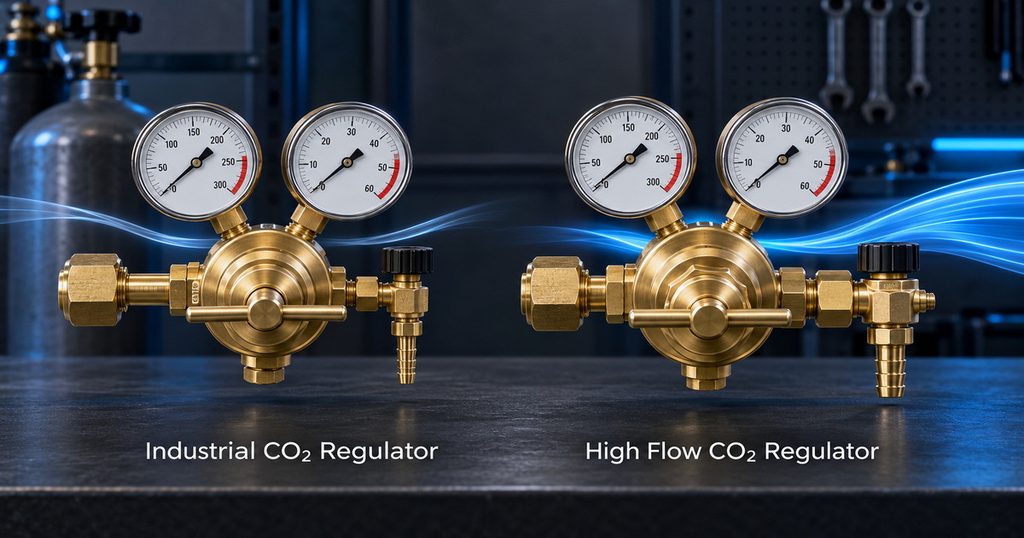
Industrial CO₂ Regulator vs High Flow CO₂ Regulator: Key Differences
For this comparison, “general-purpose industrial regulator” means a model selected for a defined workstation or moderate-demand process. It does not mean that all industrial regulators have limited capacity.
| Comparison point | General-purpose industrial CO₂ regulator | High flow CO₂ regulator |
|---|---|---|
| Main selection priority | Reliable pressure reduction for an established duty | Maintaining delivery pressure at greater gas demand |
| Typical application | Individual welding stations and intermittent processes | Higher-consumption equipment or engineered distribution systems |
| Flow capacity | Must be verified from model-specific data | Must also be verified; the label alone proves little |
| Internal design | Sized for its intended pressure and flow range | May use larger flow passages or different valve and diaphragm arrangements |
| Heating | Optional, depending on operating conditions | Often worth evaluating for sustained CO₂ withdrawal |
| Pressure stability | Depends on regulator design and operating point | Not automatically better simply because capacity is higher |
| Supply requirements | Matched cylinder or gas supply | May require greater source capacity or a vaporization system |
| Purchase decision | Fit the defined process economically | Meet verified peak demand without unacceptable pressure loss |
Neither description establishes a universal flow threshold. Buyers should compare documented performance at equivalent inlet pressure, outlet pressure, gas, and temperature conditions.
What Does an Industrial CO₂ Regulator Do?
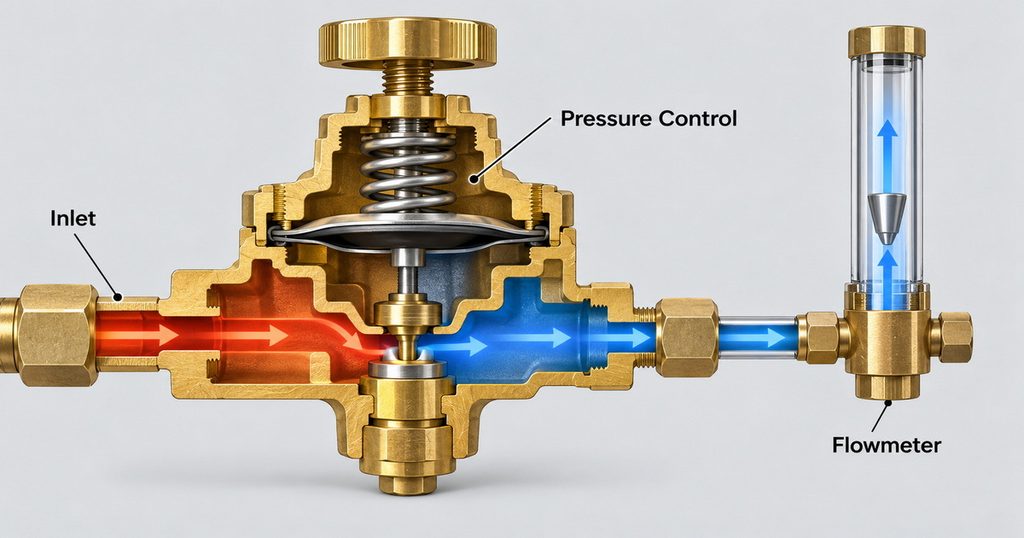
An industrial CO₂ pressure regulator reduces supply pressure to a controlled downstream pressure. Its valve responds to changing demand to keep delivery pressure within its operating capabilities.
A pressure regulator primarily controls pressure—not flow. A separate metering valve, flowmeter, or integrated flow-control assembly may be needed to establish and indicate gas flow.
Where General-Purpose Industrial Regulators Fit
A correctly sized regulator can serve:
– Individual CO₂ shielding-gas welding stations.
– Intermittent industrial gas equipment.
– Small production cells.
– Process lines with relatively consistent consumption.
For shielding applications, pure CO₂ is associated with suitable metal active gas and flux-cored welding processes. It should not be treated as a universal substitute for argon or other shielding gases.
My purchasing recommendation is to begin with the process requirements, not the heaviest-looking regulator. A well-matched conventional model can be more appropriate than a larger unit operating outside its preferred range.
What Makes a High Flow CO₂ Regulator Different?
A high flow CO₂ regulator is intended to deliver greater gas throughput while maintaining usable downstream pressure under stated conditions.
That performance may involve changes to valve geometry, flow passages, diaphragm area, or pressure-balancing arrangements. However, manufacturers achieve capacity differently. External dimensions and connection size cannot reliably establish performance.
High Flow Does Not Mean High Pressure
A process can require substantial flow at relatively low delivery pressure. Another application may require higher pressure but modest flow.
Specify these independently:
1. Maximum inlet pressure.
2. Required outlet pressure.
3. Minimum and maximum operating flow.
4. Acceptable pressure variation.
5. Continuous and intermittent operating duration.
A high flow regulator also cannot compensate for an inadequate gas source. If the cylinder cannot sustain the required withdrawal, replacing the regulator alone may leave the problem unresolved.
Compare Pressure Stability, Not Just Maximum Flow
Maximum flow is useful only when the downstream pressure remains suitable for the process.
A regulator advertised with impressive capacity may still produce excessive pressure variation at your chosen operating point.
Read the Flow Curve
A regulator flow curve shows how outlet pressure changes as flow increases under defined conditions.
Three characteristics deserve attention:
– Droop: the decline in outlet pressure as demand increases.
– Lockup: the pressure behavior as the regulator closes when flow stops.
– High-flow limitation: the region where additional demand causes substantial delivery-pressure loss.
Ask for a curve that represents your gas and expected inlet conditions. A single maximum-flow figure without its test conditions is an incomplete specification.
Separate Capacity From Stage Count
Single-stage and dual-stage describe the pressure-reduction arrangement, not the flow category.
Dual-stage regulation can reduce the effect of changing inlet pressure on outlet pressure. It does not automatically provide higher capacity or eliminate CO₂ freezing.
For buyers, the practical distinction is simple: select stage count for pressure-control requirements and select flow capacity for demand. Then verify how both perform together.
CO₂ Cooling: Why High Flow May Require Heating
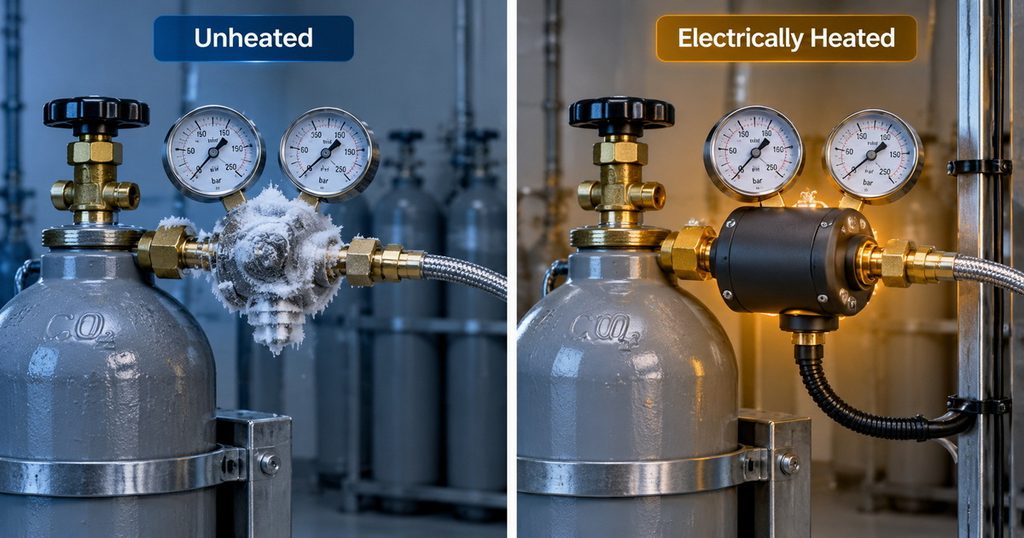
CO₂ presents thermal challenges during pressure reduction and sustained withdrawal. Under suitable conditions, solid CO₂ can form inside a regulator and restrict gas passages.
External frost and internal blockage are not identical. Visible frost alone does not identify the exact cause of unstable delivery.
When to Consider a CO₂ Heated Regulator
Evaluate heating when the application involves:
– Sustained rather than occasional gas consumption.
– Repeated cooling-related pressure or flow interruptions.
– Low ambient temperatures.
– Operating conditions identified by the manufacturer as requiring heat.
Published products illustrate why specifications matter. One electrically heated industrial model lists stabilized operation up to 30 L/min of continuous CO₂. Another two-stage heated model specifies continuous CO₂ flow up to 100 SCFH with a 200-watt heater.
These are individual product ratings, not universal heating thresholds or directly interchangeable performance claims.
Heating Does Not Replace Supply-System Engineering
A heated regulator addresses thermal conditions around pressure reduction. It should not be assumed to replace a bulk vaporizer or make ordinary gas-service equipment suitable for liquid withdrawal.
Confirm whether the system delivers gaseous CO₂ or requires equipment designed for liquid service. This distinction belongs in the initial inquiry, not after installation.
Never improvise cylinder heating or use an open flame to thaw equipment. Investigate recurring freeze-up with the regulator manufacturer and gas supplier.
Sizing a Multi-Station CO₂ Supply
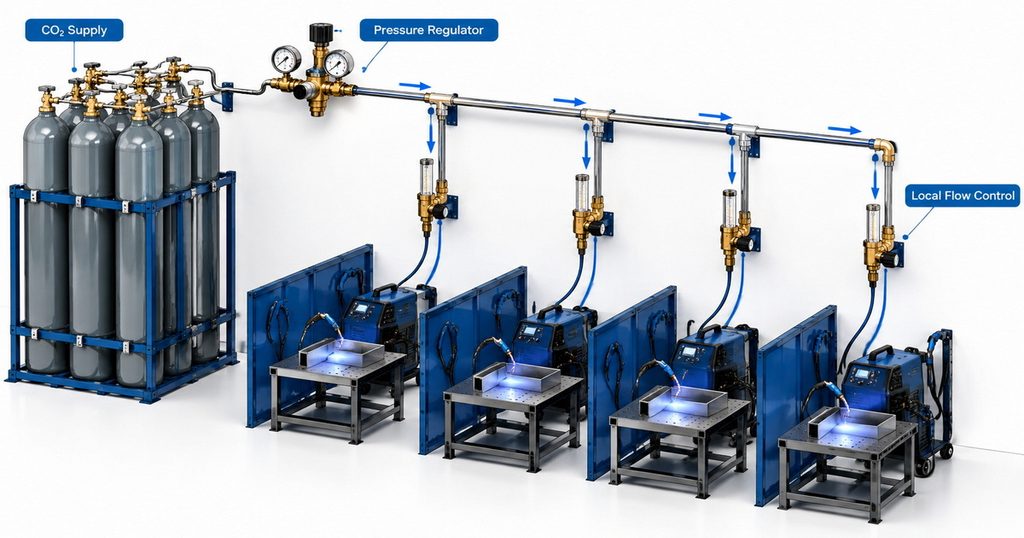
Consider a hypothetical production cell with four welding stations. Each station requires 18 L/min while operating.
If all four can run simultaneously, the combined demand is:
4×18=72 L/min
Applying an illustrative 20% planning allowance gives:
72×1.20=86.4 L/min
This is a sizing example, not a recommended welding setting or universal safety factor. Actual flow must follow the welding procedure and equipment requirements.
What the Calculation Does—and Does Not—Tell You
The calculation establishes a preliminary capacity target. It does not prove that a regulator rated above 86.4 L/min will work.
The design must also account for:
– Pressure loss through hoses, valves, and branch lines.
– Required pressure at the most distant workstation.
– Cylinder or bulk-source withdrawal capability.
– Continuous operating time and thermal conditions.
– Individual station flow control.
This example shows why a multi-station installation should be evaluated as a system. More regulator capacity is helpful only when the upstream source and downstream piping support it.
Materials and Manufacturing: What Buyers Should Verify
Brass bodies are used in many industrial CO₂ regulators. However, “high-quality brass” is not a complete performance specification.
Material grade, machining quality, sealing surfaces, internal cleanliness, and component compatibility all influence the finished assembly.
Look Beyond Body Weight
For an OEM CO₂ regulator, request details covering:
– Body material and manufacturing method.
– Wetted seals and diaphragm materials.
– Rated inlet and outlet pressures.
– Operating-temperature limits.
– Gas-specific connections.
– Inspection and traceability arrangements.
A heavier body is not evidence of superior pressure stability. Likewise, an attractive gauge does not establish measurement accuracy or regulator capacity.
Confirm the Applicable Standard
ISO 2503 addresses cylinder pressure regulators and regulators with flow-metering devices for welding, cutting, and allied processes within its stated scope.
It should not be treated as a blanket approval for every pipeline installation, electrical component, or industrial application.
Ask which standard and edition apply to the exact model. Request supporting documentation and distinguish a conformity statement from independent certification. Neither “industrial grade” nor “international standard” is sufficient without specifics.
A Practical Acceptance-Test Plan for Distributors and OEM Buyers
A structured sample evaluation provides more useful evidence than appearance-based inspection.
The following is a proposed procurement checklist, not a substitute for applicable standard tests. Qualified personnel should perform testing with suitable equipment and an approved procedure.
1. Verify identification. Check gas designation, pressure ratings, connections, and model traceability.
2. Establish conditions. Record inlet pressure, ambient temperature, outlet setting, and flow reference conditions.
3. Test the operating range. Measure delivery pressure at minimum, normal, and peak demand.
4. Check changing demand. Observe pressure behavior when equipment starts and stops.
5. Evaluate sustained duty. Run the agreed operating cycle and record pressure, flow, and thermal behavior.
6. Assess changing inlet conditions. Confirm performance across the intended supply-pressure range.
7. Review safety functions. Verify leakage, shutoff, and any protective-device requirements using approved methods.
Define acceptance limits before ordering samples. Otherwise, two parties may interpret “stable pressure” very differently.
Choosing an OEM or ODM CO₂ Regulator
For overseas brands, wholesalers, and equipment manufacturers, the best inquiry describes the operating problem rather than requesting “the highest flow available.”
An effective specification package includes:
| Required information | Why it matters |
|---|---|
| Gas composition and supply phase | Establishes service compatibility |
| Supply-pressure range | Defines inlet conditions |
| Outlet pressure and tolerance | Establishes control requirements |
| Continuous and peak flow | Supports capacity selection |
| Duty cycle and ambient temperature | Supports thermal evaluation |
| Inlet and outlet connections | Prevents installation mismatch |
| Heater voltage, if applicable | Supports electrical integration |
| Destination market and documentation | Identifies applicable requirements |
Customization may cover connections, gauge scales, flow ranges, labeling, packaging, and heating arrangements. Changes affecting performance should be validated rather than treated as cosmetic options.
For our manufacturing offering, the appropriate starting point is precision-machined brass construction, controlled assembly, and inspection matched to the agreed specification. Application-specific performance still requires model-level verification.
Which CO₂ Regulator Should You Choose?
Choose a general-purpose industrial CO₂ regulator when its documented flow range, pressure behavior, and thermal capability meet the process.
Choose a high flow CO₂ regulator when verified demand exceeds that model’s usable capacity—not simply because a larger unit appears more durable.
Consider heating when sustained CO₂ operation creates a thermal requirement. Consider dual-stage regulation when inlet-pressure variation threatens the required outlet stability.
For a tailored quotation, send us your CO₂ supply type, inlet-pressure range, outlet setting, continuous and peak flow, ambient conditions, connections, and destination market. Our OEM and ODM team can use those requirements to propose a configuration and agree on sample-validation criteria.
Frequently Asked Questions
1. Is a high flow CO₂ regulator always an industrial regulator?
Not necessarily. High flow describes capacity, while industrial describes intended use. Confirm the specific model’s pressure ratings, duty, materials, and documentation rather than relying on either label.
2. Can a standard industrial CO₂ regulator supply multiple welding stations?
Yes, if its usable capacity and the complete distribution system meet simultaneous demand. Each station also needs appropriate local flow control. Check supply capability and line losses before approving the arrangement.
3. Does a high flow CO₂ regulator always need a heater?
No. Heating depends on flow duration, pressure reduction, supply conditions, ambient temperature, and equipment design. Follow the manufacturer’s operating limits rather than using a universal flow threshold.
4. Is a dual-stage CO₂ regulator better for high flow?
Not automatically. Dual-stage regulation primarily addresses inlet-pressure effects. Compare flow curves and thermal ratings separately to determine whether a particular model meets high-demand requirements.
5. Can an argon regulator be used for CO₂?
Only when the manufacturer explicitly approves it for CO₂ and the connections, pressure ratings, seals, and metering arrangement are suitable. Physical connection compatibility alone is insufficient.
6. Why does pressure fall when several machines start together?
Possible causes include regulator droop, insufficient supply capacity, restrictive piping, or cooling-related flow restriction. Record upstream and downstream conditions during demand changes before selecting replacement equipment.
References
The article uses original editorial synthesis. The worked example, purchasing recommendations, and acceptance checklist are illustrative guidance, not reported customer results. Company-specific statements are based on the supplied background and do not imply independently verified certification.
1. Swagelok Northern California — “Parts and Performance: Selecting the Right Pressure Regulator for Each Job.” Supports pressure-versus-flow distinctions, selection inputs, and the importance of the usable operating range. [northerncal.swagelok]
2. Swagelok Northern California — “Video: Another Way to Deal With the Supply Pressure Effect.” Explains inlet-pressure effects and the role of two-stage regulation. [northerncal.swagelok]
3. Harris Products Group — “CO2 Freeze Up: Why It Happens, What You Can Do.” Explains solid CO₂ restriction, pressure-reduction cooling, and heated-regulator approaches. [harrisproductsgroup]
4. Harris Products Group — “Model 811.” Provides the product-specific example of electrically heated regulation with stabilized continuous CO₂ operation up to 30 L/min. [harrisproductsgroup]
5. Harris Products Group — “Model HP 705.” Provides the product-specific example of a two-stage regulator with a 200-watt heater and continuous CO₂ flow up to 100 SCFH. [harrisproductsgroup]
6. International Organization for Standardization — “ISO 2503:2009: Gas Welding Equipment—Pressure Regulators and Pressure Regulators With Flow-Metering Devices for Gas Cylinders Used in Welding, Cutting and Allied Processes up to 300 bar (30 MPa).” Defines the standard’s application scope. [iso]
7. International Organization for Standardization — “ISO 2503:2009/Amd 1:2015.” Identifies the amendment relevant when confirming the applicable documentation. [iso]
8. Airgas — “Safety Data Sheet: Carbon Dioxide,” SDS 001013. Supports pressure-rated equipment, compatible materials, upright cylinder handling, and ventilation precautions. [airgas]
9. GCE Group — “Basecontrol FLOW Cylinder Regulator.” Provides a documented example of forged-brass construction, gas-specific connections, and an optional electrical preheater. [gcegroup]
Hot Tags: CO₂ Regulator, Industrial CO₂ Regulator, High Flow CO₂ Regulator, CO₂ Pressure Regulator, Heated CO₂ Regulator, CO₂ Welding Regulator, Dual Stage CO₂ Regulator, Brass CO₂ Regulator, CO₂ Regulator Manufacturer, OEM CO₂ Regulator