Content Menu
● Understanding Welding Gas Regulator Pressure and Flow
>> Cylinder Pressure Is Not Delivery Pressure
>> Pressure Is Not Shielding Gas Flow
● Welding Gas Regulator Troubleshooting: Identify the Pattern
● Seven Common Causes of Unstable Welding Gas Regulator Pressure
>> 1. Pressure Droop Under Increasing Gas Demand
>> 2. Supply Pressure Effect as the Cylinder Empties
>> 3. Regulator Creep From Internal Seat Leakage
>> 4. Leaks at Connections or Downstream Components
>> 5. CO₂ Regulator Freezing During Sustained Use
>> 6. Restrictions in Hoses, Fittings, or Torch Components
>> 7. Damaged Gauges or Internal Components
● A Safe Step-by-Step Pressure Troubleshooting Procedure
>> Step 1: Decide Whether to Stop Immediately
>> Step 2: Confirm Gas and Equipment Compatibility
>> Step 3: Inspect Without Dismantling
>> Step 4: Compare Flowing and No-Flow Behavior
>> Step 5: Escalate With Useful Evidence
● Diagnose Pressure Against Time and Demand
● Choosing a More Stable Regulator for Industrial Applications
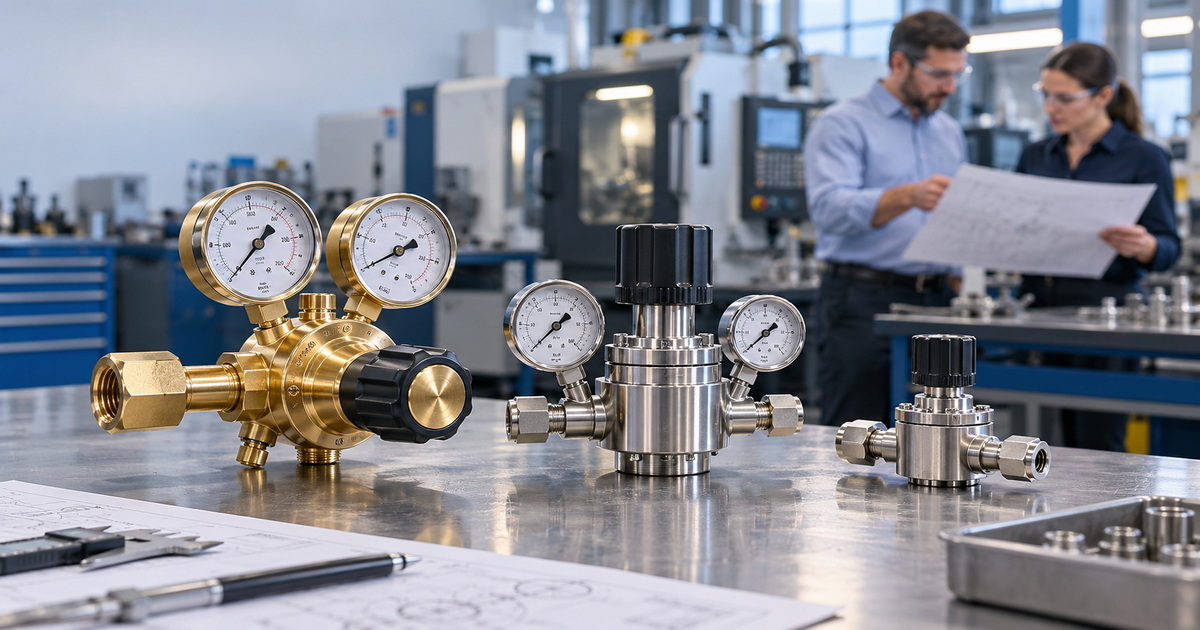
>> Specify Performance, Not Just Brass Construction
>> Match the Design to the Problem
>> Request Meaningful OEM and ODM Validation
● Get a Regulator Matched to Your Application
>> 1.Why Does My Welding Gas Regulator Pressure Drop When I Pull the Trigger?
>> 2.Why Does Outlet Pressure Rise After I Stop Welding?
>> 3.Will a Dual-Stage Regulator Eliminate Pressure Fluctuations?
>> 4.Do I Need a Heated CO₂ Regulator?
>> 5.Can I Repair a Welding Gas Regulator Myself?
>> 6.What Shielding Gas Flow Should I Use?
Your welding gas regulator may show unstable pressure because of changing gas demand, cylinder pressure variation, leaks, restrictions, CO₂ freezing, or damaged internal components. The most useful clue is not simply whether the needle moves, but when it moves: during gas flow, after flow stops, or gradually throughout a shift.
Understanding Welding Gas Regulator Pressure and Flow
Cylinder Pressure Is Not Delivery Pressure
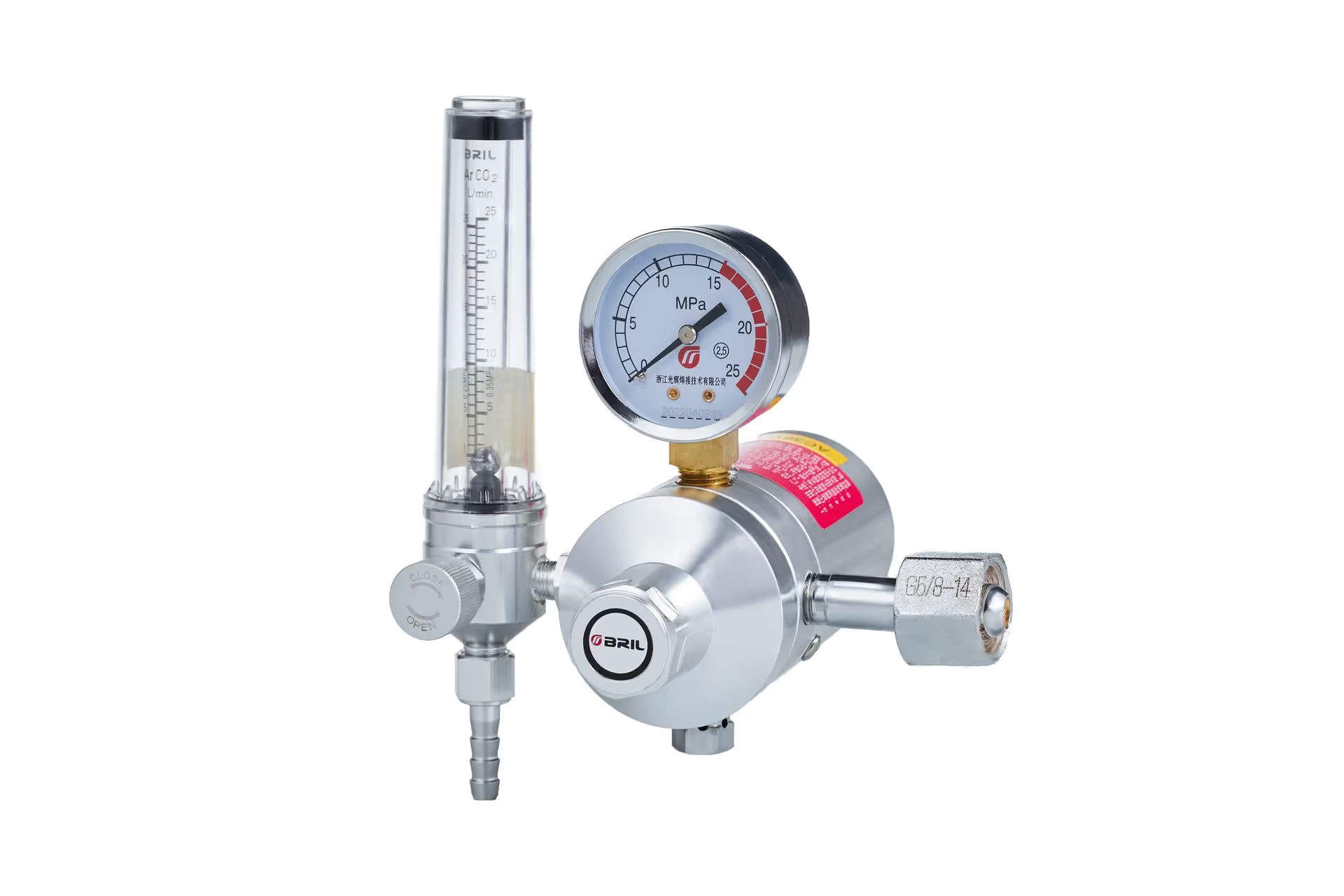
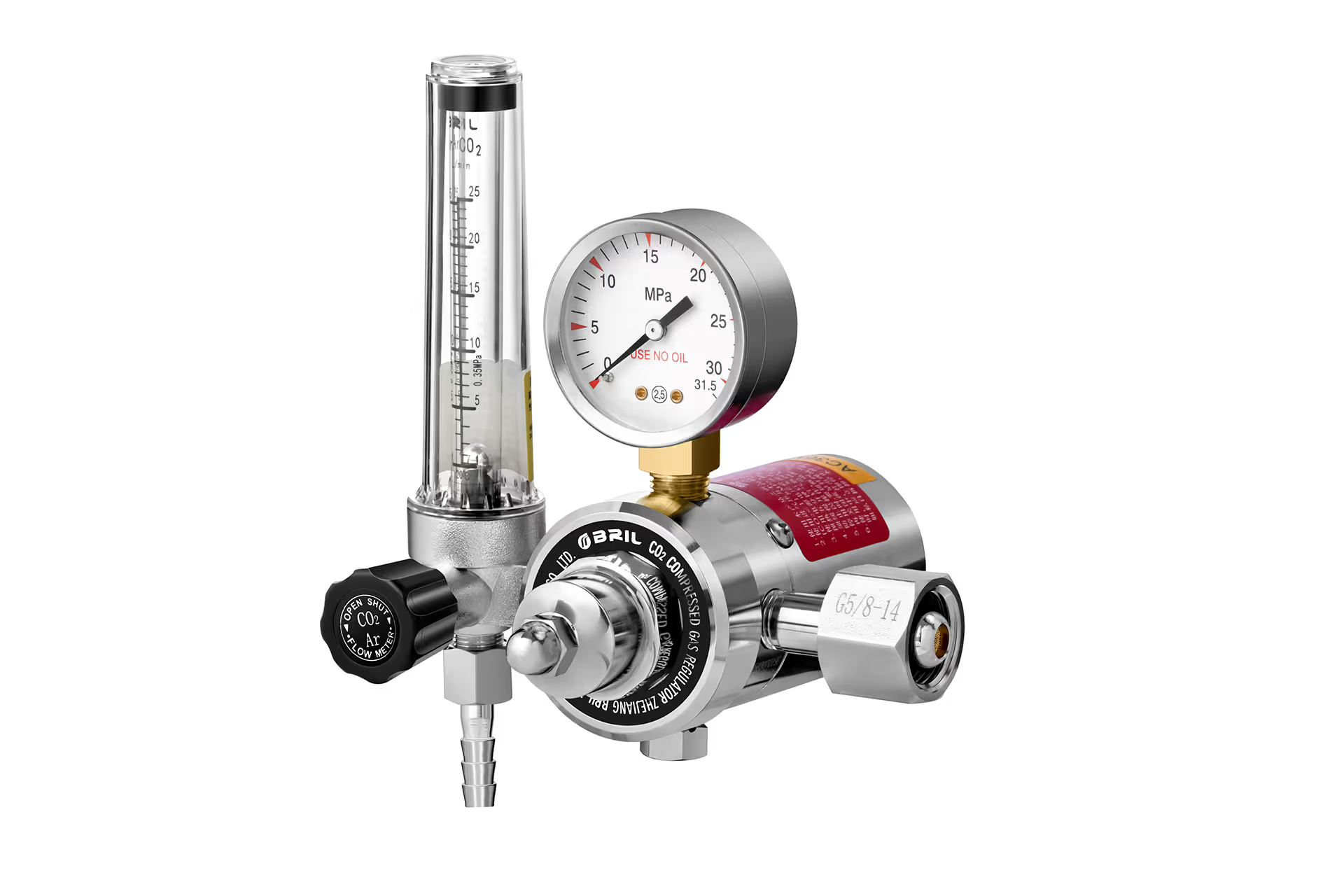
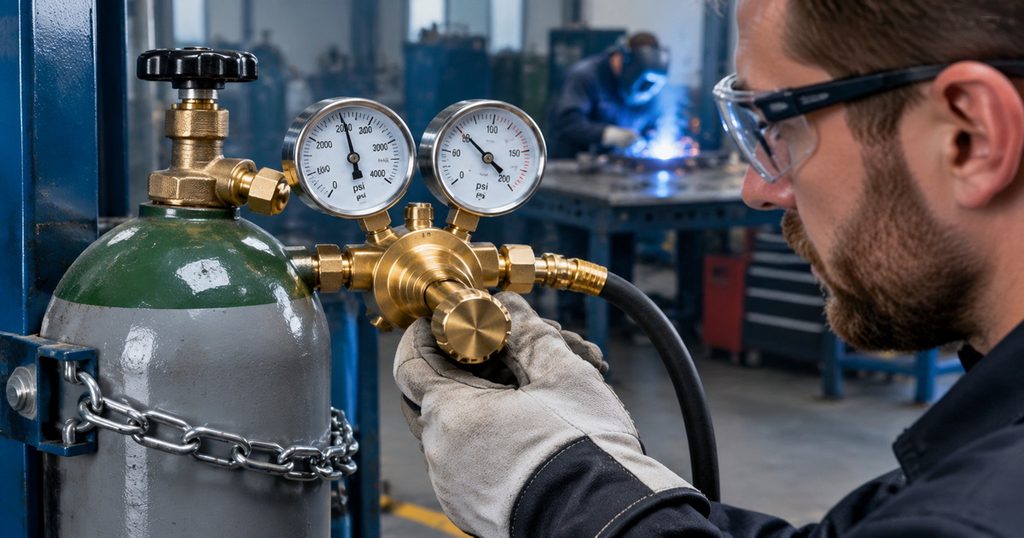
On a typical two-gauge regulator, the inlet gauge indicates cylinder pressure. The outlet gauge indicates regulated delivery pressure.
A declining cylinder-pressure reading is expected as compressed gas is consumed. However, the outlet should remain within the regulator’s specified performance limits.
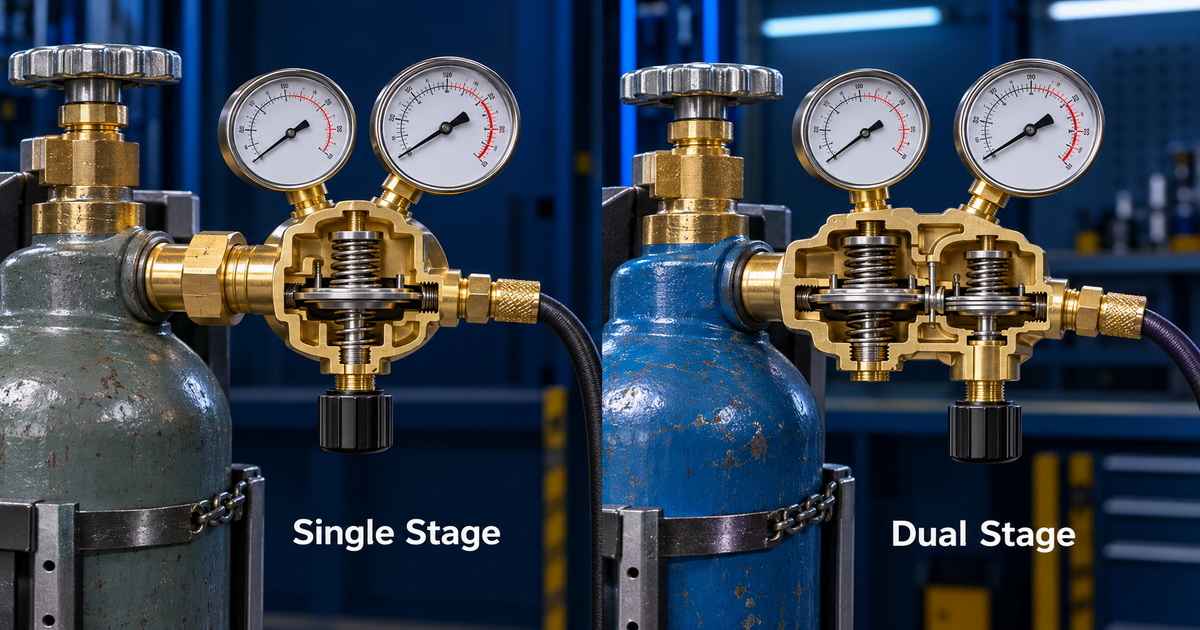
A regulator with two gauges is not necessarily a dual-stage regulator. Gauge count describes the instruments fitted; stage count describes how many pressure-reduction steps occur internally.
Pressure Is Not Shielding Gas Flow
Pressure is commonly displayed in psi or bar. Shielding gas flow is commonly displayed in cubic feet per hour or liters per minute.
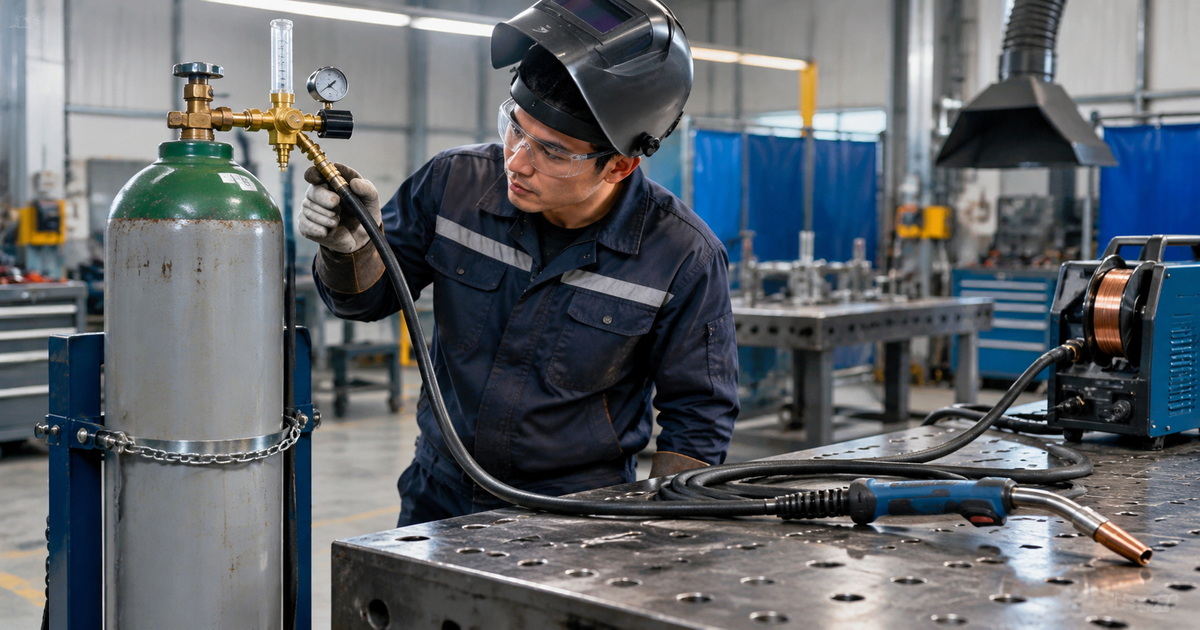
For MIG and TIG welding, the important operational measurement is the gas reaching the torch while gas is flowing. A steady outlet-pressure reading does not prove that shielding flow is adequate.
Some flow gauges infer flow from pressure through a calibrated restriction. A floating-ball flowmeter uses a different measurement arrangement. Both must be used with the specified gas and operating conditions.
Welding Gas Regulator Troubleshooting: Identify the Pattern
Use this table to organize observations before adjusting anything.
| Observed behavior | Possible explanation | Recommended response |
|---|---|---|
| Pressure falls when gas starts flowing | Normal droop, excessive demand, or restriction | Compare performance with the regulator’s flow curve |
| Outlet pressure keeps rising after flow stops | Seat leakage, commonly called creep | Stop use and arrange qualified inspection |
| Outlet pressure gradually rises as inlet pressure falls | Supply pressure effect | Evaluate regulator design and operating range |
| Pressure or flow becomes erratic during sustained CO₂ use | Cooling or internal freeze-up | Review withdrawal demand and heating requirements |
| Needle sticks or fails to return after depressurization | Damaged gauge or retained pressure | Follow the shutdown procedure and obtain inspection |
| Regulator reading is steady but torch flow is poor | Downstream leak or restriction | Check hoses, fittings, valves, and torch components |
Seven Common Causes of Unstable Welding Gas Regulator Pressure
1. Pressure Droop Under Increasing Gas Demand
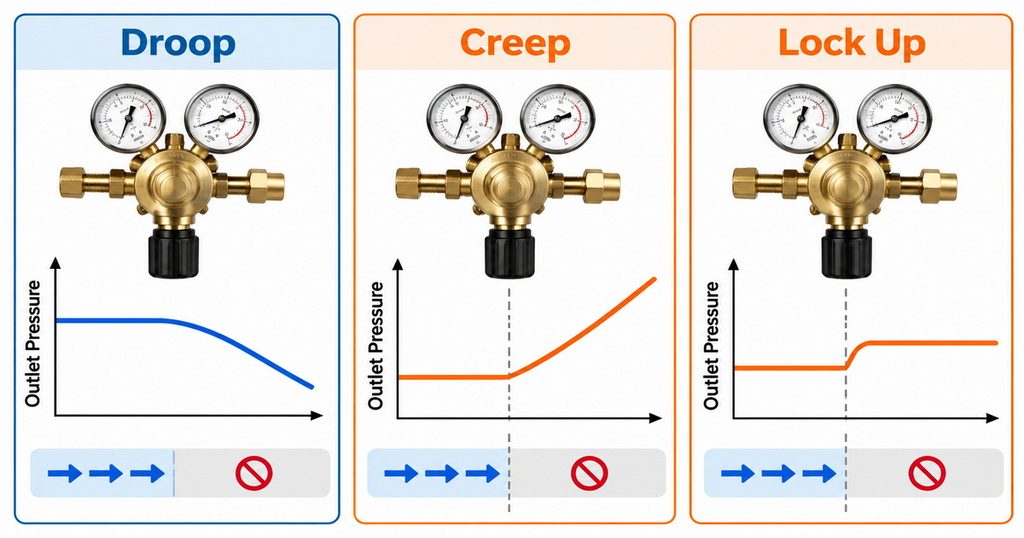
Droop is the reduction in outlet pressure as flow increases.
A regulator may hold its setting with little or no flow, then deliver a lower pressure when a torch or machine starts consuming gas. Some droop is characteristic of pressure-reducing regulators.
Excessive droop may indicate:
– A regulator undersized for the application.
– Demand above the intended operating range.
– Inadequate inlet pressure.
– Additional pressure losses through the gas system.
The correct selection method is to check delivery performance at the required flow and inlet pressure—not simply choose the highest pressure rating.
2. Supply Pressure Effect as the Cylinder Empties
In many conventional single-stage regulators, falling inlet pressure can cause outlet pressure to rise. This relationship is known as supply pressure effect, or inlet dependency.
It differs from creep because the outlet change is associated with a change in supply pressure.
A dual-stage regulator reduces pressure in two successive steps. The first stage absorbs much of the inlet-pressure variation, leaving the second stage with a more consistent supply.
However, dual-stage regulation does not correct leaks, freezing, inadequate flow capacity, or damaged seats.
3. Regulator Creep From Internal Seat Leakage
Regulator creep occurs when gas leaks past the internal valve seat and causes downstream pressure to continue rising after demand stops.
Possible causes include contamination, seat damage, or wear.
A small rise from flowing pressure to a stable no-flow pressure can be normal lock-up behavior. Continued pressure increase is different and requires attention.
Do not repeatedly turn the adjustment knob down to compensate. Remove the regulator from service according to its instructions and have it assessed by qualified personnel.
4. Leaks at Connections or Downstream Components
Leaks can occur at the cylinder connection, outlet fitting, hose, machine connection, or other joints.
A downstream leak creates unintended gas demand. If it is large enough, it can contribute to pressure loss and poor shielding.
Follow the manufacturer’s leak-testing procedure using a solution approved for the gas service. Never use a flame. Oxygen equipment requires particular attention to cleanliness and compatible testing materials.
Do not tighten, disconnect, or repair pressurized connections.
5. CO₂ Regulator Freezing During Sustained Use
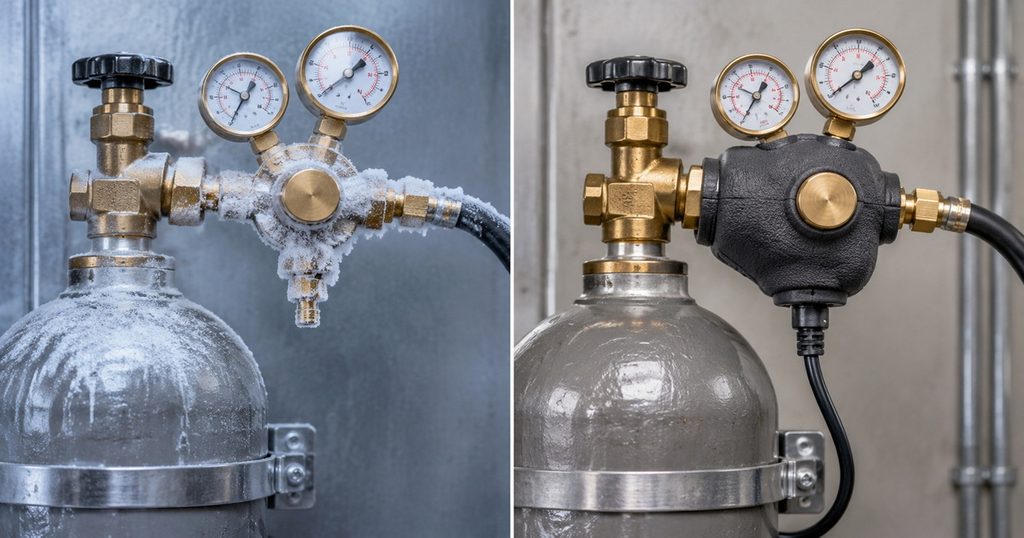
CO₂ expansion through a regulator causes substantial cooling. Under demanding conditions, internal freeze-up can interfere with gas delivery.
Warning signs may include:
– Flow that becomes inconsistent during longer operating periods.
– Pressure changes associated with sustained withdrawal.
– Heavy cooling or frost around the regulator.
External frost alone does not prove an internal blockage. Diagnose it alongside flow behavior and operating conditions.
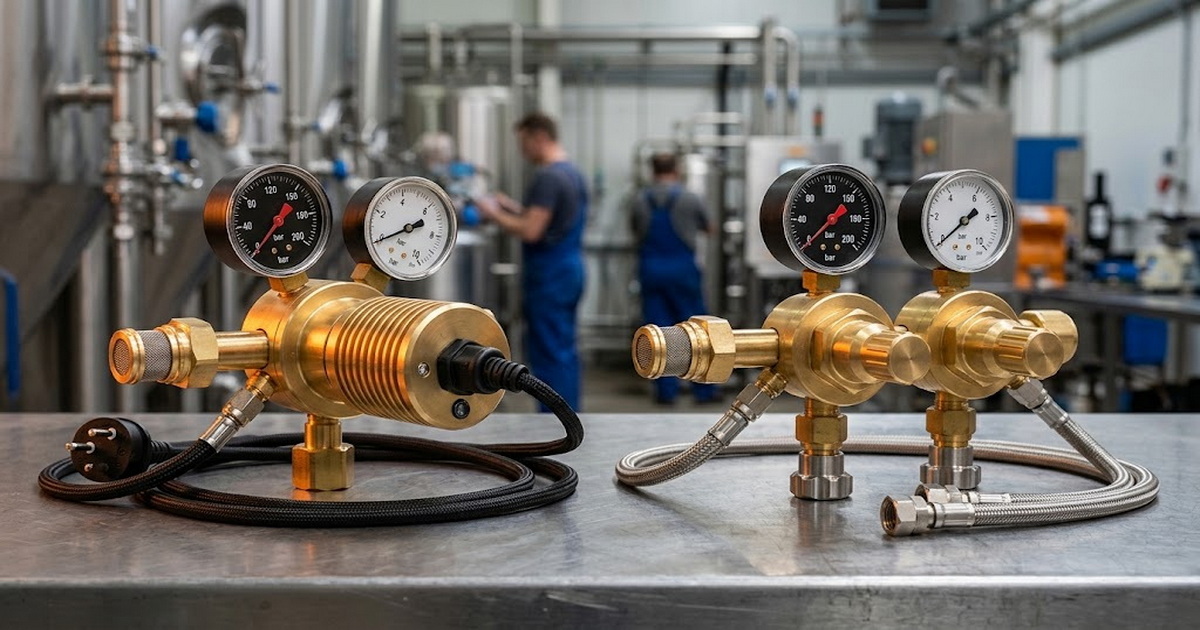
A purpose-designed CO₂ heated regulator can help relieve freeze-up. Select it for the required continuous flow, ambient conditions, electrical supply, and manufacturer-rated duty. Never use a torch or improvised heater to warm the equipment.
6. Restrictions in Hoses, Fittings, or Torch Components
A regulator can deliver stable pressure while the welding torch receives insufficient gas.
Inspect for kinked hoses, unsuitable small-bore connections, restricted valves, and contaminated torch components.
The location of the measurement matters. Pressure measured upstream of a restriction cannot establish the pressure or flow available downstream.
Increasing the regulator setting may disguise a restriction temporarily, but it does not remove the underlying problem.
7. Damaged Gauges or Internal Components
A sticking needle can make stable pressure appear unstable—or conceal a real change.
Suspect a gauge problem if the pointer does not respond normally or fails to return after the system has been correctly depressurized.
Diaphragm, spring, or valve damage may also affect regulation. These components require qualified inspection, not trial-and-error adjustment.
Do not open the regulator body or attempt to clean internal seats on the shop floor.
A Safe Step-by-Step Pressure Troubleshooting Procedure
Step 1: Decide Whether to Stop Immediately
Stop operation if pressure rises uncontrollably, gas leaks externally, a relief device discharges unexpectedly, or equipment shows physical damage.
If a significant release occurs, follow the site emergency procedure. Isolate the supply only when safe, keep personnel clear, and contact the gas supplier or emergency services as appropriate.
For oxygen equipment, keep oil and grease away from cylinders, regulators, fittings, hands, and gloves.
For conventional acetylene welding and cutting service in the United States, do not exceed 15 psig delivery pressure. Cylinder storage pressure is a different matter.
Step 2: Confirm Gas and Equipment Compatibility
Check the gas label, regulator model, rated inlet pressure, outlet range, and connection specification.
Do not assume that equipment is interchangeable because an adapter makes it fit. Oxygen, acetylene, propane, nitrogen, argon, and CO₂ require equipment approved for their respective service.
Step 3: Inspect Without Dismantling
Check accessible hoses, fittings, gauges, and mounting condition.
Follow the equipment instructions for shutdown, pressure release, reconnection, and leak testing. A cylinder valve that is difficult to operate or suspected of leaking requires supplier attention.
Step 4: Compare Flowing and No-Flow Behavior
Where the manufacturer permits an operational check, record:
1. Inlet pressure.
2. Outlet pressure during normal gas demand.
3. Outlet behavior after demand stops.
4. Actual shielding gas flow.
5. Ambient conditions and operating duration.
Use the machine’s approved gas-test function where available. Do not initiate an arc simply to check gas flow.
Continued outlet-pressure rise after flow stops is a reason to discontinue the test, not to keep adjusting.
Step 5: Escalate With Useful Evidence
Send the supplier the model number, gas type, readings, operating conditions, and a short description of when the problem occurs.
A repeatable pattern is more useful than “the pressure is unstable.”
Diagnose Pressure Against Time and Demand
A practical diagnostic method is to compare two relationships:
– Pressure versus flow: a drop as demand increases points toward droop, capacity limitations, or restrictions.
– Pressure versus time: a continued rise after flow stops points toward possible seat leakage.
A third comparison—outlet pressure versus inlet pressure—helps identify supply pressure effect.
For example, consider a hypothetical workshop where outlet pressure drops immediately whenever a second workstation starts. That pattern suggests checking combined demand and system capacity before replacing a gauge.
Conversely, pressure that keeps rising while every downstream valve remains closed calls for a different investigation.
These are illustrative scenarios, not reported customer cases.
Choosing a More Stable Regulator for Industrial Applications
Specify Performance, Not Just Brass Construction
High-quality brass and precision machining matter, but they do not establish pressure stability by themselves.
Buyers should also evaluate:
– Gas-compatible seats and seals.
– Rated inlet and outlet pressure ranges.
– Flow capacity at actual operating conditions.
– Droop and supply pressure effect.
– Lock-up behavior and seat tightness.
– Gauge suitability and readability.
– Cleanliness requirements for the intended gas.
For oxygen service, suitable materials must be accompanied by appropriate cleaning and handling controls.
Match the Design to the Problem
| Operating requirement | Selection priority |
|---|---|
| General welding with moderate demand | Correctly sized, gas-compatible regulator |
| Reduced outlet variation as cylinder pressure changes | Suitable dual-stage or low-inlet-dependency design |
| Sustained CO₂ withdrawal with freeze-up risk | Properly rated heated CO₂ regulator |
| Multiple workstations | Combined demand and distribution-system assessment |
| Oxygen or fuel-gas cutting | Gas-specific equipment and required protective devices |
Request Meaningful OEM and ODM Validation
For overseas brands, wholesalers, distributors, and equipment manufacturers, sample approval should cover more than appearance.
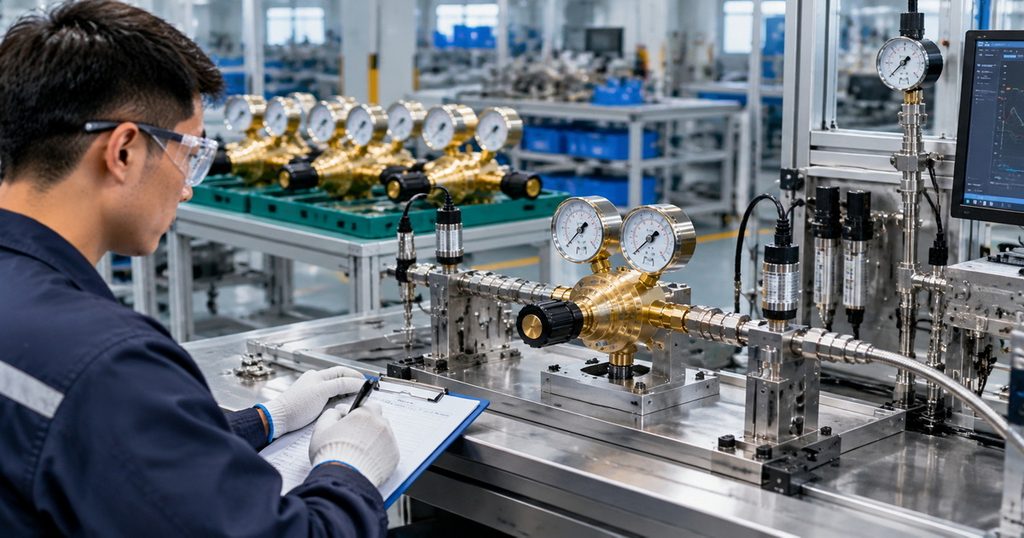
Request agreed tests for leakage, seat tightness, pressure delivery under flow, and behavior across the intended inlet range. Heated CO₂ models also need clearly defined electrical and operating requirements.
Ask for model-specific evidence supporting any claimed standard or certification. Broad statements about “international standards” are not a substitute for applicable documentation.
Get a Regulator Matched to Your Application
We manufacture and supply CO₂ regulators, heated CO₂ regulators, argon, oxygen, acetylene, propane, nitrogen, and dual-stage regulators, with OEM and ODM support.
For a targeted recommendation, send us your gas type, inlet-pressure range, required delivery pressure, peak flow, duty cycle, connection standard, and destination market. Include the symptoms of any existing pressure problem so we can discuss a suitable configuration and validation plan.
Frequently Asked Questions
1.Why Does My Welding Gas Regulator Pressure Drop When I Pull the Trigger?
Gas demand increases when the machine’s gas valve opens. Some pressure droop may be normal. A large drop warrants checking regulator capacity, inlet supply, leaks, and downstream restrictions.
2.Why Does Outlet Pressure Rise After I Stop Welding?
A small rise that stabilizes may be normal lock-up. Continued pressure increase can indicate internal seat leakage. Stop using the regulator and arrange qualified assessment.
3.Will a Dual-Stage Regulator Eliminate Pressure Fluctuations?
It can substantially reduce outlet changes caused by inlet-pressure variation. It will not eliminate every disturbance or fix leaks, blockages, freezing, and worn components.
4.Do I Need a Heated CO₂ Regulator?
Possibly, if sustained CO₂ withdrawal causes freeze-up that disrupts delivery. Selection depends on flow demand, operating duration, ambient conditions, and the regulator’s rated heating performance.
5.Can I Repair a Welding Gas Regulator Myself?
Internal repairs should be performed only by appropriately trained personnel following the manufacturer’s requirements. Do not dismantle a pressurized regulator or attempt improvised seat repairs.
6.What Shielding Gas Flow Should I Use?
Use the welding procedure, wire or torch guidance, and equipment instructions. The correct flow depends on the process and setup. Do not substitute an arbitrary outlet-pressure setting for a verified flow measurement.
References
1. [Swagelok — “Managing Supply Pressure Effect in Regulators.”] Explains inlet dependency, the inverse inlet/outlet relationship, and two-stage pressure reduction. [swagelok]
2. [Plant Engineering — “Three Steps for Identifying and Solving Common Pressure Regulator Issues.”] Covers creep, contamination, droop, regulator sizing, and flow-curve evaluation. [plantengineering]
3. [Harris Products Group — “Carbon Dioxide Regulator Freezing.”] Discusses CO₂ freeze-up and the role of heated regulators. [harrisproductsgroup]
4. [Occupational Safety and Health Administration — 29 CFR 1910.253, “Oxygen-Fuel Gas Welding and Cutting.”] Provides requirements concerning acetylene pressure, gas-specific regulators, oxygen cleanliness, connection inspection, and qualified repair. [osha]
5. [Miller Electric — Owner’s Manual O1548A, Safety and Regulator Guidance.] Identifies continued delivery-pressure rise, external leakage, and faulty gauge behavior as regulator service concerns. [millerwelds]
6. [Miller Electric — Spoolmatic 30A Owner’s Manual.] Supports using application-compatible gas equipment and following process-specific shielding-flow recommendations. [millerwelds]
Hot Tags: Welding Gas Regulator, Industrial Gas Regulator, Gas Regulator Manufacturer, Gas Regulator Supplier, CO₂ Gas Regulator, Heated CO₂ Regulator, Dual Stage Gas Regulator, Argon Gas Regulator, OEM Gas Regulator, Welding Gas Regulator Troubleshooting