Content Menu
● High Pressure Regulator vs Dual Stage Regulator: What Are You Comparing?
>> A High Pressure Regulator Describes Pressure Capability
>> A Dual Stage Regulator Describes Internal Architecture
● Why Delivery Pressure Changes as a Cylinder Empties
>> Supply Pressure Effect Explains Cylinder-Related Drift
>> Droop and Creep Are Different Problems
● High Pressure Single-Stage vs Dual Stage Regulator Comparison
● A Worked Example: Quantifying Cylinder Emptying Stability
● When a High Pressure Single-Stage Regulator Is Enough
● When a Dual Stage Regulator Is the Better Choice
● Gas-Specific Differences That Change the Decision
>> Argon and Nitrogen: Evaluate the Full Inlet-Pressure Range
>> CO₂: Separate Pressure Regulation from Thermal Management
>> Oxygen, Acetylene, and Propane: Gas Service Comes First
● A Practical Cylinder-Depletion Acceptance Test
>> Step 1: Define the Operating Envelope
>> Step 2: Establish Performance Under Flow
>> Step 3: Vary Inlet Pressure Without Readjustment
>> Step 4: Check Shutoff and Restart Behavior
>> Step 5: Identify the Usable Changeover Point
● OEM and ODM Specifications That Prevent Buying Errors
● Specify the Regulator Around Your Process
>> 1.Is a Dual Stage Regulator Better Than a High Pressure Regulator?
>> 2.Does a Two-Gauge Regulator Have Two Stages?
>> 3.Will a Dual Stage Regulator Maintain Pressure Until the Cylinder Is Empty?
>> 4.Can a Single-Stage Regulator Provide Stable Delivery Pressure?
>> 5.Do I Need a Heated Regulator for CO₂?
>> 6.What Information Should I Send for an OEM Regulator Quotation?
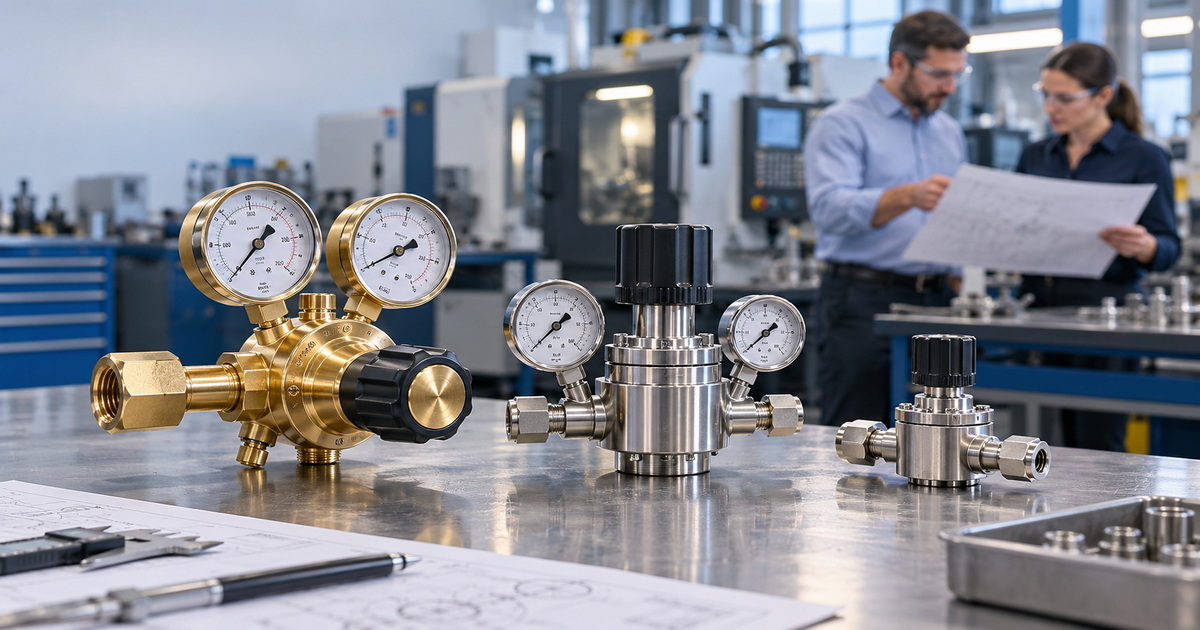
When comparing a high pressure regulator vs dual stage regulator for cylinder emptying stability, the dual-stage design generally provides steadier delivery pressure as cylinder pressure falls. However, these terms describe different characteristics: “high pressure” describes pressure capability, while “dual stage” describes how pressure reduction occurs. A regulator can be both.
For welding, cutting, and industrial gas applications, the practical question is whether a suitable single-stage regulator can maintain your required pressure throughout the cylinder’s usable operating range—or whether two-stage regulation offers better control.
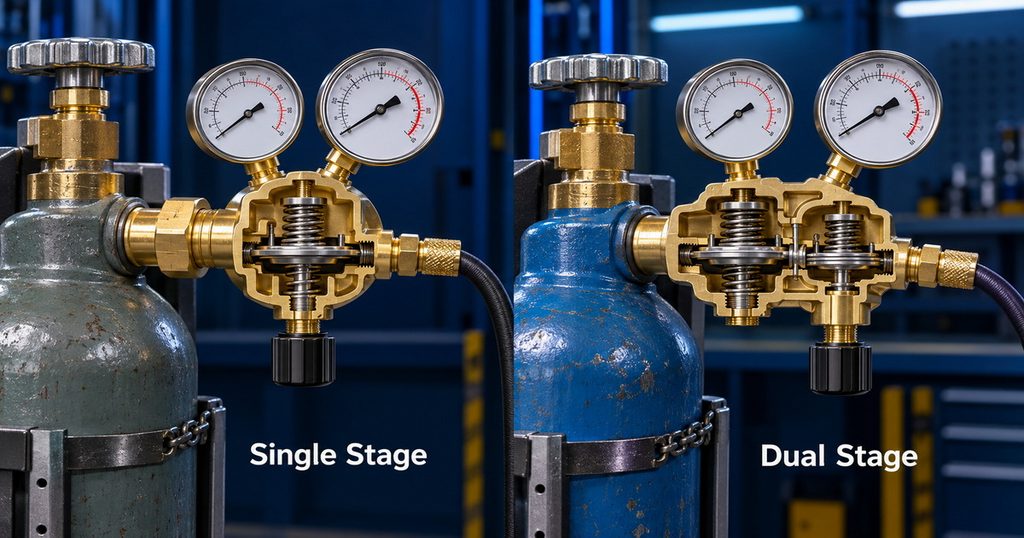
High Pressure Regulator vs Dual Stage Regulator: What Are You Comparing?
A High Pressure Regulator Describes Pressure Capability
A high pressure regulator is designed for specified high inlet pressures, high outlet pressures, or both. Because suppliers use the term differently, buyers must check the maximum inlet pressure and adjustable outlet range separately.
The label does not establish how many pressure-reduction stages the regulator contains.
For this comparison, “high pressure regulator” refers primarily to a single-stage cylinder regulator rated for the intended supply pressure. Without that clarification, the comparison risks treating overlapping categories as competing technologies.
A Dual Stage Regulator Describes Internal Architecture
A dual stage regulator reduces pressure through two sequential regulating mechanisms:
1. The first stage reduces cylinder pressure to an intermediate pressure.
2. The second stage reduces that intermediate pressure to the required delivery pressure.
The second stage therefore experiences a much smaller inlet-pressure variation than it would if connected directly to the cylinder.
Also, two gauges do not mean two stages. A single-stage regulator commonly has one cylinder-pressure gauge and one delivery-pressure gauge.
Why Delivery Pressure Changes as a Cylinder Empties
Supply Pressure Effect Explains Cylinder-Related Drift
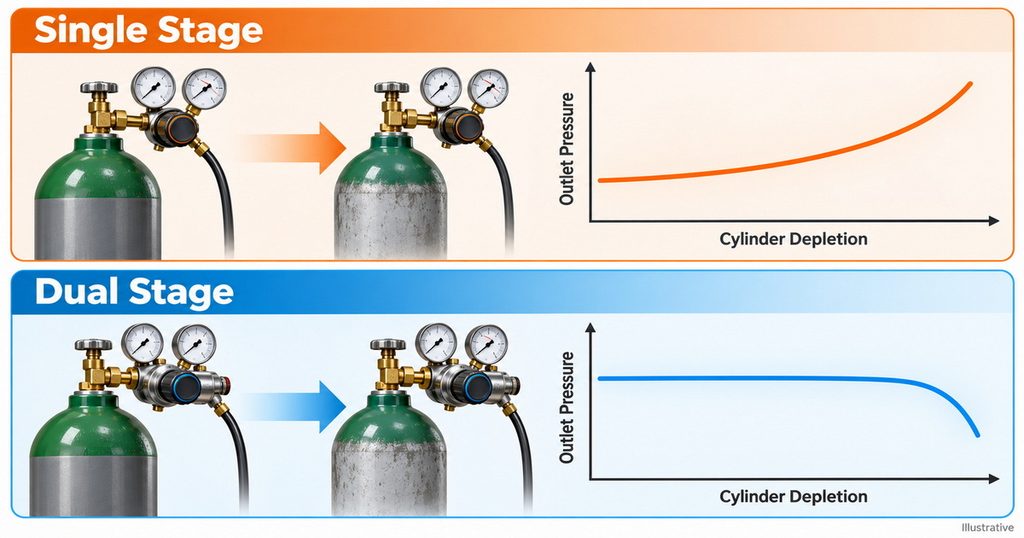
Supply pressure effect, also called inlet dependency, describes how outlet pressure changes when inlet pressure changes.
In many conventional unbalanced single-stage pressure-reducing regulators, delivery pressure rises as cylinder pressure falls. The changing inlet pressure alters the internal force balance, even when the adjustment handle remains untouched.
The direction and magnitude depend on regulator design. Buyers should therefore request measured inlet-dependency performance rather than assume all single-stage regulators behave identically.
A balanced-poppet single-stage design can reduce this effect. It may provide sufficient stability without requiring two-stage construction.
Droop and Creep Are Different Problems
Three pressure behaviors deserve separate attention:
– Supply pressure effect: Outlet pressure changes because inlet pressure changes.
– Droop: Outlet pressure falls as flow demand increases under otherwise comparable conditions.
– Creep: Outlet pressure continues rising after downstream flow stops, potentially indicating seat leakage.
This distinction matters during troubleshooting. A dual-stage regulator can reduce inlet dependency, but it does not automatically eliminate flow-related droop, seat contamination, or insufficient capacity.
A regulator should therefore be evaluated across inlet pressure, outlet pressure, and flow—not through one gauge reading.
High Pressure Single-Stage vs Dual Stage Regulator Comparison
| Selection factor | High-pressure single-stage regulator | Dual-stage regulator |
|---|---|---|
| Pressure reduction | One regulating stage | Two sequential regulating stages |
| Cylinder-emptying stability | More dependent on inlet sensitivity and balancing design | Generally less affected by changing cylinder pressure |
| Manual adjustment | May require correction during depletion | Usually requires fewer corrections |
| Flow capability | Model-dependent; suitable high-flow designs are available | Model-dependent; both stages must support demand |
| Construction | Generally simpler and more compact | Generally more complex |
| Initial cost | Often lower for comparable applications | Often higher for comparable applications |
| Best-fit duty | Attended processes with acceptable pressure variation | Processes requiring consistent delivery across depletion |
| End-of-cylinder behavior | Requires sufficient inlet-to-outlet pressure differential | Also requires adequate differential across the regulating system |
Neither construction guarantees suitability. Gas compatibility, flow capacity, outlet range, temperature limits, and downstream protection remain essential selection criteria.
A Worked Example: Quantifying Cylinder Emptying Stability
Consider an illustrative compressed-gas application with these conditions:
– Initial inlet pressure: 200 bar.
– Final evaluated inlet pressure: 20 bar.
– Required outlet pressure: 5 bar.
– Single-stage inlet sensitivity: 0.01 bar outlet change per bar inlet change.
The inlet-pressure change is 180 bar. At the assumed sensitivity, the outlet-pressure change would be approximately:
180×0.01=1.8 bar
For an unbalanced design exhibiting rising delivery pressure during depletion, a regulator initially set to 5 bar could approach 6.8 bar under those assumed conditions.
Now suppose two regulating stages each have an inlet-sensitivity magnitude of 0.01. A simplified two-stage estimate gives:
180×0.01×0.01=0.018 bar
This illustrates why sequential regulation can greatly reduce inlet dependency.
These figures are calculated examples, not specifications or test results for our products. Actual performance depends on stage settings, operating flow, temperature, and available pressure differential. The simplified relationship also stops being reliable once either stage leaves its regulating range.
When a High Pressure Single-Stage Regulator Is Enough
A suitable single-stage regulator can be the practical choice when:
– Operators remain present and can adjust delivery pressure.
– The process tolerates the documented pressure variation.
– Cylinder pressure changes relatively little between adjustments.
– A balanced design meets the stability requirement.
– Compact size or purchase cost is important.
For example, an attended welding station may not require the same pressure consistency as an automated gas-delivery process.
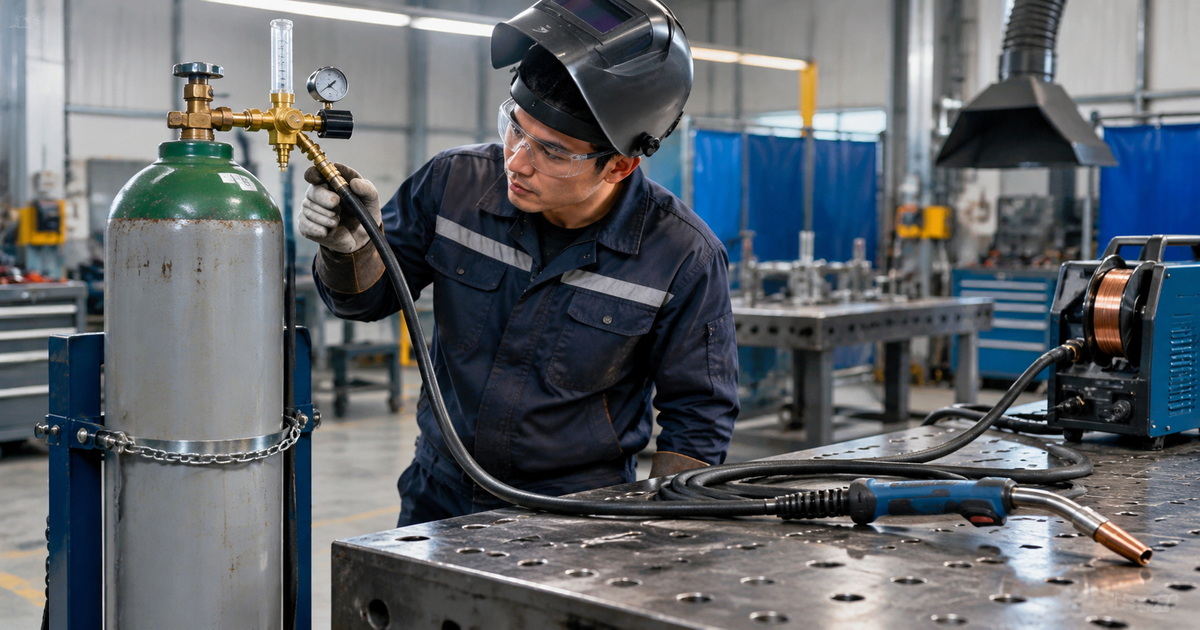
However, shielding-gas performance should be checked at the required flow. Stable pressure does not automatically guarantee stable gas delivery through every hose, valve, restriction, and torch configuration.
My purchasing priority would be to establish the acceptable operating window first. Paying for two stages adds little value if a qualified single-stage regulator already meets that window.
When a Dual Stage Regulator Is the Better Choice
A dual stage cylinder regulator becomes more attractive when inlet-pressure variation creates an unacceptable process disturbance.
Typical selection reasons include:
– Long operating periods with limited operator intervention.
– Narrow delivery-pressure tolerances.
– Repeatability requirements across cylinder changes.
– Pressure-sensitive downstream equipment.
– Production interruptions caused by repeated adjustments.
For OEM equipment manufacturers, this can also support a more consistent user experience. Customers should not need frequent regulator corrections simply because the cylinder has moved from nearly full to partly depleted.
The economic comparison should include adjustment time, rejected work, and downtime—not only the regulator’s purchase price.
Nevertheless, two-stage construction is not a substitute for sizing. An undersized dual-stage regulator may still show unacceptable pressure loss at peak demand.
Gas-Specific Differences That Change the Decision
Argon and Nitrogen: Evaluate the Full Inlet-Pressure Range
For argon and nitrogen supplied as compressed gases, falling cylinder pressure makes inlet dependency particularly relevant.
Specify the full-cylinder inlet pressure and the minimum pressure at which the process must still operate. Then compare regulator performance at both limits.
For welding systems, include the required shielding-gas flow and downstream arrangement. For nitrogen applications, distinguish low-flow instrument service from higher-flow purging or production demand.
CO₂: Separate Pressure Regulation from Thermal Management
CO₂ cylinders commonly contain liquefied gas. Their pressure does not follow the same simple depletion pattern as a cylinder containing only compressed gas.
While liquid and vapor coexist, cylinder pressure is strongly temperature-dependent. The pressure gauge is therefore not a straightforward measure of remaining CO₂ inventory.
CO₂ service also introduces cooling and freeze-up concerns during pressure reduction and sustained withdrawal.
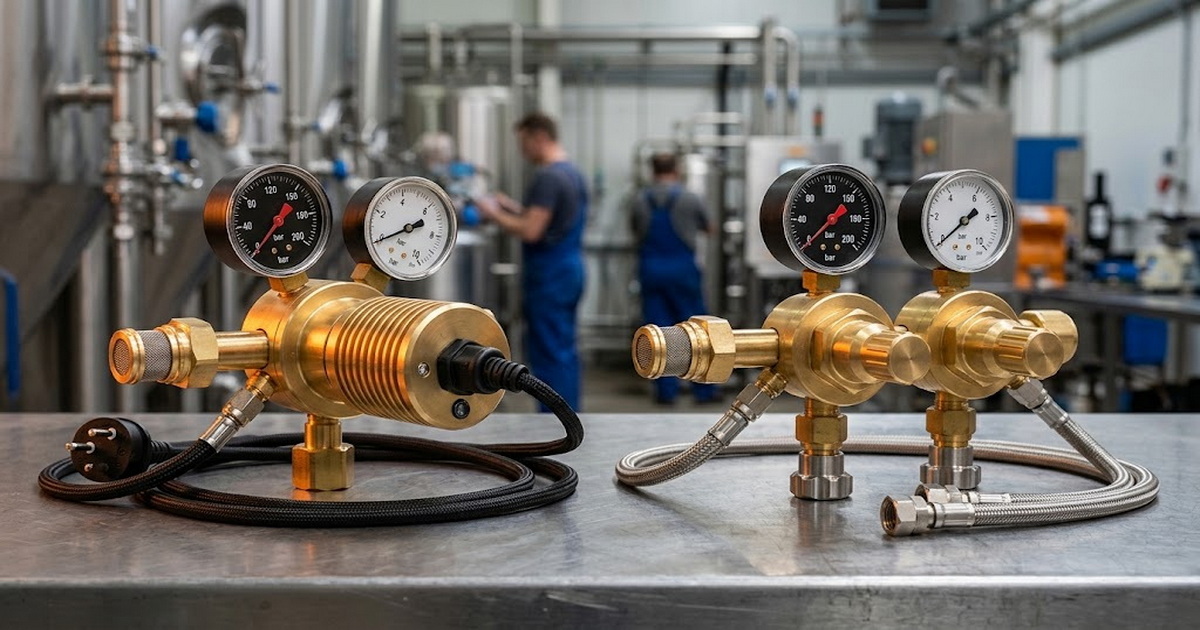
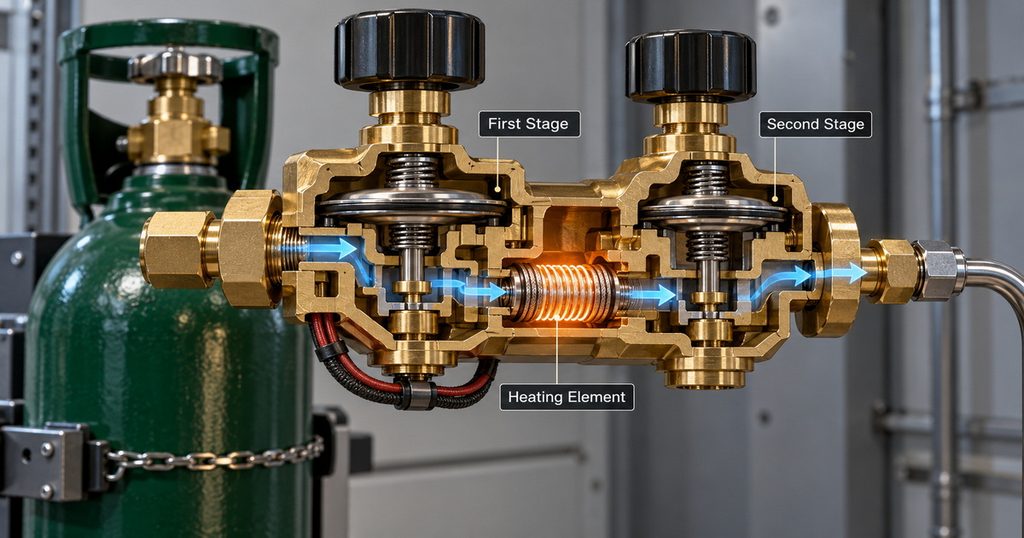
A CO₂ heated regulator addresses thermal conditions. A dual-stage regulator addresses pressure reduction and inlet dependency. These functions are complementary, not interchangeable.
Where both are necessary, specify an appropriately engineered heated two-stage solution. Do not assume that adding a heater increases the cylinder’s sustainable vapor-delivery capacity.
Oxygen, Acetylene, and Propane: Gas Service Comes First
A regulator must be designed and prepared for its actual gas service.
Oxygen applications require appropriate materials and oxygen-service cleanliness. Fuel-gas applications require the correct regulator, connections, operating limits, and associated protective equipment.
Neither a high inlet-pressure rating nor two-stage construction makes a regulator interchangeable across gases.
Use the gas supplier’s instructions and the equipment manufacturer’s operating requirements when establishing the final configuration.
A Practical Cylinder-Depletion Acceptance Test
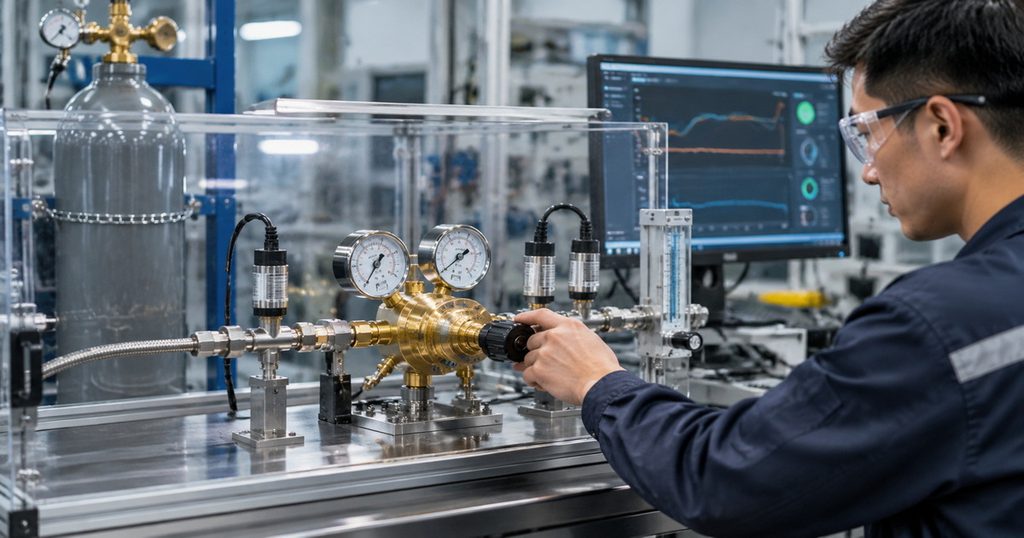
A procurement specification becomes more useful when “stable pressure” is converted into a measurable acceptance requirement.
Qualified personnel should conduct testing with suitable equipment, approved procedures, and gas-specific precautions.
Step 1: Define the Operating Envelope
Record:
– Gas and composition.
– Maximum and minimum inlet pressure.
– Target outlet pressure.
– Minimum, normal, and maximum flow.
– Ambient-temperature range.
– Permitted delivery-pressure variation.
State the measurement location. Pressure measured immediately after the regulator may differ from pressure available at the equipment inlet.
Step 2: Establish Performance Under Flow
Set the regulator at normal operating flow, following its instructions.
Measure performance at minimum and maximum demand. A no-flow gauge reading alone cannot establish suitability for a working welding or industrial gas circuit.
Step 3: Vary Inlet Pressure Without Readjustment
Evaluate several inlet-pressure points across the intended operating range.
Keep flow and temperature as consistent as practical. Record outlet pressure without correcting the adjustment handle.
This isolates cylinder-related drift more clearly than observations collected under changing production conditions.
Step 4: Check Shutoff and Restart Behavior
Assess lock-up behavior after flow stops, unexpected continued pressure rise, and response when demand restarts.
Investigate abnormal behavior rather than treating every pressure increase as ordinary inlet dependency.
Step 5: Identify the Usable Changeover Point
Determine when the regulator can no longer maintain the required outlet pressure and flow.
This establishes a practical cylinder-change threshold. It is more useful than claiming that a regulator remains stable until the cylinder is completely empty.
OEM and ODM Specifications That Prevent Buying Errors
For overseas brands, wholesalers, distributors, and equipment manufacturers, a useful inquiry should contain more than “brass dual-stage regulator.”
| Specification | What the buyer should provide or request |
|---|---|
| Gas service | Exact gas, mixture, and relevant purity requirements |
| Pressure range | Maximum inlet, minimum operating inlet, and outlet range |
| Capacity | Required flow with stated units and reference conditions |
| Stability | Maximum permitted drift across the inlet range |
| Connections | Destination-market cylinder and outlet interfaces |
| Materials | Gas-compatible body, seat, diaphragm, and seals |
| Thermal duty | Ambient limits and CO₂ heating requirements where applicable |
| Documentation | Inspection records, performance data, and applicable conformity evidence |
Brass quality matters, but it cannot compensate for unsuitable seat materials, poor cleanliness, or inadequate testing.
Specify the Regulator Around Your Process
Choose a regulator by the delivery conditions your process must maintain—not by the product label alone.
Send our engineering team your gas type, inlet-pressure range, target outlet pressure, peak flow, cylinder connection, and permitted pressure variation. We can review high-pressure, dual-stage, and heated CO₂ configurations for your OEM or ODM project and define the performance checks needed before production approval.
Frequently Asked Questions
1.Is a Dual Stage Regulator Better Than a High Pressure Regulator?
For cylinder-emptying stability, a properly selected dual-stage regulator generally performs better than a conventional unbalanced single-stage design. However, “high pressure” and “dual stage” are not mutually exclusive classifications.
2.Does a Two-Gauge Regulator Have Two Stages?
No. Gauge count indicates what pressures are displayed, not how many regulating mechanisms are inside. Check the technical description or construction drawing.
3.Will a Dual Stage Regulator Maintain Pressure Until the Cylinder Is Empty?
No. Both stages require adequate pressure differential. As inlet pressure becomes insufficient, the regulator cannot maintain its specified outlet pressure and flow.
4.Can a Single-Stage Regulator Provide Stable Delivery Pressure?
Yes. A balanced design or low-inlet-sensitivity model may meet the required tolerance. Evaluate its performance across the intended inlet-pressure and flow ranges.
5.Do I Need a Heated Regulator for CO₂?
That depends on withdrawal rate, operating duration, temperature, and equipment design. Heating addresses thermal problems; two-stage regulation addresses pressure-control behavior. Some applications require both.
6.What Information Should I Send for an OEM Regulator Quotation?
Provide the gas, cylinder connection, inlet-pressure range, outlet setting, flow demand, stability tolerance, destination market, and customization requirements. Include heating and documentation needs where relevant.
References
1. Swagelok. “Managing Supply Pressure Effect in Regulators.” Technical explanation of inlet dependency, balanced-poppet designs, two-stage reduction, and low-inlet-pressure limitations. [swagelok]
2. Swagelok. “Pressure Regulators, K Series,” publication MS-02-230. Manufacturer documentation covering regulator operation, supply pressure effect, and two-stage regulator behavior. [swagelok]
3. Swagelok Northern California. “Video: Another Way to Deal With the Supply Pressure Effect.” Explanation of the simplified combined-sensitivity calculation used as the basis for this article’s illustrative example. [northerncal.swagelok]
4. Air Products. “Carbon Dioxide,” Safetygram 18. Technical and safety information describing CO₂ as a liquefied compressed gas and its phase behavior. [airproducts]
5. Harris Products Group. “CO₂ Freeze-Up: Why It Happens, What You Can Do.” Industry guidance on freeze-up in CO₂ valves, regulators, and compressed-gas equipment. [harrisproductsgroup]
6. Harris Products Group. “Special Application Regulators.” Product information identifying electrically heated two-stage regulators for liquefied gases susceptible to freeze-up. [harrisproductsgroup]
7. ISO. “ISO 2503:2009—Gas welding equipment—Pressure regulators and pressure regulators with flow-metering devices for gas cylinders.” Standard preview published through ANSI; scope and applicability must be checked for the intended product. [webstore.ansi]
Hot Tags: High Pressure Gas Regulator, Dual Stage Gas Regulator, Two Stage Cylinder Regulator, Industrial Gas Pressure Regulator, High Pressure Regulator Manufacturer, Dual Stage Regulator Supplier, OEM Gas Pressure Regulator, CO₂ Heated Regulator, Argon Gas Regulator, Gas Regulator For Welding