Content Menu
● Heated CO₂ Regulator vs Dual Stage CO₂ Regulator: Key Differences
● How a Heated CO₂ Regulator Works
>> Surface Frost Does Not Always Mean Internal Blockage
>> Heater Wattage Is Not a Standalone Capacity Rating
● How a Dual-Stage CO₂ Regulator Works
>> Dual Stage Does Not Mean Dual Gauge
>> Pressure Stability Still Has Limits
● Which Design Better Supports Frozen Beverage Quality?
>> When Heating Provides More Value
>> When Two-Stage Regulation Provides More Value
● Match the Regulator to the Whole Gas System
>> Confirm These Inputs Before Requesting a Quotation
● A Practical Diagnostic Procedure Before Buying
>> Step 1: Record Performance During Real Demand
>> Step 2: Identify the Pattern
>> Step 3: Validate the Proposed Replacement
● Food-Contact Suitability: Industrial Quality Is Not Enough
>> Review Materials and Manufacturing Documentation
● OEM and ODM Specification Checklist for Overseas Buyers
>> Pressure and Flow Requirements
>> Heating and Protection Requirements
>> Quality Inspection Requirements
● Compare Lifecycle Cost, Not Just Purchase Price
● Final Selection and Application Review
>> 1. Can a heated CO₂ regulator also be dual-stage?
>> 2. Will a dual-stage CO₂ regulator prevent all freezing?
>> 3. Is a dual-gauge regulator the same as a dual-stage regulator?
>> 4. What pressure should a frozen beverage plant use?
>> 5. Can we use a welding CO₂ regulator for beverage production?
>> 6. Should we replace a regulator as soon as frost appears?
>> 7. What safety measures are essential around CO₂ systems?
Choosing a heated CO₂ regulator vs dual stage CO₂ regulator for frozen beverage plants starts with identifying the actual problem: freezing during gas withdrawal, unstable delivery pressure, or both. A heated regulator adds thermal energy to help prevent freeze-up. A dual-stage regulator reduces pressure in two steps to minimize the effect of changing supply pressure.
These features are not mutually exclusive. A regulator can combine electrical heating with two-stage pressure reduction.
From a manufacturing and application-selection perspective, the most important question is not which label sounds more advanced. It is which design maintains the required pressure and flow under your plant’s actual operating conditions.
This comparison focuses on frozen carbonated beverage production and dispensing systems. Noncarbonated frozen drinks may have different gas requirements.
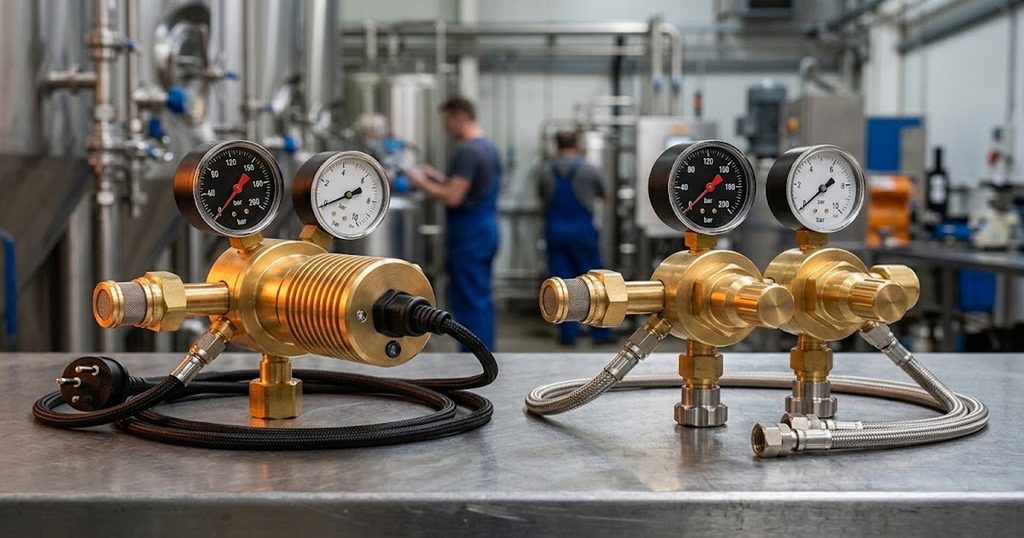
Heated CO₂ Regulator vs Dual Stage CO₂ Regulator: Key Differences
The central distinction is function: heating addresses thermal limitations, while two-stage regulation primarily addresses inlet-pressure variation.
| Comparison factor | Heated CO₂ regulator | Dual-stage CO₂ regulator |
|---|---|---|
| Main purpose | Help prevent freeze-up during CO₂ withdrawal | Minimize outlet-pressure changes caused by changing inlet pressure |
| Operating principle | Adds heat near the pressure-reduction process | Reduces pressure through two sequential regulating stages |
| Electrical supply | Required for electrically heated models | Not required unless heating or other electrical features are included |
| Main selection concern | Verified continuous-flow capacity under stated thermal conditions | Pressure stability across the specified inlet-pressure range |
| High-flow performance | Depends on heater capacity and regulator design | Depends on flow capacity, pressure differential, and thermal design |
| Typical maintenance focus | Heater, electrical connections, seals, and regulating components | Both regulating stages, seats, seals, and pressure performance |
| Important limitation | Heating alone does not guarantee stable outlet pressure | Two stages alone do not guarantee freedom from freezing |
A heated single-stage regulator and an unheated dual-stage regulator therefore solve different problems. Where both problems exist, a heated dual-stage CO₂ regulator may be appropriate.
How a Heated CO₂ Regulator Works
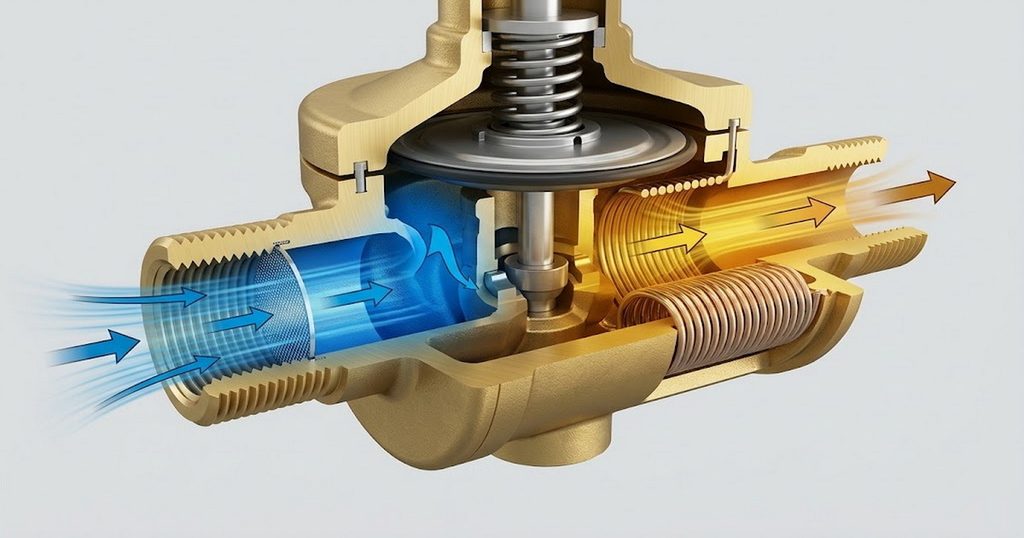
CO₂ can cool substantially as pressure falls through a regulator. Under demanding withdrawal conditions, this cooling can interfere with reliable gas delivery.
A heated CO₂ regulator introduces heat to help maintain operation within its specified limits. The heater’s location, thermal controls, body design, inlet conditions, and gas flow all affect performance.
Surface Frost Does Not Always Mean Internal Blockage
A cold regulator can collect atmospheric moisture that freezes on its exterior. This visible frost does not automatically mean that solid CO₂ is blocking the internal gas path.
A useful diagnosis distinguishes between:
– External frost with acceptable pressure and flow.
– Falling delivery pressure during sustained demand.
– Internal restrictions or seat malfunction.
– Inadequate vapor supply upstream.
Replacing a frosted regulator without checking operating performance can lead to unnecessary expense.
Heater Wattage Is Not a Standalone Capacity Rating
A larger wattage number does not prove that a regulator will support your production line.
For context, Harris technical literature describes a particular heated regulator using a 200-watt heater for continuous CO₂ delivery of 100 standard cubic feet per hour under stated severe freeze-up conditions. That is a product-specific rating, not a general rule for every 200-watt regulator.
Ask suppliers for the conditions behind any capacity claim, including inlet pressure, ambient temperature, outlet pressure, and continuous operating duration.
How a Dual-Stage CO₂ Regulator Works
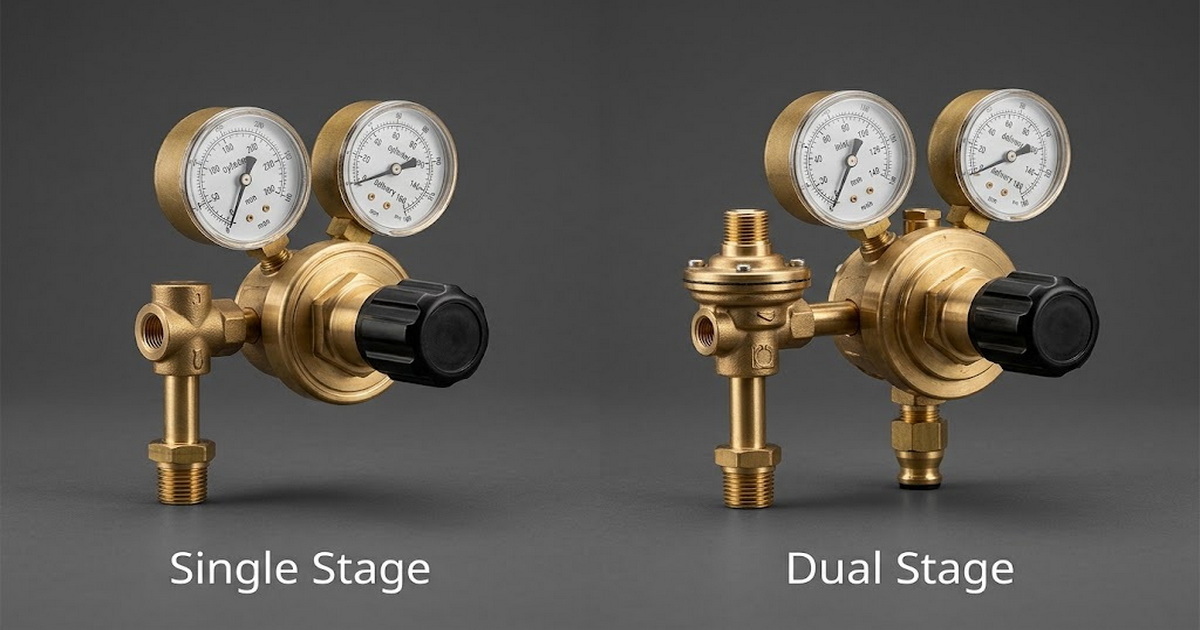
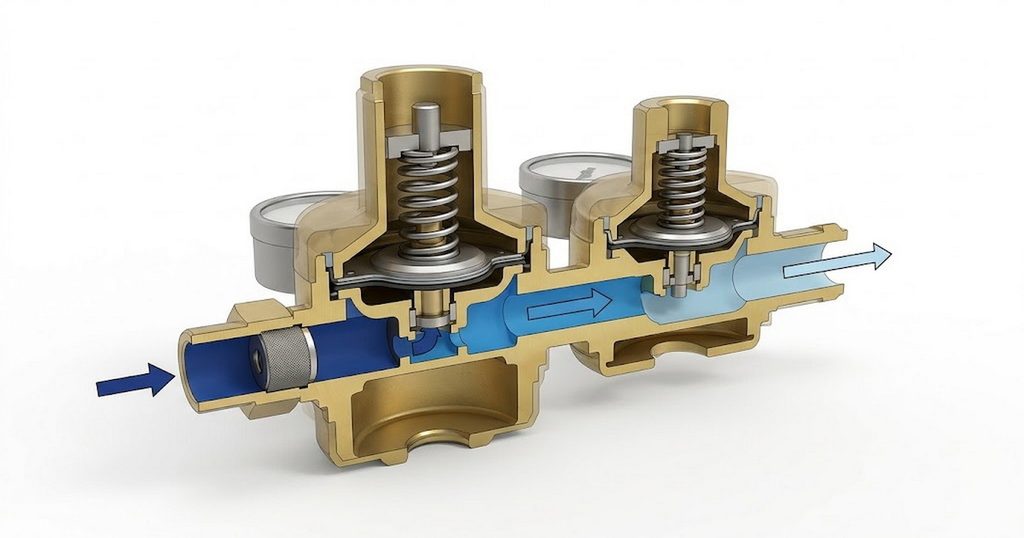
A dual-stage CO₂ regulator reduces supply pressure to an intermediate pressure, then reduces it again to the final delivery pressure.
This arrangement reduces supply pressure effect: the tendency for outlet pressure to change when inlet pressure changes.
It can be valuable where downstream equipment needs consistent pressure despite variations in the gas supply.
Dual Stage Does Not Mean Dual Gauge
Two gauges usually show inlet and outlet pressure. They do not prove that a regulator contains two regulating stages.
A dual-gauge regulator may still be single-stage.
For procurement, request a technical drawing or product specification confirming the internal pressure-reduction arrangement.
Pressure Stability Still Has Limits
Two-stage construction does not eliminate every source of pressure variation.
Outlet pressure can still fall as demand increases. This behavior, called droop, must be evaluated using suitable flow curves.
A regulator may also lose its intended two-stage behavior when inlet pressure falls below the pressure needed for the first stage to operate properly.
The practical takeaway is simple: compare documented performance, not just product descriptions.
Which Design Better Supports Frozen Beverage Quality?
Stable gas delivery supports repeatable equipment operation. However, neither regulator type independently controls every aspect of beverage quality.
Product consistency also depends on temperature, formulation, mixing, refrigeration performance, and the machine’s internal controls.
When Heating Provides More Value
Heating deserves priority when:
– Gas delivery deteriorates during sustained withdrawal.
– Freeze-related interruptions have been confirmed.
– Peak demand exceeds the existing regulator’s verified thermal capacity.
– The installation experiences demanding ambient conditions.
First confirm that the supply arrangement provides the phase of CO₂ required by the regulator. A heater should not be treated as permission to use an incompatible liquid-withdrawal connection.
When Two-Stage Regulation Provides More Value
Two-stage regulation deserves priority when:
– Outlet pressure changes as supply pressure changes.
– Operators repeatedly readjust the regulator.
– Downstream equipment has a narrow acceptable inlet-pressure range.
– The application requires documented pressure consistency across varying inlet conditions.
Where the plant already has a stable, regulated bulk supply, an additional dual-stage regulator may provide less benefit than correcting undersized piping or inadequate branch regulation.
Match the Regulator to the Whole Gas System
A frozen beverage plant may have separate pressure requirements for the main supply, syrup pumps, beverage injection, and expansion tanks.
These duties should not be combined into one assumed setpoint.
For example, one Cornelius Viper commissioning guide specifies 75–80 psi for the external machine supply while listing lower settings for internal injection and expansion functions. Those figures apply to the identified equipment configuration; they are not universal plant settings.
Confirm These Inputs Before Requesting a Quotation
Give your regulator manufacturer:
1. Supply type: cylinder bank, manifold, or bulk system.
2. Gas phase at the regulator inlet.
3. Minimum and maximum inlet pressure.
4. Required outlet pressure and permitted variation.
5. Peak simultaneous gas demand.
6. Longest expected continuous operating period.
7. Ambient temperature range and installation conditions.
8. Available electrical supply, if heating is proposed.
Also identify pipe lengths, restrictions, branch equipment, and future expansion plans.
A regulator cannot compensate for every limitation elsewhere in the distribution system.
A Practical Diagnostic Procedure Before Buying
The following application-review framework helps separate thermal problems from pressure-control problems. It is a proposed diagnostic approach, not a substitute for the equipment manufacturer’s service instructions.
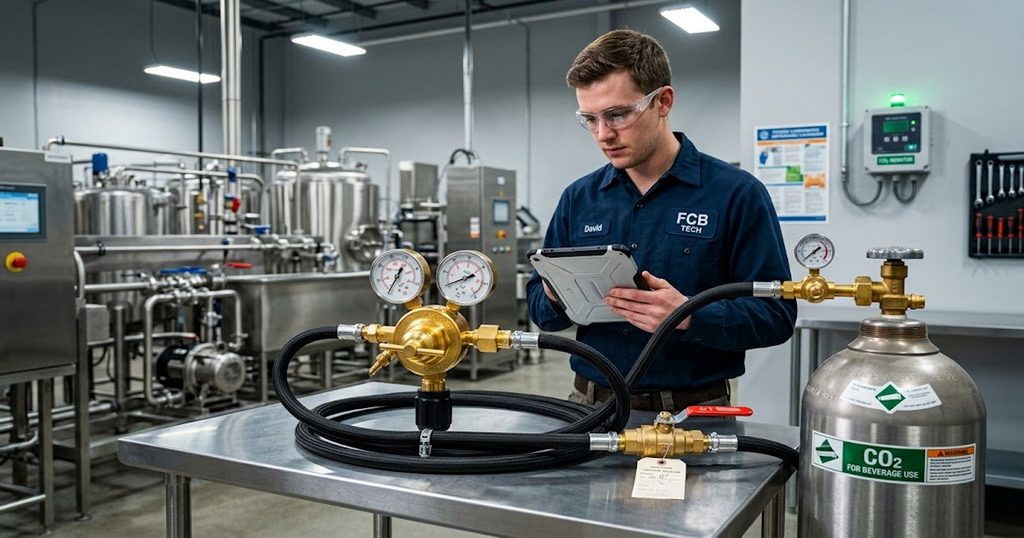
Step 1: Record Performance During Real Demand
Have qualified personnel record:
– Inlet pressure.
– Regulator outlet pressure.
– Pressure near the affected machine.
– Flow or a repeatable production-demand indicator.
– Ambient conditions.
– Heater status, where applicable.
Record these values during startup and sustained operation.
Step 2: Identify the Pattern
| Observed pattern | Possible explanation | Next verification |
|---|---|---|
| Pressure falls mainly during high flow | Regulator droop, undersizing, or line restriction | Compare flow curves and upstream/downstream pressures |
| Delivery changes as inlet pressure changes | Supply pressure effect | Evaluate suitable two-stage or balanced designs |
| Performance worsens after prolonged withdrawal | Thermal limitation or inadequate source vapor delivery | Review continuous-duty ratings and supply capacity |
| Outlet pressure rises at zero demand | Seat leakage or another fault | Isolate safely and arrange qualified inspection |
| Regulator pressure is acceptable, machine pressure is low | Distribution pressure loss | Inspect piping, valves, filters, and branch capacity |
Step 3: Validate the Proposed Replacement
Test the candidate under representative peak demand.
Agree on acceptance criteria before purchasing: allowable pressure variation, continuous operating duration, leak-test requirements, and protective functions.
This produces a more useful purchasing decision than comparing gauge size or maximum pressure alone.
Food-Contact Suitability: Industrial Quality Is Not Enough
A regulator suitable for welding is not automatically suitable for beverage service.
Food and beverage applications require attention to both gas quality and every relevant gas-contact component.
In the United States, the carbon dioxide regulation requires purity suitable for the intended use and use consistent with current good manufacturing practice. That requirement should not be confused with blanket approval of a particular regulator.
Review Materials and Manufacturing Documentation
Ask for documentation covering:
– Brass alloy or alternative body material.
– Gas-contact seals and diaphragms.
– Lubricants and assembly aids.
– Cleaning procedures and contamination controls.
– Batch identification and traceability.
– Applicable declarations for the destination market.
“High-quality brass” is not a complete material specification. Alloy composition, manufacturing cleanliness, and application suitability matter alongside machining precision.
For electrically heated models, also verify voltage, grounding, overtemperature protection, environmental suitability, and applicable electrical approvals.
Do not assume an industrial heater is suitable for washdown conditions.
OEM and ODM Specification Checklist for Overseas Buyers
For brands, wholesalers, and equipment manufacturers, customization should begin with operating requirements rather than branding.
A useful specification separates pressure performance, thermal performance, and compliance documentation.
Pressure and Flow Requirements
Define:
– Operating inlet-pressure range.
– Adjustable outlet-pressure range.
– Acceptable droop at specified flow.
– Supply pressure effect.
– Lock-up behavior and permissible leakage.
– Connection standards and installation orientation.
Heating and Protection Requirements
For heated models, define:
– Supply voltage and frequency.
– Heater rating and control method.
– Continuous-duty performance conditions.
– Overtemperature protection.
– Installation and environmental limits.
– Serviceable components and replacement availability.
Quality Inspection Requirements
Request an agreed inspection plan covering pressure integrity, external leakage, functional regulation, and traceability.
Additional thermal or electrical testing should match the final design.
Our manufacturing approach emphasizes precision machining, stable pressure control, brass material selection, and strict inspection. For beverage projects, those capabilities must be translated into an application-specific specification supported by appropriate documentation.
Compare Lifecycle Cost, Not Just Purchase Price
An unheated regulator avoids heater electricity consumption. A heated model may reduce disruption where thermal limitations are the actual cause.
However, neither design guarantees lower operating cost without site evidence.
Compare:
– Initial purchase and installation.
– Electrical installation where needed.
– Inspection and spare parts.
– Adjustment and maintenance labor.
– Recorded downtime.
– Product loss attributable to gas-delivery faults.
A useful estimate is annual avoidable downtime multiplied by the plant’s documented downtime cost. Compare that figure with the proposed system’s annualized additional cost.
Use measured plant records rather than generic savings percentages.
Final Selection and Application Review
Choose a heated CO₂ regulator when verified thermal limitations threaten delivery.
Choose a dual-stage CO₂ regulator when changing inlet pressure causes unacceptable outlet-pressure variation.
Consider a combined design when both conditions are present. In every case, verify food-service suitability, required flow, installation conditions, and downstream pressure requirements.
For an OEM or ODM quotation, send us your supply arrangement, inlet-pressure range, target outlet pressure, peak flow, operating schedule, destination market, and electrical requirements. Our team can use these inputs to propose a regulator configuration and an agreed validation plan.
Frequently Asked Questions
1. Can a heated CO₂ regulator also be dual-stage?
Yes. Heating and two-stage pressure reduction are separate design features. A regulator can incorporate both to address thermal limitations and supply pressure effect.
2. Will a dual-stage CO₂ regulator prevent all freezing?
No. Some designs improve thermal performance, but two-stage construction alone does not guarantee freeze-free operation. Confirm the manufacturer’s continuous-flow rating and operating conditions.
3. Is a dual-gauge regulator the same as a dual-stage regulator?
No. Gauge count indicates available pressure readings, not the number of regulating stages. Verify the internal design through technical documentation.
4. What pressure should a frozen beverage plant use?
Follow the equipment manufacturer’s requirements for each circuit. Main supply, injection, syrup-pump, and expansion pressures may differ. There is no universal setting for all plants.
5. Can we use a welding CO₂ regulator for beverage production?
Do not assume suitability. Confirm gas-contact materials, cleanliness, pressure performance, and destination-market requirements. Industrial gas compatibility alone does not establish beverage suitability.
6. Should we replace a regulator as soon as frost appears?
Not necessarily. External frost can occur without loss of function. Check pressure and flow performance, then have qualified personnel investigate any abnormal behavior.
7. What safety measures are essential around CO₂ systems?
Provide ventilation and CO₂ monitoring as required by applicable rules and the site risk assessment. CO₂ can accumulate and create dangerous atmospheres. Never modify equipment or improvise heating methods.
References
1. Harris Products Group. [Carbon Dioxide Regulator Freezing]. Explains CO₂ freeze-up, external frost, and the role of heated regulators. [harrisproductsgroup]
2. Harris Products Group. [Specialty Gas Pressure & Flow Control Equipment Catalog]. Provides model-specific heated regulator construction and continuous-flow performance information. [ch-delivery.lincolnelectric]
3. Swagelok. [Managing Supply Pressure Effect in Regulators]. Explains inlet dependency, two-stage pressure reduction, and operating limitations. [swagelok]
4. Swagelok. [Pressure Regulator Flow Curves]. Explains flow-related pressure droop and interpretation of regulator performance. [swagelok]
5. Cornelius. [Viper FCB Installation and Commissioning Guide]. Provides equipment-specific supply and internal regulator settings; these should not be generalized to other systems. [marmonlink-apac]
6. Electronic Code of Federal Regulations. [21 CFR §184.1240—Carbon Dioxide]. Establishes intended-use purity and current good manufacturing practice conditions for food use. [ecfr]
7. Compressed Gas Association. [Carbon Dioxide Safety]. Covers CO₂ hazards, ventilation, monitoring, and safe equipment practices. [cganet]
Hot Tags: CO₂ Regulator Manufacturer, Heated CO₂ Regulator, Dual Stage CO₂ Regulator, Industrial CO₂ Pressure Regulator, Beverage CO₂ Regulator, CO₂ Regulator Supplier, OEM CO₂ Regulator, Food Grade CO₂ Regulator, Two Stage Gas Regulator, CO₂ Regulator for Frozen Beverage Machines