Content Menu
● CO₂ and Mixed Gas Regulators at a Glance
● How the Gases Affect MIG Welds
>> Straight CO₂: Lower Gas Cost, More Cleanup Potential
>> Argon/CO₂ Blends: Smoother Arc, Different Gas Cost
● What Makes the Regulators Different?
>> Cylinder Connection and Gas Approval
>> Pressure Control Is Not Flow Measurement
>> CO₂ Freeze-Up and Continuous Duty
● A Practical Selection and Test Method
>> Match the Hardware Before Welding
>> Run a Controlled Shop Trial
>> 1.Can I Use One Regulator for Both Gases?
>> 2.Does C25 Need a Heated Regulator?
>> 3.Is 100% CO₂ Better for Penetration?
>> 4.What Flow Rate Should I Start With?
>> 5.Is C25 Suitable for Spray Transfer?
>> 6.Why Is There Frost on My CO₂ Regulator?
A CO₂ gas regulator vs mixed gas regulator for MIG welding comparison is not simply a choice between two labels on a gauge. The right setup depends on the shielding gas in the cylinder, its valve connection, the flowmeter scale, the expected gas demand, and whether sustained CO₂ withdrawal could cause freeze-up. For mild-steel MIG welding, both 100% CO₂ and argon/CO₂ blends can work well—but they serve different production priorities.
The most important distinction is this: the shielding gas changes the arc; the regulator delivers that gas at a usable, dependable flow. Buying a mixed-gas regulator will not make straight CO₂ weld like an argon blend. Likewise, switching cylinders without checking regulator compatibility can create a connection, measurement, or performance problem.
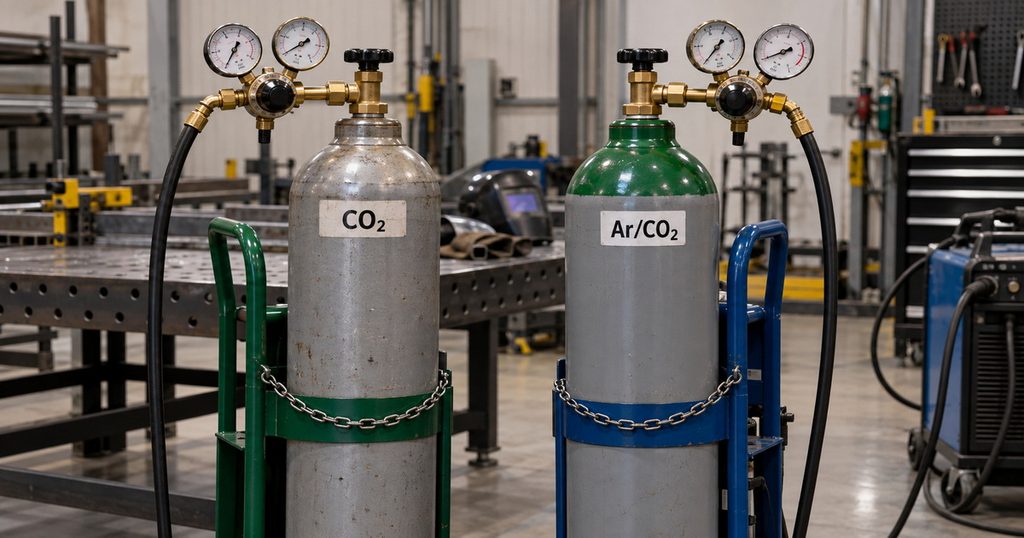
CO₂ and Mixed Gas Regulators at a Glance
In this article, *mixed gas regulator* means a regulator or flowmeter-regulator intended for a premixed argon/CO₂ shielding-gas cylinder—often called C25 when the blend is 75% argon and 25% CO₂. It does not mean a device that blends two separate cylinders. A gas mixer is a different piece of equipment.
| Selection factor | CO₂ gas regulator | Argon/CO₂ mixed gas regulator |
|---|---|---|
| Intended supply | A cylinder of 100% CO₂ | A cylinder containing a premixed argon/CO₂ blend |
| Typical U.S. cylinder inlet | CGA-320 on the CO₂ models cited below | CGA-580 on the argon/CO₂ models cited below |
| Flow indication | Use the manufacturer-specified CO₂ scale or calibration | Use the manufacturer-specified argon/CO₂ scale; one Miller series directs users to read its argon scale for the blend |
| Sustained high demand | Check CO₂ withdrawal capacity and whether a heat exchanger or approved heater is needed | Select a flow capacity appropriate to the number of welding stations |
| Best starting question | “Is the setup rated for my CO₂ cylinder and expected continuous flow?” | “Is it rated for my blend, cylinder connection, and required flow range?” |
These connections and scale instructions are examples from published product specifications, not a substitute for checking the markings on the actual cylinder and regulator in your market.
For a typical mild-steel short-circuit MIG job, Miller recommends a starting shielding-gas flow of 25–35 cubic feet per hour (CFH). That is a process recommendation, not a universal setting: nozzle size, drafts, equipment instructions, and the welding procedure still matter. More flow is not automatically better; excessive flow can disturb shielding and contribute to porosity.
How the Gases Affect MIG Welds
Straight CO₂: Lower Gas Cost, More Cleanup Potential
For mild steel, 100% CO₂ is a practical shielding-gas option. Miller describes it as a cost-effective alternative to C25, while noting that it may produce more spatter and a less consistent-feeling arc. Miller also identifies straight CO₂ as capable of good penetration on carbon steel.
That does not mean every CO₂ weld penetrates more deeply than every mixed-gas weld. Weld current, wire feed speed, transfer mode, travel speed, and contact-tip-to-work distance also affect the result. Lincoln Electric identifies current as the variable with the greatest effect on penetration and describes shielding gas as one of several influences on the penetration profile. A sound comparison holds the other variables as consistent as the procedure allows.
Straight CO₂ may suit a shop that welds mild steel, is sensitive to cylinder-gas cost, and can tolerate additional spatter removal. But a low purchase price per cylinder is only one cost. Nozzle cleaning, grinding, rework, and interruptions belong in the decision as well. Miller specifically advises welding operations to consider the longer-term cost of cleanup and rework rather than selecting inputs on upfront price alone.
Argon/CO₂ Blends: Smoother Arc, Different Gas Cost
For general mild-steel MIG work, C25—75% argon and 25% CO₂—is a common choice. Miller reports that it provides favorable arc characteristics, relatively little spatter, and a good bead profile, while generally costing more than straight CO₂.
“Mixed gas” is not one fixed recipe. Miller identifies 90% argon/10% CO₂ (C10) as an option for spray-transfer work on thicker plate. Lincoln Electric’s process guidance places argon-rich mixtures with up to 18% CO₂ in its axial or pulsed-spray guidance; the appropriate blend still depends on the wire, power source, program, and procedure. Do not assume C25, C10, and 100% CO₂ are interchangeable settings.
Material matters, too. A mild-steel shielding-gas decision should not be copied directly to aluminum or stainless steel. Miller identifies 100% argon as a common choice for aluminum MIG welding and discusses different, low-CO₂ blends for stainless-steel applications. Check the filler-wire and machine recommendations before choosing either the gas or its delivery equipment.
What Makes the Regulators Different?
Cylinder Connection and Gas Approval
The inlet fitting is the first compatibility check. Miller’s published heavy-duty range lists CGA-320 inlets for its CO₂ models and CGA-580 inlets for its argon/CO₂ models. These are product-specific specifications, not permission to choose a regulator by thread appearance alone.
Read the regulator’s gas-service marking and data sheet alongside the cylinder label. Confirm the permitted inlet pressure, outlet arrangement, flow range, and hose connection. A fitting that can be made to connect is not, by itself, evidence that the complete assembly is suitable for the gas and duty cycle. For U.S. oxygen-fuel equipment, OSHA expressly requires pressure-reducing regulators to be used only for their intended gases and pressures; that rule should not be misrepresented as a MIG-specific flow-setting standard.
This distinction also matters for manufacturers serving several product categories. A CO₂ or argon/CO₂ MIG regulator should never be marketed as interchangeable with an oxygen, acetylene, or propane regulator merely because a product family uses brass bodies or similar-looking gauges. Each application needs its own approved gas service, connection, pressure rating, and documentation.
Pressure Control Is Not Flow Measurement
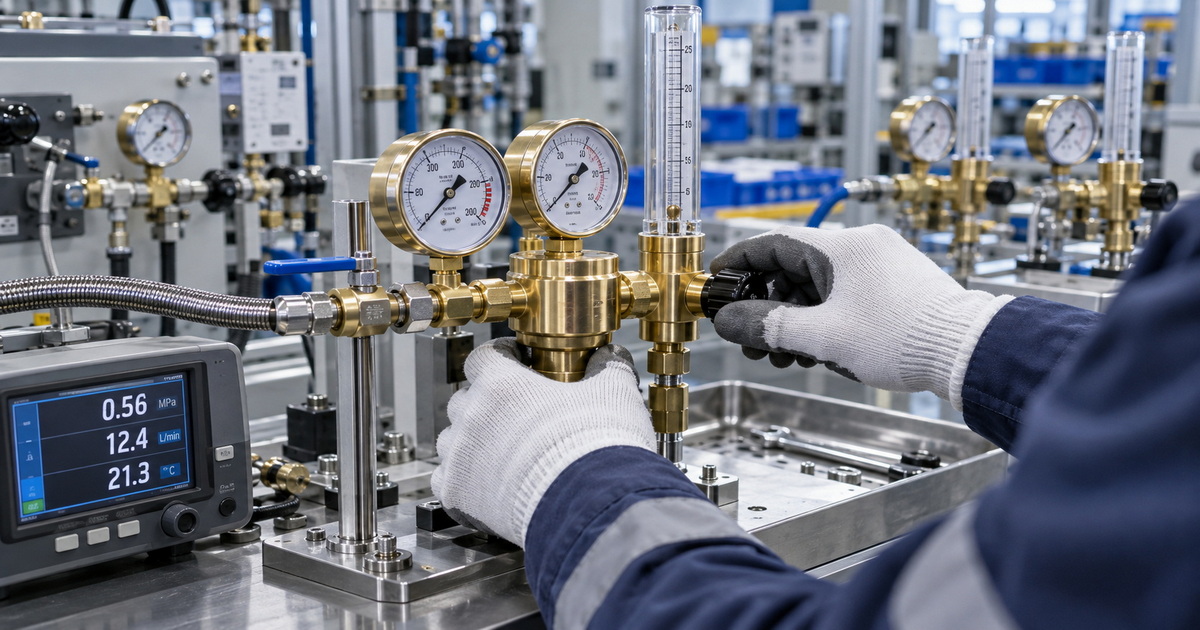
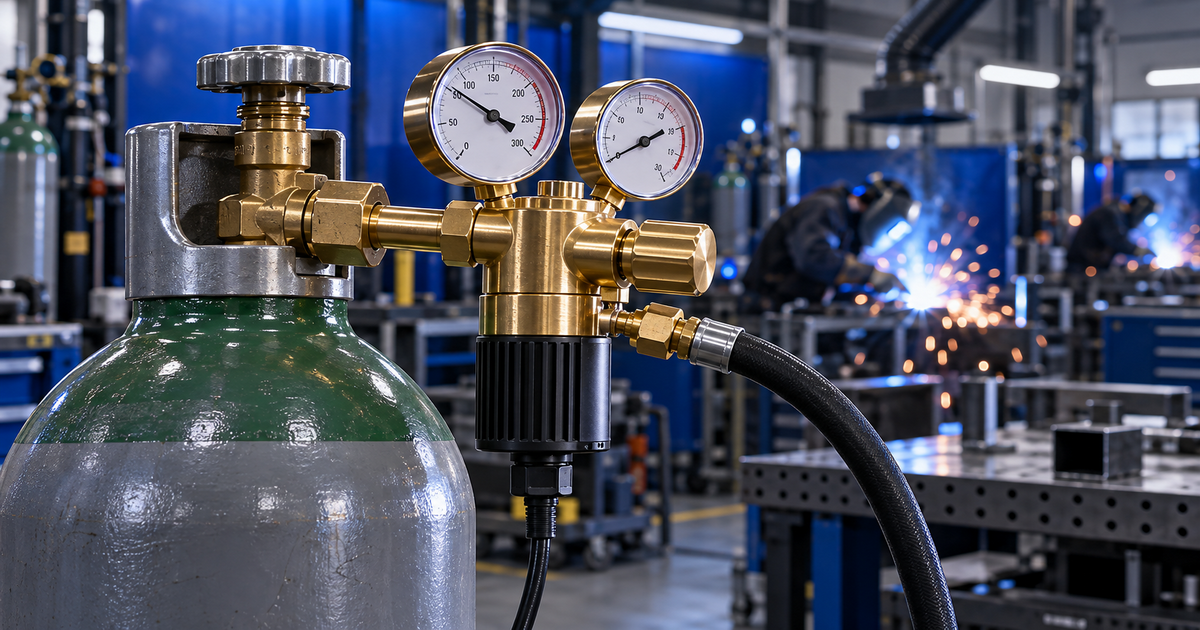
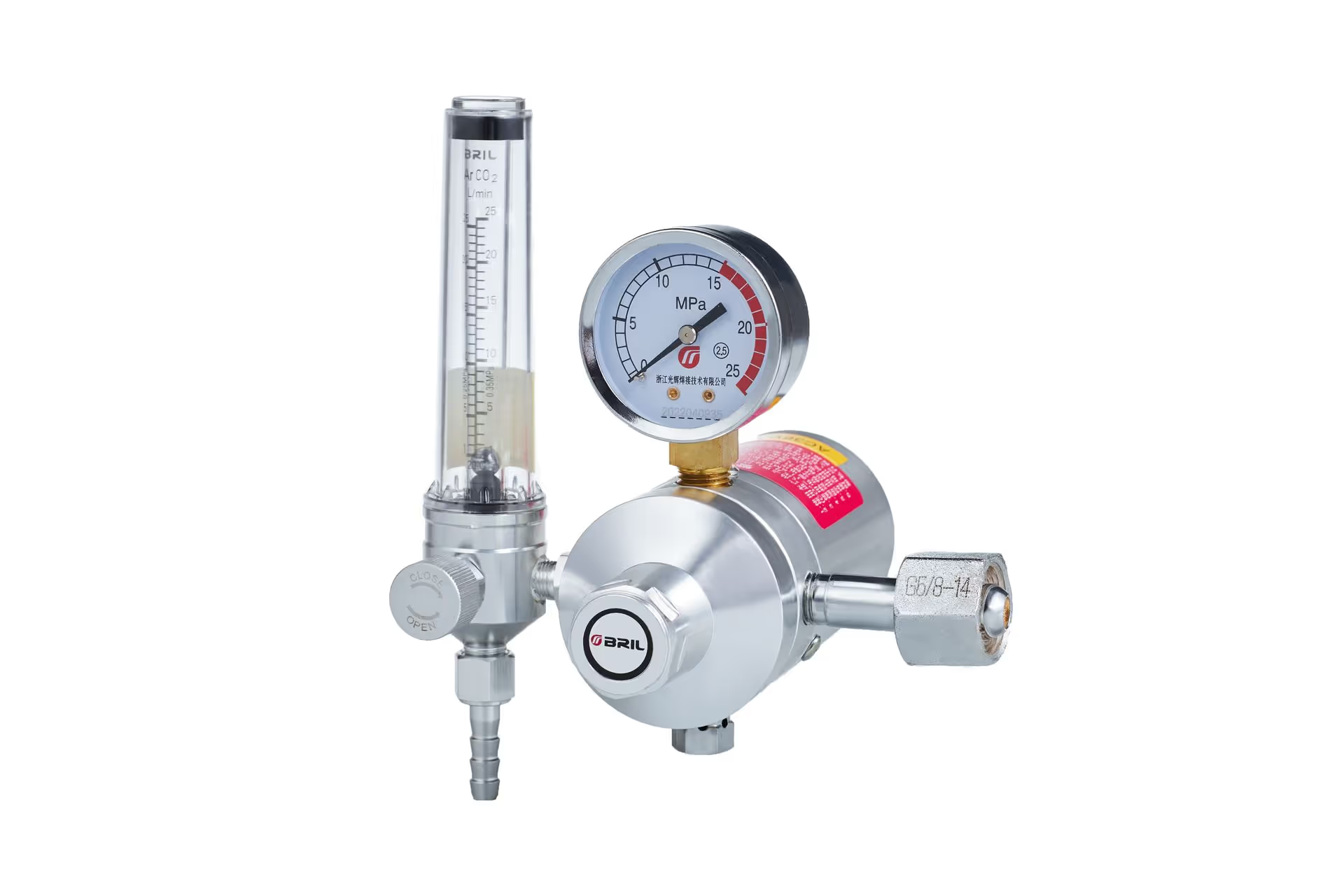
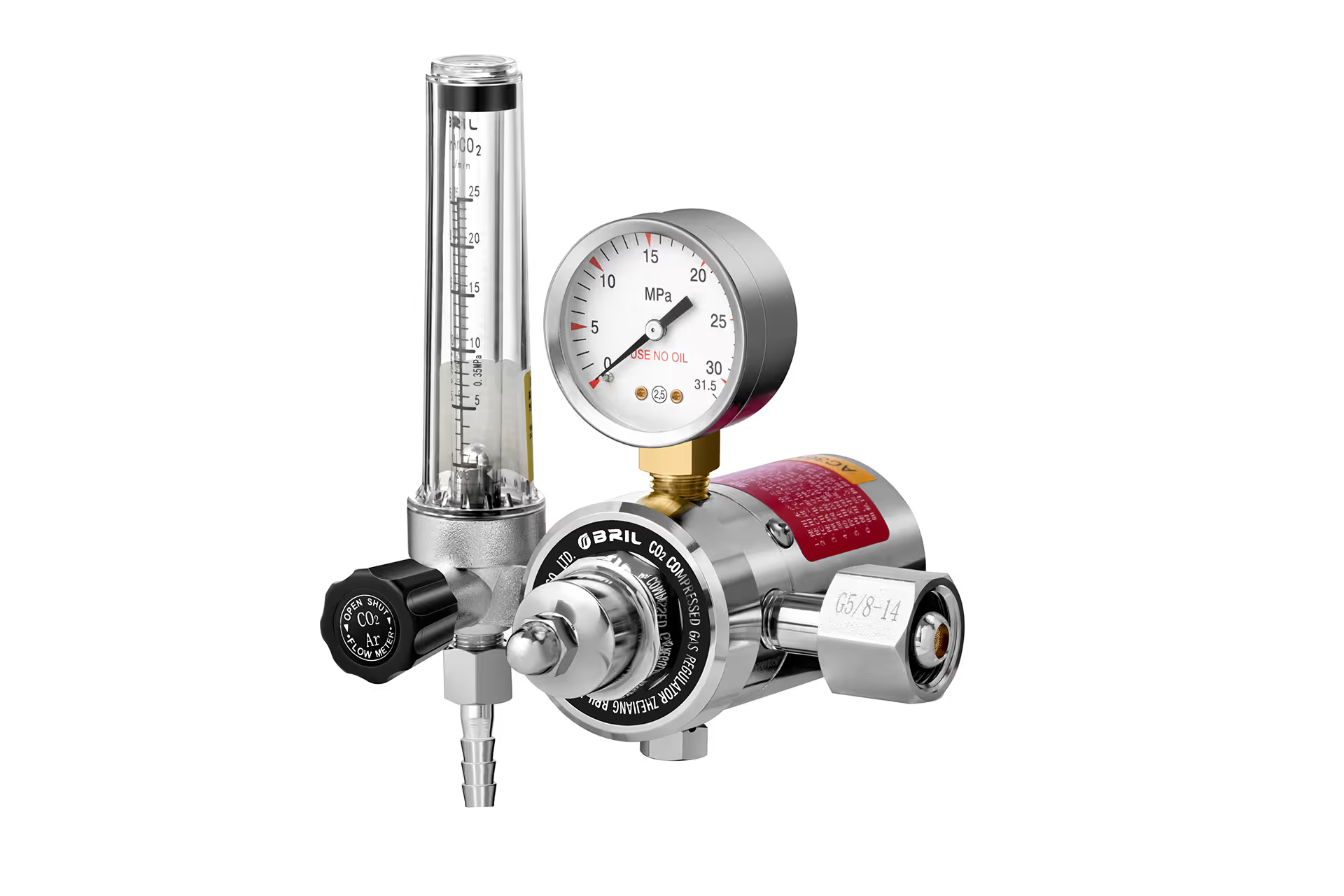
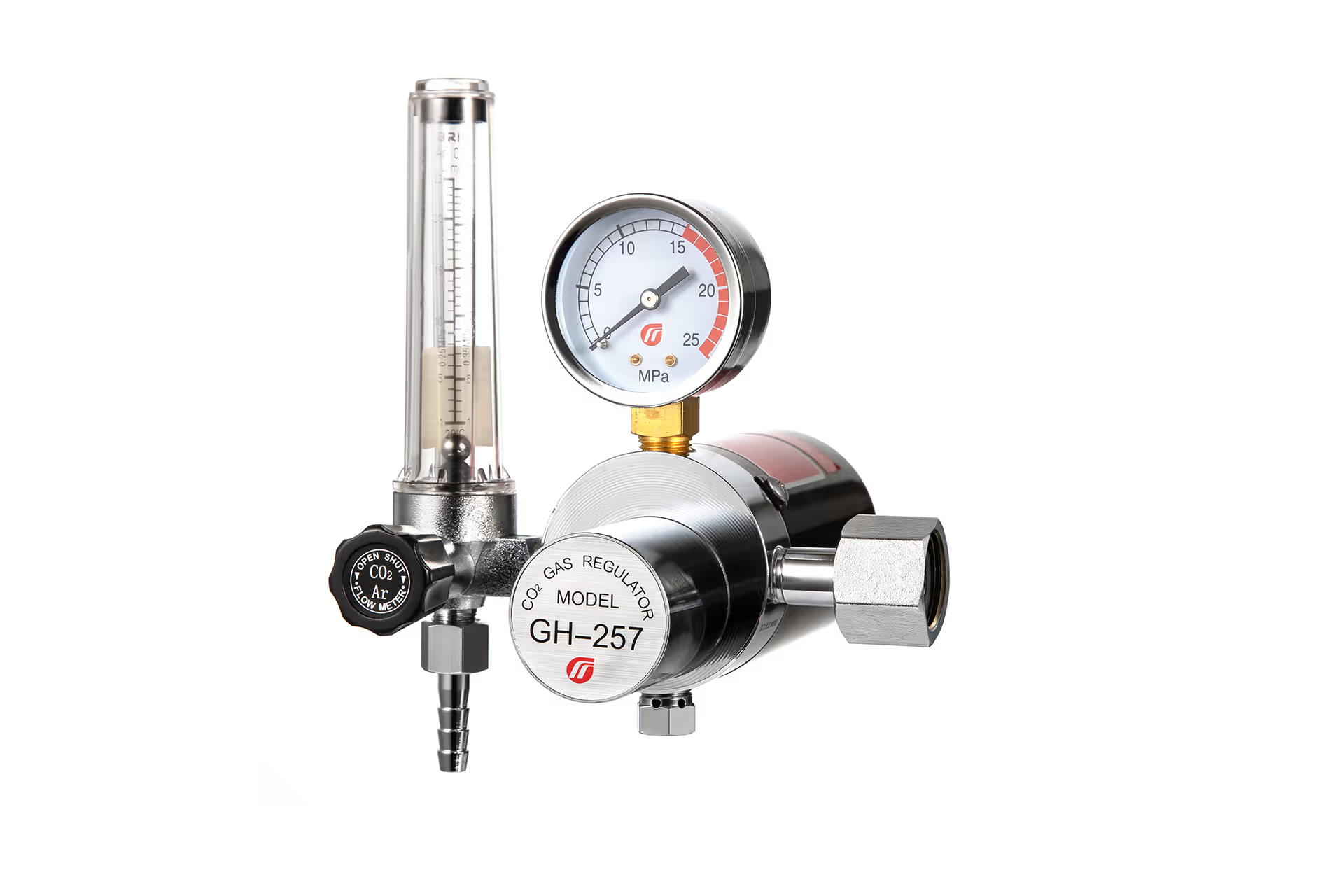
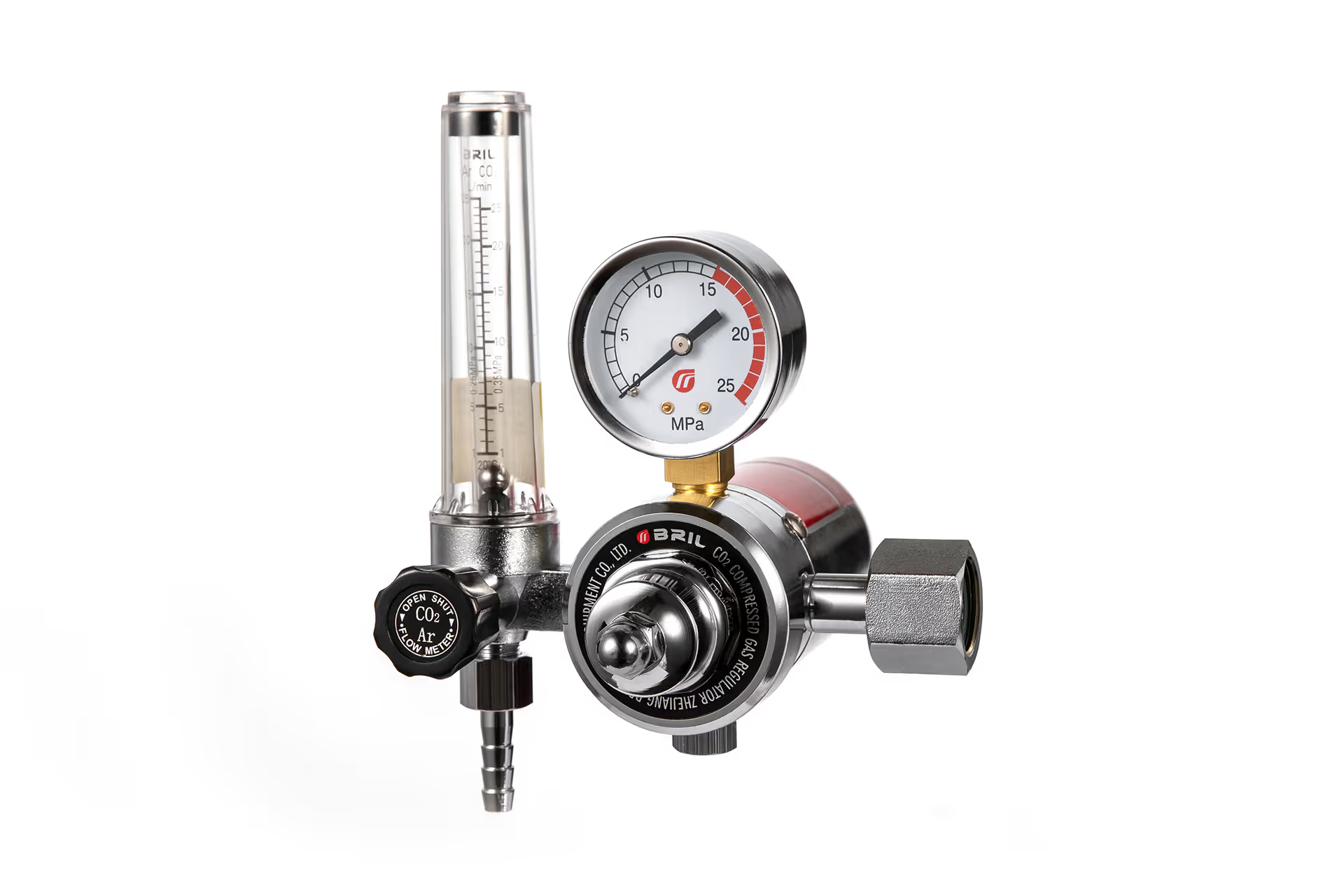
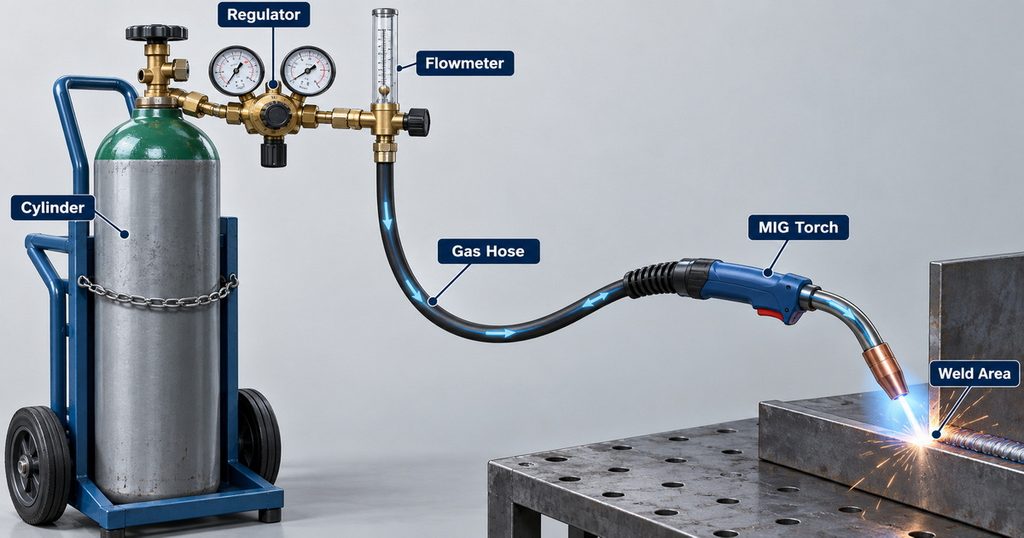
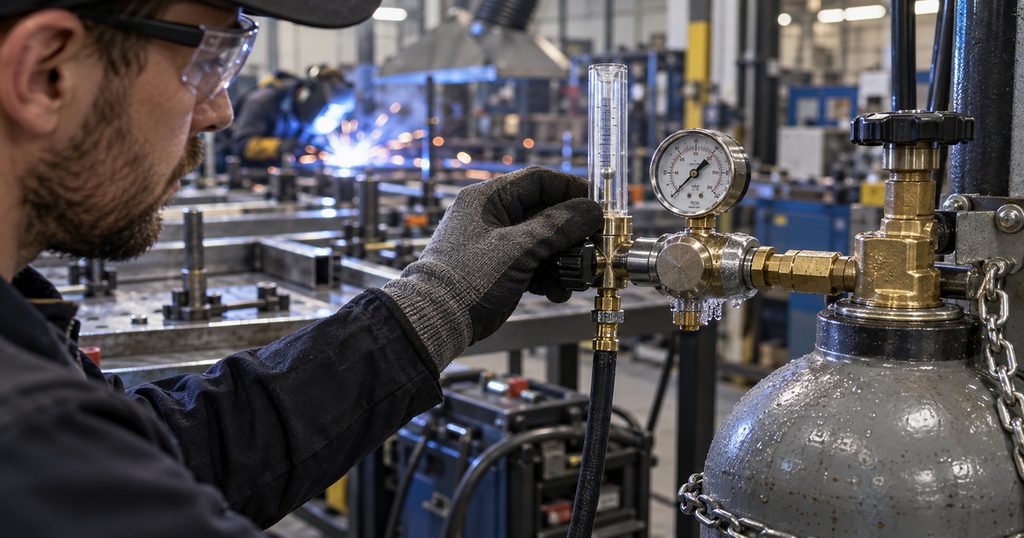
A regulator reduces and controls pressure. To set shielding-gas delivery in CFH or L/min, the setup also needs a flowmeter, flowgauge, or other suitable flow-measuring arrangement. A cylinder-pressure gauge tells the operator about supply pressure; it does not, on its own, tell them how much shielding gas reaches the MIG gun.
Flow scales deserve careful attention. Miller’s heavy-duty specification says to read the argon scale when using argon/CO₂ mix on that product series. Swagelok’s flowmeter documentation explains why media and operating conditions matter to calibration: a scale intended for one gas or set of conditions may need a different calibration for another. Follow the instructions for the *specific* instrument rather than applying a generic conversion factor.
The location of the measurement matters as well. If a displayed flow seems correct but the weld shows porosity, Miller recommends checking gas connections, gun installation, and consumables; it also notes that an external flowmeter at the gun can help verify the gas delivered there. The regulator reading and the flow available at the nozzle are related, but leaks or restrictions can separate the two.
CO₂ Freeze-Up and Continuous Duty
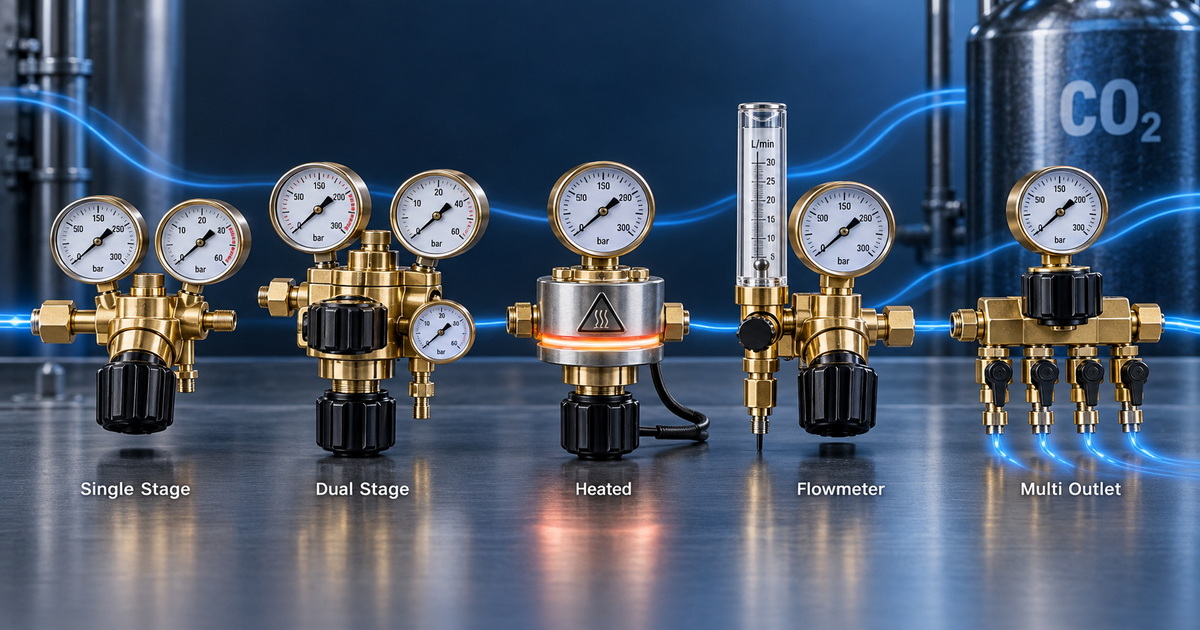
A high-demand CO₂ installation introduces a consideration that buyers can easily miss: sustained CO₂ withdrawal can chill the regulator and restrict flow. Miller’s gas-mixer manual warns that high-volume CO₂ use may cause regulator freeze-up and says to check withdrawal rate, gas moisture, and outlet pressure when troubleshooting. It lists a heated regulator, a two-stage regulator with a heat exchanger, or an individual cylinder outlet heater as possible remedies.
That does not mean every CO₂ regulator needs a heater. Select one against the expected operating conditions. Miller publishes a two-stage CO₂ flowmeter-regulator with a heat exchanger designed to reduce high-flow freeze-up. For a different, higher-capacity example, an Airgas listing describes a Harris electrically heated, two-stage CO₂ unit designed for gaseous withdrawal up to 100 SCFH. Those figures describe particular products—not a blanket capacity for all regulators.
Size the gas supply for the simultaneous stations and expected duty cycle, not just the flow setting on one torch. Miller’s manual illustrates this with 10 welders set to 30 SCFH each at 50% duty cycle, yielding an estimated average demand of 150 SCFH. Actual peak demand and cylinder withdrawal limits still need separate review. This is particularly useful when specifying equipment for a welding line or OEM project rather than a single portable machine.
A Practical Selection and Test Method
Match the Hardware Before Welding
Use this sequence when evaluating a CO₂ regulator for MIG welding against a mixed gas regulator for MIG welding:
1. Identify the welding procedure. Record the base metal, filler wire, transfer mode, machine gas program, and specified shielding gas. For procedure-controlled work, the approved welding procedure governs the choice.
2. Read the cylinder label. Determine whether it contains 100% CO₂ or a named premixed blend. Do not infer gas contents from cylinder color alone; OSHA requires cylinders covered by its rule to be marked with the gas name.
3. Verify the complete regulator specification. Check gas approval, inlet fitting, maximum inlet pressure, outlet fitting, and required flow range against the cylinder and machine documentation.
4. Check how flow is indicated. Select the manufacturer-prescribed scale or calibration for that gas. Distinguish a flow-reading instrument from a pressure-only gauge.
5. Assess sustained demand. For straight CO₂, review continuous cylinder withdrawal, ambient conditions, and any published heat-exchanger or heater requirement before specifying equipment for long shifts or multiple stations.
6. Inspect and leak-check before use. Secure the cylinder, inspect connections, and follow the equipment maker’s instructions for attaching and opening it. Miller calls for an approved oil-free leak-detection fluid and says unresolved leaks must be repaired before operation.
These steps are a purchasing and commissioning checklist, not a replacement for operator training or the manufacturer’s safety instructions. In particular, do not improvise a heating method around a cold regulator. Use equipment intended for the service and have damaged or malfunctioning assemblies inspected by qualified personnel.
Run a Controlled Shop Trial
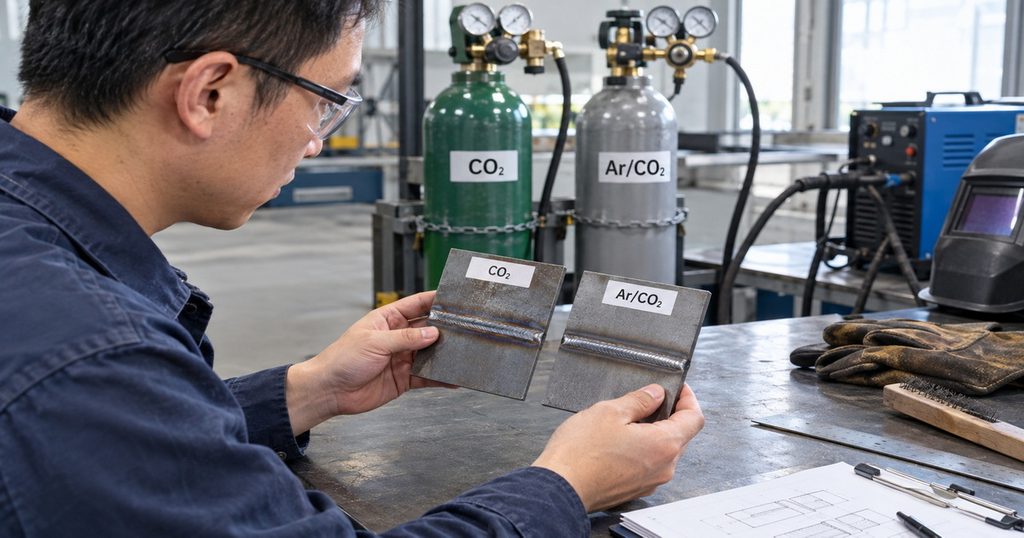
For a shop deciding between straight CO₂ and C25, a small documented trial is more informative than judging two beads by appearance alone. Start with the filler-metal manufacturer’s gas guidance and an appropriate machine program. Then record the gas, flow setting, wire, material, position, and other welding parameters for each test.
Evaluate what matters to the application:
– Weld quality: Inspect for porosity and other defects using the shop’s required acceptance method; do not treat surface appearance as proof of adequate fusion.
– Arc and cleanup: Record spatter, nozzle cleaning, grinding time, and interruptions rather than relying only on an operator’s impression.
– Gas delivery: Observe whether flow remains dependable throughout the weld cycle, especially during sustained CO₂ use; investigate restrictions, leaks, or freeze-up rather than simply increasing the indicated flow.
– Total operating cost: Compare gas expenditure with cleanup labor, rework, consumables, and downtime. A cheaper gas can still cost more per accepted part if it adds work elsewhere.
Buying Checklist and FAQ
For distributors, welding brands, and industrial buyers sourcing an OEM or ODM regulator, request a gas-specific specification sheet rather than a broad claim that one model “fits MIG.” At minimum, it should identify the intended gas service, regional cylinder inlet, maximum inlet pressure, outlet connection, delivery or flow range, flow-indication method, wetted materials, and any CO₂ freeze-up mitigation. Ask how the supplier verifies leak tightness, flow indication, pressure performance, and product traceability for the model ordered. Published regulator specifications show how materially different these details can be between CO₂ and argon/CO₂ configurations.
1.Can I Use One Regulator for Both Gases?
Only if the manufacturer explicitly approves the complete setup for both gases and the relevant cylinder connection, pressure range, and flow indication are suitable. Do not assume an adapter or a similar-looking gauge establishes compatibility. Miller’s cited product line, for example, lists distinct CO₂ and argon/CO₂ inlet configurations.
2.Does C25 Need a Heated Regulator?
Not as a routine requirement established by the sources cited here. The freeze-up concern discussed above specifically centers on sustained CO₂ withdrawal. Choose any heating or heat-exchanger provision from the actual gas service, demand, and manufacturer specifications—not from a universal rule for all MIG cylinders.
3.Is 100% CO₂ Better for Penetration?
Not in every welding setup. Miller notes good penetration with straight CO₂ on carbon steel, while Lincoln Electric explains that current and several other welding variables influence penetration. Compare approved weld procedures and test results, not gas labels alone.
4.What Flow Rate Should I Start With?
For short-circuit MIG, Miller recommends 25–35 CFH as a starting range. Follow the machine, filler-metal, and procedure instructions, then account for nozzle conditions and drafts. Too little shielding can allow porosity; too much flow can also cause problems through turbulence.
5.Is C25 Suitable for Spray Transfer?
Do not assume so. C25 is widely used for mild-steel MIG welding, but Miller points to C10 for a spray-transfer application, and Lincoln Electric’s cited axial/pulsed-spray guidance specifies more argon-rich mixtures. Check the exact machine program, wire, and welding procedure.
6.Why Is There Frost on My CO₂ Regulator?
Sustained CO₂ withdrawal can cool the gas-delivery equipment, but visible frost alone is not a complete diagnosis. If delivery pressure or flow drops, stop and check the manufacturer’s troubleshooting guidance, gas quality, withdrawal rate, and equipment condition. Miller identifies approved heated or heat-exchanger solutions for situations that require them.
Need a regulator specification for your market or production line? Send our team the cylinder gas and valve standard, target flow range, number of welding stations, duty cycle, outlet requirement, and OEM/ODM labeling needs. We can use those details to define a CO₂ or argon/CO₂ regulator configuration for technical review—without treating the two gas services as automatically interchangeable.
References
1. [Miller Electric, “What Type of Gas Is Best for MIG Welding in DIY Applications?”] — Shielding-gas choices, mild-steel comparisons, short-circuit flow guidance, and gas-coverage troubleshooting. [millerwelds]
2. [Miller Electric, “10 Welding Operation Mistakes and How To Solve Them”] — CO₂ and argon/CO₂ performance, cleanup costs, and production considerations. [millerwelds]
3. [Lincoln Electric, “Variables that Affect Weld Penetration”] — The effects of current, shielding gas, and other variables on penetration. [lincolnelectric]
4. [Lincoln Electric, “Pulsed Spray Metal Transfer” (PDF)] — Shielding-gas guidance for transfer modes and argon-rich blends. [ch-delivery.lincolnelectric]
5. [Miller Electric/Smith Equipment, “Heavy-Duty Flowmeters and Flowmeter Regulators” (PDF)] — Model-specific gas service, CGA inlets, flow ranges, scale instruction, and heat-exchanger details. [millerwelds]
6. [Miller Electric, “Proportional Standard Gas Mixers” owner’s manual (PDF)] — CO₂ withdrawal and freeze-up guidance, multi-station demand example, and equipment precautions. [millerwelds]
7. [Airgas, “Harris Heavy Duty Carbon Dioxide Flowgauge Regulator”] — Example specifications for an electrically heated, high-capacity CO₂ product. [airgas]
8. [Swagelok, “Variable Area Flowmeters—G Series and M Series” (PDF)] — Flowmeter media, calibration, and operating-condition considerations. [swagelok]
9. [U.S. Occupational Safety and Health Administration, 29 CFR 1910.253] — Cylinder marking and regulator gas-service requirements within the standard’s oxygen-fuel welding and cutting scope. [osha]
Hot Tags: CO₂ Gas Regulator for MIG Welding, Argon CO₂ Regulator for MIG Welding, MIG Welding Gas Regulator, Mixed Gas Regulator for MIG Welding, CO₂ Flowmeter Regulator, Argon CO₂ Flowmeter Regulator, Heated CO₂ Regulator for Welding, Industrial Welding Gas Regulator, Wholesale MIG Welding Gas Regulators, OEM CO₂ Regulator Manufacturer