Content Menu
● Why CO₂ Requires the Right Regulator
● Main Types of CO₂ Regulators
>> 1. Single-Stage CO₂ Regulators
>> 2. Dual-Stage CO₂ Regulators
>> 4. CO₂ Flowmeter Regulators
>> 5. CO₂ Flow-Gauge Regulators
>> 6. Multi-Outlet CO₂ Regulators and Manifold Regulators
>> 7. CO₂ Line Regulators and Point-of-Use Regulators
● How to Choose the Right CO₂ Regulator
>> Step 1: Confirm the Gas and Cylinder Connection
>> Step 2: Define Outlet Pressure and Flow Requirements
>> Step 3: Decide Between Single-Stage and Dual-Stage Control
>> Step 4: Assess Freeze-Up Risk
>> Step 5: Evaluate Materials and Manufacturing Quality
● CO₂ Regulator Safety and Installation Basics
● OEM and ODM CO₂ Regulator Solutions
>> What Buyers Should Ask a Manufacturer
● Match the Regulator to the Process
● Request a Customized CO₂ Regulator Solution
>> 1. What is the difference between a CO₂ regulator and an argon regulator?
>> 2. Do I need a heated CO₂ regulator for welding?
>> 3. Is a dual-stage CO₂ regulator better than a single-stage regulator?
>> 4. Why does my CO₂ regulator freeze?
>> 5. Can one CO₂ cylinder supply several welding machines?
>> 6. What should I check before importing CO₂ regulators from a manufacturer?
>> 7. Can a CO₂ regulator be used with oxygen, acetylene, propane, or nitrogen?
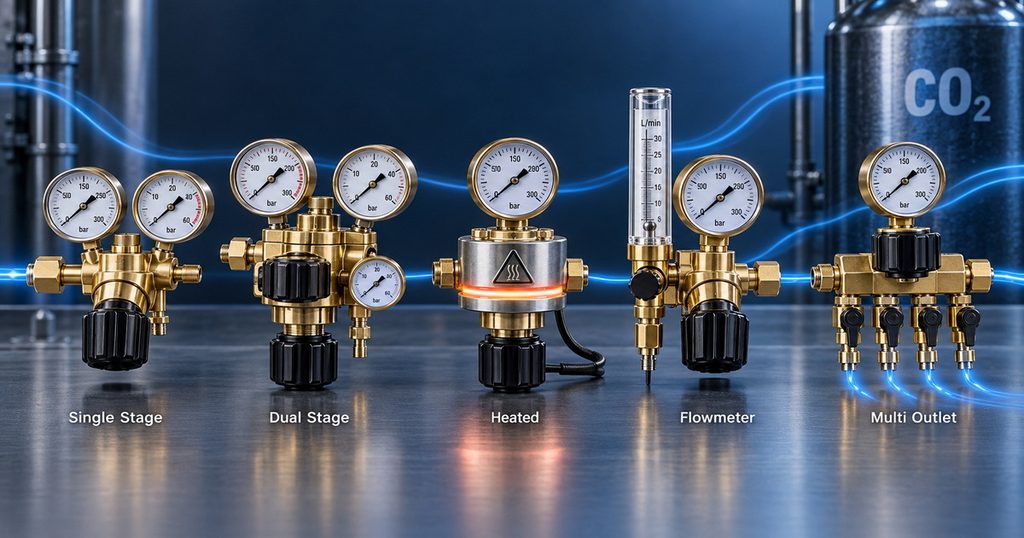
A CO₂ regulator is a pressure-control device that reduces the high pressure inside a carbon dioxide cylinder to a stable, usable delivery pressure or flow rate. Choosing the right type matters because CO₂ behaves differently from permanent gases such as nitrogen or argon: it is commonly stored as liquefied gas, its cylinder pressure is strongly affected by temperature, and it can create freeze-up problems during sustained high-flow withdrawal.
For welding, beverage dispensing, greenhouse enrichment, aquariums, laboratories, dry ice production, and industrial gas systems, the best CO₂ gas regulator depends on your required outlet pressure, flow stability, operating temperature, gas purity, cylinder connection, and safety requirements. A professional manufacturer should also be able to customize inlet fittings, outlet connections, gauges, relief devices, branding, packaging, and performance specifications for OEM and ODM customers.
Why CO₂ Requires the Right Regulator
Unlike gases stored only as compressed gas, CO₂ cylinders often contain liquid CO₂ and vapor CO₂. As liquid CO₂ evaporates to replace gas being withdrawn, it absorbs heat. Under high flow or in cold environments, this cooling effect can lower the regulator temperature enough to cause frost, unstable delivery, or restricted flow.
A regulator is therefore not simply a connector between a cylinder and a hose. It is a control component that directly influences:
– Outlet pressure stability
– Gas flow consistency
– Weld-shielding quality
– System uptime
– Operator safety
– Gas consumption
– Equipment compatibility
– Maintenance frequency
For industrial users, a poorly matched regulator can lead to pressure drift, unstable arc protection, inconsistent cutting performance, unnecessary gas waste, or interrupted production.
A properly selected CO₂ regulator should be designed specifically for the gas, pressure range, connection standard, and duty cycle involved. OSHA states that pressure-reducing regulators must only be used with the gases and pressures for which they are intended, and regulator connections must comply with applicable Compressed Gas Association connection standards.
Main Types of CO₂ Regulators
CO₂ regulators can be classified by pressure-reduction design, heating function, flow-control method, number of outlets, installation method, and end-use application. Understanding these categories makes procurement decisions more accurate for brands, distributors, welding equipment manufacturers, and industrial gas suppliers.
1. Single-Stage CO₂ Regulators
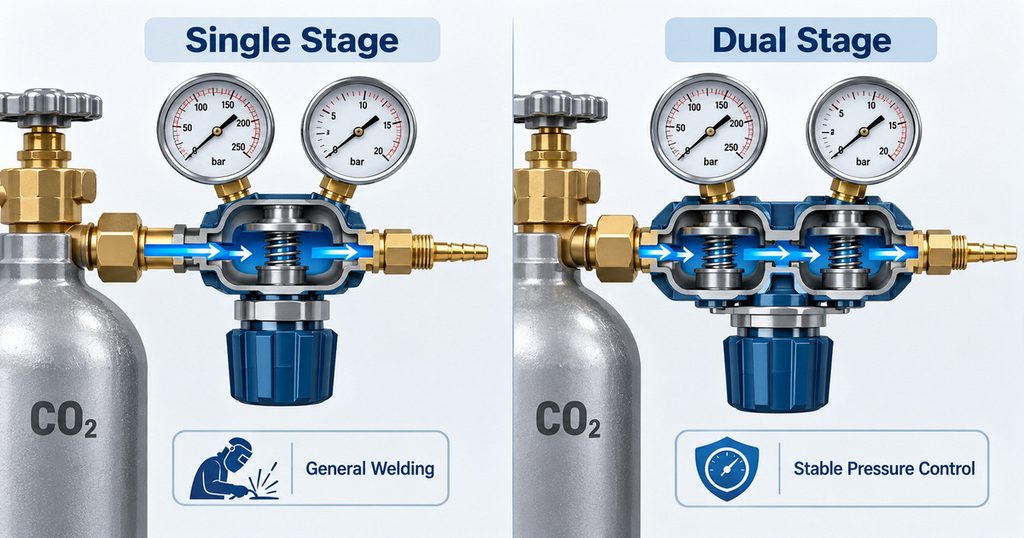
A single-stage CO₂ regulator reduces cylinder pressure to the desired outlet pressure in one pressure-reduction step. It is the most common and economical option for standard gas-control tasks.
Inside the regulator, a diaphragm, valve seat, spring, and adjusting mechanism work together to control delivery pressure. Turning the adjustment knob changes the spring force applied to the diaphragm, which changes the outlet pressure setting.
Single-stage regulators are widely used for:
– Standard MIG/MAG welding
– CO₂ shielding-gas supply
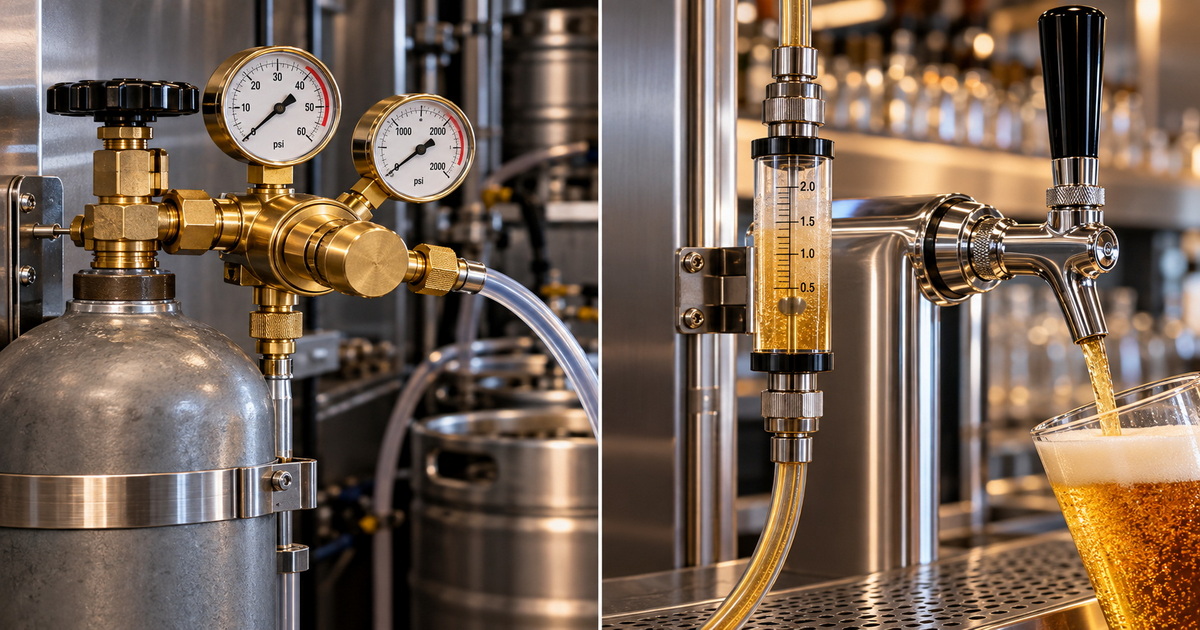
– Beverage dispensing systems
– Aquarium CO₂ injection
– Greenhouse CO₂ systems
– Short-duration industrial gas operations
– General-purpose cylinder gas control
The main advantage is its straightforward design. A well-manufactured single-stage CO₂ regulator can provide reliable control for applications where operators can periodically check and adjust the outlet pressure.
However, the delivery pressure can gradually change as cylinder pressure falls. This phenomenon is commonly called the supply-pressure effect. As the cylinder empties, the operator may need to make small adjustments to maintain the same outlet setting.
Air Liquide explains that single-stage regulators reduce pressure in one step and are generally suitable when inlet pressure variation is limited or periodic outlet-pressure readjustment is acceptable.
| Feature | Single-Stage CO₂ Regulator |
|---|---|
| Pressure reduction | One step |
| Cost | Usually lower |
| Structure | Compact and simple |
| Outlet stability during cylinder depletion | Moderate |
| Best for | General welding, dispensing, short-to-medium duty cycles |
| Operator adjustment | May be needed as cylinder conditions change |
2. Dual-Stage CO₂ Regulators
A dual-stage CO₂ regulator, also called a two-stage CO₂ regulator, reduces pressure in two sequential steps rather than one. The first stage reduces the high cylinder pressure to an intermediate pressure, while the second stage lowers it further to the required delivery pressure.
This two-step design improves output consistency when inlet conditions change. It is especially useful when users need stable gas delivery throughout a cylinder’s service life or when process quality depends on tightly controlled pressure.
Typical applications include:
– Precision welding and automated welding cells
– Laboratory gas delivery
– Analytical instruments
– Gas chromatography
– High-consistency shielding gas systems
– Long production runs
– Sensitive industrial processes
ESAB notes that the staged design allows more precise pressure control and more stable gas delivery, making dual-stage regulators appropriate where pressure stability is important, including high-precision welding and laboratory use.
A dual-stage CO₂ regulator is not always necessary for every application. It usually costs more and has a more complex internal structure. But for customers focused on reducing manual adjustment, maintaining repeatable output, and supporting higher-value equipment, the investment can be justified.
| Selection Factor | Single-Stage Regulator | Dual-Stage Regulator |
|---|---|---|
| Number of pressure reductions | One | Two |
| Initial purchase cost | Lower | Higher |
| Delivery-pressure consistency | Good for routine work | Better for critical work |
| Response to declining cylinder pressure | More noticeable | Less noticeable |
| Recommended use | General-purpose operation | Precision or continuous operation |
| Typical buyer | Workshop, distributor, basic equipment OEM | Automation integrator, laboratory, premium welding brand |
3. Heated CO₂ Regulators
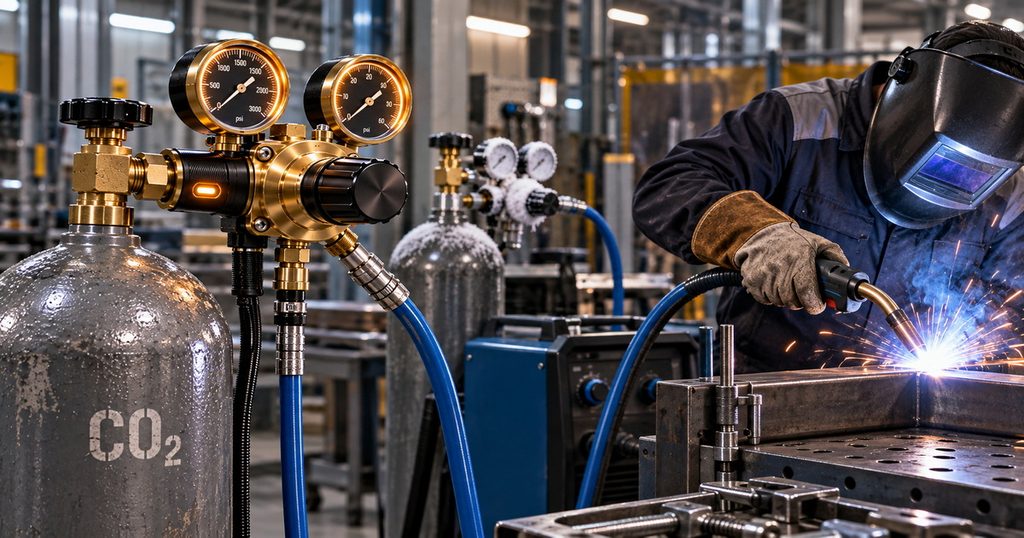
A heated CO₂ regulator is designed to reduce or prevent freeze-up during high CO₂ consumption. It typically includes an electrical heating element or heat-assisted design that helps maintain the regulator body at a temperature suitable for stable vaporization and gas flow.
When CO₂ is withdrawn rapidly, liquid CO₂ inside or near the cylinder valve can vaporize quickly. This process absorbs heat. If the system cannot absorb heat from the environment fast enough, the regulator can become very cold and accumulate frost. In severe cases, delivery pressure can become unstable or flow can be reduced.
A heated regulator is often recommended for:
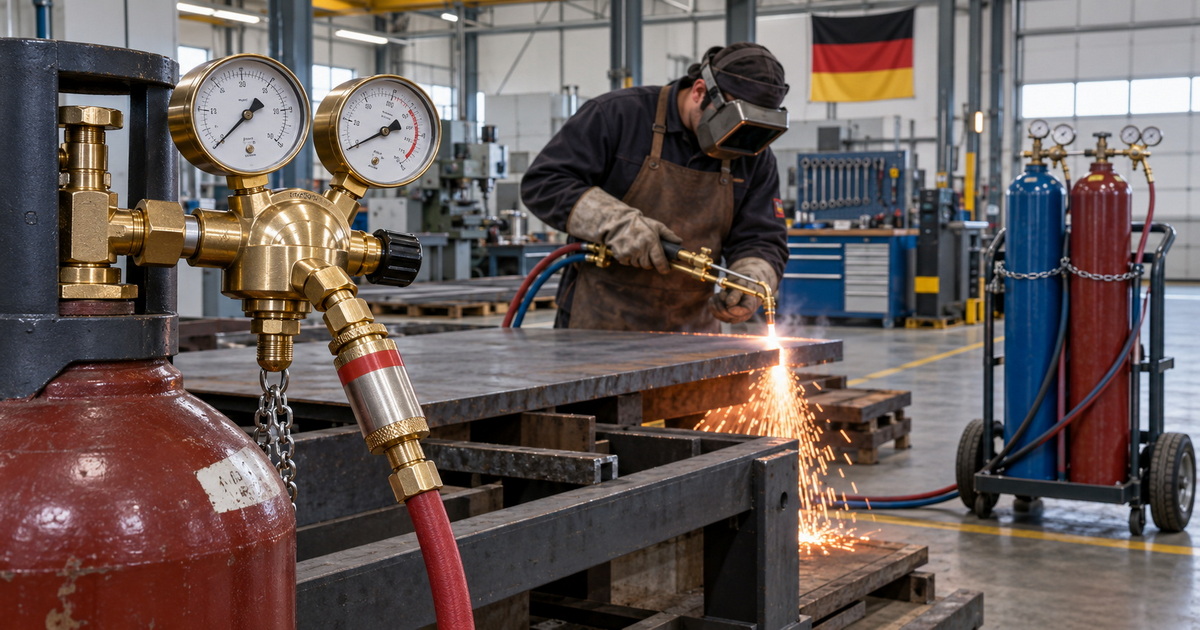
– High-output CO₂ welding systems
– Continuous welding production
– CO₂ cutting operations
– Cold workshops or outdoor environments
– High-flow industrial gas equipment
– Beverage systems with demanding draw rates
– Processes with extended duty cycles
The key purpose is not to “increase pressure.” It is to improve operational stability by helping the regulator resist temperature-related freezing and vaporization limitations.
A heated CO₂ regulator should be evaluated based on more than its heating label. Buyers should confirm:
– Heating power and voltage specification
– Temperature-control method
– Electrical safety design
– Insulation and enclosure quality
– Flow capacity under continuous demand
– Over-temperature protection
– Cable and plug configuration
– Compatibility with regional electrical requirements
– Ease of servicing and replacement
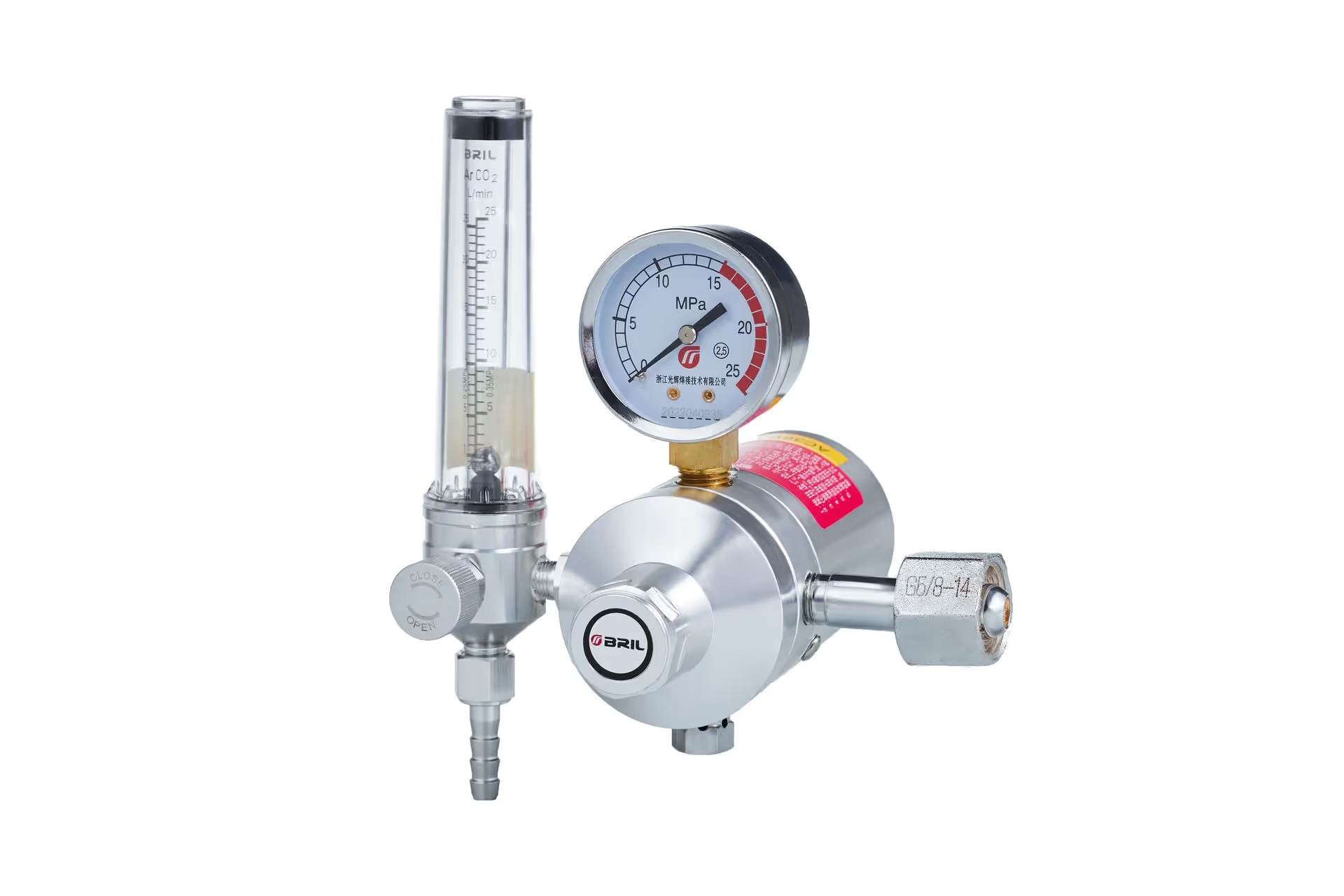
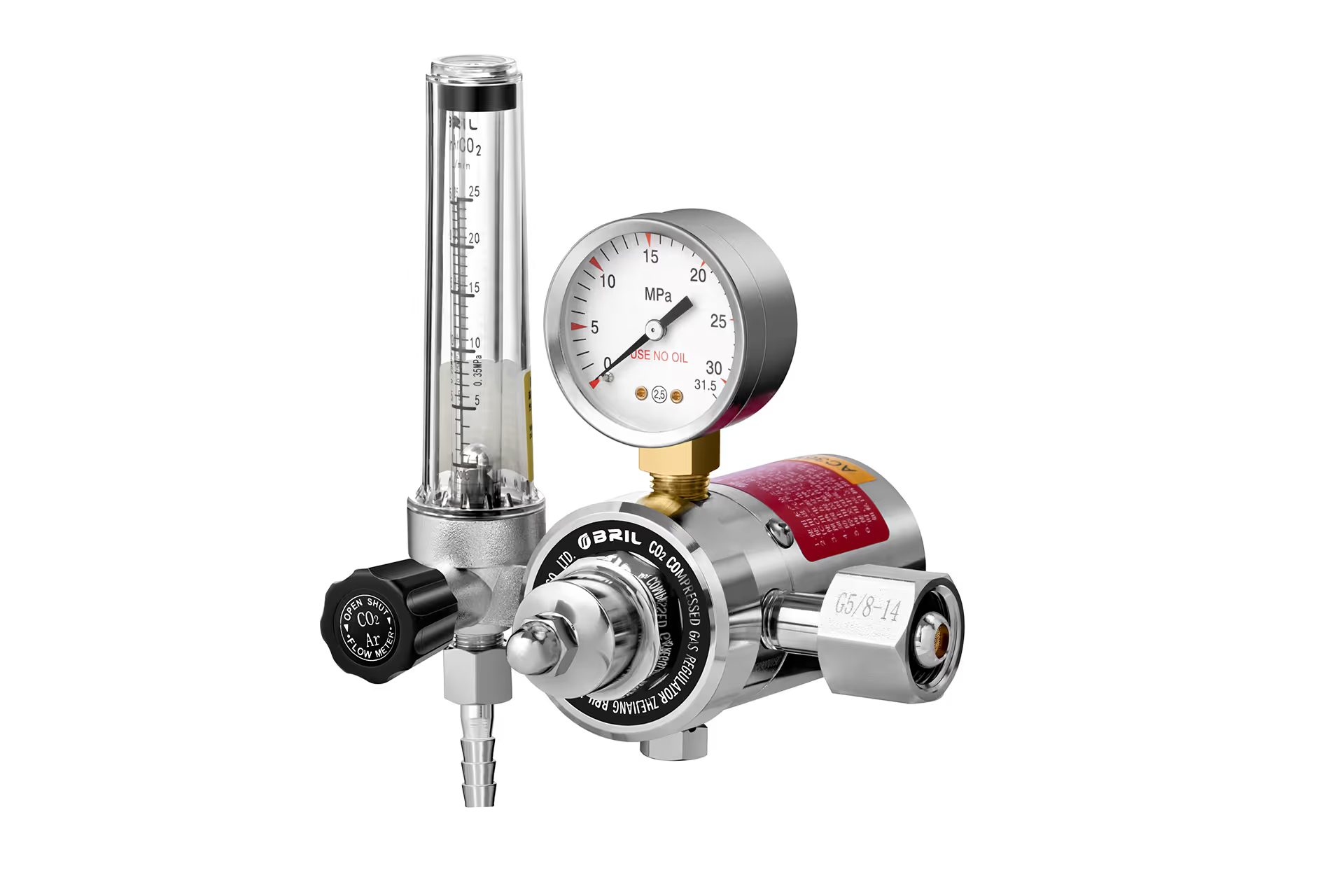
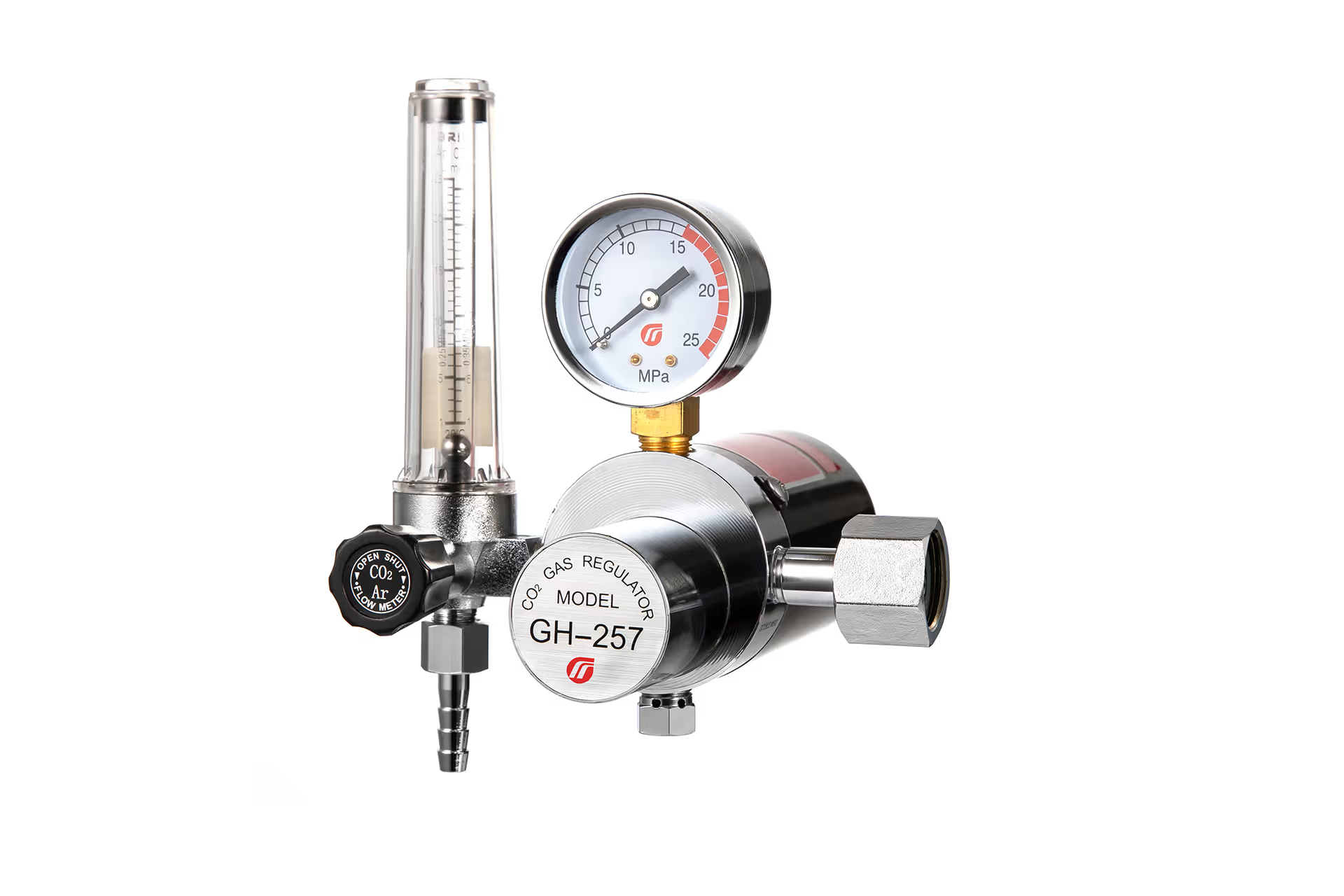
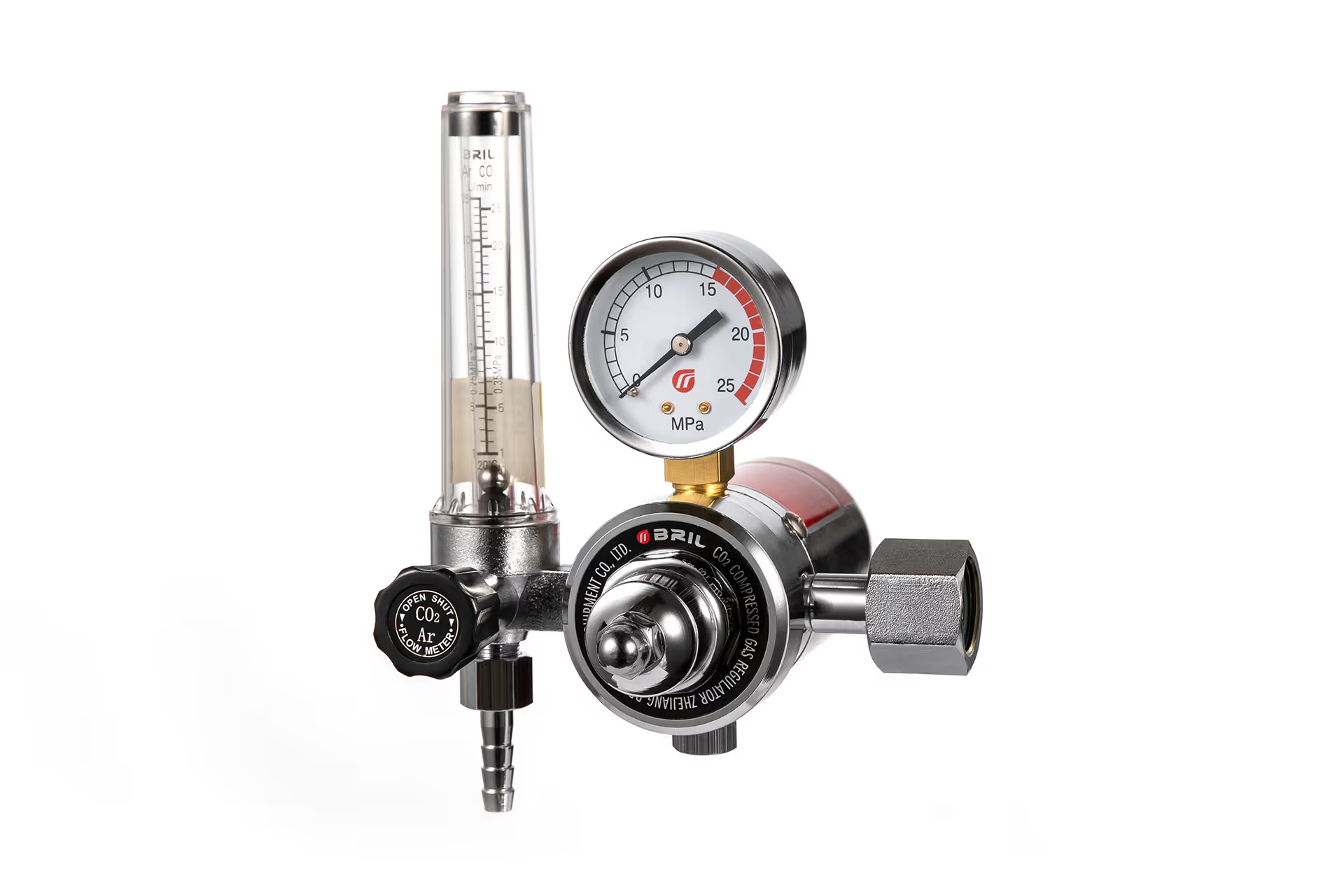
4. CO₂ Flowmeter Regulators
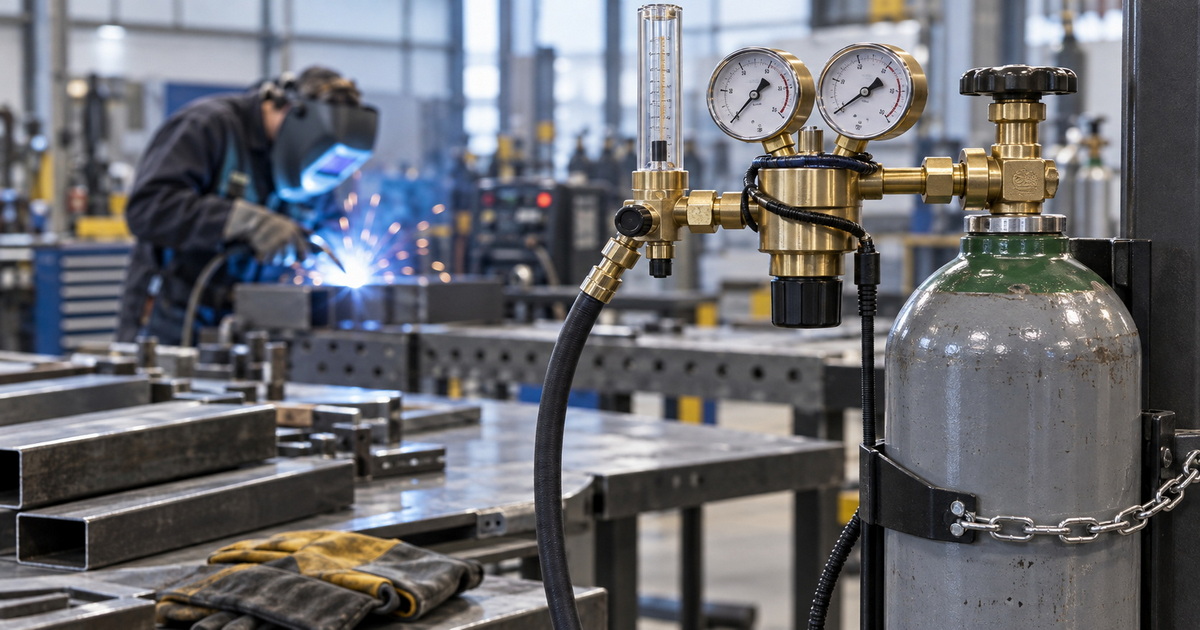
A CO₂ flowmeter regulator combines pressure reduction with a flow-measurement device. Instead of relying only on outlet pressure, the operator can set and monitor gas flow in units such as liters per minute, cubic feet per hour, or cubic feet per minute.
For welding, flow-based control is often more practical than pressure-only control because the shielding gas must reach the weld zone at an appropriate rate. Too little flow can cause inadequate shielding. Too much flow can waste gas and may create turbulence that pulls surrounding air into the shielding zone.
Flowmeter CO₂ regulators are commonly used for:
– MIG welding
– MAG welding
– TIG welding with suitable shielding gas configurations
– Robotic welding cells
– Fabrication shops
– Training centers
– Industrial welding stations
Industrial gas suppliers sell a broad range of regulator formats, including flowmeter regulators, flow-gauge regulators, single-stage units, two-stage units, pipeline regulators, and specialty-gas regulators.
For welding applications, the correct flow setting depends on the torch, nozzle size, joint design, welding position, draft conditions, wire diameter, gas mixture, and process parameters. Therefore, a regulator supplier should avoid claiming that one universal flow setting is correct for all customers.
5. CO₂ Flow-Gauge Regulators
A flow-gauge CO₂ regulator estimates or indicates gas flow through a specially calibrated pressure gauge. It can offer a compact alternative to a vertical tube-style flowmeter.
These regulators are often preferred where users need:
– A smaller overall regulator profile
– Easier gauge reading
– Lower risk of damage to a glass or clear flow tube
– A familiar gauge-based interface
– Standard welding-shop functionality
The limitation is that a flow gauge may be calibrated for a specific gas and operating condition. It should not be assumed that a gauge calibrated for argon will indicate the same actual flow when used with CO₂ or a different shielding-gas mixture.
Important OEM requirement: When developing private-label flow-gauge regulators, specify the target gas clearly. The gauge scale, calibration, outlet fitting, hose connection, and product marking must match the intended gas service.
6. Multi-Outlet CO₂ Regulators and Manifold Regulators
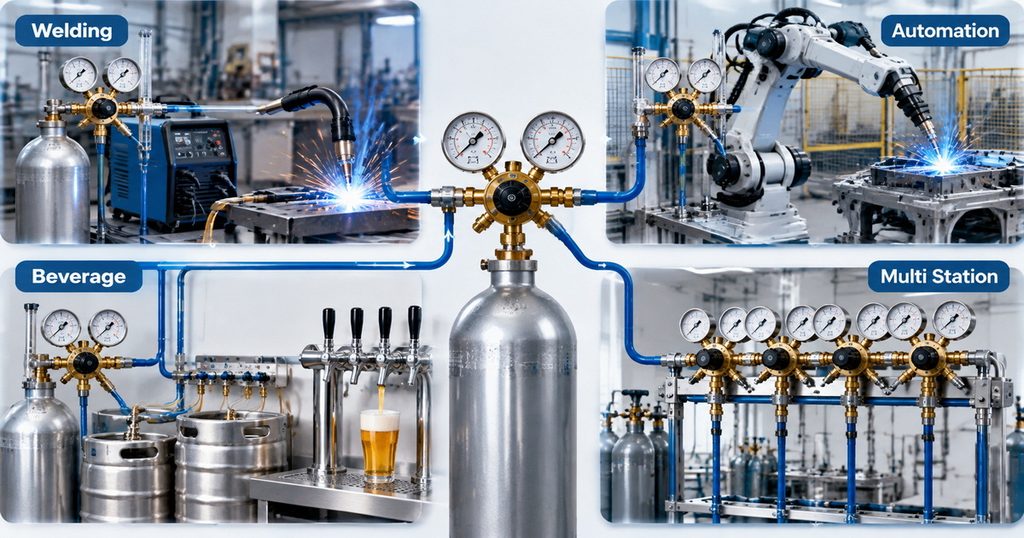
A multi-outlet CO₂ regulator supplies controlled gas to more than one downstream line. It may include two, three, four, or more outlets, each with an individual needle valve, flowmeter, or flow gauge.
This design is useful for customers who want one cylinder to feed several workstations or applications. Common examples include:
– Multi-torch welding benches
– Brewing and beverage dispensing systems
– Aquarium stores
– Greenhouse zones
– Laboratory benches
– Production fixtures
– Demonstration or training stations
For multi-user systems, stable flow distribution matters. If one user changes demand significantly, the system should minimize disruption to other outlets. Depending on the application, a dedicated manifold, secondary line regulator, or individual point-of-use regulator may provide better control than a single regulator feeding many lines.
7. CO₂ Line Regulators and Point-of-Use Regulators
A CO₂ line regulator is installed downstream from the primary cylinder regulator. Its job is to fine-tune or maintain pressure closer to the equipment using the gas.
This approach is valuable when one central gas source supplies multiple machines or when different downstream stations need different delivery pressures. For example, a primary regulator may reduce cylinder pressure to a safe intermediate line pressure, while individual line regulators provide final adjustment at each workstation.
Line regulators are particularly useful in:
– Central gas supply systems
– Welding production lines
– Beverage distribution systems
– Gas manifolds
– Automated fabrication plants
– Laboratory distribution systems
A properly designed system can improve control, simplify maintenance, and reduce the need to adjust the primary regulator every time a downstream application changes.
How to Choose the Right CO₂ Regulator
The correct regulator should be selected from the application backward—not from price forward. Start with the actual gas demand, pressure requirement, duty cycle, environment, and connection standard.
Use the following procurement checklist.
Step 1: Confirm the Gas and Cylinder Connection
First, confirm that the regulator is designed for carbon dioxide service and matches the cylinder valve connection used in your market.
Different regions may use different cylinder-valve standards and outlet configurations. Never force incompatible connections. Connection differences are a safety feature, not an inconvenience.
Regulator inlet connections are standardized to help prevent the wrong gas equipment from being connected. OSHA requires pressure-reducing regulators to be used only for the gas and pressures for which they are intended.
Step 2: Define Outlet Pressure and Flow Requirements
Ask these questions:
– What is the required outlet pressure range?
– What is the normal operating flow?
– What is the maximum peak flow?
– Will gas demand be continuous or intermittent?
– Is flow measurement more useful than pressure measurement?
– Does the system need one outlet or multiple outlets?
For example, a basic welding setup may need a flow-control regulator, while a CO₂ cutting line with high sustained demand may need a heated design with higher capacity.
Step 3: Decide Between Single-Stage and Dual-Stage Control
Choose a single-stage CO₂ regulator when cost efficiency, compact design, and normal industrial control are the priorities.
Choose a dual-stage CO₂ regulator when stable delivery pressure is critical over changing inlet conditions, cylinder depletion, or extended operation.
The right choice should reflect the process risk. If a slight pressure change has little effect on output, a single-stage design may be sufficient. If pressure variation can affect product quality, analysis, automation, or production consistency, dual-stage control becomes more valuable.
Step 4: Assess Freeze-Up Risk
A heated CO₂ regulator should be considered when the operation has one or more of these conditions:
– High flow rate
– Long continuous run time
– Low ambient temperature
– Large production demand
– Frosting observed on existing equipment
– Unstable delivery during peak consumption
– CO₂ cylinder withdrawal conditions that exceed a standard regulator’s practical capability
Do not select a heated model simply because it sounds more advanced. Select it when the process conditions demonstrate a genuine thermal-demand challenge.
Step 5: Evaluate Materials and Manufacturing Quality
For industrial gas control, material selection affects service life, sealing performance, corrosion resistance, and pressure integrity.
High-quality brass is commonly used for regulator bodies because it offers good machinability, corrosion resistance, and suitability for many industrial gas applications. But material alone does not guarantee quality. Buyers should also assess:
– Brass grade and material traceability
– Forging or machining quality
– Diaphragm material
– Valve-seat material
– Thread accuracy
– Gauge reliability
– Relief-device design
– Leakage-test procedure
– Pressure-test procedure
– Surface treatment
– Assembly cleanliness
– Packaging protection during export
A professional gas regulator manufacturer should be able to explain its quality-control process rather than relying only on generic claims such as “premium quality” or “100% tested.”
CO₂ Regulator Safety and Installation Basics
CO₂ is nonflammable, but it can displace oxygen in enclosed or poorly ventilated areas. Oregon OSHA identifies carbon dioxide as an asphyxiant hazard, meaning that a release can reduce breathable oxygen levels.
Follow these basic practices:
1. Secure the cylinder upright before connecting the regulator.
2. Verify gas compatibility between the cylinder, regulator, gauge, hose, and downstream equipment.
3. Inspect the regulator connection and sealing surface before installation.
4. Keep oil and grease away from gas-control equipment, especially equipment used around oxygen systems.
5. Open cylinder valves slowly to reduce sudden pressure shock.
6. Check for leaks using an approved leak-detection method.
7. Use adequate ventilation where CO₂ could accumulate.
8. Do not modify the regulator or bypass its relief device.
9. Remove damaged equipment from service immediately.
10. Train operators to read gauges, identify frosting, recognize leaks, and shut down the gas supply safely.
For welding and cutting work, OSHA requires oxygen and fuel-gas pressure regulators and their associated gauges to be kept in proper working order while in use. Although CO₂ is not a fuel gas, the same principle applies broadly: regulator condition and correct gas compatibility are essential for safe industrial operation.
OEM and ODM CO₂ Regulator Solutions
For overseas brands, wholesalers, distributors, and equipment manufacturers, a regulator is also a product platform. The goal is not only to buy a standard item; it is to develop a product that matches the target market, customer segment, and brand positioning.
A capable OEM and ODM CO₂ regulator supplier can support customization in areas such as:
– Logo engraving or printing
– Private-label packaging
– Color-coded adjustment knobs
– Gauge face design and language
– Inlet and outlet connection options
– Pressure and flow ranges
– Single-stage or dual-stage construction
– Heated-regulator electrical configuration
– Number of outlets
– Hose and fitting kits
– Retail, industrial, or premium product positioning
– Product manuals and warning labels
– Inspection documentation and export packaging
What Buyers Should Ask a Manufacturer
Before selecting a CO₂ regulator supplier, request clear answers to these questions:
| Buyer Question | Why It Matters |
|---|---|
| What gas is this regulator specifically designed for? | Prevents incorrect gas-service selection |
| What are the inlet and outlet pressure ranges? | Confirms technical suitability |
| Is the regulator single-stage or dual-stage? | Defines pressure-stability capability |
| What is the maximum rated flow? | Prevents undersizing |
| Does the product have a relief device? | Supports overpressure protection |
| What material is used for the body and critical components? | Indicates durability and compatibility |
| What leakage and pressure tests are performed? | Demonstrates quality-control discipline |
| Can connections and gauges be customized by market? | Supports OEM/ODM localization |
| Can you provide product drawings and inspection records? | Helps engineering validation |
| What standards or customer specifications can you support? | Improves compliance planning |
Match the Regulator to the Process
The most common purchasing mistake is treating all CO₂ regulators as interchangeable. They are not.
A small single-stage model can be an excellent solution for routine welding or beverage service. A high-capacity heated regulator can be the better choice for continuous production. A dual-stage unit can improve stability for precision equipment. A multi-outlet design can reduce cylinder count in a controlled distribution system.
The “best” CO₂ regulator is the one that matches the actual application:
– Routine welding: Single-stage flowmeter or flow-gauge CO₂ regulator.
– Long-duration, high-demand welding: Heated CO₂ regulator with suitable flow capacity.
– Precision or automated process: Dual-stage CO₂ regulator.
– Multiple workstations: Manifold or multi-outlet regulator with point-of-use control.
– Central gas distribution: Primary regulator plus line regulators.
– Private-label industrial brand: Customized OEM/ODM regulator platform with documented inspection standards.
For buyers building a durable supply chain, focus on repeatable manufacturing, accurate machining, stable pressure performance, gas-specific design, reliable quality inspection, and clear technical communication—not only unit price.
Request a Customized CO₂ Regulator Solution
If you are sourcing CO₂ regulators, heated CO₂ regulators, dual-stage regulators, argon regulators, oxygen regulators, acetylene regulators, propane regulators, or nitrogen regulators, choose a manufacturer that understands both gas-control engineering and international OEM requirements.
We support overseas brands, wholesalers, distributors, and industrial equipment manufacturers with customized regulator solutions featuring precision brass manufacturing, stable pressure control, strict quality inspection, private labeling, connection customization, and export-ready packaging.
Contact our team with your target gas, cylinder connection, outlet pressure, flow requirement, application, and branding needs to develop the right OEM or ODM gas regulator solution for your market.
Frequently Asked Questions
1. What is the difference between a CO₂ regulator and an argon regulator?
Both regulate cylinder gas pressure, but they may use different inlet connections, gauge scales, flow calibration, and gas-specific configurations. A regulator should always be selected for the intended gas and cylinder connection. Do not assume that a regulator calibrated for argon will provide accurate CO₂ flow readings.
2. Do I need a heated CO₂ regulator for welding?
Not always. A standard CO₂ regulator can work well for ordinary welding demand. A heated CO₂ regulator is more appropriate when high continuous flow, long duty cycles, cold conditions, or repeated frosting causes unstable delivery.
3. Is a dual-stage CO₂ regulator better than a single-stage regulator?
A dual-stage model generally provides more stable outlet pressure as inlet pressure changes, but it is not automatically the best choice for every user. Single-stage regulators are often sufficient and more cost-effective for normal welding, dispensing, and general industrial work.
4. Why does my CO₂ regulator freeze?
Freeze-up occurs because rapid CO₂ vaporization absorbs heat. High gas withdrawal, low ambient temperature, and extended continuous use can cool the regulator enough to cause frost and affect gas delivery. A higher-capacity or heated CO₂ regulator may be required.
5. Can one CO₂ cylinder supply several welding machines?
Yes, but the system should be designed correctly. A manifold, multi-outlet regulator, or central gas-distribution system with individual point-of-use regulators can help provide more controlled delivery to multiple stations.
6. What should I check before importing CO₂ regulators from a manufacturer?
Confirm the intended gas, inlet connection, outlet range, flow capacity, regulator stage, heating requirement, material specification, gauge design, testing process, documentation, packaging, customization capability, and applicable destination-market requirements.
7. Can a CO₂ regulator be used with oxygen, acetylene, propane, or nitrogen?
No. Regulators should be used only with the gas and pressure for which they are designed. Oxygen, acetylene, propane, nitrogen, argon, and CO₂ each have different safety considerations, connections, pressure ranges, and performance requirements. OSHA specifically requires pressure-reducing regulators to be used only for the gases and pressures they are intended to handle.
References
1. [Occupational Safety and Health Administration (OSHA) — 29 CFR 1910.253: Oxygen-Fuel Gas Welding and Cutting]. Provides U.S. regulatory requirements for welding and cutting equipment, including regulator use, gas-service compatibility, connection requirements, and equipment safety principles. [osha]
2. [Occupational Safety and Health Administration (OSHA) — 29 CFR 1926.350: Gas Welding and Cutting]. States that oxygen and fuel-gas pressure regulators and related gauges must be kept in proper working order during use. [osha]
3. [OSHA — 29 CFR 1910.253(e): Protective Equipment, Hose, and Regulators]. Summarizes regulator requirements, including intended-gas use, compatible connections, inspection of fittings, and oxygen-gauge oil warnings. [up]
4. [ESAB — Single Stage vs. Two Stage Regulators]. Explains the one-stage and two-stage pressure-reduction principles and their relevance to welding and precision applications. [esab]
5. [Air Liquide — Single-Stage Versus Two-Stage Regulators]. Describes differences in supply-pressure effects, pressure stability, and application selection for single-stage and two-stage regulator designs. [za.airliquide]
6. [Airgas — Industrial Gas Regulators]. Demonstrates the range of industrial regulator categories used in the market, including flowmeter, flow-gauge, pipeline, single-stage, two-stage, and specialty-gas regulators. [airgas]
7. [Oregon OSHA — Compressed Gas Safety Fact Sheet]. Identifies carbon dioxide and argon as asphyxiant hazards and outlines important compressed-gas storage and handling considerations. [osha.oregon]
8. [Ohio State University Department of Chemistry — Guide to Regulators]. Explains single-stage, line, and dual-stage regulator principles, including pressure stability and analytical-instrument applications. [chemistry.osu]
Hot Tags: CO₂ Regulator, CO₂ Gas Regulator, Heated CO₂ Regulator, Dual Stage CO₂ Regulator, Industrial Gas Regulator, Welding Gas Regulator, CO₂ Flowmeter Regulator, CO₂ Pressure Regulator, Gas Regulator Manufacturer, OEM Gas Regulator