Content Menu
● Leading Suppliers and Manufacturers
>> 1. Zhejiang Bril Welding Equipment Co., Ltd. — OEM Manufacturer Serving UAE Buyers
>> 2. Weldtron — UAE Welding Equipment and Gas Regulator Supplier
>> 3. Adams Tool House — Dubai Supplier of Regulators and Flowmeters
>> 4. BNT Global — UAE Welding Regulator Supplier
>> 5. Victor Regulator Suppliers in UAE — Branded Industrial Regulator Availability
>> 6. GasNeeds LLC and Specialist UAE Gas-System Suppliers
● Technical Requirements Buyers Should Define
>> Gas Type and Material Compatibility
>> Single-Stage vs. Dual-Stage Regulators
● Procurement Risks and Avoidance
>> 1. Brass Grade Substitution
>> 2. Incorrect Gas Connection
>> 3. Unstable Outlet Pressure
>> 4. Misuse of CE or ISO Claims
>> Step 1: Build an Application-Specific RFQ
>> Step 2: Validate the Factory, Not Only the Website
>> Step 3: Use a Three-Stage Sample Process
>> Step 4: Include Functional Tests in the Purchase Agreement
>> Step 5: Plan Logistics Carefully
>> 1. How can I verify whether an ISO 9001 certificate is still valid?
>> 2. Is a CE mark enough to prove that an industrial gas regulator is compliant?
>> 3. What is the most important test for a CO₂ heated regulator?
>> 4. Should I choose a single-stage or dual-stage nitrogen regulator?
>> 5. How do I prevent receiving a different material grade from the approved sample?
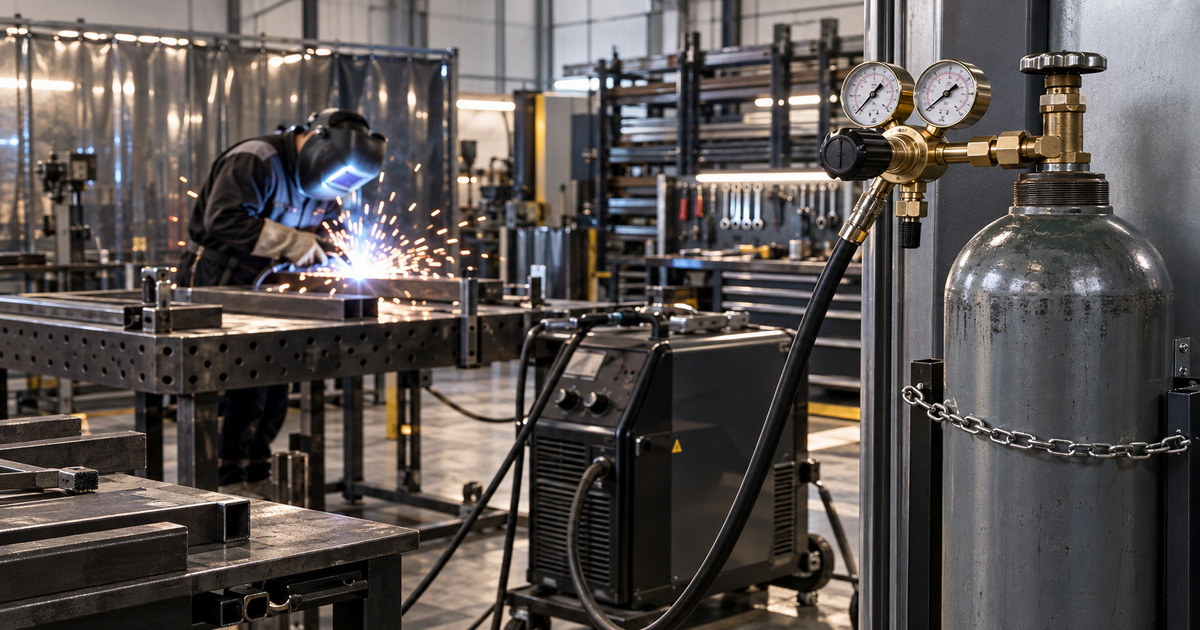
The UAE is an important Middle East procurement, distribution, and industrial-service hub for welding and industrial gas equipment—not necessarily a global production center for every regulator component. For professional buyers, the strongest UAE supply strategy often combines local stock availability, technical support, gas-cylinder connection compatibility, and a verified overseas OEM manufacturing partner.
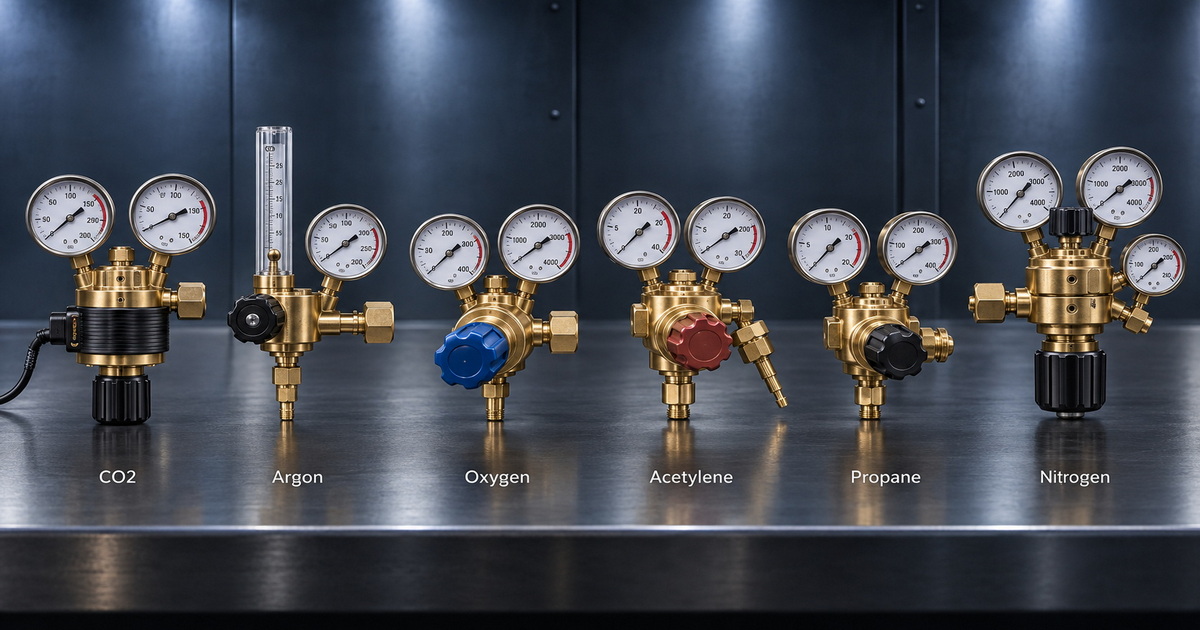
For buyers sourcing CO₂, argon, oxygen, acetylene, propane, nitrogen, or dual-stage industrial gas regulators, a supplier should not be selected simply because it offers a low unit price or has product photos online. A regulator is a pressure-control safety component. Its actual value depends on repeatable outlet-pressure stability, gas compatibility, sealing quality, thread accuracy, gauge reliability, traceability, and the supplier’s ability to reproduce the same specification in every batch.
The UAE’s broader industrial ecosystem is expanding rapidly. Official reporting states that UAE industrial exports reached AED 262 billion in 2025, up 25% year on year, while medium- and high-technology industrial exports reached AED 92 billion. This industrial expansion supports continuing demand for welding, fabrication, maintenance, oil and gas, construction, ship repair, HVAC, and gas-distribution equipment.
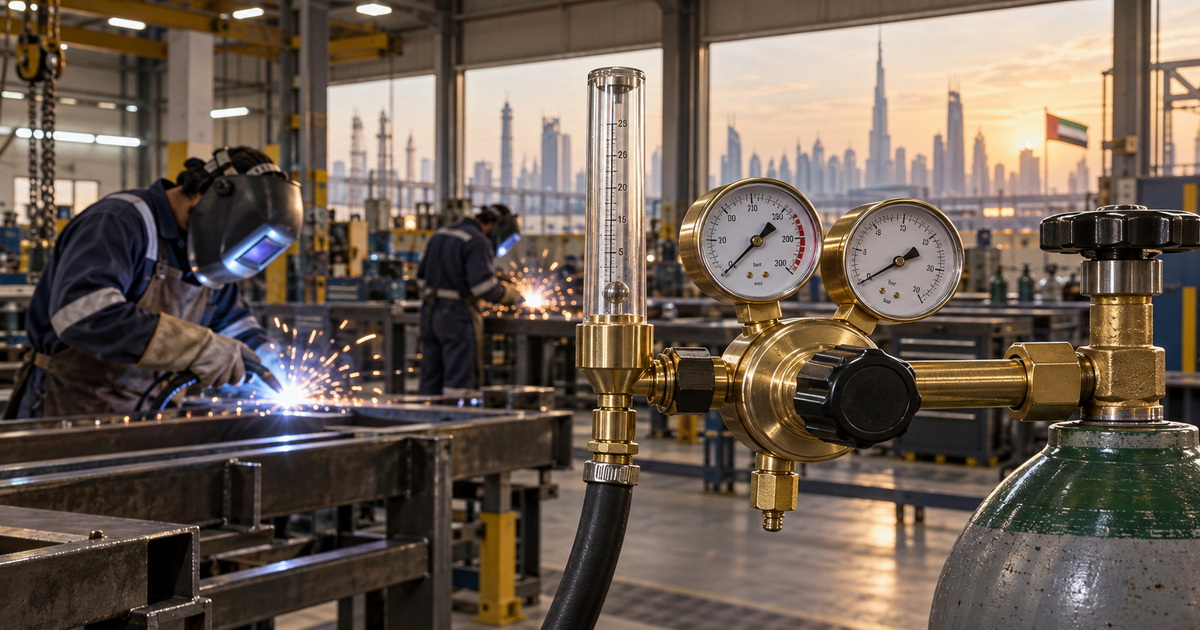
How We Evaluated Suppliers
This list is designed for procurement managers, gas distributors, welding-equipment brands, industrial wholesalers, and OEM buyers seeking a stable long-term supply relationship. It combines manufacturers that can support customized regulator programs with UAE-based suppliers that provide local availability and branded product access.
The evaluation focuses on the following practical criteria:
| Evaluation area | What professional buyers should verify | Why it matters |
|---|---|---|
| Product specialization | CO₂, argon, oxygen, acetylene, propane, nitrogen, flowmeter, heated, and dual-stage regulator coverage | Different gases require different pressure ranges, connections, seals, cleaning procedures, and safety design |
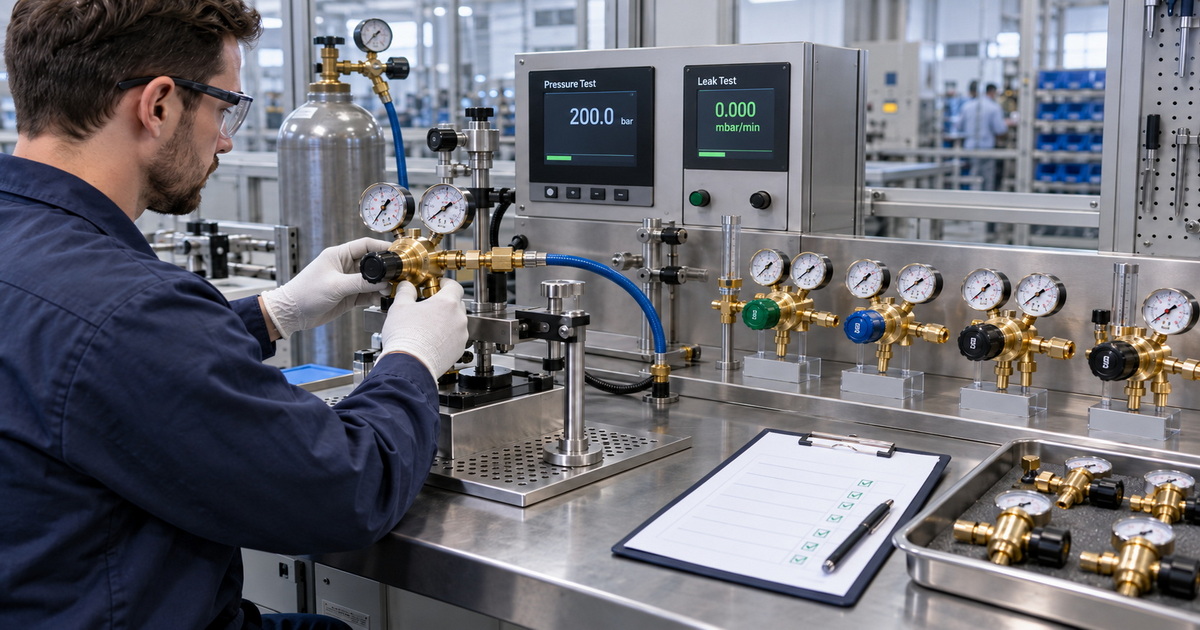
| Manufacturing capability | In-house engineering, machining, assembly, leak testing, pressure testing, and gauge calibration | Determines whether a supplier can maintain consistency rather than only resell products |
| Material transparency | Brass grade, diaphragm material, seat material, plating, forging or machining route, gauge construction | Reduces the risk of hidden material substitution |
| Quality management | ISO 9001 scope, incoming inspection, process records, leak testing, pressure-creep testing, final inspection, batch traceability | Helps prevent leakage, unstable output pressure, thread mismatch, and early field failure |
| Compliance readiness | CE/PED applicability, RoHS or REACH declaration where relevant, local cylinder-valve compatibility, product markings | Documentation must match the destination market and actual application |
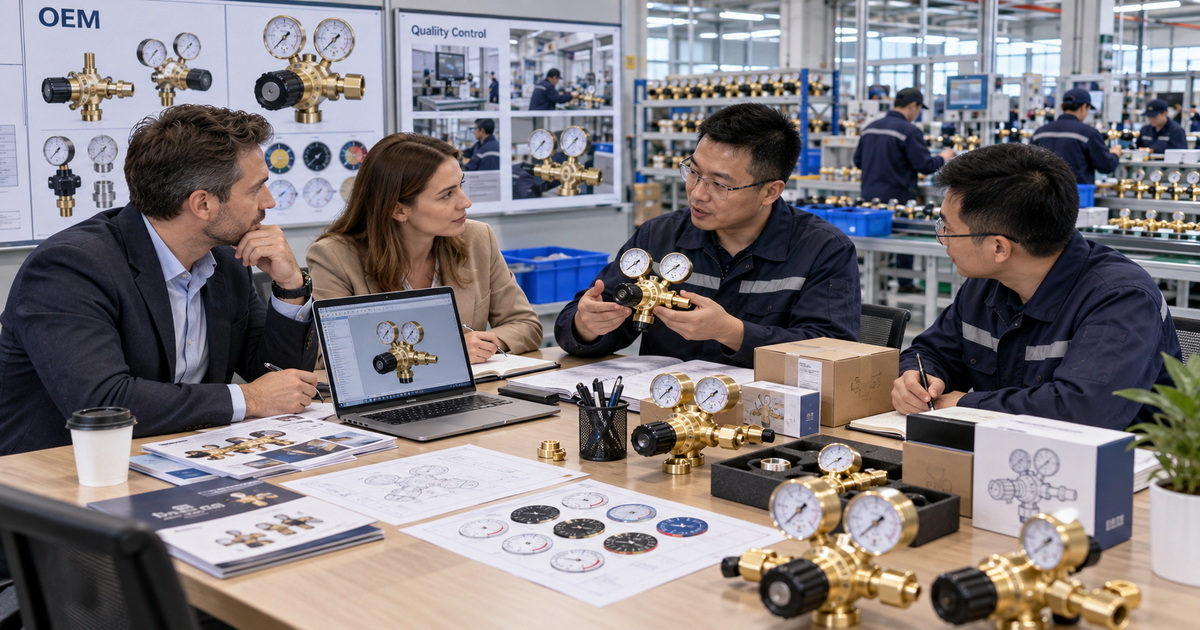
| OEM/ODM support | Private label, logo, gauge face, packaging, inlet/outlet configuration, customized pressure ranges, documentation | Critical for distributors and equipment brands building their own product line |
| Delivery reliability | Production planning, inventory support, export packaging, shipment documentation, spare-part continuity | Essential when regulators are part of a recurring distribution program |
| UAE service capability | Local stock, technical advice, brand authorization, fast quotation, after-sales access | Particularly valuable for urgent MRO, fabrication, and project-based procurement |
A key distinction is important: a UAE distributor may be the right choice for fast local replenishment, while a dedicated manufacturer may be better for private-label projects, cost-controlled bulk orders, customized gas connections, or long-term product development.
UAE Market Context
The UAE has strong demand-side advantages for industrial gas regulators. Dubai, Abu Dhabi, Sharjah, and the wider Gulf region support large populations of fabrication workshops, infrastructure contractors, ship-repair operations, oil and gas service companies, HVAC contractors, industrial maintenance teams, and gas-distribution businesses.
The country’s advantage is its commercial and logistics infrastructure. Buyers can often access imported global brands, regional distributors, welding-equipment suppliers, and industrial-gas service providers through a relatively concentrated commercial network. The UAE’s non-oil foreign trade reached approximately AED 3.8 trillion in 2025, while non-oil exports reached AED 813.8 billion, reflecting the country’s role as a re-export and distribution platform connecting Asia, Africa, Europe, and the wider Middle East.
However, buyers should recognize that “supplier in UAE” does not automatically mean “manufacturer in UAE.” Some companies operate as authorized distributors, importers, stockists, or project suppliers. This is not inherently negative—but the purchasing model should match the buyer’s goals:
– Choose a local UAE stockist or distributor when fast delivery, immediate replacement, local brand support, or project-site service is the priority.
– Choose an OEM manufacturer when you need a custom regulator program, branded packaging, specialized connections, controlled BOMs, recurring container-level orders, or a differentiated private-label product line.
– Use a hybrid sourcing model when your business needs both: locally stocked replacement products and directly imported OEM products for volume sales.
The Middle East industrial gases market was valued at approximately USD 10.41 billion in 2025 and is projected to reach about USD 17.16 billion by 2033, according to Grand View Research. Growth in industrial gases generally supports demand for reliable pressure-control products used in welding, fabrication, gas handling, process applications, laboratories, food and beverage CO₂ systems, and maintenance operations.
Leading Suppliers and Manufacturers
1. Zhejiang Bril Welding Equipment Co., Ltd. — OEM Manufacturer Serving UAE Buyers
Founded: 2002
Location: Wenzhou, Zhejiang, China
Core market role: Industrial gas regulator manufacturer and OEM/ODM partner for overseas brands, wholesalers, distributors, and welding-equipment manufacturers
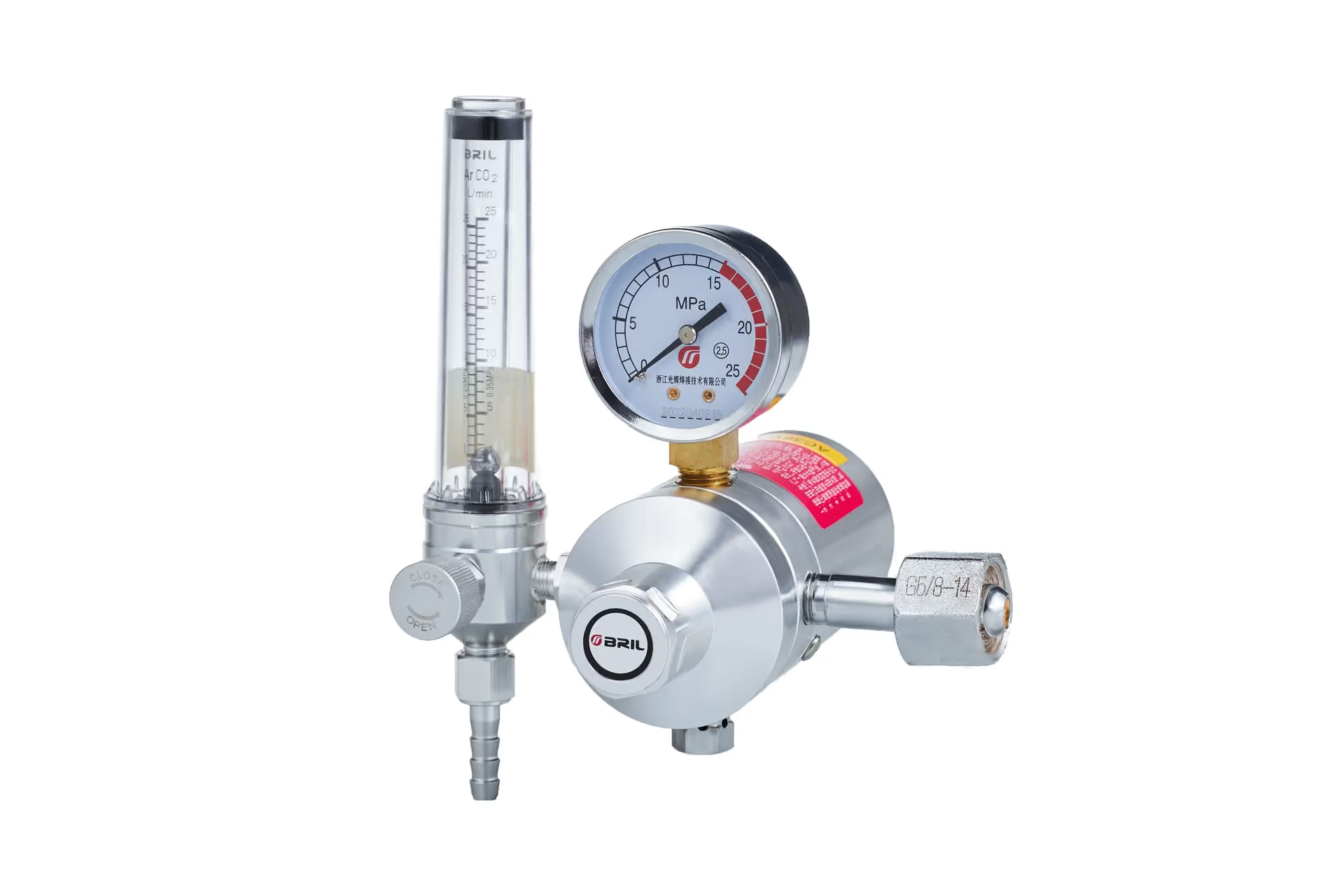
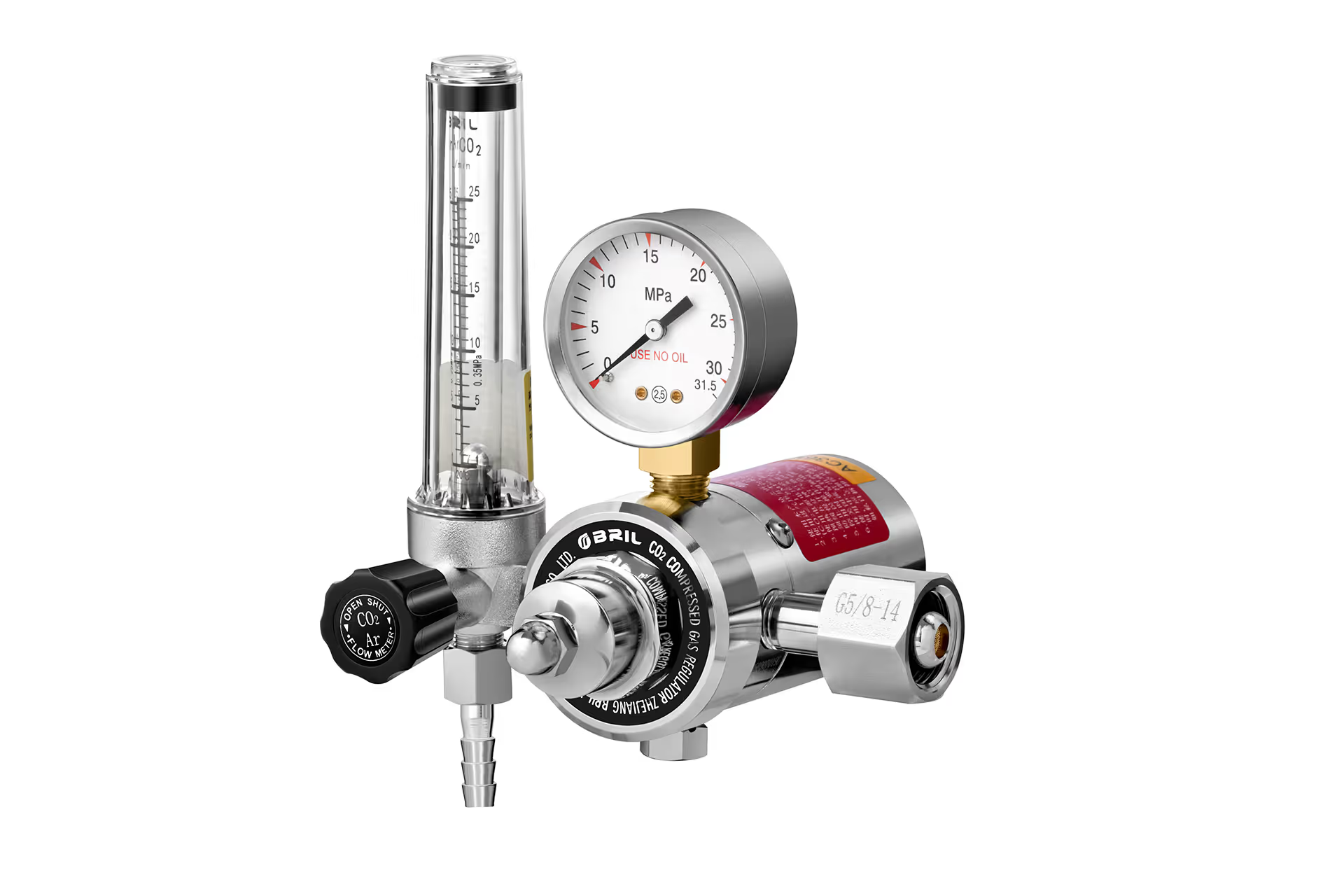
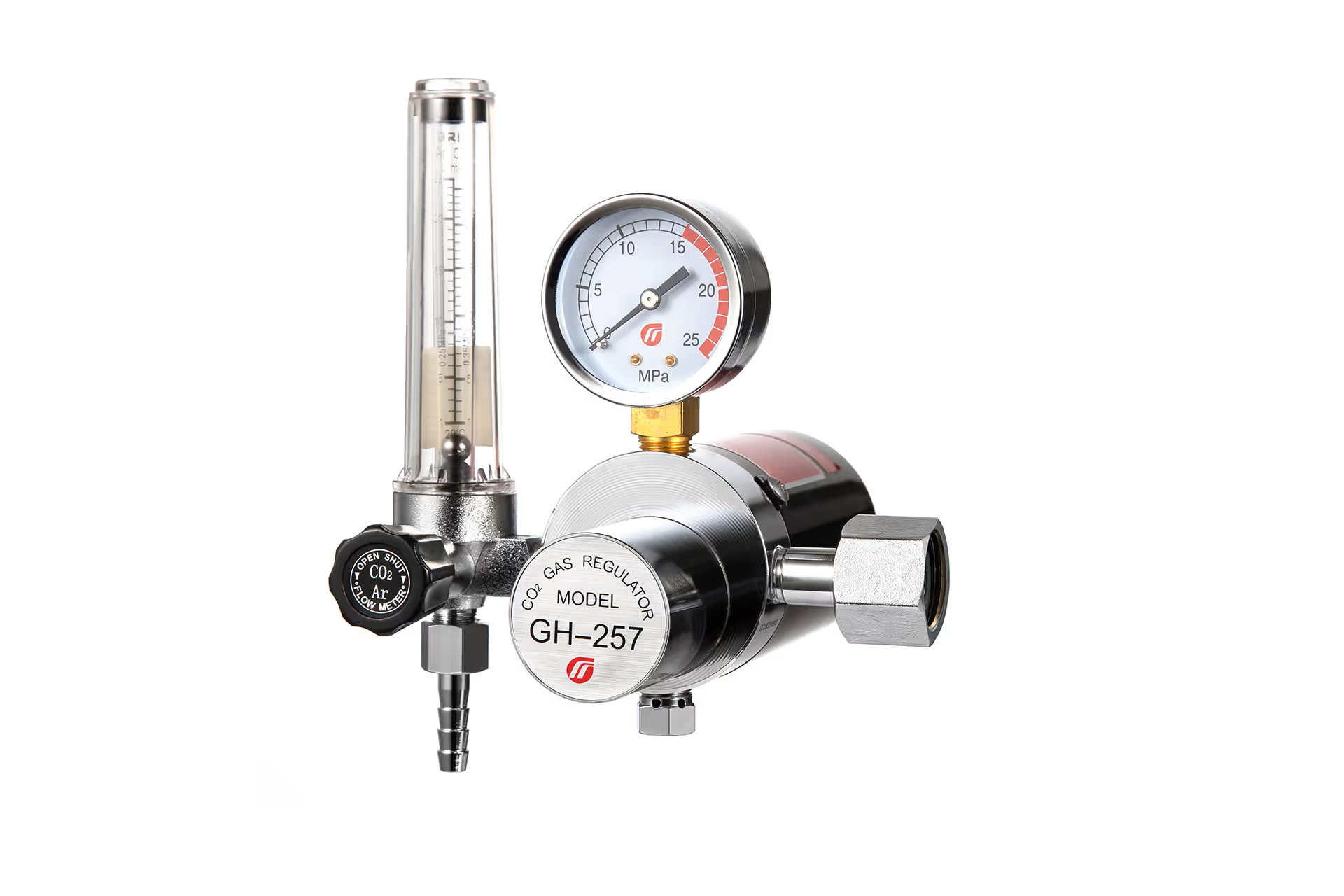
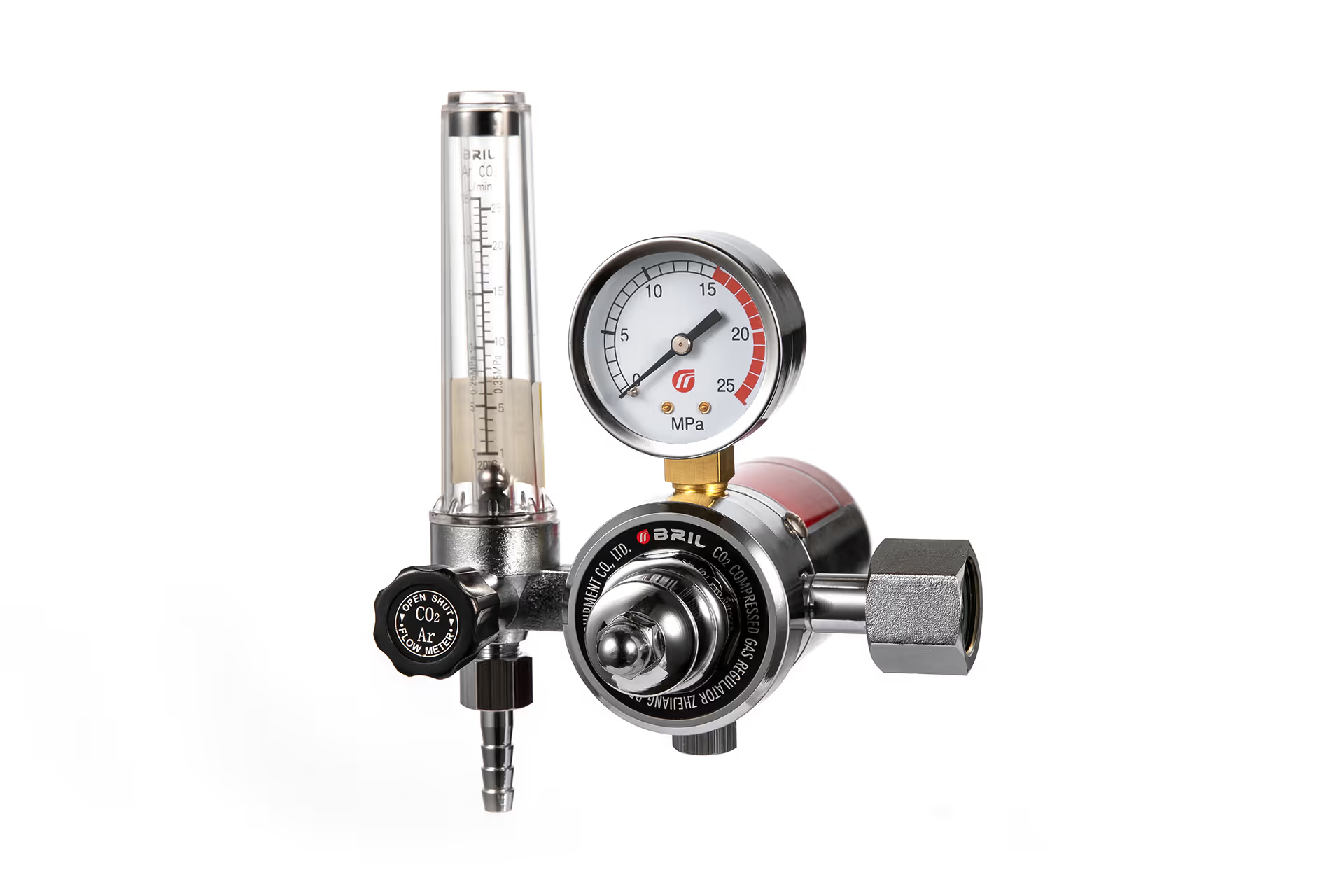
Relevant products: CO₂ heated regulators, CO₂ regulators, argon regulators, oxygen regulators, acetylene regulators, propane regulators, nitrogen regulators, flowmeter regulators, and dual-stage gas regulators
Key certification signals: ISO 9001, CE, and CNAS-related product testing/certification claims should be verified against the current certificate scope and product configuration before order placement
OEM/ODM focus: Private labeling, packaging customization, gauge face design, inlet/outlet thread selection, pressure range configuration, market-specific product labeling, and product-line development
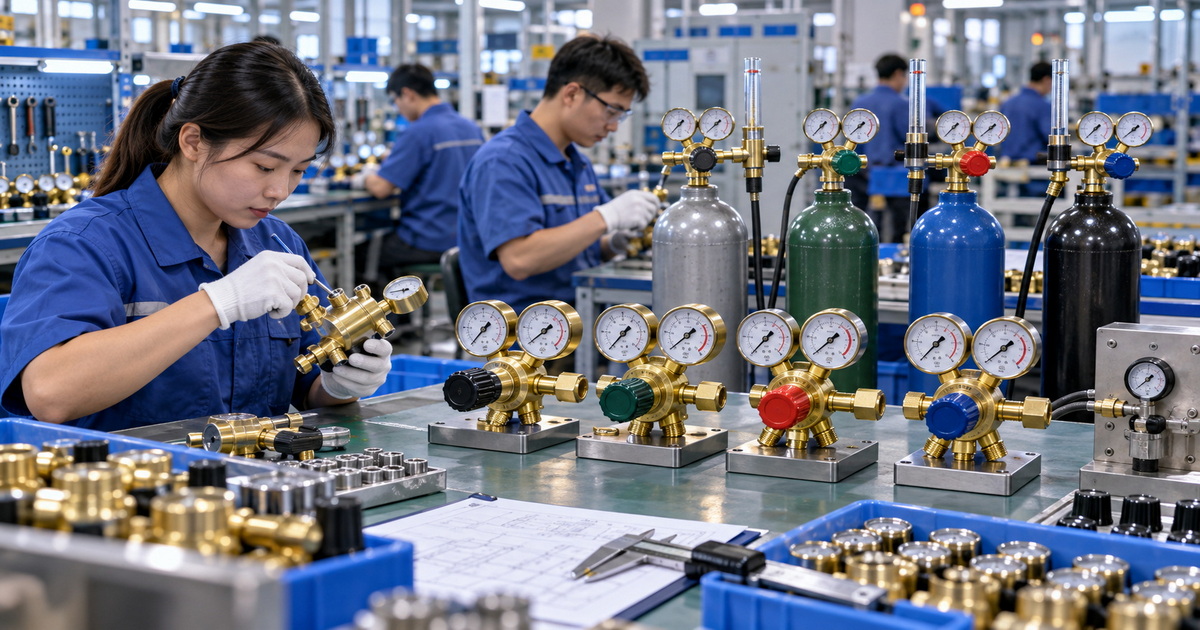
Zhejiang Bril Welding Equipment Co., Ltd. is a relevant option for UAE distributors and international buyers that need a manufacturing-oriented partner rather than only a local trading source. Founded in 2002 and based in Wenzhou’s Binhai Economic Development Zone, Bril specializes in the development, production, and sale of industrial gas pressure regulators. The company states that it has more than 20 years of industry experience, over 200 employees, modern inspection equipment, and established cooperation with domestic and overseas welding-equipment brands.
For small and medium-sized brands, Bril’s value proposition is not simply low-cost manufacturing. The more relevant commercial advantage is its ability to combine flexible OEM communication with product customization and industrial regulator specialization. This is important for distributors that need market-specific regulator designs—for example, a particular CGA, DIN, BS, or regional connection; customized gauge scales in psi, bar, MPa, L/min, or CFH; a private-label carton; or a heated CO₂ regulator matched to local voltage and plug requirements.
The company’s published profile identifies ISO 9001 certification from UKAS and IAF and states that its products have obtained CNAS and CE certifications. It also reports OEM relationships with welding-equipment brands and gas suppliers, including a full product-range OEM relationship beginning in 2022 for Messer product lines named Constant, Typhoon, Castolin, and Sotin. These claims provide useful supplier-screening starting points, but serious buyers should still request current certificates, product-specific declarations, scope details, and approved technical documents before incorporating any compliance claim into a purchase specification.
Why it may fit UAE and GCC buyers
– Suitable for importers building a private-label welding regulator range
– Broad regulator coverage across CO₂, argon, oxygen, acetylene, LPG/propane, nitrogen, and dual-stage applications
– Practical option for buyers that need technical drawing confirmation before production
– Supports OEM/ODM customization rather than only catalog product resale
– Appropriate for cost-sensitive brands that still need stable quality-control processes and clear communication
– Can support recurring distributor orders, pre-production samples, and golden-sample approval processes
What to verify before purchase
– Current ISO 9001 certificate number, validity, scope, legal entity, and factory address
– Exact CE/PED applicability for the regulator model and destination market
– Brass body specification, seat material, diaphragm material, and gauge grade
– Inlet and outlet connection standards for UAE or target export markets
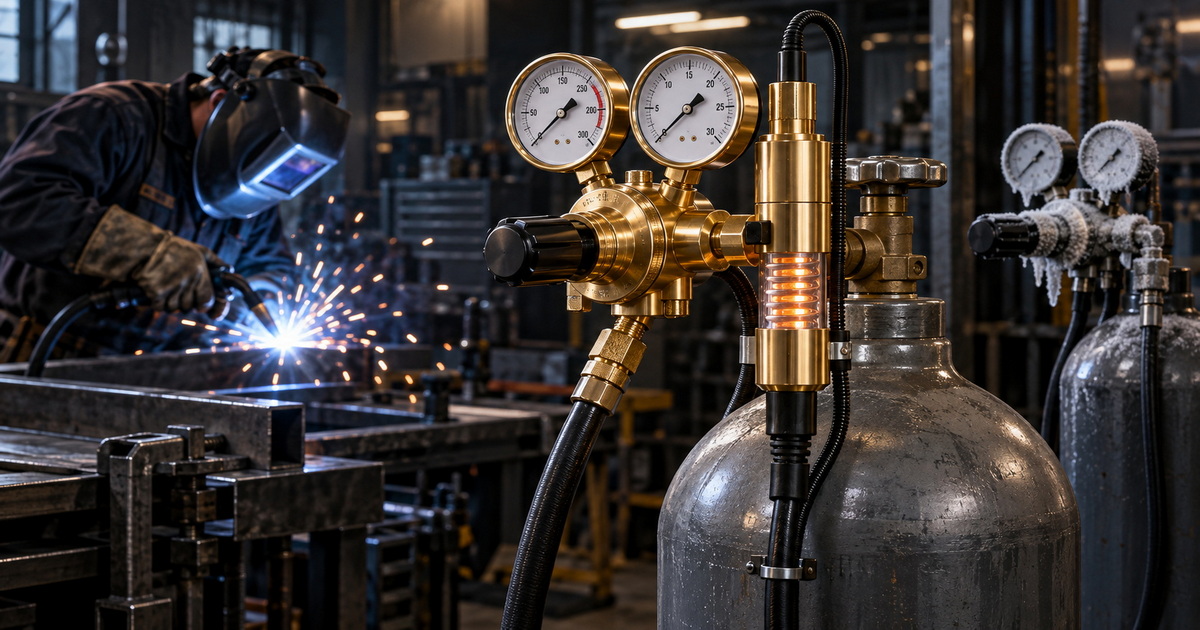
– CO₂ heater wattage, voltage, thermostat control, cable protection, plug type, and anti-freeze performance for heated models
– Batch pressure-test, leak-test, and gauge-calibration requirements
2. Weldtron — UAE Welding Equipment and Gas Regulator Supplier
Location: UAE
Core market role: Local welding-equipment and gas-regulator supplier
Primary market: UAE welding, fabrication, industrial maintenance, and workshop customers
Product orientation: Welding gas regulators and associated welding equipment
OEM/ODM scope: Primarily distribution and sourcing support; buyers should confirm whether private-label or customized import programs are available
Weldtron is positioned as a UAE-based supplier of welding equipment and gas regulators. Its public materials indicate that it supplies regulators from established international brands and identifies itself as an authorized dealer for Harris products. This makes it more relevant for buyers that prioritize access to recognized branded equipment, local availability, and distributor-level support in the UAE.
For procurement teams managing urgent workshop replenishment or contractor projects, a UAE-based supplier can reduce lead time compared with direct overseas manufacturing orders. However, buyers seeking proprietary branding, a custom pressure range, customized gauge artwork, or a large OEM regulator program should confirm whether the supplier can coordinate a direct manufacturer-backed solution.
Best suited for
– Welding workshops and fabrication companies needing local supply
– Contractors requiring short lead times
– Buyers seeking established welding-equipment brands
– MRO procurement teams that prioritize local support over private-label development
Buyer questions to ask
– Which regulator brands and models are stocked locally?
– Is the company an authorized distributor for the quoted brand and product family?
– Are spare gauges, diaphragms, fittings, and repair kits available?
– Can the supplier provide batch traceability or manufacturer test records?
– What local service, warranty, and replacement process applies?
3. Adams Tool House — Dubai Supplier of Regulators and Flowmeters
Location: Dubai, UAE
Core market role: Welding and industrial-tools supplier
Product orientation: Gas regulators, flowmeters, acetylene regulators, and welding-related equipment
Primary market: Dubai-based industrial users, fabrication businesses, and trade buyers
OEM/ODM scope: Distribution-based; confirm custom product or branding capabilities directly
Adams Tool House is presented as a Dubai-based supplier of gas regulators, flowmeters, and acetylene regulators. Its positioning as an authorized distributor is useful for buyers looking for genuine branded products and local procurement support rather than a factory-direct OEM relationship.
The supplier may be particularly relevant when the product requirement is urgent and conventional: standard oxygen, acetylene, argon, CO₂, or flowmeter regulator configurations used in welding and cutting applications. For higher-risk or specialized requirements, such as dual-stage nitrogen regulators, heated CO₂ regulators, or oxygen-cleaned medical/process configurations, the buyer should obtain a complete model-level technical specification rather than relying on generic product naming.
Best suited for
– Local welding and cutting consumable procurement
– Standard gas regulator replacement requirements
– Fabrication and maintenance teams in Dubai
– Buyers who need a local commercial contact for common gas-control items
Buyer questions to ask
– Is the offered regulator designed for the exact gas service?
– Is it a single-stage or dual-stage regulator?
– What is the maximum inlet pressure and working outlet-pressure range?
– Does the offered inlet connection match the local cylinder-valve standard?
– Is the acetylene regulator specifically rated for acetylene service rather than adapted from another gas configuration?
4. BNT Global — UAE Welding Regulator Supplier
Location: UAE
Core market role: Industrial tools and welding-regulator supplier
Product orientation: Welding regulators for cutting, welding, fabrication, and HVAC-related work
Primary market: UAE industrial users and project purchasers
OEM/ODM scope: Likely distribution and product sourcing; request confirmation for volume customization requirements
BNT Global lists welding regulators for UAE cutting, welding, fabrication, and HVAC applications. Its product positioning highlights the central function of regulators in maintaining controlled gas pressure for industrial work.
This type of supplier can be a practical option for businesses that value domestic invoicing, stock access, technical coordination, and supply consolidation with other workshop tools. It is especially relevant when gas regulators are one part of a broader purchase order that includes cutting torches, welding machines, consumables, fittings, or maintenance equipment.
Best suited for
– Buyers bundling regulators with welding and HVAC tools
– Project contractors that prefer one regional procurement source
– Fabrication shops requiring standard regulator replacement units
– Buyers who need local order coordination
Buyer questions to ask
– Can the supplier provide regulator flow curves or rated flow data?
– Are gauges calibrated or simply assembled as standard commercial components?
– What is the spare-part and warranty policy?
– Is the regulator suitable for continuous industrial duty or occasional workshop use?
– Can the supplier identify the original manufacturer and country of origin?
5. Victor Regulator Suppliers in UAE — Branded Industrial Regulator Availability
Location: UAE distribution market
Core market role: Branded gas-regulator availability through local suppliers
Product orientation: Industrial gas pressure control for fabrication, construction, offshore, repair, and maintenance applications
Primary market: Welding, shipbuilding, fabrication, rail, automotive, civil construction, and industrial maintenance
OEM/ODM scope: Not generally applicable for original-brand supply; private-label buyers should work directly with an OEM manufacturer
Victor-branded regulators are available through UAE suppliers and are marketed for demanding industrial uses including automotive, construction, heavy fabrication, light fabrication, offshore oil, railcar, maintenance, and ship or barge-building applications. Public product descriptions also reference stainless-steel diaphragm construction, consistent pressure and flow delivery, oxygen-related fire resistance considerations, and a protective knob design.
For buyers with a specification that requires a recognized international brand, an approved end-user list, or a standardized maintenance program, branded local supply can be appropriate. The trade-off is usually less design flexibility and potentially higher landed cost compared with a customized OEM manufacturing program.
Best suited for
– End users with approved-brand requirements
– Offshore, fabrication, maintenance, and contractor procurement
– Businesses prioritizing known brand continuity
– Replacement orders that must match an installed regulator fleet
Buyer questions to ask
– Which exact Victor series is supplied?
– Is the item genuine, authorized, and traceable to the manufacturer?
– What gas service, pressure range, and cylinder connection is specified?
– Is the regulator approved for the project’s application and country requirements?
– Are repair kits and replacement gauges supported locally?
6. GasNeeds LLC and Specialist UAE Gas-System Suppliers
Location: Dubai, UAE
Core market role: Gas equipment, fittings, detection, and system-related supply
Product orientation: Gas regulators, brass fittings, gas detection, valves, and related gas-system equipment
Primary market: Commercial, industrial, and gas-system buyers
OEM/ODM scope: Depends on the product category and project; verify technical and manufacturing source details
GasNeeds LLC appears in UAE supplier listings as a provider of gas regulators, brass fittings, gas detection products, and gas valves. It can be relevant when a buyer needs more than a cylinder regulator—such as fittings, shutoff valves, gas detection, or a broader gas-system package.
For industrial buyers, this category of supplier can help coordinate system compatibility. Nevertheless, a buyer should not assume that a supplier of fittings or detection equipment has the same level of regulator manufacturing expertise as a dedicated gas-regulator factory. Confirm the product origin, technical file, material certificate availability, and gas-service suitability for each item.
Best suited for
– Buyers purchasing gas-system components alongside regulators
– Commercial or industrial installation projects
– Procurement teams needing regulator, fitting, and gas-safety coordination
– UAE buyers seeking local support for system-level requirements
Buyer questions to ask
– Who manufactures the quoted regulator?
– What brass grade, seal material, and thread standard are used?
– Does the regulator include a relief valve or overpressure protection where required?
– Can the supplier provide conformity documentation and installation guidance?
– Is the item designed for industrial gas service, LPG, specialty gas, or building gas systems?
Supplier Comparison Table
Publicly verifiable capacity and MOQ figures are not consistently disclosed by UAE distributors or international suppliers. Buyers should treat blank or “quote required” fields as a signal to ask for a written production and supply plan rather than making assumptions.
| Supplier | Supply model | Main product focus | Manufacturing / OEM fit | Public capacity signal | Typical MOQ approach | Certification or documentation to verify |
|---|---|---|---|---|---|---|
| Zhejiang Bril Welding Equipment Co., Ltd. | Direct manufacturer and OEM/ODM partner | CO₂, heated CO₂, argon, oxygen, acetylene, propane, nitrogen, dual-stage regulators | Strong fit for private labels, custom specifications, packaging, gauges, threads, and ongoing product programs | 200+ employees stated; manufacturing and testing capability stated | Quote-based; confirm by model, tooling, packaging, and customization scope | ISO 9001, CE, CNAS-related claims, product test reports, material records |
| Weldtron | UAE distributor / welding supplier | Welding gas regulators and branded products | Suitable for local supply; OEM scope should be confirmed | Local supplier and authorized-dealer positioning stated | Usually quotation and stock dependent | Brand authorization, model datasheet, country of origin, local warranty |
| Adams Tool House | Dubai supplier / authorized distributor | Regulators, flowmeters, acetylene regulators | Standard local supply; OEM scope should be confirmed | Distributor positioning stated | Quote-based and model dependent | Authorization evidence, gas-specific rating, pressure specification, thread standard |
| BNT Global | UAE industrial and welding supplier | Welding and cutting regulators | Suitable for local sourcing and bundled tool procurement | Product category availability stated | Quote-based and stock dependent | Manufacturer identity, pressure and flow data, service support |
| Victor UAE supply channels | Branded distribution | Industrial gas regulators for demanding applications | Best for brand-specific purchasing; not for private label | Product specifications vary by series | Distributor/order dependent | Authorized supply chain, model-specific technical data, repair-kit availability |
| GasNeeds LLC / specialist system suppliers | Gas-system supplier | Regulators, fittings, valves, gas safety products | Useful for integrated system sourcing; verify actual regulator maker | Product-category listing | Project and product dependent | Product origin, material traceability, system compatibility, applicable approvals |
Technical Requirements Buyers Should Define
A correct industrial gas regulator specification starts with the gas and application—not with a product photo or a generic phrase such as “high-pressure regulator.”
Gas Type and Material Compatibility
Different gases create different compatibility and safety requirements:
| Gas or application | Critical technical requirements |
|---|---|
| CO₂ welding or beverage CO₂ | Verify anti-freeze behavior, stable delivery under sustained flow, suitable heater design for heated CO₂ regulators, pressure range, and appropriate outlet fitting |
| Argon or argon/CO₂ shielding gas | Confirm flowmeter scale, rated flow, hose-tail size, outlet configuration, and compatibility with MIG/TIG welding systems |
| Oxygen | Require oil-free manufacturing controls, oxygen-compatible seals, cleanliness documentation, dedicated assembly discipline, and suitable materials |
| Acetylene | Use an acetylene-specific regulator; confirm maximum outlet-pressure restriction, connection standard, gas compatibility, and flashback-arrestor integration requirements |
| Propane or LPG | Confirm vapor-phase versus liquid-phase use, ambient-temperature performance, nominal delivery pressure, safety shutoff requirements, and installation standard |
| Nitrogen | Verify inlet-pressure rating, high-pressure stability, gauge range, flow capacity, and whether single-stage or dual-stage control is required |
| Dual-stage applications | Confirm reduced pressure-drop effect as cylinder pressure declines, pressure-creep performance, and stable output over the required operating range |
An industrial gas regulator reduces the high pressure of a cylinder or pipeline to a usable downstream working pressure. But the pressure-reduction function alone does not establish fitness for every gas. The same basic shape can conceal major differences in diaphragm material, seat construction, inlet connection, maximum inlet pressure, clean-assembly process, relief design, gauge range, and intended service.
Single-Stage vs. Dual-Stage Regulators
A single-stage regulator reduces pressure in one step. It can be suitable for many welding, cutting, and general industrial uses where small changes in outlet pressure as the cylinder empties are acceptable.
A dual-stage regulator reduces pressure in two stages. It is generally preferred when output stability matters more, including laboratory applications, precise process-gas use, certain nitrogen services, analytical systems, or long-duration operations where cylinder pressure drops substantially.
Do not assume “dual-stage” automatically means better for every application. It normally adds cost and complexity. The correct decision depends on the allowable outlet-pressure variation, flow requirement, gas type, operating hours, and safety specification.
Procurement Risks and Avoidance
1. Brass Grade Substitution
One of the most common hidden quality risks is material substitution. A regulator may be advertised as “brass,” but the buyer may not know whether the body is forged brass, cast brass, recycled brass with inconsistent composition, or a lower-grade alloy with weaker corrosion resistance and thread strength.
How to reduce the risk
– Request the brass grade for body, bonnet, stem, fittings, and valve components
– Ask whether the body is forged, machined, or cast
– Request material certificates for critical components on high-volume or high-risk orders
– Include body-weight tolerance and dimensional tolerances in the technical agreement
– Compare samples against the approved golden sample before every production release
2. Incorrect Gas Connection
A regulator can be technically functional but commercially unusable if the cylinder connection does not match the target market. CGA, DIN, BS, and other national or regional connection systems are not interchangeable.
How to reduce the risk
– Specify inlet connection, outlet connection, hose-tail size, thread direction, and thread pitch in writing
– Provide an approved drawing or physical mating component where practical
– Conduct a thread-fit test on production samples
– Do not approve only a photo of the inlet nut or outlet fitting
3. Unstable Outlet Pressure
Some low-cost regulators pass a brief leak test but perform poorly during longer operation. Potential problems include pressure creep, drifting outlet pressure, poor repeatability after adjustment, and insufficient flow under load.
How to reduce the risk
– Request a pressure-creep test procedure
– Test outlet-pressure stability after the cylinder pressure declines
– Set acceptance limits for leakage, pressure drop, and repeatability
– Test at actual working flow rather than only at static pressure
– Compare gauges against a calibrated reference instrument
4. Misuse of CE or ISO Claims
An ISO 9001 certificate applies to a quality-management system, not automatically to every product’s performance or legal market access. A CE mark may only be appropriate under specific applicable legislation, product configuration, and conformity route.
How to reduce the risk
– Request the full current ISO certificate, not a cropped catalog image
– Check the legal company name, factory address, scope, certificate number, issue date, expiry date, and issuing certification body
– Verify that the certification scope includes manufacturing, not only trading
– Request the Declaration of Conformity and supporting product documentation where CE is claimed
– Confirm whether the product falls within PED or other applicable regulatory requirements for the intended market
5. Gauge Quality Mismatch
A regulator’s brass body may be acceptable while its gauges are inaccurate, poorly sealed, or vulnerable to damage during transport. This can create customer complaints even when the regulator mechanism is functional.
How to reduce the risk
– Define gauge diameter, scale, range, accuracy class where applicable, lens material, and dial artwork
– Confirm whether gauges are calibrated or batch-checked
– Require protective packaging and drop-test consideration for export cartons
– Test readability and scale units for the target market: psi, bar, MPa, L/min, or CFH
Insider Sourcing Tip
A little-discussed but important industry issue is that a regulator can pass a short static leak test and still fail in real service because of pressure creep.
Pressure creep occurs when the outlet pressure gradually rises after the regulator is set and flow is stopped or reduced. It may result from poor seat sealing, contamination, damaged sealing surfaces, inconsistent spring behavior, or weak assembly control. A supplier may show a successful one-minute leak test, yet the regulator can still drift after 10 to 30 minutes under actual operating conditions.
For this reason, buyers should add a pressure-creep requirement to the quality agreement. For example:
1. Set the regulator to the required outlet pressure.
2. Stabilize the inlet pressure at the specified condition.
3. Stop downstream flow or reduce it to the agreed condition.
4. Monitor outlet pressure for the defined period.
5. Record the permitted outlet-pressure increase.
The exact acceptance limit should be determined by the gas, application, regulator type, and relevant specification. The key principle is simple: do not rely solely on “no visible leakage” as proof of pressure-control quality.
Buyer’s Sourcing Guide
Step 1: Build an Application-Specific RFQ
A useful RFQ for an industrial gas regulator should include:
– Gas type and gas mixture
– Cylinder pressure and cylinder-valve connection
– Required outlet-pressure range
– Maximum operating flow
– Single-stage or dual-stage construction
– Required gauge units and gauge ranges
– Inlet and outlet thread standards
– Hose-tail size or outlet fitting type
– Operating temperature and environment
– Required anti-freeze performance for CO₂
– Required electrical specification for heated CO₂ regulators
– Packaging requirements
– Private-label logo, color, gauge face, and carton artwork
– Market destination and applicable certification requirements
– Annual demand forecast and initial order quantity
Step 2: Validate the Factory, Not Only the Website
Before committing to a long-term order, ask for:
– Business registration and factory address
– Factory audit photos or a live video audit
– ISO certificate and verification details
– Production-line overview
– Incoming inspection procedure
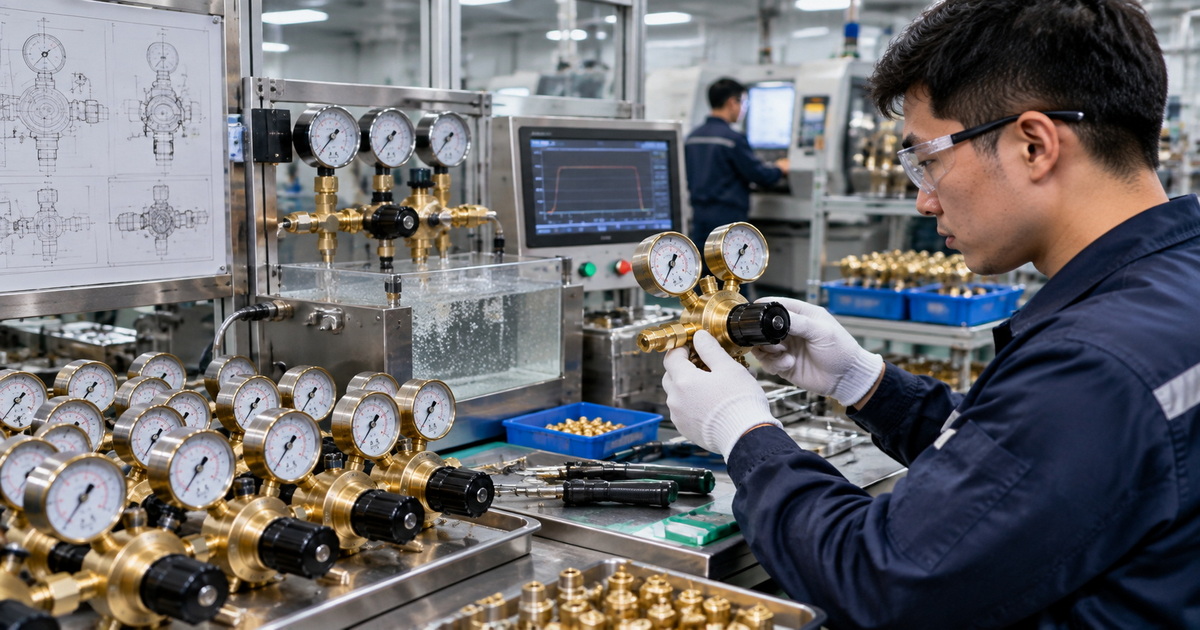
– Pressure-test and leak-test procedure
– Gauge inspection or calibration process
– Packaging and export-shipping procedure
– Product BOM or at least a controlled material specification
– Current customer references where disclosure is permitted
For Bril specifically, the company’s published profile identifies its Wenzhou location, 2002 founding date, manufacturing focus, 200+ employees, inspection capability, and stated relationships with domestic and international welding-equipment companies. Those are useful initial indicators, but procurement teams should independently validate current capacity, current certification status, exact product scope, and the configuration of the models being sourced.
Step 3: Use a Three-Stage Sample Process
Do not move directly from a catalog photo to mass production. Use a staged process:
1. Engineering sample
Verify gas compatibility, cylinder connection, outlet thread, pressure range, flowmeter scale, heater specification, gauge range, logo location, and carton concept.
2. Pre-production sample
Confirm that the sample uses the same materials, tooling, gauges, assembly process, and packaging planned for mass production.
3. Golden sample
Retain a sealed, approved reference sample. Use it as the inspection benchmark for future shipments and dispute resolution.
Step 4: Include Functional Tests in the Purchase Agreement
A professional regulator inspection plan may include:
– Inlet-pressure withstand test
– Internal and external leakage test
– Outlet-pressure stability test
– Pressure-creep test
– Flow-capacity verification
– Gauge comparison against a calibrated reference
– Thread-fit check
– Repeated adjustment-cycle test
– Visual inspection of plating, marking, logo, packaging, and gauge alignment
– Heated CO₂ regulator electrical safety and thermal-performance test where applicable
Step 5: Plan Logistics Carefully
For UAE imports, confirm the following before shipment:
– Correct HS code and import classification
– Commercial invoice and packing list accuracy
– Country-of-origin documentation if required
– Carton strength and palletization requirements
– Salt-air and humidity protection for marine freight
– Gauge protection during handling
– Spare parts and warranty stock plan
– Whether the destination customer expects Arabic or English product labeling
– Incoterms, insurance responsibility, port of entry, and delivery-to-warehouse arrangements
For heated CO₂ regulators, confirm whether the item includes electrical components, power cables, plugs, and retail packaging. The exact voltage, plug standard, cable length, thermostat setting, and electrical compliance requirement should appear on the approved specification sheet.
Conclusion
The UAE is a strategic market for industrial gas regulator procurement because it combines expanding industrial demand, strong logistics infrastructure, local branded-product availability, and access to manufacturers serving the Gulf region. The most effective sourcing decision depends on whether you need immediate local supply, a recognized brand, a fully customized private-label product, or a combination of all three.
For urgent maintenance and workshop requirements, UAE-based suppliers such as Weldtron, Adams Tool House, BNT Global, and branded distribution channels may provide practical local access. For distributors, welding-equipment brands, and wholesalers building long-term private-label programs, a specialized OEM manufacturer such as Zhejiang Bril Welding Equipment Co., Ltd. can offer broader customization, direct engineering communication, controlled product specifications, and a more scalable supply model.
Before placing a volume order, define the gas application precisely, verify certification scope, validate the actual factory or authorized distribution chain, test samples under real operating conditions, and include pressure-creep, leakage, thread-fit, and packaging requirements in the purchase agreement.
For buyers seeking customized CO₂, argon, oxygen, acetylene, propane, nitrogen, heated CO₂, or dual-stage gas regulators for the UAE and wider GCC market, request a model-specific technical package, sample plan, and written quality-control proposal before comparing quotations.
Frequently Asked Questions
1. How can I verify whether an ISO 9001 certificate is still valid?
Request the complete certificate and review the certificate number, legal company name, factory address, certification scope, issuing certification body, accreditation mark, issue date, and expiry date. Then use the certification body’s verification channel where available. Also request evidence of the most recent surveillance audit. Do not assume that a certificate held by a trading company applies to the factory that actually produces the regulator.
2. Is a CE mark enough to prove that an industrial gas regulator is compliant?
No. A CE mark alone is not sufficient proof. You need to determine whether CE marking is applicable to the exact regulator, pressure rating, intended use, and destination market. Request the product-specific Declaration of Conformity, applicable standards, test reports where relevant, technical file support, and evidence that the documentation belongs to the quoted model rather than a different product family.
3. What is the most important test for a CO₂ heated regulator?
There is no single universal test, but buyers should prioritize stable gas delivery under sustained flow, heater function, temperature control, electrical safety, cable and plug durability, leak tightness, and pressure stability. A CO₂ regulator that performs normally at room temperature with minimal flow may still freeze or lose flow stability in continuous welding use. Test it under representative duty conditions.
4. Should I choose a single-stage or dual-stage nitrogen regulator?
Choose based on the permissible output-pressure variation. A dual-stage nitrogen regulator is usually more suitable when the application needs stable outlet pressure as cylinder pressure falls, such as laboratory, process, instrumentation, or controlled-purge applications. A single-stage regulator may be appropriate for general industrial work where small pressure changes are acceptable and cost sensitivity is higher.
5. How do I prevent receiving a different material grade from the approved sample?
Use a written technical agreement that identifies the material grade, body manufacturing method, critical components, gauge specification, thread standard, and acceptable tolerances. Keep a golden sample, require batch traceability, and conduct pre-shipment inspection. For higher-risk projects, request material certificates and use third-party inspection with random disassembly or component verification.
References
1. – [UAE Ministry of Industry and Advanced Technology] — UAE industrial development policy and manufacturing-sector information. [moiat.gov]
2. – [UAE Industrial Exports Reach AED 262 Billion in 2025] — Official UAE news reporting on 2025 industrial-export performance. [wam]
3. – [UAE Ministry of Foreign Trade: Trade Data] — Official UAE trade statistics and non-oil trade information. [trade.gov]
4. – [Grand View Research: Middle East Industrial Gases Market] — Industrial gases market estimates and forecast data. [grandviewresearch]
5. – [Fortune Business Insights: Industrial Gases Market] — Global and regional industrial gases market context. [fortunebusinessinsights]
6. – [Zhejiang Bril Welding Equipment Co., Ltd. About Us] — Company history, stated certifications, manufacturing profile, and OEM references. [chinesewelding]
7. – [Weldtron UAE Gas Regulators] — UAE gas-regulator supply and distributor information. [weldtron]
8. – [BNT Global UAE Welding Regulators] — UAE welding regulator product-category information. [bntglobalme]
Hot Tags: Industrial Gas Regulator, Industrial Gas Regulator Manufacturer, Industrial Gas Regulator Supplier, Welding Gas Regulator, CO2 Gas Regulator, Heated CO2 Regulator, Argon Gas Regulator, Oxygen Gas Regulator, Dual Stage Gas Regulator, Gas Regulator OEM Manufacturer