Content Menu
● Leading Suppliers Serving Germany
>> 1. Zhejiang Bril Welding Equipment Co., Ltd.
>> 2. Messer Group / Messer Germany
>> 5. GOK Regler- und Armaturen-Gesellschaft mbH & Co. KG
>> 1. Match the Regulator to the Gas
>> 2. Material Quality: The Hidden Cost Driver
>> 3. Internal Sourcing Warning Few Buyers Ask About
● FAQ
>> 1. How can I verify whether a supplier’s ISO 9001 certificate has expired?
>> 2. Is CE marking enough to import industrial gas regulators into the EU?
>> 3. When should a buyer choose a dual-stage regulator?
>> 4. How should I evaluate a heated CO₂ regulator sample?
>> 5. What should be included in an OEM regulator agreement?
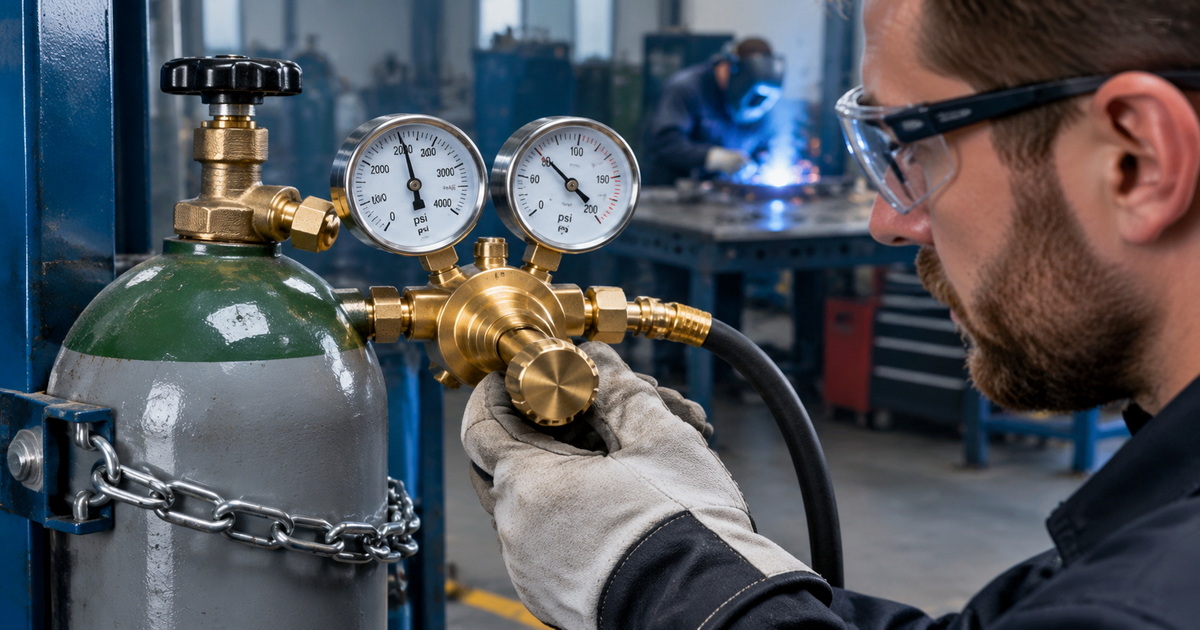
Germany is one of Europe’s most demanding markets for industrial gas-control equipment. Buyers sourcing Industrial Gas Regulators for welding, cutting, cylinder supply, laboratories, beverage CO₂ systems, or industrial production typically expect stable outlet pressure, documented conformity, reliable traceability, and consistent availability of spare parts.
For procurement teams, “German supplier” does not always mean a regulator is manufactured in Germany. Some brands operate German sales, engineering, gas-distribution, or service organizations while manufacturing occurs in other European or Asian locations. Therefore, this guide distinguishes between suppliers with a strong German market presence and manufacturers suitable for OEM/ODM procurement.
The broader industrial gas regulator market was valued at about USD 18.10 billion in 2025 and is forecast to reach USD 21.95 billion by 2030, according to one market analysis. Germany represents an important European demand center because of its dense base of machinery, automotive, metalworking, chemical, food-and-beverage, and industrial-gas businesses.
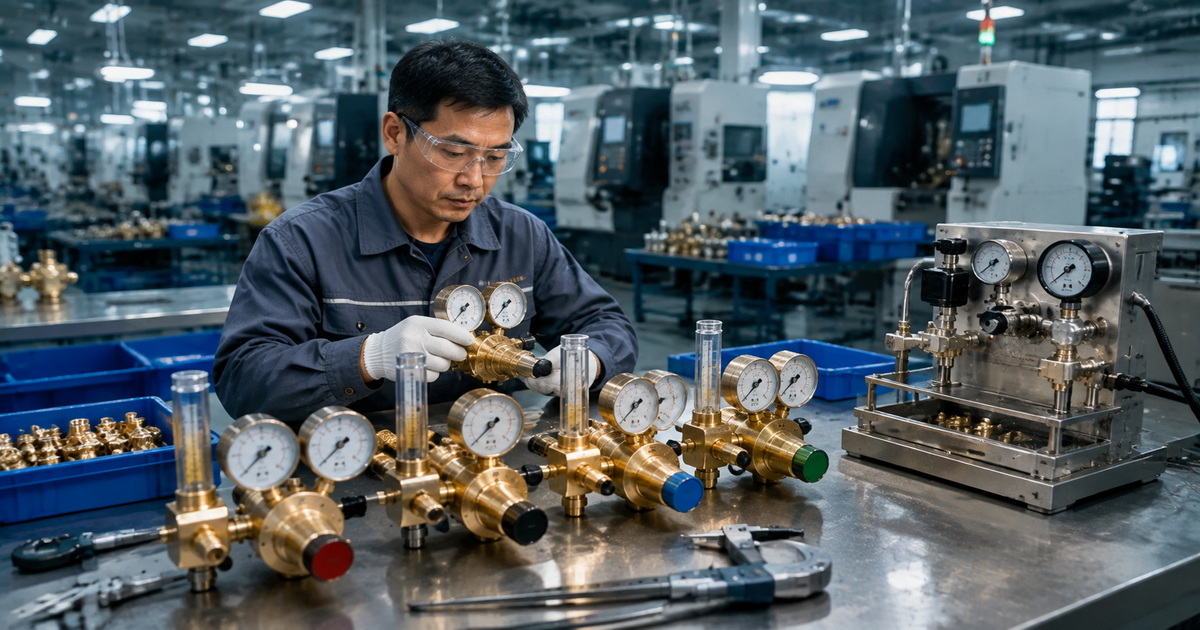
Why Germany Matters
Germany’s advantage is not one single “regulator cluster” comparable to a consumer-goods manufacturing district. Its strength is an integrated industrial ecosystem:
– Strong demand from welding and metal fabrication, automotive suppliers, process manufacturing, laboratories, and industrial-gas distributors.
– Deep engineering capability in precision machining, measurement, valves, fittings, gas-cylinder handling, and pressure-safety systems.
– High expectations for product documentation, EN/DIN alignment, CE obligations where applicable, and quality-system control.
– An established gas-supply ecosystem led by companies such as Linde and Messer, supported by equipment providers and distributor networks.
For buyers, this means German-market suppliers are often strong choices when application documentation, local responsiveness, high-specification gas systems, or established distribution support matters. However, buyers pursuing private-label welding regulators, flexible MOQs, or rapid customization should separately assess the manufacturer behind the brand.
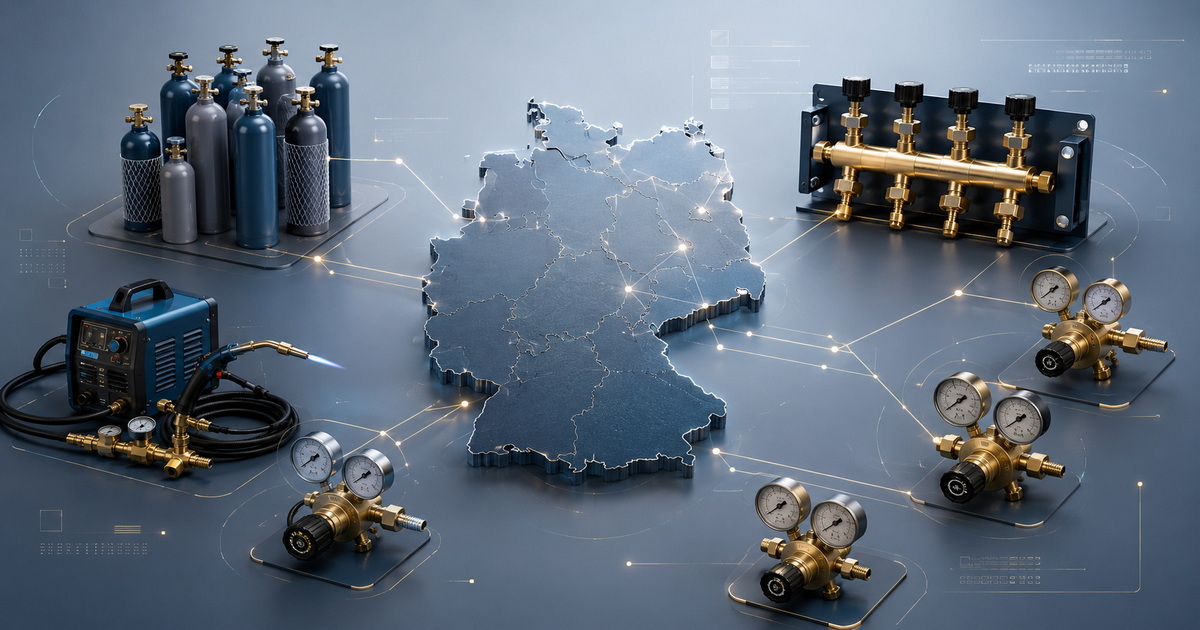
How We Selected Suppliers
This is not a revenue ranking. The following companies were selected because they have meaningful relevance to Germany’s industrial gas-control, welding-and-cutting, cylinder-regulation, or gas-distribution market.
| Evaluation dimension | What professional buyers should verify |
|---|---|
| Product fit | Gas type, inlet connection, outlet connection, pressure range, flow range, single- or dual-stage design |
| Engineering capability | Internal regulator design, diaphragm selection, valve-seat engineering, pressure-stability testing, technical drawing support |
| Quality control | Incoming brass verification, thread inspection, leak testing, pressure testing, gauge calibration, final functional inspection |
| Compliance | Applicable EN/DIN standard, CE/PED assessment where required, REACH/RoHS declaration where relevant, ISO 9001 certificate scope and validity |
| Production reliability | Capacity evidence, material sourcing, lead-time history, tooling ownership, spare-part continuity |
| OEM/ODM suitability | Private label, logo, dial artwork, packaging, thread variants, gas-specific configurations, customized pressure ranges |
| Commercial transparency | MOQ, sample lead time, warranty terms, Incoterms, inspection rights, claims process |
Leading Suppliers Serving Germany
1. Zhejiang Bril Welding Equipment Co., Ltd.
Positioning: Flexible OEM/ODM manufacturer for welding and industrial gas-regulator brands, distributors, and equipment manufacturers.
Although Zhejiang Bril Welding Equipment Co., Ltd. is headquartered in Wenzhou, China rather than Germany, it is highly relevant to buyers seeking a cost-effective manufacturing partner for German and European-market regulator programs. The company was founded in 2002 and specializes in industrial gas pressure regulators. Its disclosed qualifications include ISO 9001 certification, plus product-level CNAS and CE-related testing/certification claims.
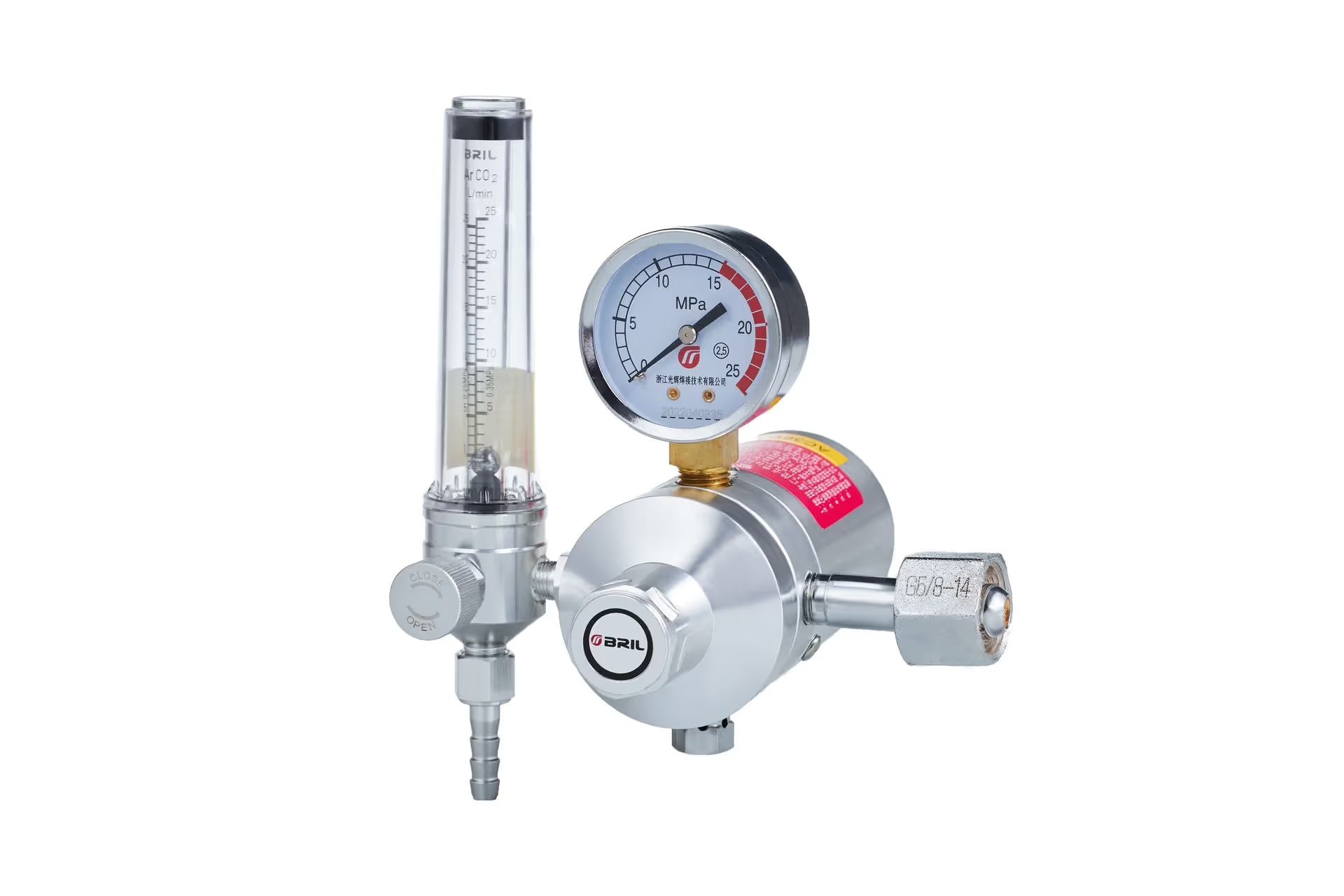
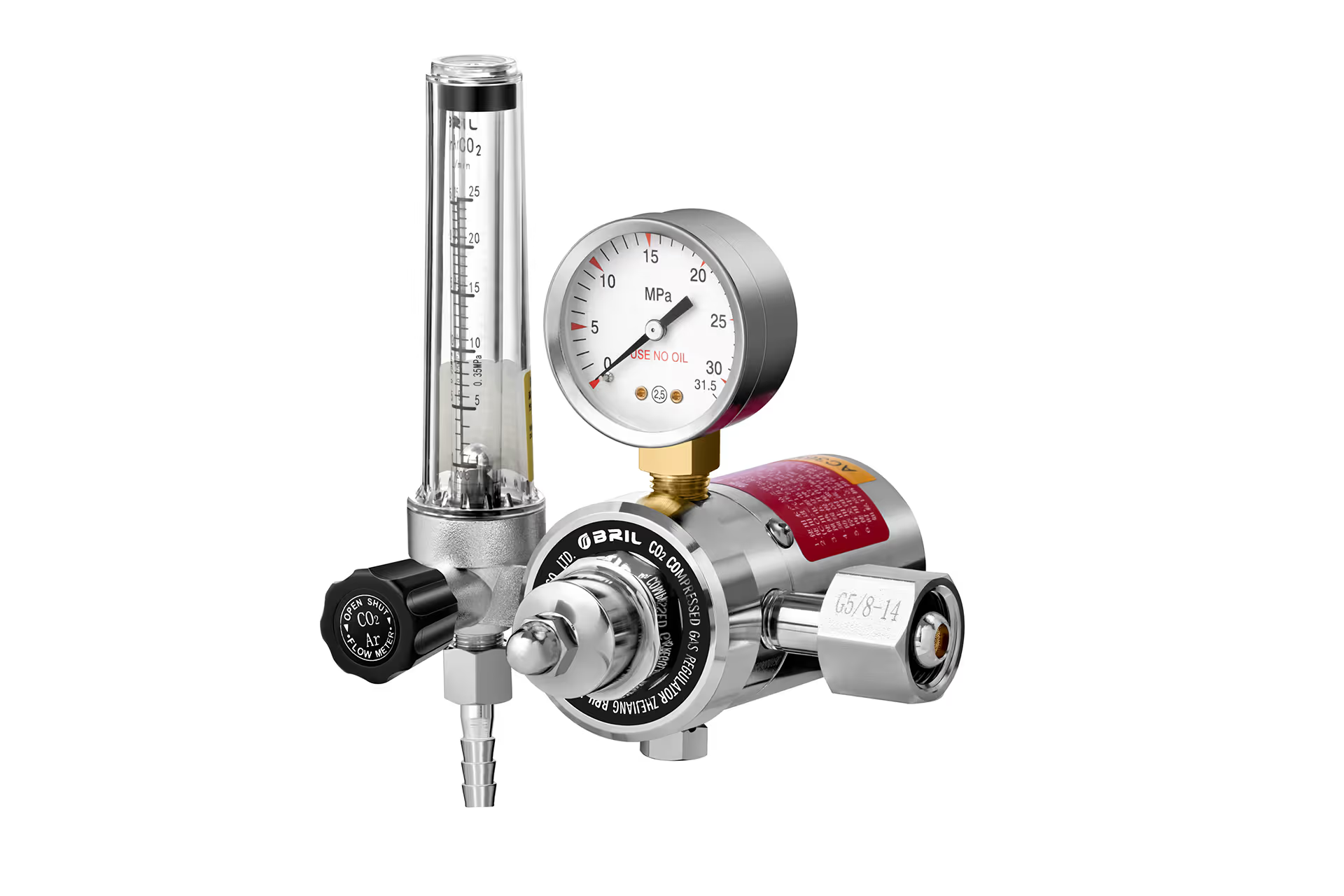
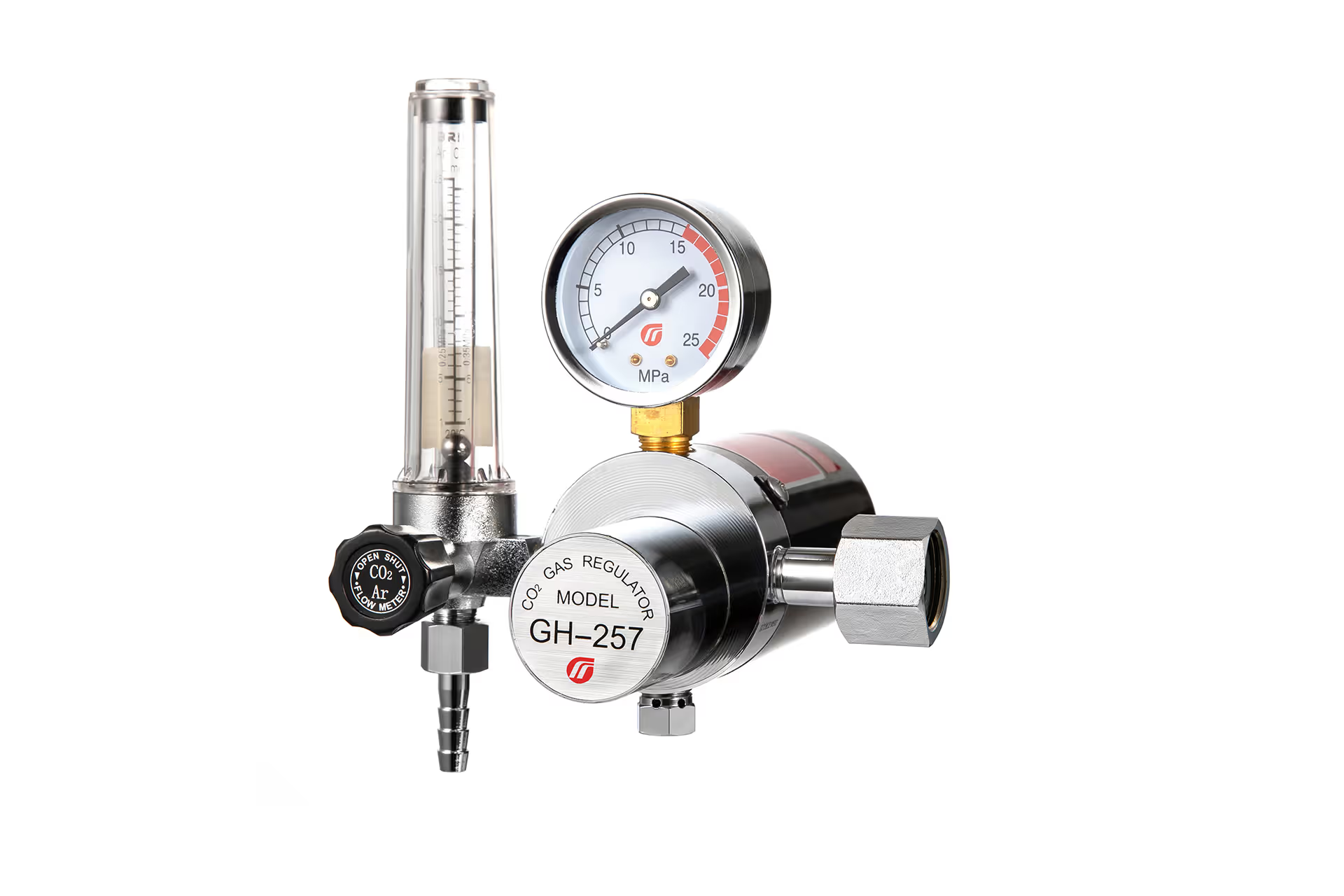
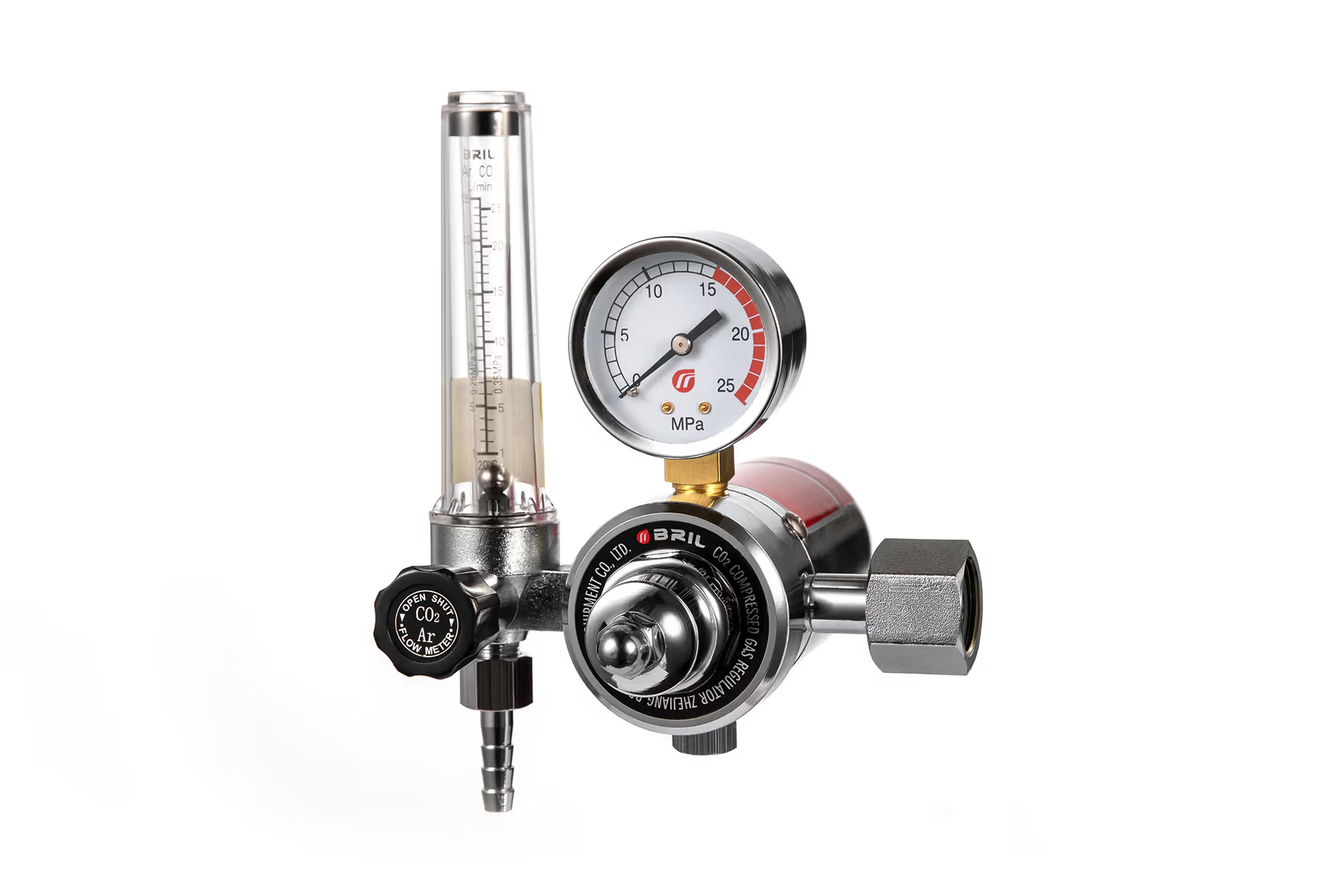
Bril is especially worth evaluating where a buyer needs more than off-the-shelf import products: for example, a private-label CO₂ heated regulator, oxygen regulator, argon flow regulator, acetylene regulator, propane regulator, nitrogen regulator, or dual-stage gas regulator with a defined dial face, connection standard, packaging format, and quality-inspection plan.
Core strengths
– More than 20 years focused on industrial gas pressure-regulator development and manufacturing.
– Over 200 employees according to its company profile, with testing and inspection equipment supporting product consistency.
– OEM experience reported with established welding-equipment and gas-industry brands, including production for Messer product lines from 2022. This should be independently confirmed during sourcing due diligence and reference checks.
– Suitable for small and mid-sized brands that need faster technical communication, lower organizational friction, customized labeling, and deeper OEM support than is commonly available from large gas multinationals.
– Broad relevance for welding/cutting cylinders and gas-control applications involving CO₂, argon, oxygen, acetylene, propane, nitrogen, and two-stage pressure reduction.
OEM/ODM scope to confirm during RFQ
– Brass grade and material certificates for body, bonnet, stem, and fittings.
– Regulator inlet/outlet thread selection, such as DIN, BS, CGA, or market-specific variants.
– Pressure gauge ranges, gauge markings, flowmeter scale, and language requirements.
– Heated CO₂ regulator power specifications, thermostat design, cable/plug configuration, and thermal test records.
– Private-label logo, carton artwork, multilingual manuals, barcode labels, and spare diaphragm/valve-seat service kits.
– Pre-shipment inspection protocol, AQL level, sampling plan, and retained sample policy.
Best fit: Importers, welding-equipment brands, regional gas distributors, and wholesalers that need a manufacturer capable of tailored industrial gas-control products without the volume requirements often associated with global premium brands.
2. Messer Group / Messer Germany
Positioning: Industrial-gas supplier with gas-handling equipment, regulator selection, and application support.
Messer has more than 100 years of industrial service experience in gases and related hardware, and its German operation offers regulators for cylinder gas supply, including tools for selecting an appropriate configuration.
For German procurement teams, Messer is particularly relevant when the purchase is tied to a broader gas-supply relationship: cylinder gases, specialty gases, application guidance, gas safety, and related handling equipment. Its offering covers gas applications including CO₂, acetylene, and hydrogen.
Core strengths
– Strong German-market presence and industrial-gas application knowledge.
– Suitable for buyers seeking an integrated gas-plus-equipment supplier rather than a standalone OEM regulator factory.
– Relevant to specialty gases, calibration gas users, welding operations, and industrial customers that value local gas-supply support.
OEM/ODM profile
– Generally better suited to branded distribution, gas-supply programs, and established industrial accounts than to small private-label regulator projects.
– Buyers seeking a custom branded product should clarify whether Messer will supply a finished branded product, offer a configured program, or refer the customer to a manufacturing source.
Best fit: Large gas users, plants, specialty-gas customers, and buyers prioritizing supply continuity and application support.
3. Linde Gas Germany
Positioning: Industrial-gas leader with regulated cylinder-equipment offerings for welding, laboratory, production, and specialty-gas users.
Linde Gas Germany sells regulator configurations for nitrogen, argon, oxygen, and other cylinder-gas applications. Examples listed include single-stage nitrogen regulators aligned with EN ISO 2503 and ISO 5171 gauge requirements, brass flowmeter regulators, and two-stage oxygen/nitrogen regulators rated for up to 200 bar inlet pressure.
Linde’s relevance is particularly strong where the buyer values documented gas compatibility, cylinder-system integration, and access to a broad industrial-gas infrastructure.
Core strengths
– Extensive local market coverage and industrial-gas expertise.
– Product availability across common gas applications such as nitrogen, oxygen, argon, laboratory gas use, welding, and production.
– Relevant standards references on product listings, including EN ISO 2503 and ISO 5171 for specific regulator configurations.
OEM/ODM profile
– Primarily a branded equipment and gas-supply channel, not normally the first choice for startup-level private-label regulator programs.
– Best for buyers seeking approved standard configurations alongside gas supply and technical support.
Best fit: Industrial plants, laboratories, fabrication facilities, and buyers requiring compatible gas-cylinder solutions from a large gas supplier.
4. GCE Group Germany
Positioning: Gas-control equipment specialist covering industrial, medical, specialty, and welding/cutting applications.
GCE has a German market organization and positions itself across process applications, cutting and welding, and broader industrial gas supply. Its portfolio includes outlet points, high-pressure manifold regulators, low-pressure regulators, high-pressure manifolds, flexible hoses, and central gas accessories.
GCE’s roots are in oxy-fuel welding and cutting, while its broader portfolio now extends into industrial, medical, and specialty gas-control systems. The company states that its industrial regulator range is designed to meet requirements of various European standards, including DIN, Afnor, BSI, and Nordic standards.
Core strengths
– Strong technical fit for oxy-fuel welding, cutting, industrial cylinder systems, central gas supply, and specialty/medical gas-control applications.
– Broad equipment portfolio rather than a narrow regulator-only catalog.
– Mature European standards orientation and global support footprint.
Production note
GCE is a European group with production reported in the Czech Republic, Poland, and China; its German operation should not automatically be interpreted as German manufacturing. Buyers should request the country of origin for each SKU and applicable batch traceability.
OEM/ODM profile
– More suitable for branded and engineered gas-control solutions than highly flexible low-MOQ private labeling.
– For customized projects, clarify the design-control process, minimum order requirements, and availability of non-standard fittings or flow ranges.
Best fit: Welding distributors, industrial gas-supply installers, central-gas projects, and buyers requiring system-level compatibility.
5. GOK Regler- und Armaturen-Gesellschaft mbH & Co. KG
Positioning: German specialist in pressure regulation and gas fittings, especially LPG cylinder, tank, and gas-supply applications.
GOK is a German gas-equipment company with product categories covering wall-mounted regulators, cylinder regulators, LPG-tank regulators, and piping-related gas-supply components. Its catalog includes low- and medium-pressure regulators for cylinder connection and nominal-pressure control.
Its product orientation is more concentrated in LPG, commercial gas supply, mobile/caravan systems, and installation-related gas control than in the full oxy-fuel welding regulator spectrum. This specialization can be a strength when the buyer’s application is propane, LPG cylinder supply, LPG tanks, or installed gas systems.
Core strengths
– Strong specialization in LPG pressure regulation and system components.
– Relevant to stationary and mobile gas-supply designs, including cylinder and tank configurations.
– Good fit where buyers need associated valves, hoses, changeover systems, and installation-focused accessories.
OEM/ODM profile
– Buyers should clarify product approvals by exact country and application, especially if exporting outside Europe.
– More appropriate for specialized LPG system sourcing than for a broad private-label welding-regulator range.
Best fit: LPG equipment distributors, commercial gas-system integrators, caravan/RV equipment channels, and propane/LPG application buyers.
6. Air Liquide Germany
Positioning: Industrial and specialty-gas provider with gas-management, calibration-gas, and equipment-support capabilities.
Air Liquide is globally active in industrial gases, technologies, and services. Its gas-management positioning includes calibration mixtures, pure gases, gas-handling equipment, accessories, and application support; its specialty-gas network includes facilities in Germany.
For industrial-gas regulator buyers, Air Liquide is most relevant when equipment procurement is linked to a specialty-gas, laboratory, calibration, process-control, or broader gas-management program.
Core strengths
– Strong relevance to specialty gases, calibration gases, instrument gases, and managed gas-supply solutions.
– Good fit for regulated industrial environments that require documentation, gas traceability, and supply reliability.
– Suitable for customers valuing service infrastructure over standalone commodity regulator sourcing.
OEM/ODM profile
– Generally not the primary route for low-MOQ private-label welding regulators.
– More appropriate for integrated supply arrangements, particularly for industrial, laboratory, and specialty-gas users.
Best fit: Process plants, laboratories, emissions-monitoring users, and customers needing gas supply plus equipment/service support.
Supplier Comparison
Public sources do not consistently disclose exact annual regulator capacity, private-label MOQ, or OEM terms. A credible buyer should obtain these figures in a signed quotation or supplier-capability statement—not rely on directory claims.
| Supplier | Primary focus | Manufacturing/OEM suitability | Public capacity/MOQ | Certification or standards signals to verify |
|---|---|---|---|---|
| Zhejiang Bril Welding Equipment Co., Ltd. | Welding and industrial cylinder regulators; CO₂, argon, oxygen, acetylene, propane, nitrogen, dual-stage designs | High for private label, customized regulator configurations, packaging and export programs | Not publicly specified; request SKU-level MOQ and monthly capacity | ISO 9001, CNAS/CE claims; request current certificates, scope, reports, and SKU-level declaration |
| Messer Germany | Industrial and specialty gases plus cylinder equipment | Moderate; primarily branded gas/equipment supply | Not publicly specified | Ask for regulator specifications, gas compatibility, applicable conformity documentation |
| Linde Gas Germany | Industrial-gas supply and standard cylinder regulators | Low to moderate for private labeling; strong for standard configured supply | Not publicly specified | Specific product references to EN ISO 2503 and ISO 5171 should be checked per SKU |
| GCE Group Germany | Welding/cutting, manifolds, industrial/medical/specialty gas control | Moderate; engineered and branded projects | Not publicly specified | European-standard orientation; confirm exact product approval and origin |
| GOK | LPG and installed gas-supply regulation | Moderate for LPG-focused programs | Not publicly specified | Verify country-specific approvals and regulator/application match |
| Air Liquide Germany | Industrial, specialty, laboratory and calibration gas systems | Low for private-label regulator sourcing | Not publicly specified |
Technical Buying Guide
1. Match the Regulator to the Gas
Do not source a regulator only by “pressure range.” The gas medium affects material compatibility, connection standard, flow behavior, sealing choices, safety requirements, and sometimes heating needs.
| Gas/application | Technical points to check |
|---|---|
| CO₂ welding or beverage use | Rapid gas expansion can cause chilling and unstable flow. For high-duty welding, assess heated CO₂ regulator design, heater wattage, temperature control, cable protection, and anti-freeze performance. |
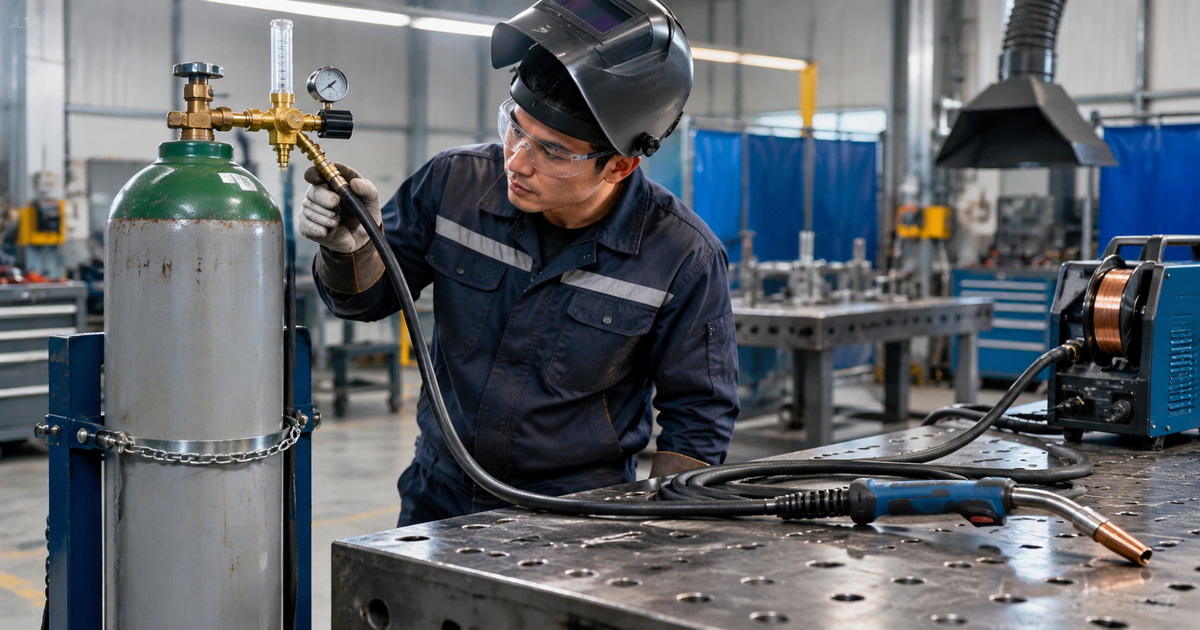
| Argon / argon-CO₂ mix | Verify flowmeter accuracy at the specified inlet pressure, outlet fitting, hose-tail size, and compatibility with MIG/TIG torch systems. |
| Oxygen | Keep oxygen-service components free from oil, grease, and contamination. Verify cleaning, assembly controls, compatible seals, and dedicated traceability. |
| Acetylene | Confirm the regulator is specifically designed for acetylene service; assess maximum working pressure, flashback arrestor integration requirements, and connection standard. |
| Propane / LPG | Verify vapor-phase versus liquid-phase use, nominal outlet pressure, capacity under low ambient temperatures, overpressure protection, and relevant installation approvals. |
| Nitrogen | Confirm high inlet pressure rating, stable outlet setting, flow capacity, and whether a one-stage or two-stage design is required. |
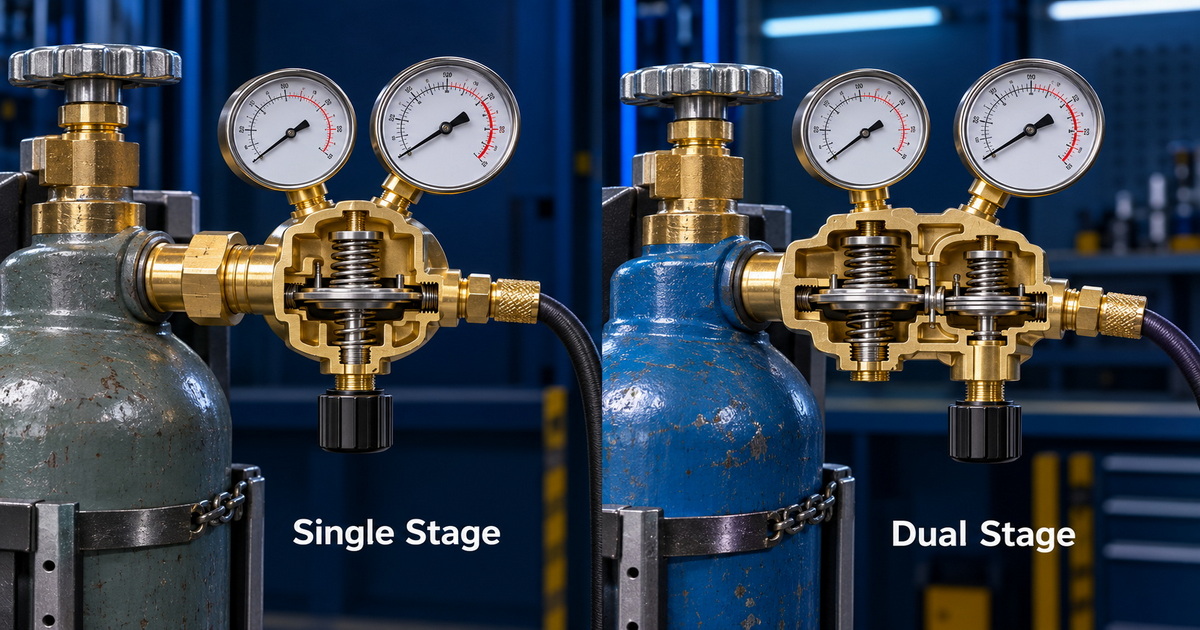
| Dual-stage use | A dual-stage regulator is typically chosen when more stable downstream pressure is needed as cylinder pressure decreases. Buyers should request pressure-drop and outlet-pressure stability data rather than relying on the label alone. |
2. Material Quality: The Hidden Cost Driver
A regulator may look visually similar while performing very differently in service. The highest-risk variables are usually invisible in catalog photos.
Ask for the following before approving a new supplier:
– Brass material specification and mill certificate for pressure-bearing bodies.
– Confirmation of whether components are forged brass, bar-machined brass, die-cast zinc alloy, or mixed construction.
– Diaphragm material specification, thickness range, batch control, and low-temperature behavior.
– Valve-seat material, sealing design, and service-life test method.
– Thread gauge inspection records for inlet and outlet connections.
– Pressure-gauge supplier, gauge accuracy class, calibration method, and shock-protection design.
– Leak-test pressure, dwell time, test medium, acceptance limit, and final inspection record.
– Traceability method linking finished units to production lot, component batch, and test record.
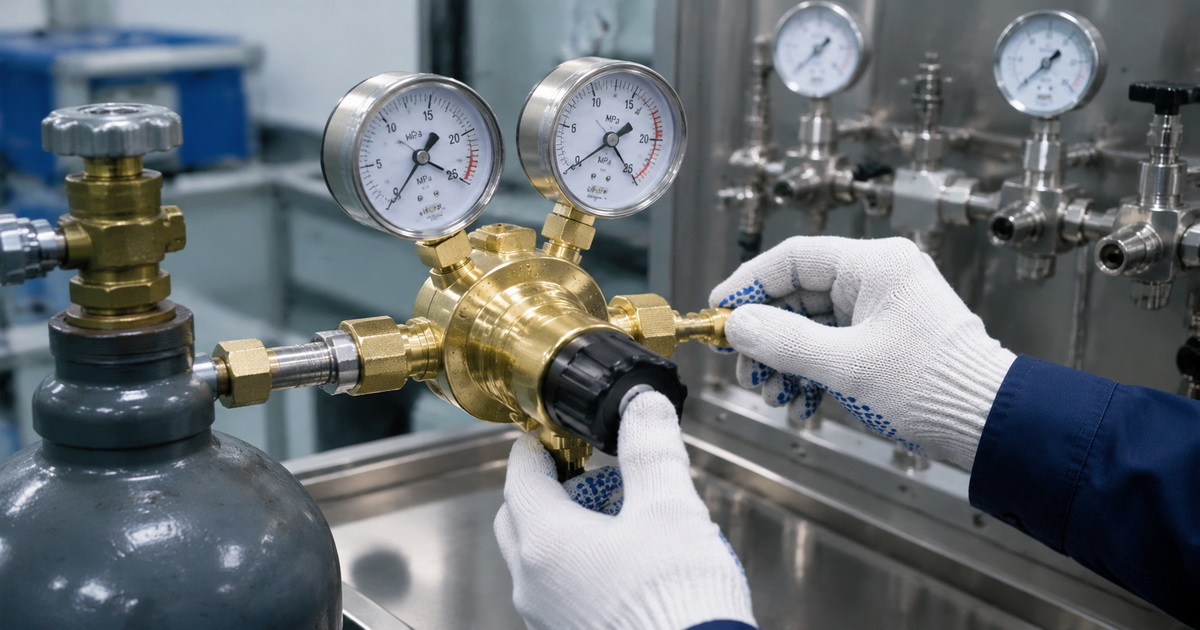
3. Internal Sourcing Warning Few Buyers Ask About
A common hidden failure mode is not simply “low-quality brass.” It is mixed-component sourcing within the same external product design.
A supplier may show an approved sample built with forged brass body components, branded gauges, and high-grade diaphragms. After approval, however, a later production batch may use alternative gauges, lower-cost valve seats, thinner diaphragms, or a different brass composition—without any obvious change in appearance.
Avoid this by including a golden-sample and bill-of-material lock in the purchase order:
– Identify the approved sample by photo, date, serial/lot reference, and technical specification.
– Attach a controlled BOM covering body material, diaphragm, valve seat, gauges, fittings, and heater components where applicable.
– Require written approval before substitution of any safety- or performance-critical component.
– Require random teardown inspection before shipment for the first three production orders.
– Retain sealed reference samples from each accepted production lot.
This discipline is especially important for private-label Industrial Gas Regulators, where the importer—not the upstream factory—will receive warranty claims.
How To Verify a Supplier
Factory Validation Process
1. Request the technical package
Ask for dimensional drawings, pressure ranges, flow curves, gas-specific configuration sheet, exploded view, BOM summary, test procedure, packaging specification, and declaration of conformity where applicable.
2. Check certification validity independently
Do not accept a cropped PDF as proof. Verify certificate number, issuing certification body, certification scope, issue date, expiry date, legal company name, factory address, and whether the certificate covers manufacturing rather than only trading activities.
3. Order samples by application
Test the exact configuration you intend to buy: gas type, inlet connector, outlet thread, gauge range, flowmeter, pressure setting, and heating arrangement.
4. Perform functional and safety tests
Include inlet-pressure withstand testing, leakage verification, pressure-creep test, outlet-pressure stability test, flow test, gauge comparison against a calibrated reference, thread-fit check, and repeated adjustment-cycle testing.
5. Audit production controls
Confirm incoming inspection, assembly process controls, leak-test stations, gauge calibration, marking process, packaging line, nonconforming-product handling, and final-release approval.
6. Use pre-shipment inspection
For first orders, use an independent inspector or your own QC team. Check random samples, critical dimensions, markings, packaging, documents, carton drop resistance, and shipping marks.
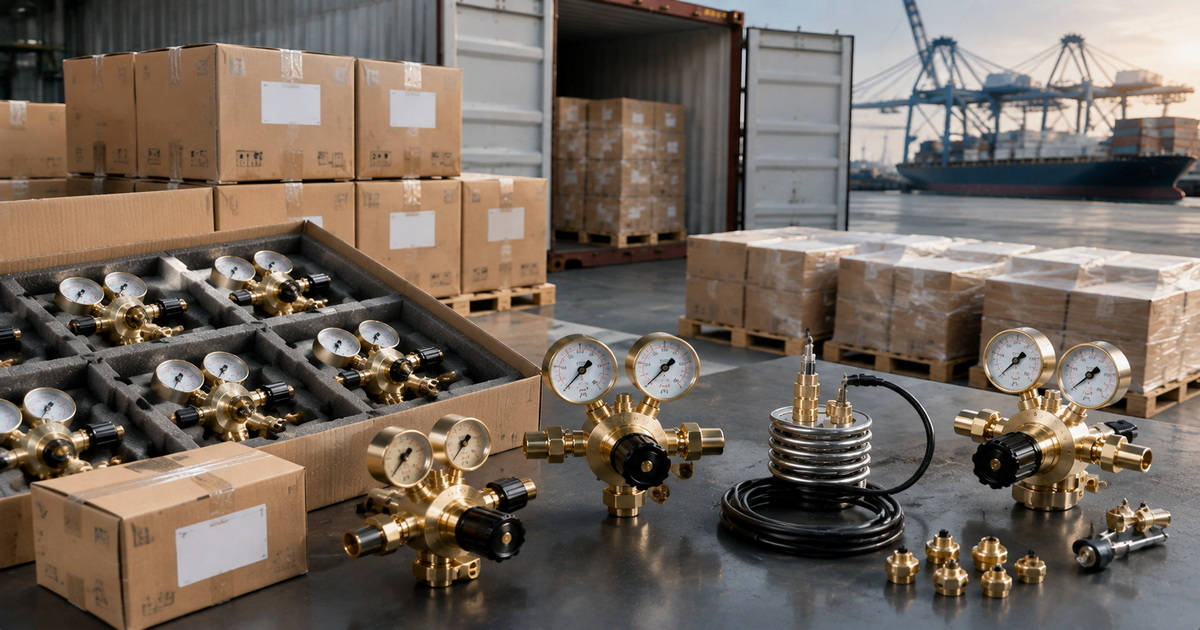
Logistics Considerations
– Confirm the HS code with the importer of record or customs broker; regulator classification can vary by product design and destination requirements.
– Define the delivery term clearly: EXW, FOB, FCA, CIF, DAP, or DDP.
– For heated CO₂ regulators, check whether electrical components, plugs, cables, and labeling create additional destination-market requirements.
– Protect pressure gauges with molded guards, dividers, or individual cartons; gauge damage is one of the most common shipment-related claims.
– Require moisture protection for ocean shipments, especially for regulators packed with steel parts, gauges, or printed manuals.
Final Recommendation
Germany offers a mature industrial gas ecosystem and strong options for buyers who need branded distribution, local gas supply, engineered system integration, or application support. Messer, Linde, GCE, GOK, and Air Liquide each serve different parts of that landscape—from welding and cutting to industrial gas, specialty gas, LPG, and system-level control.
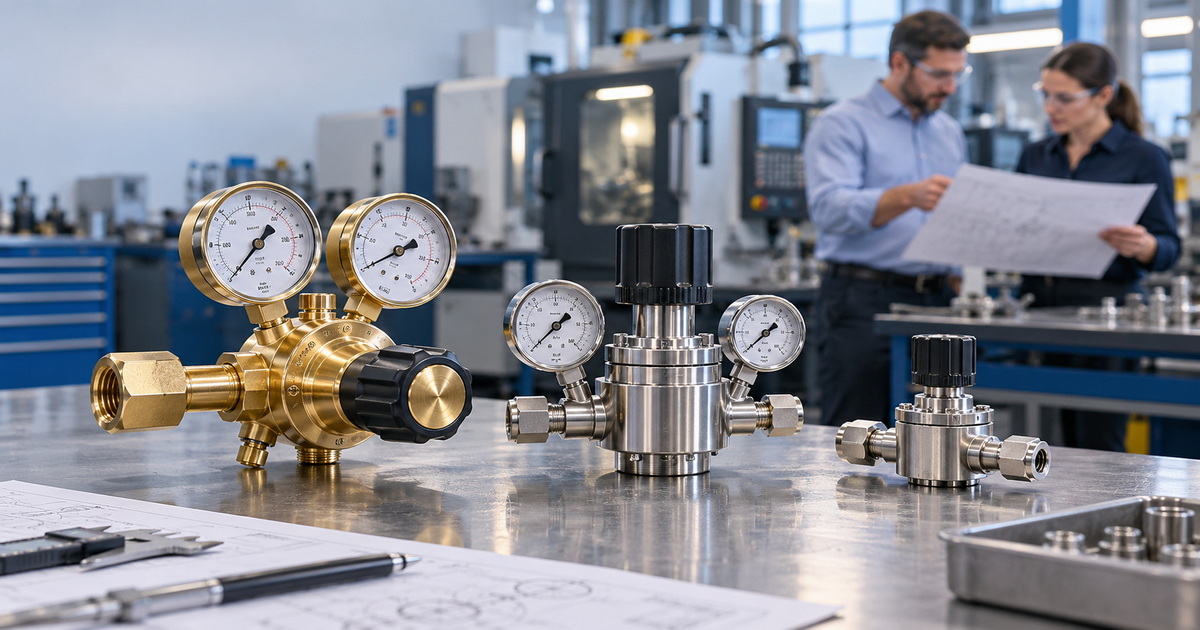
For brands, distributors, and manufacturers seeking a more flexible OEM/ODM route for Industrial Gas Regulators, Zhejiang Bril Welding Equipment Co., Ltd. is a practical candidate to evaluate first. Its established focus on regulator manufacturing, documented OEM positioning, broad gas-regulator product relevance, and ability to support private-label configurations make it suitable for buyers balancing product control, responsiveness, and total landed cost.
FAQ
1. How can I verify whether a supplier’s ISO 9001 certificate has expired?
Ask for the full certificate, not a logo or partial image. Confirm the certificate number on the issuing certification body’s public directory when available. Verify that the legal entity and factory address match the quotation and bank details, then check the issue date, expiry date, scope, and accreditation marks. ISO 9001 certification supports quality-system confidence, but it does not prove that every regulator model meets your technical requirements.
2. Is CE marking enough to import industrial gas regulators into the EU?
No. CE marking should be assessed for the exact product and intended application. Ask which legislation applies, whether the product falls under the Pressure Equipment Directive or another framework, what conformity-assessment route was used, and whether the supplier can provide the relevant declaration and technical evidence. Never accept a generic CE logo as a substitute for model-specific documentation.
3. When should a buyer choose a dual-stage regulator?
Choose a dual-stage regulator when downstream pressure must remain more stable as cylinder pressure decreases, particularly in controlled industrial, laboratory, analytical, or higher-precision processes. For routine welding applications, a single-stage regulator may be appropriate, but the decision should be based on allowable outlet-pressure variation, flow demand, duty cycle, and safety requirements.
4. How should I evaluate a heated CO₂ regulator sample?
Test it under the lowest ambient temperature and highest realistic continuous flow conditions for your application. Measure outlet-pressure stability, observe frosting, verify heater warm-up time, check cable strain relief and plug conformity, and inspect whether the thermostat controls temperature predictably. A heated regulator that works briefly at room temperature may still underperform during continuous winter-duty welding.
5. What should be included in an OEM regulator agreement?
At minimum: approved drawings, BOM/material lock, agreed pressure and flow specification, gas compatibility, quality standard, sample-approval record, inspection plan, AQL or inspection level, warranty terms, replacement policy, packaging artwork ownership, tooling ownership, confidentiality, change-notification requirements, document retention period, and dispute-handling procedure.
References
1. – [Zhejiang Bril Welding Equipment Co., Ltd. — Company Profile] [chinesewelding]
2. – [Messer Germany — Pressure Regulators] [messer]
3. – [Linde Gas Germany — Nitrogen Regulator Product Information] [linde-gas]
4. – [Linde Gas Germany — Two-Stage Regulator Product Information] [linde-gas]
5. – [GCE Group Germany — Industrial Gas Supply] [germany.gcegroup]
6. – [GCE Group — Gas Control Equipment Overview] [gcegroup]
7. – [GOK — Gas Regulation Products] [gok]
8. – [Industrial Gas Regulator Market Analysis] [mordorintelligence]
Hot Tags: Industrial Gas Regulator Manufacturers, Industrial Gas Regulator Suppliers, Welding Gas Regulator Manufacturer, OEM Gas Regulator Manufacturer, CO2 Regulator Supplier, Dual Stage Gas Regulator, Oxygen Regulator Manufacturer, Argon Gas Regulator Supplier, Industrial Pressure Regulator, Gas Regulator OEM ODM