Content Menu
● Argon Regulator vs CO₂ Regulator: Quick Comparison
● Why Thin Sheet Metal Makes Gas Selection More Important
● What an Argon Regulator Does
>> Pure Argon and Argon Mixtures Are Different Applications
>> Where Argon-Based Mixtures Help
>> Advantages and Limitations of Pure CO₂
>> When a Heated CO₂ Regulator Helps
● Which Regulator Is Better for Each Thin-Sheet Application?
>> Thin Mild Steel MIG Welding
>> Thin Stainless Steel Welding
● Regulator Details That Matter More Than the Label
>> Cylinder Connections and Pressure Ratings
>> Single-Stage vs Dual-Stage Regulation
● A Practical Trial That Separates Gas Choice from Regulator Performance
>> Step 1: Establish Comparable Conditions
>> Step 2: Qualify Each Gas Setup
>> Step 3: Record Production Outcomes
>> Step 4: Separate the Findings
● How to Set Up Gas Delivery Without Wasting Gas
● OEM and ODM Purchasing: Specify Performance, Not Just Appearance
● Compare Total Cost per Accepted Assembly
● Choose a Regulator Around Your Welding Application
>> 1. Can I Use an Argon Regulator with CO₂?
>> 2. Is Pure Argon Better for MIG Welding Thin Mild Steel?
>> 3. Does a CO₂ Regulator Cause Burn-Through?
>> 4. Do I Need a Heated CO₂ Regulator for Thin Sheet?
>> 5. Is a Dual-Stage Regulator Always Better?
>> 6. Should I Adjust Welding Gas by Pressure or Flow?
Choosing an argon regulator vs CO₂ regulator for thin sheet metal welding starts with the welding process—not the regulator’s appearance. For thin mild steel welded with solid-wire MIG equipment, an argon/CO₂ mixture is usually a more forgiving choice than pure CO₂. For TIG welding, pure argon is the common starting point. In either case, the regulator must be approved for the actual gas, cylinder connection, and operating conditions.
The essential distinction is compatibility. Shielding gas influences arc behavior, penetration, and spatter. The regulator controls gas delivery. A more expensive regulator cannot make an unsuitable shielding gas perform correctly.
From an equipment-selection perspective, the best solution matches three things: the metal being welded, the welding procedure, and the gas-delivery hardware.

Argon Regulator vs CO₂ Regulator: Quick Comparison
| Selection factor | Argon or argon-mix regulator | CO₂ regulator |
|---|---|---|
| Typical gas service | Argon and specified argon-based mixtures | Carbon dioxide; other gases only when explicitly approved |
| Thin mild steel MIG | Suitable with an approved argon/CO₂ blend | Suitable with pure CO₂ when the wire and procedure permit |
| TIG welding | Common choice with pure argon | CO₂ is unsuitable as conventional TIG shielding gas |
| Aluminum welding | Commonly used with argon | Pure CO₂ is unsuitable |
| Arc and spatter | Argon/CO₂ mixtures generally produce a smoother mild steel MIG arc with less spatter | Pure CO₂ generally produces more spatter |
| Cooling considerations | Depends on operating conditions and gas | Expansion can cause significant cooling and freeze-up |
| Flow indication | Must match the gas and calibration conditions | Requires suitable CO₂ calibration or approved instructions |
| Main purchasing priority | Approved gas service, connection, and stable flow | The same priorities, plus adequate thermal capacity |
These differences describe gas-and-regulator combinations. They do not mean an argon regulator independently creates a softer arc or a CO₂ regulator independently causes deeper penetration.
Why Thin Sheet Metal Makes Gas Selection More Important
Thin sheet provides little margin between adequate fusion and burn-through. Joint gaps, inconsistent travel speed, and repeated starts can quickly turn a manageable weld into distortion or rework.
Shielding gas affects this balance. For mild steel MIG welding, argon/CO₂ mixtures generally provide less spatter and more manageable arc characteristics than pure CO₂.
However, gas selection cannot compensate for:
– Excessive heat input.
– Poor panel fit-up.
– Unsuitable wire or transfer mode.
– Contaminated material.
– Inadequate clamping or welding sequence.
My recommendation for equipment selection is to treat the regulator as part of a complete welding system. Changing the regulator alone rarely solves a problem caused by the wrong gas or welding procedure.
What an Argon Regulator Does
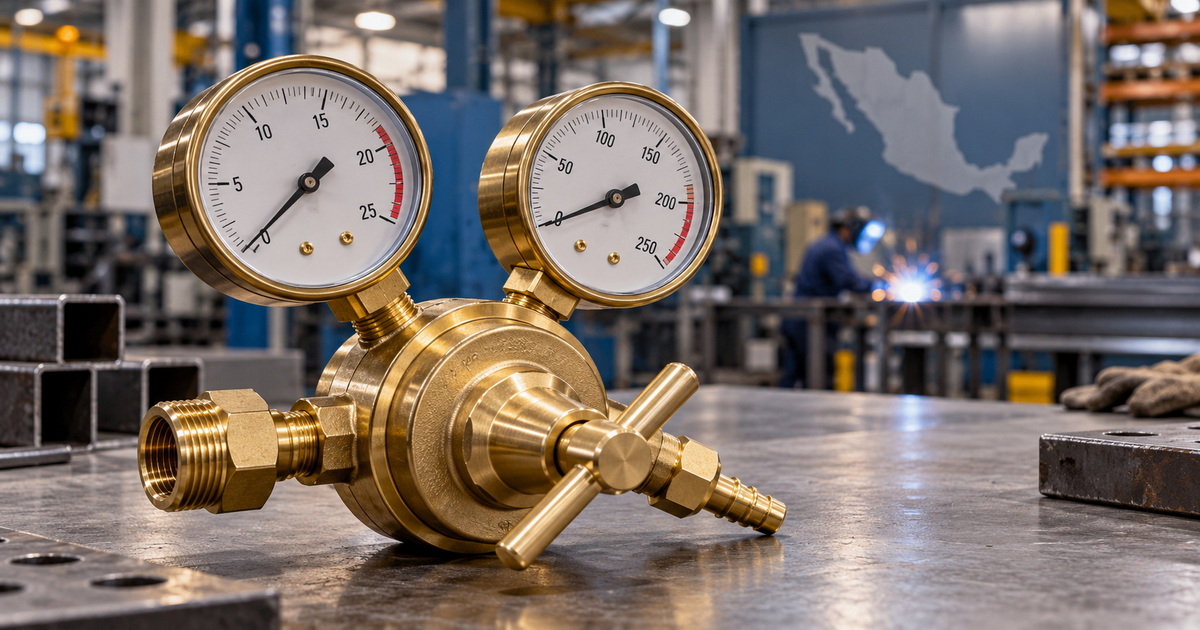
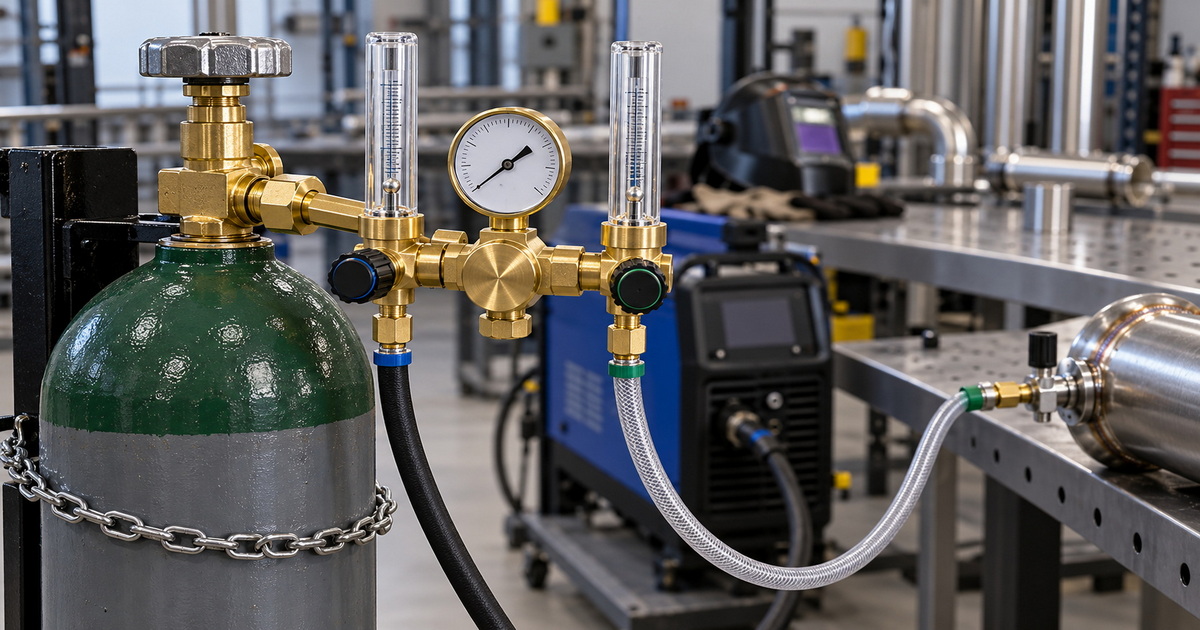
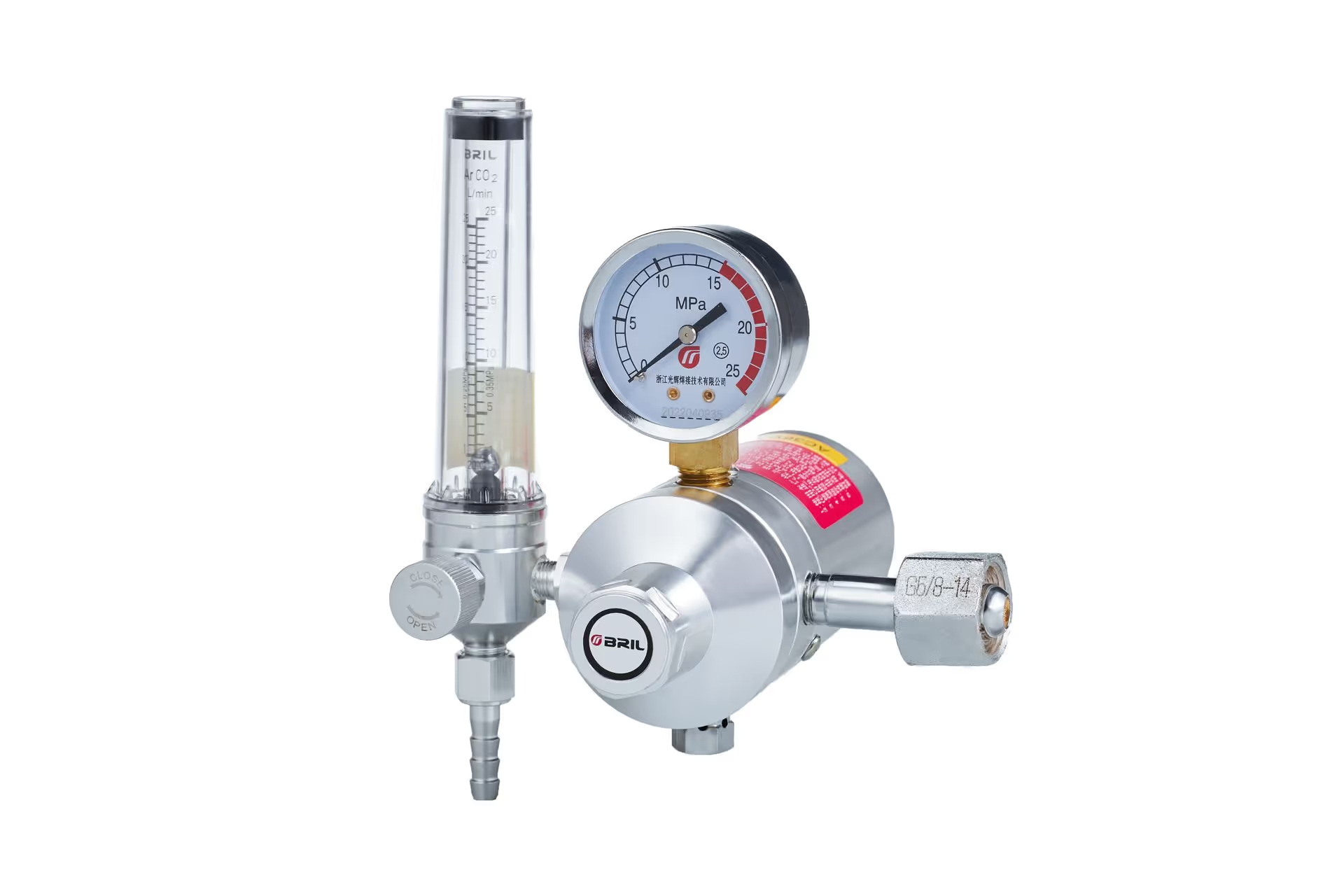
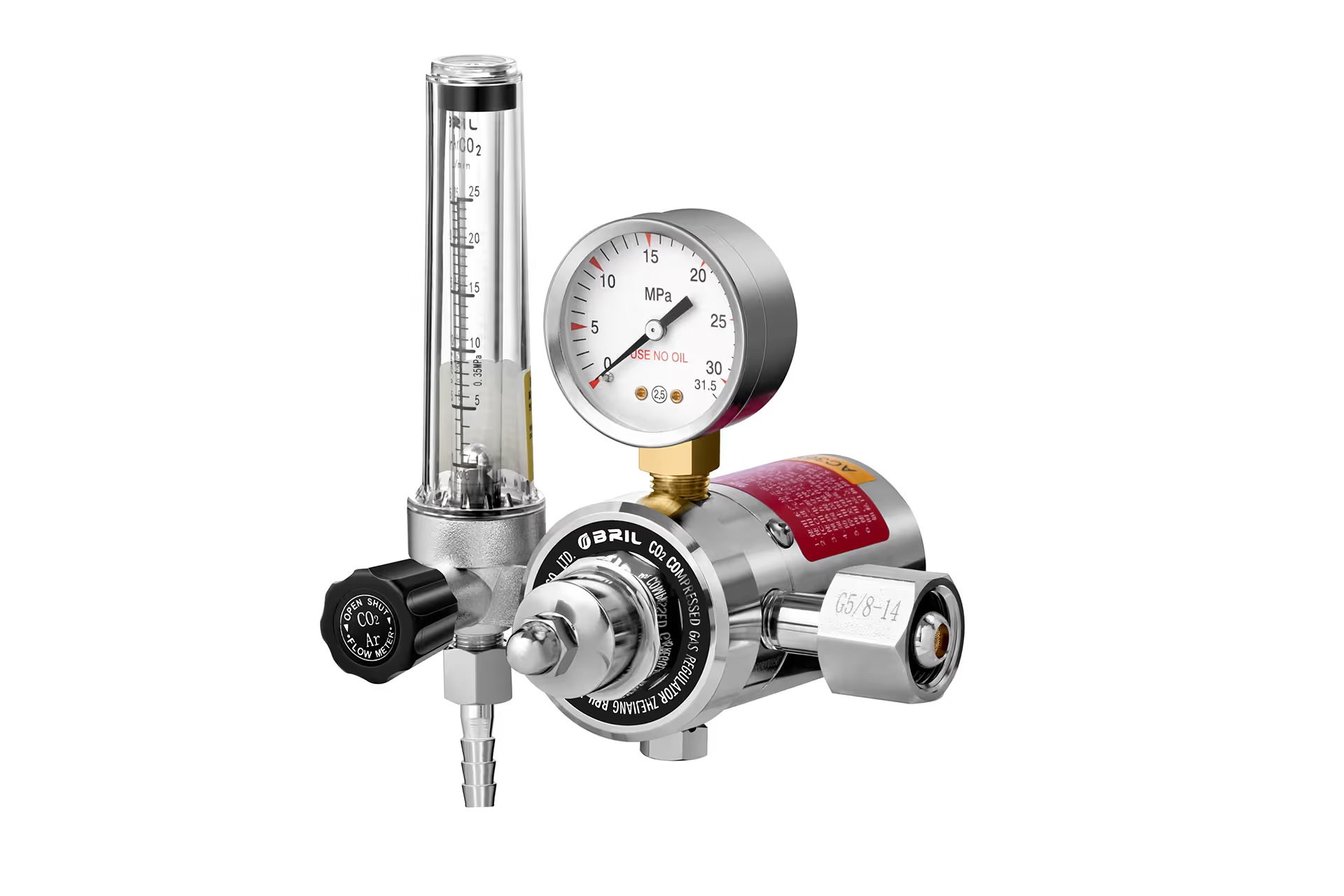
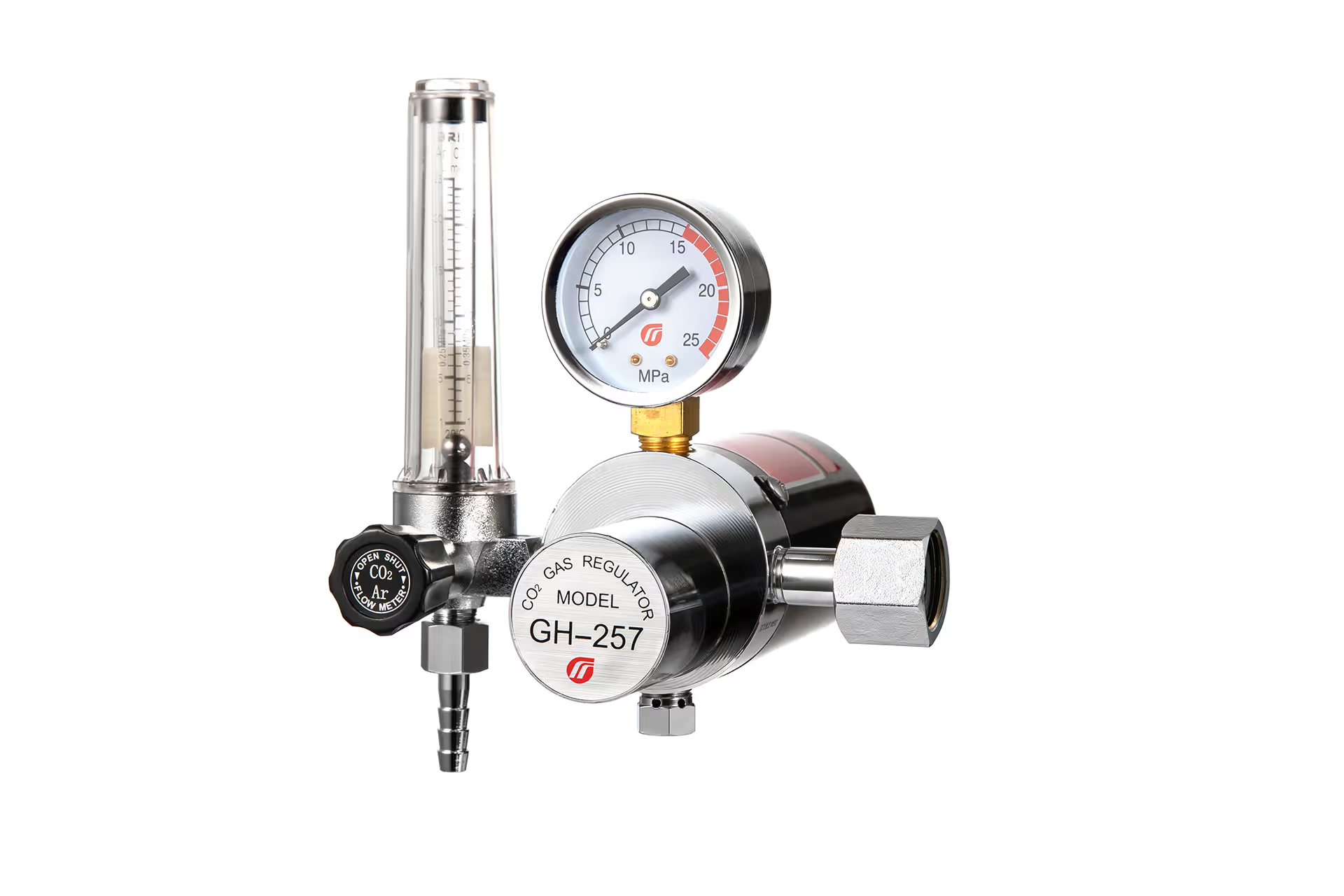
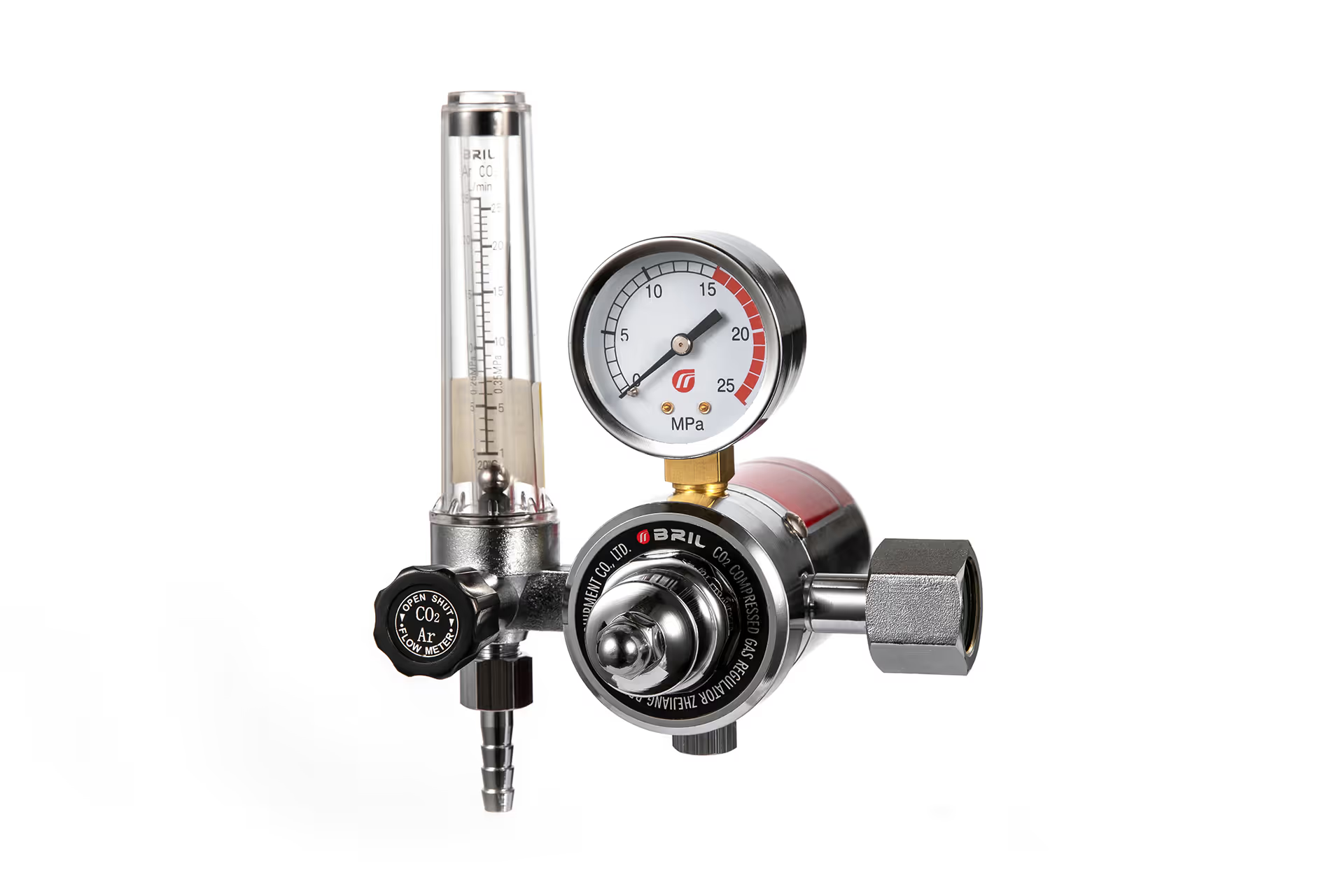
An argon regulator reduces cylinder pressure to a usable delivery pressure. Depending on its design, it may incorporate a flow gauge, a flowmeter, or a separate flow-control valve.
Pure Argon and Argon Mixtures Are Different Applications
“Argon regulator” is often used loosely in product listings. Some models support pure argon only. Others are approved for argon/CO₂ mixtures or multiple shielding gases.
For thin sheet metal, the distinction matters:
– Pure argon is widely used for TIG welding.
– Argon is commonly used for aluminum MIG welding.
– Argon/CO₂ mixtures are commonly used for mild steel MIG welding.
– Pure argon is generally not the appropriate choice for conventional solid-wire mild steel MIG.
A regulator labeled “argon” should therefore not be selected without checking its documented gas-service scope.
Where Argon-Based Mixtures Help
For thin mild steel MIG, a common starting point is a 75% argon/25% CO₂ mixture, often called C25, where supported by the wire and machine manufacturer.
Compared with pure CO₂, this mixture generally provides a smoother arc and less spatter. Those characteristics can reduce cleanup on visible sheet-metal assemblies.
Other mixtures may suit specific wires and welding modes. Do not substitute gases without reviewing the applicable procedure.
What a CO₂ Regulator Does
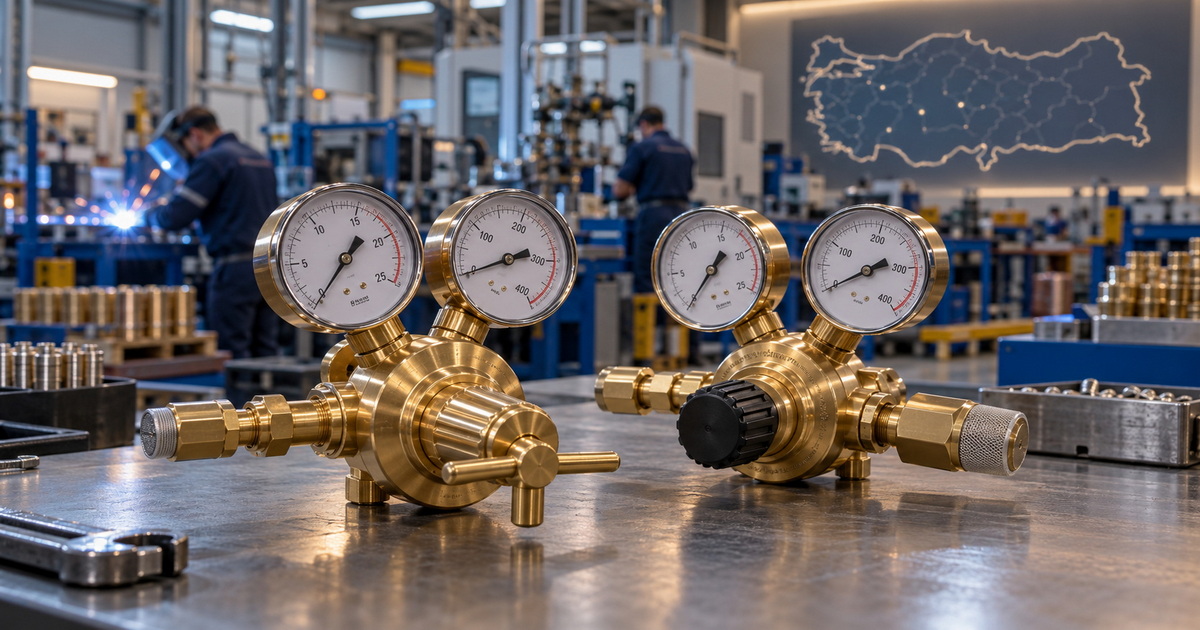
A CO₂ regulator performs the same basic pressure-reduction function but must be designed for carbon dioxide service.
Pure CO₂ remains useful in suitable steel-welding applications, especially where gas purchase cost matters. However, thin-sheet work demands careful consideration of the resulting arc behavior and finishing requirements.
Advantages and Limitations of Pure CO₂
Pure CO₂ can provide effective penetration and is often less expensive to purchase than argon-rich mixtures. The tradeoff is generally greater spatter and a less forgiving arc for delicate sheet-metal work.
That does not make CO₂ unusable for thin steel. It means the welding setup and operator technique require appropriate qualification.
For appearance-sensitive panels, compare the total production result rather than cylinder price alone.
When a Heated CO₂ Regulator Helps
Pressure reduction and gas withdrawal can cool a CO₂ regulator substantially. Under demanding conditions, freeze-up can interfere with delivery.
A purpose-designed heated CO₂ regulator may help when sustained consumption, ambient conditions, or repeated freezing disrupt gas flow.
Heating is not automatically necessary for occasional thin-sheet welding. It also does not change CO₂ into a more suitable shielding gas for TIG or aluminum.
Never use improvised heating methods. Select equipment designed for the intended gas, electrical supply, and working environment.
Which Regulator Is Better for Each Thin-Sheet Application?

Thin Mild Steel MIG Welding
An approved regulator for argon/CO₂ mixtures is usually the more practical starting point when low spatter and controllable welding behavior are priorities.
Pure CO₂ may remain commercially sensible if the wire permits it and production trials demonstrate acceptable fusion, appearance, and cleanup time.
The deciding question is not “Which regulator is better?” It is “Which approved gas-and-regulator combination produces an acceptable joint most consistently?”
Thin Stainless Steel Welding
Stainless steel requires more specific gas selection.
For TIG, pure argon is a common choice. For MIG, the shielding mixture depends on the wire, transfer mode, and required weld properties.
Do not assume that a mild steel mixture is also suitable for stainless steel. Follow the consumable manufacturer’s recommendations, then select a compatible regulator.
Thin Aluminum Welding
Argon is commonly used for thin aluminum MIG and TIG applications.
Pure CO₂ is not a substitute. Installing a different regulator does not remove the chemical incompatibility between an active shielding gas and the intended aluminum-welding process.
Regulator Details That Matter More Than the Label
Cylinder Connections and Pressure Ratings
Connections vary by gas service and market. Confirm the actual cylinder-valve standard, inlet-pressure rating, outlet connection, and sealing arrangement.
Physical attachment alone does not establish suitability. An adapter can change a connection without validating the regulator’s materials, pressure capability, or gas approval.
Flowmeter Calibration
Flowmeters depend on gas properties and operating conditions. An argon scale should not automatically be read as an accurate CO₂ scale.
Some instruments provide multiple scales. Others require manufacturer-approved corrections or gas-specific components.
Confirm:
1. The approved gas or mixture.
2. The correct scale.
3. The required operating pressure and orientation.
4. Whether verification at the torch is recommended.
Single-Stage vs Dual-Stage Regulation
Dual-stage regulation can reduce changes in delivery pressure as cylinder pressure falls.
It does not automatically improve every thin-sheet weld. A suitable single-stage unit can perform adequately when the overall gas-delivery system is correctly designed.
Also distinguish dual-stage from dual-output. Two outlets do not necessarily mean two stages of pressure reduction.
A Practical Trial That Separates Gas Choice from Regulator Performance
A useful workshop comparison should avoid changing several variables at once.
This is a proposed evaluation method, not a claimed customer case study.
Step 1: Establish Comparable Conditions
Use coupons from the same material batch with consistent thickness, joint preparation, gap, and clamping.
Keep the wire, torch condition, and operator consistent where possible.
Step 2: Qualify Each Gas Setup
Use settings appropriate to each gas. Applying identical machine settings to different shielding gases can create a misleading comparison.
Confirm stable gas delivery and check for leaks before welding.
Step 3: Record Production Outcomes
Evaluate more than bead appearance:
– Burn-through and distortion.
– Spatter and cleanup time.
– Arc-start consistency.
– Porosity or other visible defects.
– Fusion using an appropriate inspection method.
– Overall acceptance against the job requirements.
A smooth-looking weld is not proof of adequate fusion.
Step 4: Separate the Findings
If one gas gives less spatter, that is primarily a gas-and-process result.
If flow fluctuates during otherwise stable operation, investigate the delivery system: regulator capacity, calibration, leaks, restrictions, or CO₂ cooling.
This separation prevents buyers from crediting—or blaming—the regulator for every welding outcome.
How to Set Up Gas Delivery Without Wasting Gas
There is no universal flow setting for all thin-sheet welding. Required flow depends on the process, nozzle or cup, joint, gas, and surrounding conditions.
Use the following sequence:
1. Confirm the shielding gas against the welding procedure.
2. Secure the cylinder and inspect the equipment.
3. Verify gas approval, connections, and pressure ratings.
4. Follow the manufacturer’s installation instructions.
5. Check connections with an approved leak-detection method.
6. Set flow while gas is actually flowing.
7. Check delivery at the torch with a suitable instrument where practical.
8. Make a trial weld before starting production.

More gas is not always better. Excessive flow can create turbulence and draw surrounding air into the shielding zone.
Control drafts rather than repeatedly increasing flow. Maintain suitable ventilation because shielding gases can displace breathable air.
OEM and ODM Purchasing: Specify Performance, Not Just Appearance
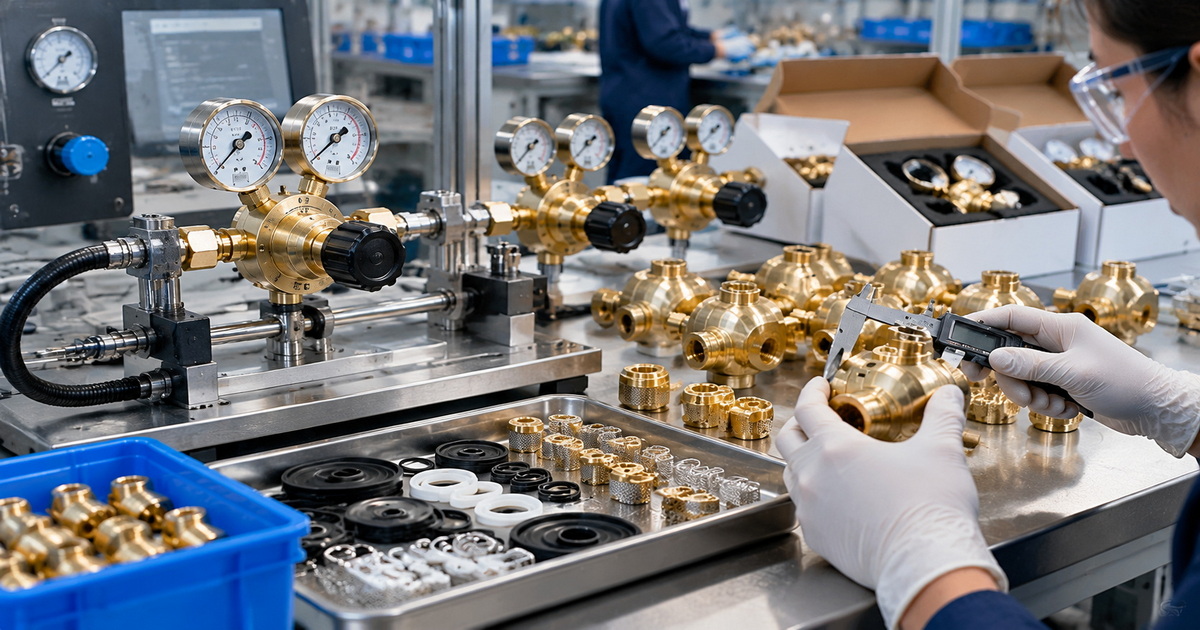
For overseas brands and distributors, similar-looking brass regulators can have different operating capabilities.
A useful specification should define:
| Requirement | Information to confirm |
|---|---|
| Gas service | Pure argon, specified mixtures, or pure CO₂ |
| Connections | Destination-market inlet and outlet standards |
| Operating envelope | Pressure, flow, temperature, and duty requirements |
| Flow indication | Gas calibration, scale, units, and instructions |
| Materials | Body, seals, diaphragm, and gas-contact compatibility |
| Inspection | Leakage, pressure stability, flow performance, and traceability |
| Heated versions | Electrical supply, protection, and intended environment |
| Compliance | Applicable requirements and supporting documentation |

Precision machining and high-quality brass matter, but neither replaces evidence of assembled performance.
Ask suppliers to explain their inspection methods and sample-approval criteria. Avoid treating a management-system certificate as proof that every product carries a particular product approval.
For private-label programs, approve technical documentation alongside packaging and branding. Clear instructions can prevent incorrect gas selection and reduce avoidable support claims.
Compare Total Cost per Accepted Assembly
A lower gas price does not necessarily produce a lower welding cost.
For thin sheet metal, compare:
> Gas cost + welding labor + cleanup + rework + rejected parts.
An argon-rich mixture may justify its additional purchase cost when it reduces finishing time. Pure CO₂ may remain economical where appearance requirements are less demanding and qualified results remain acceptable.
Likewise, a heated regulator creates value when it prevents a real delivery problem—not simply because it is a premium option.
Make the decision using your own trial results rather than an unsupported savings percentage.
Choose a Regulator Around Your Welding Application
For thin mild steel MIG, start by evaluating an approved argon/CO₂ mixture and compatible regulator. For TIG or aluminum work, select the appropriate argon-based solution. Consider pure CO₂ where the welding procedure and production economics support it.
Send our team your base metal, sheet thickness, welding process, shielding gas, cylinder connection, destination market, and expected duty cycle. We can discuss suitable regulator configurations and OEM or ODM requirements, including labeling, connection options, and inspection expectations.
Frequently Asked Questions
1. Can I Use an Argon Regulator with CO₂?
Only when the manufacturer explicitly approves that model for CO₂ service and the connections, pressure ratings, and flow indication are suitable. An adapter alone does not establish compatibility.
2. Is Pure Argon Better for MIG Welding Thin Mild Steel?
Generally, no. Conventional solid-wire mild steel MIG normally uses an active shielding component, commonly through an argon/CO₂ mixture or pure CO₂. Follow the wire manufacturer’s guidance.
3. Does a CO₂ Regulator Cause Burn-Through?
Not independently. Burn-through depends on heat input, travel speed, fit-up, material thickness, and gas-related arc behavior. Diagnose the complete welding setup.
4. Do I Need a Heated CO₂ Regulator for Thin Sheet?
Not necessarily. Heating becomes relevant when operating conditions cause freeze-up that affects delivery. Select it according to actual duty requirements.
5. Is a Dual-Stage Regulator Always Better?
No. It can improve pressure consistency as cylinder pressure changes, but it cannot correct unsuitable gas, leaks, poor calibration, or welding technique.
6. Should I Adjust Welding Gas by Pressure or Flow?
For shielding applications, the practical target is suitable gas flow at the torch. Follow the regulator and welding-equipment instructions; pressure and flow are related but are not interchangeable measurements.
Article word count: approximately 1,950 words, excluding references and the introduction below.
References
1. Miller Electric. “Successfully Welding Sheet Metal With MIG and TIG.” Practical guidance on thin-sheet welding and argon-based shielding mixtures. [Read the article]. [millerwelds]
2. Miller Electric. “What Type of Gas Is Best for MIG Welding in DIY Applications?” Comparison of mild steel shielding options, including C25, arc characteristics, and spatter. [Read the article]. [millerwelds]
3. Miller Electric. “Best Practices for Proper Shielding Gas in TIG Welding.” Guidance on argon, shielding coverage, and TIG gas selection. [Read the article]. [millerwelds]
4. Linde. “Shielding Gases.” Technical discussion of shielding-gas composition, weld shape, fusion, and spatter. [Read the technical guide]. [static.prd.echannel.linde]
5. Harris Products Group. “Carbon Dioxide Regulator Freezing.” Explanation of CO₂ freeze-up and purpose-designed heated regulators. [Read the article]. [harrisproductsgroup]
6. Linde. “TIG Welding.” Overview of TIG applications, shielding-gas selection, and aluminum welding. [Read the process guide]. [linde-gas]
7. Airgas / Harris Products Group. “Harris Model 55-2AR/CD70 Flowmeter.” Product-specific example demonstrating documented gas service, calibration conditions, and connection requirements—not universal regulator specifications. [View the product documentation]. [airgas]
Hot Tags: Argon Regulator, CO₂ Regulator, Welding Gas Regulator, Argon CO₂ Regulator, CO₂ Heated Regulator, Dual Stage Gas Regulator, Argon Regulator Manufacturer, CO₂ Regulator Supplier, OEM Welding Gas Regulator, Gas Regulator for MIG Welding