Content Menu
● Why Mexico Matters for Argon Gas Regulator Procurement
>> Industrial clusters create concentrated demand
>> Recent industry data provides context—not regulator market size
● Selection Criteria: How These Suppliers Were Assessed
● Supplier Comparison: Capacity, MOQ, and Certification Transparency
● 1. Zhejiang Bril Welding Equipment Co., Ltd.
>> Company background and market position
>> Core strengths and OEM/ODM scope
>> Procurement limitations to verify
>> Company background and principal market
>> OEM/ODM suitability and limitations
>> Company background and principal markets
>> OEM/ODM suitability and limitations
>> Company background and principal markets
>> OEM/ODM suitability and limitations
>> Company background and principal markets
>> OEM/ODM suitability and limitations
● Technical Buyer’s Guide: Specify Performance Before Branding
>> Define the regulator architecture
>> Specify brass and gas-contact materials
>> Separate standards from conformity claims
>> Treat production inspection as a separate requirement
● The Overlooked Purchasing Trap: A Flow Scale Is Part of a Calibrated System
● Factory Verification, Sampling, and Logistics
>> Verify capability without confusing size with output
>> Use a controlled sample process
>> Compare landed cost and replenishment risk
● FAQ
>> 1. How can I check whether a manufacturer’s ISO 9001 certificate has expired or been suspended?
>> 2. Can I use a report for a similar regulator model to approve my private-label version?
>> 3. Does a standard referring to 300 bar mean every compliant regulator accepts a 300-bar cylinder?
>> 4. How should we verify a dual-stage regulator when the supplier only provides exterior photographs?
>> 5. How can we prevent an approved sample from becoming a lower-cost substitute during repeat orders?
Finding a dependable argon gas regulator supplier in Mexico involves more than comparing catalog prices. Procurement managers need to evaluate pressure stability, material traceability, cylinder compatibility, production consistency, and after-sales support.
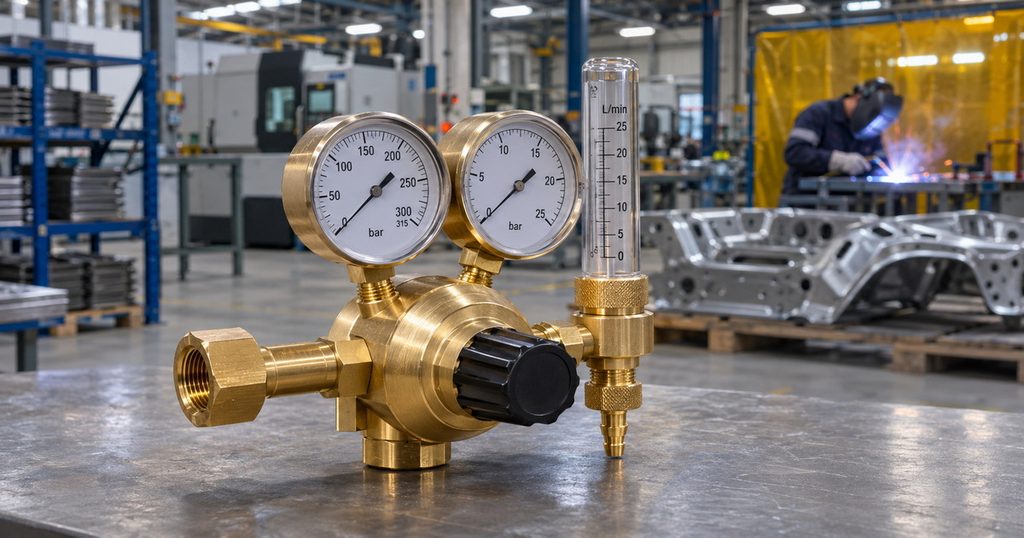
Mexico offers a substantial industrial customer base for shielding-gas equipment. Its automotive, aerospace, appliance, and metal-fabrication sectors support demand for regulators used in TIG welding, MIG welding, purging, and industrial gas distribution. However, buyers should distinguish between Mexican suppliers, international brands sold through Mexican channels, and overseas factories supplying Mexico-bound projects.
Why Mexico Matters for Argon Gas Regulator Procurement
Industrial clusters create concentrated demand
Mexico’s advantage is its established manufacturing ecosystem, not a publicly demonstrated concentration of specialist argon regulator factories.
The U.S. International Trade Administration identifies the Bajío region—Guanajuato, Querétaro, Aguascalientes, and San Luis Potosí—as an important base for automotive, aerospace, and heavy machinery. Northern states including Nuevo León, Chihuahua, and Coahuila also have strong manufacturing activity. These clusters create practical opportunities for regional equipment distribution, technical support, and replacement-part stocking.
For buyers, a supplier close to the consuming plant may simplify demonstrations, returns, and replenishment. Nevertheless, a Mexican warehouse address does not establish Mexican manufacturing origin.
Recent industry data provides context—not regulator market size
INEGI’s January 2026 report states that Mexico produced 3,953,494 light vehicles and exported 3,385,785 during 2025. Production declined 0.9% from 2024. These figures demonstrate the scale of an important downstream industrial market; they do not measure argon regulator sales or establish a regulator-market growth rate.
A more recent August 2026 advanced-manufacturing brief from the U.S. International Trade Administration identifies automotive investment in the Northern and Bajío clusters and precision-manufacturing requirements in the aerospace hubs of Querétaro and Chihuahua. This supports evaluating suppliers for repeatable industrial performance rather than assuming that all welding-equipment demand is interchangeable.
Selection Criteria: How These Suppliers Were Assessed
| Evaluation area | Evidence buyers should request | Why it matters |
|---|---|---|
| Manufacturing identity | Registered legal entity, factory address, manufacturing scope | Separates factories from trading and distribution businesses |
| Engineering capability | Drawings, configuration records, documented design changes | Supports application-specific OEM/ODM development |
| Quality management | Current certificate, covered sites, relevant scope | Establishes whether certification covers the supplying operation |
| Product performance | Leakage results, pressure curves, flow accuracy, closing behavior | Tests actual function rather than appearance |
| Production reliability | Model-specific output, current backlog, subcontracting disclosure | Makes delivery promises commercially meaningful |
| Market access | Connection specifications, instructions, applicable conformity evidence | Reduces destination-market mismatch |
| Service support | Warranty process, parts availability, authorized repair arrangements | Helps control lifecycle costs |
Supplier Comparison: Capacity, MOQ, and Certification Transparency
| Supplier | Supply position | Capacity information available | MOQ information | Certification or technical evidence |
|---|---|---|---|---|
| Zhejiang Bril Welding Equipment Co., Ltd. | China-based regulator manufacturer; overseas OEM/ODM option | Reports over 200 employees and over 3,500 m² of production area; regulator units/month not disclosed | Obtain separate quantities for samples, branded models, and new designs | Company states ISO 9001 and CE-related credentials; verify current certificates and exact model coverage |
| Grupo INFRA | Mexican industrial gas and welding-equipment supply group | Group infrastructure is published; argon regulator manufacturing capacity is not established | Confirm with the supplying branch or account manager | Request documents for the exact regulator manufacturer and model |
| Harris Products Group | International equipment manufacturer with Mexico-facing information | Mexico-allocated regulator output not disclosed | Distributor and project dependent | Model 355-2 technical information available; approval scope must match the ordered variant |
| Victor / ESAB | International gas-equipment brand with Mexican product listings | Mexico-allocated regulator output not disclosed | Distributor and project dependent | Mexican GRF400 and HRF2400 Pro listings support product evaluation |
| GCE / ESAB | International gas-control brand presented through ESAB Mexico | Mexico-allocated regulator output not disclosed | Confirm stock orders separately from engineered projects | Industrial standards information available; obtain current model-specific evidence |
The comparison draws on Bril’s company profile, INFRA’s corporate information, Harris product documentation, ESAB Mexico listings, and GCE’s standards information. Employee counts, floor area, and corporate scale should not be treated as verified monthly regulator output.
1. Zhejiang Bril Welding Equipment Co., Ltd.
Company background and market position
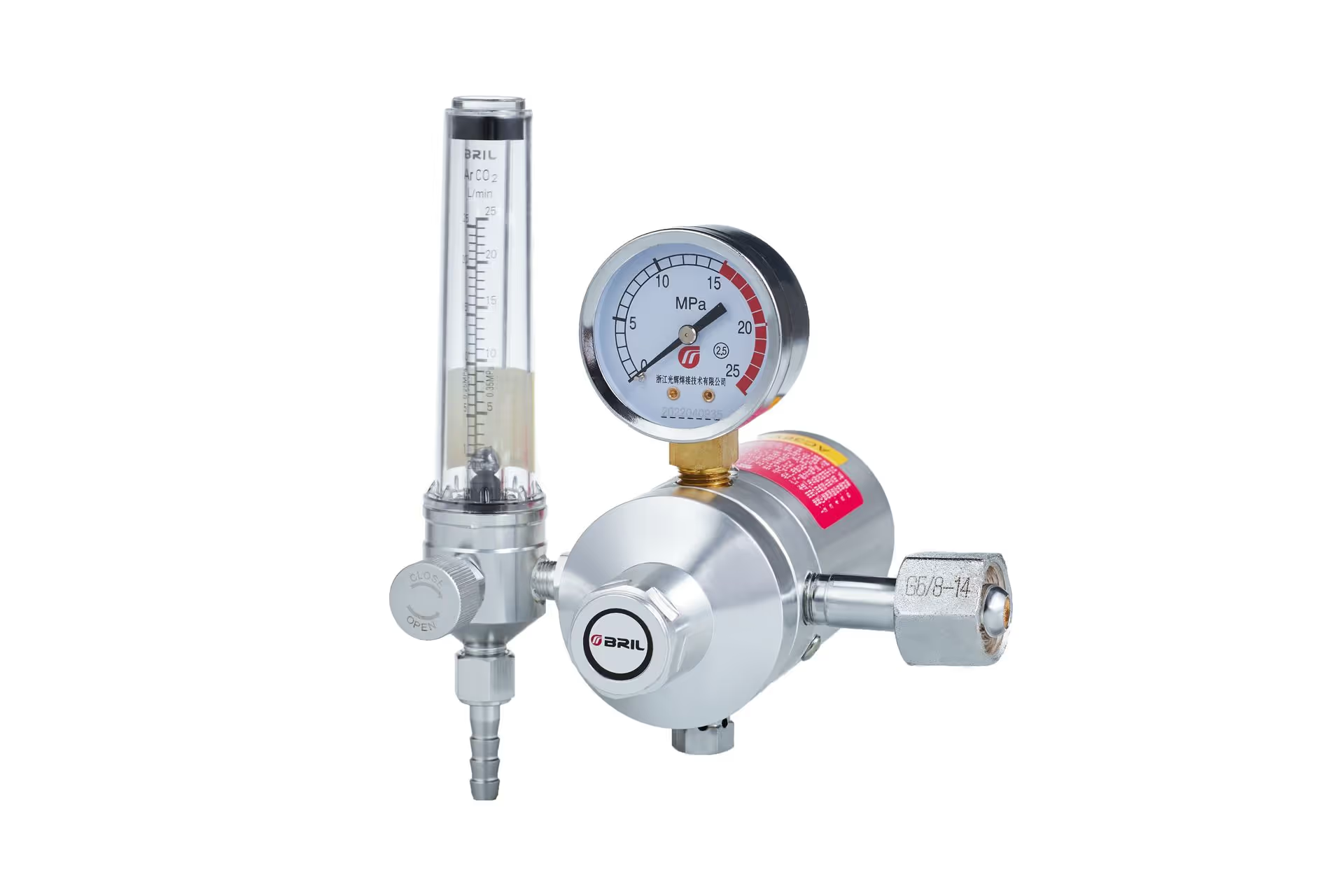
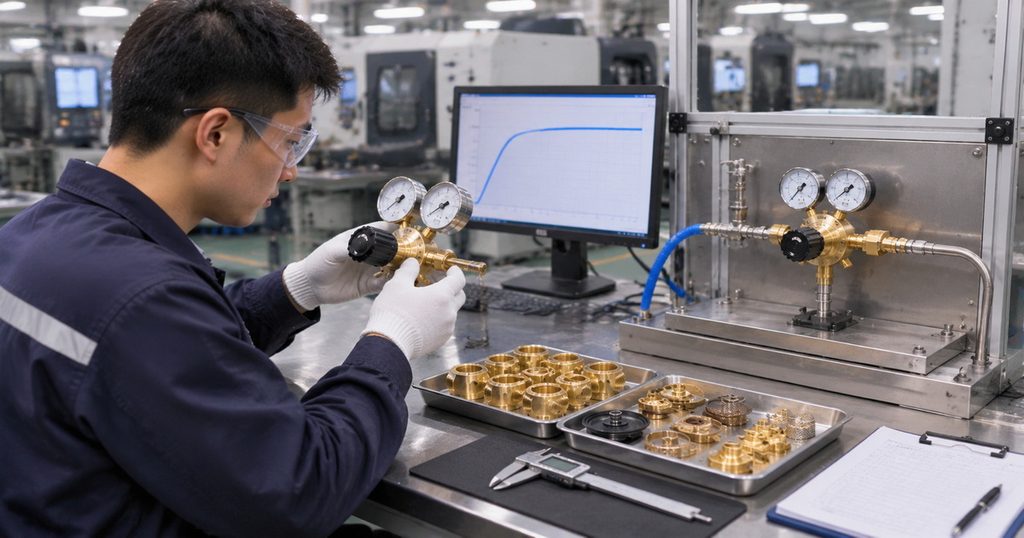
Founded in 2002, Zhejiang Bril Welding Equipment Co., Ltd. is based in Wenzhou, Zhejiang, China. Its company profile describes a business specializing in the development, manufacture, and sale of industrial gas pressure regulators. Bril reports serving more than 30 countries and regions. These are company-published statements rather than independently audited findings.
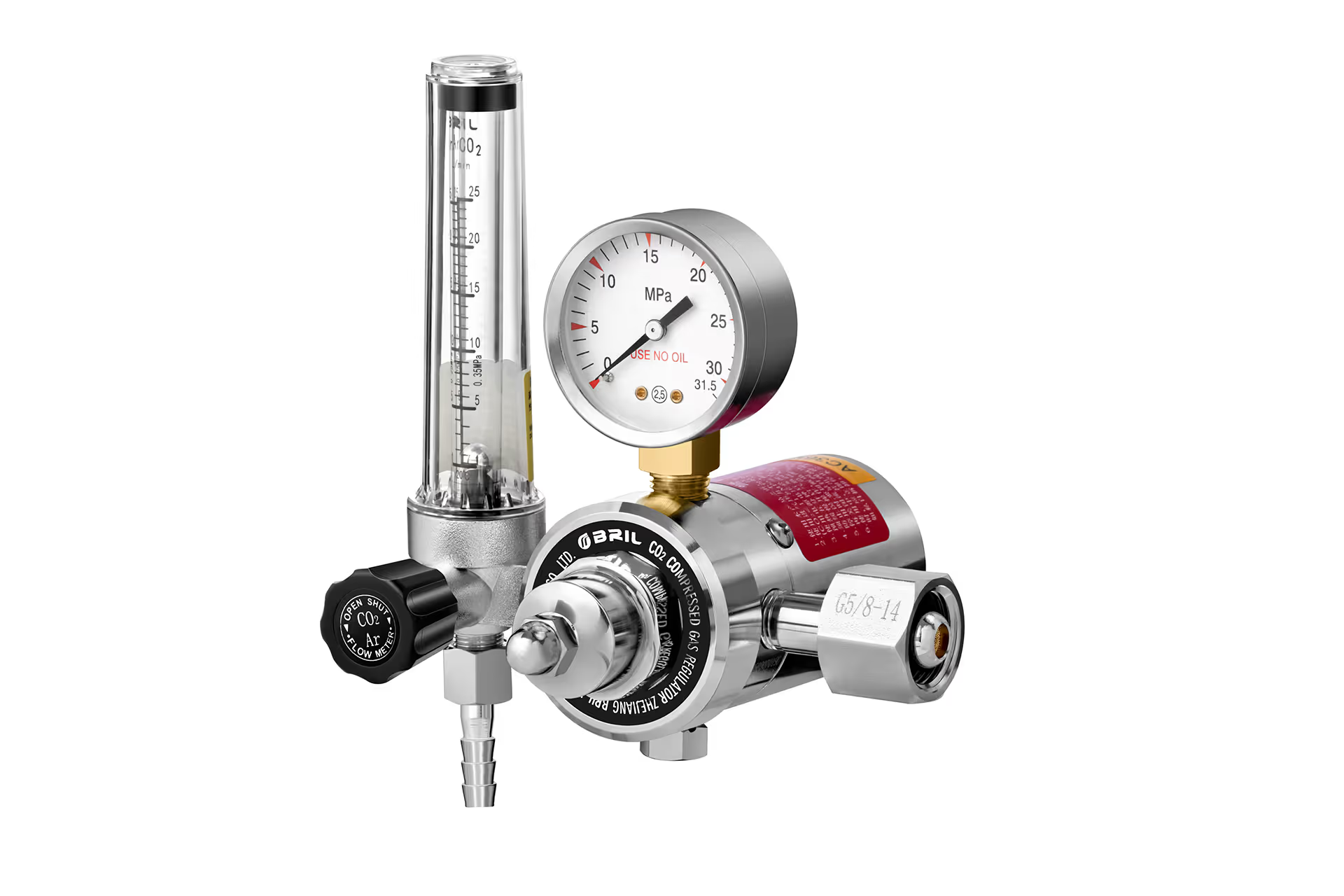
Its regulator portfolio includes argon, CO₂, heated CO₂, oxygen, acetylene, propane, nitrogen, and dual-stage products. This makes it relevant to distributors developing coordinated gas-control ranges rather than purchasing only one argon regulator model.
Core strengths and OEM/ODM scope
Bril is worth evaluating when a buyer wants direct factory participation in product configuration and private-label development.
Its published technical guidance describes an OEM/ODM workflow covering gas service, pressure and flow requirements, connection drawings, gauge scales, labels, packaging, production acceptance criteria, and change control. It also emphasizes distinguishing type testing from routine production inspection.
For smaller and medium-sized brands, the potential value is coordinated engineering and commercial communication. However, flexibility and communication efficiency should be tested during the quotation stage, not assumed from promotional language.
Useful evaluation tasks include:
– Requesting one consolidated technical and commercial response.
– Asking the engineer to identify configuration risks before sampling.
– Separating existing-platform customization from genuinely new development.
– Confirming who owns drawings, tooling, and approved revisions.
– Establishing response deadlines for sample feedback and corrective actions.
Procurement limitations to verify
Bril’s profile mentions ISO 9001, UKAS, IAF, CNAS, and CE-related credentials. These references require document-level clarification. Accreditation organizations, certification bodies, laboratory accreditation, and product conformity are different categories of evidence. Buyers should request the actual certificate issuer, certificate number, covered factory, validity status, and applicable product documents.
Bril is a candidate for a cost-performance comparison, not a verified lowest-price supplier. Compare landed cost, sample results, inspection expenses, warranty responsibility, and replenishment time before drawing that conclusion.
2. Grupo INFRA
Company background and principal market
Grupo INFRA traces its origins to a welding workshop established in 1919. Today, it presents itself as a Mexican industrial group supplying industrial and specialty gases, welding equipment, and related services across the country. Its published sector coverage includes automotive, aerospace, metal production, construction, and energy.
Core strengths
INFRA’s procurement relevance lies in its combined gas-and-equipment supply position.
A factory purchasing argon cylinders, shielding-gas mixtures, welding equipment, and accessories may benefit from discussing these requirements with one local organization. Its website provides a store locator, technical-document library, and training information. These channels make it a practical starting point for buyers prioritizing domestic contact and service coordination.
OEM/ODM suitability and limitations
The reviewed corporate information does not establish an open private-label argon regulator manufacturing program or disclose regulator-specific factory output.
Consequently, INFRA should be assessed primarily as a Mexican supply and service partner unless a particular quotation establishes otherwise.
Before ordering, ask:
– Who manufactures the quoted regulator?
– What is its declared country of origin?
– Which replacement parts are stocked locally?
– Who handles warranty assessment?
– Does the quotation cover standard branded equipment or a documented custom project?
Its strongest fit is local procurement coordination, not an assumed contract-manufacturing relationship.
3. Harris Products Group
Company background and principal markets
Harris Calorific began in 1905. The current Harris Products Group was created through Lincoln Electric’s combination of Harris Calorific and J.W. Harris in 2005. Buyers should distinguish the historical brand date from the formation of the present group.
The company supplies equipment and gas-distribution solutions for welding, cutting, brazing, and related industrial applications, supported by an international operating footprint.
Core strengths
Harris is a relevant benchmark for buyers comparing established branded shielding-gas equipment.
Its Mexico-facing material describes the 355-2 flowmeter regulator. Published product information for a specific 355-2 argon kit identifies a compact regulator-and-flowmeter arrangement, brass construction, a pressure-compensated design, and a replaceable flow tube and float. The exact configuration and approval status must be checked against the ordered part number.
The purchasing advantage is a defined product platform that can be compared through technical specifications rather than exterior appearance.
OEM/ODM suitability and limitations
Do not assume that distributor access means private-label access.
Buyers seeking Harris-branded equipment should establish authorized-channel status, Mexican warranty coverage, stock availability, and genuine replacement-part support. Buyers seeking proprietary designs or private labels should request explicit confirmation that such a program exists for their volume and territory.
Harris is particularly relevant where a recognized branded product and documented configuration matter more than unrestricted cosmetic customization.
4. Victor / ESAB
Company background and principal markets
Victor’s history dates to 1913, when founder L. W. Stettner developed gas-control equipment. Today, Victor is part of ESAB’s gas-equipment portfolio.
For Mexico-focused sourcing, ESAB publishes Mexican product pages for the GRF400 flowmeter regulator and HRF2400 Pro. These listings establish a Mexico-facing product channel, but they do not establish that the listed regulators are manufactured in Mexico.
Core strengths
Victor offers a useful comparison between application levels.
The Mexican GRF400 listing describes a compact, economical cylinder flowmeter regulator intended for light-duty applications. The HRF2400 Pro listing emphasizes higher flow capability and a high-visibility flow tube. Buyers can therefore begin with duty requirements rather than assuming that every argon flowmeter regulator serves the same workload.
OEM/ODM suitability and limitations
Victor is most straightforwardly evaluated as a branded equipment source.
For a procurement specification, confirm:
– Exact gas or mixture calibration.
– Maximum inlet pressure.
– Required operating flow range.
– Cylinder and hose connections.
– Authorized distribution and service arrangements.
– Availability of the specific replacement components.
Public Mexican product listings do not establish an unrestricted private-label program. Any custom manufacturing arrangement requires a separate written proposal.
5. GCE / ESAB
Company background and principal markets
GCE Group was founded in 1987. Its published history includes older predecessor businesses, but those dates should not be substituted for the group’s founding year.
ESAB Mexico presents GCE as part of its gas-control brand portfolio. GCE’s Latin American industrial catalog includes cylinder regulators, making it relevant to buyers evaluating industrial pressure-control options for Mexico-facing projects.
Core strengths
GCE provides published information on industrial equipment standards, including regulator, pressure-gauge, and welding-hose requirements. This is useful for technically demanding buyers who need to frame document requests around the relevant component and application.
GCE also describes shielding-gas economizers for MIG, MAG, and TIG applications. These products are relevant when gas consumption and transient flow behavior form part of the project specification. Savings, however, must be measured in the buyer’s operating conditions rather than assumed from the product category.
OEM/ODM suitability and limitations
GCE merits consideration for projects requiring technical coordination across gas-control components. Nevertheless, buyers should confirm whether the local offer covers catalog distribution, an engineered assembly, or an actual OEM agreement.
GCE and Victor both appear within ESAB’s brand portfolio. They should not automatically be counted as independent corporate sources in a supplier-diversification strategy.
Technical Buyer’s Guide: Specify Performance Before Branding
Define the regulator architecture
An argon gas regulator for welding must match the process, cylinder supply, and downstream equipment.
A quotation should specify:
– Pure argon or the exact shielding-gas mixture.
– Maximum cylinder pressure.
– Required delivery pressure and flow range.
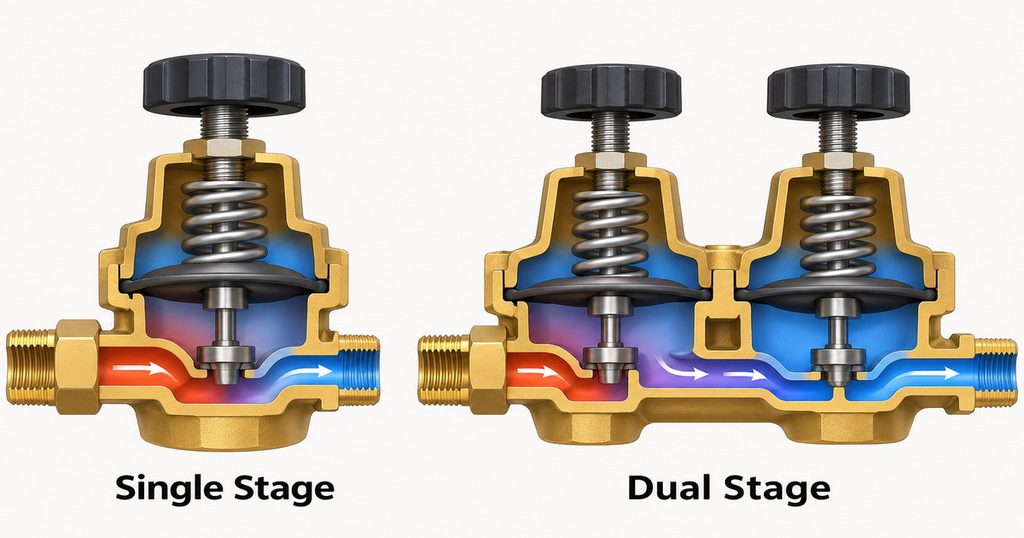
– Single-stage or dual-stage construction.
– Flowmeter or pressure-based flow indication.
– Inlet and outlet connection drawings.
– Ambient conditions and installation orientation.
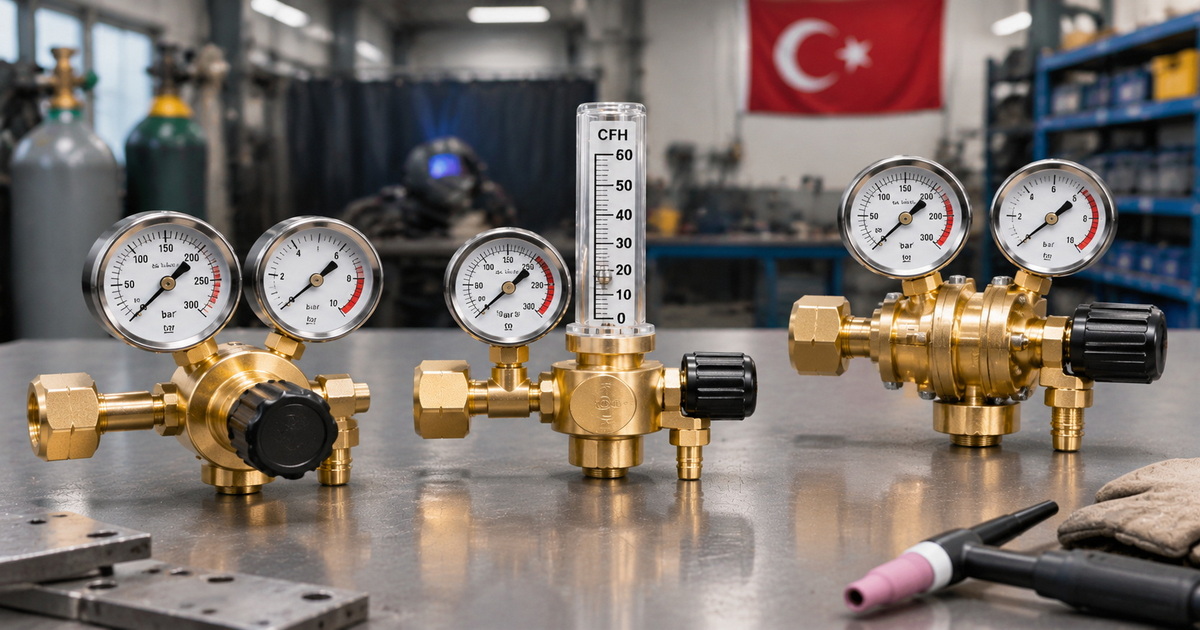
Two gauges do not establish two-stage construction. Gauges display measurements; pressure-reduction stages are internal mechanisms. Request a sectional drawing or clear technical declaration when stage count matters.
Specify brass and gas-contact materials
“High-quality brass” is not a complete purchasing specification.
Require an identified body-material designation, material documentation appropriate to the contract, and defined requirements for seats, diaphragms, seals, and other gas-contact components. Where competing suppliers propose different alloy systems, ask for composition and performance evidence rather than comparing color or weight.
Bril’s published technical guidance also emphasizes machining quality, sealing surfaces, cleaning, and material compatibility across the complete assembly. A polished or heavier body does not establish better pressure regulation.
Separate standards from conformity claims
The relevant technical framework may include:
| Document or claim | What it addresses | Procurement caution |
|---|---|---|
| ISO 2503 / applicable EN adoption | Cylinder regulators and regulators with flow-metering devices within scope | Confirm application, edition, amendments, and model rating |
| ISO 5171 | Pressure gauges for welding and allied processes | A gauge claim does not certify the complete regulator |
| ISO 3821 | Rubber hoses for welding and allied processes | Verify the supplied hose, not only the regulator |
| ISO 9001 | Quality-management system | Confirm legal entity, site, scope, and status |
| CE marking | Applicable European product legislation | Not interchangeable with an ISO test report |
Published standards guidance supports these distinctions. Some supplier pages list older editions, so the purchase specification should identify the applicable current edition or contractual adoption rather than copying a catalog reference without checking it.
CE and RoHS should not be described as interchangeable environmental certifications. For any such claim, request an applicability assessment for the exact product and destination. Bril’s own technical guidance explicitly distinguishes EN ISO 2503 compliance from CE marking and warns that electrically heated regulators require additional assessment beyond gas-pressure performance.
Treat production inspection as a separate requirement
Ask suppliers to propose documented acceptance criteria for:
– External leakage.
– Internal seat leakage.
– Outlet-pressure behavior across the required flow range.
– Closing behavior after demand stops.
– Flow indication at agreed operating points.
– Connection dimensions and identification.
– Lot traceability and inspection-record retention.
Agree which checks apply to every unit and which use a defined sampling plan. A representative design test and a shipment inspection answer different questions; neither should silently replace the other.
The Overlooked Purchasing Trap: A Flow Scale Is Part of a Calibrated System
One easily overlooked mistake is approving an argon regulator because the dial or flow tube displays the desired range.
The indication must be evaluated together with the gas, measuring arrangement, pressure conditions, and approved configuration. A pressure-based flow gauge is not the same as a device that directly measures flow. Changing the flowmeter assembly or other configuration details can also require a documented assessment of whether existing evidence remains applicable.
A practical acceptance procedure is to:
1. Record the complete regulator, flowmeter, connection, and hose configuration.
2. Test several points across the intended working range.
3. Compare indicated flow against a suitable reference instrument.
4. Repeat the assessment under representative inlet-pressure conditions.
5. Verify delivered flow at the welding point where appropriate.
6. Freeze the approved configuration in the purchasing specification.
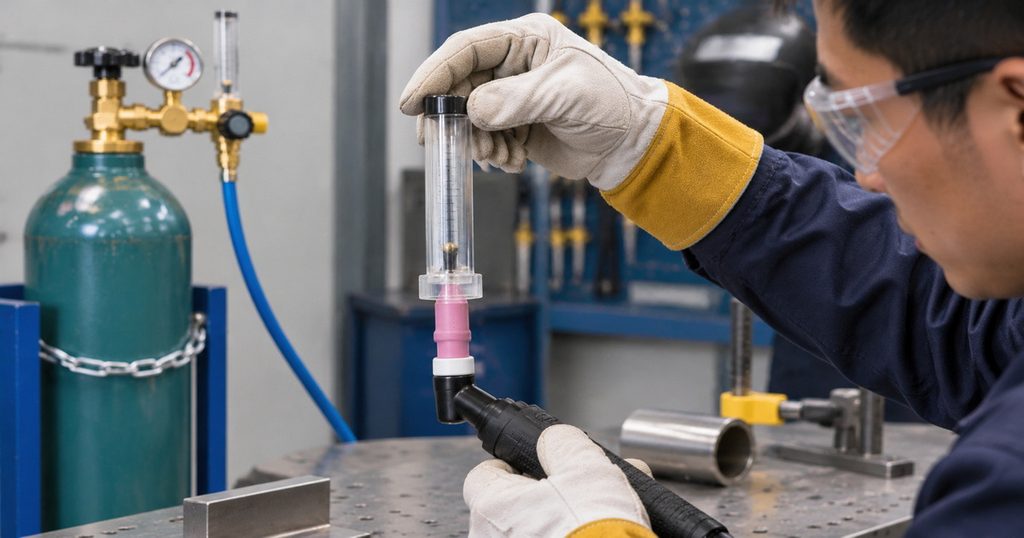
ESAB specifically offers a nozzle-position flow-checking device for argon or CO₂, illustrating why point-of-use verification is distinct from simply reading the cylinder-mounted indicator.
The commercial lesson is important: do not approve a scale, then allow unreviewed substitutions to the components that determine how that scale behaves.
Factory Verification, Sampling, and Logistics
Verify capability without confusing size with output
For a factory-direct project, request a live or independent review of machining, assembly, test equipment, material storage, and finished-goods identification.
For a distributor, focus instead on authorization, inventory accuracy, service arrangements, and traceability to the original manufacturer.
Capacity should be quoted for the actual product family. Ask for current backlog, bottleneck processes, outsourced operations, and achievable shipment quantities. A workforce figure or factory area cannot answer those questions.
Use a controlled sample process
A defensible qualification sequence is:
1. Approve the technical specification.
2. Review relevant certificates and reports.
3. Evaluate engineering samples.
4. Record the approved configuration.
5. Inspect a pilot production lot.
6. Authorize routine orders only after resolving discrepancies.
Require written approval before changes to pressure-containing parts, seats, seals, diaphragms, gauges, connections, or other performance-relevant components. This protects repeat-order consistency.
Compare landed cost and replenishment risk
For overseas supply, obtain a written logistics plan covering:
– Agreed Incoterms and named delivery location.
– Commercial invoice and packing-list requirements.
– Freight, insurance, customs, and inland transport responsibilities.
– Protective packaging for gauges and flow tubes.
– Spare-parts shipments and warranty returns.
– Country-of-origin documentation.
Ask a Mexican customs broker to confirm classification and applicable import requirements before the purchase order is released. Do not assume that shipment through a Mexican warehouse changes manufacturing origin or creates preferential tariff eligibility.
Conclusion
Bril offers an overseas factory-direct route for buyers evaluating OEM/ODM regulator development. INFRA is relevant to Mexican gas-and-equipment procurement. Harris, Victor, and GCE provide established branded product platforms and technical documentation through international or Mexico-facing channels. Their commercial suitability depends on the exact model, local availability, and contractual scope.
The strongest sourcing decision begins with a controlled specification and ends with verified production evidence—not a name on a ranking.
For a Bril OEM/ODM inquiry, submit your target market, gas or mixture, cylinder connection, inlet pressure, delivery requirements, forecast quantity, and branding scope. Request a configuration proposal, supporting documentation, sample plan, and written production acceptance criteria before approving the order.
FAQ
1. How can I check whether a manufacturer’s ISO 9001 certificate has expired or been suspended?
Check the certificate number, legal entity, factory address, scope, issuing certification body, and validity dates. Then verify status through the issuer’s official system and an accredited-certificate verification service where available.
IAF CertSearch supports searches by company or certificate details. If a record is missing or unclear, seek confirmation directly from the certification body rather than relying on a supplier’s scanned certificate alone. Also verify that the covered scope includes the relevant manufacturing activity.
2. Can I use a report for a similar regulator model to approve my private-label version?
Not without a documented coverage assessment.
Compare the tested model with the ordered configuration, including the body, pressure ratings, seats, diaphragm, connections, gauges, and flowmeter assembly. Ask the manufacturer or laboratory to explain why any differences do or do not affect the report’s applicability.
A shared appearance, model-series name, or logo does not establish equivalent coverage.
3. Does a standard referring to 300 bar mean every compliant regulator accepts a 300-bar cylinder?
No. The standard’s scope limit is not the rating of every regulator within that scope.
Verify the exact model’s declared maximum inlet pressure, gas service, connection specification, and supporting evidence. The cylinder and regulator must be selected as a compatible system.
4. How should we verify a dual-stage regulator when the supplier only provides exterior photographs?
Request a sectional drawing, internal schematic, or technical declaration showing two pressure-reduction stages. Then evaluate pressure-control performance under the intended operating conditions.
Two gauges are not evidence of two-stage construction. Conversely, stage count alone does not establish satisfactory performance; request measured outlet-pressure behavior across changing inlet pressures and required flow rates.
5. How can we prevent an approved sample from becoming a lower-cost substitute during repeat orders?
Make the approved configuration contractual.
Record drawings, material specifications, component identities, markings, and test criteria. Require advance notification and written approval for performance-relevant substitutions. Link production lots to inspection records, and define when a change triggers renewed testing.
An approved sample is useful only when the supplier and buyer can identify exactly what was approved.
References
1. Zhejiang Bril Welding Equipment Co., Ltd. — Company profile, founding date, location, self-reported operating scale, markets, and certification statements. [chinesewelding]
2. Zhejiang Bril Welding Equipment Co., Ltd. — “EN ISO 2503 and Welding Gas Regulators: What OEM Buyers Should Know,” published November 2, 2026; technical scope, configuration control, and OEM qualification guidance. [chinesewelding]
3. INEGI — January 9, 2026 RAIAVL results, reporting Mexico’s 2025 light-vehicle production and exports. These are downstream industry statistics, not argon regulator market data. [inegi.org]
4. U.S. International Trade Administration — “Mexico—Advanced Manufacturing,” regional manufacturing-cluster overview. [trade]
5. U.S. International Trade Administration — “Mexico Advanced Manufacturing,” August 24, 2026; automotive and aerospace investment context. [trade]
6. Grupo INFRA — Corporate website, sector coverage, equipment and gas supply, technical-document resources, training, and store-location information. [grupoinfra]
7. Grupo INFRA — Published account of its 1919 workshop origins. [x]
8. Harris Products Group — Company history and formation of the present group. [harrisproductsgroup]
9. Harris Products Group — Mexico-facing 355-2 flowmeter regulator information; supplementary model-specific technical listing. [harrisproductsgroup]
10. ESAB — Corporate history and Victor heritage; Mexican GRF400 and HRF2400 Pro product listings. [esab]
11. GCE — Group history, Latin American cylinder-regulator catalog, and industrial standards overview. [gcegroup]
12. ESAB Mexico — GCE brand information; ESAB guidance on checking shielding-gas flow at the welding nozzle. [esab]
13. IAF CertSearch — Accredited management-system certificate verification platform. [iafcertsearch]
Hot Tags: Argon Gas Regulator, Argon Regulator Manufacturers, Argon Regulator Suppliers, Argon Gas Regulator Suppliers In Mexico, Wholesale Argon Regulators, OEM Argon Gas Regulators, Industrial Gas Regulators, TIG Welding Argon Regulators, Argon Flowmeter Regulators, Dual Stage Argon Regulators