Content Menu
● Argon CO₂ Mixed Gas Regulator vs Pure CO₂ Regulator: Key Differences
● What an Argon CO₂ Mixed Gas Regulator Actually Does
>> It Controls Premixed Gas, Not the Mixing Ratio
>> Typical Applications for Argon-Rich Blends
● What Makes a Pure CO₂ Regulator Different?
>> CO₂ Cooling Changes the Operating Challenge
>> When a CO₂ Heated Regulator Makes Sense
● Welding Performance: Separate the Gas from the Regulator
>> Arc Stability, Spatter, and Penetration
>> Transfer Mode and Material Compatibility
● Flowmeter Calibration: The Compatibility Detail Buyers Miss
>> Pressure and Flow Are Different Measurements
>> Why Gas-Specific Scales Matter
● Can You Use an Argon CO₂ Regulator for Pure CO₂?
● Single-Stage vs Dual-Stage Gas Regulators
● A Practical Five-Step Selection and Setup Checklist
>> 1. Define the Actual Application
>> 2. Confirm the Complete Connection System
>> 3. Inspect and Install According to the Manual
>> 4. Set Flow Under Operating Conditions
>> 5. Verify Sustained Performance
● A Better Cost Comparison: Cost per Accepted Weld
● OEM and ODM Specifications for Overseas Buyers
● Specify the Right Regulator for Your Application
>> 1.Is an Argon CO₂ Mixed Gas Regulator the Same as a Pure CO₂ Regulator?
>> 2.Does a Mixed Gas Regulator Create a 75/25 Blend?
>> 3.Does Every CO₂ Regulator Need a Heater?
>> 4.Can an Adapter Make the Two Regulators Interchangeable?
>> 5.Is a Dual-Gauge Regulator a Dual-Stage Regulator?
>> 6.Which Regulator Is Better for Continuous Production?
Choosing between an argon CO₂ mixed gas regulator and a pure CO₂ regulator involves more than matching a fitting to a cylinder. Both reduce cylinder pressure, but their suitability depends on approved gas service, flowmeter calibration, inlet connections, operating conditions, and resistance to CO₂ cooling.
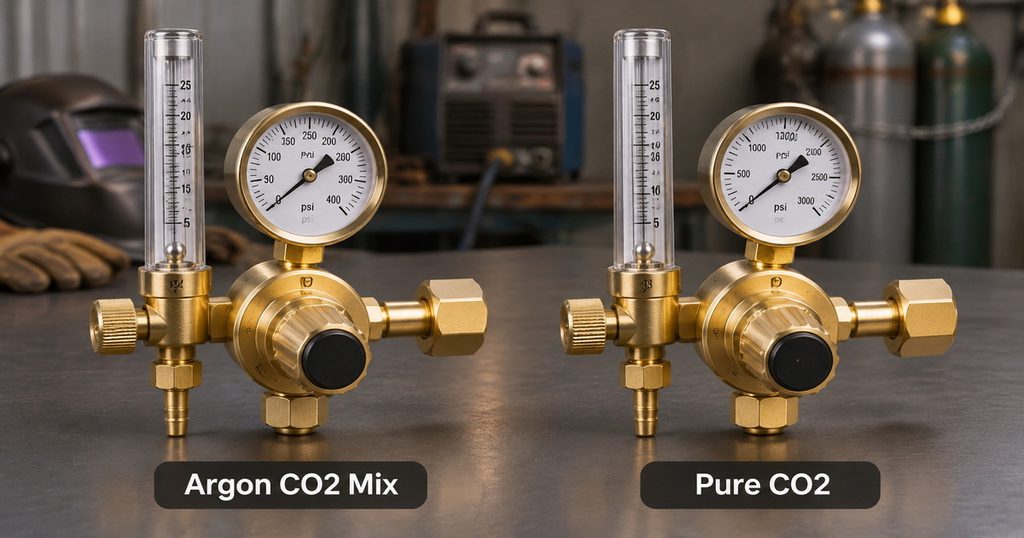
Argon CO₂ Mixed Gas Regulator vs Pure CO₂ Regulator: Key Differences
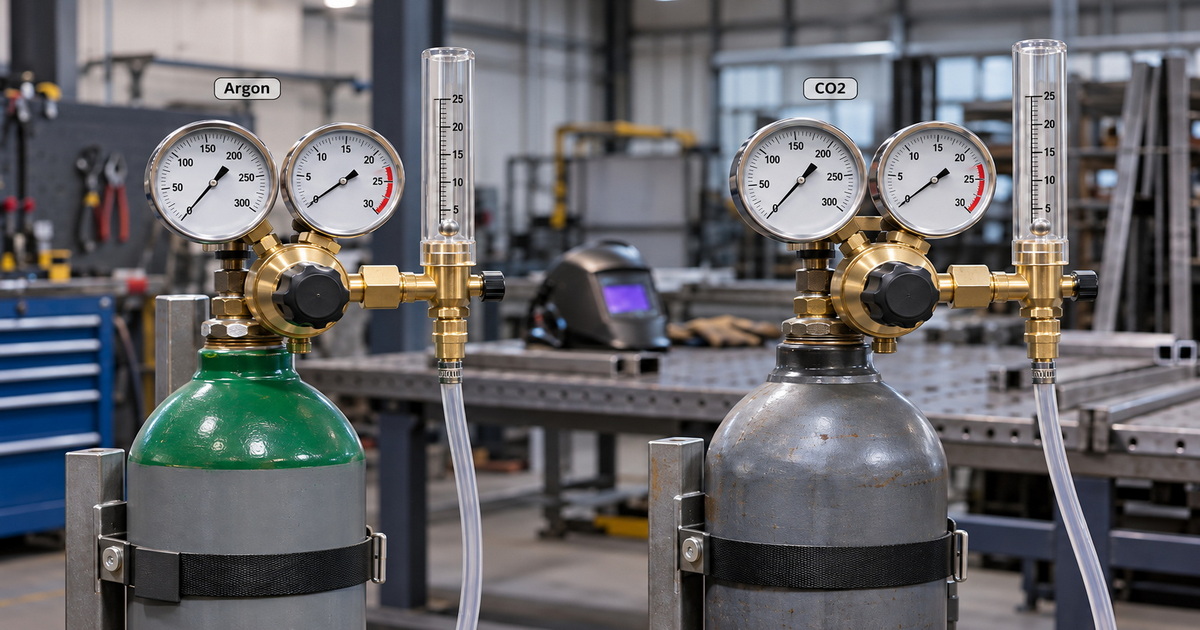
An argon CO₂ mixed gas regulator normally supplies premixed shielding gases, such as 75% argon/25% CO₂. A pure CO₂ regulator is specified for carbon dioxide service, with suitable connections, flow indication, and operating characteristics.
These categories can overlap. Some manufacturers approve particular regulators or flowmeters for multiple gases. However, “argon/CO₂” labeling does not automatically establish compatibility with every blend, cylinder, or application.
| Comparison point | Argon CO₂ mixed gas regulator | Pure CO₂ regulator |
|---|---|---|
| Primary application | Premixed shielding gas delivery | Carbon dioxide delivery |
| Common welding use | Carbon-steel welding with specified blends | Carbon-steel welding using 100% CO₂ |
| Typical U.S. cylinder connection | Commonly CGA 580 | Commonly CGA 320 |
| Flow indication | Must match the specified blend or approved scale | Must be suitable for CO₂ |
| Cooling considerations | Application-dependent | Particularly important during sustained withdrawal |
| Heating options | Usually selected according to operating conditions | Heat exchangers or electrical heating may be appropriate |
| Interchangeability | Requires manufacturer confirmation | Requires manufacturer confirmation |
| Main purchasing priority | Blend compatibility and stable delivery | CO₂ compatibility and thermal performance |
Connections vary by country and cylinder supplier. Treat the U.S. examples as regional references, not universal specifications.
What an Argon CO₂ Mixed Gas Regulator Actually Does
It Controls Premixed Gas, Not the Mixing Ratio
A standard mixed gas regulator reduces pressure from a cylinder containing an already prepared blend. It does not combine separate argon and CO₂ supplies or maintain a mixing ratio between them.
Producing a blend from separate cylinders requires a suitable gas mixer or proportioning system.
This distinction matters when ordering equipment for centralized welding installations. A “mixed gas regulator” and a “gas mixing system” perform different functions.
Typical Applications for Argon-Rich Blends
A 75% argon/25% CO₂ blend is widely used for short-circuit welding of carbon steel. Compared with pure CO₂, it generally provides a smoother arc, less spatter, and a more attractive bead.
Argon-rich blends such as 90% argon/10% CO₂ are also used for suitable spray and pulsed applications. The correct composition depends on the welding procedure, wire, material, and machine program.
The regulator supports reliable delivery. It does not determine the blend’s welding characteristics.
What Makes a Pure CO₂ Regulator Different?
CO₂ Cooling Changes the Operating Challenge
Pressure reduction cools the gas. In CO₂ service, sustained withdrawal can create substantial cooling, potentially leading to frost and unstable operation.
External frost does not automatically prove internal failure. Nevertheless, declining flow, leakage, or pressure instability requires investigation rather than repeated adjustment.
A dedicated CO₂ regulator should be selected for its specified duty, including flow demand, ambient temperature, and continuous operating time.
When a CO₂ Heated Regulator Makes Sense
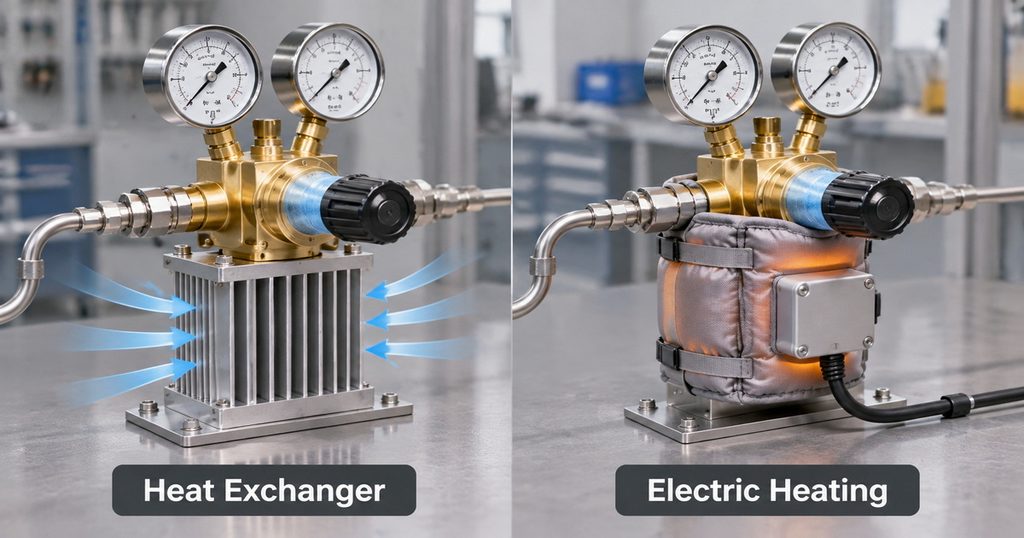
A heated CO₂ regulator may be appropriate for demanding applications where cooling disrupts delivery. Another approach is a regulator incorporating a passive heat exchanger.
These are different solutions:
– A heat exchanger transfers heat from the surroundings.
– An electrically heated regulator supplies additional heat.
– Neither automatically increases the cylinder’s sustainable withdrawal capacity.
Not every pure CO₂ application needs electrical heating. Select it against documented operating requirements, not simply because frost appears occasionally.
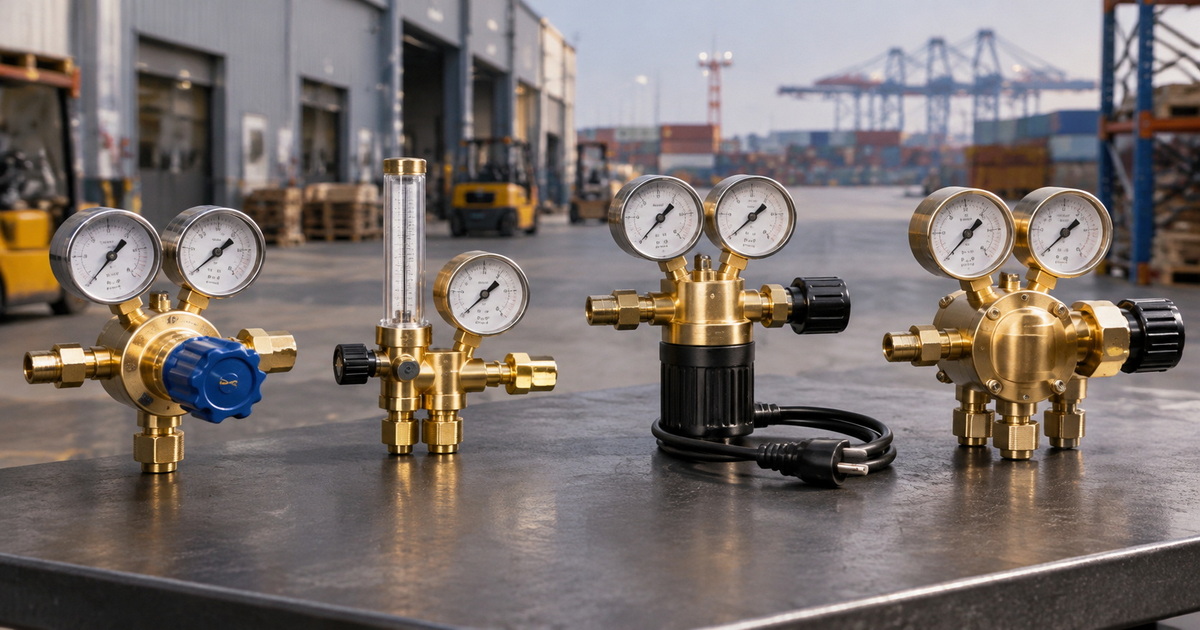
For electrically heated models, confirm voltage, frequency, power rating, temperature controls, and destination-market electrical requirements.
Welding Performance: Separate the Gas from the Regulator
Arc Stability, Spatter, and Penetration
Pure CO₂ is often economical and can provide deeper penetration in suitable carbon-steel applications. It also generally produces more spatter and a rougher bead than common argon/CO₂ blends.
An argon-rich mixture can reduce cleanup and improve bead appearance. However, results still depend on wire selection, voltage, current, travel speed, and transfer mode.
A premium regulator cannot compensate for an unsuitable shielding gas or incorrect welding parameters.
Transfer Mode and Material Compatibility
For conventional spray-transfer welding, an appropriate argon-rich blend is normally required. Pure CO₂ is not a direct replacement for a specified argon-rich spray-transfer gas.
Likewise, neither pure CO₂ nor an argon/CO₂ welding mixture should be treated as a universal shielding gas. Aluminum welding commonly uses pure argon, while stainless-steel applications require carefully selected mixtures.
Choose the process and gas first. Then specify the regulator.
Flowmeter Calibration: The Compatibility Detail Buyers Miss
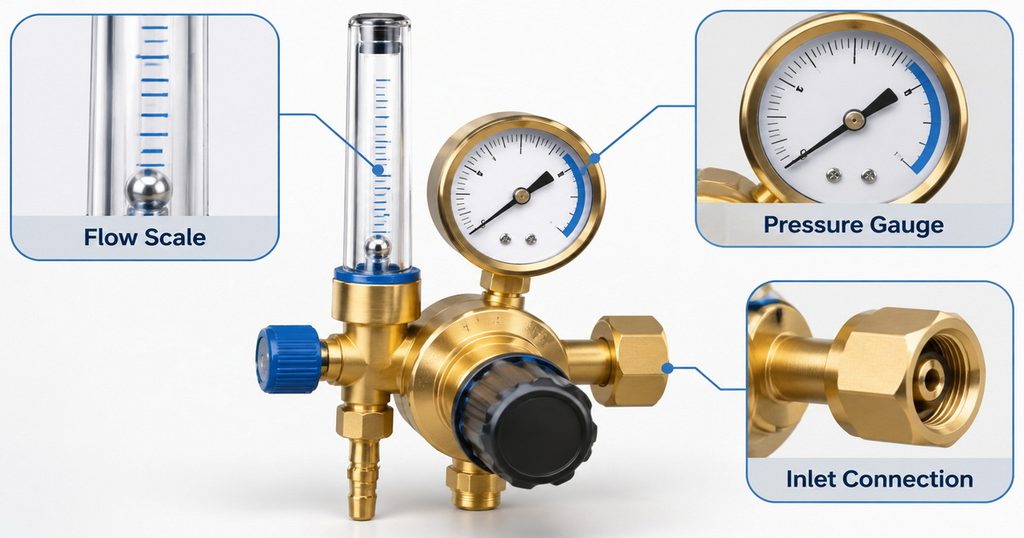
Pressure and Flow Are Different Measurements
Cylinder pressure, delivery pressure, and shielding gas flow describe different conditions.
A pressure gauge reports pressure. A flowmeter reports flow under its stated calibration conditions. Some welding regulators use a pressure-based flow gauge calibrated for a particular gas and metering arrangement.
Consequently, a gauge marked in liters per minute does not necessarily measure flow independently of downstream conditions.
Why Gas-Specific Scales Matter
Flowmeter readings depend on the instrument design, gas properties, and calibration pressure. Manufacturers therefore offer instruments with separate scales for argon, argon/CO₂ mixtures, CO₂, or helium.
Do not assume that an argon-scale reading remains accurate with pure CO₂.
Before switching gases, verify:
1. The regulator’s approved gas service.
2. The correct cylinder connection.
3. The applicable flowmeter scale.
4. The required operating pressure.
5. Any manufacturer-specified correction or limitation.
For production work, confirm delivery at the torch with a suitable checking device rather than relying only on the regulator display.
Can You Use an Argon CO₂ Regulator for Pure CO₂?
Sometimes—but only when the manufacturer approves the specific model and configuration.
Mechanical fit is just one requirement. An adapter does not establish that the regulator has suitable seals, pressure ratings, calibration, or thermal capacity.
The reverse also applies: a CO₂ regulator should not be moved to an argon-rich supply without confirming compatibility and the appropriate inlet arrangement.
My purchasing rule would be simple: require written confirmation covering the complete assembly. Avoid relying on an informal statement that “the threads fit.”
Where gas changes are frequent, clearly identified, manufacturer-approved configurations can reduce operator confusion and purchasing errors.
Single-Stage vs Dual-Stage Gas Regulators
Single-stage and dual-stage describe pressure-reduction architecture—not the number of gauges.
A single-stage regulator reduces pressure in one step. A dual-stage regulator uses two successive reductions and can provide more stable delivery as inlet pressure changes.
However, a dual-stage design is not automatically necessary for every welding station. A well-specified single-stage flowmeter regulator may be suitable for routine work.
For either design, request performance information rather than relying on the product name:
– Outlet-pressure behavior across the specified inlet range.
– Flow capacity at the required delivery pressure.
– Performance during repeated starts and stops.
– Approved temperature range.
– CO₂ duty limitations, where applicable.
Two gauges do not prove that a regulator is dual-stage.
A Practical Five-Step Selection and Setup Checklist
1. Define the Actual Application
Record the gas composition, cylinder supply, welding process, required flow range, working temperature, and operating schedule.
For multiple torches, specify simultaneous demand. One station’s typical flow is not the complete installation requirement.
2. Confirm the Complete Connection System
Verify the inlet standard, sealing arrangement, outlet connection, hose specification, and local cylinder requirements.
Never force mismatched connections or introduce improvised fittings.
3. Inspect and Install According to the Manual
Secure the cylinder and inspect the regulator, valve connection, seals, and hoses. Follow the equipment supplier’s installation sequence and use an approved leak-detection method.
Keep gas equipment free from contamination. Do not use a flame to check for leaks.
4. Set Flow Under Operating Conditions
Set shielding gas flow with gas passing through the intended delivery path, following the welding equipment instructions.
Avoid selecting one universal flow rate. Nozzle size, transfer mode, torch configuration, and drafts affect the requirement. Excessive flow can waste gas and create turbulence.
5. Verify Sustained Performance
Observe delivery through a representative production cycle. Investigate falling flow, unstable readings, persistent leakage, or abnormal cooling.
Do not apply open flames or improvised heating to a cold regulator.
A Better Cost Comparison: Cost per Accepted Weld
Comparing cylinder prices alone can produce the wrong purchasing decision.
A more useful framework is:
Total operating cost = gas + equipment + energy + maintenance + cleanup + rework + downtime.
Consider a hypothetical example—not a measured customer case. If an argon-rich blend costs more but saves three cleanup minutes per assembly, the labor saving may outweigh the gas premium. Conversely, pure CO₂ may remain attractive where the qualified process delivers acceptable results without significant additional cleanup.
Run a controlled production trial:
– Keep material, wire, and acceptance criteria consistent.
– Use suitable parameters for each gas.
– Record gas consumption and accepted output.
– Measure cleanup time and rejected welds.
– Include heater energy and stoppages where relevant.
This produces a more defensible comparison than assuming either gas is always cheaper.
OEM and ODM Specifications for Overseas Buyers
For brands, wholesalers, and equipment manufacturers, the strongest specification is an application document—not a photograph of a preferred regulator.
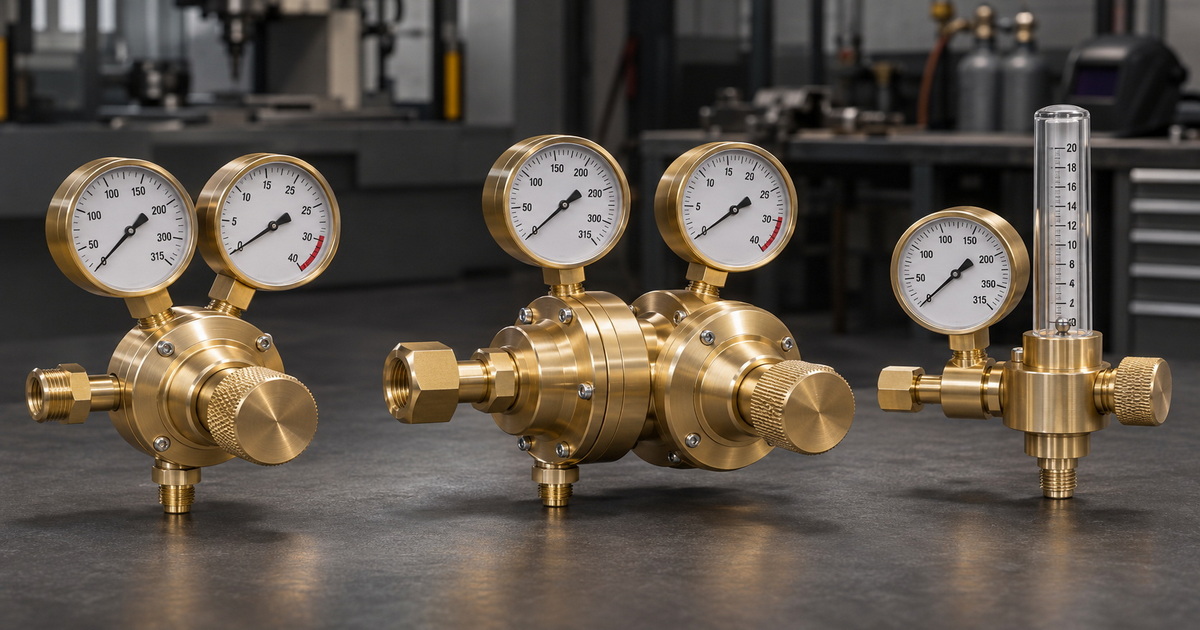
Our manufacturing focus includes precision machining, brass construction, stable pressure control, inspection, and customized gas-control configurations. These capabilities should translate into verifiable purchasing requirements.
An effective inquiry should include:
| Specification area | Information to provide or request |
|---|---|
| Gas service | Exact gas or blend and intended application |
| Pressure | Maximum inlet pressure and required delivery range |
| Flow | Operating range, units, and calibration basis |
| Connections | Destination-market inlet and outlet standards |
| Materials | Brass specification and compatible sealing materials |
| Thermal duty | Ambient range, continuous demand, heating requirements |
| Quality verification | Agreed leak, pressure, and functional test records |
| Documentation | Labels, instructions, traceability, applicable conformity evidence |
A quality brass body is valuable, but it does not independently prove flow accuracy, leak tightness, or suitability.
Before placing a volume order, agree on sample acceptance criteria and the supporting documentation. Request evidence for the exact model rather than assuming every configuration shares the same approvals.
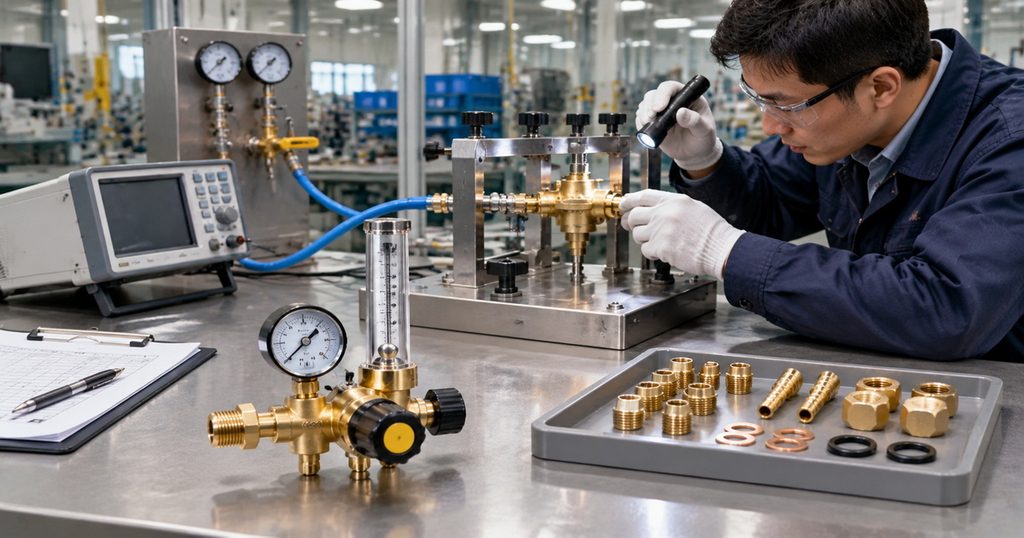
Specify the Right Regulator for Your Application
Send us your gas composition, destination market, cylinder connection, pressure requirements, flow range, and operating schedule. For heated models, include the required electrical supply.
We can use those details to discuss an appropriate standard, OEM, or ODM configuration, along with sample evaluation and agreed inspection requirements.
Frequently Asked Questions
1.Is an Argon CO₂ Mixed Gas Regulator the Same as a Pure CO₂ Regulator?
Not necessarily. Some models support multiple gases, but inlet connections, calibration, and operating limitations can differ. Check the exact specification.
2.Does a Mixed Gas Regulator Create a 75/25 Blend?
No. A standard regulator supplies an existing premix. Combining separate gas supplies requires suitable mixing equipment.
3.Does Every CO₂ Regulator Need a Heater?
No. Heating depends on flow demand, operating duration, temperature, and equipment design. Some applications use unheated regulators or passive heat exchangers successfully.
4.Can an Adapter Make the Two Regulators Interchangeable?
An adapter changes the connection only. It does not establish gas compatibility, accurate flow indication, or adequate thermal performance.
5.Is a Dual-Gauge Regulator a Dual-Stage Regulator?
No. Gauge count and pressure-reduction stages are separate characteristics. Check the manufacturer’s construction details.
6.Which Regulator Is Better for Continuous Production?
Choose the model validated for the actual gas, sustained flow, inlet conditions, and duty cycle. Continuous CO₂ applications deserve particular attention to cooling and supply capacity.
References
The manufacturer resources below support the gas-selection guidance, connection examples, calibration discussion, and product-design comparisons. Product specifications apply to the named models, not every regulator in the same category.
1. Miller Electric — “What Type of Gas Is Best for MIG Welding in DIY Applications?” Explains common shielding-gas compositions, welding characteristics, and the consequences of insufficient or excessive flow. [millerwelds]
2. Miller Electric — “Understanding the Basics of MIG Welding for Mild Steel.” Compares 75% argon/25% CO₂ with pure CO₂, including spatter, bead appearance, and penetration. [millerwelds]
3. Miller Electric — “Reduce Weld Rework With These Tips.” Discusses shielding-gas selection for short-circuit, spray, and pulsed welding. [millerwelds]
4. Miller/Smith Equipment — “CO₂ Flowmeter Regulator w/Heat Exchanger, 30 PSIG,” model 35-30-320. Documents a CO₂-specific design, CGA 320 inlet, and heat exchanger intended to reduce freeze-up. [millerwelds]
5. Miller/Smith Equipment — “Argon/CO₂/Helium Medium-Duty Flowmeter, 1/4″ MNPT, 50 PSIG,” model H2230A. Describes a multiscale flowmeter with gas-specific scales and a specified operating pressure. [millerwelds]
6. Miller/Smith Equipment — “15001 Series Surge Protector, 30 CFH.” Related product listings identify separate CGA 580 argon and CGA 320 CO₂ flow-gauge regulator configurations. [millerwelds]
7. Miller Electric — “10 Steps for Safe Oxy-Fuel Torch Setup.” Supports general cylinder-security, connection-selection, inspection, and leak-testing principles; its fuel-specific operating sequence should not replace shielding-gas equipment instructions. [millerwelds]
Hot Tags: Argon CO2 Regulator, CO2 Gas Regulator, Argon Gas Regulator, Welding Gas Regulator, CO2 Heated Regulator, Dual Stage Gas Regulator, Gas Regulator Manufacturer, Gas Regulator Supplier, OEM Gas Regulator, Welding Gas Flowmeter Regulator