Content Menu
● Argon vs CO₂ Regulator: Key Differences at a Glance
● Choose the Shielding Gas Before Choosing the Regulator
>> Argon/CO₂ Mixtures for Mild Steel
>> Pure CO₂ for Cost-Conscious Steel Welding
>> Argon for Aluminum MIG Welding
● Can You Use an Argon Regulator on a CO₂ Cylinder?
>> CGA 580 vs CGA 320 Connections
● Flowmeter vs Flow-Gauge Regulator: Which Is Better?
● Why CO₂ Regulators Freeze—and When Heating Helps
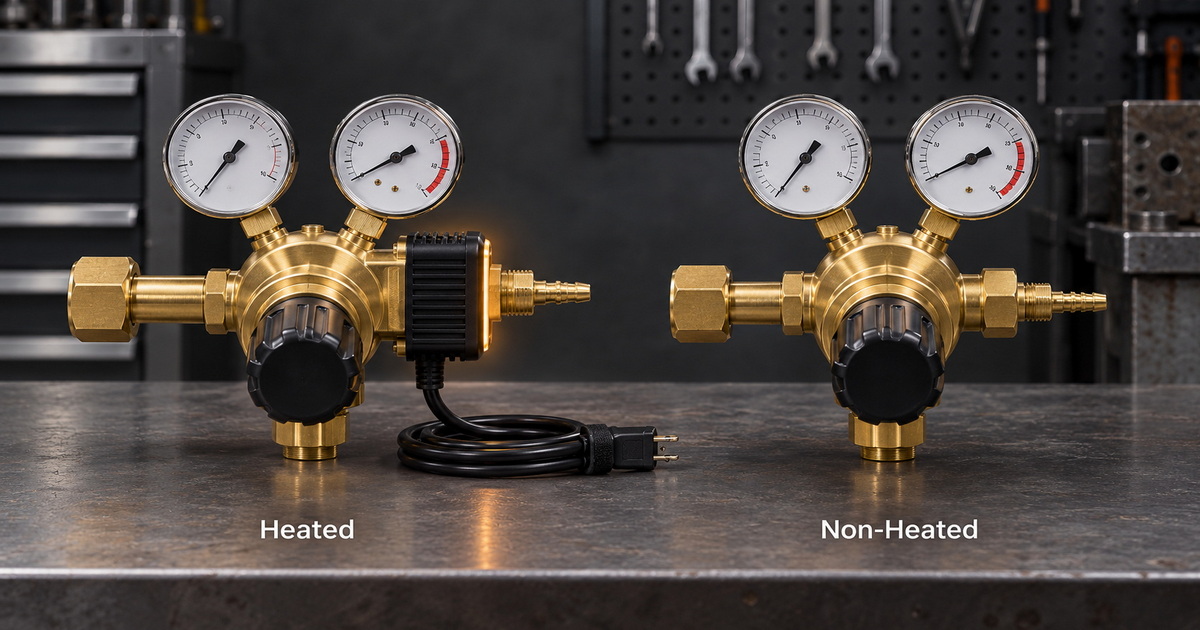
>> When to Consider a Heated CO₂ Regulator
● Single-Stage vs Dual-Stage Gas Regulators
● How to Set Up a MIG Welding Regulator
● Three Practical Checks That Improve Regulator Selection
>> 1. Run a Sustained-Flow Acceptance Test
>> 2. Compare Cost per Finished Part
>> 3. Diagnose Porosity Before Replacing the Regulator
● OEM and ODM Regulator Buying Checklist
● Which Regulator Should You Choose?
>> 1.Can one regulator handle argon and CO₂?
>> 2.Do I need a heated regulator for occasional CO₂ welding?
>> 3.Can I use a CO₂ regulator for aluminum MIG welding?
>> 4.Is an argon/CO₂ regulator the same as a gas mixer?
>> 5.Does a dual-stage regulator have two outlets?
>> 6.What should I check before ordering regulators in bulk?
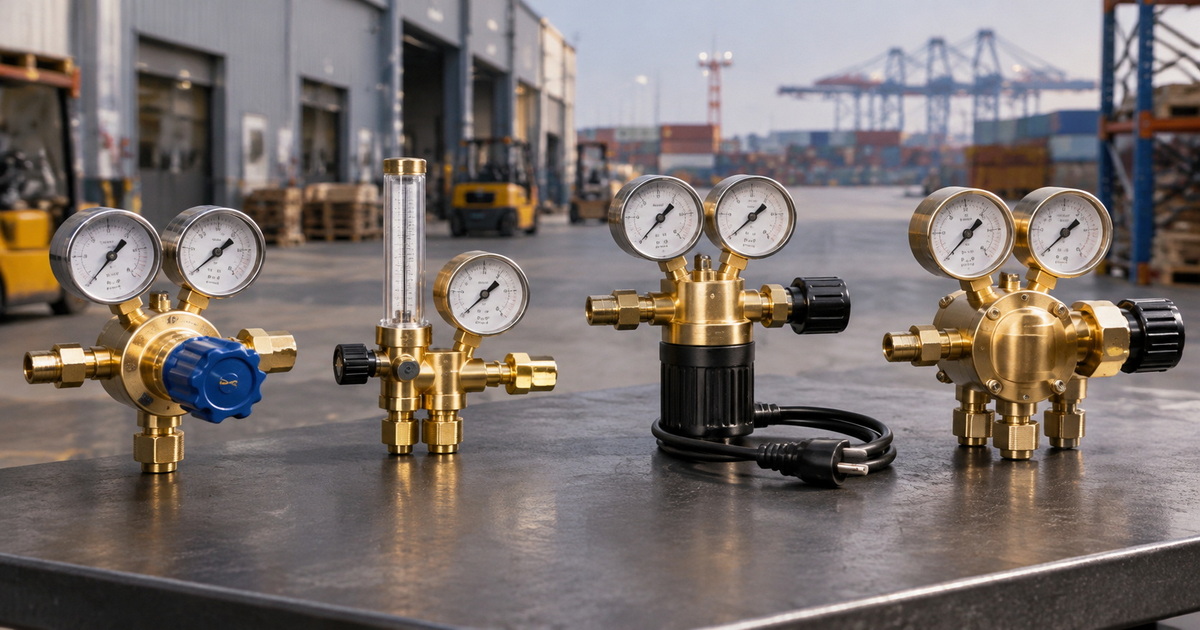
Choosing an argon vs CO₂ regulator for MIG welding starts with the gas in your cylinder—not the appearance of the regulator. For an argon-rich shielding mixture, select a regulator approved for that mixture and its cylinder connection. For pure carbon dioxide, select a CO₂-rated regulator with the correct inlet fitting and flow calibration.
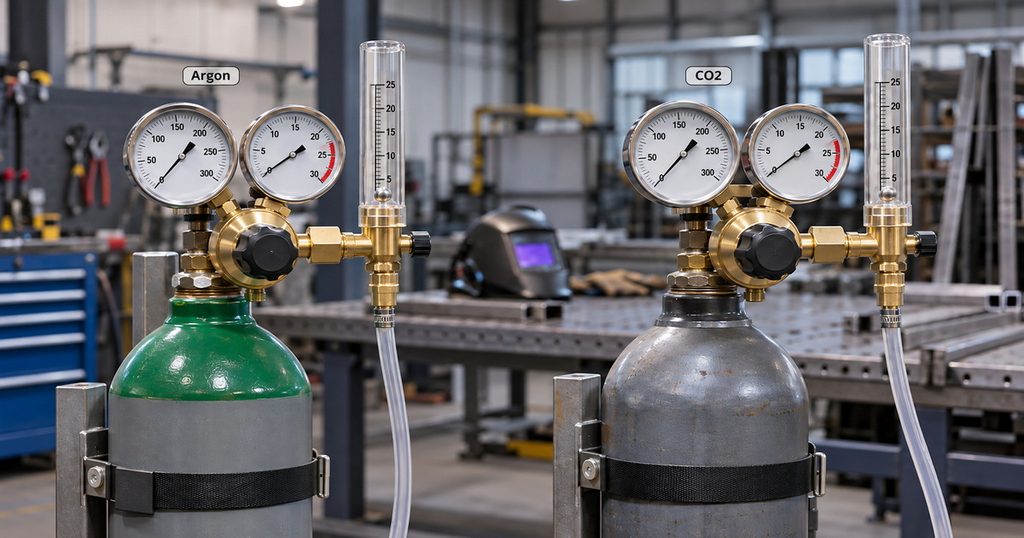
Argon vs CO₂ Regulator: Key Differences at a Glance
| Selection factor | Argon or argon-mixture regulator | Pure CO₂ regulator |
|---|---|---|
| Intended service | Argon and specified shielding mixtures | Carbon dioxide |
| Common US cylinder connection | CGA 580 | CGA 320 |
| Flow indication | Scale approved for argon or specified mixtures | CO₂-calibrated scale or approved correction |
| Thermal considerations | Usually less demanding in routine welding service | Expansion can cause severe cooling and flow restrictions |
| Heated versions | Generally unnecessary for ordinary argon shielding | Useful when operating conditions create freeze-up |
| Typical applications | Mild steel with approved mixtures; aluminum with argon | Mild steel welding with pure CO₂ |
| Main purchasing risk | Assuming every argon regulator supports every mixture | Ignoring sustained-flow and thermal requirements |
These are typical distinctions, not universal specifications. Connections vary by country, and some manufacturers offer regulators explicitly approved for multiple gases.
Choose the Shielding Gas Before Choosing the Regulator
A regulator controls gas delivery. It does not change the shielding gas or compensate for an unsuitable welding procedure.
Although workshops commonly call both processes “MIG welding,” welding with CO₂ or argon/CO₂ mixtures technically falls under metal active gas welding because CO₂ participates in the arc environment.
Argon/CO₂ Mixtures for Mild Steel
A 75% argon/25% CO₂ mixture, often called C25, is a common choice for short-circuit welding of mild steel. Compared with pure CO₂, it generally provides a smoother arc and less spatter.
Select a regulator whose manufacturer approves it for that mixture. The product description may say “argon,” “argon/CO₂,” or list several supported gases.
For spray transfer, gas selection changes. An argon-rich mixture such as 90% argon/10% CO₂ may be appropriate, but the power source, wire, and welding procedure must support that operating mode.
Pure CO₂ for Cost-Conscious Steel Welding
Pure CO₂ can reduce shielding-gas purchase costs and provides useful penetration characteristics. However, it typically produces more spatter and a less stable arc than common argon-rich mixtures.
The lowest gas price does not automatically produce the lowest finished-part cost. Additional cleanup, consumable use, and rework can offset the initial saving.
A CO₂ welding regulator must also handle the cooling associated with pressure reduction, particularly during extended gas flow.
Argon for Aluminum MIG Welding
Aluminum MIG welding commonly uses pure argon or an approved argon/helium mixture. CO₂ is not an interchangeable substitute.
For aluminum work, select an argon-compatible regulator and follow the filler-metal and equipment recommendations for shielding gas and flow.
Likewise, do not assume pure argon is the default gas for conventional mild-steel MIG welding. Choose the gas for the material and procedure first.
Can You Use an Argon Regulator on a CO₂ Cylinder?
Sometimes—but only when the regulator manufacturer explicitly approves the complete configuration.
An adapter changes the mechanical connection. It does not establish gas compatibility, correct the flow scale, increase pressure capacity, or prevent freezing.
Before using an argon regulator for CO₂, verify:
– Approval for pure CO₂ service.
– Maximum inlet pressure and permitted operating conditions.
– The specified cylinder adapter and sealing arrangement.
– CO₂ flow calibration or an approved conversion method.
– Continuous-flow capacity under the expected duty cycle.
Some commercial flowmeter regulators support argon, argon/CO₂ mixtures, and CO₂ using separate scales. Others are gas-specific.
For distributors, “universal regulator” is therefore a description that needs supporting specifications—not an assumption to put on a product label.
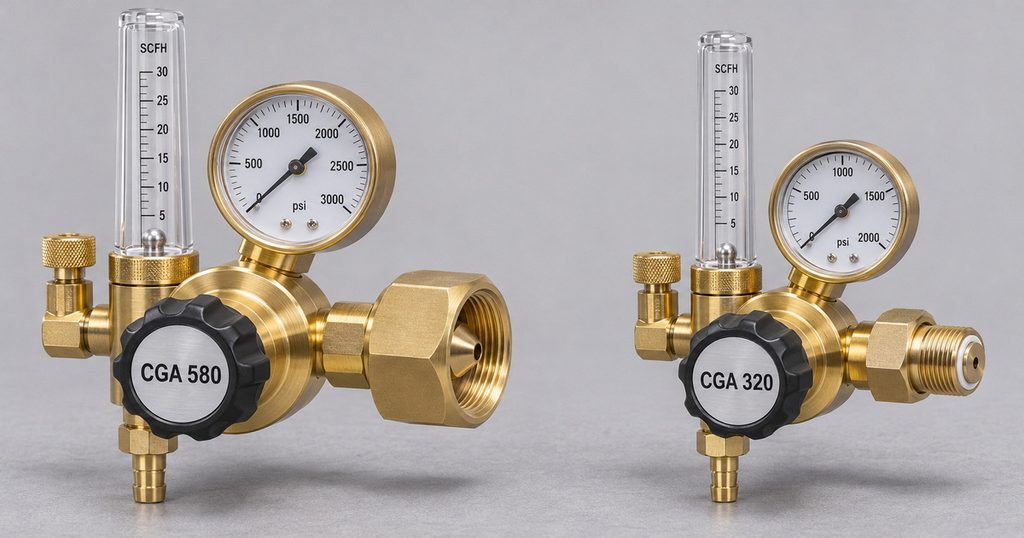
CGA 580 vs CGA 320 Connections
In the United States, CGA 580 commonly serves argon and argon-based shielding mixtures, while CGA 320 serves CO₂.
International buyers should not order by gas name alone. Regional cylinder-valve standards differ.
A useful purchase specification identifies the connection standard, thread, sealing method, cylinder service, and destination market. Never force a connection or improvise seals to make incompatible fittings fit.
Flowmeter vs Flow-Gauge Regulator: Which Is Better?
An argon regulator and a CO₂ regulator may use either a flow tube or a dial-style flow indication.
Flowmeter Regulators
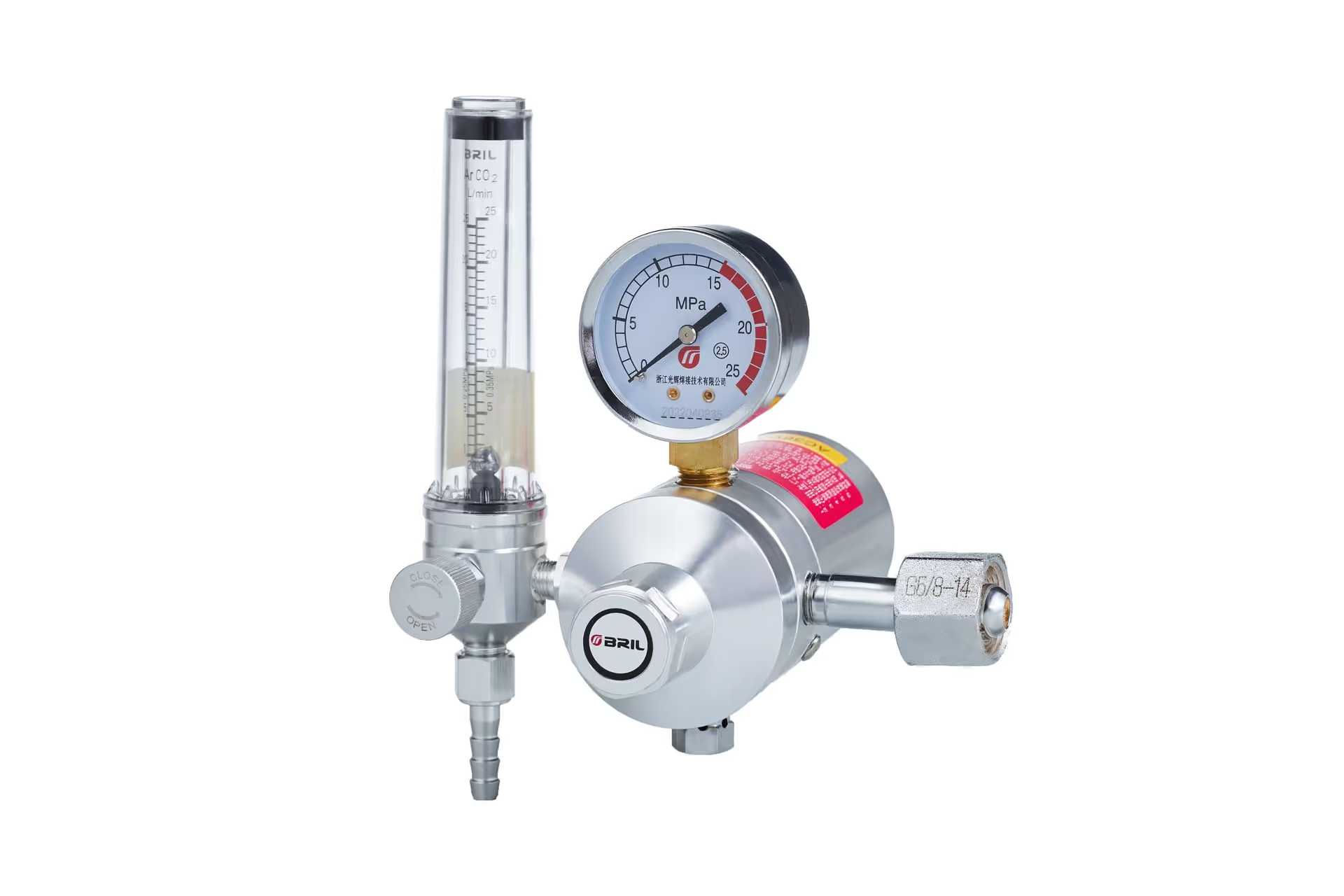
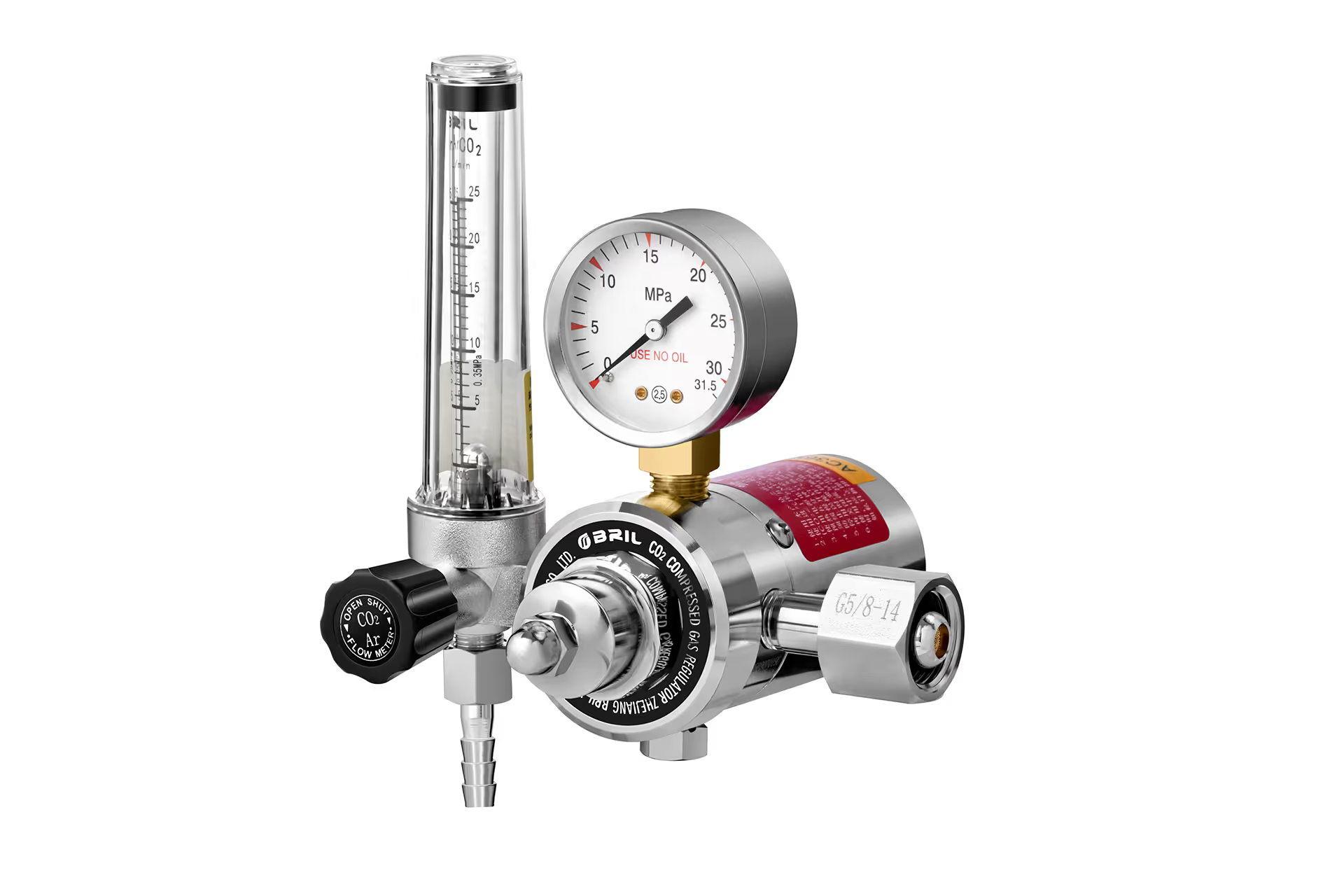
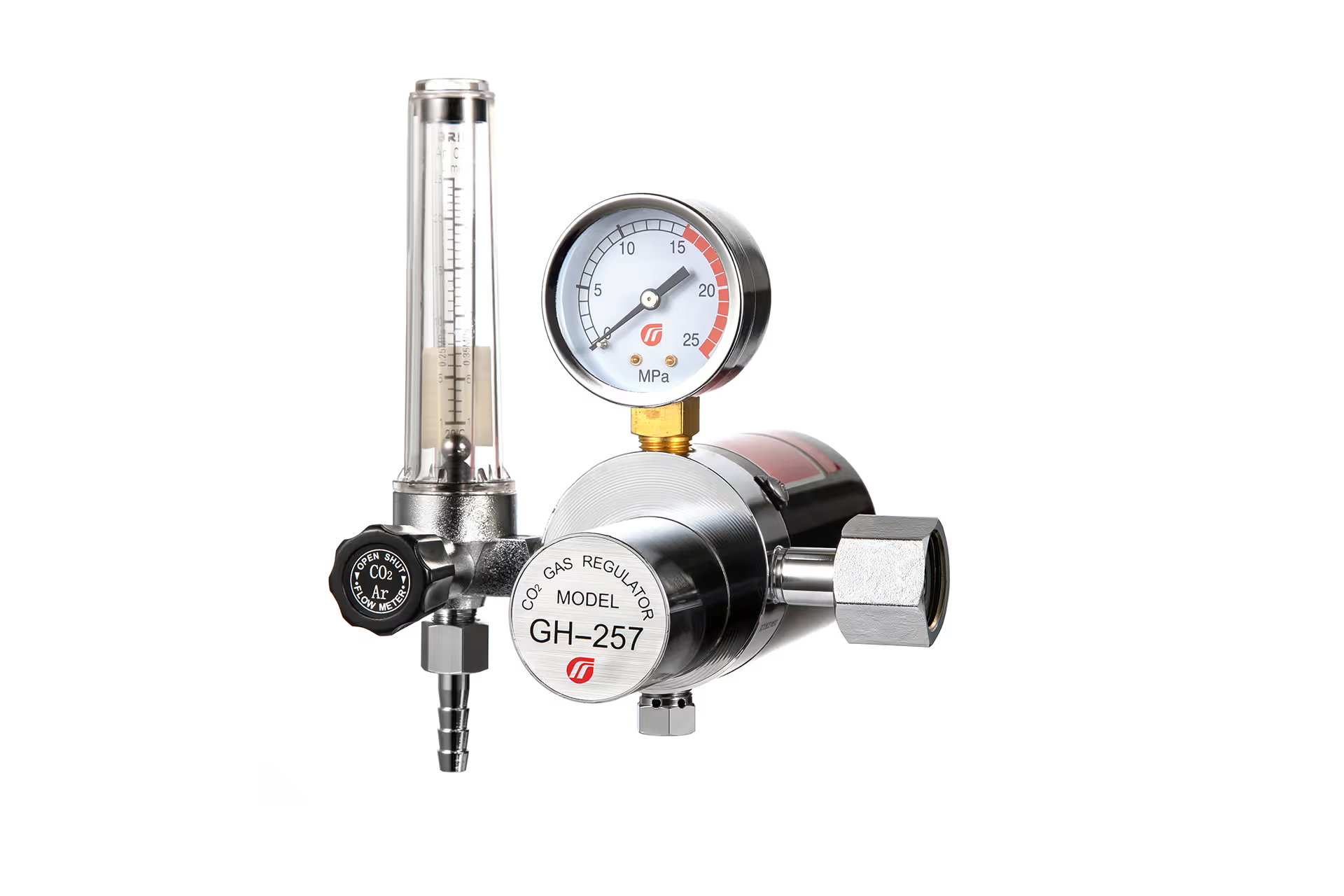
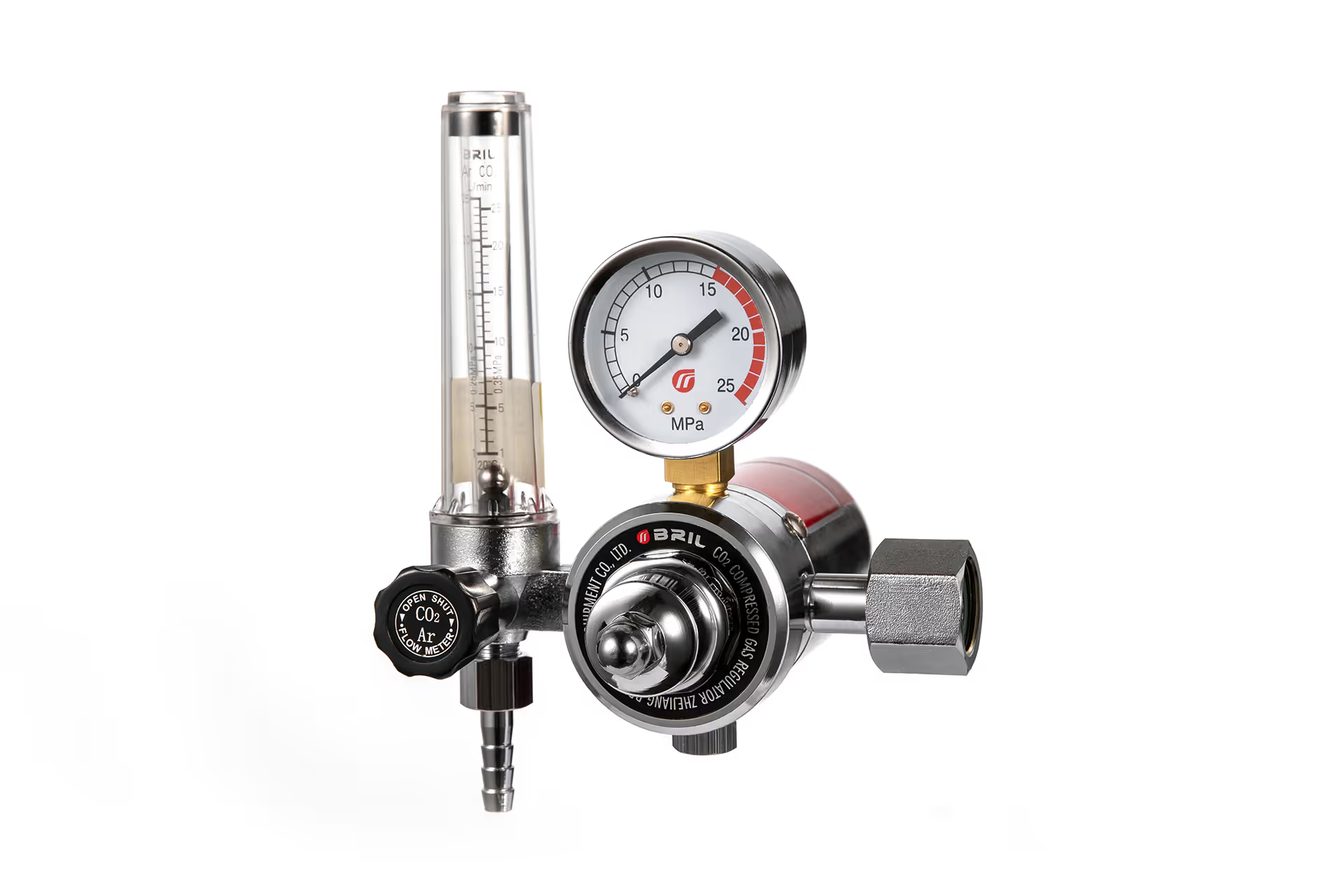
A flowmeter regulator typically combines pressure reduction with a transparent tube and floating indicator.
It offers a visible flow reading, making routine adjustment straightforward. However, its reading depends on the correct gas scale, specified operating pressure, and installation orientation.
Multi-gas tubes may contain separate scales. Reading the argon scale while supplying pure CO₂ can produce an incorrect interpretation of actual flow.
Follow the manufacturer’s instructions for where to read the float; the reference point can vary with its design.
Flow-Gauge Regulators
A flow-gauge regulator uses a pressure-based indication calibrated to represent flow through a specified restriction.
This design can be compact and economical. Its accuracy depends on the intended downstream arrangement.
Do not confuse a cylinder-pressure gauge, an outlet-pressure gauge, and a flow-indicating gauge. They show different things.
For production troubleshooting, a suitable flow-checking device at the welding gun can help establish whether the required gas actually reaches the nozzle.
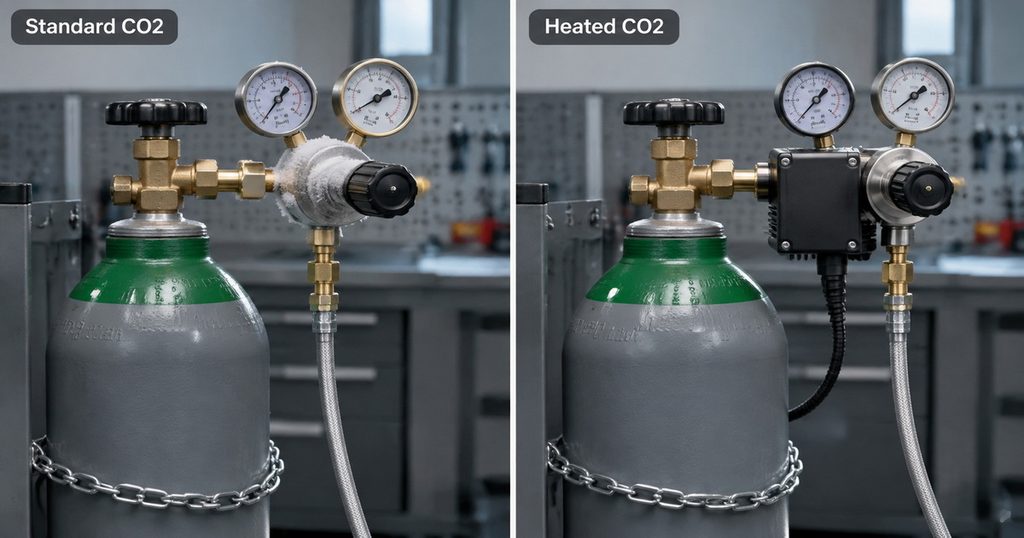
Why CO₂ Regulators Freeze—and When Heating Helps
CO₂ undergoes substantial cooling during expansion. Under certain pressure and temperature conditions, solid CO₂ can form inside the pressure-control system and restrict flow.
External frost and internal blockage are not identical. Frost can be atmospheric moisture freezing on a cold regulator body; interrupted gas delivery requires further investigation.
When to Consider a Heated CO₂ Regulator
Evaluate a heated regulator or approved heat-exchanger design when the application involves:
– Long, continuous welding cycles.
– High sustained gas demand.
– Repeated flow instability associated with cooling.
– Production requirements that cannot tolerate gas interruptions.
Ambient temperature alone does not predict freeze-up. Inlet conditions, flow, duty cycle, and regulator construction also matter.
Not every CO₂ welding station requires electrical heating. Specify it against operating conditions rather than treating it as a mandatory upgrade.
Never use a torch, open flame, or improvised heater to warm gas equipment. Use equipment designed and approved for the service.
Single-Stage vs Dual-Stage Gas Regulators
A single-stage regulator reduces pressure in one regulating stage. A dual-stage regulator does so in two stages.
Dual-stage designs can provide more consistent delivery pressure as cylinder pressure changes. This can benefit pressure-sensitive applications and longer operating cycles.
However, two gauges do not mean two stages. A single-stage regulator often has one gauge for cylinder pressure and another for delivery pressure or indicated flow.
For CO₂, some two-stage designs also improve resistance to freeze-up. That does not make every dual-stage regulator a substitute for a properly sized heated unit.
The practical question is not “Which design sounds more advanced?” It is “Which design maintains the required delivery performance throughout this application?”
How to Set Up a MIG Welding Regulator
Use the regulator and welding-machine manuals as the controlling instructions. A practical commissioning sequence is:
1. Secure the cylinder upright and confirm its gas identification.
2. Inspect the regulator, connection, hose, and specified seals.
3. Confirm gas approval, pressure rating, and connection compatibility.
4. Install the regulator according to its instructions.
5. Open the cylinder valve slowly while standing clear of the regulator face.
6. Check connections with an approved leak-detection solution.
7. Activate the machine’s gas-test function and set flow while gas is moving.
8. Verify shielding at the gun and make a test weld.
Miller recommends approximately 25–35 cubic feet per hour for many short-circuit MIG applications—about 12–17 liters per minute. This is a starting range, not a universal setting.
Nozzle size, joint geometry, transfer mode, drafts, and the qualified welding procedure can change the requirement.
Excess flow is not automatically better. If shielding is poor, investigate leaks, restrictions, nozzle contamination, and air movement rather than simply opening the valve further.
Three Practical Checks That Improve Regulator Selection
1. Run a Sustained-Flow Acceptance Test
A regulator may appear satisfactory during a brief demonstration but behave differently during a production-length cycle.
For supplier evaluation, request a documented test covering:
– Gas and inlet conditions.
– Target flow and test duration.
– Delivery stability throughout the test.
– Leakage and shutoff performance.
– Thermal behavior during CO₂ service.
Agree on acceptance limits before testing. This turns “stable performance” into a measurable purchasing requirement.
2. Compare Cost per Finished Part
Consider two illustrative workshops—not documented customer case studies.
One produces occasional steel repairs and prioritizes low gas purchase costs. Another manufactures visible components where spatter removal consumes paid labor.
Pure CO₂ may suit the first operation. An argon-rich mixture may offer better overall value for the second.
Compare gas consumption, cleanup time, consumables, downtime, and rejected parts. A regulator’s purchase price is only one part of that calculation.
3. Diagnose Porosity Before Replacing the Regulator
Porosity does not prove the regulator is defective.
Check the cylinder contents, hose connections, gun seating, nozzle condition, drafts, and actual gas delivery. Then compare the flow reading with the approved setting.
If flow is stable but porosity persists, examine material cleanliness and welding parameters. Replacing a sound regulator will not correct contamination or an unsuitable shielding gas.
OEM and ODM Regulator Buying Checklist
For overseas brands, wholesalers, and equipment manufacturers, a precise specification reduces the risk of unsuitable private-label products.
| Specification | What buyers should confirm |
|---|---|
| Gas service | Argon, named mixtures, pure CO₂, or explicitly approved multi-gas use |
| Inlet connection | Destination-market cylinder standard and sealing arrangement |
| Pressure rating | Maximum inlet pressure and specified delivery conditions |
| Flow range | Range suited to the intended welding applications |
| Calibration | Gas, scale units, reference conditions, and accuracy specification |
| Construction | Brass specification, diaphragm materials, and seal compatibility |
| Thermal capacity | Sustained CO₂ performance and heating requirements |
| Inspection | Leak, pressure-control, flow, and functional test records |
| Customization | Branding, packaging, manuals, fittings, and traceability |
| Compliance | Applicable destination-market requirements and supporting documents |
Precision machining and suitable brass materials matter, but they do not independently establish complete regulator quality. Assembly control, seal selection, calibration, and final inspection matter too.
Avoid accepting “international standards” as a complete compliance statement. Ask which requirements apply to the exact model and market.
Which Regulator Should You Choose?
For argon or argon-rich mixtures, choose an approved argon/mixture regulator with the correct cylinder connection and flow scale.
For pure CO₂, choose a CO₂-rated regulator sized for the actual operating cycle. Evaluate heating when sustained demand creates a credible freeze-up risk.
For multi-gas workshops, use a documented multi-gas model or dedicated regulators—not an unverified adapter-based arrangement.
As a manufacturer offering argon regulators, CO₂ regulators, heated CO₂ regulators, and dual-stage configurations, we can support application-specific OEM and ODM selection. Send your gas composition, cylinder connection, required flow, duty cycle, destination market, and branding requirements to request a matched specification and quotation.
Frequently Asked Questions
1.Can one regulator handle argon and CO₂?
Yes, some models explicitly support both. Confirm gas approval, inlet configuration, flow calibration, and operating limits. Physical connection alone is insufficient.
2.Do I need a heated regulator for occasional CO₂ welding?
Not necessarily. Intermittent welding may work with a correctly sized unheated CO₂ regulator. Heating should address a demonstrated or anticipated thermal requirement.
3.Can I use a CO₂ regulator for aluminum MIG welding?
Only if the regulator is also explicitly approved and correctly configured for the required argon-based gas. Pure CO₂ itself is unsuitable for aluminum MIG shielding.
4.Is an argon/CO₂ regulator the same as a gas mixer?
No. A regulator controls delivery from its gas supply. A gas mixer combines separate gas supplies in controlled proportions.
5.Does a dual-stage regulator have two outlets?
Not necessarily. “Dual-stage” describes two pressure-reduction stages. “Dual-outlet” describes separate delivery connections. These are different features.
6.What should I check before ordering regulators in bulk?
Confirm the gas, cylinder connection, pressure rating, flow calibration, sustained-duty performance, inspection criteria, and destination-market requirements. Approve a representative sample before a larger order.
References
1. Miller Electric — “What Type of Gas Is Best for MIG Welding in DIY Applications?” Guidance on shielding mixtures, welding applications, flow settings, and checking delivery at the gun. [millerwelds]
2. Miller Electric / Smith Equipment — “CO₂ Heavy-Duty Flowmeter Regulator, 80 PSIG.” Product specifications illustrating CO₂ service, CGA 320 connections, and rated flow. [millerwelds]
3. Miller Electric / Smith Equipment — “Argon/CO₂/Helium Medium-Duty Flowmeter Regulator, 50 PSIG.” Multi-gas approval and separate flow-tube scales. [millerwelds]
4. Harris Products Group — “CO₂ Freeze-Up: Why It Happens, What You Can Do.” Technical explanation of expansion cooling, internal solid formation, duty-cycle effects, and heated regulators. [harrisproductsgroup]
5. Harris Products Group — “Model HP 722C.” Two-stage pressure regulation and delivery consistency as cylinder pressure changes. [harrisproductsgroup]
6. Harris Products Group — “4043.” Aluminum filler-metal applications and recommended argon or argon/helium shielding gases. [harrisproductsgroup]
7. Miller Electric / Smith Equipment — “Argon/CO₂ Heavy-Duty Flowmeter Regulator, 80 PSIG.” Example of an explicitly specified multi-gas regulator with a CGA 580 inlet. [millerwelds]
Hot Tags: Argon Regulator, CO2 Regulator, MIG Welding Gas Regulator, Argon CO2 Flowmeter Regulator, Heated CO2 Regulator, Dual Stage Gas Regulator, Welding Gas Regulator Manufacturer, Industrial Gas Regulator Supplier, OEM Gas Regulator, Wholesale Welding Regulators